alt.tesla
Nikola Tesla: the man, the work, the mythology.
The group’s one-line description in the Usenet namespace reads “Famous Inventor / Radio, Xray, Teslacoil.” — a name that takes in both the documented engineering record and the free-energy literature attached to it.
This directory preserves no archive of the group: nothing here records what was posted to it.
On this page
- The engineer behind the name
- The induction motor and the polyphase system
- The current war, as the record has it
- Chicago in 1893, and Niagara
- The coil, and the people who still build them
- Colorado Springs and Wardenclyffe
- Patents, priority and the decision of 1943
- Last years, death, and the archive in Belgrade
- Two kinds of traffic under one name
- Where the documents are
- Scope and limits
The engineer behind the name
Nikola Tesla was born on 10 July 1856 at Smiljan, a village then in the Military Frontier of the Austrian Empire and now in Croatia, the son of an Eastern Orthodox priest. He graduated from the Higher Real Gymnasium at Karlovac in 1873 and in 1875 enrolled at the Imperial-Royal Technical College in Graz on a Military Frontier scholarship, where he followed Jakob Pöschl's lectures on electricity. By his third year he was failing, and he left Graz in December 1878 without a degree.
The training that mattered came from the young telephone and lighting industries. In 1881 he moved to Budapest to work under Tivadar Puskás, becoming chief electrician of the Budapest Telephone Exchange once it came into service and making a number of improvements to its central station equipment. In 1882 Puskás found him a post in Paris with the Continental Edison Company, at its works at Ivry-sur-Seine, where he installed incandescent lighting and was set to designing and rebuilding dynamos and motors.
In 1884 Charles Batchelor, who had overseen the Paris installations, was brought back to run the Edison Machine Works in New York and asked that Tesla be brought over as well. Tesla emigrated in June 1884 and worked at the Machine Works for six months, troubleshooting installations and improving generators, before quitting; what precipitated it is not clear from the record, and may have been a bonus he believed he had earned and did not receive. In March 1885 the patent attorney Lemuel W. Serrell introduced him to two businessmen, Robert Lane and Benjamin Vail, who financed the Tesla Electric Light and Manufacturing Company, for which he took out his first United States patents and built a lighting system at Rahway, New Jersey. When the backers decided in 1886 to run a utility instead, they abandoned the company; Tesla, who had assigned his patents to it for stock, was left with neither.
The induction motor and the polyphase system
Late in 1886 Tesla met Alfred S. Brown, a Western Union superintendent, and the New York attorney Charles Fletcher Peck, who agreed to back him and handle his patents; the Tesla Electric Company was formed in April 1887 and a laboratory fitted out at 89 Liberty Street. There, in 1887, Tesla built an induction motor that ran on alternating current, using polyphase current to produce a rotating magnetic field. Patented in May 1888, it was self-starting and needed no commutator, and so avoided the sparking and the constant servicing of brushes that direct-current machines demanded.
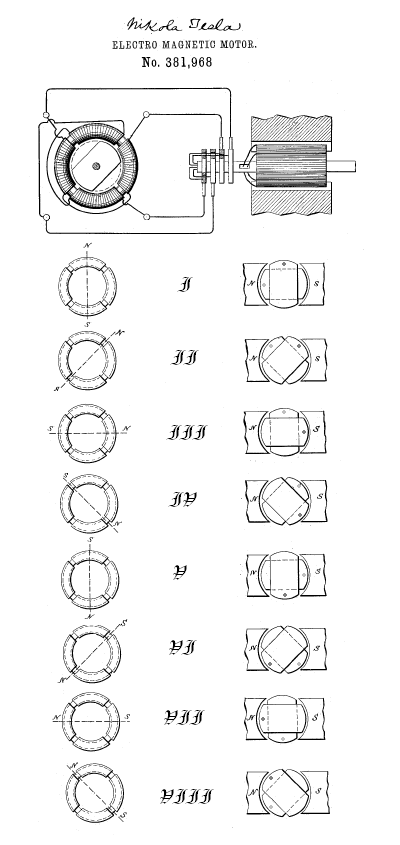

Peck and Brown had the machine independently tested before publicising it. On 16 May 1888 Tesla demonstrated it before the American Institute of Electrical Engineers, an appearance arranged by the physicist William Arnold Anthony, who had done the testing, and by Thomas Commerford Martin, editor of Electrical World. Westinghouse engineers reported that the motor and its power system were viable, which was what the alternating-current business George Westinghouse was building needed.
In July 1888 Brown and Peck licensed the polyphase motor and transformer designs to Westinghouse for $60,000 in cash and stock together with a royalty of $2.50 for every alternating-current horsepower produced, and Tesla was engaged for a year as a consultant at Pittsburgh. The licence did not survive intact. The near-collapse of Barings Bank set off the financial panic of 1890, and Westinghouse's lenders demanded cuts to spending on research and patents, the guaranteed royalty among them. Early in 1891 Westinghouse put it to Tesla that if the lenders were not satisfied he would lose control of his own company and Tesla would be left to deal with the bankers. Tesla agreed to release the company from the royalty clause; six years later Westinghouse bought the patent outright for a lump sum of $216,000, as part of a patent-sharing agreement with General Electric.
The current war, as the record has it
That licence was signed into a market at war with itself. Westinghouse, Edison Electric and Thomson-Houston were undercutting one another in a capital-hungry business, and the technical question of direct against alternating current was argued partly as a publicity campaign. In the war of the currents, Edison Electric maintained that its low-voltage direct-current system was the safer. The engineering advantage on the other side was the transformer: alternating current could be sent long distances at high voltage and stepped down for indoor use, which direct current could not then match.
In the spring of 1888 a run of fatal accidents involving pole-mounted high-voltage lines produced a press furore, and the electrical engineer Harold P. Brown, who was given the use of Edison's West Orange laboratory, staged public electrocutions of animals there in support of the claim that alternating current was the more dangerous form. The argument then reached the newly legislated electric chair: the New York Medico-Legal Society committee charged with settling the details took Brown on as a consultant and recommended 3,000 volts, without determining whether the current should be direct or alternating; and Westinghouse financed the unsuccessful appeal of William Kemmler, the first prisoner condemned to die by that method.
It ended commercially rather than rhetorically. The deal announced on 15 April 1892 merged Edison General Electric with Thomson-Houston to form General Electric — a firm holding roughly three quarters of the American electrical business, with Thomson-Houston's management in charge and Edison's name off the door; from that point both surviving giants marketed alternating-current systems. Tesla's own part was that of a licensor and a name on the patents rather than a combatant.
Chicago in 1893, and Niagara
By the beginning of 1893 Westinghouse engineers had an efficient version of the induction motor, and Benjamin G. Lamme's rotary converter made the polyphase system compatible with the single-phase alternating and direct-current plant already in the ground. The company marketed the result as the Tesla Polyphase System.
Westinghouse Electric underbid General Electric for the contract to light the 1893 World's Columbian Exposition in Chicago, and the fair became the system's public demonstration: a polyphase alternating-current supply that lit the exhibition and could also feed the other alternating- and direct-current exhibits on the ground. A space in the Electricity Building held models of the induction motor. Tesla visited for a week of the six-month run and gave demonstrations of wireless lighting in a darkened room.
The commercial consequence came at Niagara. Edward Dean Adams, president of the Cataract Construction Company, had convened an International Niagara Commission in 1890 to find a way of harnessing the falls; the proposals before it included two-phase and three-phase alternating current, high-voltage direct current and compressed air. In 1893 Adams asked Tesla to assess the competing systems, and Tesla advised that a two-phase system would be the most reliable. The generating contract went to Westinghouse Electric and the distribution contract to General Electric.
The Edward Dean Adams plant, built in 1895, was the first large-scale alternating-current generating station in the world. Ten generators of 5,000 horsepower each delivered 2,000 volts, stepped up to 10,000 volts for the district and to 20,000 volts for the longer runs to Buffalo, Lockport and Tonawanda, and the original Westinghouse machines stayed in service until the plant closed in 1961. Its transformer house, the only part still standing, was added to the National Register of Historic Places in 1975 and designated a National Historic Landmark in 1983.
The coil, and the people who still build them
At the 1889 Exposition Universelle in Paris Tesla learned of Heinrich Hertz's experiments demonstrating electromagnetic radiation. Trying to drive a Ruhmkorff coil from a high-speed alternator, he found that the high-frequency current overheated the iron core and melted the insulation between the windings. His answer was an oscillating transformer with an air gap in place of insulating material and a movable iron core: the Tesla coil, an air-cored resonant transformer producing high-voltage, low-current, high-frequency alternating current. The patent covering its use for lighting was filed on 25 April 1891, and he demonstrated the circuit publicly on 20 May 1891 in a lecture at Columbia College. He became a naturalised citizen of the United States that July, and served as a vice-president of the American Institute of Electrical Engineers.
The coil was the instrument behind most of what followed. After 1890 Tesla used it to experiment with transmitting power by inductive and capacitive coupling, lighting Geissler tubes and lamps across a stage in public demonstrations, though none of those ventures yielded a commercial product; from 1894 he put it to X-ray work as well. In 1898 he showed a boat steered by coherer-based radio control — a telautomaton, in his term — at an electrical exhibition at Madison Square Garden. A fire on 13 March 1895 destroyed his South Fifth Avenue laboratory, taking with it early notes, models and demonstration pieces.
Coils are still built, and that practice is the direct ancestor of the bench work described at the head of this page. A modern coil typically produces between 50 kilovolts and several million volts at frequencies between about 50 kilohertz and 1 megahertz. The circuit had a working commercial life in spark-gap transmitters for wireless telegraphy until the 1920s; today it is built mainly for demonstration and display, by a worldwide community of amateurs who call themselves coilers and meet at conventions to show what they have made.
The published safety literature on those machines is specific. Radio-frequency discharges passed through the body often do not produce the pain and muscle contraction of an ordinary shock, because the nervous system does not respond to currents above roughly 10 to 20 kilohertz; the absence of sensation is not evidence that the current is harmless. Arcs striking bare skin cause deep burns, and an arc that strikes the primary winding can momentarily open a conducting path from the supply transformer to the output terminal. The explanation that has persisted among hobbyists — that skin effect confines high-frequency current to the surface of the body — is false: at coil frequencies the penetration depth in human tissue is of the order of 24 to 72 centimetres.
Colorado Springs and Wardenclyffe
In 1899 Tesla set up an experimental station at high altitude in Colorado Springs, where the El Paso Electric Light Company supplied alternating current free of charge; John Jacob Astor IV invested $100,000. There Tesla operated a coil in the megavolt range, producing artificial lightning with discharges of up to 135 feet and at one point burning out the El Paso generator. The day-by-day record he kept there, from 1 June 1899 to 7 January 1900, survives, but it reached print only in 1978, in a Belgrade edition published by Nolit and annotated by Aleksandar Marinčić and Vojin Popović.
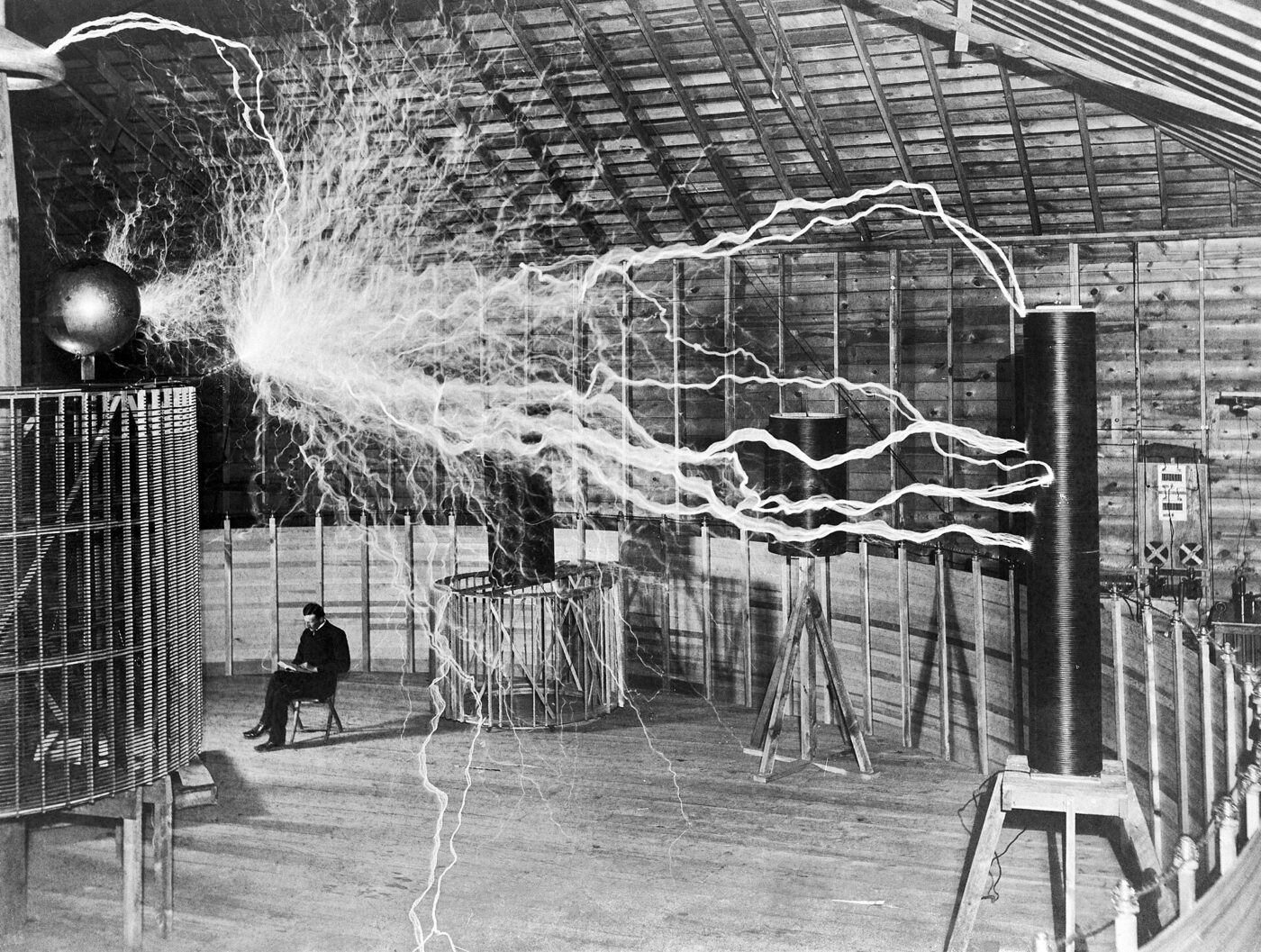

His observations of the electrical noise of lightning led him to conclude that the globe itself could be used to conduct energy over long distances, and it was that conclusion, rather than the radio-wave physics then being established, which shaped the rest of his wireless work. In March 1901 he obtained $150,000 from J. P. Morgan in return for a 51 per cent share in any wireless patents that resulted, and began building at Shoreham on Long Island.
The main building at Wardenclyffe was designed by the architect Stanford White, and by the end of 1902 the transmitting tower had reached its full height of about 187 feet. In December 1901 Marconi transmitted the letter S from England to Newfoundland, and investment followed his radio-based system rather than Tesla's conduction-based one. The project halted in 1905 after Morgan declined to fund an enlarged design, and Tesla mortgaged the property against a hotel debt that eventually amounted to some $20,000.
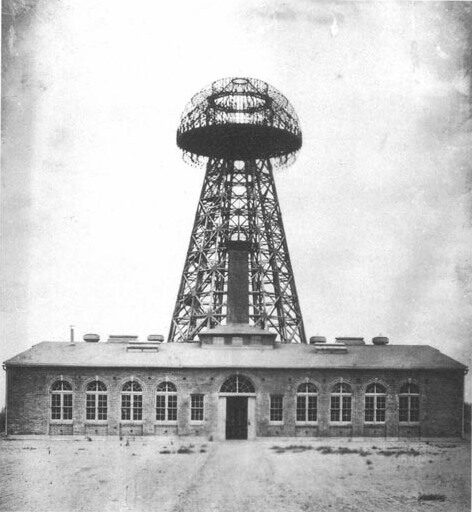

The tower was dynamited by the Smiley Steel Company from 4 July 1917 and was not entirely down until September. The property afterwards carried a photographic works — Peerless Photo Products from 1939, Agfa from 1969 to 1992 — until the Tesla Science Center bought the land in 2013; the site was listed on the National Register of Historic Places in 2018.
Patents, priority and the decision of 1943
Tesla obtained around 300 patents worldwide; at least 278 are known, issued in 26 countries. Each carries a filing date, a description and drawings, and claims that were examined against what had been filed before, which makes the set the firmest ground there is for questions about what he did and when.
Priority in radio is a genuine dispute with a technical literature behind it. Marconi's first United States radio patent was granted in 1897; his 1900 application covering improvements to radio transmission was rejected several times on the ground that it infringed existing patents, among them two Tesla tuning patents of 1897, before being approved in 1904. In 1915 Tesla attempted to sue the Marconi Company for infringement of his tuning patents; in the same period the American Marconi company sued Telefunken, which retained Tesla as a witness for two years at $1,000 a month, and that case became moot when the United States entered the war in 1917.
On 21 June 1943, five months after Tesla's death, the Supreme Court of the United States decided Marconi Wireless Telegraph Co. of America v. United States, reported at 320 U.S. 1, on review of a Court of Claims case brought against the federal government over the alleged use of wireless patents during the First World War. Four patents were in issue: two of Marconi's, No. 763,772 and reissue No. 11,913, one of Oliver Lodge's and one of John Ambrose Fleming's. The Court held that the broad claims of Marconi patent No. 763,772 were invalid, having been anticipated by John Stone Stone. The ruling reached the claims before it: it did not invalidate Marconi's earlier patent for radio transmission, and a compensation suit of that kind decides the validity and scope of particular claims rather than the general historical question of who invented radio.
Last years, death, and the archive in Belgrade
After Wardenclyffe stopped, Tesla worked from a succession of offices — 165 Broadway from 1906, the Metropolitan Life Tower from 1910 to 1914, 8 West 40th Street from 1915 to 1925 — trying to develop and market patents. On his fiftieth birthday in 1906 he demonstrated a bladeless turbine of 200 horsepower running at 16,000 revolutions per minute, and engines of that type were tested at the Waterside power station in New York in 1910 and 1911. By the mid-1920s most of his patents had expired and he was effectively bankrupt.
He lived in hotels and left unpaid bills behind him at several; from 1934 he was at the Hotel New Yorker, where Westinghouse Electric paid him $125 a month in addition to his rent. From 1931, when the journalist Kenneth Swezey organised a celebration of his 75th birthday that put him on the cover of Time, he made the birthday party an annual event and invited the press to it, so that much of what he said publicly in his last decade was said to reporters rather than to engineers.
In the autumn of 1937 he was struck by a taxicab near his hotel and broke three ribs; he refused to see a doctor and never fully recovered. He died alone in his room at the Hotel New Yorker on the night of 7 January 1943, aged 86, the cause given as coronary thrombosis; the mayor of New York, Fiorello La Guardia, read a eulogy at his funeral on 10 January. Two days after the death, the country being at war and his nephew Sava Kosanović not being an American citizen, the Federal Bureau of Investigation asked the Office of Alien Property Custodian to seize his effects; John G. Trump, a professor of electrical engineering at MIT then serving the National Defense Research Committee, examined them and reported after three days that they held nothing that would “constitute a hazard in unfriendly hands”.
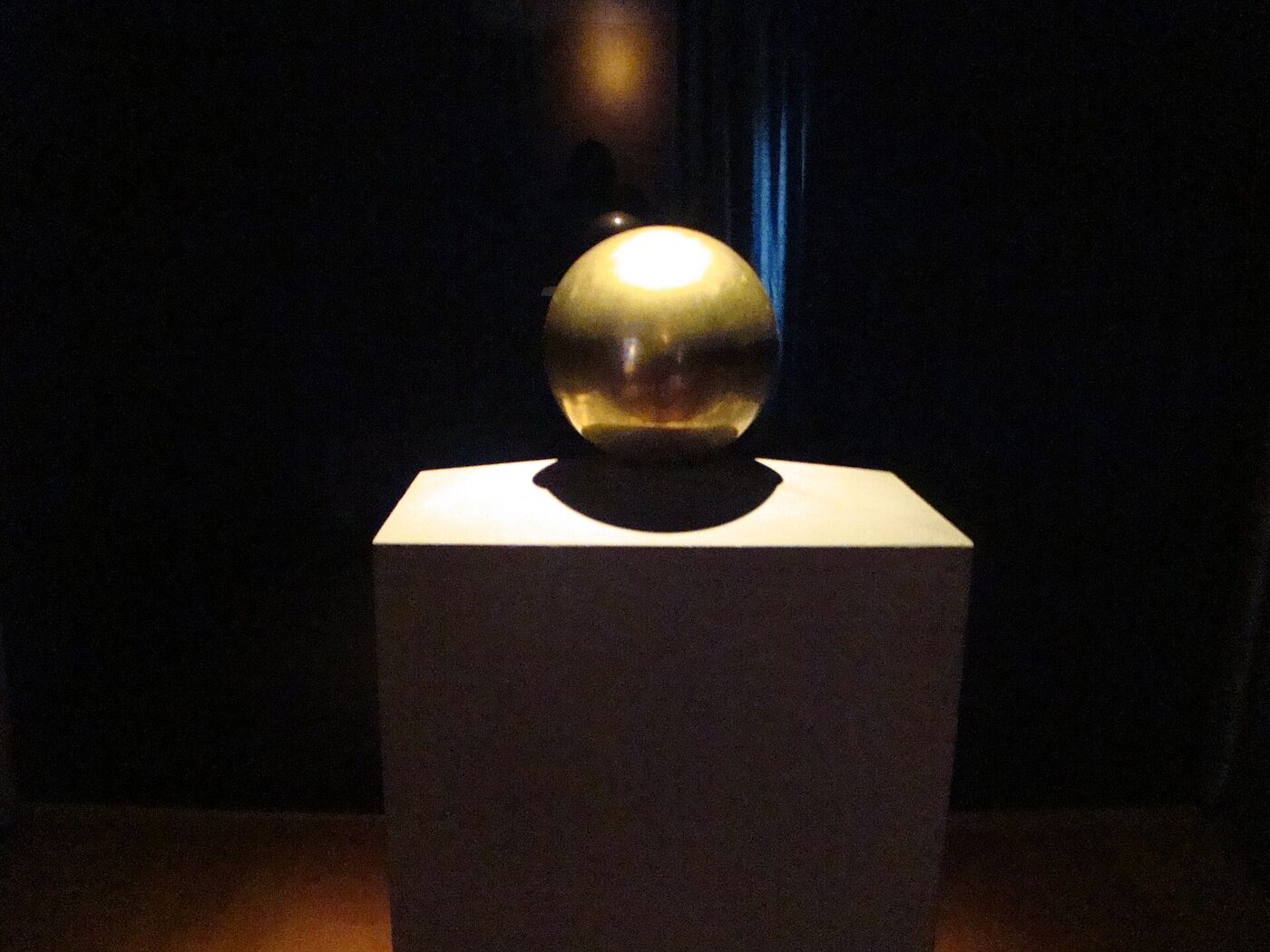
The estate went to Belgrade in the early 1950s, after long pressure from Kosanović, shipped in eighty trunks marked N.T. The Nikola Tesla Museum was founded on 5 December 1952 and occupies a villa at Krunska 51. It holds more than 160,000 original documents, along with technical exhibits, plans and drawings. In 1957 Kosanović's secretary Charlotte Muzar brought Tesla's ashes from the United States; they are displayed there in a gold-plated sphere on a marble pedestal. The archive was inscribed on the UNESCO Memory of the World register in 2003, and in 1960 the General Conference on Weights and Measures gave his name to the SI unit of magnetic flux density.

Two kinds of traffic under one name
A newsgroup named after a person collects whatever attaches to the name. Groups named for a field — the engineering and science groups indexed under sci.*, for instance — take their scope from their subject matter; a group named for a man takes its scope from his reputation. Tesla's reputation had carried, for decades before Usenet existed, both a documented engineering record and a large body of claims that the record does not contain. Both arrived here, and the mixture is a standing feature of the group rather than an accident of a few threads. This article neither reproduces the second kind of material nor argues against it.
What a reference page can offer instead is the test that separates the two. A statement about the past can be traced to a dated document — a patent as filed, a contract, a notebook page, a court record, a catalogued item in an archive — or it can only be traced to another retelling. Everything set out above has a document of the first kind behind it.
The chronology of those documents explains a good deal about why retellings came to dominate. Tesla's papers left the United States only in the early 1950s and were catalogued in Belgrade thereafter; his Colorado Springs record went unpublished for seventy-eight years and then appeared first in a Yugoslav edition; the fire of 1895 had already destroyed a body of earlier material outright; and in his last decade his own public statements were made mostly at press gatherings. A reader in the English-speaking world therefore had ready access to journalism about Tesla long before having any access to Tesla's own documents. That imbalance was in place decades before this group existed, and the group inherited it along with the subject.
Nor is every contested question in the field of the same kind. The priority dispute over radio is argued in the technical-history literature with patents, filing dates and testimony on the table — the Antique Wireless Association published a monograph on the Tesla and Marconi claims in 1980 — and it is a different sort of question from one for which no documentary record has ever been produced.
A coil measurement can be repeated on a bench with instruments; a claim about what happened in 1899 or in 1943 can only be checked against a document. This directory holds no messages from the group; an archive of it is at Google Groups.
Where the documents are
The primary material sits in a small number of well-defined places:
- The patents. The rotating-field induction motor is No. 381,968 of 1888; the coil-based lighting system was filed on 25 April 1891 and granted as No. 454,622 that June.
- The court record. Marconi Wireless Telegraph Co. of America v. United States is reported at 320 U.S. 1 (1943), and the opinion states its own scope.
- The notebooks. The Colorado Springs record of 1899 to 1900 was published by Nolit in Belgrade in 1978, with editorial commentary.
- The archive. The Nikola Tesla Museum in Belgrade holds the papers, instruments and drawings that left New York in the 1950s.
- The surviving fabric. The Adams transformer house at Niagara Falls and the Wardenclyffe site at Shoreham are both on the National Register of Historic Places.
Photographs need the same care as text: the best-known picture of the Colorado Springs station, reproduced above, is a promotional double exposure, and Tesla said so in his own record. The group is catalogued here among the other alt.* groups this directory covers.
Scope and limits
This directory preserves no message archive. What survives here of alt.tesla is the name, its line in the Internet Systems Consortium's newsgroups file — “Famous Inventor / Radio, Xray, Teslacoil.” — and the account above of the subject that line names. There is no subscriber count, no traffic estimate and no readership survey for the group, and no post, thread or participant is quoted or named on this page.
The patents, court reports, notebooks, museum holdings and listed sites named above are cited from the published record, and each is named so that it can be checked. Where a question about Tesla is contested in that record, this page names the documents on each side; it does not report how the newsgroup argued it.
Reading alt.tesla today
- Historical archive: Google Groups — alt.tesla (coverage varies by group and era).
- Open in a newsreader:
news:alt.tesla— the original site offered exactly this link, and it still works if your system has a newsreader registered for thenews:scheme. - Live access: point an NNTP newsreader at a modern server — see accessing Usenet today.
- The original news2mail e-mail subscription service ended in the mid-2000s and no longer operates.