soc.culture.afghanistan
Discussion of the culture and people of Afghanistan.
Active through the 1990s and 2000s, soc.culture.afghanistan carried diaspora conversation on Afghan history, Pashto and Dari language and poetry, music, and the daily news that repeatedly redrew the country.
Like most soc.culture groups it was unmoderated. Hierarchy-wide lists preserved from November 1992 already carry it, which places its documented life across the war for Kabul, the Taliban years and 2001.
On this page
- The group's own paperwork
- A removal that did not take
- A diaspora in layers
- The layers did not share a politics
- Who could post, and from where
- Language and script
- Seven bits, and two languages that would not fit
- The country as a dated record: the monarchy to 1989
- The country as a dated record: 1992 to 2021
- The Persian inheritance, and the borders attached to it
- The Pashto canon, and the couplet that travelled best
- Music, and its documented suppressions
- The table, the calendar and the field
- The neighbours, and what overtook the group
- What the record does not show
- Scope, sources and limits
The group's own paperwork
A Big-Eight newsgroup is supposed to leave a paper trail, and for once the trail is here. The Internet Systems Consortium mirrors the Usenet control messages, and the file for this group opens with the message that created it: a Control: newgroup soc.culture.afghanistan issued on 26 November 1991 by the moderator of news.announce.newgroups, from a machine at Rensselaer Polytechnic Institute. Its first two lines are the whole administrative history of the group in one sentence.
soc.culture.afghanistan is an unmoderated newsgroup which passed its vote for creation by 204:29 as reported in news.announce.newgroups on 21 Nov 1991.
Two hundred and four votes in favour, twenty-nine against. Under the group-creation guidelines of the period a proposal needed at least a hundred more valid yes votes than no votes and at least two-thirds of all valid votes in favour; this one cleared both thresholds comfortably. The result was posted on 21 November 1991 and the control message followed five days later, which is exactly the waiting period the guidelines prescribed: five days from the appearance of the result in news.announce.newgroups, during which errors in the voter list or in the procedure could be raised. The machinery worked as designed, and the group was on the network before the year was out.
The same message carries the two texts that define what the group was for. The first is the catalogue line, the flat one-clause description that news administrators pasted into their newsgroups file and that most readers would ever see:
soc.culture.afghanistan Discussion of the Afghan society.
The second is the charter, reproduced in the control message from the call for votes:
This is a discussion group for the Afghans and for the non-Afghans with questions about the Afghan culture. This is just a social group and does not represent any political groups.
The last sentence is worth reading twice for what it declines to do. It is a charter dated to November 1991, some five months before the government in Kabul fell, and it disclaims any factional ownership of the name at the top of the group. It is not a statement that politics would be off-topic; a charter cannot enforce that, and no unmoderated group ever managed it. Whether the proposers were anticipating a particular argument is not something the record consulted here can establish, and the sentence is quoted rather than interpreted.
Everything else in the file is housekeeping. A control message dated 3 December 1991 from a Stanford University news system carries the right Control header and a distribution of su, meaning it was never intended to leave the campus; its one-line body describes a newsgroup for people constructing an eco theme house, which is to say that somebody reissued the wrong text with the right header. Two more local reissues follow, one from New York University on 1 April 1992 and one from the computer science department at the University of Maine on 26 April, both with empty bodies and both confined to a single site by their distribution headers: the routine act of a news administrator restoring a group his active file had lost. A fifth, from a Swiss host in September 1995, carries a newsgroups-file line with the description left blank. None of these creates anything. They are the sediment that accumulates around a group that is being carried.
The group sat in the branch that the Great Renaming of 1987 had built for exactly this purpose, and whose voting ritual and general habits are described on the soc.* hierarchy page and the culture-branch hub rather than repeated here. One accident of that arrangement is worth recording because it is checkable in a single line: sorted alphabetically, soc.culture.afghanistan is the first entry in the entire soc.culture.* family. In the newsgroups and active files the Internet Systems Consortium distributes today, which list 139 groups under that prefix, it still is. Anyone who ever scrolled a list of the world's national newsgroups began with this one.
A removal that did not take
The last message in the control file is an attempt to delete the group. It is dated 4 November 2001, carries Control: rmgroup soc.culture.afghanistan, was crossposted to soc.config, soc.control and soc.groups as well as to the group itself, and reads in its entirety: please remove the bogus newsgroup soc.culture.afghanistan. It was injected through a consumer host in Quebec while quoting a message identifier from a university machine in Karlsruhe, gives an Approved header in the name of the developer of the tin newsreader, and ends with a signature consisting of one nonsensical sentence. It belongs to the wave of forged control messages that circulated in that period; a near-identical message aimed at another group in this family is examined on the soc.culture.arabic page.
The claim it made was false against the record as it then stood. The Internet Systems Consortium archives the periodically posted Bogus Usenet Groups article, the list of names that a majority of administrators regarded as invalid; the last issue in that archive, of 3 July 2000, does not list soc.culture.afghanistan as bogus. It appears twice on the opposite side of the ledger, as the correct name that two malformed strings, news.admin.culture.afghanistan and news.groups.culture.afghanistan, ought to have been.
Why such a message fails is a matter of configuration rather than of policing. A control message is a request, and each news administrator decides by configuration whether to honour it. Those decisions live in control.ctl, the configuration file INN ships and ISC mirrors, and for the Big Eight it leaves no discretion: a newgroup or rmgroup aimed at any of the eight hierarchies is discarded unless it originates from [email protected] and its signature verifies against the key published for news.announce.newgroups. An unsigned request from a consumer account in Quebec satisfies none of that.
The outcome is verifiable in one line today. soc.culture.afghanistan still appears in the newsgroups file ISC distributes, with the identical description it was given in 1991, and in the active file with the flag y, meaning postable and unmoderated. Whoever sent the message in November 2001 achieved nothing at all, which was the ordinary fate of forged removals in a network where every administrator decided individually what to honour.
A diaspora in layers
The readership of a national culture group is the country's emigration, filtered by who had an internet account. In the Afghan case that emigration is unusually well documented and unusually stratified, and that stratification is what the group's nominal constituency consisted of. Afghans did not leave once. They left in distinct waves, at distinct moments, for distinct destinations, under distinct governments, and the diaspora that resulted is layered rather than uniform.
Before 1979: a thin first layer
The oldest layer is very old, very small, and only partly Afghan. Camel drivers worked the Australian interior from the 1860s to the 1930s and were known collectively as Afghans, or Ghans, although the majority of them came from the western parts of British India, from Baluchistan, Punjab, Sindh and the North-West Frontier Province, with some indeed from Afghanistan and a few from Egypt and Turkey. A first party arrived at Melbourne from Karachi on the ship Chinsurah on 9 June 1860 with a shipment of twenty-four camels for the Burke and Wills expedition; the sources conflict on whether three men or eight came with them. About three thousand drivers followed during the 1860s. Most arrived alone on three-year contracts, leaving wives and families behind, and lived apart from white settlements in camps and later in so-called Ghantowns; some married Aboriginal or European women, and descendants of the cameleers still live at Marree in South Australia, where in 1861 they built what is recorded as the earliest mosque in the country. As a source of later migration the layer was negligible: at the census of 2006, only 149 Afghanistan-born residents of Australia had arrived before 1979.
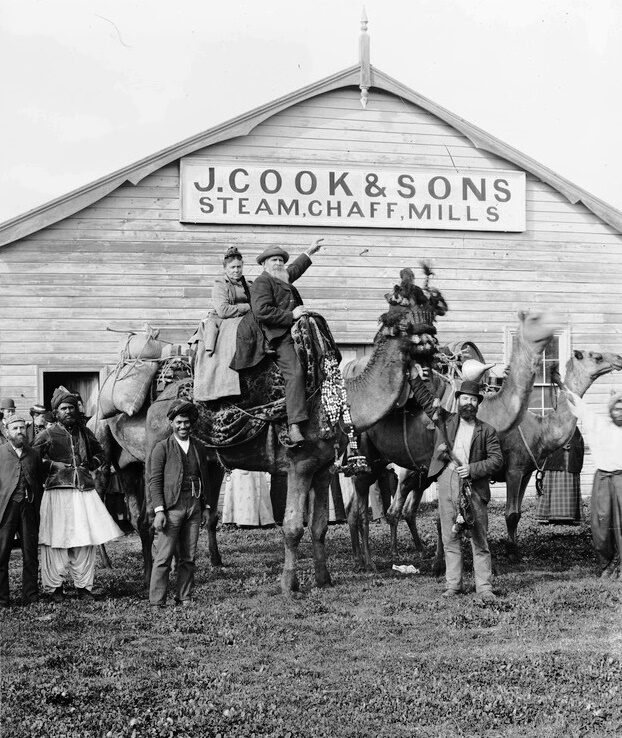

In Europe the equivalent layer was commercial and academic. About two thousand Afghans lived in West Germany during the 1970s, most of them businessmen and students, with the trade city of Hamburg drawing carpet merchants in particular. The Afghan community in the United States was minimal before 1979. This was a country that exported very little of its population before the end of the monarchy.
1979 and after: the largest displacement of its generation
The Saur Revolution of April 1978 and the Soviet deployment that began in December 1979 produced the first mass movement, and it was enormous. One standard account puts the total made refugees by that war at 5.5 million, a third of the country's pre-war population; another estimate gives 6.2 million. By the end of 1981 the UNHCR reported that Afghans were the largest single group of refugees in the world; there were still over six million of them by 2000.
Most of the movement went to the two neighbours. Pakistan began admitting Afghans in large numbers from 1979; by the end of 2001, on UNHCR figures, there were over four million Afghans on the Pakistani side of the border. By 1988, 3.3 million were housed in Pakistan, about a hundred thousand of them in the city of Peshawar and more than two million elsewhere in the province then called the North-West Frontier; the Jalozai camp alone had over a hundred thousand residents in that year. Pakistan held the largest share of that displacement for decades, and the UNHCR describes its subsequent return programme from Pakistan as the largest assisted return programme in the world; the fact is stated here as demography and left, as an account, to the soc.culture.pakistan page, which owns it. In Iran, a UNHCR report estimated some 2.8 million Afghans by 1992, of whom only about a tenth lived in camps; the rest dispersed into Iranian cities and the labour market.
The onward movement from those two countries produced the readership that could actually reach Usenet. In Germany the population reached about eleven thousand by 1982. In the United States, Afghan families began arriving as admitted refugees and asylum seekers from 1980; the earliest of them were largely the urban, educated and comparatively wealthy, many having applied for refugee status while in Pakistan or India and a considerable number having lived in Germany first. The family-reunification cases that followed drew far more heavily on rural districts, and the difference in education, wealth and outlook between the two groups is a documented feature of the American community rather than an impression.
The 1990s: the civil war and the Taliban years
The second European wave belongs to the 1990s and is a different population again. Germany's Afghan community reached roughly fifty thousand by 1994. The Netherlands began receiving Afghan refugees in the late 1980s, and most of its first-generation Afghan population settled between 1992 and 2001, which made it the second most common European destination after Germany in the decade to 2002; Afghans there accounted for more than a fifth of the roughly 170,000 asylum applications lodged by Afghans in Europe in that decade, with the annual figure peaking in 1998. The country-by-country totals for 1992 to 2002 are on record: Germany received the most, 57,600 asylum requests; the Netherlands 36,500 refugees and asylum seekers; the United Kingdom 29,400, Austria 25,800, Denmark 7,300 and Sweden 3,100, with every other pre-2004 member of the European Union receiving fewer than two thousand each.
Australia's numbers describe the same decade from the far side of the world: of Afghanistan-born residents counted at the 2006 census, 7,707 had arrived during the 1990s and 8,554 since 2000, against those 149 who came before 1979. By 2006, 9,356 of them, or 56 per cent, had taken Australian citizenship.
After 2001, and after 2021
The fourth movement ran in both directions. Millions returned after 2001: on the UNHCR's own account it had directly helped around 4.4 million Afghans to return home from Pakistan in the decade after the programme began in 2002, in what it describes as the largest assisted return programme in the world, and by 2012 some 5.7 million returnees had increased Afghanistan's population by about a quarter. At the same time resettlement programmes run by countries in the International Security Assistance Force moved further thousands westward. The fifth movement followed the events of August 2021, when more than 123,000 people were evacuated through Kabul airport between 14 and 30 August, and more than 100,000 Afghan nationals subsequently moved to the United States. That community was estimated at about 250,000 in 2022, against a United States Census Bureau count of 65,972 in 2006, a figure to set against the 200,000 that a news report asserted without sourcing in 2001.
The present sizes of the communities the group could once have reached are a matter of national statistics. The German statistical office estimated 425,000 people of Afghan descent in Germany in 2022, the third largest group from outside the European Union; more than fifty thousand of them live in Hamburg, about 2.7 per cent of that city's population. Dutch figures give 51,830 people of Afghan origin in 2021; the 2011 count of 40,064 was already more than eight times the 4,916 recorded in 1996. In Pakistan roughly 1.44 million Afghans were registered with the UNHCR at the start of 2022, and in October 2023 the Pakistani government ordered undocumented foreign nationals, of whom it counted some 1.73 million Afghans, to leave by 1 November or face deportation. In Iran, 780,000 Afghans were registered as refugees in October 2020, with an estimated further two million undocumented Afghans and nearly 600,000 Afghan passport holders in the country.
The larger picture, as of 2023, was 3.2 million internally displaced Afghans and 6.4 million Afghan refugees abroad, one of the largest refugee populations in the world. Afghans and their children lawfully reside in at least ninety-six countries. The group's name pointed at a country. Its plausible readership was scattered across four continents before the group was a year old.
The layers did not share a politics
A layered emigration is not merely a demographic curiosity. Someone who left in 1980, someone who left in 1992 and someone who left in 1996 had fled three different administrations, and in each case the administration they fled had been the enemy of somebody else's. An unmoderated newsgroup put all of them on one page, with no editor and no filter.
The consequence was noticed by observers on the ground. Writing in Der Spiegel in 2008 about Hamburg, then the city with the largest Afghan population of any in Europe at some 7,000 German citizens of Afghan origin and about 14,000 other residents of Afghan origin, a team of reporters described a community that was, in the published translation, relatively loose-knit and rarely perceived as an ethnic group, partly because the immigrants had been so deeply divided at home that there was little left to unite them as a community abroad. A Washington Post report of October 2001 described the Afghan-American community concentrated in Fremont and Hayward, California, as in many ways a microcosm of a country nearly a dozen time zones away, and recorded members saying that the divisions of home persisted in the new place alongside a shared attachment to it. Fremont's Centerville district is one of several places worldwide nicknamed Little Kabul; Hamburg's Steindamm, Lajpat Nagar in Delhi and a hotel district in Moscow are others.
Dutch research on the same population found a group that was heterogeneous socially and ethnically, containing speakers of several languages of Afghanistan and representatives of political currents ranging from communists to democrats to Islamic activists, and noted that within the roughly 130 Afghan associations founded in the Netherlands most people preferred to work with those of similar background. The point was made sharply in the late 1990s when the Dutch government established a war-crimes investigation unit; the first refugees it charged were two former officers of the Afghan intelligence service of the 1980s, tried in 2005 and sentenced to twelve and nine years, and the discovery that such men were living among the refugee population was reported at the time to have caused considerable unrest and fear within the community. Emigration had not divided the country into victims in one place and perpetrators in another. It had moved a divided society sideways.
This is the honest description of the group's constituency, and it can be established entirely from sources outside Usenet. What conversations actually took place inside the group, in what proportions and with what temperature, this site cannot say and does not claim to know: no message archive of any newsgroup is preserved here, and the section further down headed What the record does not show sets out precisely where the evidence stops.
Who could post, and from where
For essentially the whole of this group's active life there was no public internet inside Afghanistan. That is not an inference; it is documented in the administrative record of the country's own top-level domain, and the documents are unusually candid.
The Internet Assigned Numbers Authority records a registration date for .af of 16 October 1997, a year after the Taliban had taken Kabul. IANA's own redelegation report of 8 January 2003 sets out what happened next. The domain was delegated to an individual in Kabul as administrative contact and hostmaster, with a firm in London as technical contact which agreed, by arrangement with IANA, to run the registry and provide free registration on a temporary basis until a stable operation could be established inside Afghanistan. That never happened. As the report puts it, in the late 1990s the ongoing civil war made the administrative contact's role increasingly difficult; new registrations were halted while nameserver updates and DNS resolution continued; and by early 2000, after numerous attempts by e-mail, telephone and postal mail over a sustained period, IANA could not confirm whether the contact was still inside Afghanistan or, in the report's words, alive. In August 2001 the Taliban administration formally prohibited all non-governmental internet use inside the country.
The rest of the report is a chronology of restoration. Taliban military forces deserted Kabul on 13 November 2001; an Interim Authority was established on 22 December; on 31 December the United Nations Development Programme approached IANA offering to take over the registry, and IANA recorded the position it found in a sentence that settles the question this section asks: there was a near-total absence of a local internet community within Afghanistan, and at that date only a few internet links had been established in Kabul by international organisations and non-governmental bodies. A redelegation package went to IANA on 10 September 2002 from the Minister of Communications of the Islamic Transitional Government and the UNDP; the ICANN board authorised the accompanying memorandum of understanding on 18 November 2002; the report issued on 8 January 2003; and the domain reopened on 10 March 2003 as a joint programme of the UNDP and the Afghan Ministry of Communications, administered thereafter by the Afghanistan Network Information Center.
Public internet service inside the country became available in 2002, under the administration that took office after Bonn. Before that, through the 1990s, the country was almost entirely offline, and such Afghan presence as existed on the web had been built abroad: the first Afghan web directory, afghana.com, was launched from the diaspora in 1999, carrying links to Afghan-related sites, maps, business listings, historical documents, books and mail and chat services for people who were not in Afghanistan.
The consequence is plain and this page does not pretend otherwise. soc.culture.afghanistan was written from outside Afghanistan. Its charter says for the Afghans and for the non-Afghans, but the Afghans it could actually reach were, with negligible exceptions, Afghans abroad, and for most of the group's life anyone posting from inside the country would have been doing so over a telephone line obtained from a neighbouring state. In reach it was nearer to the correspondence page of an emigre newspaper than to the town square its name suggests. The same asymmetry, in a milder form, shaped nearly every soc.culture group whose country was poor or at war; the general version of the problem is treated on the soc.culture.asian page.
Language and script
Afghanistan has two official languages, and the constitution adopted in January 2004 states the position in a form worth quoting exactly, because it names more languages than it makes official. Article 16 provides that from amongst Pashto, Dari, Uzbek, Turkmen, Balochi, Pashai, Nuristani and other current languages in the country, Pashto and Dari shall be the official languages of the state, with provision for a third official language in areas where a majority speaks it, and it commits the state to fostering and developing all the languages of Afghanistan.
The pairing itself is older than that constitution and its second half is contested. Successive governments in the region promoted New Persian as a language of administration for centuries; Pashto was introduced as an additional language of administration in the nineteenth century, under a ruler of the Barakzai dynasty. In 1964, under the constitution promulgated in the reign of the last king, the state changed the official name of the Persian spoken in Afghanistan from Farsi to Dari, a word generally derived from the term for the court. The change was administrative rather than linguistic, the language itself being unaltered by it, and the new name has never been fully accepted: many Persian speakers in Afghanistan continue to call the language Farsi. An Afghan analyst and former ambassador, quoted by a broadcaster in 2017, described the dispute as pitting those who look at the language as a shared heritage including the thinkers, writers and poets of Farsi against those who believe that Dari has older roots and provides a distinct identity. Which language a scattered readership writes in, and what it calls the first of the two, is therefore a question with a history attached before a single word is typed.
One distinction is worth making once and making precisely, because it is regularly muddled. Dari and Pashto are Iranian languages, of the Indo-European family. They are written in the Perso-Arabic script, which is the Arabic script with additions, but they are not related to Arabic, which is Semitic. A group like this one shared a writing system with the Arabic-language community on Usenet and almost nothing else; that community has its own page at soc.culture.arabic, and the technical problems the two shared are noted below rather than duplicated there.
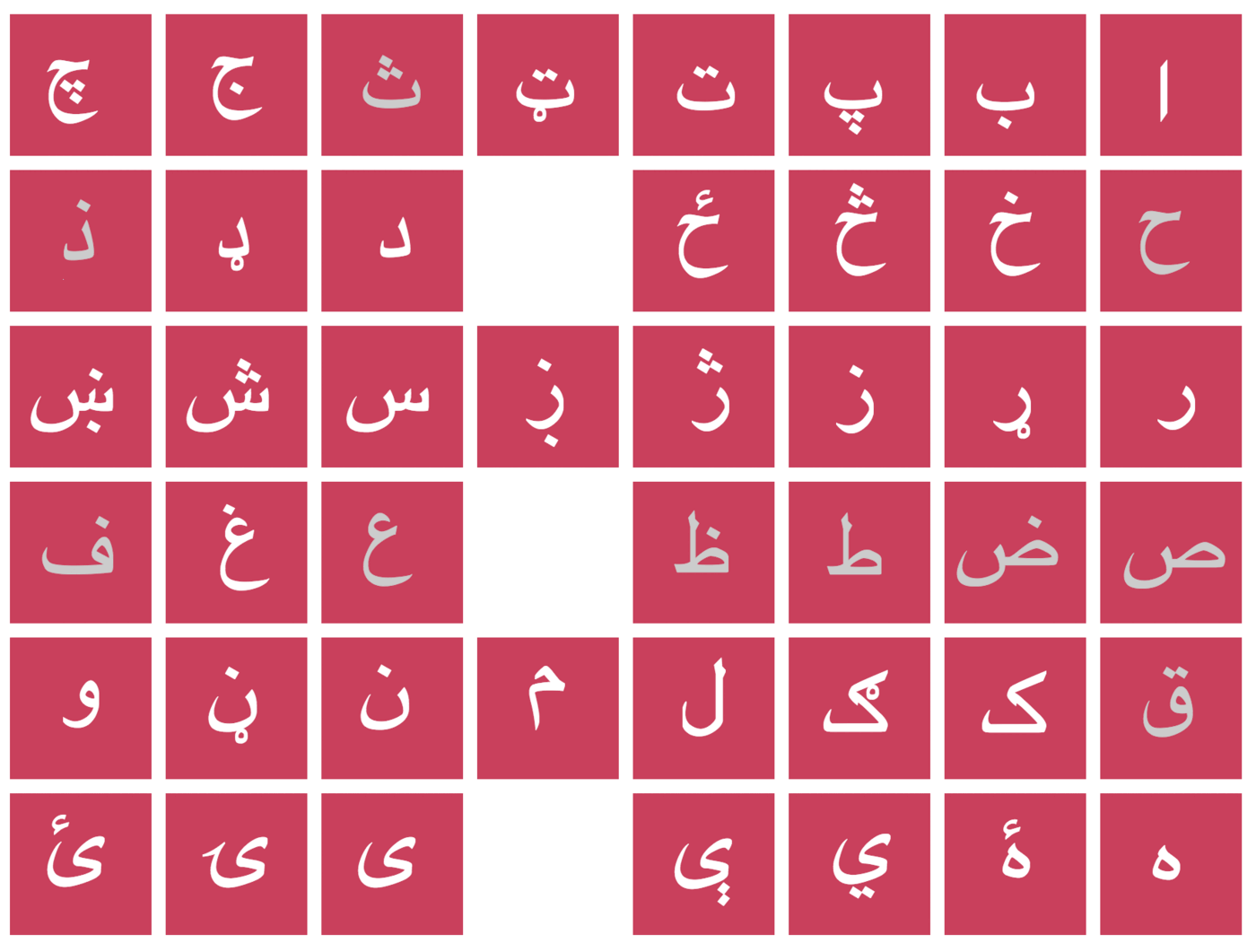
The Pashto alphabet is the more elaborate of the two. It is written right to left, originated in the sixteenth century, and has 45 letters and four diacritic marks. It uses all 28 letters of the Arabic alphabet and the three additional letters Persian uses, and then adds further letters of its own for sounds neither Arabic nor Persian has: retroflex and affricate consonants written by attaching marks to existing letters. The retroflexes take a small circle, known variously as a pandak, a gharwanday or a skenay, beneath the corresponding dental letter; two others are formed by putting a dot above and a dot below the shapes for s and r. Ten further letters appear only in loanwords of Arabic origin borrowed through Persian, and eight of those represent no Pashto sound at all, being pronounced as other phonemes. A writing system that accretes in that way is a record of the languages a region has passed through, and it is also, as the next section explains, a problem for eight-bit character sets.

Seven bits, and two languages that would not fit
Usenet of the group's early years was a plain seven-bit medium. Getting a non-Latin script through it was a matter of luck, local convention and the tolerance of every machine on the path, and neither Dari nor Pashto had a settled answer for most of the group's life.
The eight-bit standard for the Arabic script was ISO/IEC 8859-6, whose first edition was published in 1987 and which derives from ASMO 708, devised by the Arab Standardization and Metrology Organization in 1986 in close cooperation with ECMA, which adopted it as ECMA-114 in the same year. It was designed to cover Arabic, and it does exactly that: it encodes nominal letter forms only, without preshaped forms, and it does not include the extra letters needed to write most Arabic-script languages other than Arabic itself, Persian and Urdu among them. A Dari or Pashto text could not be represented in it.
Unicode did have the room, and had it early. The Arabic block of the standard covers the Persian and Pashto letters, and it did so from the first version: the block as published in Unicode 1.0.0, dated 1991 in the Consortium's own list of enumerated versions, assigned 169 code points, among them the ranges U+0670 to U+06B7, U+06BA to U+06BE, U+06C0 to U+06CE and U+06D0 to U+06D5. The eight Pashto consonants that neither Arabic nor Persian has fall inside those ranges: U+067C, U+0681, U+0685, U+0689, U+0693, U+0696, U+069A and U+06BC. The Unicode Character Database's own age file marks that range 1.1 rather than 1.0, but the file explains why in its header, and the reason is bookkeeping rather than history: assignment ages are only tracked from version 1.1 onwards, because version 1.0 predated the changes required by the merger with ISO 10646. Unicode 1.0.1 is dated 1992 and 1.1.0 is dated 1993.
An encoding existing in a published standard and an encoding working between two strangers are different things, and the gap was measured in years. Support had to arrive in text editors, in newsreaders, in the news transport itself and in every gateway along the way, and through the 1990s it very largely had not. The practical answer, in this group as in every other group whose language used the Arabic script, was romanisation: Dari and Pashto written out in Latin letters, with spellings settled ad hoc or not settled at all. The general history of that constraint, and of how much harder the problem became for scripts with tens of thousands of characters, is told on the soc.culture.asian page.
The country as a dated record: the monarchy to 1989
What follows is chronology with attribution, and nothing more. The arguments about these events are not this page's to settle; where estimates conflict, the conflicting figures are given with the bodies that produced them.
The monarchy ended on 17 July 1973, when the king's cousin, who had been prime minister from 1953 to 1963, took power in a coup mounted while the king was convalescing in Italy. The king did not contest it and formally abdicated on 24 August, remaining in exile; the coup ended more than two centuries of royal rule counted from the founding of the Durrani Empire in 1747. In Dari the event is known as the coup of 26 Saratan, after the month of the Afghan calendar in which it fell. The republic that replaced it lasted five years. On 27 and 28 April 1978 it was overthrown in turn by officers acting for the People's Democratic Party of Afghanistan, in the events known as the Saur Revolution, again after a month of that calendar. The president and members of his family were killed.
By the spring of 1979, on the account of one standard history, 24 of the country's 28 provinces had seen outbreaks of violence. Soviet forces were deployed on 25 December 1979, and the Soviet-Afghan War ran from that date until 15 February 1989, when the last Soviet troops left on the schedule agreed in the Geneva Accords of April 1988. The Soviet presence peaked at roughly 115,000 troops by the mid-1980s; some 80 per cent of the country was reckoned to lie outside government control.
The casualty estimates for that decade are wide and the width is the point. Soviet military dead are given as 14,453 in the official Soviet accounting and as more than 26,000 in reports attributed to the Russian General Staff. Afghan civilian deaths are estimated at 562,000 in the battle-deaths dataset published by Lacina and Gleditsch in 2005, at one million by Goodson and Johnson in 2011, and at up to two million and beyond by other scholars, with some accounts of the war putting total Afghan deaths at around three million. Against a population recorded at 13.5 million in the census of 1979, published estimates of the proportion killed range from 6.5 to 11.5 per cent. The estimates are not reconcilable, and this page gives them as a range with their sources rather than choosing one.
These are the years that made the group's readership. The people who would later hold university and workplace accounts in Hamburg, Fremont, Toronto and Sydney were, for the most part, moved by this decade or by its immediate consequences.
The country as a dated record: 1992 to 2021
The government of the republic was overthrown in April 1992; the war among the victorious mujahideen parties for control of Kabul is dated by historians from 28 April 1992 and ran to 27 September 1996. The Uppsala Conflict Data Program records 26,759 killed in that conflict. Kabul itself was heavily damaged, and the record of what happened in the city during those years was compiled at length by Human Rights Watch in a report published on 6 July 2005 under the title Blood-Stained Hands, Past Atrocities in Kabul and Afghanistan's Legacy of Impunity. The factional lines of that war ran partly along ethnic ones, among Pashtun, Tajik, Hazara and Uzbek communities, and outside states, Pakistan, Iran, Saudi Arabia, Russia and the United States among them, were involved in ways that remain contested in the literature.
The Taliban emerged as a faction in that war in 1994, their first major military activity coming in October and November of that year, and took Kabul on 27 September 1996, from which date the Islamic Emirate of Afghanistan reckons its establishment. Between 1996 and 2001 exactly three widely recognised states, Pakistan, Saudi Arabia and the United Arab Emirates, declared it the rightful government of Afghanistan; the United Nations continued to recognise the Islamic State of Afghanistan, which held roughly a tenth of the territory against the Emirate's ninety per cent. Both facts bear on a group named for the country, because for those five years the state that governed most of Afghanistan was one that almost every government in the world formally declined to recognise.
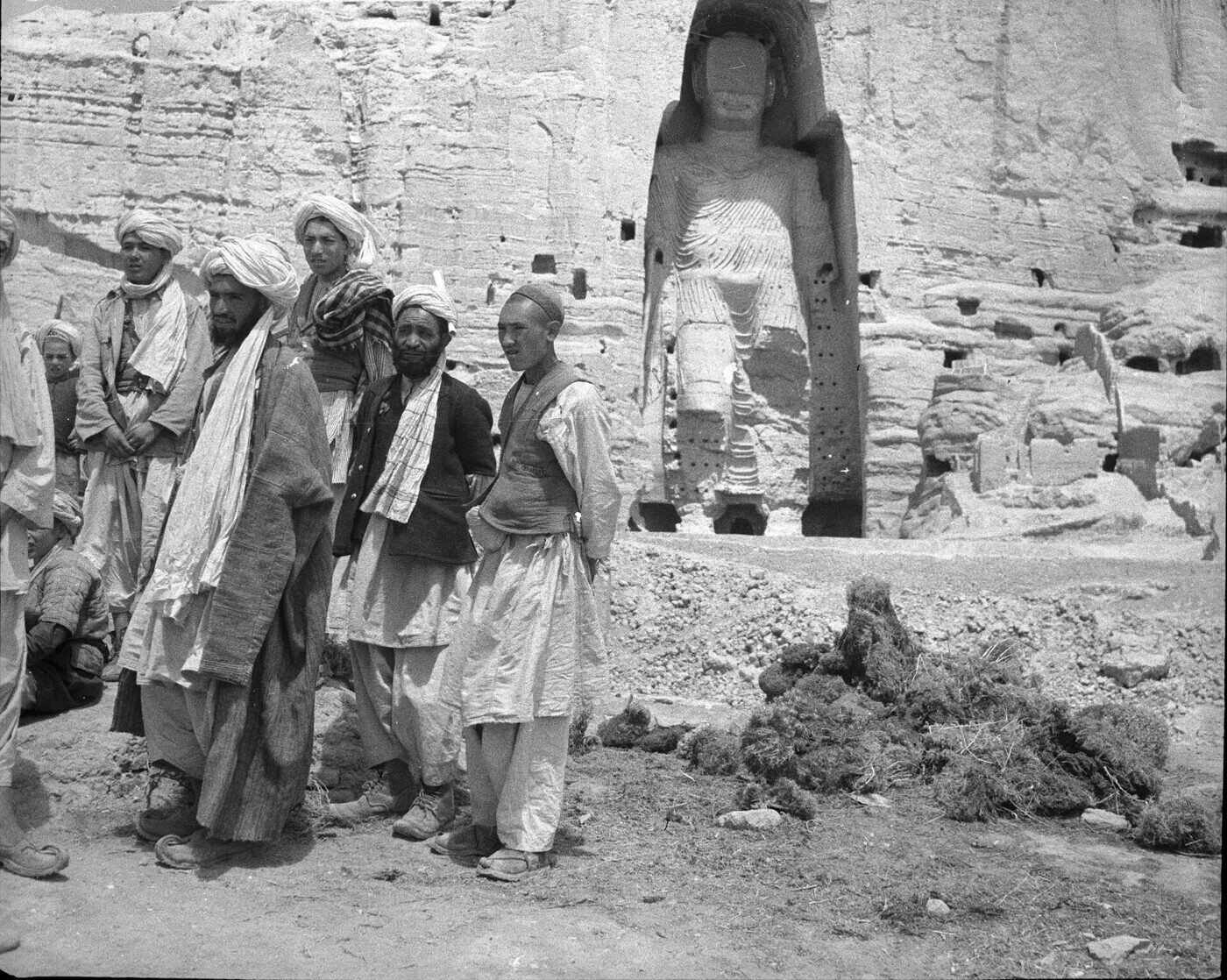
On 26 February 2001 an order was issued for the destruction of the statues of Afghanistan. The two colossal Buddha figures at Bamiyan, cut into the cliff face and measuring 55 and 38 metres, were destroyed the following month. Carbon dating of organic material recovered from the rubble afterwards placed the smaller eastern figure between 544 and 595 CE and the larger western figure between 591 and 644 CE. The valley was inscribed on the UNESCO World Heritage list in 2003 and placed on the List of World Heritage in Danger in the same year, where it remains.
-_Menschen_-_Annemarie_Schwarzenbach_-_SLA-Schwarzenbach-A-5-20-174_(cropped).jpg)
After the attacks of 11 September 2001, a United States-led military operation began on 7 October. Taliban forces left Kabul on 13 November. On 5 December twenty-five prominent Afghans meeting under United Nations auspices at Bonn concluded the agreement formally titled the Agreement on Provisional Arrangements in Afghanistan Pending the Re-Establishment of Permanent Government Institutions; an Interim Authority took office on 22 December 2001, and an Islamic Transitional Government succeeded it in June 2002. A constitutional loya jirga sat and the constitution quoted earlier in this article was approved by consensus in January 2004 and signed on 26 January 2004, running to 162 articles.
The war that followed lasted until 2021. The Costs of War Project at Brown University counts 176,000 people killed in Afghanistan across it: 46,319 civilians, 69,095 national military and police, and 52,893 opposition fighters, with the explicit caveat that the true toll is probably higher once deaths from disease and from loss of access to food, water and infrastructure are counted. The United States-Taliban agreement was signed on 29 February 2020. Kabul was taken on 15 August 2021; between 14 and 30 August more than 123,000 people were evacuated by air; the American withdrawal completed on 30 August 2021.
Only two dates in this article describe conditions under which Afghanistan itself could have taken part in a newsgroup bearing its name: 2002, when public internet service became available inside the country, and 2003, when its own domain reopened. By then the group was eleven years old.
The Persian inheritance, and the borders attached to it
A culture group's charter names culture, and in the Afghan case culture arrives with borders attached, because a great deal of the classical Persian canon was made in cities that are now inside Afghanistan and more than one modern state claims it.
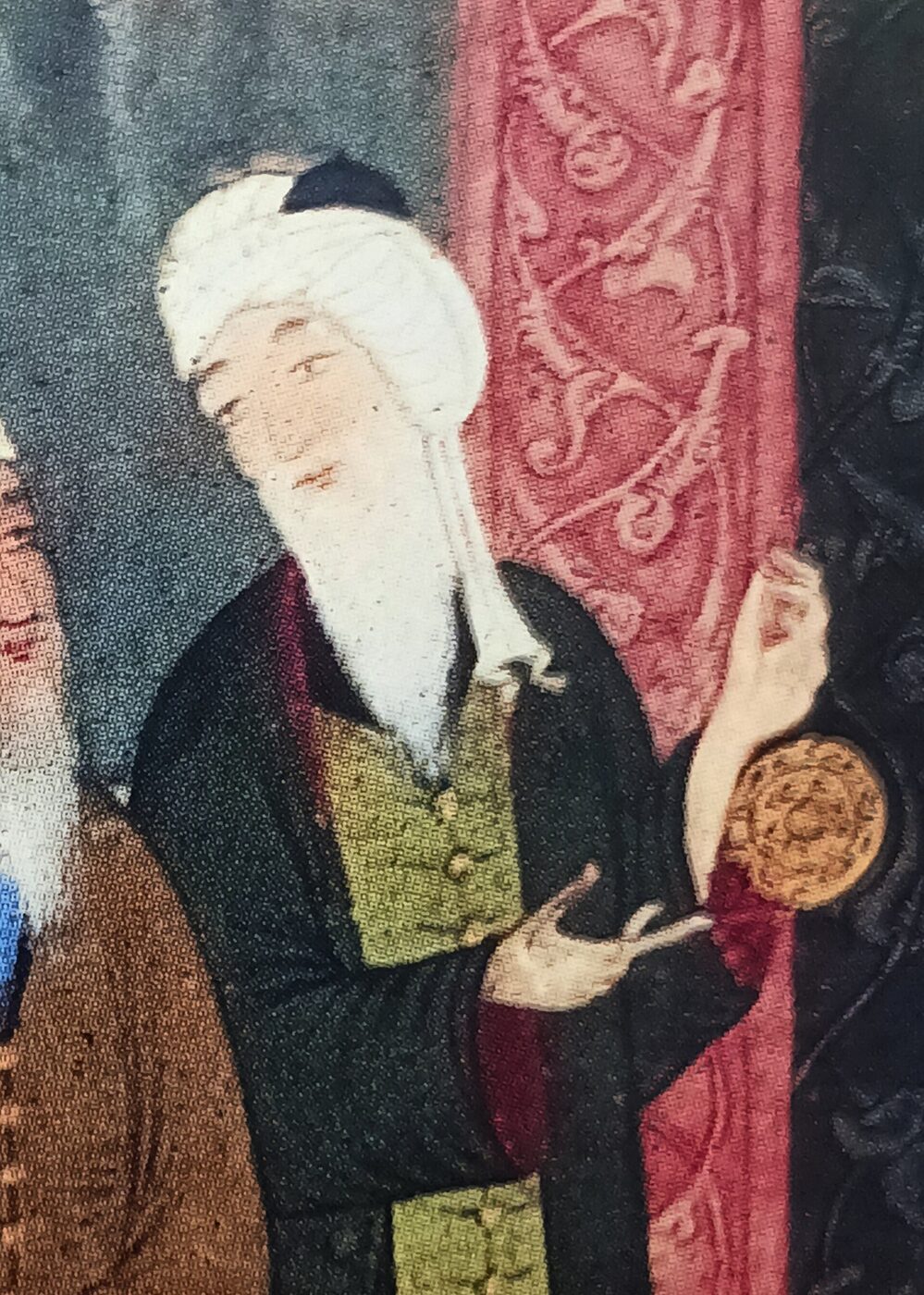
Sanai was born at Ghazni in 1080 and died there between 1131 and 1141. His Hadiqat al-Haqiqa, the Walled Garden of Truth, dedicated to the Ghaznavid sultan Bahram Shah, is described as the first Persian mystical epic of Sufism. Rabia Balkhi, associated with Balkh and writing in the tenth century in both Persian and Arabic, is the first known woman poet to have written in Persian; schools, hospitals and roads in Afghanistan, Pakistan and Iran are named after her, and her shrine is in the mausoleum of a fifteenth-century Sufi at Balkh. Jami was born on 7 November 1414 at Torbat-e Jam, in what is now Iran, spent his career at Herat, in what is now Afghanistan, and died there on 9 November 1492; his Haft Awrang, the Seven Thrones, is the best known of his poetic works.
._By_Behz%C3%A2d,_from_the_Romance_of_Alexander_by_Nez%C3%A2m%C3%AE._Manuscript_of_the_Khamseh_of_the_emir_'Al%C3%AE_F%C3%A2rs%C3%AE_Barlas,_Herat_1494-1495;_British_Library,_Or._6810,_f_225_v.jpg)
The hardest case is Rumi, and it is hard in an instructive way. He was born on 30 September 1207 at Wakhsh, in what is now Tajikistan; his family came from Balkh, in what is now Afghanistan, and he carries the byname al-Balkhi; his family fled westward before the Mongol advance and he settled at Konya, in what is now Turkey, where he died on 17 December 1273 and where his tomb is. His two great works, the Masnavi and the Divan named for the wandering dervish whose disappearance occasioned it, were composed in Persian in Anatolia. Persian, Tajik, Afghan and Turkish readers all have grounds for a claim, and the claim is not the kind of thing a thread settles.
None of this is Afghan literature in the sense a modern national curriculum means. It is a shared Persianate inheritance that four or five modern states divide between them, and a newsgroup named for one of those states inherits the division along with the poetry.
The Pashto canon, and the couplet that travelled best
The Pashto tradition enters by a different door. Its written canon is conventionally dated from the sixteenth century and from one figure: Bayazid Ansari, known as Pir Roshan, born about 1525 just outside Jalandhar in the Punjab and moved in childhood to his family's ancestral home at Kaniguram in what is now South Waziristan, who died between 1572 and 1578 and who devised a script of 41 letters for writing Pashto. The alphabet used for the language is traced to his work. Its best-known later names are Khushal Khan Khattak, 1613 to 1689, poet, tribal chief and warrior, and Rahman Baba, the Mohmand poet whose dates are given as about 1632 to 1706 and whose collected diwan survives in illustrated manuscripts held in institutional collections.
Beneath the written canon lies an older oral layer, and it is the layer that travelled best through a seven-bit network. The tappa, more widely known as the landay, is a single couplet of twenty-two syllables, nine in the first line and thirteen in the second, and the lines do not generally rhyme. It is traditionally sung aloud rather than written, and treats love, separation, homeland, grief and war. The Pashto word means a short, poisonous snake, which is generally read as an allusion to its brevity and its sarcasm. Two lines of twenty-two syllables can be carried through improvised Latin transliteration with far less damage than a page of Jami, and of all the literary forms in this article the landay is the one best suited to a medium that could not render its own alphabet.
Music, and its documented suppressions
Radio broadcasting began in Afghanistan in 1925; the station was destroyed in 1929 and broadcasting did not resume until Radio Kabul opened in 1940. Modern popular music followed the radio, arising in the 1950s as radio became commonplace, with orchestras that mixed Afghan and Indian instruments with European clarinets, guitars and violins, and the 1970s are generally described as the golden age of the country's music industry. In 1951 an Afghan woman sang live on the radio for the first time. The most widely known figure of the pop era, born on 14 June 1946 and dead on his thirty-third birthday on 14 June 1979 in circumstances still disputed, has been called the Elvis of Afghanistan in the English-language press; the style he popularised drew on Indian, Iranian, Middle Eastern and Afghan folk traditions and is treated in the literature as fusing them into a sound unique to Afghanistan. The elite classical performers of the period up to the 1980s were overwhelmingly trained in the Indian classical tradition.
The instrument at the centre of it is the rubab, a lute-like instrument described by Afghans as their national instrument and called the lion of instruments; it is a forerunner of the Indian sarod. The dombura is the folk instrument of the north, popular among Hazaras, Uzbeks, Turkmens and Tajiks and played with much banging and scratching on the body of the instrument to give a percussive sound; the ghichak is a string instrument made among Hazaras and Tajiks. Afghan usage is precise about what counts: unaccompanied religious singing, including Koran recitation, is not classed as music at all.
Two suppressions are documented. The civil war of the 1990s drove many musicians out of the country, and the Taliban government that followed banned instrumental music and much public music-making from 1996 to 2001. Music has been prohibited again since 2021, with reported bans at weddings, at social gatherings and on radio and television, and reported destruction of instruments, including the burning of instruments in Herat province in late July 2023. Between them the two prohibitions cover about ten of the years since the group was created, during which a substantial part of the culture the group was chartered to discuss could not lawfully be performed in the country the group was named for.
The table, the calendar and the field
The national dish is Kabuli pulao, known in Afghanistan as Qabili palaw, a pilaf of steamed rice with caramelised carrots and raisins and marinated meat, commonly garnished with almonds and pistachios and sometimes with saffron. Neither Afghanistan nor Uzbekistan, where a close relative is made and called osh palov, refers to it by the name of the city of Kabul; in Saudi Arabia the same dish is known as Bukhari rice, after Bukhara. One study places its origin not in Kabul at all but at the northern border with Uzbekistan. Dishes travel along the same routes as the people who cook them, which is why a national dish in one country is a regional one in three others.
The calendar is worth a line because it governs when anything is celebrated. Afghanistan uses the Solar Hijri calendar, whose year begins at the March equinox with Nowruz and whose epoch is 19 March 622 CE, and until 2023 it named its months for the signs of the zodiac rather than with the Zoroastrian month names used in Iran. This is not a curiosity: the coup of July 1973 is known in Dari as the coup of 26 Saratan, and the revolution of April 1978 is the Saur Revolution, both named for zodiacal months. A reader working from a Gregorian calendar and a reader working from a Solar Hijri one are, on occasion, discussing the same event under two different dates.
The national sport is buzkashi, literally goat-pulling, played on horseback with the carcass of a calf, prepared by beheading and disembowelling it and soaking it in cold water for a day to toughen it, which riders attempt to place in a goal. It is often played on Fridays and draws crowds in the thousands. The anthropologist who wrote the standard monograph on it drew an explicit parallel between the game and the seizing and holding of political authority in Afghanistan, which has made the sport a standing metaphor in writing about the country ever since. It shares part of the recent history of Afghan music: banned under the first Taliban government as immoral, resumed after 2001, and permitted to continue after 2021.
Cricket arrived by a route that belongs to this article rather than to a sports page. The game became popular among Afghan refugees in Pakistan during the 1980s and 1990s, and the Afghanistan Cricket Federation was formed there in 1995; the game came home with the returnees from late 2001. An Afghan side entered Pakistan's domestic competition in the 2001-02 season, playing in the second division of the Quaid-e-Azam Trophy; the national team played its first One Day International against Scotland at Benoni on 19 April 2009; the board became an affiliate member of the International Cricket Council in 2001, an associate member in 2013, and a full member with Test status in 2017. When the team first played at a World Cup, in 2015, reporting noted that it contained many players who had picked up the game in refugee camps. Pakistan's own cricketing story belongs to the soc.culture.pakistan page; what belongs here is the mechanism, which is that a displaced population brought a sport back with it, in the same decades and by the same routes as everything else in this article.
The neighbours, and what overtook the group
No national group in this branch stayed inside its nominal borders, and this one had unusually interested neighbours. soc.culture.pakistan and soc.culture.iranian sat next to it in the same namespace, and the two states they were named for were the ones whose policies toward Afghanistan were most often at issue in the histories cited above. Between them those two states hosted the overwhelming majority of Afghan refugees for four decades, which is a material connection that a group named for, say, Austria did not have.
What ended the group was not any of this. It was the same thing that ended almost every group in the branch. After 2001 the world's attention arrived in Afghanistan and so, belatedly, did the web: dedicated Afghan news sites and web forums, most of them built and run from the diaspora, offered from the mid-2000s what a newsgroup had previously been the cheapest way to provide. Usenet's general decline through the 2000s did the rest, as the large service providers withdrew their news feeds and readers who had arrived through those feeds went elsewhere. The group was not removed and has not been removed since; it simply thinned out, along with the rest of the branch, in the way described on the soc.culture hub.
What it was, for as long as it was carried, was infrastructure of a modest and now unfamiliar kind: a plain-text address at which a population dispersed across four continents could be reached at the price of a university account, at a moment when nothing else did that job as cheaply. The dispersal it was built around has, since then, only grown.
What the record does not show
This directory preserves no message archive for soc.culture.afghanistan, or for any other group. That is not a gap that further research would close; it is a property of what this site is, which is a preserved directory built from a mail-to-news gateway's view of the network. Several consequences follow, and they are stated plainly because pages like this one are cited by people who need to know where the evidence stops.
- Nothing here can establish how much traffic the group carried, in any year, or how that volume changed. No subscriber estimate, readership survey or article count for this group has been located.
- Nothing here can establish what proportion of the group's articles concerned politics, language, history, family news or anything else, nor how any of those proportions changed over time. Statements of that kind about this group would be invention, and where earlier versions of this page made them they have been removed.
- No thread title, no poster, no quotation and no individual article is attested by anything in this directory, and none appears in this article.
- The rhythm of the group, whether threads ran for a week or for months, whether traffic spiked around events, cannot be reconstructed from anything available here.
- The group's Request for Discussion and Call for Votes are not in the ISC archive of news.announce.newgroups, which holds no file for this group at all and whose per-group files for the soc hierarchy begin in 1992. The vote tally, the result date and the charter survive only because the creating control message quoted them, which is why this article quotes that message rather than the original proposal.
- The names of the proposers and the votetaker are therefore not on the record consulted here.
What can be established, and what this article accordingly consists of, is the group's own administrative paperwork; the documented history of the emigration that formed its readership; the documented state of connectivity in the country it was named for; the documented history of its languages and their encodings; and the documented history and culture of Afghanistan in the period the group was alive. All of that is checkable. None of it requires guessing at the contents of a room nobody kept the minutes of.
Scope, sources and limits
The group's dates, tally, charter, catalogue description, later control messages and current status come from the Usenet control-message archive and the newsgroups and active files distributed by the Internet Systems Consortium, from ISC's archive of the Bogus Usenet Groups article, from the group-creation guidelines posted to news.announce.newgroups, and from the control.ctl file distributed with INN. The domain history comes from the Internet Assigned Numbers Authority's delegation record for .af and from IANA's published report on the redelegation of the domain, dated 8 January 2003. The character-encoding dates come from the Unicode Consortium's own list of enumerated versions and from the Unicode Character Database's age file, read directly.
Demographic, historical and cultural statements are attributed in the text to the body or study that produced them: UNHCR for refugee totals, national statistical offices for census counts, the Uppsala Conflict Data Program and the Costs of War Project for casualty counts, Human Rights Watch for the record of the fighting in Kabul, and named scholars for the disputed estimates of the 1980s. Where estimates conflict, both ends of the range are given with their sources rather than a single figure. Where a characterisation is contested, it is presented as a characterisation and its author identified by role.
Two deliberate omissions. No living person is named anywhere in this article, including in the quoted paperwork, where roles are given instead. And no verdict is offered on any of the events chronicled here. The purpose of a directory page is to record what a newsgroup was and what world it belonged to, accurately enough that a reader can go and check; adjudicating four decades of war is not among the things it can honestly do.
Reading soc.culture.afghanistan today
- Historical archive: Google Groups — soc.culture.afghanistan (coverage varies by group and era).
- Open in a newsreader:
news:soc.culture.afghanistan— the original site offered exactly this link, and it still works if your system has a newsreader registered for thenews:scheme. - Live access: point an NNTP newsreader at a modern server — see accessing Usenet today.
- The original news2mail e-mail subscription service ended in the mid-2000s and no longer operates.