soc.culture.albanian
Albania and Albanians around the world.
Covering Albania, Kosovo and the Albanian diaspora, this group mixed language and folklore threads with intense political discussion — particularly during the 1997 unrest and the 1999 Kosovo war, when it became a live news channel for families abroad.
Its long-running debates on Albanian history and the standard vs. Gheg/Tosk dialect question are still cited in language forums.
On this page
- A name argued in the paperwork
- The vote, and who cast it
- A language group, not a country group
- The two old diasporas
- An independent branch
- One nation, one language: how the standard was settled
- Writing Albanian on a seven-bit network
- The record in dates
- The instruments, and the bodies that made the findings
- Where the readership was
- The arguments the group inherited
- What a culture group carried
- The rest of the namespace
- What the record does not show
- Scope and limits
A name argued in the paperwork
The administrative file for this group survives complete, which is not true of every group in this directory. The Internet Systems Consortium's mirror of news.announce.newgroups holds both Requests for Discussion, both Calls for Votes and the final result; the same organisation's control-message archive holds the newgroup notices that followed. Between them they date every step from proposal to creation. The first thing the file records is a change of name.
The Request for Discussion posted on 1 November 1994 proposed an unmoderated group called soc.culture.albania. A second Request for Discussion followed on 6 December 1994, and it opens with a numbered list of what had changed. The first item reads: The newsgroup name has been changed from soc.culture.albania to soc.culture.albanian. The second records that the proposal was now also being posted to soc.culture.greek and soc.culture.turkish, on which the first had not appeared. Charter, rationale and summary were carried over word for word. The file does not say who asked for the change or on what argument; it records only that, between one posting and the next, the group stopped being named after a state and began being named after a people and a language.
Usenet took namespace taxonomy seriously, and most soc.culture.* names were haggled over at some length; the soc.* hierarchy page describes the ritual in general. What makes this particular edit worth the ink is that the amended name turned out to describe the subject far better than the original would have. Albanian speakers live in Albania and in Kosovo, in the west of North Macedonia, in the south-east of Montenegro, in southern Serbia, in scattered communities of southern Italy and Greece whose settlement predates the Ottoman conquest, and in a labour and student diaspora spread across Europe, the Americas and Australasia. A single group named for a country would have been a group about one of those places. A group named for the language and the people had to be about all of them, and the charter says so.
soc.culture.albanian will be a newsgroup dedicated to the exchange of information and discussion of issues on Albania and the Albanian people in Albania and other areas in the Balkans (Kosova, Macedonia, Montenegro) and Albanians living around the world. Anyone interested will be welcome to participate in discussions about: Albanian history and culture; Albanian political and social issues; Albanian concerns in the Balkan crisis; Economic investment in Albania; Travel Information; and other topics. The discussions will be held in Albanian and English.
Four points in that text are worth marking, because each of them shaped what the group became. It names four Balkan jurisdictions and then adds the rest of the world. It uses Kosova, the Albanian form of the name, in a document that otherwise reads as neutral administrative English. It anticipates argument, in the phrase about the Balkan crisis, rather than pretending a culture group would be about recipes. And it declares two working languages, which committed the group in advance to a character-set problem that Usenet was in no position to solve for it. Each of those is taken up below.
The vote, and who cast it
Discussion ran in news.groups through November and into December 1994. The first Call for Votes was posted on 5 January 1995 and a last call on 18 January, both by a votetaker posting for the Usenet Volunteer Votetakers, the standing pool of neutrals who ran Big-Eight ballots in that period; ballots had to reach the voting address by 23:59:59 UTC on 26 January 1995. The Call for Votes also records where the electorate was expected to be found: after appearing in news.announce.newgroups it was to be sent on to two mailing lists, one hosted at an international research-and-exchanges body and one on a machine at the Massachusetts Institute of Technology. The proposal's own rationale had already noted that there are already several Albanian listservers. The newsgroup was not the community's first online address; it was its first public one.
The rationale is blunt about the motive. All Balkan and most East European countries already have their own newsgroups, it says, and Albanian users had until then to turn to soc.culture.europe, soc.culture.yugoslavia and the groups of other Balkan countries and peoples, in a few of which they have not been very welcome. The Call for Votes puts the same claim in one line: Albanians are the only Balkan nation that do not have a newsgroup of their own. Whether that was exactly true depended on how one counted peoples against states, which is the argument the group's name had just been amended to acknowledge.
The result was posted on 1 February 1995 under the subject line RESULT: soc.culture.albanian passes 564:30. There were 564 votes to create and 30 against, 594 valid votes in all, with two abstentions. The Big-Eight thresholds of the day, restated in the result itself, required a two-thirds majority of valid votes and at least 100 more yes votes than no; the ballot cleared both by a distance. As the procedure required, the votetaker published the full list of voters, address by address, so that the count could be checked by anyone who cared to.
That published list is the only quantitative evidence anyone has about who wanted this group, and it repays counting. Sorting the 564 affirmative addresses by the top-level domain each one sat in gives 280 in .edu — just under half the total, and in the great majority of cases an American university — then 97 in .com, 40 in .uk, 21 in .ca, 18 in .org, 17 in .de, 15 in .tr, and single figures across some two dozen further domains, from Sweden, Austria and Norway to Malaysia, Japan and Singapore. Twenty-two of the affirmative addresses in all sat in a country-code domain anywhere in south-eastern Europe: fifteen Turkish, four Greek, and one each in Slovenia, Croatia and Bulgaria. There was no address in .yu, none in .mk, and none in .al.
That last absence is worth dwelling on: on neither side of the question, in a list of 594 published addresses, did a single voter write from Albania. The reason is not mysterious, and the figures for it are given further down: in 1995 the entire population of Albania with any form of internet access would have fitted comfortably into a lecture theatre. The group was voted into existence almost entirely by people outside the countries it was about, and that asymmetry is the single most important fact about its first decade.
After the mandatory five-day objection period, the moderator of news.announce.newgroups issued the newgroup control message on 14 February 1995, reissuing it on 21 February and again on 14 March, as was then the practice for making sure a new group reached servers that had missed the first notice. The message carried the line administrators were to paste into their newsgroups files, which is still the line the group carries today: soc.culture.albanian Albania and Albanians around the world.
A language group, not a country group
The consequence of the charter's scope is that the group's subject is a population distributed across several states whose political situations differ from one another completely. Setting the demography out plainly, with each figure attached to the count that produced it, is the least tendentious way to show what that meant.
- Albania. The 2023 census recorded a resident population of 2,402,113, a fall of about 420,000 on the count of 2011, driven by emigration and a falling birth rate; 2,186,917 people, or 91.04 per cent, were recorded as ethnic Albanians.
- Kosovo. The census conducted by the Kosovo Agency of Statistics in April 2024 returned 1,585,566 inhabitants in its published data and 1,588,566 in the preliminary release; ethnic Albanians were 91.8 per cent of the total. Albanian is one of the territory's two official languages, alongside Serbian. The 2011 predecessor census recorded 1,739,825, a figure that excludes the Serb-majority municipalities of the north, which boycotted it, and undercounts Serb and Roma residents further south for the same reason.
- North Macedonia. In the 2021 census Albanians numbered 446,245, or 24.3 per cent of the resident population. Counting the diaspora members who enumerated themselves, the same census returned 619,187 Albanians, 29.52 per cent of a total of 2,097,319 — a resident-versus-diaspora gap of some 170,000 people, which is itself a fair description of the subject of this page.
- Montenegro. The 2023 census recorded 30,978 Albanians, 4.97 per cent of the population, concentrated in the municipalities of Ulcinj (73.53 per cent) and Tuzi (62.55 per cent) and speaking Gheg varieties continuous with those of northern Albania.
- Serbia. The 2022 census recorded 61,687 Albanians, about 0.9 per cent of the population — 31,340 in Preševo and 25,465 in Bujanovac — chiefly in the municipalities of the Preševo valley in the far south. The statistical record notes that the 2011 round undercounted those same two municipalities because most of the Albanian community boycotted it, which is the mirror image of the caution attached to the Kosovo census of the same year.
Add to those the resident migrant populations of Greece, Italy, Germany, Switzerland, Turkey and the United States, dealt with separately below, and the group's nominal constituency runs to somewhere between seven and ten million people — the range the standard reference works give, and a range rather than a number for the good reason that censuses count citizenship in some places, ethnicity in others and language in others again, and that a great many people appear in none of them.
Three of those jurisdictions changed their constitutional arrangements during the group's active life, and a fourth changed its name. None of that is this page's to adjudicate. What it meant for the newsgroup is simpler and quite specific: a thread begun by a poster in Tirana, answered by one in Skopje and continued by one in Ulcinj was a conversation between three legal systems, three school systems and three sets of assumptions about what the state was for, conducted in one language whose standard form all three had been taught. Very few soc.culture.* groups had that shape. The groups for the Yugoslav successor states, whose own stories are told at soc.culture.yugoslavia and soc.culture.bosna-herzgvna, were organised the other way round: one group per state, with the peoples crossing between them.
The two old diasporas
Behind the modern migrations sit two much older ones, both well enough documented to be stated without hedging, and both a standing reminder that the Albanian-speaking world has never been coextensive with any state.
The Arbëreshë of southern Italy descend from refugees who settled in the Kingdom of Naples and in Sicily between the fourteenth and eighteenth centuries, after the death of Skanderbeg in 1468 and during the Ottoman advance, some of them arriving by way of the Albanian communities of Attica and the Morea. About fifty Arbëreshë communities survive, spread across seven regions of the south, with a population usually given as about 100,000. Most belong to the Italo-Albanian Church, an Eastern Catholic church of the Byzantine rite, organised in the eparchies of Lungro for the mainland and Piana degli Albanesi for Sicily, with the abbey of Grottaferrata near Rome as its third jurisdiction. Their speech, Arbërisht, derives from the Tosk of southern Albania and Epirus, and is protected in Italian law by act number 482 of 1999 on the historic linguistic minorities.
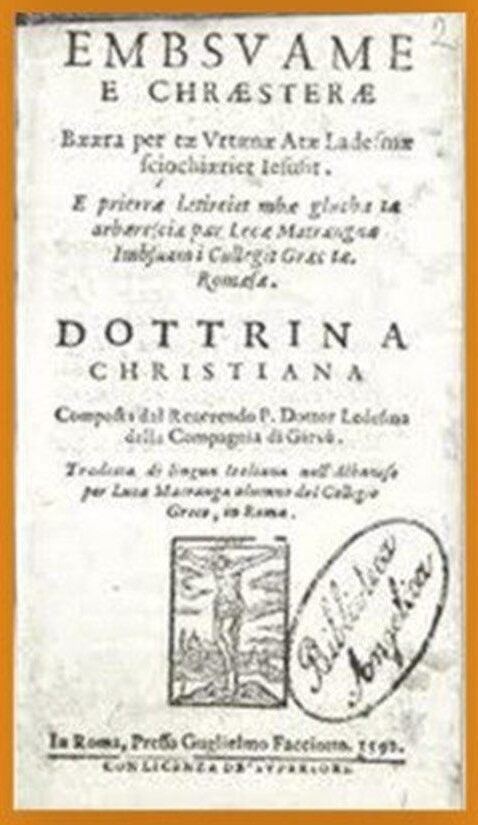
The Arbëreshë also hold a place in the history of the written language out of all proportion to their numbers. E mbësuame e krështerë, a catechism translated into Albanian by a priest of Piana degli Albanesi who had been educated at the College of St Athanasius, the Greek college in Rome, was published there in 1592 and is among the earliest printed books in the language. And when Tirana convened its orthography congress in 1972, delegates came from Albania, from Yugoslavia and from the Arbëreshë communities.

The Arvanites of Greece descend from settlement first recorded in the late thirteenth and early fourteenth centuries, with the main waves running from about 1350 to about 1600 and the last of the old migrations in the second half of the eighteenth century. They settled in Attica, Boeotia, southern Euboea, the Saronic islands, the north-east of the Peloponnese and the north of Andros; the number of villages with a traditional Arvanite population is put at more than five hundred. Their speech, Arvanitika, is a southern Tosk variety, written traditionally in Greek letters, and classified as severely endangered by UNESCO's Atlas of the World's Languages in Danger; estimates of remaining speakers range between 30,000 and 150,000, and include what linguists call terminal speakers, who will not pass the language on. The scale of the shift can be read from the older estimates: in the small kingdom of Greece of about 1854 to 1861 something between a sixth and a quarter of the population is reckoned to have been Albanian-speaking, and by about 1879, after the Ionian Islands were incorporated, about 11.3 per cent.
The Arvanites are Greek Orthodox, took a prominent part in the Greek War of Independence, and today almost all identify as Greeks and not as Albanians. That is a matter of documented self-description, not of dispute, and it marks the outer edge of what a group named for a language can be said to cover: the charter's reach and a community's own account of itself do not everywhere coincide, and both belong in the record.
An independent branch
Albanian is unusual enough among European languages that getting it right is worth a paragraph of its own, because it is frequently stated loosely. It is an Indo-European language, and it is an isolate within that family: no other language has been conclusively linked to its branch. The only other Indo-European languages that are the sole surviving members of their own branch are Greek and Armenian. Albanian is not a Slavic language, not a Romance language and not a Turkic one, though centuries of contact have left it with loanwords from Latin, Greek, Slavic and Ottoman Turkish. Reference works give a worldwide total on the order of seven and a half million speakers.
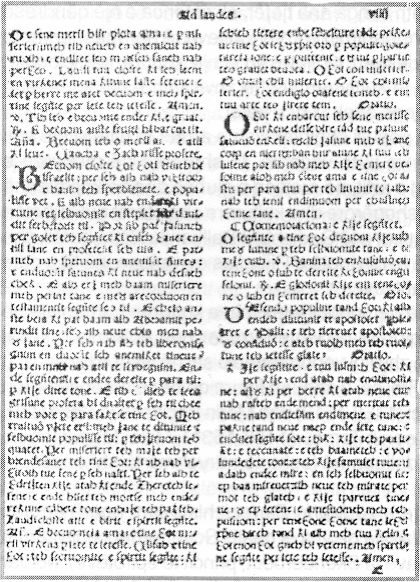
The written record is late and, for that reason, closely studied. The oldest surviving attestation is a baptismal formula of 1462, set down in Latin letters by Pal Engjëlli, archbishop of Durrës, in a pastoral letter written for a synod: eight words giving the words of baptism in Albanian. The oldest published book is the Meshari, a missal printed in 1555 by the Catholic cleric Gjon Buzuku, 188 pages set in two columns, of which a single original copy is known and is held in the Vatican Library. Buzuku wrote in Gheg and used the Latin alphabet with a few letters borrowed from medieval Cyrillic and Greek where Latin ones would not serve — the first of many Albanian compromises between a language and the type available to set it.

Two dialect groups divide the language, and the boundary is a river. Gheg is spoken north of the Shkumbin, in northern Albania, Kosovo, North Macedonia and Montenegro; Tosk is spoken south of it, and is the ancestor of both the Arbëresh of Italy and the Arvanitika of Greece. Their standard varieties are mutually intelligible; the differences are principally phonological, and the bulk of the vocabulary is shared. Which of them the literary standard should rest on was, for most of the twentieth century, a political question as much as a linguistic one, and it is the subject of the next section.
One nation, one language: how the standard was settled
Before 1908 Albanian was written in whichever script the writer's confession and schooling supplied. Catholic writers of the north used Latin letters, Orthodox writers of the south used Greek ones, Muslim writers used the Arabic script of Ottoman Turkish, and between about 1750 and 1850 several inventors produced original alphabets for the language from scratch; the standard survey lists seven of them. A bilingual Greek and Albanian New Testament printed at Corfu in 1827, with the Albanian set in Greek letters, is a fair specimen of the period.
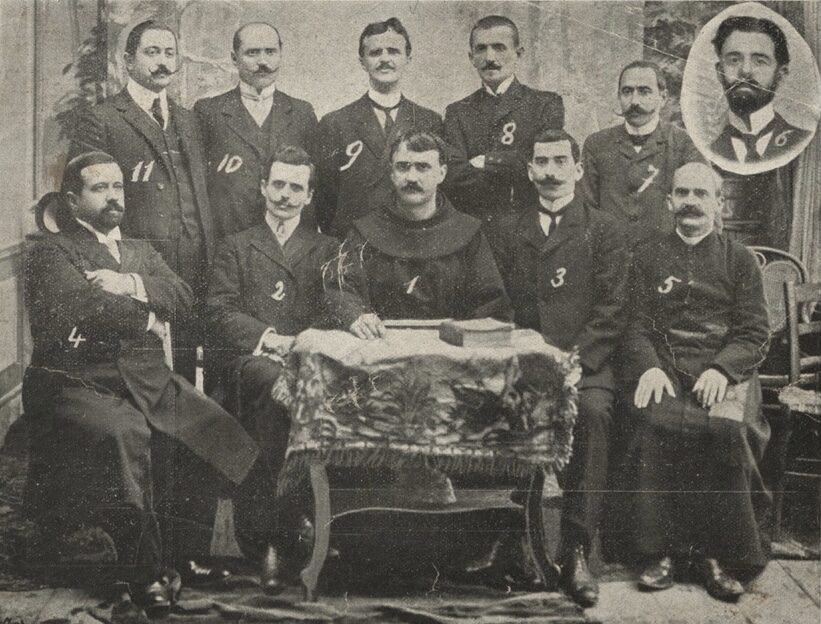
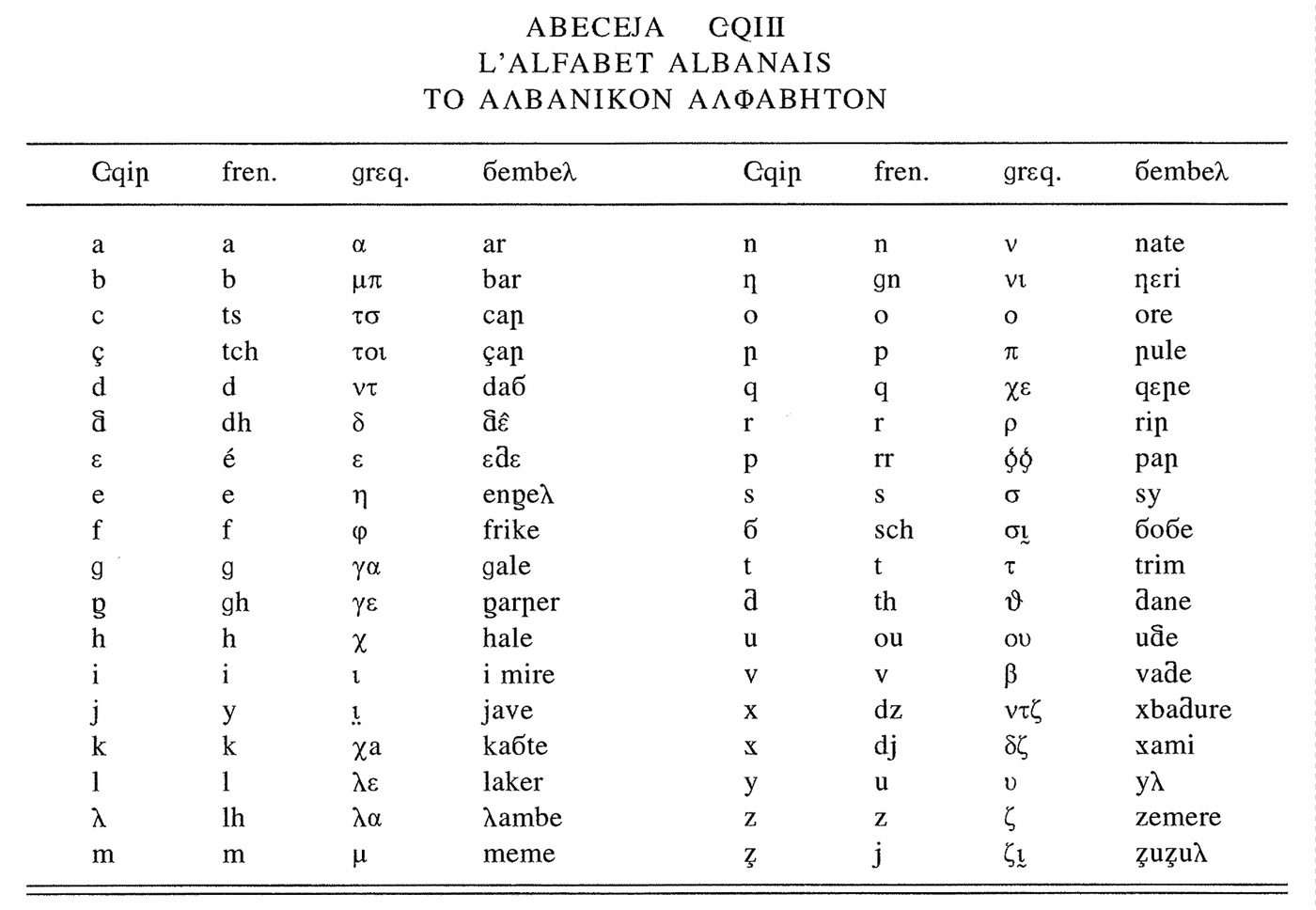
The Congress of Manastir met from 14 to 22 November 1908 in Manastir, now Bitola in North Macedonia, hosted by the Bashkimi club, a literary society, in premises that are today the Museum of the Albanian Alphabet. Fifty delegates attended, of whom thirty-two had the right to vote, and they elected a commission of eleven to choose between three rival alphabets — the Istanbul, the Bashkimi and the Agimi. The congress could not choose one outright and settled on a compromise: it approved two, the widely used Istanbul alphabet with minor changes and a modified version of the Bashkimi alphabet. The Istanbul alphabet then fell out of use, essentially extinct within a few decades, for a reason that will matter later on this page — it required custom-cut glyphs that its rival did not.

One decision of that congress is worth recording for what it shows about how alphabets are really chosen. The letter ç was adopted in preference to a ch digraph on the ground that c-with-cedilla could be found on every typewriter, because French used it; the Bashkimi alphabet had been designed in the first place to be typed on a French machine. Eighty years before Albanian met the seven-bit character set, its orthography was already being designed around the character repertoire of the machines available to type it.
The standard literary language took another six decades to settle, and its history has a clear shape. A Literary Commission meeting at Shkodër between 1916 and 1918 recommended the Elbasan subdialect, a southern Gheg variety close to Tosk, and that recommendation was upheld after the First World War by the Congress of Lushnjë. After the Second World War the new communist state imposed Tosk in administration, education and literature; standardisation was directed by the Institute of Linguistics and Literature of the Academy of Sciences. A linguistic conference held at Pristina in 1968 resolved that the Albanians of Yugoslavia would adopt the Tosk-based standard being prepared in Tirana, at the expense of the Gheg they actually spoke — a decision taken, on the usual account, out of a fear that divergence would be read as separateness.
The Orthography Congress met in Tirana from 20 to 25 November 1972 under the motto One nation, one language. Eighty-seven delegates attended, from Albania, from Yugoslavia and from the Arbëreshë of Italy. It issued a resolution establishing the rules of standard Albanian orthography; a commission then published the volume Drejtshkrimi i gjuhës shqipe in 1973 and the orthographic dictionary Fjalor drejtshkrimor i gjuhës shqipe in 1976. The settlement has been contested in print ever since, chiefly by writers from the Gheg-speaking north and from Kosovo, on the ground that a standard adopted under a one-party state, from a project drafted in its capital, by a congress in which only about one delegate in nine came from Kosovo, was less a linguistic settlement than a political one. Its defenders read the same congress as the moment a scattered language acquired one written form. The literature of that argument is substantial and it did not stay in the journals; it was one of the recurring subjects of the newsgroup.
Writing Albanian on a seven-bit network
Standard Albanian is written in a Latin alphabet of thirty-six letters. Twenty-five of them are unaccented Latin letters, nine are digraphs — dh, gj, ll, nj, rr, sh, th, xh, zh — and exactly two carry a diacritic: ç and ë. Of those two, ë does the heavier work, standing for the unstressed vowel that ends an enormous number of Albanian words and marks a good deal of its grammar. Strip it and a reader can usually still follow the sentence; the sentence is nonetheless no longer correct.
Usenet's transport and much of its software assumed seven-bit US-ASCII, in which neither letter exists. Where the eighth bit survived, a post was legible; where a gateway, an elderly newsreader or a quoted reply stripped it, the accents were the first thing to go. This was the common lot of every accented language on the network, and it is the reason a word can appear in the archives in two forms. Anyone searching that record today should try both.
Where Albanian was luckier than most of its neighbours is in the arithmetic of the code pages. Checked directly against the encodings themselves, all four letters occupy identical byte positions in ISO 8859-1, ISO 8859-2, ISO 8859-16, Windows-1252 and Windows-1250: capital Ç at 0xC7, small ç at 0xE7, capital Ë at 0xCB, small ë at 0xEB. A post composed in a Western European encoding and read in a Central European one therefore arrived intact, where Czech, Polish or Croatian text passed the same way would have come out as gibberish. For a language whose speakers sat on both sides of that particular software frontier, this was a considerable piece of luck, and it was luck rather than design.
The DOS-era code pages were less accommodating. IBM code page 437, the original character set of the PC and still in the path of a great deal of software in the 1990s, encodes capital Ç at 0x80, small ç at 0x87 and small ë at 0x89 — but has no capital Ë at all. A body of text could therefore pass through such a system unharmed while a subject line set in capitals lost a letter. Code pages 850 and 852 restored the missing capital at 0xD3, and Mac OS Roman had all four at positions of its own. The practical effect of that variety was that a post could survive one hop and be mangled at the next.
The problem is not entirely historical, and there is a specimen of it in the current record. The newsgroups file distributed by the Internet Systems Consortium describes one Albanian-language group as Ky forum ashtë vetëm për shqiptarët, with every e-diaeresis in that line stored as the single byte 0xEB, in the manner of ISO 8859-1, while sibling groups four lines below store the same letter as the two bytes 0xC3 0xAB, in the manner of UTF-8. Both conventions sit in one file, a few lines apart, and no reader's software can be right about both at once.
Unicode removed the difficulty rather than solving it in place. Both letters, in both cases, have sat in the Latin-1 Supplement block since version 1.0 of the standard, and that block's repertoire has never changed since. The historic Albanian scripts waited very much longer: the Elbasan script was encoded at U+10500 in Unicode 7.0 of June 2014, and the Vithkuqi script — the 33-letter alphabet printed in an eight-page spelling book in 1844 — at U+10570 in Unicode 14.0 of September 2021, both long after the group had fallen quiet. The Istanbul alphabet, one of the two the Congress of Manastir approved, has no block of its own for a different reason: it was never a separate script, but a mixture of Latin and Greek letters, ten of whose characters were either non-Latin or carried diacritics. What made it expensive to cast in metal in 1908 is exactly what makes it unremarkable to Unicode.

The record in dates
What follows is a chronology and nothing else: dated events and instruments that the group's traffic was reacting to, each stated as the record has it, with no claim here about cause, blame or consequence.
- 28 November 1912 — independence from the Ottoman Empire is proclaimed at Vlorë; a provisional government is formed six days later, on 4 December.
- 30 May 1913 — the Treaty of London settles the territorial questions arising from the First Balkan War; the borders drawn in and after 1913 leave a large Albanian-speaking population outside the new state.
- 11 January 1946 — the People's Republic of Albania is proclaimed; from 28 December 1976 it is styled the People's Socialist Republic. Enver Hoxha led it from 1946 until his death in 1985 and Ramiz Alia from 1985 to 1991. Travel and visa restrictions made it one of the most difficult countries in Europe either to enter or to leave.
- 1961 and 1978 — the ruptures with the Soviet Union and then with China leave the state without a patron; it had ceased to take part in the Warsaw Pact and formally withdrew in 1968, the only member to do so before 1990.
- May 1967 — the anti-religious campaign launched that year is complete: religious institutions have been made to give up all 2,169 churches, mosques, cloisters and shrines in the country, many of them converted into cultural centres. Article 37 of the 1976 constitution provided that the state recognises no religion, and supports atheistic propaganda.
- 1974 — constitutional reform in Yugoslavia gives Kosovo its own administration, assembly and judiciary, and its Albanian-language institutions their fullest standing.
- By 1983 — approximately 173,371 concrete bunkers have been built across Albania against invasion, part of a programme running from 1967 to 1986.
- March 1989 — Kosovo's autonomy within Serbia is substantially reduced.
- 2 July 1990 — locked out of the assembly building, Albanian members of the Kosovo provincial assembly vote in the street to declare Kosovo a republic within the federation; the assembly and provincial government are dissolved in response. On 7 September 1990 the dissolved assembly meets at Kaçanik and adopts a constitution for a Republic of Kosova.
- 11 December 1990 — one-party rule ends in Albania; multi-party elections follow on 31 March 1991 and the communist state is formally abolished on 29 April 1991.
- 8 August 1991 — the cargo ship Vlora reaches Bari carrying tens of thousands of Albanians, the most conspicuous single episode of that year's exodus by sea to Italy.
- 22 September 1991 — the Republic of Kosova declares independence; a referendum held from 26 to 30 September endorses it; a general election follows on 24 May 1992. Through the decade its institutions run in parallel with the official ones, in education, health care and taxation, under the policy of peaceful resistance associated with Ibrahim Rugova (1944–2006); of all states, only Albania recognised the Republic of Kosova.
- 21 April 1992 — the registration date recorded for the
.alcountry-code domain in IANA's root database, nearly three years before the newsgroup existed. - December 1995 — the settlement that ended the war in Bosnia and Herzegovina, whose story belongs to that group's own page, made no provision regarding Kosovo. The omission is a matter of the text and was widely remarked at the time.
- 8 to 16 January 1997 — several of Albania's pyramid investment schemes collapse; their liabilities were later estimated at more than one billion United States dollars, close to half of gross domestic product.
- 16 January to 11 August 1997 — the Albanian civil unrest, in which approximately 2,000 people were killed. A state of emergency is declared on 1 March and the government resigns; a Government of National Reconciliation is formed on 9 March. Estimates cited from the United Nations Development Programme's 1998 report on Albania put the material taken from state depots at hundreds of thousands of weapons together with large quantities of ammunition, grenades and mines.
- 28 March 1997 — the United Nations Security Council adopts Resolution 1101 at its 3,758th meeting, by fourteen votes to none with China abstaining, establishing a multinational protection force.
- 15 April to 8 August 1997 — the Italian-led force deploys as Operation Alba; 7,265 troops from ten countries take part, and the last foreign soldiers leave on 10 August. Early parliamentary elections are held on 29 June, with second-round voting on 6 July, alongside a referendum on restoring the monarchy that is rejected by 66.7 per cent of voters.
- 28 February 1998 to 11 June 1999 — the dates conventionally given for the Kosovo conflict. The NATO air campaign against the Federal Republic of Yugoslavia ran from 24 March to 10 June 1999.
- 9 to 12 June 1999 — the Military Technical Agreement, known as the Kumanovo Agreement, is signed on 9 June between the international security force and the governments of the Federal Republic of Yugoslavia and of Serbia; the Security Council adopts Resolution 1244 on 10 June, authorising an international civil and military presence and establishing the United Nations Interim Administration Mission in Kosovo; the first NATO-led elements enter Kosovo at five in the morning on 12 June.
- 13 August 2001 — the Ohrid Framework Agreement is signed by the government of the Republic of Macedonia and representatives of the Albanian minority, ending that year's armed conflict and setting out constitutional and language commitments.
- 17 February 2008 — a declaration of independence is adopted at a meeting of the Assembly of Kosovo by 109 of its 120 members. It was the second such declaration; the first was made on 7 September 1990.
- 22 July 2010 — the International Court of Justice delivers its advisory opinion in Accordance with international law of the unilateral declaration of independence in respect of Kosovo.
The earliest entries and the last two lie outside the group's own life — the last of them well after its traffic had thinned. They are included because the group's archive is a record of what its posters believed at the time, which is a different thing from a record of what happened, and is most useful when read beside one.
The instruments, and the bodies that made the findings
The register of this page requires that documents be named, that findings be attributed to whoever made them, and that no verdict be reached here. On the events of 1998 and 1999 and their aftermath the documentary record is large, and the following is a summary of what exists rather than an account of what it means.
Security Council Resolution 1244, adopted on 10 June 1999, authorised an international civil and military presence and established the interim administration; among the principles annexed to it are a complete and verifiable phased withdrawal of military, police and paramilitary forces and the return of an agreed number of Yugoslav and Serbian personnel for limited functions, among them a presence at Serbian patrimonial sites and key border crossings. The Kumanovo Agreement of the previous day is the military instrument by which the withdrawal was arranged. Both remain the reference documents to which arguments about the province's status are still, by all sides, referred.
Casualties and disappearances were counted afterwards, name by name, in a joint project of the Humanitarian Law Center, the International Commission on Missing Persons and Serbia's commission on missing persons. The Kosovo Memory Book, in its 2015 revision, records 13,535 people killed or missing between 1 January 1998 and December 2000: 10,812 Albanians, 2,197 Serbs and 526 Roma, Bosniaks, Montenegrins and others. Of these, 10,317 were civilians — 8,676 Albanians, 1,196 Serbs and 445 Roma and others — and 3,218 were combatants. A later revision of the same database gives a total of 13,548. Displacement figures vary more widely with the method used: the standard accounts put the displacement of Kosovo Albanians during the conflict at between 1.2 and 1.45 million, and the number of Serbs, Roma and other non-Albanians displaced during and after it at between about 113,000 and more than 200,000.
Findings of law were made by several bodies and should not be run together. In 2001 a supreme court sitting in Kosovo under United Nations administration found that there had been a systematic campaign of terror against the Albanian population — murders, rapes, arson and severe maltreatment — and that its object had been to force people out rather than to destroy them as such, and therefore that it was not genocide. The International Criminal Tribunal for the former Yugoslavia, which by 2014 had issued its final verdicts in the Kosovo cases, convicted six Yugoslav or Serbian officials and one Albanian commander; the convictions of the officials were for deportation, other inhumane acts by way of forcible transfer, murder and persecution as crimes against humanity, and for murder as a violation of the laws or customs of war. In its 2009 judgement in the case of six of those officials, the same tribunal recorded of the negotiations that preceded the air campaign that the international negotiators did not take an entirely even-handed approach to the respective positions of the parties.
On status, the record is a disagreement rather than a conclusion, and it is best reported as one. The International Court of Justice, asked by the General Assembly whether the declaration of independence of 17 February 2008 accorded with international law, gave its advisory opinion on 22 July 2010. It found unanimously that it had jurisdiction; decided by nine votes to five to comply with the request; and held by ten votes to four that the declaration did not violate international law. The Court stated expressly that it did not consider it necessary to address whether Kosovo had achieved statehood, or whether international law conferred any positive entitlement to declare independence. Recognition is counted differently by different parties: the tally of recognitions by United Nations member states is commonly given as 110, while Kosovo puts the figure at 120 and Serbia at 84, on the ground that some recognitions have since been withdrawn. Serbia does not recognise Kosovo as a sovereign state. The two nonetheless agreed in September 2020 to normalise economic relations, and under the agreement mediated by the European Union and accepted at Ohrid in 2023 each undertook not to block, or encourage others to block, the other's progress towards European Union membership. Those are the facts of the disagreement; the disagreement itself is not this page's to settle.
Where the readership was
The group had no home time zone, and its likely readership was governed less by where Albanians lived than by where Albanians had institutional network access — which in the 1990s meant a university or an employer, not a work permit.
More than 800,000 people left Albania after 1991, most of them for Greece and Italy. The Greek census of 2001 counted 443,550 Albanian immigrants and that of 2011 counted 480,851, and Albanians have remained by a wide margin the largest immigrant community in Greece. Italian statistics recorded 441,027 Albanian citizens resident in 2019, the second largest immigrant group in the country, a figure held down by the more than 250,000 people who acquired Italian citizenship between 2008 and 2020 and are counted as Italians thereafter. For Kosovo the corresponding figure is more than a million people leaving permanently since the late 1980s, not counting those who fled the conflict and afterwards returned.
Further north the counts are less tidy, because the states concerned record nationality rather than ethnicity. The German microcensus of 2020 found about 316,760 Albanians in Germany, made up of 242,855 people holding Kosovan nationality and 73,905 holding Albanian. In Switzerland no statistics are collected on self-identification at all; the 2000 census gave about 170,000 Albanian speakers, and in 2016 some 3.1 per cent of the permanent resident population, 258,415 people, named Albanian as their main language. In the United States the American Community Survey's one-year estimate for 2024 counted about 224,000 people reporting Albanian ancestry, 0.07 per cent of the population, with the largest communities in New York, Michigan and Massachusetts. Turkey is the widest range of all: Albanians are not recognised as a minority there and no count is made, and the number of citizens of full or partial Albanian descent is put at anywhere between 500,000 and six million, a spread that reflects a community largely assimilated over a century and more, of whom only a small proportion now describe themselves as Albanian.
Against those numbers stands the connectivity of Albania itself, which for most of the group's life was among the lowest in Europe. The World Bank's series for individuals using the internet gives 0.01 per cent of the population in 1995, the year of the creation vote; 0.05 per cent in 1997, the year of the collapse; 0.08 per cent in 1999; 0.11 per cent in 2000, the first year of the news2mail gateway; and 2.42 per cent in 2004, its last. The same series for 1999 puts Greece at 6.9 per cent, Italy at 14.4, Germany at 20.8 and Switzerland at 34. Fixed telephone lines tell the same story from further back: 1.37 per 100 inhabitants in 1992, 1.29 in 1995, still under 5 in 2000. Fixed broadband subscriptions do not appear in the World Bank series for Albania until 2005, at 0.009 per 100 people.
A delegated domain is an administrative fact rather than a connection, and the .al record makes the point neatly. IANA's root database gives its registration date as 21 April 1992 and its manager as the Electronic and Postal Communications Authority in Tirana. Three of the zone's name servers today sit in the nic.al domain; the other two are hosts outside the country, one of them in the Australian academic domain. The country had an address on the network for three years before the newsgroup existed, and for most of a decade after that it had rather more address than network.
The practical consequence is the one the vote list already showed. This was a conversation about a country conducted very largely from outside it, by students and professionals on university accounts in North America and western Europe, by the older political emigration, and by the descendants of earlier waves — with voices from inside Albania and Kosovo becoming steadily more common late in the decade as university computing centres came online, and with the labour migration of the 1990s, which was numerically the great majority of the diaspora, barely represented at all. A readership spread from the Pacific coast of North America to the Balkans has no working day; news breaking in Europe in the morning met a North American readership still asleep, and threads took their rhythm from the gap.
The arguments the group inherited
A charter that names four jurisdictions and then adds the rest of the world is a charter that has budgeted for disagreement, and the group's own rationale had already said so in the phrase about the Balkan crisis. Nothing below is an account of particular threads — none is quoted anywhere on this page — but the standing subjects of Albanian public argument in the 1990s are a matter of record, and they can be named without being joined.
History supplied the most durable of them, and in every case the historical claim carried present-day weight, which is why the threads were long. The origin of the Albanians and the ancestry of their language is a real scholarly field, worked over by historians, linguists, archaeologists and more recently geneticists, in which more than one hypothesis has been advanced and none commands universal assent; the popular version of that argument, and the uses to which it is put, is a subject in itself. The fifteenth-century resistance led by Skanderbeg, and what his legacy ought to mean now, is another. So are the reading of the Ottoman centuries, the character of the nineteenth-century national awakening, and above all the borders settled in and after 1913, which left a large Albanian-speaking population outside the state that had just been created — the single fact from which most of the twentieth century in this article follows.
A second set of subjects the group inherited were shared with its neighbours, and are contested between them. The region that Greek usage calls Northern Epirus and Albanian usage calls southern Albania — a term the Kingdom of Greece began to use in 1913, and one since associated with the Greek minority in Albania — is one. The Cham Albanians, a Tosk-speaking community of the Ionian coast displaced from Greek Epirus in the 1940s, are another. The position of Albanians in what was then the Republic of Macedonia was a third, and unlike the other two it was still moving during the gateway years, through the conflict of 2001 and the framework agreement signed at Ohrid on 13 August 2001. This page states that these subjects were argued and that the parties to them disagree; it does not adjudicate any of them.
The third standing argument was the language itself, described above: which Albanian the standard should be, and what the settlement of 1972 was worth. It is the one subject on this list that a newsgroup was unusually well placed to host, because its participants were writing the language every day, in two dialects and on machines that could not always render either correctly.
What a culture group carried
Between the crises the traffic was ordinary, and the ordinary subjects of an Albanian culture group are better documented outside Usenet than the politics are. Four of them can be stated exactly.
Iso-polyphony. The multi-part singing of southern Albania, in which solo lines are carried over a choral drone, is practised across the four regions of the south — Lalëria, Toskëria, Çamëria and Labëria — with related forms around Peshkopi in the north, in Malësia on the Montenegrin border, and in the Polog, Tetovo, Kiçevo and Gostivar areas of North Macedonia. Songs of two parts are sung by women only; those of four parts are a Labërian speciality and are held to be the most complex form. UNESCO added it in 2008, under reference 00155, to the Representative List of the Intangible Cultural Heritage of Humanity.
The festivals. The National Folk Festival was first held at Gjirokastër Castle from 8 to 16 October 1968, timed to the birthday of the head of state, who was a native of the town; it was preceded by festivals held in Tirana in 1949 and 1959. It was staged again at five-year intervals in 1973, 1978, 1983 and 1988, at the citadel of Berat in 1995, and back at Gjirokastër from September 2000. Two dates in the calendar recur wherever Albanian is spoken: Dita e Verës on 14 March, a spring festival of pre-Christian origin, and 22 November, Dita e Alfabetit, the anniversary of the close of the Congress of Manastir, marked in Albania, Kosovo, North Macedonia and the diaspora alike.
The literature. Beyond Buzuku and the sixteenth-century writers, the nineteenth-century national awakening produced a body of poetry still recited from memory, and the twentieth century produced in Ismail Kadare (1936–2024) a novelist whose works have been published in forty-five languages and whose international reputation began with the French translation of The General of the Dead Army, published in Paris in 1970. Argument about how his career under the one-party state should be read is itself a durable subject.
The kanun. The customary law of the northern highlands is a genuinely important historical subject and a frequently sensationalised one, so it is worth stating carefully and in the past tense. Albanian customary law was transmitted orally by tribal elders over at least five centuries; several regional bodies of it were collected and published in the twentieth century, of which the best known, named for the fifteenth-century lord Lekë Dukagjini, was compiled by the priest and folklorist Shtjefën Gjeçovi and published in 1933, four years after his death. Scholars note that the attribution of the text to Dukagjini is conventional rather than documentary, and that the customs it records were not static between the fifteenth century and the twentieth. The communist state suppressed the practice; some of it reappeared after 1990 amid the weakening of state institutions in Albania and in Kosovo. That reappearance is a subject of criminological and legal literature, and belongs there rather than here.
Religion in the group had a distinctive inflection, and the census figures explain why. At Albania's 2023 census 45.86 per cent of the population were recorded as Muslim and a further 4.81 per cent as Bektashi, 8.38 per cent as Catholic and 7.22 per cent as Orthodox, with 13.82 per cent believers of no denomination, 3.55 per cent atheists and 15.76 per cent declining to answer; a 2018 survey by the United Nations Development Programme found 62.7 per cent of respondents saying they did not actively practise. Behind those numbers lies a country in which Sunni Islam, the Bektashi order — whose leadership moved to Albania and established its headquarters in Tirana after Sufi orders were banned in Turkey in 1925 — Orthodoxy and Catholicism have long coexisted, and in which every one of them was suppressed together between 1967 and 1990. Confessional identity was accordingly a subject of discussion in the group more often than it was a line of division, though never for every poster.
The rest was the ordinary freight of a diaspora forum, and needs no documentation because every such group carried it: requests for news of a particular town or family, questions about documents, visas and remittances, music and recipes and football, and the periodic homesick first post answered with more warmth than Usenet's reputation would lead anyone to expect.
The rest of the namespace
One further thing the administrative record shows is what was never created. The Big Eight acquired no group for Kosovo, none for Macedonia and none for Serbia; the archive of news.announce.newgroups holds no proposal for any of them. The current newsgroups file distributed by the Internet Systems Consortium still lists exactly one Big-Eight group for this subject, and it is this one. That is why the first Request for Discussion was crossposted to alt.news.macedonia — described in the same file as News concerning Macedonia in the Balkan Region — rather than to a soc.culture group that did not exist.
The crosspost lists are, in fact, a small map of who the proposers took the neighbours to be. The first Request for Discussion names as its destinations news.groups, news.announce.newgroups, soc.culture.europe, soc.culture.yugoslavia, soc.culture.croatia, soc.culture.bosna-herzgvna, soc.culture.italian, alt.news.macedonia, misc.news.bosnia and the BosNet listserv gateway; the second added the Greek and Turkish groups. Every one of those is a boundary along which the group's subject matter ran, and along which its threads later ran too.
Everything else Albanian on the network lived outside the Big Eight, in the hierarchies where a group could be created by asking. The current newsgroups file lists alt.languages.albanian, alt.fr.lettres.langue.albanaise for the French-speaking world, alt.shqip and alt.sq, and a small Albanian-language family in the free.* hierarchy: free.shqip and beneath it groups for Kosova, Maqedonia, Tirana, culture, politics, music and sport. Their descriptions are written in Albanian, where the Big-Eight group's line is in English — and, as noted above, their diacritics are encoded two different ways in the same file.
The control archive holds one last curiosity. On 4 November 2001 a forged rmgroup control message was issued for soc.culture.albanian, carrying a forged sender address borrowed from a well-known Usenet newsreader project and the terse instruction please remove the bogus newsgroup soc.culture.albanian, above a signature line of machine-generated nonsense. It was one of a run of such forgeries: an identical message, same forged sender and same reference header, was issued against soc.culture.belarus within the same two days, and the archive holds others. No administrator of consequence acted on any of them. The group is still in the newsgroups file; the forgery is still in the archive; and the two sitting side by side are a fair picture of how Usenet's control plane actually worked, which was on the honour system, with the honour supplied after the fact by administrators who declined to be fooled.
What the record does not show
As a community, this group left almost no trace. That is the normal condition of soc.culture.* groups and it is worth stating plainly rather than papering over. There is no readership survey for it, no archived FAQ that this page has been able to locate, no charter revision, no moderation, and no second group into which its traffic was ever split. Nobody kept minutes, because it was a newsgroup.
What can be said with certainty is what the paperwork says: the dates, the two names, the charter, the vote and its distribution by domain, the creation message and the forged removal attempt. Everything beyond that would have to come from the message archive itself, and this page quotes none of it. No thread title, poster name, message count or posting from the group appears anywhere above, for the simple reason that inventing them would be worth less than admitting the gap.
The group's decline is not documented either, but it is not mysterious. By the years of the news2mail gateway, between 2000 and 2004, Usenet's centre of gravity had already shifted towards web forums and portals, and Albanian-language spaces on the web multiplied as home connectivity finally spread from about 2005 onwards — a curve the figures above make plain. Traffic thinned through the 2000s across the whole hierarchy, and there is no reason to think this group was an exception. What survives is the record of a national conversation held across a decade of upheaval, kept by people none of whom imagined they were keeping one.
Two things follow. The first is that the archive is the primary source and this page is not; anyone with a research question about what was actually said in soc.culture.albanian should read the archive, not this. The second is that the archive is a record of belief, not of fact — of what a distributed community believed and argued in a given week of a decade in which its subject was repeatedly remade — and is most useful read against the dated record set out above rather than in place of it.
Scope and limits
This page is about a newsgroup. Where its subject touches the pages of its neighbours in this directory, it states its own facts with attribution and does not retell theirs: the Yugoslav federation and its dissolution belong to soc.culture.yugoslavia, Bosnia to soc.culture.bosna-herzgvna, and the machinery of the hierarchy to the soc.culture.* overview.
On the contested matters the rule followed here has been the narrow one. Instruments are named and dated. Findings are attributed to the body that made them. Figures are attached to the census, survey or database that produced them, and where sources disagree the disagreement is reported rather than resolved. Where a question is unsettled between states it is left unsettled, and no position is taken on it. Nothing above is offered as a verdict on anything, and nothing above is advice.
The group itself has outlasted almost everything it argued about. It was created on 14 February 1995 by a control message that servers were free to ignore, it was never removed except by a forgery that nobody honoured, and it is still in the newsgroups file thirty years later — a room that a few hundred people voted into existence, mostly from university accounts in countries none of them were from, so that a conversation which had been happening on mailing lists and in other people's newsgroups could happen somewhere with its own name on the door.
Reading soc.culture.albanian today
- Historical archive: Google Groups — soc.culture.albanian (coverage varies by group and era).
- Open in a newsreader:
news:soc.culture.albanian— the original site offered exactly this link, and it still works if your system has a newsreader registered for thenews:scheme. - Live access: point an NNTP newsreader at a modern server — see accessing Usenet today.
- The original news2mail e-mail subscription service ended in the mid-2000s and no longer operates.