soc.culture.assyrian
Assyrian culture, history and current events.
A small, dedicated group serving the Assyrian/Chaldean/Syriac communities of Iraq, Iran, Syria, Turkey and the diaspora — one of very few public forums anywhere in the 1990s for a stateless people to discuss language preservation (neo-Aramaic), church history and political recognition.
Genealogy and village-history threads here preserved names and details that exist in few written sources.
On this page
- The group's own paperwork
- The charter, and the claims in the rationale
- A removal that did not take
- The naming question, which governs everything else
- A name a newsgroup could not carry
- Three thousand years of a written language
- The script, and its three hands
- Getting Syriac through a seven-bit network
- Where the readers were, and where they were not
- The diaspora the group was addressed to
- What the charter promised, and what the calendar supplied
- 1915, as the record has it
- 1933, and what it did to the name
- The twentieth century, in instruments and displacements
- 2014, and the Nineveh Plains
- A dated record
- What the record does not show
- Scope and limits
The group's own paperwork
The administrative record for this name is close to complete, which is not the rule in this branch. The Internet Systems Consortium's mirror of news.announce.newgroups holds a file under the group's own name, and it contains three messages: a Request for Discussion posted on 5 April 1995, a first Call for Votes on 8 May, and a last Call for Votes on 16 May. All three carry the Approved: header of the moderator of news.announce.newgroups, and all three were injected through UUNET. The proponent posted from a Chicago internet provider; the two Calls for Votes were issued by a neutral third party writing under the Organization line Usenet Volunteer Votetakers. Ballots were to be mailed, one per person and no more than one per account, and the votetaker warned that addresses and votes of all voters would be published in the final results list. Voting closed at 23:59:59 UTC on 29 May 1995.
What the file does not contain is the RESULT. It simply stops. After the second Call for Votes come four lines — a heading reading soc.culture.assyrian Bounce List - These votes HAVE been counted, a rule of hyphens, and two e-mail addresses at a Chicago provider — and then the file ends. Anyone reconstructing this group's creation from the news.announce.newgroups archive alone would have to record the vote as unresolved.
It is not unresolved. The tally survives in a different place: the control archive, which holds the messages that actually created and would later have destroyed the group. ISC's control file for the name contains five messages. The first is dated Tuesday, 6 June 1995 at 14:30:15 GMT, carries Control: newgroup soc.culture.assyrian, and opens with a single sentence of record:
soc.culture.assyrian is an unmoderated newsgroup which passed its vote for creation by 406:27 as reported in news.announce.newgroups on 29 May 1995.
That is 433 valid votes cast, a margin of 379 in favour and 93.8 per cent of the ballot for creation. The Big-Eight rules of the period required a hundred more yes votes than no votes and at least two-thirds of the valid total; this vote cleared the first by a factor of nearly four and the second by some twenty-seven points. One small oddity is on the face of the record and is left as it stands: the control message says the result was reported on 29 May, the same day the ballot was due to close.
The same newgroup message was re-issued twice, on 13 June and on 6 July 1995, with bodies identical to the first: only the dates and message identifiers differ. That was routine housekeeping — a periodic re-send so that sites which had missed the first message, or had joined the network since, would create the group. Then, on 1 August 1995, a fourth newgroup control message appears, sent not from the hierarchy's moderator but from a news account at a university in Texas, posted to the pseudo-group soc.culture.assyrian.ctl with a body of zero lines. It is an administrative artefact of one site's configuration rather than an event in the group's life, and it is recorded here only because it is there.
The line the creating message asked administrators to add to their newsgroups file reads, in full and with a tab between the name and the description:
soc.culture.assyrian Assyrian culture, history, language, current diaspora.
Thirty years later it is still there. The newsgroups file that ISC distributes today runs to 45,003 lines and describes 139 groups under soc.culture.*; line 41,676 is the sentence above, unaltered. The companion active file carries the group with a status flag of y — unmoderated, posting permitted — and its article counters recording no articles held. Not every name in this family fared as well: soc.culture.armenian, whose story is told on its own page, appears in neither file.
The charter, and the claims in the rationale
The charter was quoted four times — in the RFD, in both Calls for Votes, and again in the creating control message, where it is introduced as the charter, culled from the call for votes. Its opening paragraph reads:
The soc.culture.assyrian newsgroup will serve the Assyrian community worldwide, and will be open for discussion to all Assyrians and interested parties. Discussions will include topics on Assyrian history, culture, politics, religion, education and social activities. Because Assyrians are scattered all over the world, special emphasis will be placed on the Assyrian diaspora.
It then set out the subjects by name, and the list is worth reproducing as the proposal wrote it, because it is the only description of the group's intended contents that anyone signed:
- Assyrian history, from the empire to modern times
- Assyrian archaeology (topics related to Assyriology)
- The Assyrian language (ancient, classical, and modern)
- Assyrian Christianity (current issues and history)
- Assyrian music and art
- Assyrian folk dance and cuisine
- Assyrian human and civil rights in Middle East countries
- The latest news from Assyrians around the world
- Assyrian politics in Iraq
- and other topics
A single sentence closed the charter and settled the group's working language: The discussions will be held mostly in English, and some transliterated Assyrian. That clause is doing more work than it looks. It is a technical concession, and the section on encoding below explains what the alternative would have required.
The RFD also made an undertaking that the surviving record cannot show was kept. Under a heading of its own, marked Archive, it promised: The content of the postings shall be archived and made researchable via FTP-mail or other such means. No such archive is preserved here, and none is known to this directory.
The rationale is a document of 1995 and should be read as one. It argued that no newsgroup then dealt with Assyrian affairs, and continued: Since Assyrians are a separate national minority within several Middle Eastern (and Western) countries, and are not Arabs, and whose first language is Assyrian, a separate newsgroup is deemed necessary. There are 3.4 million Assyrians in the world, with the largest population (2 million) in Iraq. Both halves of that require comment. The claim of two million in Iraq is far above the figures later current: reference summaries put the Assyrian population of Iraq at around 1,100,000 in the 1980s, and an estimate attributed to an Iraqi Christian official and widely repeated since puts about 300,000 remaining. And the assertion that the community is not Arab was, in this namespace, a claim about where a group belonged: the Arab-world umbrella group has its own page at soc.culture.arabic, and this proposal was explicitly a request not to be filed under it.
Where the proposal was posted is as informative as what it said. The RFD went to news.announce.newgroups and news.groups and was cross-posted into five culture groups: Lebanon, Israel, Palestine, Arabic and Jordan. A month later the Call for Votes went to those five and to six more — Iranian, Greek, Kuwaiti, Turkish, Egyptian and Kurdish. Between April and May the proposal had stopped addressing the Arab world and started addressing the whole neighbourhood, which is a fair description of where the community actually lives.
One incidental artefact of those postings can be read as a rough gauge of relative traffic. Each message carries an Xref: header listing the article number the injecting server had assigned in every group. These are one machine's counters, not network totals, and they measure the whole life of a group at that site rather than current volume; but on 8 May 1995 the same server's counters stood at 115,556 for soc.culture.turkish, 41,072 for soc.culture.arabic, 2,195 for soc.culture.kuwait, 2,049 for soc.culture.kurdish and 1,103 for soc.culture.jordan. Eight days later, when the second Call for Votes went out, the Turkish counter had reached 116,948 — some 1,400 further articles at that one site inside a week. The proposal was being read into rooms of very different sizes.
A removal that did not take
The fifth and last message in the control file is a request to delete the group. It is dated 4 November 2001 at 00:28:04 GMT, carries Control: rmgroup soc.culture.assyrian, and its body is one line: please remove the bogus newsgroup soc.culture.assyrian. Beneath it sits a signature of randomly assembled nonsense, the tell of a generated message. The From, Sender and Approved headers all give the name and address of the maintainer of a well-known Unix newsreader, who did not send it; the message identifier quotes a university machine in Karlsruhe while the injection path runs through a consumer host in Quebec.
The important finding is what stands beside it. The same sender, from the same address, worked alphabetically through soc.culture.* that evening, and the timestamps in the surviving control files line up in alphabetical order: soc.culture.assyrian at 00:28:04, Greek at 00:33:09, Iraq at 00:35:30, Jewish at 00:36:08, Kuwait at 00:36:58, Palestine at 00:40:12, rep-of-georgia at 00:41:02 — a quarter of an hour of indiscriminate sweeping, each message identical but for the group name and the nonsense signature. There is no evidence in the control archive of any campaign directed at this name, this community or its subject. That matters on a page like this one, because such campaigns did happen in this branch: the sustained forgery against soc.culture.armenian, and the periodic Bogus Usenet Groups list that recorded which names administrators considered invalid, are set out on that group's page, and the mechanics by which an unsigned rmgroup fails are worked through on soc.culture.arabic. Neither is retold here.
The removal failed. The group is in the current newsgroups and active files, described in the words its creating message supplied in 1995.
The naming question, which governs everything else
The community this group was created for is called, in English, by four principal names: Assyrian, Chaldean, Syriac and Aramean. There is no universally accepted English rendering of the endonym Suryoyo or Suryoye, and specialist scholarship states plainly that the choice among these terms is often determined by political alignment and tracks denominational and regional lines. This page reports the documented positions and adopts none of them. Where a source uses a particular term, the term is that source's.
The positions, as recorded:
- Assyrian, taken from descent from the ancient Assyrians, is advocated by adherents within all the Middle Eastern churches of both the East and West Syriac rites. The Church of the East was the first of the churches to adopt an identity derived from ancient Assyria; it was known officially as the Church of the East until 1976, when it was renamed the Assyrian Church of the East.
- Chaldean was for centuries a western scholarly label for the Aramaic language, still normal usage in the nineteenth century. It began to designate a body of people in 1445, when the Council of Florence accepted a profession of faith made in Aramaic by the metropolitan of the Aramaic speakers in Cyprus and decreed that nobody should thereafter dare to call them Nestorians. It is now most often equated with adherence to the Chaldean Catholic Church, although not all Chaldean Catholics identify as Chaldean.
- Syriac is the ecclesiastical and linguistic term carried by the West Syriac churches and by the classical language. The Syriac Orthodox Church has officially rejected the use of Assyrian in favour of Syrian since 1952, though not all of its adherents reject Assyrian identity.
- Aramean, taken from the ancient Arameans, is advocated by some adherents of the West Syriac churches. Assyrians identifying as Aramean have obtained recognition on that basis from the Israeli government.
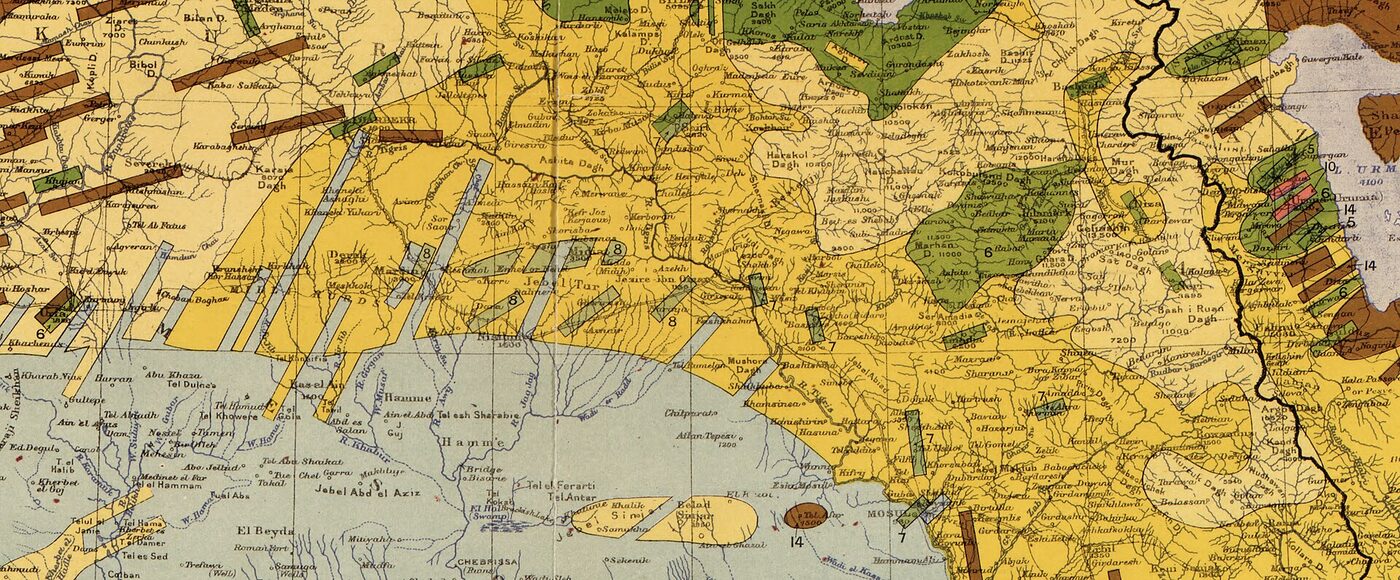
%2C_%22Chaldeans%22_(7)_and_%22Jacobites%22_(8)%2C_in_Maunsell's_map%2C_Pre-World_War_I_British_Ethnographical_Map_of_eastern_Turkey_in_Asia%2C_Syria_and_western_Persia_01_(cropped).jpg)
The institutional history behind those labels is datable, and it contains an inversion that is easy to state and easy to get backwards. In 1552 a group of bishops of the Church of the East, objecting to hereditary succession to the patriarchate, elected a rival patriarch and sent him to Rome; he made his profession of faith before Pope Julius III on 20 February 1553, was consecrated bishop in St Peter’s Basilica on 9 April — by a cardinal, or by the pope himself according to other accounts — and received the pallium, the sign of patriarchal authority, at a papal consistory on 28 April. His line, the Shimun line, drifted from Rome over the following century and formally broke communion in 1672 — and it is that line which is today the Assyrian Church of the East. The traditional Alqosh-based line, meanwhile, moved the other way: in 1830 Pope Pius VIII recognised its head as patriarch, and its non-hereditary succession has led the Chaldean Catholic Church ever since. The church now called Assyrian is the one that went to Rome first; the church now called Chaldean is the one that stayed.
Two further separations belong to the twentieth century and were live memory when the newsgroup was created. In 1964 the patriarch of the Church of the East decreed a set of changes including the adoption of the Gregorian calendar and a shortening of Lent; traditionalists dissented, and in 1968 elected a rival patriarch, forming the Ancient Church of the East, based in Baghdad. And on 11 November 1994, in St Peter's Basilica, the Pope and the Catholicos-Patriarch of the Assyrian Church of the East signed a Common Christological Declaration in which the two churches professed the same doctrine concerning Christology — less than five months before the RFD was posted, and precisely the kind of item the charter's clause on Assyrian Christianity (current issues and history) was written to cover.
One further caution is on the scholarly record and applies to everything below. Because the Ottoman state classified its populations by religion rather than ethnicity, at least one historian of the period has argued that speaking of an Assyrian genocide for the events of 1915 is anachronistic. The argument is about the categories available in the sources, not about whether people were killed. It is recorded here because the naming question and the historical question are entangled at their roots, and no honest account can separate them.
A name a newsgroup could not carry
One consequence of the naming dispute belongs to this directory rather than to any encyclopaedia. The official bodies that have had to count or address this community have generally solved the naming problem by refusing to choose — either by binding the names together in one label, or by counting more than one of them side by side.
- The United States Census Bureau lists Assyrian/Chaldean/Syriac as a single option on its forms, separately from Syrian, which it files under Arab. The 2020 census recorded 119,402 people declaring that ancestry in whole or part.
- The Australian census counts the names apart rather than together: at the most recent census 40,218 people reported Assyrian ancestry and 21,166 reported Chaldean, tabulated as two separate categories that reference summaries then add together.
- Sweden's Riksdag, on 11 March 2010, passed a motion recognising as an act of genocide the killing of Armenians, Assyrians/Syriacs/Chaldeans and Pontic Greeks in 1915. Three names joined by slashes, in the text of a parliamentary resolution.
A Usenet newsgroup cannot do that. The syntax of Netnews articles restricts each component of a group name to a very short list of characters: an ASCII letter, a digit, a plus sign, a hyphen or an underscore. That rule is stated formally in RFC 5536 of November 2009 and was the settled practice for two decades before it was written down. There is no slash. There is no way to spell Assyrian/Chaldean/Syriac in a newsgroup name, and no way to give one people three names in one address.
So the proposal had to pick a word, and the record shows it picking one deliberately and defending the choice: the charter uses Assyrian throughout, the rationale asserts a distinct national minority, and the group's whole existence is a bet that one of the four names could stand for all of the community. Whether that bet was accepted is not something this page can determine, because no message archive survives. What can be said is that the same divisions the name encodes were reproducing themselves in the physical institutions of the diaspora at exactly the same moment: in 1996, the year after the group was created, the Syriac Orthodox Church in Sweden divided into two dioceses, both seated in the same town of Södertälje, one of which does not reject the Assyrian name and one of which does. A decade later two satellite channels were operating from that town, one associated with a modernising political movement and one founded by Syriacs identifying as Aramean.
Scholarship on the community makes the connection to media of exactly this kind explicit, noting that disputes among the subgroups have increasingly taken on a global dimension through the growth of diaspora communities and the spread of online forums and advocacy platforms. soc.culture.assyrian, created in 1995, sits at the front of that sequence. It was among the first public, worldwide, permanently addressable places where a dispersed community could conduct such an argument in one room. That the room had to have a single name is a fact about Netnews, not about the argument.
Three thousand years of a written language
Aramaic is a Northwest Semitic language which originated in the region of Syria and spread to Mesopotamia, the southern Levant, Sinai, south-eastern Anatolia, the Caucasus and eastern Arabia, and it has been continuously written and spoken in different varieties for over three thousand years. It was made the second official language of the Assyrian empire under Tiglath-Pileser III, who reigned from 745 to 727 BC, and it served in turn as a language of public life and administration in the Neo-Assyrian, Neo-Babylonian and Achaemenid empires. Few languages now spoken have a written record of that depth.
The modern situation has three layers, and the newsgroup's charter named all three when it promised discussion of the Assyrian language (ancient, classical, and modern).
Classical Syriac is the Middle Aramaic dialect of Edessa, adopted as the liturgical language of the Syriac churches and still their main liturgical language. It is the language of the manuscript tradition, of the Peshitta, and of the grammatical and lexical scholarship that carried Aramaic study into European universities.
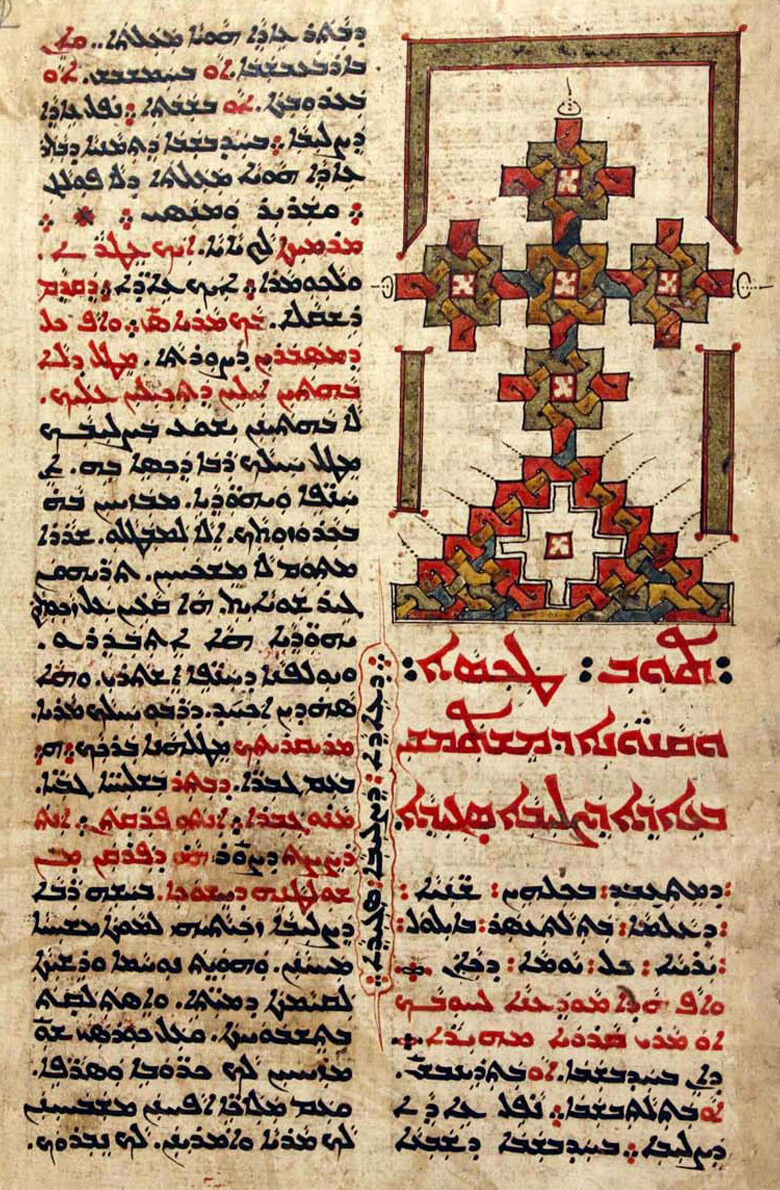

The modern vernaculars are several, and they are not descendants of Classical Syriac. Suret, also called Assyrian, covers several varieties of Northeastern Neo-Aramaic; Chaldean Neo-Aramaic belongs to the same group. Turoyo, also called Surayt or Suryoyo, is a Central Neo-Aramaic language traditionally spoken in Tur Abdin in south-eastern Turkey and in north-eastern Syria; an estimate for 1970 put 20,000 speakers still living in that region, and the language is now spoken mostly in the diaspora and is listed among the endangered languages of the area. These vernaculars descend from Old Aramaic and were heavily influenced by Classical Syriac after its adoption as a liturgical language, but the line of descent is not direct. Most of them began to be written only in the nineteenth century.
The written vernacular is therefore young, which is the fact that matters for a text-based medium. A community writing Suret or Turoyo in 1995 was working in a literary tradition roughly a century and a half old, with no single agreed orthography for the spoken forms, on top of a classical written tradition of nearly two millennia. That is a hard combination to standardise even on paper.
The script, and its three hands
The Syriac alphabet has been used to write the Syriac language since the first century. It is a Semitic abjad descending from the Aramaic alphabet by way of Palmyrene, and it is the ancestor of the Sogdian, Old Uyghur and Mongolian scripts. It runs right to left in horizontal lines, has no distinction of letter case, and is cursive: most but not all letters join within a word, and several change shape according to their position. All twenty-two letters are consonants; vowels are optional and are written with diacritic marks.
Three hands remain in use, and they carry the community's divisions in their names.
- Estrangela is the oldest and classical form. The name is generally derived from the Greek strongyle, rounded, though a derivation from a phrase meaning gospel character has also been proposed. It is no longer the main hand for writing Syriac but has been in partial revival since the tenth century and is standard in scholarly editions, titles and inscriptions. Vowel marks are usually absent from it, because the script predates the specialised diacritics.
- Madnhaya, the eastern hand, is the one used for the East Syriac dialect — and it is known by at least four other names: Swadaya, vernacular or contemporary; Athoraya, Assyrian; Kaldaya, Chaldean; and, inaccurately, Nestorian. The naming dispute described above reaches all the way down into the name of the letterform.
- Serto, the western hand, whose name means line, came into fashion from the eighth century, possibly because it made more economical use of parchment. Its letters are simplified, flowing derivations of Estrangela.


The two vowel systems are entirely different in kind, which is why a font that renders one badly can render the other unreadably. The eastern tradition marks vowels with configurations of dots above and below the letter: a dot above and a dot below for one vowel, two diagonal dots above for another, two horizontal dots below for a third. The western tradition marks them with miniature Greek letters written above or below — capital alpha, lower-case alpha, lower-case epsilon, capital eta, a combined upsilon-and-omicron, and a lower-case omega used only in a vocative interjection.
The script has also carried languages other than Aramaic. Arabic written in Syriac letters is called Garshuni, and was common where knowledge of the Arabic alphabet was not yet widespread; Sogdian was written in it; and Malayalam written in Syriac letters is called Suriyani Malayalam, a fact with consequences for Unicode discussed below. In the late 1920s and 1930s both Cyrillic and Latin alphabets for the Urmi dialect were developed in the Soviet Union and some material was published in them. They did not supplant the Syriac script, but the use of Latin letters in this community became widespread anyway, for the plainest of reasons: most of the diaspora settled in Europe and the English-speaking world.
Getting Syriac through a seven-bit network
Usenet assumed Latin text. RFC 1036 of December 1987, the standard for the interchange of Usenet messages, adopted the rule that news articles must be valid Internet mail messages under RFC 822, whose message body is defined as a sequence of lines of ASCII characters, and was in several respects more restrictive still. The general problem this created for non-Latin scripts is treated on soc.culture.armenian and is not repeated here. What follows is specific to this script, and it is a harder case than most.
There was never an eight-bit escape. ISO/IEC 8859, the family of single-byte encodings that carried European and Middle Eastern scripts through the 1990s, has fifteen published parts, excluding the abandoned part 12. Part 6 encodes Arabic; part 8 encodes Hebrew. No part of ISO/IEC 8859 encodes Syriac. Nor is there a national standard filling the gap: the IANA character-set registry, from which the charset= label on a MIME body is drawn, holds 258 registered character sets as of its last update on 6 June 2024, and not one of them is Syriac. There has never been a legacy encoding for this script to fall back on, and therefore never a way to label Syriac text in a message that predates Unicode support.
Unicode was consequently the first and only route, and it arrived late. The documentary trail is precisely dated, and it runs straight through the years in which such groups were busiest. A draft proposal for Syriac character encoding was submitted to the Unicode technical committee as document L2/97-130 on 24 February 1997. Supporting letters, examples and character-property tables followed through February and March 1998; a formal proposal to encode Syriac in ISO/IEC 10646 was circulated as L2/98-050 on 6 March 1998; and the final proposed draft of ISO/IEC 10646-1 Amendment 27, Syriac, is dated 22 October 1998, with the table of replies to its ballot dated 27 August that year.
The result can be checked to the code point against the Unicode Character Database's own age file. The Syriac block occupies U+0700 to U+074F. Version 3.0, released in 1999, assigned 71 characters in four runs: fourteen punctuation and text-critical marks at U+0700 to U+070D, including the Harklean obelus, metobelus and asteriscus inherited from the seventh-century Harklean revision of the New Testament; the abbreviation mark at U+070F; twenty-nine letter code points from U+0710 SYRIAC LETTER ALAPH to U+072C SYRIAC LETTER TAW, comprising the twenty-two letters of the alphabet together with seven variant forms; and twenty-seven vowel points and diacritics at U+0730 to U+074A, a run that ends with SYRIAC MUSIC and SYRIAC BARREKH. Version 4.0, in 2003, added six more letters, at U+072D to U+072F and U+074D to U+074F, proposed for writing Sogdian and Persian in the Syriac script. The Syriac Supplement block at U+0860 to U+086F followed only in version 10.0, in 2017, and holds eleven letters at U+0860 to U+086A for writing Suriyani Malayalam.
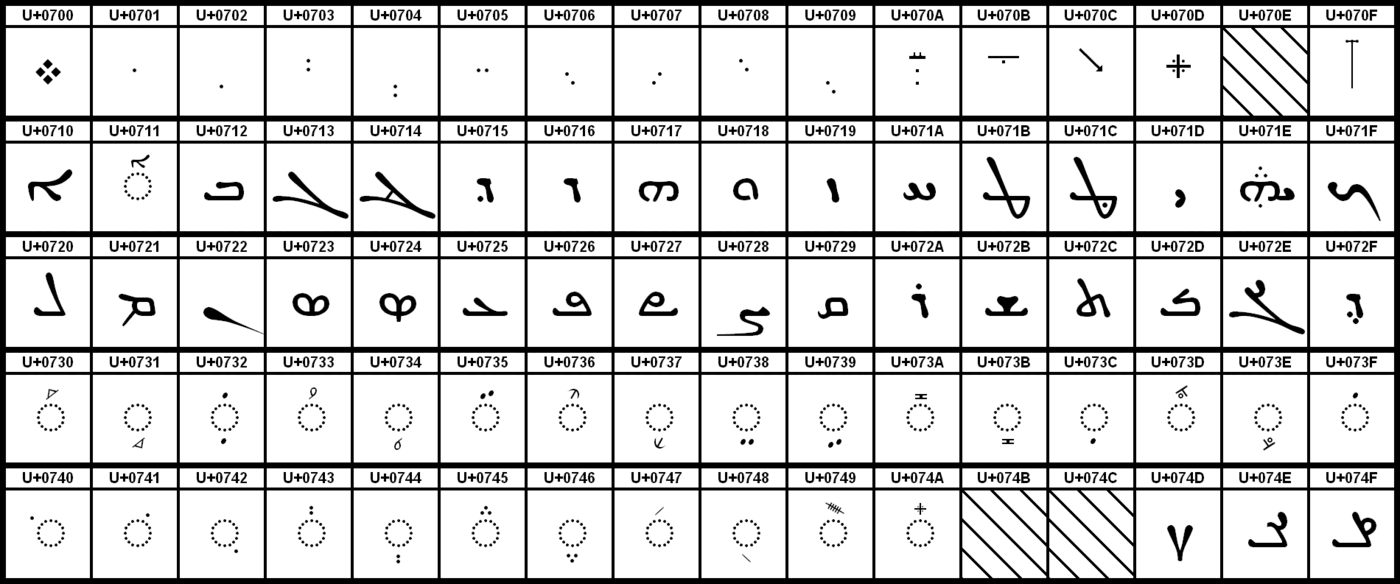

Assigning the characters did not finish the job. Right-to-left text needs a correct bidirectional class for every character, and cursive text needs contextual shaping: a letter must know what its neighbours are before it can be drawn. Both were still being corrected long after the block shipped. A committee document of 13 March 2001 addressed the joining group of one letter; another of 27 October 2010 refixed the bidirectional class of U+070F, the Syriac abbreviation mark; a further paper of 21 July 2011 collected Syriac shaping fixes and clarifications. Rendering this script is not a matter of having the code points.
Much of the encoding work was itself a diaspora undertaking. The Syriac Computing Institute was founded informally in 1992 and registered in 1996, working from Piscataway, New Jersey; it was renamed Beth Mardutho in 2009 when its activities widened beyond computational linguistics, and it went on to build a Syriac digital library hosted at Rutgers University from 2000. The people who got the script into the standard were, in the main, people living where the readers of this newsgroup lived.
None of which helped the group. Unicode 3.0 shipped four years after the vote; usable fonts, input methods and newsreader support came later still. So the group did what its charter said it would do: English, with Neo-Aramaic in Latin transliteration, in a community that had no single transliteration standard and several vernaculars to transliterate. The consequence for anyone who finds surviving traffic is permanent. Searching for it in Syriac script will retrieve nothing, because the traffic was not written in Syriac script; a researcher must guess at the Latin spellings the posters happened to choose.
Where the readers were, and where they were not
A culture group's demography is set by where the network is, and in this case the network and the community were almost exactly out of alignment. The World Bank's series for individuals using the internet as a percentage of population, compiled from International Telecommunication Union returns, can be read directly against the group's life.
In 1995, the year the group was voted into existence, the figures for the diaspora countries were: Sweden 5.1 per cent, the United States 9.2, Australia 2.8, Germany 1.8. By 1997 they were 23.7, 21.6, 16.4 and 6.7; by 2000, Sweden stood at 45.7 per cent and the United States at 43.1. In the same years the homeland states stood at: Turkey 0.08 per cent in 1995 and 0.47 in 1997; Iran 0.004 and 0.05; Syria 0.0 and 0.03. For Iraq the series records no value at all before 2001, when it stands at 0.1 per cent; it reaches 0.5 in 2002 and 0.9 in 2004.
Behind Iraq's blank rows is a policy. Internet access in Iraq was banned in 1997 and 1998 and permitted from 1999, with limited availability; the state's own provider, Uruklink, also known as the State Company for Internet Services, was initially the sole provider in the country. Home access and internet cafes in Baghdad came only in 2002, with many sites blocked, and one contemporary reference work estimated that just 25,000 Iraqis used the internet in that year. Iraq's country-code domain, .iq, was entered in the root zone on 9 May 1997, but its delegated manager was imprisoned in Texas, the domain lay unused, and ICANN approved redelegation to Iraq's communications regulator only in 2005 — a decade after the group was created.
The effect is plain in the figures. For the whole of the group's first four years there was effectively no public internet in the country that the charter's own rationale said held the largest Assyrian population. The group was a diaspora talking largely to itself about a homeland that could not answer. What it carried from the region came through people who had left, through relatives on telephone lines, through bulletins and press items relayed by hand. For the national frame this directory has pages at soc.culture.iraq, soc.culture.syria and soc.culture.lebanon.
The diaspora the group was addressed to
The charter said that special emphasis would be placed on the diaspora, and the demographic record explains why that was not a courtesy. More Assyrians now live outside the homeland than within it. The largest communities recorded in reference summaries are in the United States, Germany, Sweden, Australia, Canada and the Netherlands, and the geography of settlement maps closely onto the divisions of language and church described above.
- The United States. The 2000 census recorded 34,484 people of Assyrian ancestry in Michigan, 22,671 in California and 15,685 in Illinois — the three states that between them account for the great majority of the American total. The Detroit-area community is primarily Chaldean-speaking and from Iraq; the Chicago-area community is predominantly Iraqi; those in California, concentrated in the Central Valley around Turlock and Modesto and in the southern counties, tend to be from Iran. A farming settlement was established around Turlock from about 1905 by immigrants from Urmia, and by 1930 Assyrians were twenty per cent of the town's population, with the southern part of it known as Little Urmia.
- Australia. In the 1996 census 9,571 people in New South Wales and 2,191 in Victoria spoke Assyrian; sixty per cent of them had been born in Iraq, twenty-one per cent in Australia and thirteen per cent in Iran, and by church affiliation fifty-four per cent belonged to the Assyrian Church of the East, twenty-seven to the Chaldean Catholic Church and seven to the Syriac Orthodox Church. In the 2001 census 9,520 residents of the Fairfield local government area in western Sydney gave Assyrian ancestry and 8,879 spoke Assyrian at home. At the most recent census 40,218 Australians reported Assyrian ancestry and 21,166 Chaldean, counted separately.
- Sweden. The community dates precisely. On Thursday 9 March 1967, 108 stateless Assyrians flew from Beirut and landed at Bulltofta airport outside Malmö, under a Swedish quota of 200 Christians from Lebanon administered by the national employment service in coordination with the World Council of Churches and the UN High Commissioner for Refugees; they were taken by bus to a refugee housing complex at Alvesta in Småland. A second group of 98 arrived on Thursday 13 April. The families selected in Beirut were mostly young and mostly from Turkey. The Assyrian Federation of Sweden was founded over 15 to 17 April 1977 by twenty-one representatives of eleven local associations. Estimates of the size of the Swedish community differ by source and are not reconcilable here: reference summaries give figures ranging from about 100,000 to 200,000.
- Germany. The first large wave arrived in the 1960s and 1970s through the Gastarbeiter programme, largely from Turkey; a second came in the 1980s and 1990s as refugees from the Kurdish–Turkish conflict. The community is scattered across Munich, Wiesbaden, Paderborn, Essen, Göppingen, Cologne, Hamburg, Berlin, Augsburg and Gütersloh rather than concentrated in one place.
Two structural consequences follow, and both are unusual for a soc.culture.* group. The first is that the readership had no shared working day. Settled communities lay across roughly eighteen hours of clock time, from the Pacific coast of North America through the American Midwest, Sweden and Germany to the homeland regions and eastern Australia. A country group's traffic follows one nation's evening; this one had no hour at which the whole readership was asleep and no single national news cycle to set its rhythm. The general shape of soc.culture.* as a family of such rooms is described on the branch's hub page.
The second is that the readership's internal divisions were geographical as well as ecclesiastical. Sweden and Germany drew Turoyo speakers from Turkey, of West Syriac tradition; Chicago and Sydney drew Iraqis; Detroit drew Chaldean speakers; California and Russia drew Iranians. A single English-language newsgroup put all of those in one room for the first time. Whatever else that produced, it is the condition under which the naming argument could be had at all.
What the charter promised, and what the calendar supplied
No archive of this group’s messages was available for this page, so nothing is said below about particular threads, posters or volumes. What can be described honestly is the material the charter committed the group to, and the annual calendar that any group serving this community would necessarily have followed.
The commemorative year has fixed points. Kha b-Nisan, also called Resha d-Sheta or Akitu, is the Assyrian New Year, celebrated on 1 April with traditional dress, parades and the recitation of the creation story. Sauma d-Ba'utha, the Nineveh fast, is a three-day period of fasting and prayer commemorating the repentance of the Ninevites. Assyrian Martyrs Day falls on 7 August; it was declared by the Assyrian Universal Alliance in 1970 in memory of the 1933 killings at Simele and is also known as the National Day of Mourning. The churches do not share one calendar. The Assyrian Church of the East adopted the Gregorian calendar in 1964; the Ancient Church of the East, formed by those who dissented from that decision, kept the older reckoning, and celebrated Christmas on the Julian date until a decision announced in June 2010. A single newsgroup serving all of these churches carried more than one liturgical year at once.
The charter also promised music, art, folk dance and cuisine, and those are better documented than the politics. The cuisine is Mesopotamian, sharing most of its dishes with the surrounding region while keeping its own names for them: dolma, rice and tomato stuffed in vine leaves, cabbage, peppers, courgette and aubergine; pacha, a heavy stew of stuffed lamb stomach with offal; harissa, a porridge of hulled wheat with chicken or beef and broth, eaten with butter or cinnamon; tepsi, a baked casserole of layered fried vegetables and meat; and among the sweets kadeh, a thick sweet buttery pastry prepared for Christmas. The music combines folk material with western pop and soft rock; the traditional instruments are the zurna and the davul, and the characteristic dance is the khigga, a circle dance in a line performed as bride and groom enter a wedding reception. Of the singers of that generation, Evin Agassi (1945–2024), an Iranian-American whose career ran more than fifty years and produced over forty albums, most of them in the 1980s and 1990s, was among the best known; Sargon Gabriel, born in Habbaniyah in Iraq and recording in the same folk-pop idiom since the 1960s from a base in Chicago, was another.
Sport supplied material of another kind. Assyriska Fotbollsföreningen grew out of an association founded in Södertälje in 1971 by Assyrian refugees from Turkey; the football team was started three years later, in 1974, and played its first season in the lowest Swedish division in 1975. It reached the second tier in 1992, the first immigrant club to do so, lost the Svenska Cupen final of 2003 to IF Elfsborg, and in 2005 played in Allsvenskan, the top division of Swedish football, with its matches broadcast in more than eighty countries. Reference accounts of the club describe it as acting as a national team for a people that has no state.
1915, as the record has it
The events of 1915 are the largest single fact in this community's modern history and the most contested in their characterisation. What follows reports the documented record and the positions of the bodies that hold them. It adjudicates nothing.
In Neo-Aramaic the events have been known since 1915 as the Sayfo or Seyfo, from the word for sword, which since the tenth century has also carried the sense of extermination. Other terms used within the community include the Arabic nakba and the Turkish firman, the latter reflecting a belief that the killings followed an official decree.
The documented sequence, as set out in specialist scholarship: mass killing of Assyrian civilians began during the Ottoman occupation of Persian Azerbaijan between January and May 1915, committed by Ottoman forces and pro-Ottoman Kurds; in Bitlis province Ottoman troops returning from Persia joined local Kurdish tribes in massacring the Christian population, Armenian and Assyrian alike; Ottoman forces and Kurds attacked the Assyrian tribes of Hakkari in mid-1915 and had driven them out by September, despite a coordinated armed defence; and the governor of Diyarbekir province initiated a campaign against all the Christian communities there, including Syriac Christians, meeting only sporadic armed resistance in parts of Tur Abdin. Assyrians living farther south, in what is now Iraq and Syria, were not targeted. Scholarship records that the killings were less systematic than those of Armenians: in some places all Christians were killed, while in others local officials spared Assyrians and targeted Armenians.
The death toll is a matter of claims rather than counts, and the claims should be attributed. The Assyro-Chaldean delegation at the Paris Peace Conference stated losses of 250,000 in the Ottoman Empire and Persia, around half the pre-war population, and raised the figure to 275,000 at the Lausanne Conference in 1923. Specialist scholarship notes that the source of those numbers is unknown, that their accuracy has been impossible to verify, and that the delegation had an incentive to overstate. Regional estimates by contemporary observers vary widely against one another: a Catholic priest working in Diyarbekir put Christian deaths in that province at 144,185 in total, of whom 60,725 Syriac Orthodox, 10,010 Chaldeans, 3,450 Syriac Catholics and 500 Protestants; a British Army officer's figures for the same province were 157,000 in total, of whom 96,000 Syriac Orthodox. In some areas more than half the population was killed; the communities in present-day Syria and Iraq were left largely intact.
The characterisation is contested between states. The Turkish government denies that the Sayfo was a genocide, though scholarship records that, unlike its denial in the Armenian case, it prefers to avoid the subject. On the other side of the argument, formal acts of recognition exist and are datable: in December 2007 the International Association of Genocide Scholars passed a resolution recognising the Assyrian genocide; Sweden's Riksdag passed its motion on 11 March 2010; Armenia and the Netherlands passed resolutions in 2015 and Germany in 2016. Memorials stand in Armenia, Australia, Belgium, France, Greece, Sweden, Ukraine and the United States.
Two further findings from the same literature bear directly on this newsgroup. The first is that the Sayfo is less well known than the Armenian genocide partly because its victims were divided among mutually antagonistic churches and did not develop a collective identity — the naming question, again, at the root of the historical one. The second is chronological: during the 1990s, before the first academic research on the Sayfo appeared, Assyrian diaspora groups inspired by campaigns for Armenian genocide recognition began to press for a similar formal acknowledgement. That is the decade in which this newsgroup existed, among the diaspora communities that were doing the pressing. The recognition argument itself is conducted largely about the Armenian case, and this directory's account of it as a record belongs to soc.culture.armenian; it is not retold here.
1933, and what it did to the name
The second dated catastrophe followed Iraqi independence. In 1932 the Assyrian leadership declined to be absorbed into the new state and asked the League of Nations to recognise a right of self-government in the area of northern Iraq known as the Assyrian triangle. Fighting broke out at the Syrian border in the summer of 1933, and historians do not agree on who began it: the British administrative inspector for Mosul wrote that the Assyrians had no intention of clashing with Iraqi forces, while an Iraqi historian held that the Assyrian irregulars provoked the army.
What followed is documented. Military activity had ceased by 6 August 1933, but from 8 August the Iraqi Army executed Assyrian men found in the Bekher region between Zakho and Dohuk. Refugees gathered around the police post at the town of Simele and were told they would be safe under the Iraqi flag; on 11 August they were ordered back to their homes, the flag over the post was pulled down, and troops opened fire. The main campaign lasted to 16 August, with raids reported to the end of the month. Official British sources estimated the total number of Assyrians killed during August 1933 at about 600; Assyrian sources put the figure between 3,000 and 6,000. After the Simele massacre, as it is generally known in English, about 6,200 Assyrians left immediately for the neighbouring French Mandate of Syria and were joined by some 15,000 more over the following years — more than 20,000 refugees in all, on a League of Nations record. They concentrated in the Jazira region and built the villages along the Khabur river that stand there still. The events are said to have influenced Raphael Lemkin in devising the term genocide.
The Catholicos-Patriarch of the Church of the East, detained since June, was flown to Cyprus by the Royal Air Force on 18 August 1933 and moved to the United States in 1949; the patriarchate of the Assyrian Church of the East was thereafter seated in Chicago, and returned to Iraq only in 2015. That is a fact of some weight for a newsgroup of the 1990s: the head of one of the community's principal churches had been resident in the same American city as much of its readership for two generations.
The other consequence is the one that closes the circle with the naming question, and it is stated explicitly in the scholarship. Simele is often cited as a major amplifier of the modern naming dispute. Under duress, Chaldean and Syriac Orthodox clergy sent letters congratulating the Iraqi authorities on suppressing the Assyrian rebellion; an American diplomat who witnessed the period reported to his government that these testimonials had been exacted virtually at the point of a pistol. For many Chaldean Catholics and Syriac Orthodox, the lesson drawn was that being Assyrian was itself sufficient reason to be killed, and the perceived remedy was to deny any affiliation with Assyrian identity. A dispute that is often presented as a quarrel about ancient descent has, on this account, a datable modern cause.
The twentieth century, in instruments and displacements
Between the two dated catastrophes and the newsgroup's own decade lies a sequence of measures and movements, each of which can be attached to a document or a date.
The period from the 1940s to 1963 is generally described as one of respite, with Assyrians accepted into mainstream Iraqi society and represented in business, politics and the military. The Ba'ath Party seizures of power in Iraq and Syria in 1963 reversed that: according to material collected by the UN High Commissioner for Refugees, laws aimed at suppressing Assyrian national identity followed, traditional Assyrian names were banned, and Assyrian schools, political parties, churches and literature were repressed; the governments did not recognise Assyrians as an ethnic group, pressed them to identify as Iraqi or Syrian Christians, and fostered divisions along denominational lines — Assyrian Church of the East against Chaldean Catholic against Syriac Orthodox. It is worth recording that a state policy of encouraging exactly the divisions the naming dispute runs along is part of the documented background to that dispute.
On 20 February 1972 the Iraqi government passed a law recognising the cultural rights of Assyrians, permitting Aramaic to be taught alongside Arabic in schools where the majority of pupils spoke it, providing for Assyrian programmes on public radio and television, and planning three Syriac-language magazines in the capital; an Association of Syriac-Speaking Authors and Writers was established. The account of these measures given here is drawn from Iraq's own periodic report to the UN Committee on the Elimination of Racial Discrimination — which also records that the extension of Aramaic teaching to intermediate and secondary schools never happened.
The Assyrian Democratic Movement was founded on 12 April 1979 after meetings held in secrecy in Kirkuk, Mosul and Baghdad, drawing together smaller cultural, political and student groups. It entered the political field in 1982, issuing its newspaper Bahra in June of that year; its members and headquarters were attacked during the Anfal campaign in 1988; it took part in the uprising of 1991 and won seats in the Kurdish regional elections of 1992. The Anfal campaign of 1986 to 1989, directed at Kurdish opposition, is recorded as having killed some 2,000 Assyrians and razed more than thirty towns and villages together with twenty-five monasteries and churches.
After 1991 the Assyrian towns of northern Iraq lay inside the Kurdish-administered zone. On 19 May 1992 elections were held to the 105-seat Kurdistan National Assembly: 100 seats were contested by proportional representation with a seven per cent threshold, and five were reserved for the Assyrian minority, of which the Assyrian Democratic Movement took four and Kurdistan Christian Unity one. Whether that arrangement amounted to protection, partnership or pressure was argued from every side, and would have been argued in this newsgroup; no archive survives to show how.
Turkey's numbers over the same period record a different kind of loss. Tur Abdin, the traditional centre of West Syriac culture, held 50,000 Assyrians at the 1960 census; by 1992, after the intense conflict between the Turkish state and the PKK in the 1980s, the figure had fallen to about 1,000. It has since recovered to roughly 2,500, with the wider Turkish community estimated at 25,000, most of them in Istanbul rather than the ancient settlements. Germany's second wave of arrivals in the 1980s and 1990s is the other side of that ledger.
2014, and the Nineveh Plains
The displacement that emptied much of the community's Iraqi heartland happened a decade after the newsgroup fell quiet, and it is recorded here because a reference page about this community that stopped in 2005 would be misleading.
The decade between the newsgroup's active years and that displacement is part of the same record. The invasion of 2003 was followed by insurgency and sectarian violence in which Christian communities were repeatedly targeted: on 1 August 2004 a series of six car bombs went off during Sunday evening Mass at churches in Baghdad and Mosul, killing at least twelve people and wounding at least seventy-one, and reference accounts record it as the first major attack on the Christian community since the invasion. The exodus that followed reduced the Iraqi population the 1995 rationale had described to a fraction of itself. Over the same years the traffic that groups like this one carried was moving, across Usenet generally, to web forums, community news sites and later to social media, and this group fell quiet; read now, its paperwork is the record of a community on the eve of the events that would transform it.
The city of Mosul fell to the Islamic State of Iraq and the Levant between 4 and 10 June 2014. On 7 August 2014 the same forces took the towns of the Nineveh Plains to the north and east of it: Qaraqosh, also called Bakhdida, then the largest Christian town in Iraq, thirty kilometres south-east of Mosul; together with Karamlish, Tel Keppe, Batnaya and Bartella. Kurdish forces had withdrawn from Qaraqosh and the surrounding area, and civilians fled in panic. The Chaldean archbishop of Kirkuk and Sulaymaniyah stated that all the inhabitants of those four towns were leaving. Contemporary reporting put the number who fled Bakhdida and the neighbouring villages at around 100,000, a quarter of Iraq's Christian population, most of them moving into the Kurdistan Region. On 7 August the United Nations reported that 200,000 new refugees had sought sanctuary in northern Iraq since 2 August.
Assyrian militias were formed in response, the Nineveh Plain Protection Units among them, in late 2014; some later became part of the Iraqi armed forces. The Islamic State was driven out of the Khabur valley and the area around Al-Hasakah in Syria by 2015 and out of the Nineveh Plains in Iraq by 2017.
The demographic effect is on the record as a set of estimates rather than a census, and the estimates should be attributed. Reference summaries put the Assyrian population of Iraq at around 1,100,000 in the 1980s; an estimate attributed to an Iraqi Christian official, widely repeated, puts about 300,000 remaining. The departure was disproportionate to the community’s size: Assyrians made up just over five per cent of Iraq’s pre-war population but, on United Nations figures, as much as thirteen per cent of the Iraqi refugees stranded in Syria, Jordan, Lebanon and Turkey. Syria's community, estimated at 400,000 in 2014, has been affected by its own war; Iran's is put at 20,000. Iraq's constitution of 2005 recognises Syriac, in article 4, as one of the official languages in the administrative units where its speakers constitute a density of population, and the Kurdistan Region's constitutional text of 2004 provides for Syriac as a language of education and culture for those who speak it. Both provisions postdate the newsgroup.
A dated record
The following is offered as chronology only, and gathers dates given with their sources above. Items before 1995 are background to the group; items between 1995 and roughly 2005 fall in or near its active life; later items postdate it and are included because the subject requires them.
- 8th century BC — Aramaic made an official language of the Assyrian empire under Tiglath-Pileser III.
- 1st century AD — earliest use of the Syriac alphabet to write Syriac.
- 1445 — the Council of Florence accepts the profession of faith of the metropolitan of the Aramaic speakers in Cyprus; the term Chaldean begins to designate Aramaic speakers in communion with Rome.
- 20 February, 9 April and 28 April 1553 — Yohannan Sulaqa makes his profession of faith before Pope Julius III, is consecrated bishop in St Peter’s Basilica, and receives the pallium as patriarch.
- 1672 — the Shimun line formally breaks communion with Rome.
- 1830 — Pope Pius VIII recognises the head of the traditional line as patriarch; the Chaldean Catholic succession dates from here.
- 1910 — a British ethnographical map of eastern Turkey in Asia labels the community's regions as Nestorian, Chaldean and Jacobite.
- January–September 1915 — the killings and deportations known as the Sayfo.
- 1919 and 1923 — the Assyro-Chaldean delegation states losses of 250,000 at the Paris Peace Conference and 275,000 at Lausanne.
- 8–16 August 1933 — the killings in and around Simele; the patriarch is flown to Cyprus on 18 August.
- 1930s — more than 20,000 refugees from Iraq settle in the Jazira region of Syria and found villages along the Khabur river.
- 1952 — the Syriac Orthodox Church officially rejects the use of Assyrian in favour of Syrian.
- 1960 census — 50,000 Assyrians recorded in Tur Abdin.
- 1963 — Ba'ath Party seizures of power in Iraq and Syria; measures against Assyrian identity follow.
- 1964 and 1968 — the calendar and liturgical decree of the patriarch of the Church of the East; traditionalists elect a rival patriarch, forming the Ancient Church of the East.
- 9 March and 13 April 1967 — 108 and then 98 stateless Assyrians arrive in Sweden from Beirut under a quota of 200.
- 1970 — the Assyrian Universal Alliance declares 7 August as Assyrian Martyrs Day.
- 20 February 1972 — Iraqi law recognising Assyrian cultural rights and permitting Aramaic teaching.
- 1974 — a football team is started within the Assyrian association founded in Södertälje in 1971; it becomes Assyriska FF.
- 1976 — the Church of the East is renamed the Assyrian Church of the East.
- 15–17 April 1977 — the Assyrian Federation of Sweden is founded by twenty-one representatives of eleven associations.
- 12 April 1979 — the Assyrian Democratic Movement is founded after meetings in Kirkuk, Mosul and Baghdad.
- 1986–1989 — the Anfal campaign; some 2,000 Assyrians recorded killed and more than thirty villages destroyed.
- 19 May 1992 — elections to the 105-seat Kurdistan National Assembly, five seats reserved for the Assyrian minority.
- 11 November 1994 — the Common Christological Declaration is signed in St Peter's Basilica.
- 5 April 1995 — Request for Discussion for soc.culture.assyrian.
- 8 and 16 May 1995 — first and last Calls for Votes; ballot closes 23:59:59 UTC on 29 May.
- 6 June 1995 — the newgroup control message; the vote passed 406 to 27.
- 1996 — the Syriac Orthodox Church in Sweden divides into two dioceses, both seated in Södertälje.
- 9 May 1997 —
.iqentered in the root zone; internet access in Iraq banned in 1997–1998. - 24 February 1997 to 22 October 1998 — the Unicode and ISO/IEC 10646 proposal documents for Syriac.
- 1999 — Unicode 3.0 assigns 71 characters in the Syriac block; internet access permitted in Iraq, with limited availability.
- 3–4 November 2001 — a forged rmgroup sweep runs alphabetically through soc.culture.*, this name among them.
- 2003 — Unicode 4.0 adds six Syriac letters.
- 1 August 2004 — six car bombs at churches in Baghdad and Mosul during Sunday evening Mass; at least twelve killed.
- 2005 — ICANN approves redelegation of
.iq; Iraq's constitution recognises Syriac in article 4. - December 2007 — the International Association of Genocide Scholars adopts a resolution on the Assyrian genocide.
- 11 March 2010 — Sweden's Riksdag passes its recognition motion.
- 4–10 June 2014 — the fall of Mosul.
- 7 August 2014 — Qaraqosh, Karamlish, Tel Keppe, Batnaya and Bartella taken; some 100,000 people flee the Nineveh Plains.
- 2017 — the Nineveh Plains retaken; Unicode 10.0 adds the Syriac Supplement block.
One item in that list needs a correction of its own dating, and it is given here rather than buried: the forged removal request is dated 4 November 2001 in GMT and 3 November in the eastern North American time zone from which it was injected. Both dates appear in its headers.
What the record does not show
The gaps in the record for this page are as load-bearing as its findings, and are set out here.
- No messages. No body text from soc.culture.assyrian was available for this page. Nothing here describes a thread, a poster, a quotation or a volume of traffic, because there was nothing to describe them from. Where this page says what the group would have carried, it is reasoning from the charter and from the calendar of the community the charter names, and it says so.
- No archive, despite the promise. The RFD undertook that postings would be archived and made researchable. Whether that was ever done is not recorded in any document consulted here, and no such archive is known to this directory.
- No RESULT posting. The vote tally is known only because the creating control message restates it. The news.announce.newgroups file for this name breaks off mid-way through a bounce list, and the full roll of voters that the Call for Votes promised to publish is not in it.
- No position on the name. This page sets out the documented positions of churches, scholars and individuals on whether the community should be called Assyrian, Chaldean, Syriac or Aramean, and endorses none of them. It uses the name the newsgroup used when writing about the newsgroup, and each source's own term when reporting that source. Nothing here should be read as a finding about the correct term.
- No adjudication of 1915. This page records that the Turkish government denies the events of 1915 were a genocide; that the International Association of Genocide Scholars and the parliaments of Sweden, Armenia, the Netherlands and Germany have adopted the contrary characterisation; and that at least one historian regards the ethnic framing as anachronistic given the categories in the Ottoman sources. Setting those positions beside one another is a description of a dispute, not a contribution to it.
- No reliable counts anywhere. The death tolls for 1915 and 1933 are claims by parties with an interest, corrected in different directions by later scholarship. The population figures are census returns that do not use comparable categories — the American census combines three names into one option, the Australian counts two of them separately, and the homeland states have not consistently enumerated the community at all — alongside organisational estimates of unknown method. Every number on this page carries the body that produced it for exactly this reason.
- No named participants. The proponent, the votetaker, the moderator who issued the control message, the two voters whose addresses survive on the truncated bounce list and the newsreader maintainer whose address the 2001 forgery used are all identifiable from the archive files cited here. None of them is named on this page. The only individuals named anywhere on it are public figures named in published reference sources for facts that have nothing to do with the newsgroup.
- Two figures this page could not reconcile. Reference sources give the size of the Swedish community both as 100,000 to 150,000 and as 150,000 to 200,000; the range is reported here rather than a single number. And the Australian census counts Assyrian and Chaldean ancestry separately, so the commonly quoted single Australian total is a sum of two categories made after the fact, not a figure the census itself publishes.
Scope and limits
This page is about a newsgroup. Its load-bearing claims about the group — the dates of the RFD and the two Calls for Votes, the ballot deadline, the tally of 406 to 27, the newgroup and rmgroup control messages, the charter and rationale text, and the line in the newsgroups file — are taken from two archives mirrored by the Internet Systems Consortium: the news.announce.newgroups file for this group name and the control-message file for it, together with the current CONFIG newsgroups and active files. Those documents are quoted exactly where they are quoted at all.
The encoding claims are checkable independently: the code-point ranges and version numbers come from the Unicode Character Database's derived-age file, the character names from its main data file, the proposal document numbers and dates from the Unicode consortium's own record of the block's history, the count of registered character sets from the IANA registry, and the newsgroup-name syntax from RFC 5536. The connectivity figures are the World Bank's series for individuals using the internet, compiled from ITU returns, read country by country and year by year rather than summarised.
Everything else — the history of the language and the script, the church chronology, the naming positions, the events of 1915, 1933 and 2014, and the diaspora demography — is encyclopaedic background, verified against reference sources during the writing of this page and attributed in the text to the body, delegation, parliament, census or scholarship that produced it. Where sources disagree, both figures are given. Where a claim is a party's assertion rather than an established finding, it is labelled as an assertion.
What this page does not do is take sides. It does not decide what the community should be called, whose account of 1915 is correct, or what any state, church or organisation ought to have done. It records what is documented, says who documented it, and stops. Readers who want the surrounding country pages will find them at soc.culture.iraq, soc.culture.syria and soc.culture.lebanon; the hierarchy that made rooms like this one is described at soc.culture.
Reading soc.culture.assyrian today
- Historical archive: Google Groups — soc.culture.assyrian (coverage varies by group and era).
- Open in a newsreader:
news:soc.culture.assyrian— the original site offered exactly this link, and it still works if your system has a newsreader registered for thenews:scheme. - Live access: point an NNTP newsreader at a modern server — see accessing Usenet today.
- The original news2mail e-mail subscription service ended in the mid-2000s and no longer operates.