soc.culture.asian
Discussions about Asian cultures generally.
Broader than any single country group, soc.culture.asian hosted pan-Asian identity discussion — particularly strong on Asian-American and Asian-diaspora experience, intermarriage, media representation and second-generation language loss.
It was frequently crossposted with country groups, which made it both a crossroads and, at times, a battleground; its flame wars over identity terminology are period pieces now.
On this page
- The paperwork, and the hole where it should be
- A continental umbrella in a branch built for countries
- What the word covered, and where
- The groups beneath it in this directory
- Seven bits, and the continent that would not fit in them
- Another kind of unification: ISCII and the Brahmic scripts
- Han unification: what it is, and why it was done
- Han unification: the objections
- The answers the standard gave
- What the encoding history meant for a group like this one
- Who could post, and from where
- The readership abroad
- A vocabulary with dates on it
- What an umbrella carried that a country group did not
- What the record does not show
- Scope and limits
The paperwork, and the hole where it should be
A group in the Big Eight was supposed to leave a documentary trail behind it. The Great Renaming, carried out in 1987 after the software changes of the preceding year had made it practical, sorted the old net.* namespace into seven topical trees and gave cultural and national groups a corner of soc.*; from then on a new group was proposed in a Request for Discussion, argued over in news.groups, voted on by a neutral votetaker, and finally brought into being by a control message whose text every news administrator could inspect. The mechanics of that ritual belong to the branch as a whole and are set out on the soc.culture.* hub rather than repeated here. What matters on this page is what the ritual left behind, because for this particular name it left almost nothing.
The Internet Systems Consortium mirrors the surviving Usenet administrative record, and for soc.* it is unusually complete. Its news.announce.newgroups archive holds proposal files — discussions, calls for votes, results — for 193 soc.culture.* names, running alphabetically from soc.culture.70s to soc.culture.zimbabwe; there is no file for soc.culture.asian. Its control-message archive holds newgroup and rmgroup traffic for 295 names beneath soc.culture.*; there is none for soc.culture.asian. The PGP-signed List of Big Eight Newsgroups posted from news.announce.newgroups on 16 October 2002 — 2,354 groups in all, 267 of them in soc.* and 156 of those in soc.culture.* — does not contain the name either, and neither do the consortium's current newsgroups and active files, both checked for this article. Nor, and this is the more interesting absence, does the name appear in David Lawrence's periodic Bogus Usenet Groups article, the standing list of names that had turned up in enough servers' active files to be worth publicly disowning; the editions of 2 December 1992, 6 January 1994, 2 January 1996, 4 February 1998, 4 January 1999 and 3 July 2000 were checked and none mentions it.
The two nearest names in the alphabet are better attested, though not completely. Neither soc.culture.asean nor soc.culture.asian.american has a proposal file in that archive either, both of them being older than its coverage of the branch; but both appear in the control archive, in the 2002 list and in the consortium's current files, which is three places more than the name on this page manages. The 2002 list carries them with the terse one-line descriptions the conventions of the day allowed:
soc.culture.asean— Countries of the Assoc. of SE Asian Nations.
soc.culture.asian.american— Issues & discussion about Asian-Americans.
The control archive dates the second of those only loosely. Its earliest surviving newgroup message for soc.culture.asian.american was issued from a machine at Compass, Inc. of Wakefield, Massachusetts, on 23 May 1991 at 17:36:28 GMT, with the body Issues & discussion about Asian-Americans. — but soc.culture.asean was re-issued from the same host twelve seconds earlier, soc.culture.arabic fourteen seconds before that, and soc.culture.african a further twenty seconds earlier still. That is a machine walking down a list, not a group being created. The message records the group as already existing; it does not date its founding, and the founding is not in the archive.
The same files show how little a control message settled. Shortly after midnight GMT on 4 November 2001, a run of rmgroup messages went out over the network from a single poster at intervals of a few seconds, each addressed to one of these groups and each carrying the identical line asking that the bogus newsgroup be removed; soc.culture.african, soc.culture.arabic, soc.culture.asean and soc.culture.asian.american were all named. All four were still in the Big Eight list eleven months later, and all four remain in the consortium's active file today. Removal, like creation, was a request that every administrator answered privately.
Several readings of the gap are available, and the surviving record does not choose between them. A name could be carried in the active files of particular servers with no Big Eight creation behind it at all — administrators added names by hand constantly, and a name once added tended to travel to whoever peered with that machine. A name could have been created and removed early enough to fall outside an archive whose control-message coverage of this branch effectively begins in 1991. And a name could enter one server's configuration as a variant of a neighbouring one and stay there for years. Each of those things demonstrably happened somewhere on Usenet during the period. Which of them happened here is not recorded.
What can be said without inference is narrower and firmer. This directory preserves what a particular news gateway's server carried, and that server carried a group under this name, with the one-line description shown at the head of this page. That description matches no line in the Big Eight list, which is itself a small piece of evidence about where it came from. Everything below is therefore written about a group whose traffic is not preserved here and whose founding paperwork does not appear to survive anywhere — which is the ordinary condition of most of Usenet, and no reason to invent a substitute for it.
A continental umbrella in a branch built for countries
soc.culture.* was overwhelmingly a branch of country groups. Of the 156 soc.culture.* names in the October 2002 list, the great majority took a single state, and the rest took a language, a people or a region. Only two took a continent outright: soc.culture.african, filed as Discussions about Africa & things African, and soc.culture.europe, Discussing all aspects of all-European society. A further handful took something between a country and a continent — soc.culture.arabic, soc.culture.maghreb, soc.culture.nordic, soc.culture.baltics, soc.culture.latin-america, soc.culture.caribbean, soc.culture.pacific-island — and soc.culture.asean took an inter-governmental organisation rather than a landmass. The institution behind that last name, its founding, its membership and its summits, belongs to its own page rather than to this one.
An umbrella group of that kind carries a structural difficulty that a national group does not. Its subject exists only one level of abstraction above the groups underneath it, and the readers of those groups are under no obligation to accept the abstraction. A group named for a country inherits its audience: anyone with a connection to the place has a reason to look in. A group named for a continent has to earn its audience thread by thread, and the question of whether it should exist at all — whether the category it names is a real thing or a filing convenience — tends to recur inside it as ordinary traffic. The umbrellas were, by construction, the groups most likely to argue about their own premise.
The Asian stretch of the branch was the most crowded part of it. The same 2002 list carries more than forty soc.culture.* groups named for an Asian country, region, language or people: soc.culture.china, soc.culture.taiwan, soc.culture.hongkong and soc.culture.japan in East Asia; soc.culture.korean; soc.culture.indian with a family of eight regional and informational sub-groups beneath it, from soc.culture.indian.delhi to soc.culture.indian.telugu; soc.culture.pakistan with six of its own, for education, history, politics, religion, sports and a moderated edition; soc.culture.filipino, soc.culture.indonesia, soc.culture.vietnamese, soc.culture.mongolian, soc.culture.hmong, soc.culture.tamil, soc.culture.punjab and the rest. The descriptions have a period flavour that no summary improves on — soc.culture.japan was filed as Everything Japanese, except the Japanese language, the language having been sent elsewhere in the namespace.
Above forty-odd such groups, a broad group has a particular character. Almost nothing is off topic in it, which is both its purpose and its problem: coherence has to come from the readers rather than from the charter, because the charter excludes nothing. It receives the questions that are too wide for any national group to claim, the questions that belong to two countries at once, and the questions a country group has just declared off topic. It is a crossroads before it is a community.
What the word covered, and where
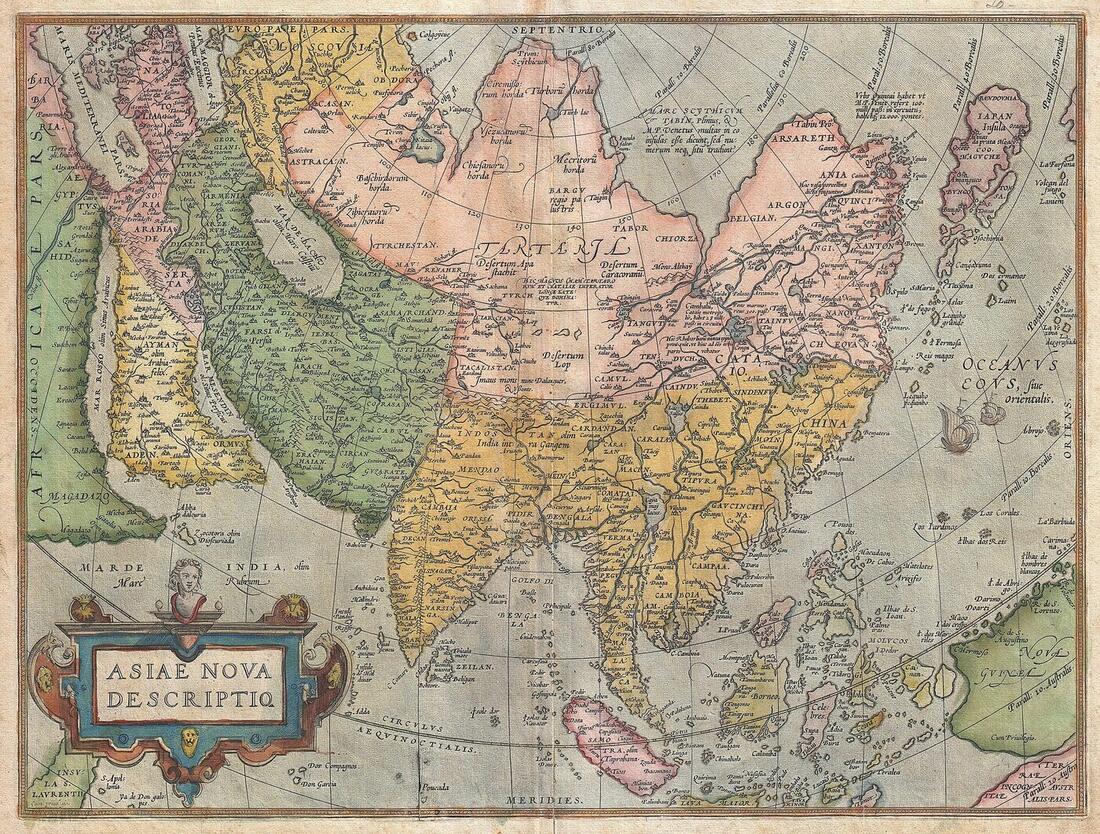
The name carried an ambiguity that no charter could have resolved. Asia is the largest continent by any of the usual reckonings: about 9 per cent of the earth's surface and some 30 per cent of its land area, subdivided into 49 countries of which five — Georgia, Azerbaijan, Russia, Kazakhstan and Turkey — lie partly in Europe, and holding roughly 4.7 billion people, about 60 per cent of the world's population. It is also, as reference works are increasingly careful to note, a category of European manufacture: the threefold division of the old world into Europe, Asia and Africa has been in use since the sixth century BCE by way of Greek geographers, and the resulting idea of Asia was applied to the peoples it names from outside. No group chartered for the continent could inherit a settled definition of its own subject, because none existed.
_-_Geographicus_-_AsiaeNovaDescriptio-ortelius.jpg)
The linguistic spread is the plainest measure of how much the label holds. Sino-Tibetan, Indo-European, Austronesian, Austroasiatic, Kra-Dai, Dravidian, Turkic, Japonic, Koreanic, Mongolic, Tungusic and Afroasiatic all have major populations in Asia, and linguists treat them as unrelated to one another; several further families and a number of isolates sit alongside them. Ethnologue counts more than seven hundred languages in Indonesia alone, more than four hundred in India and more than a hundred in the Philippines. No other single word Usenet used as a group name covered anything like that range of unrelated speech.
Where the ambiguity became concrete was in official usage, and the period supplies a dated example on each side of the Atlantic. In the United States, the Office of Management and Budget published its revision of Statistical Policy Directive No. 15 in the Federal Register of 30 October 1997 — inside the group's working life — and the definition it fixed reads:
Asian. A person having origins in any of the original peoples of the Far East, Southeast Asia, or the Indian subcontinent including, for example, Cambodia, China, India, Japan, Korea, Malaysia, Pakistan, the Philippine Islands, Thailand, and Vietnam.
Two features of that notice matter here. It separated the previous single category of Asian or Pacific Islander into two, creating Native Hawaiian or Other Pacific Islander as a category of its own; and it left West Asia out of Asian altogether, the same document defining White as a person having origins in any of the original peoples of Europe, the Middle East, or North Africa. An American reader in 1998, following the federal standard, would have understood soc.culture.asian to exclude both the Pacific and the Middle East, and to include South Asia.
British official usage of the same years drew the boundary somewhere else. The 1991 census was the first in the United Kingdom to ask an ethnicity question at all; the 2001 census used the heading Asian or Asian British for Indian, Pakistani, Bangladeshi and other Asian backgrounds, and placed Chinese not there but under the separate heading Chinese or Other Ethnic Group — a placement reversed for the 2011 census, whose Asian heading carries a Chinese tick-box. A British reader of the group's name in 1998 would therefore have expected South Asia first and might have been surprised to find East Asia at all.
The two conventions were simultaneous, official, and irreconcilable, and both had readers in the group. A geographer, meanwhile, would have added Central and West Asia to either of them. This page records those usages with their dates and does not adjudicate between them; the point is not that one reading was correct but that a group carrying the bare word inherited all of them at once, and that its readers knew it.
The groups beneath it in this directory
This directory preserves ten South and Southeast Asian country groups alongside the umbrella. Their one-line descriptions below are the text carried in the Big Eight group list of 16 October 2002, quoted as published; the pages themselves treat each country in its own right, and nothing in them is repeated here.
- soc.culture.thai — Thai people and their culture.
- soc.culture.sri-lanka — Things & people from Sri Lanka.
- soc.culture.bengali — Sociocultural identity of worldwide Bengali population.
- soc.culture.malaysia — All about Malaysian society.
- soc.culture.singapore — The past, present and future of Singapore. — with a moderated sibling preserved beside it, filed as Singapore & Singaporeans. (Moderated)
- soc.culture.nepal — Discussion of people and things in & from Nepal.
- soc.culture.laos — Cultural and Social Aspects of Laos.
- soc.culture.cambodia — Cambodia and its people.
- soc.culture.burma — Politics, culture, news, discussion about Burma.
- soc.culture.bangladesh — Issues & discussion about Bangladesh.
That list is itself a demonstration of the ambiguity described above, because it is not the whole of Asia as a geographer would draw it. This directory also holds pages for groups covering countries that the same geographer would place in West and Central Asia and that the American federal standard of 1997 would not: soc.culture.afghanistan, soc.culture.iraq, soc.culture.jordan, soc.culture.lebanon, soc.culture.syria, soc.culture.azerbaijan and soc.culture.rep-of-georgia among them. Whether those belong under a name like this one is exactly the question the previous section describes as unsettled, and this page does not settle it by arranging its own index.
What the list makes visible is the shape of the problem. Ten preserved country groups from one part of the continent, more than forty Asian-named groups in the branch as a whole, and above them a single name covering the largest and most populous continent on earth. The ratio of coverage to claim is the whole story of an umbrella group, and it explains both why the traffic was miscellaneous and why so much of it was passing through on its way somewhere else.
Seven bits, and the continent that would not fit in them
A pan-European group met a version of this problem and could largely ignore it; a pan-Asian one could not. Usenet articles were, by the standard of the day, RFC 822 messages, and the network of the late 1980s and early 1990s could not be relied on to carry the eighth bit of a byte from one hop to the next. Anything a poster wanted every reader to see had to survive as printable ASCII. Latin-script languages lose their accents in that pipe and remain readable. East Asian text does not survive it at all, because it does not fit in a single byte to begin with.
Each country had solved the problem separately, and early. China issued GB 2312 in 1980: 6,763 Chinese characters in two levels, the first of 3,755 ordered by reading and the second of 3,008 by radical and stroke count, plus 682 signs covering punctuation, Japanese kana, Greek, Cyrillic, Zhuyin and a double-byte pinyin set — 7,445 graphic characters in all. Taiwan's Institute for Information Industry defined Big5 for traditional characters in 1984, the name recording a collaboration of five of the island's largest computer firms, and it was adopted in Hong Kong and Macau as well. Japan's standard appeared in 1978 as JIS C 6226, was later renamed JIS X 0208 and revised in 1983, 1990 and 1997, and prescribes 6,879 graphic characters — 6,355 kanji and 524 non-kanji — carried in practice by the rival Shift JIS, developed by ASCII Corporation with Microsoft, and EUC-JP. South Korea's KS C 5601, later KS X 1001, runs from a first edition of 1974 through the double-byte set standardised in the middle 1980s and revisions in 1987, 1992, 1998 and 2002, covering hangul and hanja together and normally transported in EUC form.
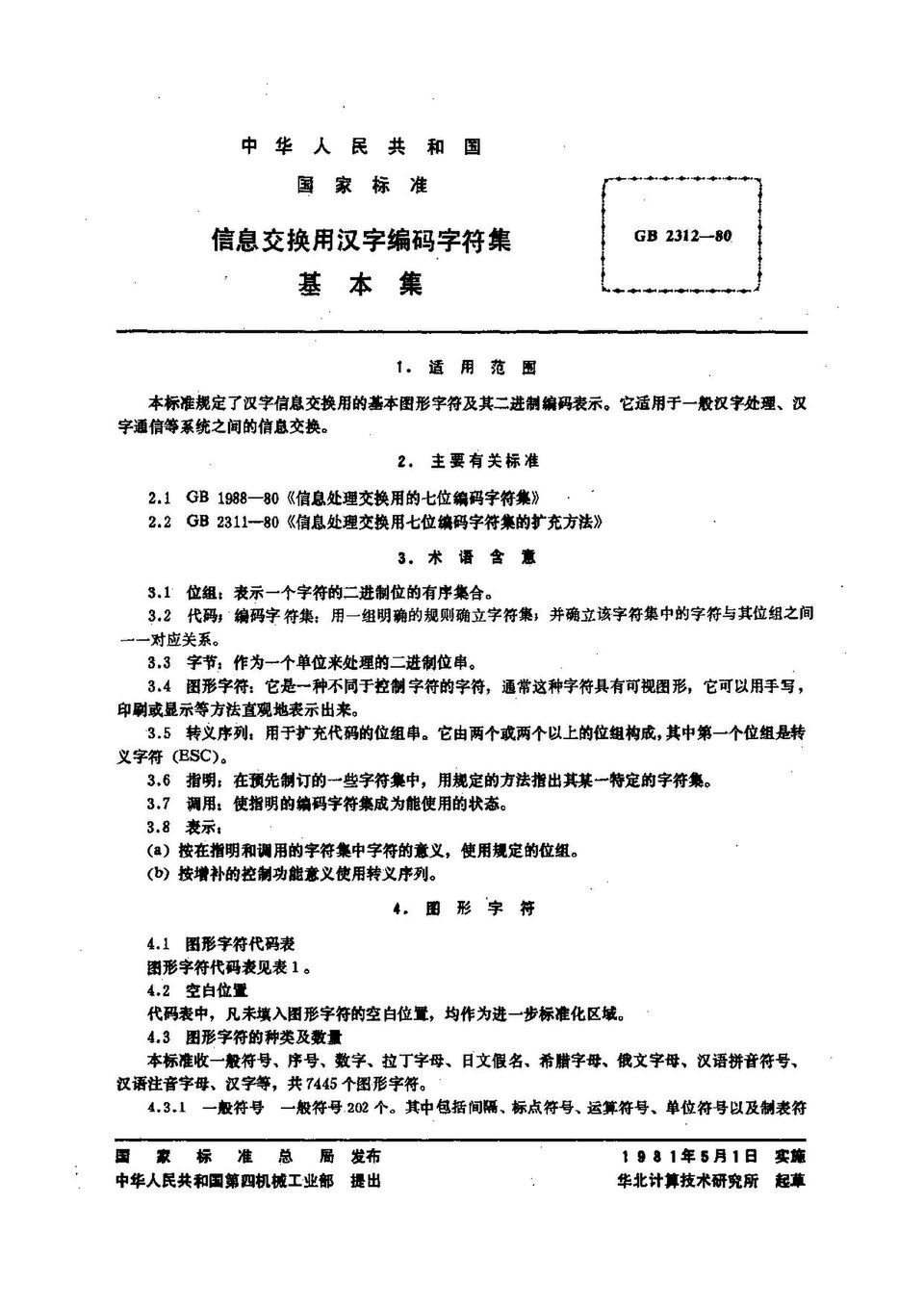
The national standards did not agree with one another. The same bytes read as one sentence under GB 2312 and as a different and usually meaningless one under Shift JIS, the failure Japanese named mojibake and everyone else eventually borrowed the word for. Since the wire would not carry eight-bit data anyway, each language community built a seven-bit wrapper of its own, and the resulting documents are among the most useful primary sources this subject has, because each of them says in plain English what it was for.
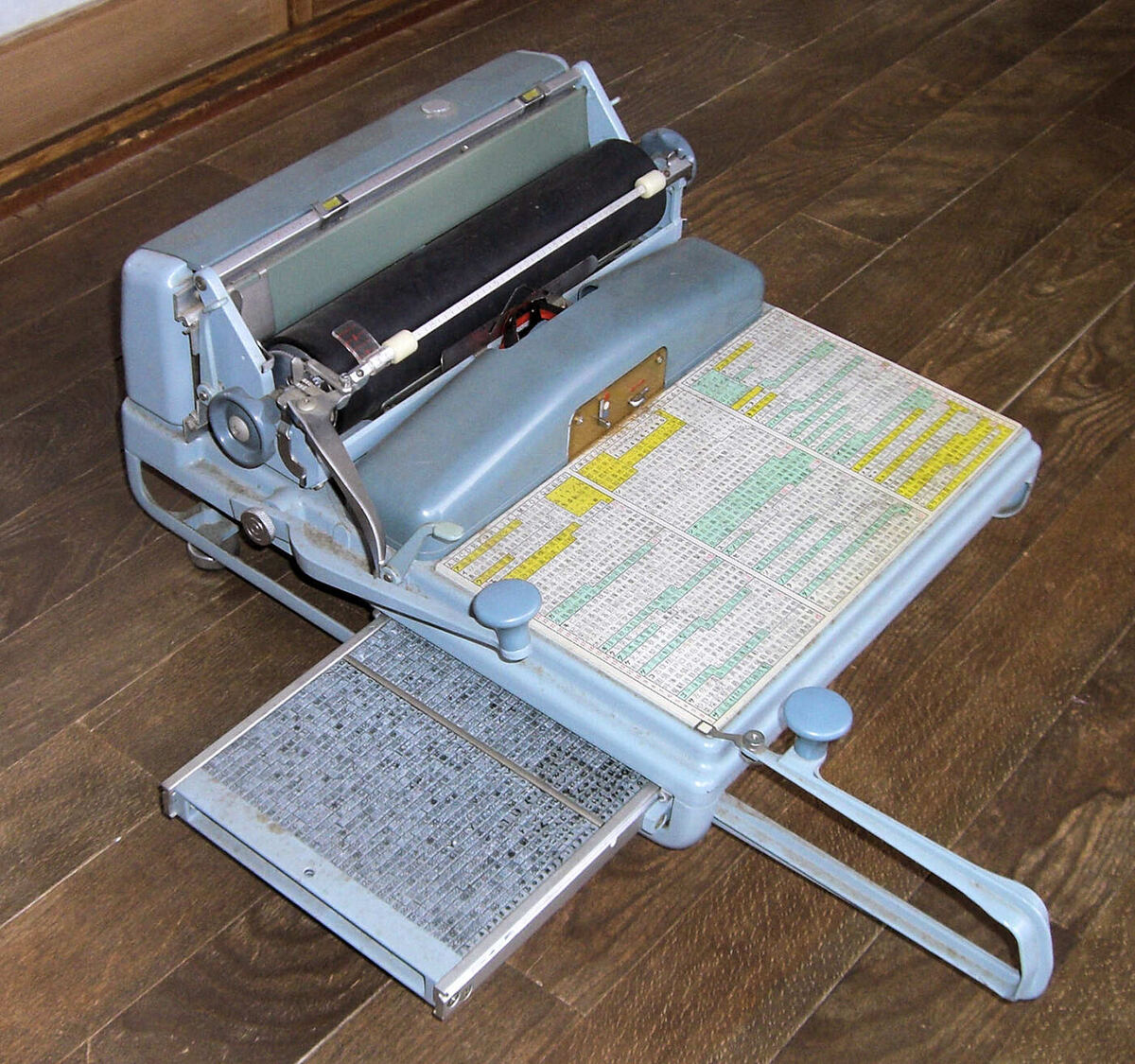
The scale of the repertoire is easier to grasp as an object than as a number. A Japanese typewriter of the period was not a keyboard but a tray: the operator located each character among several thousand pieces of type and picked it up with a selector arm. Every one of those pieces had to become a code point before the machine on the other end of a news feed could show it, and no single-byte encoding was ever going to hold them.

- ISO-2022-JP, published as RFC 1468 in June 1993 by J. Murai of Keio University with M. Crispin and E. van der Poel, describes the encoding used in electronic mail and network news messages in several Japanese networks, and records that it was first specified by and used in JUNET.
- ISO-2022-KR, RFC 1557 of December 1993, by U. Choi and K. Chon of KAIST with H. Park of Solvit Chosun Media, describes a method specified in 1991 and in use since, shifting in and out of KS C 5601 with the SO and SI control codes.
- HZ, RFC 1843 of August 1995 by Fung Fung Lee at Stanford University, wraps GB 2312 inside printable ASCII; the memo states that its content is identical to an article of the same title written by the author on 4 September 1989, six years before the RFC.
- ISO-2022-CN and ISO-2022-CN-EXT, RFC 1922 of March 1996, from authors at Tsinghua University, CITS, the Institute for Information Industry and the University of Washington, are seven-bit and support simplified and traditional characters together, using GB and CNS or Big5.
One document went further, and it is the closest thing the period produced to a script a pan-Asian group could actually have used. RFC 1554, published in December 1993 by M. Ohta of the Tokyo Institute of Technology and K. Handa of the Electrotechnical Laboratory, defines ISO-2022-JP-2, a multilingual extension in which all characters are encoded with seven bits only and the text switches between registered character sets by escape sequence. The table of what it could hold is the interesting part: ASCII, JIS X 0208 in its 1978 and 1983 forms, JIS X 0201-Roman, JIS X 0212, GB 2312-1980, KS C 5601-1987, and ISO 8859-1 and ISO 8859-7 for Latin and Greek. Japanese, simplified Chinese, Korean, western European and Greek text in a single seven-bit message. The memo records that it was supported by MULE, the multilingual Emacs, and that it was used experimentally; it never became what a reader could assume the other end would render.
That is the decisive fact for a group like this one. Each solution served one language community and assumed software that community had installed. A conversation that genuinely spanned the region had no script it could hold in common, and the one character set every participant's newsreader could be relied on to display was ASCII. Pan-Asian discussion therefore happened in English — not by charter, not by preference, and not as a statement about anything, but because English was the only thing the wire was certain to deliver. Traffic in the region's own languages went where a single encoding could be assumed: to national groups, to the Japanese fj.* hierarchy, to mailing lists among people who had agreed in advance what their bytes meant.
Another kind of unification: ISCII and the Brahmic scripts
The other half of the continent had a parallel story with a different shape, and it is worth setting beside the CJK one because the two are so nearly opposite. India's answer to the encoding problem was the Indian Script Code for Information Interchange, ISCII, standardised by the Bureau of Indian Standards as IS 13194:1991. It is an eight-bit code whose lower 128 positions are plain ASCII. What it does with the upper 128 is the unusual part.
The Brahmi-derived writing systems share a structure, so ISCII assigns letters of the same phonetic value to the same code point and overlays the scripts on one another. The supported set is Bengali–Assamese, Devanagari, Gujarati, Gurmukhi, Kannada, Malayalam, Odia, Tamil and Telugu; a single code pair renders as one syllable in Devanagari, the same syllable in Malayalam, the same in Gurmukhi, the same in Tamil, according to a script-selection code that changes the writing system until the next indicator or the end of the line. One motivation, as the standard's own documentation puts it, was that a single encoding would allow easy transliteration between writing systems — a hope that the reference literature now records as having run into enough incompatibilities not to be practical.
ISCII was never widely used outside certain government institutions, but its layout outlived it, because Unicode adopted it. The code points U+0900 to U+0954 of the Devanagari block were in their original form a direct copy of positions A0 to F4 of the 1988 ISCII standard, and the Bengali, Gurmukhi, Gujarati, Odia, Tamil, Telugu, Kannada and Malayalam blocks were all laid out on their ISCII encodings in the same way. Nine scripts entered the universal character set in the arrangement an Indian national standard had given them.
Set the two unifications side by side and the symmetry is exact and instructive. East Asia was unified across languages by character identity: one code point for a character that Chinese, Japanese and Korean all use, with the shape left to the font. South Asia was unified across scripts by phonetic value: one code point for a sound, with the shape left to the script indicator. Both were engineering economies. Both drew the objection that an economy of that kind flattens a distinction somebody cares about. Only one of them became a public controversy, and the reason is largely that only one of them was carried into a standard that everybody was eventually obliged to use.
Vietnam produced the document that speaks most directly to a group of this kind. RFC 1456 of May 1993, from the Vietnamese Standardization Working Group, describes VISCII, an eight-bit encoding, and VIQR, a mnemonic scheme for representing Vietnamese in plain US-ASCII on seven-bit systems. Its abstract records who was actually using them:
These conventions are widely used by the overseas Vietnamese who are on the Internet and are active in USENET.
A standards document of 1993, describing a diaspora keeping its own orthography alive inside seven bits, on Usenet, because that was where the community was. It is the single best contemporaneous description of the constituency this branch of the hierarchy served, and it was written by people solving a character-encoding problem.
Han unification: what it is, and why it was done
Han unification is the decision, taken in the design of Unicode and of ISO/IEC 10646, to map the Han characters of the Chinese, Japanese, Korean and historically Vietnamese writing systems into a single shared repertoire rather than encoding each national set separately. The resulting collection is contracted to Unihan. The governing idea is that a character used in several languages is one character rather than three, and that the regional differences in how it is drawn are differences of glyph, not of character — the same sort of difference as between a single-storey and a double-storey lower-case a.
The reason was arithmetic before it was philosophy. The first version of Unicode was designed to fit into sixteen bits, which allows 65,536 code points in total; 20,940 of them were reserved for CJK ideographs. A repertoire of Han characters that kept the Chinese, Japanese and Korean national sets distinct would have approached or exceeded a hundred thousand characters and would not have fitted. The sixteen-bit constraint was abandoned later — the surrogate mechanism of Unicode 2.0 in 1996 opened the space above it — and there are now more than a hundred thousand unified ideographs encoded across eleven blocks; but the constraint was live when the decision was taken, and the decision has not been revisited.
The Unicode Standard's own appendix on the subject gives a chronology that is worth having in order, because the group's active years sit on top of it. A Han character cross-reference database began at Xerox in 1986; a parallel effort started at Apple in 1988; the two databases were merged in 1989, producing the first draft of a unified Unicode Han set, which the Unicode Working Group proposed for inclusion in ISO/IEC 10646 at a meeting of the American standards committee X3L2 in September 1989. An ad hoc meeting in Beijing that October began cooperation with the Association for a Common Chinese Code. A second, in Seoul in February 1990, produced on a Korean proposal the Chinese/Japanese/Korean Joint Research Group, the CJK-JRG. A second draft went out for wide review in December 1990, alongside the announcement of the Unicode Consortium's formation; the Consortium was not formally incorporated in California until 3 January 1991, and the first volume of The Unicode Standard appeared that October. The December 1990 draft was checked in detail by East Asian scholars at the University of Toronto, and China's own GB 13000 proposal was merged with it. The CJK-JRG first met in Tokyo in July 1991, agreed to build on GB 13000, and agreed to verify the results against unification rules developed by Professor Miyazawa Akira and other members of the Japanese delegation.
On 27 March 1992 the group completed the Unified Repertoire and Ordering, version 2.0. It was published by the Unicode Consortium in The Unicode Standard, Version 1.0, Volume 2, which appeared in June 1992 and carried the Han ideographs, and by ISO in ISO/IEC 10646-1:1993. In October 1993 the CJK-JRG became a formal subgroup of ISO/IEC JTC1/SC2/WG2 and was renamed the Ideographic Rapporteur Group; at its second meeting, in Hà Nội in February 1994, it agreed to bring Vietnamese chữ Nôm ideographs into a future version. Extension A, 6,582 characters, was completed in 1998 and first encoded in Unicode 3.0 of September 1999. Extension B, 42,711 characters drawn from classical dictionaries, literary sources and national standards, was completed in 2000 and first encoded in Unicode 3.1 of March 2001, the first block of unified ideographs to sit outside the Basic Multilingual Plane. Eight further extensions have followed, the most recent first encoded in 2025. In June 2019 the group was renamed once more, to the Ideographic Research Group, keeping its initials.
Han unification: the objections
The decision was contested at the time and has been ever since. At the international level, the initial position of the CJK Joint Research Group favoured DIS 10646, a draft that kept the national sets separate; the account most often cited says it was set aside in favour of unification with the Unicode repertoire by the votes of American and European members of ISO, with the Japanese position unclear. Endorsing unification was in any case a condition of merging Unicode and ISO/IEC 10646 into a single standard, which was the larger prize.
Objection has been loudest in Japan, where there is a long documented history of public and scholarly protest at the culling of historically and culturally significant variant forms. In 1993 the Japan Electronic Industries Development Association published a pamphlet whose title translates as We are worried for the future character encoding system, summarising the principal criticisms of the unification approach. The complaint was not primarily aesthetic. Two strands recur in the literature.
The first is scholarly. If a historical text is written with a particular variant form of a character, and the standard has unified that form with another, the text cannot be encoded so as to preserve its own orthography; the scholar is pushed back to locating the right shape in a particular typeface, which defeats the purpose of a plain-text encoding. The second is personal, and in Japan it is a matter of law and paperwork as well as sentiment: proper names are orthographically conservative, the supplementary list of characters that may legally be used in registered personal names has been enlarged repeatedly since it was introduced, and a person whose surname uses a variant form has a practical interest in that form surviving the round trip through a computer system.
Behind both sits a question that is not technical at all, and that a group chartered for Asian cultures generally was in no position to settle: whether a shared repertoire is an engineering economy or a statement about whose writing belongs to whom. The Unicode Standard's own position is that the identity of the Han characters is fundamentally independent of language, and that the nationality of the characters became an issue only when each country began to create coded character sets based on purely local needs. That is a coherent position, and it is also a position, and the people who dissented from it in the 1990s were not confused about what they were dissenting from. This page records the argument; it does not settle it.
The answers the standard gave
Three mechanisms answer the objection, and they arrived in that order over about fifteen years.
The first is procedural and dates from the original work. The Unicode Standard states it in one sentence: the Source Separation Rule says that ideographs that are distinctly encoded in a source must not be unified. In other words, if a national standard already gave two shapes two separate positions, Unicode was obliged to keep them separate too, so that text could be converted into the universal set and back out again without loss — which is why the standard also calls it the round-trip rule. It is numbered rule R1, and the standard is candid that it was applied only to the original CJK Unified Ideographs block and not to the extension blocks that followed, the rapporteur group having dropped it in 1992. That is a limitation with real consequences for anyone working outside the common repertoire.
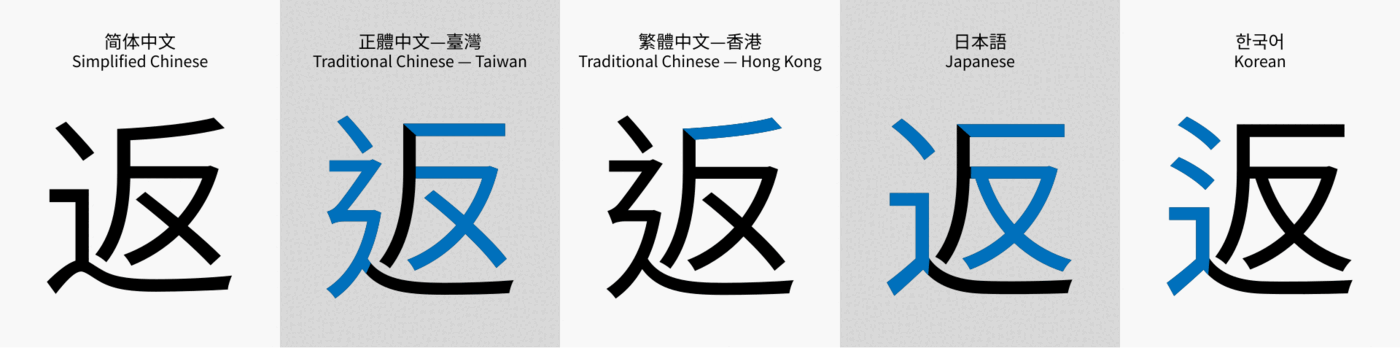
The second is typographic. A unified code point is drawn by a font, and regional fonts draw it in the regional way; the same code point rendered by the simplified Chinese, Taiwanese, Hong Kong, Japanese and Korean cuts of one typeface produces five visibly different characters. This works when the software knows which language it is rendering. It works badly when a single document mixes them — which is exactly what a pan-regional discussion group is — and it does not help a reader who needs a form that belongs, typographically, to somebody else's country.

The third mechanism is the one that addresses the scholarly complaint directly, and it is much later than the group. Variation selectors were introduced in Unicode 3.2, released in March 2002, and supplemented in Unicode 4.0 of April 2003. An Ideographic Variation Sequence is a pair: an ideograph followed by a variation selector from the range U+E0100 to U+E01EF, which restricts the rendering of that ideograph to a defined subset of glyphs without changing which character it is. Because no single collection of such sequences could satisfy scholars, governments and publishers at once, the mechanism was made a registry rather than a list: the Ideographic Variation Database, governed by Unicode Technical Standard #37 and maintained by a registrar, currently Ken Lunde. Its first registration, the Adobe-Japan1 collection, was made on 14 December 2007 and now holds 14,684 sequences; five further collections have been registered since, two of them Japanese and the others submitted from Korea, Macao and elsewhere.
The chronology is the point worth keeping. The unification was settled in March 1992. The remedy that lets a Japanese scholar pin a particular variant in plain text was first registered in December 2007. The whole active life of a group like this one falls inside that gap, which is one reason the argument was still live whenever it surfaced on Usenet, and why it surfaced in the register of grievance rather than of engineering.
What the encoding history meant for a group like this one
Two consequences follow for the traffic, and both are visible in the shape of what survives elsewhere on Usenet.
The first is that the group ran in English, and so did every other genuinely cross-regional forum of the period. That was not a cultural preference or a political fact; it was a property of the transport. Where a single national community could agree on an encoding, it used one, and the national groups did. Where no such agreement was possible, ASCII was the residue everybody shared. A reader who came to soc.culture.asian expecting the languages of the continent would have found the languages of the continent discussed, described, transliterated and argued about, in English.
The second consequence is about the archive rather than the conversation, and it outlasts both. A discussion conducted in ASCII is searchable decades later by anyone who can type the words. A discussion conducted in ISO-2022-JP, HZ or an unlabelled eight-bit code page left bytes that may match no query a modern reader would think to enter, in an archive whose software may or may not still know how to decode them. The visibility of a period's conversations in the present is partly a function of which encoding they happened to be conducted in — which flatters the English-language umbrella groups relative to the national groups, and is worth remembering before drawing any conclusion from what is easy to find.
Who could post, and from where
Connectivity across this region varied more, during the group's working life, than across any comparable area on earth. Two countries were on international research networks very early; several were not on the public internet until the group was already old. Any statement about who was writing has to start there.
South Korea was first, and by a margin that still surprises people. The System Development Network went live in May 1982, connecting the Korea Institute of Electronics Technology to Seoul National University over a 1,200 bits per second leased line; it was built on TCP/IP by Kilnam Chon and his students, which is generally described as making Korea the earliest adopter of the protocol suite outside the United States and Europe. By 1985 the network linked around twenty universities, national research centres and corporate laboratories; in 1986 the country received its first public IP address block and registered the .kr domain. The Korean encoding memo described above, RFC 1557, came out of the same academic world a decade later: the people who built the network were also, in large part, the people who settled how Korean would be written on it.
Japan followed in 1984. The Japan University Network, JUNET, was established in October of that year by the University of Tokyo, the Tokyo Institute of Technology and Keio University, running UUCP over telephone lines in explicit imitation of Usenet; the first link, between the Tokyo Institute of Technology and Keio, ran at 300 bits per second, and the three-way connection that followed at 1,200. The WIDE Project's own history records the milestones: in 1985 the WIDE Research Group was founded, electronic mail written in Japanese began to be exchanged on JUNET, and JUNET gained its first international connectivity, to CSNET in the United States. By July 1987 JUNET had grown to more than 250 nodes across 87 organisations. In 1989 WIDE obtained a 64 kbit/s leased line to the United States by way of the University of Hawaii and connected to NSFNET at 9,600 bits per second. JUNET itself was discontinued in October 1994, the year the WIDE international line was raised to 1.5 Mbit/s.
Elsewhere the dates run much later. China's first message out of the country was electronic mail sent on 20 September 1987 to Karlsruhe, reading, in the standard translation, Across the Great Wall, towards the rest of the world; the country was on the internet intermittently from May 1989 and permanently from 20 April 1994. India's ERNET began in 1986 for the educational and research community; the first 9.6 kbit/s leased line ran between Delhi and Mumbai in January 1991, a 64 kbit/s gateway from NCST Mumbai to UUNET in Virginia was commissioned in 1992, and public access opened on 15 August 1995 through the state-owned Videsh Sanchar Nigam Limited. Indonesia's first commercial internet service provider licence was issued in 1994. Vietnam was linked by a UUCP connection to the Australian National University from about 1992, an arrangement begun by a retired academic wanting to reach his former students, and did not officially launch internet service until 19 November 1997. The dates for Thailand, Malaysia, Singapore, Nepal, Sri Lanka and Laos are set out on their own pages here and are not repeated.
The gap those dates produced can be measured. The World Bank series for individuals using the internet, as a percentage of population, gives the following for the years in which such groups were busiest:
- 1995 — Japan 1.6 and South Korea 0.8; China, India, Indonesia and the Philippines all below one in two thousand, and Vietnam not yet carried on the series
- 1997 — Japan 9.2, South Korea 3.6, Indonesia 0.2, the Philippines 0.14, India 0.07, China 0.03
- 1999 — South Korea 23.6, Japan 21.4, the Philippines 1.4, China 0.7, Indonesia 0.4, India 0.3, Vietnam 0.13
- 2001 — South Korea 56.6, Japan 38.5, China 2.6, the Philippines 2.5, Indonesia 2.0, Vietnam 1.3, India 0.7
In 1999 the proportion of South Koreans online was roughly a hundred and eighty times the proportion of Vietnamese. That is not a difference of degree between neighbouring countries; it is the difference between a wired society and one whose national service had been open for about two years. A group named for the whole continent was, in consequence, never hearing from the continent in anything like proportion to its population, and the imbalance was at its most extreme precisely in the years when Usenet mattered most.
The readership abroad
The other half of the answer is that a great deal of the posting came from outside Asia altogether. Usenet reached universities and research institutions long before it reached homes anywhere, and the universities of North America, Britain and Australia held very large numbers of students and staff from the region who had an account, a terminal and no long-distance telephone bill. For much of the 1990s the practical description of a poster to a group like this one is a student or academic writing about home from several thousand miles away, or a member of a settled community writing from the country they had grown up in.
The size of that constituency has a documented history. The Immigration and Nationality Act of 1965 abolished the national-origins formula that had effectively excluded Asian immigration to the United States since the 1920s, and the effect compounded over the following half-century: figures compiled by Jie Zong and Jeanne Batalova for the Migration Policy Institute in January 2016 put the number of Asian immigrants in the United States at 491,000 in 1960 and about 12.8 million in 2014, and their share of the foreign-born population at 5 per cent in 1960 and 30 per cent in 2014. The generation that reached American and Canadian universities in the late 1980s and 1990s — the first cohort for whom a campus Usenet account was ordinary — was largely the children of that change.
This produces the asymmetry that shaped the group's character, and it is a structural point rather than a sentimental one. As a single identity, Asian is very largely a diaspora construction: an instance of what sociologists call panethnicity, a category assembled from peoples with little shared history who find themselves perceived and treated as one in the place they have moved to. The term was popularised in this sense by Yen Le Espiritu, whose Asian American Panethnicity: Bridging Institutions and Identities was published by Temple University Press in 1992, at the very start of the group's active period, and took the Association for Asian American Studies book award in 1994. Comparatively few people in Asia would describe themselves as Asian before describing themselves as something narrower; the label acquires its force abroad.
The consequence for the group was that its premise made most sense to the readers who were furthest from the place it named. That is not a criticism of the group. It is the reason it had traffic at all, and it accounts for the difference of emphasis that anyone reading across the branch can see: writers in the diaspora treating questions of category and belonging as urgent and personal, writers inside the region more often treating the same questions as somebody else's filing problem.
A vocabulary with dates on it
Terms of self-description change, and the ones current while the group ran are not always the ones current now. What follows is documented usage history with dates attached. It is not a recommendation about which words to use, and the fact that a term has a coinage date is not an argument for or against it.
The word the group's premise rests on is far younger than any of the cultures it covers. Asian American was coined in 1968 by Yuji Ichioka and Emma Gee at the University of California, Berkeley, at the founding of the Asian American Political Alliance in May of that year. It was meant to displace Oriental and to assemble a single political identity out of communities — Chinese, Japanese, Filipino, Korean, Asian Indian — that had previously organised separately and had not claimed a common name. It is, in the most literal sense, a constructed term with two authors and a date.
The academic apparatus arrived in the same months. Asian American studies came out of the Third World Liberation Front strikes, in which the alliance was one of the founding organisations. The strike at San Francisco State College began on 6 November 1968 and ran until 21 March 1969, the longest strike by students at an academic institution in the United States; the settlement of 20 March 1969 produced the country's first College of Ethnic Studies, with Asian American Studies among its four units. A parallel coalition at Berkeley struck from 22 January 1969, and its strike produced the country's first Department of Ethnic Studies, conceded on 7 March 1969. Ichioka himself taught the first Asian American Studies course at UCLA in 1969 and was named associate director of that university's new Asian American Studies Center. The Association for Asian American Studies was established in 1979. By the time Usenet reached campuses in quantity, the subject had been taught for two decades, and a readership weighted towards students and academics contained people who had read the literature sitting beside people meeting the terms for the first time.
Model minority is slightly older than Asian American and came from outside the communities it described. Its earliest widely cited use is the sociologist William Petersen's article Success Story, Japanese-American Style in The New York Times Magazine of 9 January 1966, which framed Japanese Americans as an ethnic minority that had achieved conspicuous success despite marginalisation. The standing objections to it — that it averages away very large differences within and between the communities it flatters; that it has been deployed in arguments about other minorities; that being cast as successful makes discrimination harder to see and assistance harder to obtain — are set out at length in the academic literature and are the kind of argument that recurred wherever the subject came up. It was one of the period's recurring genres rather than one of its threads.
Oriental is the term the 1968 coinage was meant to replace, and its retreat from official American English can be dated precisely, because it was legislated. Public Law 114-157, approved on 20 May 2016, amended the Department of Energy Organization Act and the Local Public Works Capital Development and Investment Act of 1976 to strike the words Negro, Puerto Rican, American Indian, Eskimo, Oriental, or Aleut and Negroes, Spanish-speaking, Orientals, Indians, Eskimos, and Aleuts and to insert Asian American, Native Hawaiian, a Pacific Islander, African American, Hispanic and their companions. The word therefore stood in United States law until well into the present century, long after the period this page describes, which is a useful corrective to any account that treats terminological change as sudden.
The official categories moved on their own schedule as well. The United States census counted South Asians under the heading Hindu on the forms of 1910 to 1940; the 1980 census was the first to offer Indian (East) as a separate option, bringing South Asian ancestries into the group of categories that the 1997 notice would consolidate as Asian. An Asian/Pacific American Heritage Week was created by a joint resolution that President Carter signed on 5 October 1978, becoming Public Law 95-419, and was extended to a month by a bill President Bush signed in 1990. And the Office of Management and Budget's revision of 30 October 1997, quoted earlier, split the single Asian or Pacific Islander category into two, so that from the 2000 census onwards Asian and Native Hawaiian or Other Pacific Islander were distinct federal categories. Every one of those changes altered what the word on the group's masthead officially meant, inside the group's lifetime, without anybody having to post about it.
Two things follow, and they are the reason this section exists. First, the terms in dispute were recent, deliberate and coined for a purpose, and it remained open to any reader to decline them, as some did, at length. Second, an archive of the period is written in the vocabulary of the period: a phrase that reads as neutral, dated or offensive to a reader today may have been any of those things to different readers at the time, and the honest way to read such an archive is with the dates in hand.
What an umbrella carried that a country group did not
No archive of this group's messages is preserved here, and no thread, poster or message count from it is quoted anywhere on this page. What can be described honestly is the kind of traffic a broad unmoderated group of the period carried, which is a matter of the structure of the namespace rather than of any particular posting.
The material genuinely suited to a continental charter was comparative. The cross-border inheritances — Buddhist, Confucian, Hindu, Islamic — belong to no single flag, and a question about how a practice differs between two countries has no natural home in either country's group. So do the things that travel with a family rather than a passport: food, festivals, and what a household expects of its children, none of which sits inside one national charter when the household's members come from several. The colonial histories invite the same treatment, since British, French, Dutch, Portuguese, Spanish, American and Japanese rule left very different institutional residues in adjacent places, and comparing them is precisely the operation a national group is not shaped for. The 1990s added a live popular-culture case, as Hong Kong cinema, Japanese animation and Indian film found audiences far outside their home markets and produced exactly the cross-border comparisons an umbrella existed to host.
A second category is the overflow. Every national group has a boundary, and the traffic that falls outside it goes somewhere. Questions about being of mixed background, about which group a person belongs in, about what the categories are for, do not sit inside any single country's charter and land in the umbrella by default. So do the questions of people whose connection to the region is by ancestry rather than residence, and whose reference points are two countries at once. The subjects that recur across diaspora writing of this period have that shape: how a community is depicted in the films and television of the country it has settled in; marriage across a community boundary and what it is taken to mean; and the language a second generation does not keep, which is the most ordinary and the least reversible of the three.
A third is the meta-traffic: the group discussing its own scope. In a country group this is rare and procedural. In an umbrella it is a permanent editorial condition, because the group's subject is exactly the thing in dispute. Whether the label meant East Asia or South Asia, whether it should have included West or Central Asia, whether it was a real category or an artefact of somebody else's census form — these were not digressions from the group's business but a recurring part of it.
Then there is the ordinary traffic of any unmoderated group of the era: questions from students with essays due, from travellers, and from the merely curious, answered with widely varying accuracy; periodic housekeeping in the FAQ tradition; and, from the mid-1990s, the industrial spam that washed over all of Usenet and that an unmoderated group had no mechanism whatever to refuse.
Finally, crossposting, which shaped umbrella groups more than any other kind. A Usenet article addressed at once to a broad group and to two or three national ones appeared in all of them as a single thread, so an argument begun elsewhere could arrive complete — participants, history and grievances intact — in front of an audience that had missed its beginning. A wide group sitting above forty narrow ones is a border town by construction. A great deal of what passed through it was not addressed to it.
What the record does not show
The honest inventory of what is missing is longer than the inventory of what survives, and stating it plainly is more useful than filling it.
There is no founding paperwork: no Request for Discussion, no Call for Votes, no result with a tally, no newgroup control message, and no charter text in any of the places where charters were kept. There are no readership or subscriber figures, no message counts and no traffic series; the readership surveys that produced such numbers for a few large groups of the era did not produce them for this one, or at least nothing survives if they did. There are no moderator records, because the group was not moderated. There are no thread titles, poster names or quotations preserved in this directory, and none are supplied here.
The general Usenet archive is itself uneven in ways that bear directly on any attempt to check such a group. Deja News began collecting the network in March 1995, so anything earlier depends on later reconstruction. During the company's transition to a shopping service in 1999, which involved relocating its servers, many older messages became unavailable. Google acquired the archive in February 2001; by the end of that year it had been supplemented with material reaching back to 11 May 1981, though coverage of any particular group and year remains patchy. Google Groups stopped supporting the posting or viewing of new Usenet content on 22 February 2024, leaving the existing archive in place. None of that guarantees that a small or short-lived group is represented at all.
What the surviving administrative record does establish is set out in the first section of this page and is genuinely useful: the shape of the branch, the exact wording of the neighbouring descriptions, the dates on which control messages moved, and the fact that this name is absent from the lists in which it might have been expected. A negative result carefully described is a finding. It is not, however, a story, and no story has been supplied in its place.
Scope and limits
What is described here is a newsgroup, not the continent it was named for. This page is not an account of Asia, and it is emphatically not an adjudication of anything argued on Usenet or off it. Several of the histories that touch this subject are actively contested between states whose citizens both read pages like this one, and the treatment above is deliberately confined to what can be dated, quoted and attributed: standards documents with publication dates, control messages with timestamps, census definitions with Federal Register citations, network milestones with the operators' own chronologies behind them.
Where a dispute is described — Han unification and its critics, the meaning of the word Asian in American and British official usage, the vocabulary of self-description and its dates — the description records the positions and their sources and stops there. Readers looking for a verdict on any of them will not find one here, and should not read the ordering of the material as implying one.
Country-level detail belongs to the country pages, several of which are considerably longer than this one and all of which were written from their own sources; the Southeast Asian bloc as an institution belongs to the ASEAN group's page. Where this page and a member page cover the same ground, the member page is the more specific and should be preferred.
The last limitation is the most important and applies to the whole of it. What is preserved here is a directory entry, a one-line description and the surrounding history. The conversations themselves are gone from this site, and what they contained is not something this page can tell you. The value of the record is that it fixes what the group was, what it could and could not carry, and when — not that it settles what was said in it.
Reading soc.culture.asian today
- Historical archive: Google Groups — soc.culture.asian (coverage varies by group and era).
- Open in a newsreader:
news:soc.culture.asian— the original site offered exactly this link, and it still works if your system has a newsreader registered for thenews:scheme. - Live access: point an NNTP newsreader at a modern server — see accessing Usenet today.
- The original news2mail e-mail subscription service ended in the mid-2000s and no longer operates.