soc.culture.armenian
Armenian culture, history and diaspora.
The national culture group for Armenia and one of the most widely dispersed diasporas of the twentieth century, covering language and script, church history, the republic after 1991, and the history the community regards as central to it.
Its administrative record is unusually turbulent: the Internet Systems Consortium’s control archive holds more than a hundred messages for the name, beginning with a creation on 1 April 1996 and a removal three days later.
On this page
- A record one hundred and twenty-one messages long
- 1 April 1996, 11:11:11 GMT
- Why one forged message mattered
- 23 September 1996: a proposal for a name that already existed
- What became of the proposal
- The Bogus Usenet Groups list
- August to November 1998: the name forged seventy-seven times
- December 1996: the alt.* group that survived
- Absent from the current list, and what that does and does not mean
- The language, the script, and what a 1990s newsgroup could carry
- The diaspora the name was addressed to
- The republic, as a dated chronology
- The recognition question, as record
- What the record does not show
- Scope, sources and limits
A record one hundred and twenty-one messages long
The Internet Systems Consortium mirrors the administrative record of Usenet: for every group name that anyone ever tried to create or destroy, a file of the control messages sent in its name. Most of those files are short. A group proposed properly, voted properly and created properly generates a creation message, a couple of reissues for servers that missed it, and — decades later, if the group is retired — a removal. Twelve neighbouring files in the same branch were checked for this article; they hold between three and fifteen messages each, and most hold fewer than six, for an entire working life.
The file kept under the name soc.culture.armenian holds one hundred and twenty-one. Eighty-one of them are newgroup messages, instructing every news server on the network to add the group. Forty are rmgroup messages, instructing every news server to remove it. The earliest is dated 1 April 1996 at 11:11:11 GMT; the latest is dated 29 November 1998, and the file stops there.
The distribution by year and type is the shape of the story:
- 1996 — four
newgroupmessages, twelvermgroupmessages. - 1997 — nothing at all.
- 1998 — seventy-seven
newgroupmessages, twenty-eightrmgroupmessages.
Ninety-six of the hundred and twenty-one carry the From address [email protected] and twenty-two the address [email protected]. Both are David C. Lawrence, then the moderator of news.announce.newgroups and therefore the one person entitled to create or remove a group in the Big Eight hierarchies. The remaining three come from an address at Netcom, a large American commercial provider of the period. As will become clear, the From line on a Usenet control message is a claim rather than a fact. A hundred and eighteen of these messages bear Lawrence's name: seventy-eight are creations, and the other forty are removals which state that the creations were forged.
It is worth saying at the outset what this kind of evidence is. The control archive records what was sent to the network about a name. It records nothing whatever about what was read, posted or argued under that name. A file of a hundred and twenty-one messages is a record of an administrative dispute of unusual persistence; it is not a record of a community. This article sets out the first in full, because it survives in full, and is explicit about the absence of the second.
1 April 1996, 11:11:11 GMT
The first message in the file is a newgroup. It carries the name and the approval address of the moderator of news.announce.newgroups, it was crossposted to news.groups and to the group it was creating, and it gives the line that news administrators were to paste into their newsgroups file: soc.culture.armenian — Armenia, its culture and history.
Underneath that line it carries two sentences that no genuine creation message ever carried. They inform the reader that anyone can create a newsgroup in the alt, biz, comp, earth, humanities, misc, news, rec, sci, soc, talk, us, or any other Usenet hierarchy, and that new newsgroup proposals may optionally be discussed in news.groups. That is a parody of the real boilerplate, and an inversion of the entire Big Eight procedure, which existed precisely so that not anyone could create a newsgroup and so that discussion was not optional.
The timestamp is 11:11:11 GMT on 1 April. The same timestamp, to the second, is carried by the first forged creation of a neighbouring name in this branch, which is described below.
Three days later, on 4 April 1996 at 15:16:24 GMT, an rmgroup went out over the same name. Its body is five lines long and it says what it needs to say twice over:
The recent newgroup for this group in my name was a forgery.
soc.culture.armenian is widely considered a bogus newsgroup given that it has not been approved by accepted USENET group creation procedures. Please remove the group from your active file.
That paragraph is the most frequently repeated text in the whole file. It appears, word for word, in all forty rmgroup messages, over two and a half years. In 1996 alone it went out twelve times: on 4, 5, 8, 11, 12 and 15 April; on 4, 5, 6, 8 and 15 May; and finally on 6 June, after which the name went quiet for twenty months.
Repetition of that kind is not obsessive; it is how removal worked. A single rmgroup reached the servers that were listening when it was sent. Sites that had been offline, sites whose feeds were slow, sites that had accepted the forged creation and then dropped the correction — each needed to be reached again. Every re-send was an attempt to catch the machines the previous one had missed.
Why one forged message mattered
Usenet had no central register of newsgroups, and no server anywhere held an authoritative list. A group existed on a given machine because that machine's administrator, or that machine's software acting under standing instructions, had accepted a message saying that it should. Those standing instructions lived in a configuration file — control.ctl under INN, its equivalents elsewhere — and for the Big Eight most administrators set them to act automatically, because the alternative was reading every control message on the network by hand.
Automatic acceptance was safe only so long as the sender could be identified, and in 1996 that was the weak point. The documentation distributed with the PGP control-message tooling from the same archive states the problem without embellishment: Usenet articles are notoriously easy to forge, and control messages are no exception; because administrators often want their systems to honour requests from particular people automatically, it is risky to trust the From and Sender headers to identify the real sender, as had historically been done. The remedy — signing a handful of headers as well as the body, so that the action itself was covered by the signature — had been built for exactly this failure. Not every site had adopted it.
The consequence is that a convincing forgery propagated as fast and as far as the genuine article, and undoing it meant persuading thousands of independently operated machines to act. That asymmetry is the whole mechanism, and the file for this name is a two-and-a-half-year demonstration of it.
In May 1996 the mechanism was set out in the file itself, by a sender who dropped the impersonation. On 4 and 5 May 1996, three further newgroup messages for this name were posted from an address at Netcom, carrying the same newsgroups-file line but not Lawrence's name. One of them appends the sentence Please note that I'm not David Lawrence. Another carries a cheerful open letter to news administrators recommending that they reconfigure their servers to honour every newgroup message and silently discard every rmgroup message, which would have made removal impossible — and which the letter presents as a labour-saving measure. The same three messages, differing only in the group name and the description line they carry, went out over the neighbouring name soc.culture.ethiopia (the episode is set out on the page for its moderated sibling) on the same two days, each within half a minute of its counterpart.
23 September 1996: a proposal for a name that already existed
Six months after the forged creation, the proper procedure was invoked. On 23 September 1996 at 21:28 GMT, a Request for Discussion for an unmoderated soc.culture.armenian was posted to news.announce.newgroups by Saro Chakarian. It is the only document filed under this name in the group-creation archive, and it is sixty-seven lines long.
Its proposed newsgroups line is not the one the forgeries used. Where they said Armenia, its culture and history, the RFD proposes:
soc.culture.armenian Armenian related discussions.
The rationale opens with a sentence that is startling to read against the control archive:
There are many Armenian related sites on the internet that provide information, and chat rooms for Armenians all over the world to communicate. However, there is no newsgroup pertaining to the discussion of Armenian related issues.
Whether the proponent knew about the April forgery and regarded it as a nullity, or did not know about it because his own server had honoured the removal, the archive does not say. Either reading is consistent with the document. What the sentence establishes is that as of September 1996 a member of the community was writing, in the network's own formal register, that the room did not exist.
The rationale goes on to argue demand by pointing at an existing service, and its figures are the proposal's own claim rather than an independently verified count: it states that ArmeniaNet, at the address www.armenia.org, which provided members with chat rooms for discussion, had over 5,000 members and about 250,000 hits per month, and that these numbers suggest the proposed newsgroup would be used extensively if created. The charter that follows is short enough to give whole:
Soc.culture.armenian will be a newsgroup dedicated to the discussions of Armenian related topics. These discussions will include, but will not be limited by, cultural issues, historical issues, current events, economic status, and future development.
The proposal is explicit that the group would be unmoderated, and gives its reason in the rationale: so that all posts intended for the group would be read by whoever chose to read them, without the approval of a moderator. That is a deliberate choice, made in a branch where several communities in the same season were reaching for the opposite arrangement.
The distribution list at the foot of the document is the most revealing part of it. Every RFD had to state where it had been circulated, and this one names, besides news.announce.newgroups and news.groups, four neighbouring country and culture groups: soc.culture.assyrian, soc.culture.greek, soc.culture.russian and soc.culture.turkish. It also names two mailing lists, both at the University of Southern California: [email protected] and [email protected]. The proponent was, in other words, announcing the proposal to the diaspora's own established lists and, at the same time, to the neighbours most likely to have an opinion about it. Nothing in the archive records what any of them said.
What became of the proposal
The RFD set out the procedure it was subject to, in the standard wording of the period: a discussion phase of at least twenty-one days from the first posting to news.announce.newgroups, after which a Call for Votes might be posted by a neutral vote taker if the discussion warranted it, with all discussion to take place in news.groups. The full apparatus — the twenty-one-day discussion period, the neutral votetakers, the arithmetic that a proposal had to satisfy, the five-day waiting period between a result and a creation — belongs to the branch rather than to this group, and is described at soc.culture.* and the soc.* hierarchy.
What matters here is what the archive contains afterwards, which is nothing. The file for this name in the group-creation archive is 3,404 bytes long, holds one message, and was last modified at the minute the RFD was posted. No revised RFD, no Call for Votes, no result, no creation message. In an archive that preserves ballot rolls naming every voter for groups whose names nobody now remembers, the silence is worth recording; the archive does not explain it.
It is worth putting a genuine creation message beside the forgeries, because the difference is visible at a glance. When the neighbouring soc.culture.assyrian was created on 6 June 1995, the message announcing it stated one vote tally, 406 to 27; named one date, 29 May 1995, on which that result had been reported in news.announce.newgroups; gave one newsgroups-file line; and then reproduced the charter, described in the message itself as culled from the call for votes. One tally, one date, one charter, one message. That is what the record of a created group looks like.
No such message exists for soc.culture.armenian. The name has an RFD and a hundred and twenty-one control messages, and no result.
The Bogus Usenet Groups list
There was a third document in this system, and it is the one that fixes the name's official status. At intervals of a week or two through the 1990s, the moderator of news.announce.newgroups posted an article headed Bogus Usenet Groups: a list of names circulating on the network that the Big Eight did not recognise, with a one-phrase reason beside each. Its preamble is careful about its own authority:
While Usenet is a cooperative anarchy, and doesn't really have "official" and "bogus" groups that are enforcable anywhere other than at each individual site, groups listed in this article are considered by a majority of admins to be not valid based on the reasons above.
The same preamble explains how a name got onto the list at all: by having had either well-propagated newgroup messages or a remarkably high number of articles posted to it. It advises administrators at INN and C News sites to flag such groups so that their traffic went to the junk spool rather than propagating, while noting that crossposts from a bogus group into a valid one would still travel normally.
In the posting of 25 February 1998 the list contains the line:
soc.culture.armenian no proposal
It is there in every subsequent posting checked for this article, including those of 9 November 1998 and 4 January 1999, and it is still there in the last such article the archive holds, dated 3 July 2000, by which time the list ran to 5,882 entries.
The label deserves one careful sentence, because this directory does not tidy up its sources. The list's vocabulary distinguishes several categories — names filed as no proposal, names filed as failed vote, names that should be something else, names superseded by a successor. soc.culture.armenian is filed under the first. An RFD for the name does exist in the group-creation archive, dated eighteen months before that posting. Whether the compiler meant that no proposal had ever been made, or that none had reached the stage that could create a group, the article does not say, and this page will not decide it for him.
August to November 1998: the name forged seventy-seven times
After a gap of nearly two and a half years in which the archive preserves no creation for the name, it was attacked again, on a scale that has no obvious parallel in the branch. Between 26 August and 19 November 1998, seventy-seven newgroup messages for soc.culture.armenian were posted in the name of the moderator of news.announce.newgroups.
They share a template. Each carries the header line Organization: The Cabal. Below the moderator’s name, each carries the same one-word sign-off: Meow. Each opens with a sentence of the correct form — that soc.culture.armenian is an unmoderated newsgroup which passed its vote for creation by a stated tally, as reported in news.announce.newgroups on a stated date. And each states a different tally.
Seventy-seven messages; seventy-seven tallies; no two alike. They run from 50 votes to 10 at the low end up to 348 to 17 at the high end, and they include a 75 to nothing and a 181 to nothing. The dates of the supposed reports are spread across twenty-five different days between 26 August and 19 November 1998. No such report was published on any of them. A genuine result has one tally and one date, as the Assyrian message above shows.
There is a further tell, and it is arithmetical. The passing rule set out in the periodically posted Big Eight guidelines required both at least a hundred more yes votes than no votes and at least twice as many yes votes as no. Eighteen of the seventy-seven tallies would not have satisfied it. All eighteen — 50:10, 73:30, 96:8, 149:51 and the rest — fall short of the hundred-vote margin, and three of them, 65:42 and 91:48 and 107:54, fall short of the two-to-one proportion as well. Whoever generated the numbers was not generating them against the rule they purported to satisfy.
One hundred and five of the hundred and twenty-one messages in the file carry an X-PGP-Sig header, including sixty-nine of these seventy-seven. The presence of a signature header is not the presence of a valid signature; that is exactly what the verification tooling described earlier exists to distinguish, and the moderator's own removals describe every one of the messages that provoked them as a forgery.
The sign-off dates the episode. The Meow Wars were a Usenet flame war that began in 1996 and ended around 1998, whose participants flooded newsgroups with high volumes of nonsense to swamp on-topic discussion, and whose calling card was that word. The same template — the same header, the same sign-off, the same manufactured tallies — was applied in the same weeks to the neighbouring name soc.culture.ethiopia (the episode is set out on the page for its moderated sibling), whose control file holds sixty-eight such creations between the same two dates, and whose first forged creation carries the identical timestamp of 1 April 1996 at 11:11:11 GMT. What the two files jointly establish is that one method was applied to more than one national name in the culture branch. They do not establish who applied it, and this page does not guess.
The corrections kept pace. Twenty-eight rmgroup messages went out in 1998, on nineteen separate days between 16 February and 29 November. Four of them — two on 16 February, one on 23 February, one on 16 March — precede the August wave and have no corresponding newgroup preserved in this file at all: the archive keeps the correction but not the thing corrected. The last message of any kind is an rmgroup dated 29 November 1998, and the file ends.
December 1996: the alt.* group that survived
Between the RFD and the second forgery wave, the name acquired a working equivalent in the one hierarchy where no procedure was required.
On 31 December 1996, at 16:15:58 GMT and again eight seconds later at 16:16:06, two newgroup messages created alt.culture.armenian. They were posted by Uenal Mutlu from an address at a Munich provider, crossposted to alt.config, and carried the newsgroups-file line alt.culture.armenian — Armenian Culture together with a one-line statement of purpose: that the group should be an international discussion group for the Armenian culture. The second message is marked booster — the alt.* convention for a re-send intended to push a new group out to servers the first message had not reached.
That was the whole procedure, and it was legitimate. The alt.* hierarchy was created as the escape valve from the Big Eight formalities: a group there exists if enough administrators choose to carry it, and the customary courtesy of announcing the intention in alt.config was observed here. Two messages, eight seconds apart, no vote, no forgery, no correction.
The control file for that name holds exactly those two messages and nothing else — no removal, no dispute, no repetition. Set against a hundred and twenty-one messages for the soc.* name over thirty-two months, the contrast is the plainest statement in the record of what the Big Eight procedure cost and what it was for.
Absent from the current list, and what that does and does not mean
The Internet Systems Consortium distributes the master pair of files that most operators still treat as the description of the Usenet namespace: an active file listing the groups, and a newsgroups file giving each a one-line description. Both currently hold 45,003 entries, of which 139 are in soc.culture.*.
soc.culture.armenian is not among them. The name appears in neither file. Its immediate alphabetical neighbours do — soc.culture.arabic, soc.culture.argentina, soc.culture.asean, soc.culture.assyrian — and so do the four groups the 1996 RFD was circulated to. The name that does appear, with the description it was given on the last day of 1996, is alt.culture.armenian — Armenian Culture.
The same archive's current control.ctl shows how the question is settled now. For all eight Big Eight hierarchies the default rule is to drop every newgroup and every rmgroup message, from every sender, without exception; the only messages honoured are those from [email protected] that verify against the news.announce.newgroups signing key, whose fingerprint the file prints. The entire class of attack recorded above is, on a correctly configured modern server, inert.
What the absence means is narrow and should be stated narrowly. The active and newsgroups files record the groups the Big Eight recognises as validly created. soc.culture.armenian is missing from them because it was never validly created: it has an RFD, no vote, no result, eighty-one forged or unauthorised creations, forty repudiations, and a standing entry on the bogus list.
What the absence does not mean is that nothing happened under the name. Forged creations propagate; that is the point of forging them. Some servers accepted the April 1996 message, some accepted one of the seventy-seven of 1998, and some accepted both and never received a correction. This directory is itself evidence of that. Its pages exist because a mail-to-news gateway carried the groups it lists between 2000 and 2004, and it has a page for this name — which means that at least one commercial feed of that period was still offering it, four years after the moderator of news.announce.newgroups had told the network forty times to take it away. A group can be bogus in the namespace and present on the machine in front of you. That was true of a great many names, and the distinction between the two is one this directory's pages depend on.
The language, the script, and what a 1990s newsgroup could carry
The Armenian alphabet is traditionally dated to about AD 405 and attributed to Mesrop Mashtots, an Armenian linguist and ecclesiastical leader; several accounts name Isaac of Armenia, Sahak Partev, alongside him. It had thirty-six letters at the outset. Two more, օ and ֆ, were added in the medieval period to write foreign sounds, bringing the count to thirty-eight. Between 1922 and 1924 Soviet Armenia adopted a reformed spelling which, among other changes, treated the ligature և as a letter in its own right, giving the thirty-nine of the reformed orthography; communities outside the Soviet sphere generally did not adopt the reform, so both orthographies remained in use.
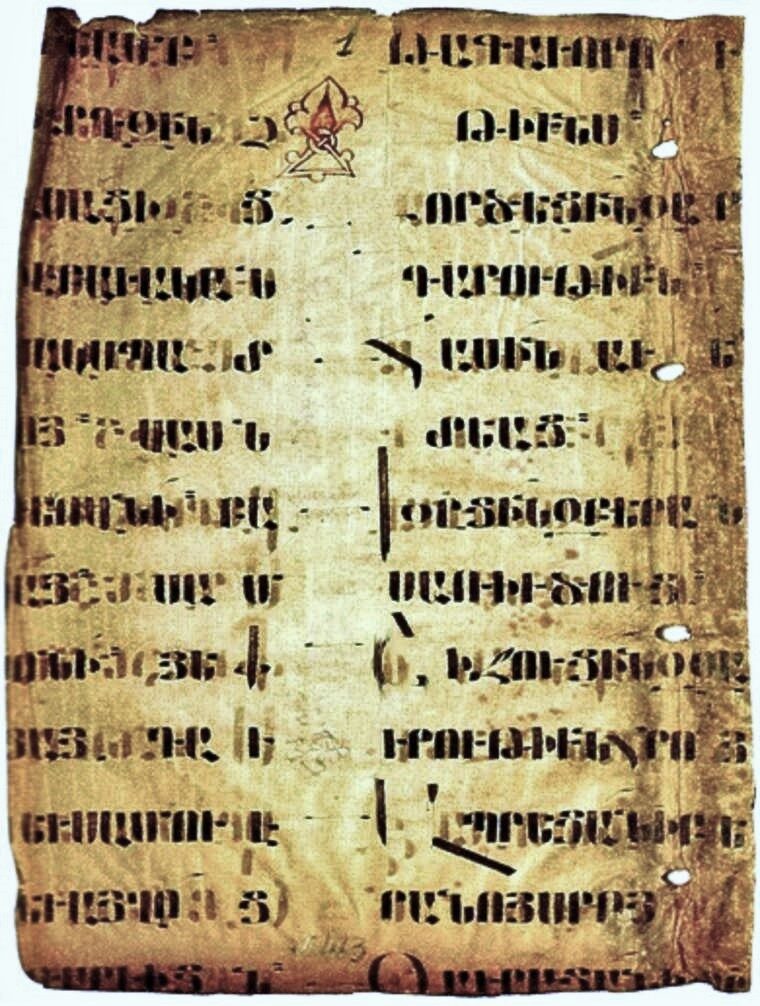

The language itself is the sole member of an independent branch of the Indo-European family, with an estimated five to seven million speakers worldwide. It has two standardised modern forms: Eastern Armenian, based mainly on the Yerevan dialect, and Western Armenian, based mainly on the Istanbul dialect. That split matters for a diaspora newsgroup, because it maps onto the diaspora itself: the republic, Russia and Iran on one side of it, and most of the communities formed after 1915 on the other.
Now the part that is checkable to the code point. The Armenian block in Unicode occupies U+0530 to U+058F. Ninety-one characters in that range are currently assigned. The Unicode Character Database's own age file dates eighty-five of them — the capitals from U+0531 ARMENIAN CAPITAL LETTER AYB through U+0556, the modifier letters and punctuation at U+0559 to U+055F, the lower case from U+0561 to the ligature U+0587 ARMENIAN SMALL LIGATURE ECH YIWN, and U+0589 ARMENIAN FULL STOP — to version 1.1, released in 1993. The rest arrived one and two at a time over the following quarter-century:
- U+058A ARMENIAN HYPHEN — version 3.0, 1999.
- U+058F ARMENIAN DRAM SIGN — version 6.1, 2012.
- U+058D and U+058E, the right-facing and left-facing Armenian eternity signs — version 7.0, 2014.
- U+0560 ARMENIAN SMALL LETTER TURNED AYB and U+0588 ARMENIAN SMALL LETTER YI WITH STROKE — version 11.0, 2018.
Five further Armenian ligatures live outside the block, at U+FB13 to U+FB17 in Alphabetic Presentation Forms, beginning with ARMENIAN SMALL LIGATURE MEN NOW.
Before Unicode there was ArmSCII, the Armenian Standard Code for Information Interchange, a family of single-byte encodings defined by Armenian national standard 166–9 and its associated documents: a seven-bit form, an eight-bit superset of ASCII intended for Unix and Windows, and a rearranged eight-bit variant intended for DOS and Mac systems. It was never widely implemented. The standard was published after ISO 10585 had already defined a different seven-bit encoding for the script; industry support did not follow; Microsoft Windows never supported it natively.
There is a harder fact behind that one, and it is decisive for anything sent over the wire. The IANA character-set registry — the list from which the charset= label on a MIME message body is drawn — currently holds 258 registered character sets. Not one of them is Armenian. ArmSCII was never registered, in any of its forms, which means that even where a correspondent's machine could produce Armenian text in it, there was no standard label by which a mail or news message could declare what it contained.
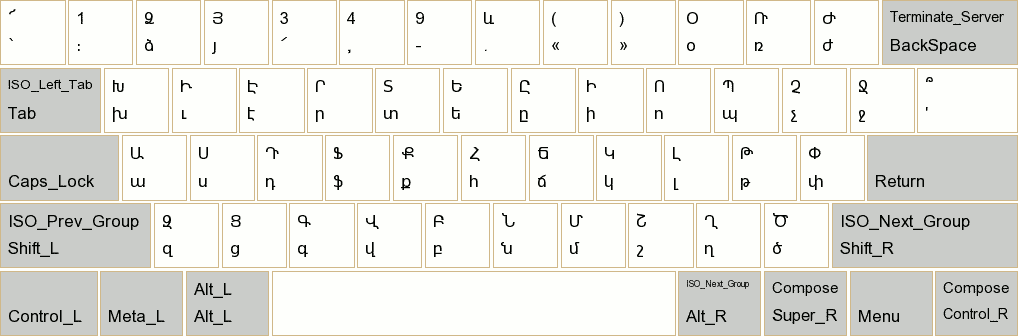

Stack that on the transport rules of the period. RFC 822, the 1982 standard for Internet text messages, defines a message body as simply a sequence of lines containing ASCII characters. RFC 1036 of December 1987, the standard for the interchange of Usenet messages, adopts the rule that all Usenet news messages must be formatted as valid Internet mail messages according to RFC 822, and is in several respects more restrictive still. MIME, which supplied the machinery for labelled character sets and encoded bodies, arrived with RFC 1341 in June 1992 and was reissued as RFC 2045 and its companions in November 1996 — the same season as this group's RFD — and adoption across news software was neither instant nor uniform. Even the modern standard, RFC 5536 of November 2009, keeps header fields in US-ASCII and requires non-ASCII to be encoded by the MIME mechanisms.
One clause of that same modern standard explains something visible on every page of this directory. A newsgroup name is a sequence of components, and a component character may only be an ASCII letter, a digit, a plus sign, a hyphen or an underscore. There has never been a point in the history of Netnews at which a group could be named in the Armenian script. The name soc.culture.armenian is in Latin letters for the same reason that soc.culture.russian and soc.culture.greek are: the wire would not carry anything else.
What none of this establishes is what any particular reader actually did. Transliteration into Latin letters, private font hacks, eight-bit text sent unlabelled and hoped for — all were common practice somewhere on the network in the 1990s, and the record for this name preserves not one line of body text from which to say which of them was used here.
The diaspora the name was addressed to
The RFD's distribution list points at mailing lists rather than at a country, and that is the right instinct for this subject. The Armenian diaspora is among the oldest and largest in the world; the majority of Armenians have lived outside the ancestral homeland since the events of 1915, and the community's institutions were built accordingly.
The figures should be attributed rather than asserted, because the counts differ and the counters differ. The CIA World Factbook has stated that widely varying estimates put the diaspora at anywhere from five to nine million, easily outnumbering the population of Armenia. Robin Cohen's Global Diasporas gives a total of 7,580,000 Armenians living abroad as of 2000, and for an earlier snapshot — 1966, some forty years after the genocide — two million in Eastern Armenia, 330,000 in Russia and 450,000 in the United States and Canada. Standard reference summaries put the number of people of Armenian ancestry outside the republic today at around five million, with the largest populations in Russia, the United States, France, Georgia, Iran, Germany, Ukraine, Lebanon, Brazil, Argentina, Syria and Turkey.
The oldest of the communities is the Armenian Quarter of the Old City of Jerusalem, in the south-western corner of the walled city, occupying about fourteen per cent of its area. Armenian presence there long predates the quarter as an administrative division: a sixth-century mosaic floor with an Armenian dedicatory inscription was excavated in the Musrara neighbourhood a few hundred metres from the Damascus Gate.
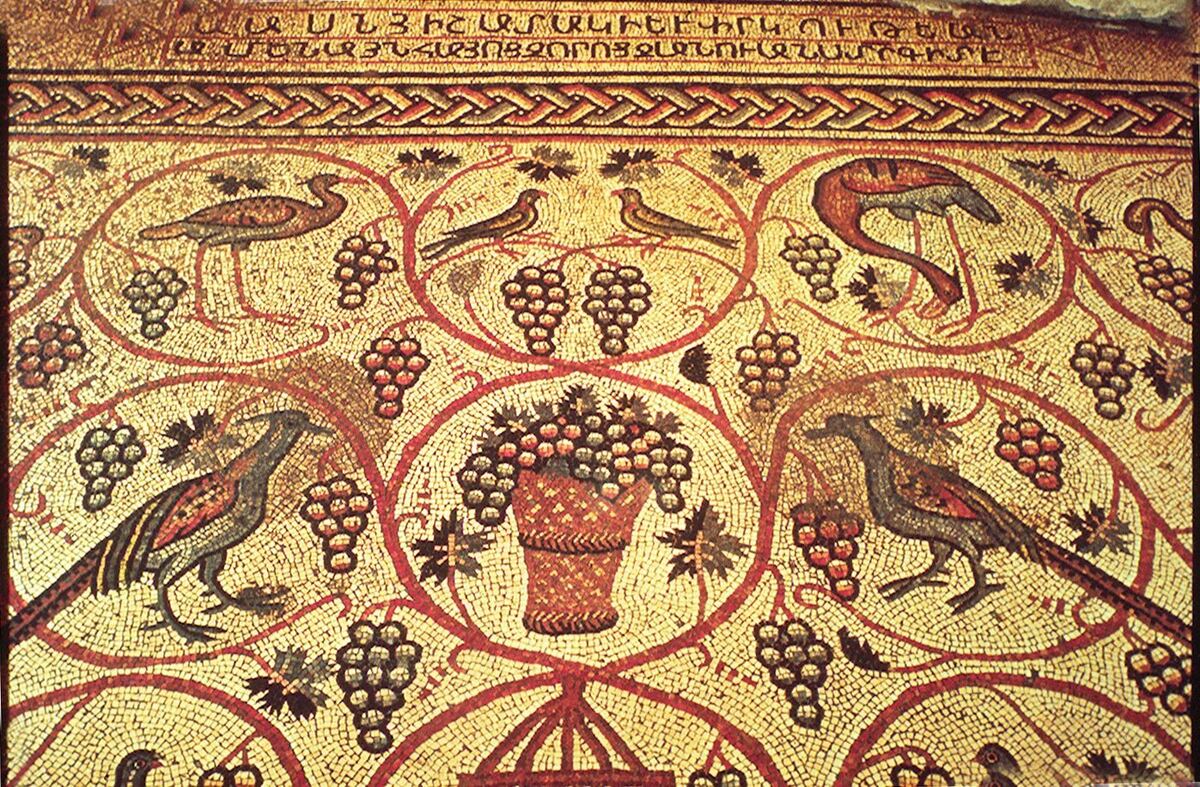

The institutions that carried the community across the twentieth century are datable and are worth naming, because they are what a diaspora newsgroup was in practice competing with and drawing on:
- The Armenian Apostolic Church, the autocephalous national church, part of Oriental Orthodoxy and one of the most ancient Christian churches; the Kingdom of Armenia is generally described as the first state to adopt Christianity as its official religion, in the early fourth century.
- The Catholicosate of the Great House of Cilicia, headquartered since 1930 at Antelias in Lebanon — an ecclesiastical centre of the post-1915 Middle Eastern communities rather than of the republic.
- The Armenian Patriarchate of Constantinople, an autonomous see whose seat is the patriarchal church in the Kumkapı neighbourhood of Istanbul.
- The Mechitarists, the Benedictine Congregation founded in 1701 by Mekhitar of Sebaste, whose presses and scholarship carried Armenian letters through the eighteenth and nineteenth centuries from outside the homeland entirely.
- The Armenian General Benevolent Union, established at Cairo in 1906, whose headquarters moved to New York with the onset of the Second World War.
To that list the 1990s added an emigration of its own, from the republic rather than from the old communities. Writing in the Bulletin of the Atomic Scientists in 1996 — contemporaneous with this group's proposal — Astghik Vardanian cited a United Nations Development Programme figure of 676,000 people, about a fifth of the population, leaving Armenia during that period, settling mainly in Russia, the United States and Israel. Whatever readership the name attracted in the second half of the 1990s was drawn from a population that was itself in motion.
The republic, as a dated chronology
The years the name was fought over were not quiet ones in the country it was named for. What follows is a chronology and nothing more: dates and documented events, with no judgement offered on any of them.
- February 1988 — the beginning of the First Nagorno-Karabakh War, dated by standard accounts from February 1988 to May 1994, between the majority ethnic Armenians of Nagorno-Karabakh, backed by Armenia, and the Republic of Azerbaijan.
- 7 December 1988, 11:41 local time — the Spitak earthquake, surface-wave magnitude 6.8, maximum intensity X on the MSK scale. Casualty estimates in the sources range from 25,000 to 50,000 dead, with up to 130,000 injured. Spitak, Leninakan (now Gyumri) and Kirovakan (now Vanadzor) were the worst affected.
- December 1988 — Mikhail Gorbachev formally asked the United States for humanitarian help within days of the earthquake, the first such Soviet request since the late 1940s; 113 countries sent aid.
- 25 February 1989 — the first unit of the Armenian Nuclear Power Plant at Metsamor was shut down, following the decision taken after the earthquake to close the plant.
- 1 December 1989 — the joint decision of the Armenian SSR Supreme Council and the Artsakh National Council on the reunification of the Armenian SSR and the Mountainous Region of Karabakh.
- 23 August 1990 — the Declaration of State Sovereignty of Armenia, signed at Yerevan.
- 21 September 1991 — the Republic of Armenia established upon the dissolution of the Soviet Union.
- 12 May 1994 — the Bishkek Protocol, a provisional ceasefire agreement signed by representatives of Armenia, Azerbaijan, the breakaway Republic of Artsakh and Russia at Bishkek.
- 26 August 1994 — the .am country-code top-level domain delegated, according to the IANA root zone database.
- 5 November 1995 — the second unit at Metsamor restarted, six years after being shut down.
The last two entries are worth reading together, because they bracket the material conditions of the group's years. A newsgroup presupposes a machine, a line and a power supply, and in Armenia between 1989 and 1995 the third of those was the constraint. The country's only nuclear plant was closed after the earthquake, and the years before its restart are the years in which the proposal for this group was drafted. The .am delegation of August 1994 marks the other end of the same story: a national namespace on a network that the country was, at that moment, in a poor position to reach.
The recognition question, as record
This section reports positions and dates. It attributes each to whoever holds it and adjudicates nothing, which is the standing rule of this directory on subjects where states legislate.
The recognition of the Armenian genocide is the acknowledgement that the Ottoman Empire's massacres and forced deportation of Armenians from 1915 to 1923 constituted genocide. Reference summaries of the scholarly literature state that outside Turkey and Azerbaijan the historical consensus is that the persecution was a genocide, citing among others Donald Bloxham, Ronald Grigor Suny, Fatma Müge Göçek and Roger W. Smith.
The scholarly bodies acted on their own account. The International Association of Genocide Scholars passed a resolution unanimously recognising the Ottoman massacres of Armenians as genocide at its conference in Montreal on 13 June 1997 — within a year of this group's RFD. In February 2002 an independent legal opinion commissioned by the Turkish Armenian Reconciliation Commission and published by the International Center for Transitional Justice concluded that the events of 1915–1918 were a genocide while holding that no legal consequences flowed from that conclusion, genocide having been criminalised in international law only after the Genocide Convention.
State recognition has been a matter of dated parliamentary acts spread over sixty years. Uruguay was the first, on 20 April 1965. Cyprus followed in 1975 and again in 1982. The Armenian SSR recognised it in 1988. Russia recognised it in 1995; Greece and Canada in 1996; Lebanon in 1997; Belgium and France in 1998; Italy and the Holy See in 2000; Germany in 2016; the United States by resolutions of both chambers in 2019 and by presidential statement in 2021. The European Parliament has adopted resolutions to the same effect in 1987, 2000, 2002, 2005 and 2015. A tally maintained in the standard reference account puts the number of states that had officially recognised the events as genocide at thirty-six as of June 2026.
Turkey's stated position is that the events of 1915 were a tragedy that resulted in the loss of many innocent lives, but that they cannot be described as a genocide; the government holds that the deportation was a legitimate state action. Azerbaijan likewise rejects the characterisation.
The subject is also, unusually, a matter of enacted and contested law in several jurisdictions, and the record there is mixed in both directions:
- Article 301 of the Turkish Penal Code, in force from 1 June 2005 and amended on 30 April 2008, makes it an offence to insult the Turkish nation; more than sixty prosecutions have been brought under it.
- A French bill criminalising denial of recognised genocides was passed in 2011–12 and ruled unconstitutional by the Conseil constitutionnel on 28 February 2012, on the ground that punishing anyone contesting the existence of crimes that lawmakers had themselves recognised was an unconstitutional attack on freedom of expression. A further French law to similar effect, adopted in 2016, was struck down by the same body in January 2017.
- In Perinçek v. Switzerland, the Grand Chamber of the European Court of Human Rights ruled on 15 October 2015 in favour of the applicant, who had been convicted by a Swiss court for publicly denying the Armenian genocide and who argued his right to freedom of expression. The judgment was welcomed by some scholars as a defence of free speech and criticised by others for the distinction it drew from Holocaust denial.
The single most documented Usenet episode connected to this subject is not a story about this group. For several months in the first half of 1994, an account posting under the name Serdar Argic replied to essentially any article mentioning Turkey with long texts denying the Armenian genocide, at a volume that ran into tens of thousands of articles and that most observers concluded was largely machine-generated. That account, and what it demonstrated about the crossposting structure of the culture branch, belongs to soc.culture.kuwait.moderated, which sets it out in full; nothing is added to it here. It is relevant to this page only as context: by the time anyone proposed a group under this name, the branch already had a documented history of this argument arriving in rooms that had not asked for it.
What the record does not show
A page of this length about a group with a hundred and twenty-one control messages and one proposal risks leaving the impression that the group is well documented. It is not. The following are all things this article would have liked to say and cannot.
- Whether anyone read it. No readership estimate, subscriber count or posting volume for this name has been found in any source consulted. The name did not exist under any procedure before April 1996, and no periodic readership report covering it has been located.
- What was discussed. Not one thread title, subject line or line of body text from the group appears in the material consulted for this page. The control archive preserves administrative messages, not articles.
- What happened to the RFD. The proposal directed discussion to news.groups. Whether it was discussed there, ignored, or argued to a standstill is not preserved in the group-creation archive, which holds the proposal and nothing after it.
- Who forged the messages. The 1998 wave carries a sign-off associated with a known Usenet harassment campaign of the period, and the 1996 forgery shares a distinctive timestamp with a forgery of another name in the same branch. Neither fact identifies a person, and the archive does not.
- How many servers carried it. That some did is certain from the fact that removals had to be repeated for two and a half years, and from this directory's own existence. How many, and for how long, is not recoverable from these sources.
- What the community made of any of it. Whether the forgeries were noticed, resented or simply used as a room is the most interesting question this page can ask and the one on which it has nothing.
One small correction of this directory's own front matter belongs here. The one-line charter at the head of this page is an editorial summary written for this archive, as the footer of every page states. The name has two documented descriptions of its own and they do not agree with each other: Armenia, its culture and history, which is the line carried by the forged creations of 1996 and 1998 and by the Netcom messages, and Armenian related discussions., which is the line the September 1996 RFD actually proposed. The second is the only one that was ever put forward by anybody entitled to put it forward, and it was never adopted.
Scope, sources and limits
Every administrative statement above was taken from primary documents fetched for this article and counted directly rather than quoted from a secondary account. The control-message figures — 121 messages, 81 creations, 40 removals, the sender addresses, the seventy-seven distinct tallies, the eighteen that fail the passing rule, the date range from 1 April 1996 to 29 November 1998 — come from the Internet Systems Consortium's control archive for the name and were derived by parsing the file. The Request for Discussion, its charter and its distribution list come from the same body's news.announce.newgroups archive, where the file for this name holds that one document. The status entry comes from the periodically posted Bogus Usenet Groups article in the same archive, and the passing rule and timetable quoted above from the Big Eight newsgroup-creation guidelines archived beside it. The current namespace and the current control-message policy come from the active, newsgroups and control.ctl files distributed from the same server.
The technical statements about the script were verified against primary standards rather than descriptions of them: the code points and their versions against the Unicode Character Database's own data files, the character-set registry against IANA's published registry, and the message-format rules against the texts of RFC 822, RFC 1036, RFC 1341, RFC 2045 and RFC 5536. Where a fact rests on an encyclopaedia rather than a standard — the dating of the alphabet, the diaspora figures, the chronology of the republic, the recognition record — it is attributed in the text to whoever established or published it, and the reader should treat the attribution as part of the claim.
The limits are the ones set out in the previous section, and they are not incidental. This is a page about a name, its paperwork and the world that paperwork points at. The room itself — if it was a room — left nothing behind that these sources preserve, and no amount of context about Armenia, the diaspora or the alphabet substitutes for that. Where this article has had to choose between a general statement that is true and a specific one that would be more interesting, it has taken the general one.
Reading soc.culture.armenian today
- Historical archive: Google Groups — soc.culture.armenian (coverage varies by group and era).
- Open in a newsreader:
news:soc.culture.armenian— the original site offered exactly this link, and it still works if your system has a newsreader registered for thenews:scheme. - Live access: point an NNTP newsreader at a modern server — see accessing Usenet today.
- The original news2mail e-mail subscription service ended in the mid-2000s and no longer operates.