soc.culture.bangladesh
Life and culture of Bangladesh.
soc.culture.bangladesh covered literature (Tagore and Nazrul quotation wars), cricket, monsoon and flood news, and the politics of the Awami League vs. BNP era.
Bangladesh had no public internet connection until 1996, and Bengali script did not travel on a network built for ASCII: two constraints on any Usenet group named for the country.
On this page
- A split argued in the group's own paperwork
- What the administrative record holds, and what it does not
- A state and a language that do not coincide
- 1947: a line through a single language
- 1952, and a commemoration the state carried to UNESCO
- 1971 on the record
- The constitution, and the periods of rule
- The delta, the rivers and the weather
- Who could post, and from where
- The keyboard problem
- The diaspora and the money it sent
- The development record, attributed
- What a culture group carried that a language group did not
- What the record does not show
- Scope and limits
A split argued in the group's own paperwork
Most pages in this directory have to reconstruct what a newsgroup was for from the outside. This one does not have to. The reason soc.culture.bangladesh exists as something distinct from its neighbour is written down, in public, in the administrative record of Usenet itself — because in 1993 and again in 1994 somebody tried to carve a second group out of the same population, and had to explain in writing why the country group would not do.
The first attempt is dated 6 January 1993. A Request for Discussion for a group to be called soc.culture.lang.bengali was posted through news.announce.newgroups and cross-posted to news.groups, soc.culture.indian, soc.culture.bangladesh, soc.culture.tamil, soc.culture.indian.telugu and alt.culture.kerala. Its proponent wrote that the group would encourage discussion on the culture of Bengali speaking people of different countries and the growth and evolution of Bengali language and literature, and set out a ten-point charter prefaced by a stipulation: It shall not discuss religious and political aspects of the Bengali populace or of the subcontinent. The introduction stated the geography plainly — Bengali, it said, is spoken predominantly in Bangladesh, where it is the state language, and in the West Bengal state of India. The proposal appears to have gone no further; no Call for Votes for that name survives in the archive.
The second attempt, nineteen months later, succeeded, and it is the document that matters here. The Request for Discussion for soc.culture.bengali was posted on 18 August 1994, again cross-posted to soc.culture.bangladesh. Its rationale contains the sentence this page exists to gloss:
Soc.culture.bangladesh, a newsgroup for and by the citizens of the country with the single largest Bengali population in the world, is inappropriate, since it's primary focus is on issues specific to Bangladesh, which generates a feeling of alienation among Indian Bengalis, particularly in view of existing political differences between New Delhi and Dhaka.
That is the split, stated by the people making it, in 1994: a state group already existed and was doing its job, and the job it was doing was the wrong shape for readers whose Bengali identity did not come with a Bangladeshi passport. The proposed charter went further and drew the boundary in the other direction as well, sending political argument back across it:
The discussion of political issues that are not of primary interest to the Bengali culture, and relates to Bengalis only as a part of a separate identity viz. their national one, is discouraged in the forum, and should take place in soc.culture.indian, soc.culture.bangladesh and/or other relevant forums.
A first Call for Votes went out on 21 September 1994 and a second on 29 September, both conducted by a neutral third party under the banner of the Usenet Volunteer Votetakers. The result was posted on 19 October 1994: unmoderated group soc.culture.bengali passes 738:41 — 738 yes, 41 no, 779 valid votes, three invalid ballots, comfortably past both the hundred-vote margin and the two-thirds supermajority the guidelines of the day required. The five-day discussion period that followed the result passed without a successful challenge and the group was created.
So the two groups are not duplicates that drifted apart. They were separated deliberately, by argument, in front of witnesses, with the state group as the incumbent and the language group as the case for the defence. Everything below follows from that division of labour. The language, the script, the transliteration problem and the literary canon shared across the border belong to soc.culture.bengali, and are treated there. What is left here is the state: its borders, its constitution, its elections, its rivers, its economy, its cricket team, and the long argument about how it came to exist.
What the administrative record holds, and what it does not
The Bangladesh group's own paperwork is thinner than its neighbour's, and thin in an informative way. The Internet Systems Consortium mirrors the Usenet administrative archive, and for soc.culture.bengali it holds the complete file: the Request for Discussion, both calls for votes, the result and the full roll of voters. For soc.culture.bangladesh there is no such file at all. No RFD, no CFV, no result, no tally; a request for one returns nothing. The group predates the portion of the record that survives in that collection.
What does survive is the control-message archive, and it is worth reading closely because it is almost entirely made of copies. The file opens with a curiosity of Usenet housekeeping: a newgroup control message whose Date header reads 31 December 1969 at 23:59:59, one second before the Unix epoch, and whose own Comments header explains why: this header was wholly fictionally created on 7 Jan 1993 by [email protected]. Its body carries a purpose statement in the format used by the periodic checkgroups postings:
Purpose: To provide a forum for issues relating to Bangladesh and its culture. Moderated: No.
This is the moderator of news.announce.newgroups back-filling a synthetic creation record for a group whose real one had been lost, and dating it to the beginning of computable time rather than pretend to a date he did not have. It is a small, honest piece of archival practice, and it is the closest thing to a birth certificate this group has.
The earliest real item is dated 23 May 1991: a newgroup control message from a machine at a company in Wakefield, Massachusetts, with a world distribution and a one-line body, Issues & discussion about Bangladesh. After it come five more newgroup messages — from Magdeburg in June 1991, from the University of Maine in April 1992, from Lakehead University in June 1992, from a small site in Alberta in April 1993 and from a hospital network in Italy in June 1998 — each with a local distribution (UniDo, umcs, lu, vort, collabra-internal), each an administrator re-issuing the creation locally so that his own server would carry a group the rest of the network already had. None of them is the original.
The last entry in the file is dated 4 November 2001 and goes the other way: a forged rmgroup, asking administrators to please remove the bogus newsgroup soc.culture.bangladesh, posted through a Quebec news server, carrying a header arrangement that folds the control line into an X-No-Archive header, with a randomly generated signature beneath it. Forged rmgroups against Big-8 groups were a recurring nuisance of that period and were routinely ignored by news administrators, whose servers were configured to honour only authenticated control messages for the hierarchy. The group was not removed. It appears in the current newsgroups file exactly as it appeared in 1991:
soc.culture.bangladesh Issues & discussion about Bangladesh.Two things follow. First, the group was unmoderated for its whole life — the checkgroups entry says so, and no moderation notice exists — so nothing was vetted before the network saw it, and the tone was set entirely by whoever kept turning up. Second, it was created early. The country groups of soc.culture.* were voted into being through the late 1980s and early 1990s, in the namespace the Great Renaming of 1987 had laid out, and the Bangladesh group was already in the newsgroups file by May 1991 and already carrying traffic in volume by January 1993. It was one of the first, not one of the later ones.
There is one further piece of evidence, and it needs handling with care. The five proposal and result postings quoted above were archived with their Xref headers intact — the line in which a news server records the article number it has assigned each message in each group. On the uunet spool, soc.culture.bangladesh was article 10061 on 6 January 1993, 22771 on 18 August 1994, 23697 on 21 September 1994, 23845 on 29 September 1994 and 24174 on 19 October 1994. Those are one server's local counters, they include cross-posts, and they say nothing about how many readers there were. But they are consecutive, they come from the same spool, and the arithmetic between them is real: 12,710 articles were numbered into that group in the 589 days from January 1993 to August 1994, about twenty-two a day, and 477 in the twenty-eight days of the autumn 1994 voting period, about seventeen a day. That is not a quiet group. It is the only quantitative statement about this group's traffic that can be made from a primary source, and it should not be pushed further than that.
A state and a language that do not coincide
The reason a language group and a state group could both be argued for is arithmetical, and the figures are worth setting out precisely, because the usual shorthand — that Bengali is the language of Bangladesh — is true and misleading at the same time.
Bengali is among the most widely spoken languages on earth: recent compilations put first-language speakers at roughly 242 million and total speakers, including second-language users, at around 284 million. Bangladesh is one of its two homes. It is the state and national language there, and about 98 per cent of the population speaks it as a first language. The country recorded 106,314,992 people at the 1991 census and 124,355,263 at the census of 2001; the 2022 census returned 169.8 million, which makes it the eighth most populous country in the world and the most densely populated large country in it, at some 1,265 people per square kilometre in 2020.
The other home is across the border, and it is not small. In the 2011 Census of India, 97,237,669 people returned Bengali as their mother tongue — 8.03 per cent of India's population, second only to Hindi; counting those who gave it as a second or third language brings the total to 107,472,243. The same series records 69,595,738 Bengali speakers in 1991 and 83,193,311 in 2001. To put the 2011 number the way the group's own readers would have: there were more Bengali speakers inside India than there were people in Germany, or Egypt, or Vietnam. India is not a place where Bengali happens to be spoken. It is one of the two places where Bengali lives, with official status in West Bengal, in Tripura and in the Barak Valley of Assam.
Two homes, and the border between them was drawn on a different principle from the language. That is the structural fact of this page and the structural fact of the argument that produced the 1994 vote. A Bengali speaker in Calcutta and a Bengali speaker in Dhaka share a script, a literature and a new year; they do not share a passport, a constitution, an army, a currency, a cricket board or a national anthem — and in one famous exception they very nearly share the last of those, since Rabindranath Tagore wrote the words of the anthems of both India and Bangladesh.
The division of this directory follows the division the posters made. Where a subject belongs to the language and its speakers wherever they are — the script on a seven-bit network, the transliteration schemes, the shared canon, the festivals kept on both sides — it is covered at soc.culture.bengali and is only touched on here. Where a subject belongs to the state — how it was made, how it is governed, what it exports, who leaves it and what they send back — it is covered here. The continent-wide questions, and the general problem of non-Latin scripts on Usenet, sit at soc.culture.asian.
1947: a line through a single language
The border begins in 1947. The partition of Bengal divided the British Indian province along the Radcliffe Line, between the Dominion of India and the Dominion of Pakistan: the Hindu-majority west became the Indian state of West Bengal, the Muslim-majority east became East Bengal, a province of Pakistan separated from the rest of that country by about a thousand miles of India. A referendum in Sylhet on 6 July 1947 severed that district from Assam and attached it to East Bengal, which is why so much of the later British Bangladeshi migration traces back to one corner of the map. The province was renamed East Pakistan in 1955 under the One Unit scheme.
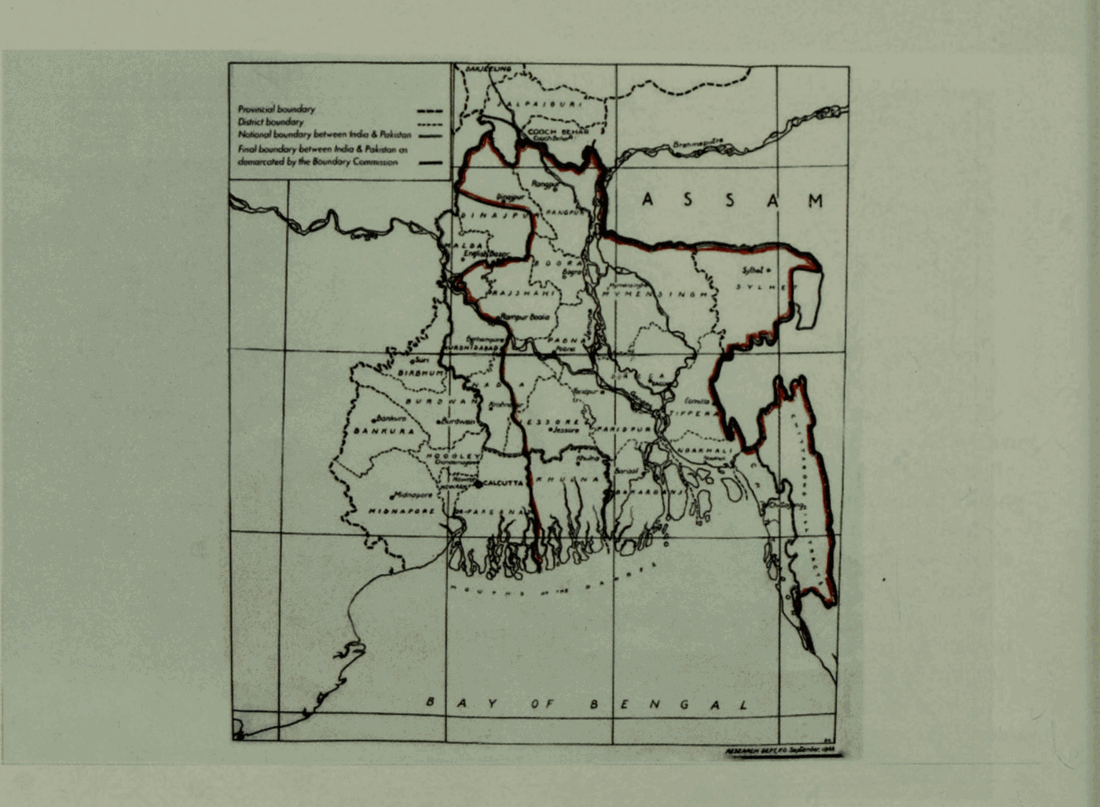

The consequence for the group's subject matter is direct. The new state was defined by religion and contained the majority of the population of Pakistan, while the capital, the army command and the civil service sat in the western wing. Bengali speakers found themselves the demographic majority of a country whose language of state was to be Urdu, and the argument that followed — conducted first over language, then over autonomy, then over everything — is the thread that runs through 1952, 1966, 1970 and 1971 and out the other side into the politics the newsgroup was reading in the 1990s.
Partition also seeded the diaspora question. Bengali-speaking populations moved in both directions in 1947 and again in 1971, which is why the Indian census counts large Bengali populations far from West Bengal, and why family migration stories were a recurring register in both groups. The best-documented version of that story from the language side is at soc.culture.bengali; what belongs here is the harder-edged fact that after 1947 the same language had two governments, and after 1971 it had two governments and a war between them in living memory.
1952, and a commemoration the state carried to UNESCO
The events of 21 and 22 February 1952 in Dhaka — the police firing on a student demonstration for the official status of Bengali, and the dead it produced — are the language movement's, and are set out in the dated record at soc.culture.bengali. What belongs to a state group is the second half of that story: what the state, and the states before it, subsequently did with the date.
The constitutional half came first. On 7 May 1954 the constituent assembly of Pakistan resolved, with the Muslim League's support, to grant official status to Bengali, and the first constitution of Pakistan, enacted on 29 February 1956, made Bengali an official language of the country alongside Urdu in article 214(1). The commemorative half is written in concrete. Students of Dhaka Medical College put up a monument on the site in February 1952; the police demolished it within days. The permanent Shaheed Minar, designed by the sculptors Hamidur Rahman and Novera Ahmed, was begun in November 1957, halted when martial law was declared, and eventually built to a 1963 design; it was destroyed by Pakistani forces during the 1971 war and rebuilt in 1972, and replicas of it now stand in towns across the country and wherever the diaspora is thick enough to raise one. From a one-day bookstall set up on Bangla Academy premises on 21 February 1972, the Amar Ekushey Book Fair grew into a month-long state-organised event on the same ground, run by the academy under the Ministry of Culture.
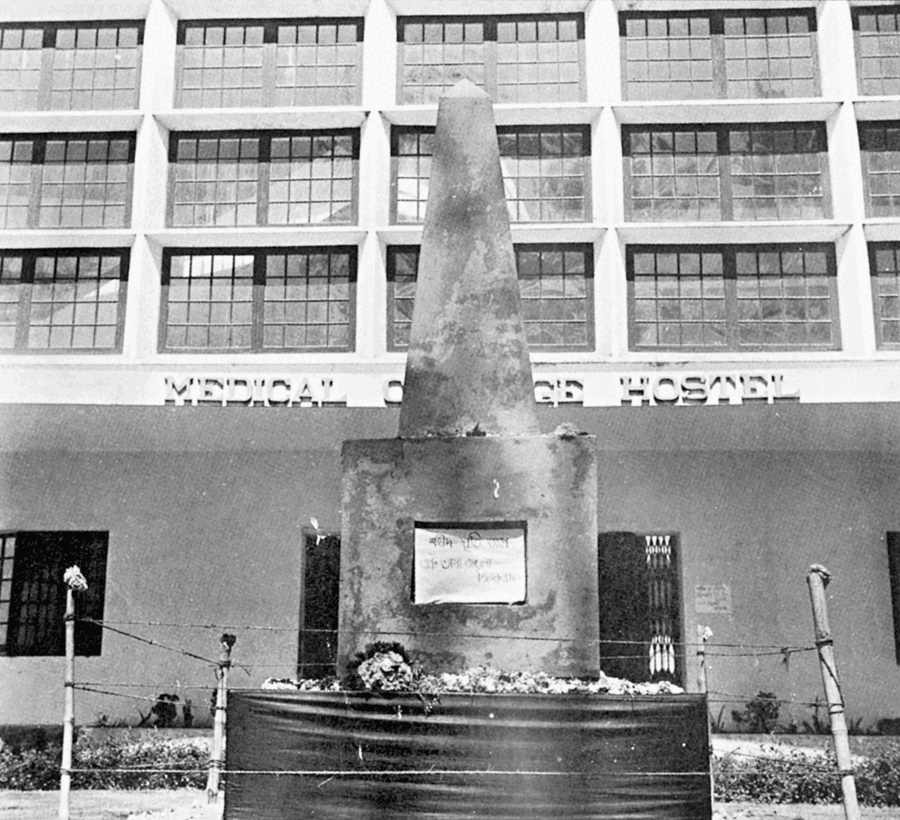

After 1971 the date became a national observance of independent Bangladesh, and it acquired an international career in the late 1990s by a route that runs directly through the population this newsgroup was written by. On 9 January 1998 Rafiqul Islam and Abdus Salam, two Bengalis living in Vancouver, wrote to the Secretary-General of the United Nations proposing an international day for mother tongues, with 21 February as the date, in commemoration of the 1952 killings. The proposal was introduced in the Bangladeshi parliament, taken up formally by the government and submitted to UNESCO, where it was shepherded through the machinery by Bangladesh's permanent representative to the organisation and his predecessor.
The thirtieth session of the UNESCO General Conference resolved on 17 November 1999 that 21st February be proclaimed International Mother Language Day throughout the world to commemorate the martyrs who sacrificed their lives on this very day in 1952. It was first observed internationally on 21 February 2000, and the United Nations General Assembly gave the day formal recognition in 2002 with resolution 56/262. All three of those dates fall inside the years this gateway was running, and the first of them — a letter from two expatriates in Canada that became a state proposal and then a global observance — is as good a demonstration as the period offers of what a diaspora with a postal address and an internet connection could do to the calendar.
1971 on the record
This section reports. It does not adjudicate. The events of 1971 are characterised very differently in Bangladesh and in Pakistan, including on the central question of whether they constituted genocide, and the published casualty estimates differ from one another by more than an order of magnitude. What follows gives the documented sequence, then the estimates attributed to the bodies and scholars who produced them, with their ranges stated as ranges. The Pakistani record of the same events is the subject of soc.culture.pakistan and is not retold here.
The sequence. Pakistan's first direct general election was held on 7 December 1970, for 300 general constituencies of which 162 lay in East Pakistan. The Awami League won 160 of those 162 seats and all seven women's seats reserved for the province, giving it an absolute majority in the National Assembly; the Pakistan Peoples Party won 81 general seats, all in the west. The National Assembly was not convened. On 25 March 1971 the Pakistan Army launched Operation Searchlight in East Pakistan; independence was declared on 26 March; the Awami League was banned and martial law declared. Nine months of fighting followed between the Pakistan Army and allied militias on one side and the Mukti Bahini on the other. India entered the war on 3 December 1971. On 16 December 1971 the commander of Pakistani forces in the east signed an instrument of surrender in Dhaka. The Bangladesh Liberation War is dated 26 March to 16 December 1971 and Bangladesh has kept those two dates as Independence Day and Victory Day ever since.
Displacement is the least contested of the numbers. An estimated 10 million refugees crossed into India during 1971, and an estimated 30 million people were displaced inside East Pakistan. After the surrender India held some 92,000 to 93,000 Pakistani prisoners of war and released them over the following two years; 195 of them had been identified as suspects in war crimes, and under the tripartite Delhi Agreement of 1974 they were repatriated rather than tried, in return for Pakistan's recognition of Bangladesh, which followed that year.
The death toll is contested, and the published figures should be read with their sources attached:
- Bangladeshi authorities have maintained that as many as three million people were killed. That figure is embedded in Bangladeshi official commemoration, literature and school teaching.
- The Hamoodur Rahman Commission, the judicial inquiry set up by the government of Pakistan under the chief justice of its Supreme Court, which examined nearly 300 witnesses and delivered its supplementary report on 23 October 1974, put the figure at 26,000 civilian casualties. It is the lowest published estimate, and it came from the Pakistani state's own inquiry.
- Midway through the nine months, the United States Central Intelligence Agency and State Department made a conservative estimate of 200,000 killed.
- A population survey conducted in Matlab in 1976 by the International Centre for Diarrhoeal Disease Research recorded 868 excess wartime deaths in the surveyed area, from which an overall excess of nearly 500,000 deaths across the country was extrapolated. A 2008 study in the British Medical Journal by Ziad Obermeyer, Christopher Murray and Emmanuela Gakidou, built on that survey, estimated 125,000 to 505,000 civilian deaths.
- A 2018 paper by the historian Christian Gerlach concluded that overall deaths in East Pakistan in 1971–72 slightly exceeded half a million and could not have exceeded one million, and that many of those deaths came from hunger, want and exhaustion, a number of them in the year after the fighting.
- Sarmila Bose's 2011 book Dead Reckoning put the figure between 50,000 and 100,000; the book drew strong criticism from journalists and academics working on the period.
- Estimates of the number of women raped during the war run, in the published literature, from 200,000 to 400,000.
Reference works accordingly give the range as 300,000 to 3,000,000, which is another way of saying that the arithmetic is unsettled and that every figure in it carries an argument behind it.
The characterisations attached to those numbers differ as sharply as the numbers do. In Bangladesh the events are described officially and popularly as a genocide; the term is standard in Bangladeshi law, commemoration, scholarship and public discourse, and Bangladesh has sought international recognition of it as such. A substantial scholarly literature outside both countries uses the same term, and United States diplomats in Dhaka used it in cables at the time. The government of Pakistan has consistently declined to: successive statements have expressed regret for what happened in 1971 without accepting the characterisation, and a foreign ministry statement of 30 November 2015 rejected any Pakistani complicity in atrocities. Pakistan's own commission held the military responsible for widespread atrocities in East Pakistan and recommended that named senior officers be publicly tried, while also recording testimony of inhumane treatment of West Pakistani service families by Bengalis; estimates of Bihari civilians killed by Bengalis range from about a thousand, on the Minorities at Risk project's figure, to the 500,000 claimed by Bihari representatives. Numerous figures in Pakistani public life have called for an unconditional apology and an acknowledgement. This page records that these positions exist and that they conflict. It reaches no finding between them.
Two further points bear directly on why 1971 was live traffic in the 1990s rather than settled history. The first is documentary. The Hamoodur Rahman Commission's report was classified on delivery and suppressed for a generation; press reporting in Pakistan in the 1990s revealed that it was being held at military headquarters in Rawalpindi, and its contents were published by Dawn and India Today in August 2000, with the government releasing the report the same year. A newsgroup running in 1999 was arguing about a document nobody outside a very small circle had read; a newsgroup running in 2001 was arguing about one that had just appeared in the newspapers. The second is prosecutorial. India was investigating senior Pakistani officers with a view to war-crimes trials as early as 22 December 1971; Bangladesh announced in February 1972 that it would try a hundred of them; none of those trials happened. Bangladesh's own International Crimes Tribunal, which prosecutes wartime collaborators rather than Pakistani officers, was not established until 2009, after this gateway had closed. Through the whole of the newsgroup's active life, therefore, the question of whether anyone would ever be tried for 1971 was open, unresolved and domestically explosive — which is precisely the condition under which Usenet arguments last for years.
The constitution, and the periods of rule
The Constitution of Bangladesh was adopted by the constituent assembly on 4 November 1972 and came into effect on 16 December 1972, the first anniversary of the surrender. It established a unitary parliamentary republic on a Westminster model, declared Bengali the state language, and named four fundamental principles of state policy: nationalism, socialism, democracy and secularism. Those four words, and what later happened to one of them, supplied one of the group's most durable arguments.
The national anthem entered the constitution at the same moment. Amar Sonar Bangla, whose words Tagore is conventionally said to have written in 1905, the year of the first partition of Bengal — though the original manuscript has never been found and the date is disputed — was adopted provisionally by the provisional government on 10 April 1971 and became official with the constitution on 16 December 1972; only the first ten lines are sung. Objections to it have recurred at intervals ever since, on several distinct grounds: that its imagery is religiously Hindu, that it was written by a poet who was never a Bangladeshi citizen, that it addresses an undivided Bengal rather than the state that sings it, and that it was adopted under Indian influence. The state's dealings with the other national poet were more direct still: Kazi Nazrul Islam, by then long silenced by illness, was brought from India to Dhaka on 24 May 1972 with the consent of the Indian government, given the status of national poet, granted Bangladeshi citizenship on 18 February 1976, and after his death on 29 August 1976 buried beside the central mosque of Dhaka University, as a line of his own had asked. The literary standing of both poets belongs to soc.culture.bengali; what belongs here is that both were adopted as instruments of state, and that adopting them was itself contested.
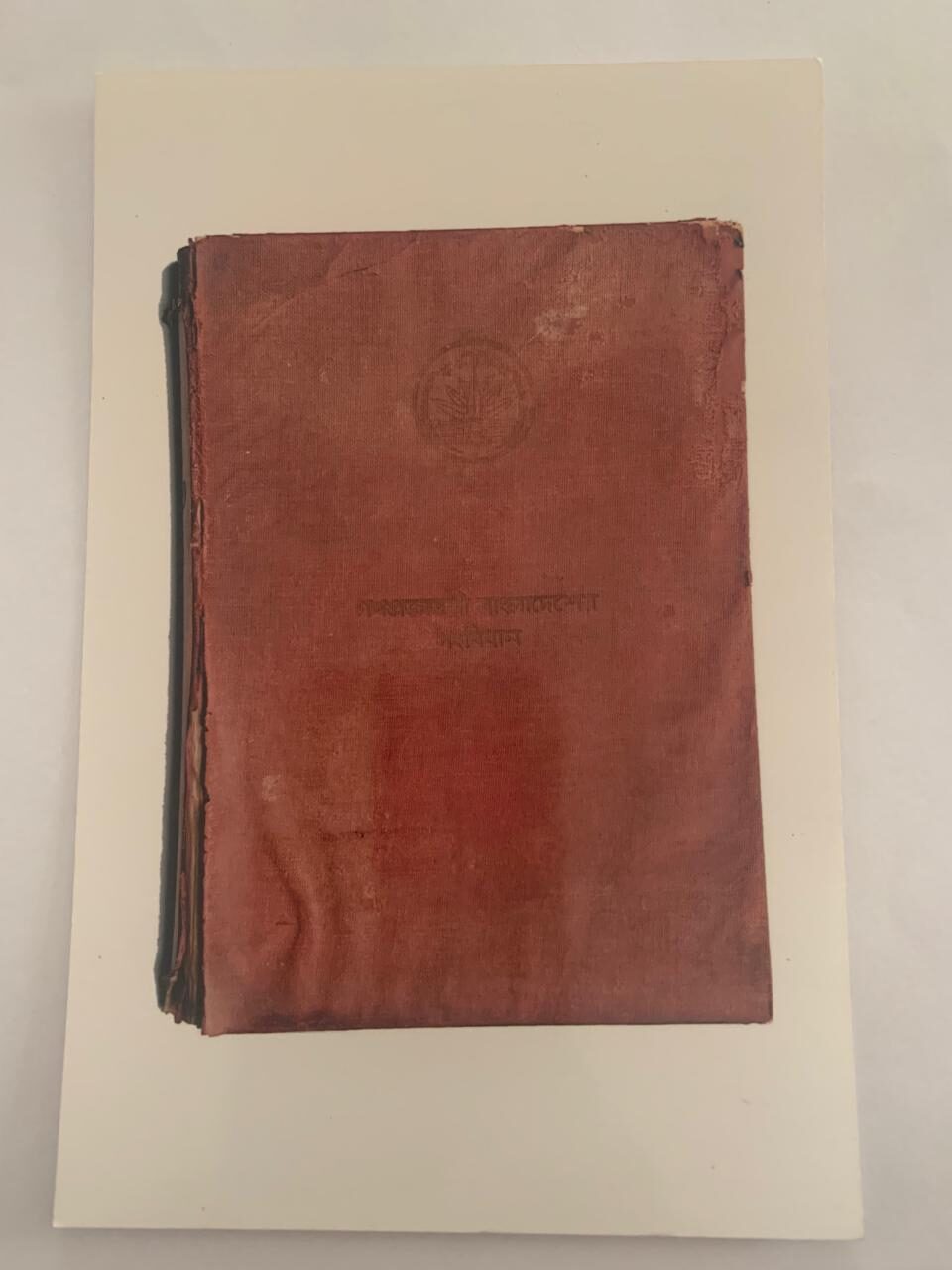

The constitutional history that followed is a sequence of dated amendments, and having them in one place is more use than any characterisation of them:
- 15 August 1975 — the founding president is assassinated; constitutional rule is suspended and martial law declared, and successive proclamation orders amend the constitution between 1975 and 1979.
- 6 April 1979 — the Fifth Amendment validates every amendment, order and proclamation made by the martial-law authorities between 15 August 1975 and 9 April 1979, and places them beyond challenge in any court. The Supreme Court struck it down in 2010.
- 24 March 1982 — a further coup; Hussain Muhammad Ershad, president from 1983, governs until 1990.
- 11 November 1986 — with constitutional rule restored, the Seventh Amendment validates the proclamations, martial-law regulations and orders issued between 24 March 1982 and 11 November 1986, protecting the outgoing regime from prosecution for acts committed under military rule.
- 9 June 1988 — the Eighth Amendment declares Islam the state religion, inserting Article 2A, and decentralises the judiciary by creating six permanent High Court benches outside Dhaka. The judgment in the case challenging it, Anwar Hussain v. Bangladesh, is among the best known in Bangladeshi constitutional law.
- 6 December 1990 — Ershad resigns after weeks of mass protest.
- 27 February 1991 — a general election returns the Bangladesh Nationalist Party as the largest party with 140 of 300 directly elected seats; it forms a government with the support of Jamaat-e-Islami, and Khaleda Zia becomes prime minister in March.
- 18 September 1991 — the Twelfth Amendment, passed after a referendum, moves executive authority from the president to the prime minister and makes the cabinet answerable to parliament, restoring the arrangement of the 1972 text.
- 15 February 1996 — a general election boycotted by the main opposition parties records a turnout of about 21 per cent, the lowest in the country's history; the governing party wins 278 of the 300 directly elected seats and the administration lasts twelve days.
- 28 March 1996 — the Thirteenth Amendment institutes non-partisan caretaker governments to hold general elections, with a chief adviser appointed by the president and the election to follow within ninety days.
- 12 June 1996 — a fresh election, held under the first caretaker administration, is won by the Awami League; Sheikh Hasina is invited to form a government on 23 June.
- 1 October 2001 — the second election held under a caretaker government; 1,935 candidates from 54 parties and 484 independents contest 300 seats. The Bangladesh Nationalist Party returns to office.
Two features of that list explain a great deal about the group's traffic. The first is that in the eleven years from 1990 the country moved from military rule to a parliamentary system and then invented an institution — the caretaker government — specifically to make elections credible to people who did not trust the incumbent to run them. The second is that the constitution's founding secularism and its later declaration of a state religion sat in the same document at the same time, which is the sort of unresolved provision that produces argument indefinitely. Religion and secularism, and where the boundary of permissible expression lay, were among the group's standing subjects; the international controversy of 1994 around the writer Taslima Nasrin, who left the country under threat, ran through it as it ran through every Bengali forum of the day, and the underlying disagreement — between readers who saw blasphemy and readers who saw a writer being silenced — outlasted the headlines by years. This page takes no view on the merits.
The delta, the rivers and the weather
Bangladesh occupies the delta of the Ganges, the Brahmaputra and the Meghna, three of the largest river systems in Asia arriving at the sea through one flat country. That geography produces two categories of recurring news, and both of them turned a scattered discussion group into a clearing-house faster than anything else could.
The first is disaster. The cyclone of 29 April 1991 came ashore on the south-eastern coast near Chittagong at high tide, with peak winds the India Meteorological Department put at about 235 kilometres per hour and a storm surge of six metres; at least 138,866 people died, and it remains among the deadliest tropical cyclones in recorded history. The flood of 1998 ran from July to September, after continuous rainfall in the upstream catchments of all three river systems, and put water over roughly two-thirds of the country. On the official statistics compiled by ActionAid and reported at the time in the British press, some 25 million people were displaced and 1,050 died, of whom 360 deaths were attributed to drowning, snake bite and waterborne disease; 30 million people were affected in total; between 32 and 45 of the country's 64 districts were hit, Dhaka among them; 800,000 hectares of farmland were affected and 575,000 hectares of crops destroyed, and 300,000 tube wells were damaged. The International Centre for Diarrhoeal Disease Research in Dhaka reported an average of 700 patients a day at the height of it, most of them children. Britain contributed 21 million pounds in relief; more than a million tonnes of food aid were pledged internationally.
For a newsgroup written mostly from abroad, an event of that scale produced a very specific kind of traffic: word of particular districts, requests for news of particular towns, and the mechanics of getting money home quickly through channels that were slow at the best of times. The remittance section below is the other half of that story.
The second category is water as a standing dispute rather than an event. The Farakka Barrage, built across the Ganges in the Indian state of West Bengal a short way upstream of the Bangladeshi border, was begun in 1961 and came into operation in the 1970s; it diverts water into a feeder canal 38 kilometres long that carries it to the Bhagirathi-Hooghly, principally to flush silt from the port of Kolkata. The consequences for dry-season flow into Bangladesh have been argued between the two governments for the better part of fifty years. A five-year sharing treaty signed in 1977 expired in 1982 unrenewed. A comprehensive thirty-year treaty was signed in New Delhi on 12 December 1996, recognising Bangladesh's rights as a lower riparian and setting out a schedule for dividing the flow at Farakka. It was attacked domestically by the opposition of the day as insufficient, though that opposition did not renege on it when it took office in 2001; on the Indian side the complaint is that the allocation leaves too little for the harbour the barrage was built to serve. Farakka is the standing example of a grievance durable enough to survive the treaty meant to settle it, and it is one of the few subjects on which the Bangladesh group and its Indian neighbour reliably found something to disagree about.
The other territorial settlement of the period was internal. On 2 December 1997 the government and the Parbatya Chattagram Jana Samhati Samiti signed the Chittagong Hill Tracts Peace Accord, ending an insurgency that had run since the 1970s; it recognised the distinct ethnicity and special status of the peoples of the region, created a regional council drawn from the three district councils, and established a ministry for tribal affairs to be headed by a person of tribal ethnicity. It was objected to from opposite directions at once — as conceding too much, and as remaining largely unimplemented — and both objections were still being made when the group went quiet.
Who could post, and from where
A newsgroup named for a country was, for most of its life, written from almost anywhere but. The connectivity record is dated and unforgiving.
From the early 1990s Bangladesh had dial-up access to electronic mail through the bulletin-board systems of a handful of local providers. Users were charged by the kilobyte, and mail was exchanged with the rest of the world by international dial-up over UUCP — store-and-forward batches carried on a metered trunk call, not a live link. The national user base did not exceed about 500 people. In June 1996 the country's first VSAT data circuit was commissioned and the Bangladesh Telegraph and Telephone Board licensed two internet service providers. Liberalisation followed: over 180 registered providers by 2005. Subscriptions grew from 186,000 in 2000 to 617,300 in 2009, which was still only about 0.4 per cent of the population. Abundant capacity waited until May 2006, when Bangladesh was connected to submarine fibre for the first time through the sixteen-country SEA-ME-WE 4 consortium, with a landing station at Cox's Bazar.
The country-code domain arrived late and can be dated exactly. The IANA root database records .bd as registered on 20 May 1999, three years after the first commercial providers opened, and lists the manager as the Posts and Telecommunications Division of the government of Bangladesh, with the technical contact at the state telecommunications company in Dhaka. The neighbouring delegation, .in, dates from 8 May 1989. Ten years separate them.
The consequence for this archive is the same as for its neighbour, and the neighbour states it with the full run of comparative penetration figures at soc.culture.bengali. In short: for the whole of this group's first decade, a post written in Dhaka was the hard case and one written from a university building in North America, Britain or Australia was the easy one. In the early 1990s a network account came bundled with a university department or a technical employer, so the first cohort was drawn from Bangladeshis studying and working abroad. That cohort did not map onto emigration as a whole — the largest Bangladeshi migrant populations of the period were labour migrants in the Gulf, and a construction camp came with no news server. What the archive preserves is a particular and comparatively privileged slice of the diaspora, and the asymmetry only eased as the country came online at the end of the decade, by which time Usenet's own era was closing.
The keyboard problem
The Bengali script on a seven-bit network is the language group's subject and is treated at soc.culture.bengali. What belongs to a state group is narrower and more concrete: the question of how, on a machine in Dhaka or a machine in New Jersey, a person actually got Bengali letters out of a keyboard — and the fact that Bangladesh spent decades failing to agree on the answer, in public, with standards bodies involved.
The dispute has a founding artefact and a grim footnote. In 1965 the Dhaka University professor and playwright Munier Choudhury redesigned the layout of the Bengali typewriter in collaboration with the Remington typewriter works in what was then East Germany. The resulting machine, the Munier-Optima, became the most used typewriter in Bangladesh, and its key arrangement became the ancestral layout that later software developers implemented on computers — it is still available in a Unicode-optimised form. Its designer was killed on 14 December 1971, in the killing of Bengali intellectuals in the last days of the war. The layout that anchors Bangladeshi Bengali typing is therefore, quite literally, a relic of the war argued about two sections above.
Computer layouts began in 1985 with Shahidlipi, the first Bengali keyboard developed for a computer, a phonetic layout mapped onto QWERTY for the Macintosh, carrying about 182 characters and partial conjuncts across four levels. It was displaced by Bijoy, a proprietary layout and software package published for Windows in March 1993 and for the Macintosh in December 1998, which became the dominant way of setting Bengali type in Bangladesh for the whole of the newsgroup's active life. Three properties of it matter for a Usenet poster. It was licensed per machine and had to be bought for each computer it ran on. Its character handling was built on an ASCII mapping rather than on Unicode, so its vowel-sign and conjunct input conventions differ from the Unicode ones. And it was one of several: by the early 2000s Bijoy, Bashundhara, Munier, Borno and Lekhoni were all in use in the country at once, on incompatible arrangements.
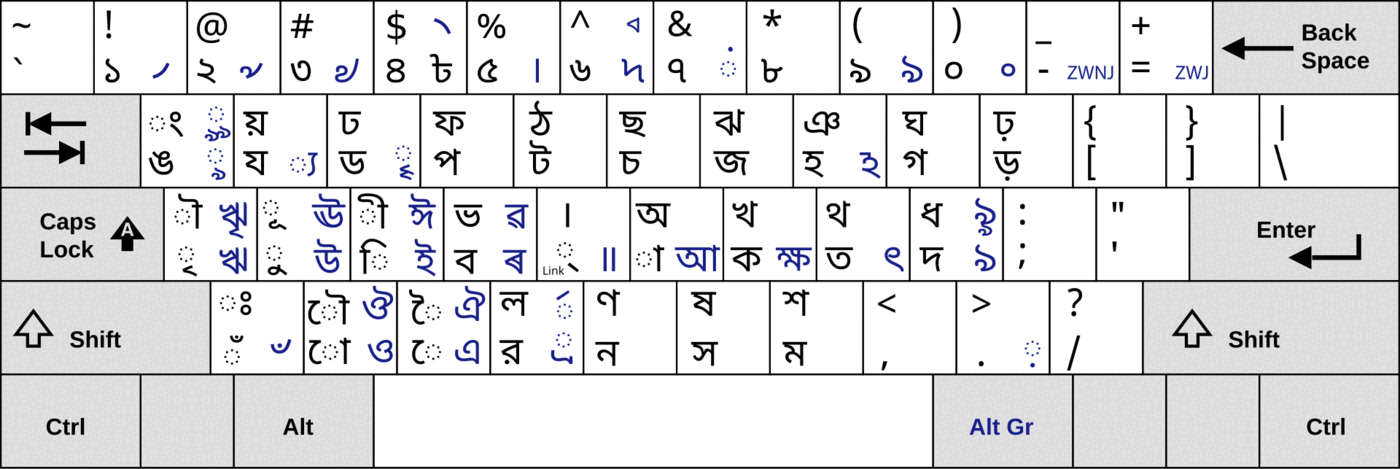

The standardisation attempt is documented and did not go smoothly. In 2004 an initiative was taken to produce a national Bengali computer keyboard precisely because of the multiplicity of existing ones. The Bangladesh Computer Council — a statutory body established by parliament under Act No. IX of 1990 — reviewed the layouts in circulation and formulated the Jatiyo, or National, layout, arranging letters, symbols and ligatures across four levels with the most frequent on the first two. The Bangladesh Standards and Testing Institution declared it the national standard as Bangladesh Standard BDS 1738:2004. The Council subsequently modernised it and the standards institution approved the revision as BDS 1738:2018. In between, in 2017, the Council announced the most widely used layout — the proprietary Bijoy — as the national keyboard layout. A national standard, a revised national standard, and an intervening declaration in favour of the incumbent it was meant to replace: the record shows a dispute, not a settlement, and none of it was resolved while the newsgroup was running.
The free Unicode alternatives arrived at the very end of the group's life. Akkhor was first released on 1 January 2003. Avro Keyboard, which offers phonetic entry — the user types Bengali in Latin letters and the software converts — alongside fixed layouts, was published on 26 March 2003, a date chosen because it is Bangladesh's Independence Day; it is described as the first free Unicode and ANSI compliant Bengali keyboard interface for Windows, and a Linux version followed in 2012 under the Mozilla Public License. The UniJoy layout, standardised for Unicode by the Ekushey project, was added to the m17n input database on 7 December 2005. The Bengali InScript layout, designed so that all Indic scripts share one arrangement, was adopted by Microsoft and shipped by default in Windows; it is used mainly in India, which meant that an Indian Bengali and a Bangladeshi Bengali typing the same word were, as often as not, using entirely different keys to do it.
So: what did a poster to this group actually have to do? Through the 1990s, the honest answer is that they mostly did not type Bengali at all. Typing it meant buying a licence for software that produced bytes a mail gateway would mangle, in a layout the recipient's machine probably did not have; reading it meant the same problem in reverse. The rational move was to write Bengali in Latin letters and English in English, which is what the archive is full of. The equipment to do better existed from 2003; the audience had largely gone by then. That is the shape of the whole story, and it is why a search of this group's archive in Bengali script returns almost nothing.
The diaspora and the money it sent
The notice-board sat on top of a migration economy with a distinctive shape, and it is the most checkable thing about this group's world. The International Organization for Migration counts almost 8.7 million Bangladeshis living abroad, the sixth-highest country of origin for international migrants in the world.
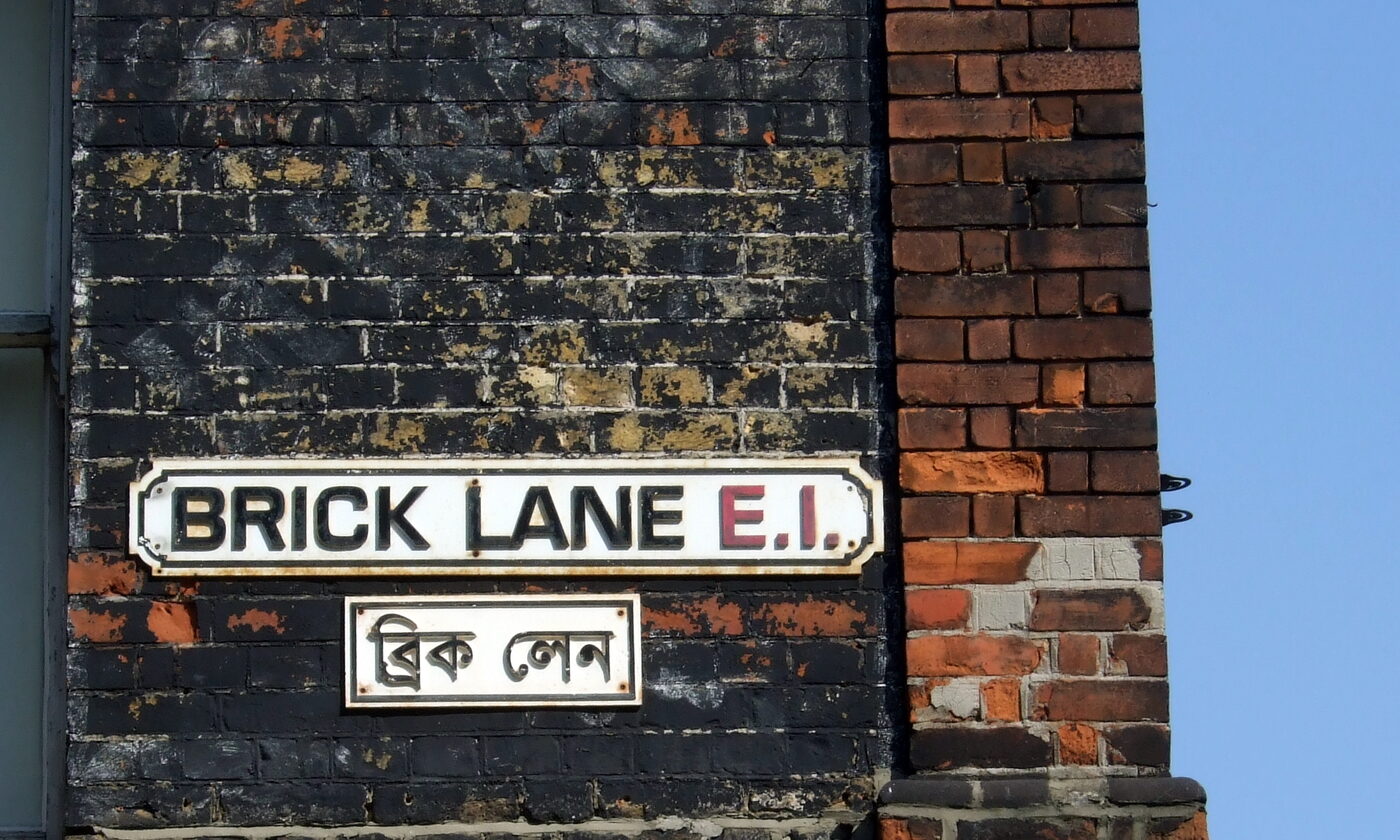
The distribution is weighted heavily towards temporary labour contracts rather than settlement, and the published estimates for individual countries vary widely: Saudi Arabia is given as anything from about two million to three and a half million, the United Arab Emirates from about 700,000 to 1.2 million, with roughly 680,000 in Oman on 2018 figures, between 800,000 and a million in Malaysia, about 400,000 in Qatar and 350,000 in Kuwait, and large populations in Pakistan and India as well. The settled communities lie elsewhere: migration to Britain runs back through lascar recruitment and chain migration from the Sylhet region and concentrated in the east London boroughs, where the area around Brick Lane and Spitalfields was branded Banglatown in 1997, the year an ornamental arch in the red and green of the Bangladeshi flag was erected at the street's entrance, with the electoral ward renamed Spitalfields and Banglatown in 2002. Bangladeshi migration to the United States grew mainly from the 1990s and now runs to some 600,000; Italy, Canada, Japan and Australia hold communities in the tens or low hundreds of thousands. The British Bangladeshi population and its Sylheti-speaking majority are treated in more detail at soc.culture.bengali.

The money followed the same map, and Bangladesh has counted it since 1974, when the Wage Earners' Scheme was set up to bring expatriate earnings home through legal channels. About 11.8 million US dollars came through it in the 1974–75 fiscal year. The Bangladesh Bank's series of annual wage-earner remittances, set against World Bank output figures, gives the curve across the newsgroup's life:
- 1990–91 — 763.91 million US dollars, 2.47 per cent of GDP
- 1994–95 — 1,197.63 million, 3.16 per cent
- 1995–96 — 1,217.06 million, 2.62 per cent
- 1998–99 — 1,705.74 million, 3.33 per cent
- 1999–2000 — 1,949.32 million, 3.65 per cent
- 2000–01 — 1,882.10 million, 3.49 per cent
- 2003–04 — 3,371.97 million, 5.18 per cent
- 2005–06 — 4,802.41 million, 6.69 per cent
- 2009–10 — 10,987.40 million, 9.53 per cent
- 2012–13 — 14,461.14 million, 9.64 per cent
Inflows reached almost 30 billion US dollars in 2024, the third-highest total in South Asia, and the World Bank counted almost 32.8 billion in 2025, which makes Bangladesh the seventh-highest recipient of remittances in the world. The share of national output moved between roughly two and a half and just under ten per cent across the period covered by the fiscal-year series above.
Two things about the curve are relevant to this newsgroup specifically. The first is that it more or less doubles across the years such groups were at their busiest, and the doubling happened before sending money home became routine and electronic — which is why the ordinary freight of an expatriate notice-board in this period included bank drafts, informal transfer channels and exchange rates alongside admissions questions, visa questions, requests for a Bangla font that would survive somebody's mail software, and the small logistics of keeping a culture running far from its kitchens. The second is that remittances and garments between them are the two pillars the country's foreign earnings rest on: ready-made garments made up 82 per cent of export earnings on the 2021 figures, and Bangladesh is the world's second-largest exporter of them. A group whose readership was disproportionately abroad, and whose home economy depended on people who were abroad, is a genuinely unusual object, and the reason it is worth saying plainly is that the readership skew which makes the archive a poor sample of Bangladeshi opinion is the same skew that makes it a decent sample of the population the country's balance of payments actually ran on.
The development record, attributed
The other thing that happened to Bangladesh across the newsgroup's lifetime is that a set of social indicators moved a very long way. The World Bank's own summary of the period is that when the country was born on 16 December 1971 it was the second poorest in the world, and that its transformation over the following fifty years is one of the great development stories. It is a documented record and it is worth stating with the sources attached, because it is one of the few subjects on which the group's period looks materially different in retrospect than it did at the time.
- Poverty: the national poverty rate has fallen by roughly a third in the past two decades and stood at about a fifth of the population in the most recent published figures, with about 5.6 per cent in extreme poverty in 2024.
- Fertility: the total fertility rate, once among the highest in the world, fell from 5.5 in 1985 to 3.7 in 1995 and 1.9 in 2022 — below replacement level.
- Electrification: a country with several blackouts a day in 2009 reached full electricity coverage by 2022.
- Economy: Bangladesh has the second-largest economy in South Asia, and in 2021 its per capita income passed both India's and Pakistan's.
The institutional side of it is equally documented. BRAC was founded on 21 March 1972, in the immediate aftermath of independence, and is now the largest non-governmental development organisation in the world by number of employees, with over 90,000 staff and operations in a dozen or so countries beyond Bangladesh. Grameen Bank, a specialised community development bank making small uncollateralised loans, became the standard international reference for microcredit and shared the Nobel Peace Prize with its founder in 2006. The International Centre for Diarrhoeal Disease Research in Dhaka is the institution behind much of the clinical research on oral rehydration therapy, and it appears twice in this article already: once treating seven hundred patients a day in the flood of 1998, and once, in 1976, running the population survey from which the most careful estimates of the 1971 death toll were later derived. The garment industry grew from almost nothing in the late 1970s into the country's dominant export sector within a generation.
None of this belongs in an article about a newsgroup as advocacy, and it is not offered as any. It belongs because it is the material circumstance of the people writing: a readership that had left a country described in 1971 as among the poorest on earth, and that spent the 1990s watching, from a distance, the arrival of the indicators that would make that description obsolete. Bangladesh remains classified among the least developed countries, has hosted several hundred thousand Rohingya refugees since the exodus from Myanmar in 2016 and 2017, and the same sources that record the indicators above record political instability, inflation and corruption as persistent constraints. The honest summary is that the record is mixed and the trajectory is documented, and this page reports both.
What a culture group carried that a language group did not
Strip out everything the language group covered and a substantial residue remains, all of it belonging to the state rather than the tongue.
A national calendar. Independence Day on 26 March and Victory Day on 16 December are the state's own anniversaries, tied to the 1971 dates given above; 21 February is a national holiday; 15 August and 14 December mark other dated events of the country's history. None of those is kept in West Bengal. A festival calendar shared across the border — the Bengali new year, Durga Puja, the food that goes with them — is the language group's material and is covered at soc.culture.bengali; what a country group has instead is a calendar that only one of the two Bengals observes.
Institutions. A parliament, the Jatiya Sangsad, whose amendments are listed above; a Supreme Court whose constitutional judgments are argued over by name; a computer council that writes keyboard standards; a standards institute that ratifies them; a central bank that publishes the remittance series; a bureau of statistics that runs the censuses; a language academy that runs the February book fair. A language does not have any of these. A state has all of them, and a country newsgroup carried the arguments about all of them.
A cricket team. This one arrived during the group's own lifetime rather than before it, and the sequence is short and consequential. Bangladesh became an associate member of the International Cricket Council in 1977 and made its first official international appearance at the 1979 ICC Trophy; its first one-day international was against Pakistan at Moratuwa on 31 March 1986, and its first win in the format did not come until 1998. It won the ICC Trophy in Kuala Lumpur, played between 24 March and 13 April 1997, beating Kenya in the final and qualifying for a World Cup for the first time. At the 1999 World Cup in England it beat Scotland for its first World Cup victory, and then on 31 May beat Pakistan by 62 runs at Northampton — 223 for 9 from its fifty overs, Pakistan all out for 161 in 44.3 — an upset against a side that went on to reach the final. It became a full member of the International Cricket Council on 26 June 2000, the tenth Test-playing nation, and played its inaugural Test against India in Dhaka on 10–13 November that year. Three years turned a minor associate side into a national subject with a fixture list attached, and they were three of the years in which such groups were busiest. Cricket is also the one subject on which a Bangladeshi group and its Pakistani neighbour had something concrete and recent to say to each other; what was said on the Pakistani side belongs to soc.culture.pakistan.
The delta. Floods, cyclones, embankments, river erosion, the flow at Farakka and the arsenic in the tube wells are a national conversation, not a linguistic one, and they recur on a schedule set by the monsoon rather than by anything a discussion group decides.
What the record does not show
It is worth being explicit about the limits, because this group is unusually well documented at the administrative level and unusually poorly documented at the conversational one.
There is no subscriber count for soc.culture.bangladesh, no readership survey, no moderator, no charter beyond the one-line descriptions quoted above, and no creation record. There is no reliable list of the group's regular posters and this page does not attempt one. No thread title, message count, quotation or participant name appears anywhere above that was not taken verbatim from an archived control message or proposal that can be fetched and checked. The article-number arithmetic in the second section is the only quantitative claim about the group's traffic made here, and its limitations are stated where it is made.
What survives in the archives is uneven, as Usenet archives generally are; the early years are patchy everywhere on the network, and this group's early years are precisely the years it was busiest. Searching the surviving corpus has the specific difficulty described at soc.culture.bengali: Bengali proper nouns have three or four plausible Latin spellings, nothing is normalised, and a search entered in Bengali script returns essentially nothing because the script is not there. Dates, author lines and thread structure are the dependable handles; words are not.
Like the rest of the hierarchy, the group thinned through the 2000s as spam rose and its readership moved to web forums, diaspora portals and mailing lists — a decline described in general terms at the soc.* hub. The timing carried a small irony common to the whole family: by the time operating systems could reliably render the script and free software could reliably type it, the audience that had spent a decade working around both problems had largely gone somewhere else.
Scope and limits
To restate the division of labour, since the whole point of this page is that the division was deliberate. The language, the writing system, the transliteration problem, the shared literary canon and the festivals kept on both sides of the border are covered at soc.culture.bengali, whose readership overlapped this one's substantially and whose founding proposal argued for the separation in the words quoted at the top of this article. The Pakistani record of 1947 and 1971, and the arguments conducted from that side, are at soc.culture.pakistan. Continent-wide subjects, and the general problem of non-Latin scripts on a network built for ASCII, are at soc.culture.asian. How a soc.* group was proposed, voted on and created — the machinery whose output is quoted throughout this page — is described at the soc.* hub, and the culture branch as a whole at soc.culture.*.
What this page has tried to do is treat a country newsgroup as what its own paperwork says it was: a forum for issues relating to Bangladesh and its culture, unmoderated, created early, written largely from outside the country it was named for, and busy with subjects on which reasonable people disagreed at length. Where those subjects remain contested — and 1971 above all — this article has set out the documented sequence, attributed every estimate and every characterisation to the body or scholar that produced it, given ranges as ranges, and stopped there. That is what the sources support. Anything further would be an argument, and arguing was the newsgroup's job, not this directory's.
Reading soc.culture.bangladesh today
- Historical archive: Google Groups — soc.culture.bangladesh (coverage varies by group and era).
- Open in a newsreader:
news:soc.culture.bangladesh— the original site offered exactly this link, and it still works if your system has a newsreader registered for thenews:scheme. - Live access: point an NNTP newsreader at a modern server — see accessing Usenet today.
- The original news2mail e-mail subscription service ended in the mid-2000s and no longer operates.