soc.culture.bengali
Bengali language and culture across borders.
Distinct from the Bangladesh group by design: soc.culture.bengali covered the language and culture shared across Bangladesh and Indian West Bengal — Tagore, Satyajit Ray, Durga Puja, and the literature of both Calcuttas and Dhakas.
The cross-border framing produced unusually rich threads, and occasionally unusually heated ones, on partition memory.
On this page
The group and its era
Most of the soc.culture.* hierarchy was organised by country. soc.culture.bengali belonged to the smaller set organised by language, alongside the Basque and Berber groups, and its one-line description in the periodic newsgroup listings said so plainly: “Sociocultural identity of worldwide Bengali population.” A population, not a state — with well over two hundred million speakers, Bengali is among the most spoken languages on earth, and the group was scaled to the language rather than to any one of its addresses. It was unmoderated, like most of its neighbours.
The two halves were not symmetrical, and the asymmetry set the group’s boundaries. In Bangladesh, Bengali is the language of the state and of almost the whole population; in India it is one official language among many, the language of West Bengal and of large populations in Assam and Tripura. What each half owned separately went elsewhere — Bangladesh’s governments, elections and constitutional arguments belonged next door at soc.culture.bangladesh — and what was left here was the property both claimed jointly: a script, a literature, a festival calendar, and the standing question of who held the better title to each.
For most of the 1990s the group was written largely from outside Bengal. Public internet access arrived late in the region — India’s first commercial dial-up service opened in 1995, and Bangladesh was connected only in mid-1996, through a single 64 kbps satellite link — so the early conversation belonged mainly to graduate students and professionals posting from university and corporate accounts in North America, Europe and Australia, discussing home from a considerable distance.
The delegation dates of the two country-code domains give that gap a checkable edge. IANA’s root database records .in as registered on 8 May 1989 and .bd on 20 May 1999 — ten years apart, and in the Bangladeshi case three years after the country’s first commercial providers had already opened for business. Before June 1996 what Bangladesh had was dial-up access to the bulletin boards of a handful of local operators, whose mail was exchanged with the outside world by international dial-up over UUCP: store-and-forward batches carried on a metered trunk call rather than a standing link, with a national user base numbered in the hundreds. Reading a newsgroup under that arrangement was possible. Doing it every day was an expense.
It was also written in the wrong script. Usenet carried plain ASCII, the Bengali script could not survive the journey, and usable fonts and input methods only became commonplace in the early 2000s. Posters improvised, spelling Bengali in Latin characters by ear or by private systems of their own devising, threaded through English. Competing romanisation schemes, and arguments about them, became a minor genre in their own right.
Who could post, and from where
The clearest measure of who was in a position to take part at all is the proportion of each country’s population using the internet, as recorded in the World Bank’s series compiled from International Telecommunication Union data. For the years on either side of the gateway’s window the figures are small enough to be worth setting out in full.
- Bangladesh — 0.004 per cent in 1998; 0.07 per cent in 2000; 0.14 per cent in 2002; 0.20 per cent in 2004.
- India — 0.14 per cent in 1998; 0.53 per cent in 2000; 1.54 per cent in 2002; 1.98 per cent in 2004.
- United States — 30.1 per cent in 1998; 43.1 per cent in 2000; 58.8 per cent in 2002; 64.8 per cent in 2004.
The United Kingdom’s figure for 2004, the last year this gateway ran, was 65.6 per cent. Set beside Bangladesh’s 0.20 per cent and India’s 1.98 per cent for the same year, the arithmetic settles the question of the group’s composition without any guesswork about the archive: throughout its active life a reader in London or New Jersey was drawing on an infrastructure some three hundred times thicker than the one available in Bangladesh and some thirty times thicker than the one available anywhere in India.
National percentages say nothing about where inside a country the connections sat, and they count users rather than posters. But the order of magnitude has a direct consequence for anyone using the archive as evidence. What survives is not a sample of Bengali opinion; it is a sample of the opinion of Bengalis who had an institutional or corporate account, usually abroad and usually in an English-medium profession. The balance began to shift only after the group’s working life was over: on the same series Bangladesh stood at 0.24 per cent in 2005 and reached one per cent of the population for the first time in 2006.
Where the readership was
No census anywhere counts Bengali speakers abroad, and that is the first thing to say about the group’s geography. The categories that exist count nationality or ethnicity, and they cut across the language rather than along it. Britain’s census counts a Bangladeshi ethnic group — 283,063 people in 2001, and 451,529, or 0.7 per cent of the population, in 2011 — and has no category at all for Bengali-speaking migrants from West Bengal, who are returned as Indian. In the United States the American Community Survey put people of Bangladeshi origin at 213,372 in 2018, well after the group had gone quiet. Every figure below is therefore a proxy and a floor, not a readership.
The British share carries a complication that bears directly on the language. Around 95 per cent of British Bangladeshis trace their origins to the Sylhet region, and Sylheti’s relation to standard Bengali is itself disputed: most linguists now treat it as a language in its own right rather than a dialect, and the academic consensus on mutual intelligibility with standard Bengali runs from hardly intelligible to unintelligible. The largest Bengali-origin population in Europe spoke at home a variety that the written register of the group did not represent.
The Gulf held the largest concentrations of Bangladeshi nationals anywhere outside South Asia — more than two million in Saudi Arabia on later estimates, several hundred thousand each in the United Arab Emirates, Oman, Qatar and Kuwait — overwhelmingly on temporary work contracts rather than in the universities and corporate offices whose accounts made Usenet posting possible in the 1990s. What the archive holds is the North American and British end of a much larger dispersal, and the estimates for the Gulf are estimates, gathered years after the fact.
A readership arranged like that has no common hour. Dhaka runs six hours ahead of Greenwich, eleven ahead of New York in the northern winter and fourteen ahead of California, so a group holding Dhaka, London and the American west coast at once had no hour that was the evening in all three. Bangladesh kept no summer time, so the gap to Britain and to North America widens and narrows twice a year without anything changing at the Dhaka end.
What was discussed
The most dependable subject was the language itself. A group premised on a shared tongue argued about the tongue: the differences between the Bengali of Calcutta and the Bengali of Dhaka, the pressure of English on both, and the standing worry over whether children being raised in London or New Jersey would speak it at all. Literature travelled in transliteration — poems, song lyrics, requests for the words to something half-remembered — and the group’s long, digressive discussions had a recognisable ancestor in the Bengali institution of adda, unhurried conversation pursued for its own sake.
The calendar supplied fixtures. Ekushey, 21 February, commemorates the students killed in Dhaka in 1952 during the Language Movement’s campaign for Bengali’s official status; no date could matter more to a group organised around the language, and UNESCO’s decision in 1999 to mark it worldwide as International Mother Language Day was precisely the kind of news the group existed to note. Pohela Boishakh, the Bengali new year kept on both sides of the border in mid-April, brought annual greetings threads and the practical business of organising celebrations in cities where mid-April meant nothing in particular.
Even the new year was not quite a shared date. Bangladesh keeps Pohela Boishakh on 14 April, following the revision of the Bengali calendar drawn up in 1966 by a committee under Muhammad Shahidullah and officially adopted in 1987; West Bengal keeps the older reckoning, which falls on 14 or 15 April depending on the year. A group addressing both sides at once had to say which calendar it meant.
The harder history came with the territory. The 1947 partition of Bengal placed the group’s two halves in different countries; the 1971 Liberation War made one of them a third. Both returned regularly — as family migration stories, as commemorative threads, and as arguments about memory in which Hindu and Muslim, Indian and Bangladeshi participants were mostly people with histories rather than positions, though the distinction did not always survive a long thread. The shared language gave the group more common ground than many soc.culture pairings could claim; it did not make the ground level.
Writing Bengali on a seven-bit network
The obstacle was never the character standard. Bengali was in Unicode from the first release: the block runs from U+0980 to U+09FF, 128 code points of which 89 were assigned in Unicode 1.0.0, published in October 1991 — before most of the people who would later post to the group had an internet connection at all. The layout was not devised for Unicode either. The code points from U+0981 to U+09CD were taken over directly from the Bengali positions of the 1988 revision of ISCII, the Indian Script Code for Information Interchange, together with several Assamese characters in the U+09F0 column. ISCII, standardised by the Bureau of Indian Standards as IS 13194:1991, covers nine Indic scripts on a scheme in which the lower 128 positions hold plain ASCII and the upper 128 hold the Indic characters, each letter placed at the code point its phonetic equivalent occupies in every other script.


What was missing was everything between the standard and the screen. A Bengali code point is not a Bengali glyph: the script joins consonants into conjunct ligatures and sets vowel signs before, after, above and below the consonant they belong to, so displaying it needs a shaping engine as well as a font, and typing it needs a keyboard driver the operating system will load. Through the 1990s none of that was reliably present on a general-purpose desktop, and news software that would carry an eight-bit body intact from end to end was a further assumption stacked on top of the rest.
Bangladeshi computing meanwhile grew up on tools that predated usable Unicode rendering and did not follow it afterwards. Mustafa Jabbar’s proprietary Bijoy layout, whose Windows version appeared in March 1993 and whose Macintosh version followed in December 1998, became the dominant way of setting Bengali type in the country, and its input conventions differ from the Unicode ones. The free Unicode-based alternatives arrived at the very end of the group’s life or after it: Mehdi Hasan Khan’s Avro Keyboard, which offers phonetic entry — the user types Bengali in Latin letters and the software converts it — was first released on 26 March 2003, with its source under the Mozilla Public License, and the UniJoy layout was added to the m17n input database on 7 December 2005. The distance between having a code point and being able to read it is the whole history of Indic scripts online in this period.
Transliteration, and what it does to the archive
What filled the gap was Latin letters, and the most durable of the transliteration schemes for Indic scripts came out of Usenet itself. ITRANS — Indian languages TRANSliteration, written by Avinash Chopde — appeared in 1994 on rec.music.indian.misc, the group where film song lyrics and trivia were being exchanged, and in parallel on a Sanskrit mailing list with the same difficulty. It is a pure ASCII scheme, no diacritics and no eighth bit, with tables for Devanagari first and for the other major Indic scripts alongside it, Bengali among them, and a converter that turns the Roman text back into the script. A Bengali poster in the mid-1990s could therefore write unambiguously, provided both ends agreed to use it.
Most did not. The formal alternatives were worse suited to the medium rather than better: ISO 15919, the international standard for the romanisation of Indic scripts, was published in 2001 and depends on diacritics — the dotted and barred letters that only Unicode fonts carry — which made it precisely the wrong instrument for a network that could not carry the script in the first place. What actually went down the wire was improvised: each poster spelling by ear and by habit, in a Latin alphabet that offers one letter where Bengali distinguishes several, and with no settled convention for the vowels.
The consequence for anyone searching the archive today is direct and unforgiving. A word has no canonical spelling in that corpus. The festival written on this page as Pohela Boishakh is written elsewhere as Pahela Baishakh and as Poila Boishakh; a name can appear as Rabindranath or as Robindronath; most Bengali proper nouns have three or four plausible Latin forms and a full-text search returns whichever one the searcher happened to guess. Nothing is normalised, and searching in the Bengali script returns nothing at all, because the script is not there. The dependable handles on a message from this group are its date, its author line and its thread, rather than its words.
The dated record
What follows is set out as a record and nothing more: the dates on which the group’s recurring subjects actually turn. Where an item falls outside the years the group was carried here, that is stated.
Before the group
- 21 March 1948 — at Race Course Maidan in Dhaka, Muhammad Ali Jinnah states that Urdu, and only Urdu, will be the state language of Pakistan.
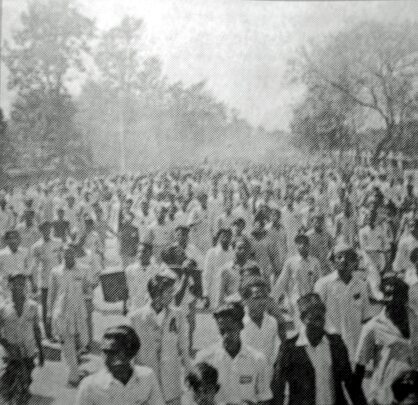
- 21 February 1952 — police open fire on a student demonstration in Dhaka. Those killed include Abdus Salam, Rafiq Uddin Ahmed, Abul Barkat and Abdul Jabbar; the government’s own count for the day was three dead and sixty-nine injured.
- 24 February 1952 — a memorial, the first Shaheed Minar, is completed at dawn; it is destroyed by police on 26 February.
- 7 May 1954 — the constituent assembly of Pakistan resolves to grant official status to Bengali.
- 3 December 1955 — the Bangla Academy is founded in Dhaka.
- 1956 — Bengali is adopted as an official language of Pakistan alongside Urdu in the first constitution, at article 214(1).

Within the years this gateway carried the group, 2000 to 2004
- 21 February 2000 — International Mother Language Day is observed for the first time, following its proclamation by the thirtieth session of the UNESCO General Conference on 17 November 1999.
- 26 June 2000 — Bangladesh becomes the tenth Test-playing nation in cricket.
- 10 to 13 November 2000 — Bangladesh plays its first Test match, against India, at the Bangabandhu National Stadium in Dhaka.
- 2002 — the United Nations General Assembly adopts resolution 56/262, which recognises the day.
- 26 March 2003 — the Avro Keyboard is released, described by its authors as the first free Unicode-compliant Bengali keyboard interface for Windows.
- 26 December 2004 — Bangladesh defeats India by 15 runs in a one-day international in Dhaka, its first victory over India in an international cricket match.
After the group’s working life
- 7 December 2005 — the UniJoy Bengali layout is added to the m17n input database.
- May 2006 — Bangladesh is connected to submarine fibre for the first time, through the sixteen-country SEA-ME-WE 4 consortium, with a landing station at Cox’s Bazar.
- 2016 — UNESCO inscribes Mangal Shobhajatra, the Pohela Boishakh procession organised by the Faculty of Fine Arts of the University of Dhaka, on its Representative List of the Intangible Cultural Heritage of Humanity.
- 2021 — UNESCO inscribes Durga Puja in Kolkata on the same list.
A canon with two custodians
The custody argument is built into the oldest object in the canon. The Charyapada, a collection of mystical Buddhist songs compiled in a late Apabhramsha idiom at a date on which scholars differ, their estimates running from the seventh century to the twelfth, survives in a palm-leaf manuscript that Haraprasad Shastri rediscovered in the library of the Nepalese royal court and published in 1916. Scholars of Assamese, Bengali, Maithili and Odia all find features of their own languages in it, and each of those literatures counts it as its earliest surviving work. A group organised around a shared literature began, in other words, with a text that four literatures share and none can hold alone.
Rabindranath Tagore (1861–1941) supplies the group’s structural fact in miniature. In 1913 he was awarded the Nobel Prize in Literature, the first Indian to win a Nobel Prize of any kind and the first non-European to be given the literature prize, and compositions of his were later adopted as the national anthems of two countries: India’s Jana Gana Mana and Bangladesh’s Amar Sonar Bangla. Whatever else the two states disagreed about, each opened its official occasions with words by the same man.
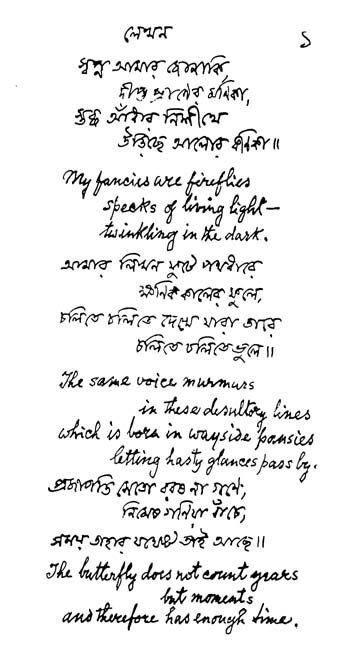

Kazi Nazrul Islam’s biography crosses the line in the middle. He was born in 1899 at Churulia, in the Asansol subdivision of what is now West Bengal; the newly independent Bangladesh brought him to live in Dhaka on 24 May 1972 and conferred its citizenship on him on 18 February 1976; he died on 29 August 1976 and is buried beside the central mosque on the University of Dhaka campus. He was accorded the status of national poet of Bangladesh in 1972, a recognition not formally gazetted until 2024. Both literatures teach him.
Satyajit Ray’s work belonged by production and language to the Calcutta side. Pather Panchali was released in 1955 and completed as a trilogy with Aparajito in 1956 and Apur Sansar in 1959; an honorary Academy Award was presented to him by video link in 1992, twenty-four days before his death on 23 April that year. He considered making a film about the 1971 war and abandoned the idea. Bengali-language cinema on the Dhaka side developed separately, which left the group with one language and two national film industries to compare.
The institutions are duplicated in the same pattern. The Bangla Academy, founded in Dhaka on 3 December 1955, exists for research, publication and translation in Bengali language, literature and culture; West Bengal has its own counterpart in the Paschimbanga Bangla Akademi. So are the literary calendars, and they very nearly coincide. The Kolkata Book Fair, run by the Publishers and Booksellers Guild, began in 1976 and is held at the turn of January and February; the Dhaka fair grew out of a one-day sale of books that Chittaranjan Saha laid out on a mat in the Bangla Academy grounds on 21 February 1972, was taken over by the Academy in 1978, was formally constituted as the Amar Ekushey Grantha Mela in 1984, and runs from 1 February, timed to the Ekushey anniversary. Two fairs, one language, the same fortnight, different countries.
The calendar, the kitchen and the derby
Between the anniversaries, the traffic of a culture group is domestic, and this one had an unusually well-documented set of fixtures to work with. Durga Puja, the principal festival of the Bengali Hindu year, falls in the month of Ashvin, September or October. It is a public holiday in West Bengal, Odisha, Tripura, Bihar and Assam, and in Bangladesh and Nepal, and it is kept by Bengali associations across the diaspora, where the standing practical difficulty is that a date fixed by a lunisolar calendar does not oblige by landing on a weekend in a country that does not observe it.
Food carried at least as much of the conversation, and it is where the two halves are most nearly identical. Ilish, the hilsa shad, is the national fish of Bangladesh and the state fish of West Bengal at the same time, cooked on both sides in the same mustard preparation; Bangladesh registered it as a geographical indication on 6 August 2017. Ownership arguments over Bengali sweets have since been conducted in the same formal register: West Bengal obtained a geographical indication for Banglar Rosogolla on 14 November 2017 and Odisha one for Odisha Rasagola on 29 July 2019, the registry holding that the two were distinct in colour, texture, taste, juice content and method of manufacture. All three registrations postdate the group by more than a decade. The arguments they formalise are older than Usenet.
Sport gave the same structure a weekly form. The Calcutta football derby, between Mohun Bagan, established in 1889, and East Bengal Club, founded in 1920, is organised along precisely the line the group straddled: Mohun Bagan is associated with the Ghotis, the Bengalis of the western districts, and East Bengal with the Bangals, whose families came from the eastern half of undivided Bengal. The two clubs first met on 8 August 1921, in the semi-final of the Cooch Behar Cup, and drew nil–nil. The rivalry is older than the border it now maps.
Music travelled better than anything else, having the advantage of being singable across the border without amendment: the songs of Tagore and of Nazrul are two repertoires that both halves teach and perform. Lyrics are short, quotable and, at a pinch, transliterable, and on a network that could not render the script the texts that travelled best were the short ones — a verse, a couplet, a half-remembered line put up for identification.
Context
The group sat within a small constellation. soc.culture.bangladesh and soc.culture.indian carried the two national conversations, each with its own weather; threads crossed between all three, and a discussion’s temperature often depended on which group it had started in. soc.culture.bengali worked as the overlap — the place where a reader in Calcutta and a reader in Dhaka were addressed as members of the same audience rather than citizens of neighbouring ones.
By the years this gateway carried the group, 2000 to 2004, soc.culture.bengali — like most of its hierarchy — was past its peak. Web forums, mailing lists and early community sites were absorbing the diaspora’s conversation, and an unmoderated group paid the usual toll in spam. The timing held a small irony: just as operating systems learned to render the script the group had spent a decade transliterating around, the audience that had done the transliterating was moving elsewhere.
What survives in the archives is uneven, as Usenet archives are, but valuable in a specific way: a plain-text record of how a scattered language community talked to itself before the web made that ordinary — argumentative, homesick, occasionally luminous, and conducted almost entirely in borrowed letters.
Reading soc.culture.bengali today
- Historical archive: Google Groups — soc.culture.bengali (coverage varies by group and era).
- Open in a newsreader:
news:soc.culture.bengali— the original site offered exactly this link, and it still works if your system has a newsreader registered for thenews:scheme. - Live access: point an NNTP newsreader at a modern server — see accessing Usenet today.
- The original news2mail e-mail subscription service ended in the mid-2000s and no longer operates.