soc.culture.belgium
Belgium: Flanders, Wallonia and Brussels.
A trilingual group (Dutch, French, English) for a country whose central topic — the Flemish/Walloon settlement — supplied it with inexhaustible material. Beer, comics (bande dessinée), and cycling provided the peace treaties between rounds.
It coordinated loosely with be.* hierarchy groups; soc.culture.belgium was where the international audience met the domestic one.
On this page
The group and its era
The soc.culture.* hierarchy worked on a simple premise: any country with enough readers to sustain a conversation got a group. Belgium's was in place by the mid-1990s, part of the wave of national groups created before the web absorbed casual discussion. Its early population was what early internet access dictated — Belgians at universities and research institutions, emigrants writing from North American and European accounts, and outsiders with questions about a country they were about to move to.
Its timing was pointed. The group's formative years began almost where the fourth Belgian state reform ended: the constitutional revision of 1993 had just declared Belgium a federal state composed of communities and regions, completing on paper a process of federalisation under way since 1970. The group therefore never discussed a settled country. It discussed a settlement — one whose terms were still being renegotiated election by election, and whose critics and defenders both posted.
Traffic followed the standard soc.culture arc: growth through the 1990s, a peak around the turn of the millennium — the years the news2mail gateway carried the group to subscribers' mailboxes — then a slow drain towards web forums, leaving spam and stalwarts. What remains is an archive, and a fairly candid one.
The history of the hierarchy itself belongs to the soc.culture roster and is not retold here. What follows is the surrounding record: connectivity, constitutional machinery, encoding, diaspora and cultural traffic.
Getting online from Belgium
The checkable anchor for a country's arrival on the network is its top-level domain. IANA's root database records .be as initially registered on 5 August 1988 — early, and a good deal earlier than any Belgian could have used it from home. The registry that runs it today, DNS Belgium vzw/asbl of Leuven, was itself only established in 1999, and adopted a decentralised network of accredited registrars on 11 December 2000. Between delegation and that liberalisation the domain existed chiefly as an academic and corporate address space. On the access side, Belnet, the national research and education network serving universities, research centres and federal departments, was established in 1993 — the same year as the constitutional revision that made the country federal.
The World Bank's series for individuals using the internet, drawn from ITU reporting, gives the shape of the domestic audience across exactly the years this archive covers:
- 1993 — 0.2 per cent of the population
- 1995 — 1.0 per cent
- 1996 — 3.0 per cent
- 1997 — 4.9 per cent
- 1998 — 7.9 per cent
- 1999 — 13.8 per cent
- 2000 — 29.4 per cent
- 2001 — 31.3 per cent
- 2002 — 46.3 per cent
- 2003 — 50.0 per cent
- 2005 — 55.8 per cent
Read against the same series for the United States — 16.4 per cent in 1996, 30.1 per cent in 1998, 43.1 per cent in 2000 — the asymmetry of the group's first years is plain. In 1996 an American was more than five times as likely to be online as a Belgian; by 2000 the ratio was under one and a half to one, but Belgium was still behind — 46.3 per cent against 58.8 — in 2002. A country group in that period was therefore not a sample of the country. Its home-based contingent came from wherever institutional access happened to be — campuses, research institutes, engineering and finance employers, and the international offices of Brussels — while its emigrant contingent was writing from networks that had reached ordinary households years earlier. The balance only shifted late: the jump from 13.8 per cent in 1999 to 46.3 per cent in 2002 is the arrival of Belgian domestic access, and it coincides with the period in which such groups were most used and, immediately afterwards, with the web forums that drew the same readers away.
What was discussed
The reliable core was constitutional. Threads returned to the mechanics of the settlement: the language border fixed in law in 1962–63, the special arrangements for municipalities with language facilities, the flow of public money between regions, and the number of governments — perennially astonishing to outsiders — that a country of ten million maintained. The settlement produced two standing positions: the Flemish case for further autonomy and fiscal accountability, and the francophone case for solidarity and minority guarantees.
The colonial past arrived on schedule. Belgium's public reckoning with the Congo Free State intensified in the years the group was active: Adam Hochschild's King Leopold's Ghost appeared in 1998, a parliamentary commission examined the 1961 assassination of Patrice Lumumba and reported in 2001, and the Belgian government offered a formal apology in 2002. Leopold II and the Congo were part of the subject a group about Belgium existed to cover, and the country's newspapers and historians were arguing over them in the same years.
Around the heavy material ran the ordinary business of a diaspora group: genealogy queries from descendants of Walloon and Flemish emigrants to North America, practical questions from people relocating to Brussels for work, recipes, football, and requests for the correct rendering of untranslatable words. In a group with no single working language, which language a thread should proceed in was a small recurring negotiation — occasionally the national question in miniature.
Four language areas, one English-language group
The machinery those threads assumed is precise, and worth setting out plainly. Two laws, promulgated on 8 November 1962 and 2 August 1963, determined which municipality belonged to which language area, and there are four: Dutch, French, German, and the bilingual area of Brussels-Capital. Each municipality belongs to exactly one. Twenty-seven municipalities carry language facilities for a minority group — twelve in the Dutch-language area providing services in French, four in the French-language area providing them in Dutch, two more in the French-language area providing them in German, and all nine municipalities of the German-language area providing them in French. A municipality's language affiliation can be changed only by a special law, which needs a majority in each language group of the federal parliament; the map has barely moved since.
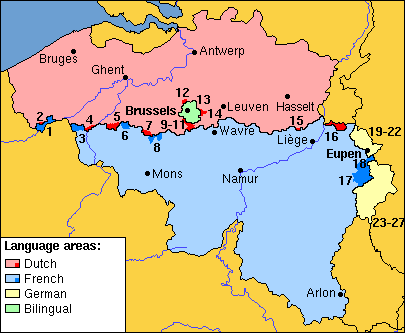

On top of the areas sits the second structure, built in six instalments. The first state reform, in 1970, created three cultural communities. The second, in 1980, turned them into communities with competence over person-related matters such as health and youth policy, and created the Flemish and Walloon Regions. The third, in 1988–89, established the Brussels-Capital Region with its own institutions and transferred education to the communities. The fourth, in 1993, made Belgium a full federal state and split the province of Brabant into Flemish and Walloon halves. The fifth, in 2001, moved agriculture, fisheries, foreign trade and development cooperation to the communities and regions. The sixth, from 2011, divided the electoral and judicial arrondissement of Brussels-Halle-Vilvoorde and shifted some 17 billion euros of competences downward — well after the group's active life, and so present in the archive only as a prediction.
The demographic weights, on current figures, run roughly three to two. The Flemish Community numbers about 6.9 million people, some 60 per cent of the population; the French Community about 4.5 million, some 40 per cent; the German-speaking Community 79,479, or 0.7 per cent, as of 2024. By region on 1 January 2024, Flanders held 6.82 million (58.0 per cent), Wallonia 3.69 million (31.4 per cent) and Brussels 1.25 million (10.6 per cent). Those are present-day counts rather than contemporaneous ones, but the proportions have been stable enough that the group's arguments were conducted against much the same arithmetic.
None of which an English-language newsgroup could represent. soc.culture.belgium was necessarily a meeting point rather than a national forum: a venue in which a Dutch-speaker and a French-speaker could argue in a language that was, for both, a second or third. Usenet's language hierarchies sat immediately alongside — the Dutch-language nl.*, the German-language de.*, and the French-language fr.* — and a reader who wanted a conversation conducted wholly in one of the country's three official languages had somewhere else to go. What the English-language group offered instead was the one thing a monolingual hierarchy could not: a floor on which the two large communities met the same audience at the same time, including an audience with no stake in the question at all.
Accents on a seven-bit network
Usenet's article format, RFC 1036 of December 1987, was built on the mail conventions of RFC 822 and required printing ASCII in the parts that machines had to parse — message identifiers and the name portion of a From line among them. Dutch, French and German are Latin-script languages, so Belgium never faced the transliteration problem that confronted groups writing Cyrillic or Arabic. It faced the narrower and more insidious one: diacritics.
ISO 8859-1, Latin-1, covered nearly everything the three languages needed in daily use. It did not cover everything. The French ligature œ, the capital Ÿ that French orthography needs for case conversion, and the Dutch ij treated as a single letter all fell outside it. ISO/IEC 8859-15 was published in 1999 to repair part of that gap: it added €, Œ, œ, Ÿ, Š, š, Ž and ž, dropping eight little-used positions — ¤, ¦, ¨, ´, ¸, ¼, ½ and ¾ — to make room. The Dutch ij was not among the additions. Latin-9 arrived in the group's late-middle years, and three years before euro notes and coins were in Belgian pockets.
A second hazard was closer to home. Windows-1252, the encoding most Belgian posters on Microsoft software were actually emitting, places printable characters — curly quotation marks, the euro sign — in the 0x80 to 0x9F range that ISO 8859-1 reserves for control codes. Through the 1990s many Microsoft products labelled such text as ISO-8859-1 or as ASCII, or left it undeclared entirely, and it rendered wrongly on other systems, often as question marks. MIME, restated as RFC 2045 in November 1996, supplied the fix — an explicit character-set label and the quoted-printable and base64 transfer encodings — but only for posters whose software used it, and news software adopted it unevenly.
The practical habit that developed was the one that develops everywhere: strip the accents and hope. A Belgian archive is unusually punished by that habit, because so many of its proper nouns exist in three forms before any accent is lost. Liège is Luik in Dutch and Lüttich in German. Brussels is Bruxelles and Brussel at once, which is the legal position as well as the linguistic one. A search of the archive for one spelling misses the others, and a search for the accented spelling misses every post in which the accent was dropped in transit or by hand. Anyone working through this material seriously has to search each place under at least four strings: the French form with its accent, the French form without, the Dutch form and the German form.
Unicode was never the obstacle. The Latin Extended-A block, U+0100 to U+017F, has been present since Unicode 1.0 in 1991 and contains both IJ and ij at U+0132 and U+0133 and Œ and œ at U+0152 and U+0153; the accented vowels of French and Dutch were encoded from the beginning. The characters existed for the whole of the group's life. What did not exist, for most of it, was a reliable expectation that the software at the other end would render them.
Context
The Belgium under discussion was eventful. King Baudouin — briefly declared unable to reign in 1990 rather than sign a law liberalising abortion — died in 1993. The Dutroux case broke in 1996, and that October the White March brought hundreds of thousands into Brussels in grief and anger at the institutions: one of the rare moments in the group's lifetime when the language border seemed briefly beside the point. The dioxin scandal of 1999 helped put the Christian democrats into opposition for the first time in four decades, and euro notes replaced the Belgian franc in 2002.
Brussels supplied a second, less domestic audience. As the seat of the European institutions and of NATO, the city delivered a rotating population of new arrivals with questions about housing, schools, bureaucracy and the etiquette of a bilingual capital — people for whom a country-specific newsgroup was one of the few places online to ask.
The standing prediction — that Belgium would eventually split — was made regularly and has now been wrong for as long as the archive runs. That may be the most Belgian thing about the group: a decades-long argument, conducted in several languages at once, that ends every round with the parties still at the same table. The archive preserves the argument in progress, which is arguably the truer record.
The dated record
The following is a chronology and nothing else. It carries no argument about cause and characterises no party; it exists so that a reader meeting a thread in the archive can place it. Items marked as predating or postdating the group are noted as such.
- 8 November 1962 and 2 August 1963 — laws determining the four language areas and the municipalities with language facilities. Predates the group by three decades; assumed by nearly every constitutional thread in it.
- 1970 — first state reform: three cultural communities created.
- 1980 — second state reform: cultural communities become communities with person-related competences; Flemish and Walloon Regions created.
- 1988–89 — third state reform: Brussels-Capital Region established with its own institutions; education transferred to the communities.
- 4 April 1990 — King Baudouin declared unable to reign; the reign resumed the following day, 5 April 1990. Predates the group.
- 1993 — fourth state reform: Belgium declared a federal state; the province of Brabant divided into Flemish Brabant and Walloon Brabant.
- 31 July 1993 — death of King Baudouin.
- 21 May 1995 — federal election, the first held under the 1993 Constitution, with the Chamber of Representatives reduced from 212 seats to 150.
- 13 August 1996 — Marc Dutroux, Michelle Martin and Michel Lelièvre arrested.
- 15 August 1996 — Sabine Dardenne and Laetitia Delhez found alive in a concealed cell.
- 17 August 1996 — the bodies of Julie Lejeune and Mélissa Russo recovered at Sars-la-Buissière.
- 3 September 1996 — the bodies of An Marchal and Eefje Lambrecks recovered.
- 15 October 1996 — the Court of Cassation removes the investigating judge, Jean-Marc Connerotte, from the case.
- 20 October 1996 — the White March: around 300,000 people demonstrate in Brussels.
- 13 June 1999 — federal election, held in the year of the dioxin affair; the Christian democratic parties record historic losses and the eight-year premiership of Jean-Luc Dehaene ends.
- 2001 — fifth state reform: agriculture, fisheries, foreign trade and development cooperation transferred to the communities and regions; the Brussels institutions reformed.
- 1 March 2004 — the Dutroux trial opens at Arlon. 17 June 2004 — verdict of guilty on several counts of murder. 22 June 2004 — sentence of life imprisonment. All three fall after the period in which such groups were most used.
- 2011 — sixth state reform: the arrondissement of Brussels-Halle-Vilvoorde divided and some 17 billion euros of competences transferred. Postdates the group's active life entirely.
Where the readers were
Belgian emigration to North America was substantial, old and well documented, which is why the genealogy traffic had somewhere to come from. About 200,000 Belgians emigrated to the United States between 1820 and 1970. At the 2000 census 360,642 Americans reported Belgian ancestry, concentrated in Wisconsin (57,808, or 1.08 per cent of the state), Michigan (53,135) and Illinois (34,208); the figure had fallen to 339,512 by 2019 and 312,593 by 2024, the ordinary attrition of a self-reported ancestry several generations old. The Wisconsin settlements are the oldest core: Bay Settlement was founded in 1853, and its church of St Hubert completed by 1860.
Canada holds a second concentration, later and more francophone in its placement. Census counts of Belgian ancestry there ran from 2,994 in 1901 and 9,664 in 1911 to about 61,000 in 1961, 176,615 in 2011 and 186,665 in 2016 — by that last count 57,890 in Ontario, 51,340 in Quebec and 21,515 in Manitoba. The federal government after 1867 gave Belgian immigrants preferred status and steered them towards the francophone Catholic communities of Quebec and Manitoba; a westward movement into Alberta followed after 1920.
The effect on a newsgroup is structural. Belgium keeps Central European Time, one hour ahead of Greenwich and two in summer; Wisconsin and Manitoba keep Central Time, seven hours behind it. A thread begun in a Belgian evening was read in a North American morning and answered in a North American evening that was already the next Belgian day, and in the era when propagation between servers still took hours rather than seconds the replies crossed each other regularly. A group with no single home time zone gets slower threads, more duplicated answers to the same question, and a lower chance that an argument is settled inside a day. It also gets a persistent asymmetry of concern: for the home-based reader the constitutional threads were about next month's politics, and for the third-generation reader in Green Bay or Saint Boniface they were about a grandparent's country.
Comics, beer and the calendar
Between the crises, the traffic was cultural, and the cultural material is far better documented than the politics. Belgian comics are the clearest case: Hergé launched The Adventures of Tintin in a newspaper supplement in January 1929; the magazine Spirou first appeared on 21 April 1938; Tintin magazine began in 1946 with simultaneous French and Dutch editions, the Dutch one titled Kuifje. The industry that followed was genuinely large — in 2000 almost 40 million albums a year were printed in Belgium, three-quarters of them exported, with Dupuis, Le Lombard and Casterman accounting for roughly three-quarters of French comics sales. The bilingual publishing habit matters here: comics are one of the few Belgian cultural forms that were routinely issued in both national languages from the start, which is why they are also one of the few subjects on which a Flemish and a francophone poster could compare notes without translating a canon first.
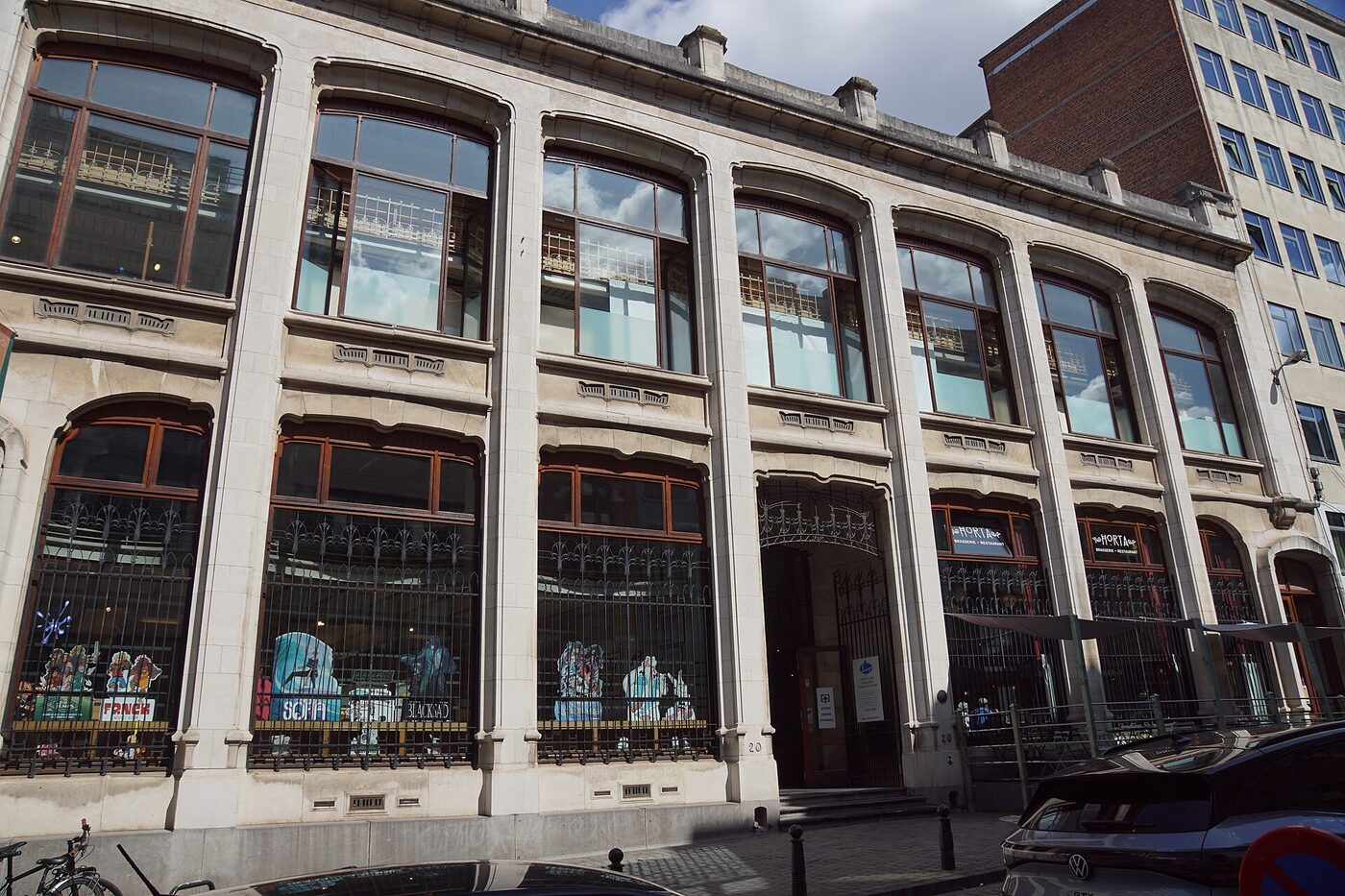
The Belgian Comic Strip Center opened on 6 October 1989 in the former Magasins Waucquez in Brussels, an Art Nouveau warehouse designed by Victor Horta and the only survivor of his series of department stores; it now receives around 200,000 visitors a year. It opened just before the group did.
_20230826.jpg)
Beer was the other perennial, and the one most likely to bring in outsiders. Belgium's brewing tradition is not merely large but taxonomically odd: lambic, from the Pajottenland south-west of Brussels and the valley of the Zenne, is fermented spontaneously by wild yeasts rather than pitched, and gueuze is a blend of old and young lambic set to referment in the bottle, sometimes drawn from three consecutive years. The International Trappist Association, founded in 1997, restricts the label to beer brewed within the walls of an abbey under the community's supervision, on a non-profit basis with the surplus going to charity. Six Belgian abbeys qualified during the group's lifetime; five hold the designation today — Chimay, Orval, Rochefort, Westmalle and Westvleteren — Achel having lost it in January 2021. The scale is current rather than contemporaneous, but gives the order of magnitude: 411 breweries and more than 1,600 distinct beers in 2024. UNESCO added beer culture in Belgium to its Representative List of the Intangible Cultural Heritage of Humanity on 30 November 2016, long after the group had gone quiet.
The table produced the same recurring exchanges as every culture group. Fried potatoes have a documented Belgian claim reaching back to a 1781 account of inhabitants around Namur, Dinant and Andenne eating fried potatoes since about 1680; moules-frites is described often enough as the national dish to guarantee the argument; the waffle exists in distinct Brussels and Liège forms; speculoos, shortcrust cinnamon biscuits, belong to the days around Saint Nicholas on 6 December. The regional split shows in the dishes themselves — waterzooi from Ghent, boulets à la liégeoise from Liège — which is why a recipe thread in a group like this one so often turned into a discussion of which half of the country a dish belonged to.
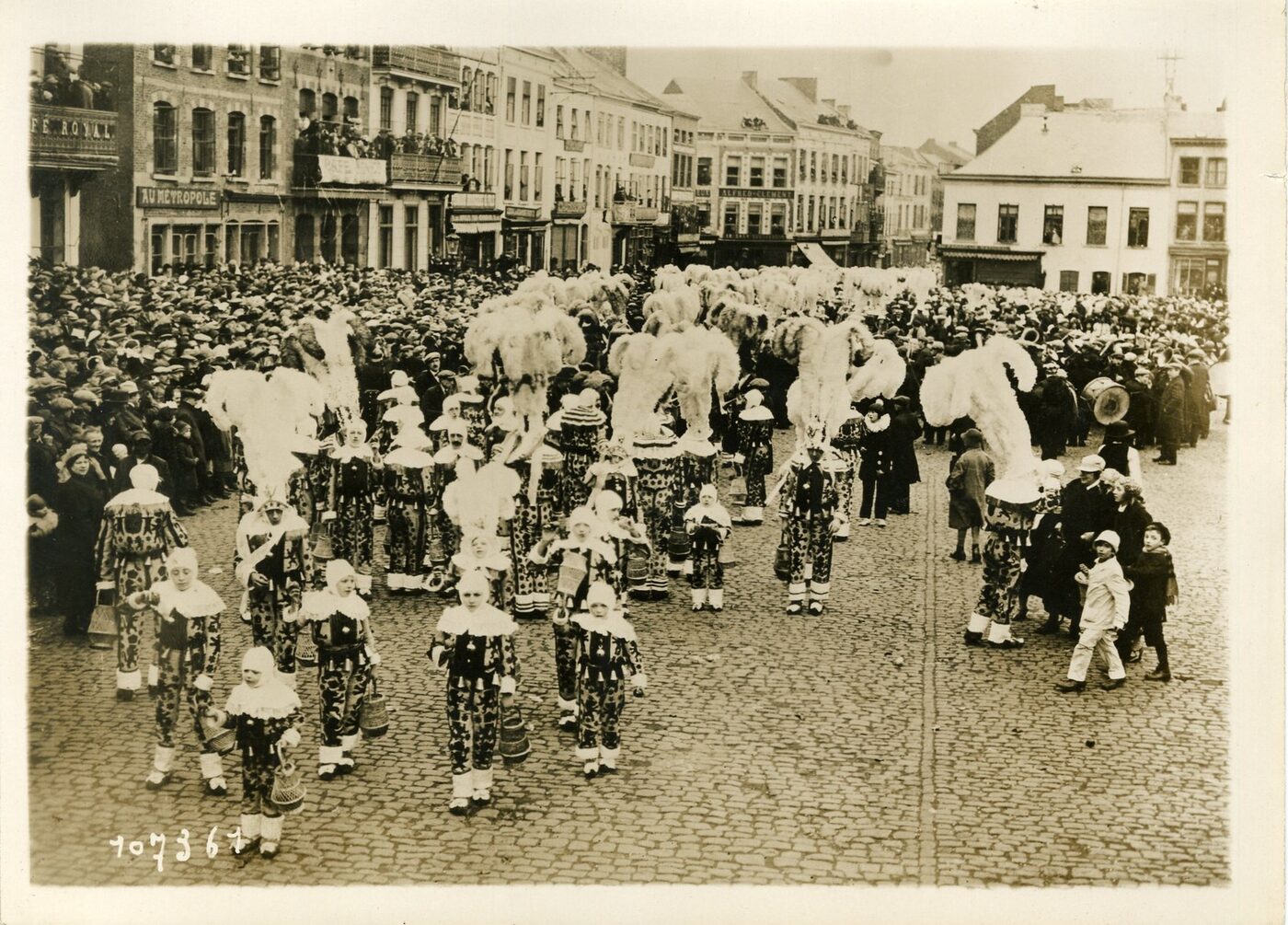
The festival calendar supplied dates rather than opinions. The Carnival of Binche occupies the Sunday, Monday and Tuesday before Ash Wednesday; its Gilles appear in wax masks and wooden clogs, up to a thousand of them, throwing oranges to the crowd, and UNESCO proclaimed the carnival a Masterpiece of the Oral and Intangible Heritage of Humanity in 2003.

Sport gave the year its other fixed points, and cycling gave Belgium two of the oldest races in the calendar. Liège–Bastogne–Liège was first run for amateurs in 1892 over 250 kilometres from Spa to Bastogne and back, and is the oldest of the five Monuments of the professional road season; it is held in the Ardennes in late April. The Tour of Flanders was first run on 25 May 1913 and is now held in early April; its founding director, Karel van Wijnendaele, said the police put the crowd for the early editions at 500,000, and in Flanders the race has long been treated as a cultural institution rather than a sporting fixture. Football's contribution inside the group's own lifetime was UEFA Euro 2000, co-hosted by Belgium and the Netherlands from 10 June to 2 July 2000, at which Belgium beat Sweden in its opening match, lost to Italy and then to Turkey, and went out at the group stage — a result of the kind that generates a great deal of newsgroup traffic and very little of it cheerful.
Reading soc.culture.belgium today
- Historical archive: Google Groups — soc.culture.belgium (coverage varies by group and era).
- Open in a newsreader:
news:soc.culture.belgium— the original site offered exactly this link, and it still works if your system has a newsreader registered for thenews:scheme. - Live access: point an NNTP newsreader at a modern server — see accessing Usenet today.
- The original news2mail e-mail subscription service ended in the mid-2000s and no longer operates.