soc.culture.brazil
Talking about the people and country of Brazil.
A Latin American national group: football and carnaval, Plano Real economics, MPB and bossa nova, and Portuguese-language humour.
Groups of this kind kept long-lived FAQs answering recurring questions about documents, travel, shipping and the practicalities of living abroad; the genre, not any single document, is what the record establishes.
On this page
The group and its era
soc.culture.brazil sat in the soc.culture.* hierarchy, the long shelf of national and regional groups that accumulated after Usenet's late-1980s reorganisation gave social discussion a top level of its own. Like most of its neighbours it was unmoderated: anyone with news access could post, and the group's character was set less by its charter than by whoever kept showing up.
Its era maps awkwardly onto Brazil's own network history. Through the early 1990s, internet access in Brazil ran almost entirely through academic networks, so the group's first constituency was heavy with Brazilian postgraduates and researchers at foreign universities — people reading news from a campus terminal several time zones from home. Commercial internet provision inside Brazil was only authorised in 1995, after which the balance slowly shifted towards readers posting from the country itself.
That geometry — an emigrant-heavy forum discussing a country most of its members had only temporarily left — shaped the tone. Threads about work, homesickness and the practicalities of going back sat alongside arguments over the news from home, which in 1990s Brazil was rarely in short supply.
The dates behind that account are checkable. Brazil's country-code domain, .br, carries a registration date of 18 April 1989 in IANA's root database, within two years of the reorganisation named above and in the same first wave as its neighbours: Argentina 23 September 1987, Chile 15 December 1987, Mexico 1 February 1989. The academic National Research Network, RNP, was formed by the academic communities of Rio de Janeiro and São Paulo at the end of the 1980s, and its backbone was built from 1991. Brazil was therefore never absent from the network the group lived on. It was present from the beginning, but present as a set of campuses rather than as a public.
Getting online from Brazil
Until the middle of the 1990s the Brazilian internet was a state undertaking: RNP was a government-funded academic network, and the long-distance circuits belonged to Embratel and the Telebrás system, which stayed in public hands until the privatisation of 1998. The internet became commercially available in Brazil in May 1995. In the same month, on 31 May 1995, Interministerial Ordinance 147 created the Comitê Gestor da Internet no Brasil, the multi-stakeholder committee that has administered the domain ever since and that still appears as the sponsoring organisation on the IANA record for .br; it was amended by Presidential Decree 4,829 of 3 September 2003.
The consequence for the group can be read straight off the penetration series. Individuals using the internet, as a share of the Brazilian population, on the ITU figures compiled by the World Bank:
- 1994 — 0.04 per cent
- 1995 — 0.1 per cent
- 1996 — 0.45 per cent
- 1997 — 0.8 per cent
- 1998 — 1.5 per cent
- 2000 — 2.9 per cent
- 2002 — 9.1 per cent
- 2005 — 21.0 per cent
- 2010 — 40.7 per cent
Those nine lines describe the whole of the group's active life. In 1996 fewer than five Brazilians in a thousand had internet access of any kind, and access at that level was still overwhelmingly institutional. A Brazilian at a North American or European campus faced no such filter at all: news access came with the account. The tilt of the early readership towards the diaspora was not a matter of temperament or of who cared more. It was arithmetic, and it eased only as the domestic percentage climbed — which, on the same series, means it eased mainly after 2000.
The other thing the series shows is scale. Brazil's population was large enough that a modest percentage produced a very large absolute number: 9.1 per cent of roughly 178.5 million people in 2002 is of the order of sixteen million users, against about twelve million in Mexico and four million in Argentina on the same source's figures for the same year. That arithmetic — not a high penetration rate, which Brazil did not have — is what lies behind the familiar description of Brazil as Latin America's largest online population. By 2005 the Brazilian figure was of the order of thirty-eight million. Almost none of that growth reached Usenet: it arrived after the audience for text-only, server-based discussion had already begun to move, and the new arrivals went to the web.
What was discussed
The group's lifetime coincided with the first decades of the New Republic, and national politics supplied a continuous backbone. The impeachment of Fernando Collor de Mello in 1992 was exactly the kind of slow, document-heavy story a newsgroup digests well, and the elections that carried Fernando Henrique Cardoso to office in 1994 and 1998, then Luiz Inácio Lula da Silva in 2002, each brought partisans of every camp into the same room.
Behind the current affairs lay longer arguments about the military dictatorship of 1964–1985, which had ended less than a decade before the years in which such groups were busiest. Questions of amnesty, memory and how the period should be judged recurred, argued by people for whom it was family history rather than abstraction; the group carried those debates without ever settling them, which is roughly what such forums are for.
Certain events pulled the whole readership into a single conversation. The death of Ayrton Senna at Imola in May 1994 was one — the sort of national shock that briefly turns an expatriate forum into something closer to a wake. The 1992 Earth Summit in Rio, and the running international argument over the Amazon, drew outside readers into the group and with them a recurring counter-theme: Brazilians pushing back on how their country was described from abroad.
Beneath the headline material ran the perennial staples: which language to post in, with threads sliding between Portuguese and English depending on who was being addressed; regional rivalries conducted with more energy than malice; race and class debated at every level of quality; and the patient, endlessly repeated correction, delivered to each newly arrived outsider, that Brazilians speak Portuguese.
The dated record
The fixed points of the period are set out here as dates and nothing more. No causal claim is made by the ordering, and no judgement by the inclusion.
- 5 October 1988 — the current Federal Constitution promulgated by the National Constituent Assembly.
- 18 April 1989 — registration date recorded by IANA for the
.brdomain. - 15 March 1990 — Fernando Collor de Mello took office as president.
- 29 September 1992 — the Chamber of Deputies voted to open impeachment proceedings, 441 votes to 38.
- 29 December 1992 — Collor resigned.
- 1 August 1993 — the cruzeiro real introduced.
- 1 July 1994 — the real introduced, replacing the cruzeiro real at 2,750 to one.
- 17 July 1994 — Brazil beat Italy 3–2 on penalties after a goalless final at the Rose Bowl, Pasadena.
- 31 May 1995 — the Comitê Gestor da Internet no Brasil created; the internet became commercially available in Brazil the same month.
- 12 July 1998 — Brazil lost the World Cup final 3–0 to France at the Stade de France, Saint-Denis.
- 6 August 2001 — the novelist Jorge Amado died, four days before his eighty-ninth birthday.
- 30 June 2002 — Brazil beat Germany 2–0 at the International Stadium, Yokohama, Ronaldo scoring in the sixty-seventh and seventy-ninth minutes.
- 1 January 2009 — Brazil began applying the Orthographic Agreement of 1990; the reformed spelling became obligatory from January 2016.
Two entries sit outside the group's own life, at either end. The 1988 Constitution predates any mass network in Brazil and most of the traffic described on this page; the orthographic changes of 2009 and 2016 arrived long after that traffic had stopped, and appear here only because they alter how period Portuguese is spelled and therefore how the archive can be found. Everything between those two dates falls inside the years the group was being read.
Hyperinflation and the Real Plan
The most measurable change of the group's early years was monetary. Between 1986 and 1994 Brazil used five units of account in succession — the cruzado from 1986, the cruzado novo from 1989, the cruzeiro from 1990, the cruzeiro real from 1 August 1993, and the real from 1 July 1994 — most of them arriving with a stabilisation programme and each in turn overtaken. The World Bank's consumer-price series gives the scale of what they were trying to stop: annual inflation of 2,948 per cent in 1990, 433 per cent in 1991, 952 per cent in 1992, 1,927 per cent in 1993 and 2,076 per cent in 1994.
The Real Plan worked by inserting an intermediate step. For a transitional period prices were quoted in a non-monetary unit of account, the unidade real de valor, whose value tracked the United States dollar; on 1 July 1994 the URV was converted into a circulating currency, the real, at 2,750 cruzeiros reais to one. Fernando Henrique Cardoso was finance minister when the plan was designed and was elected president later the same year. On the same World Bank series annual inflation fell to 66 per cent in 1995, 15.8 per cent in 1996, 6.9 per cent in 1997 and 3.2 per cent in 1998. The currency then appreciated, touching 0.83 to the dollar in early 1995, and the quasi-fixed exchange-rate regime ran until the devaluation of January 1999.
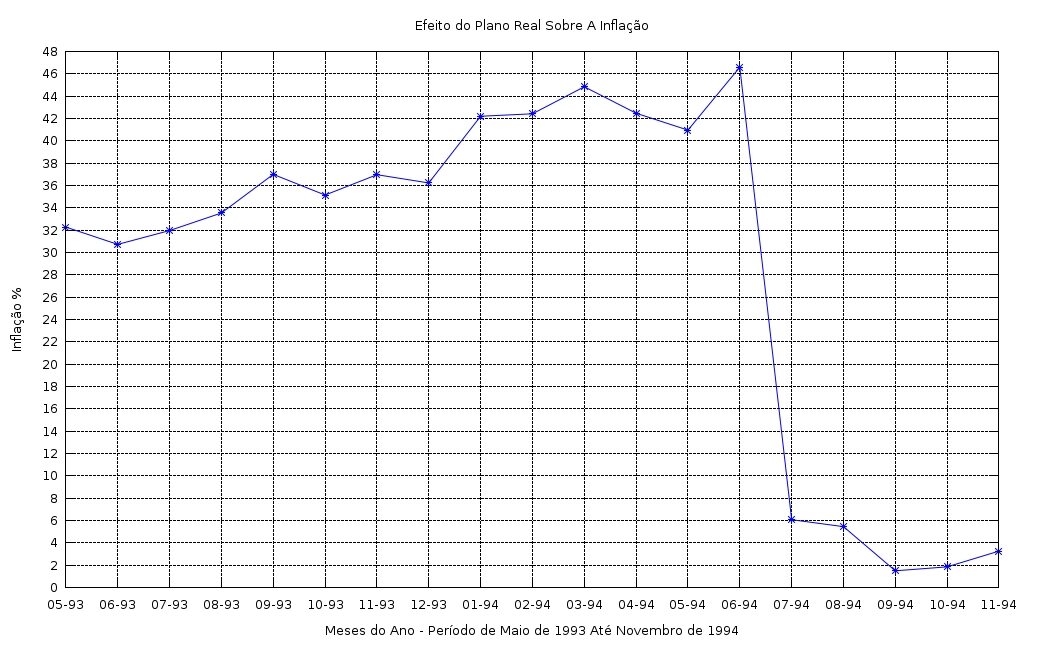

For a readership spread across several currencies these were not abstract numbers. An exchange rate is the term in which a salary earned abroad, a remittance sent home and a decision about when to return are all denominated, and between 1990 and 1999 that term moved by orders of magnitude and then stopped moving. The plan is also the reason the economics on this page can be dated at all: hyperinflation leaves a country without stable prices to argue about, and the Real Plan restored them.
Writing Portuguese on a seven-bit network
Portuguese is written in the Latin alphabet, which spared soc.culture.brazil the romanisation schemes that groups writing Cyrillic, Greek, Arabic, Hebrew or the CJK scripts had to invent for themselves. What it did not spare them was the diacritic. Brazilian Portuguese needs the acute, the grave, the circumflex, the tilde and the cedilla — á à â ã ç é ê í ó ô õ ú — and, until the 1990 agreement removed it, the diaeresis in words such as lingüiça.
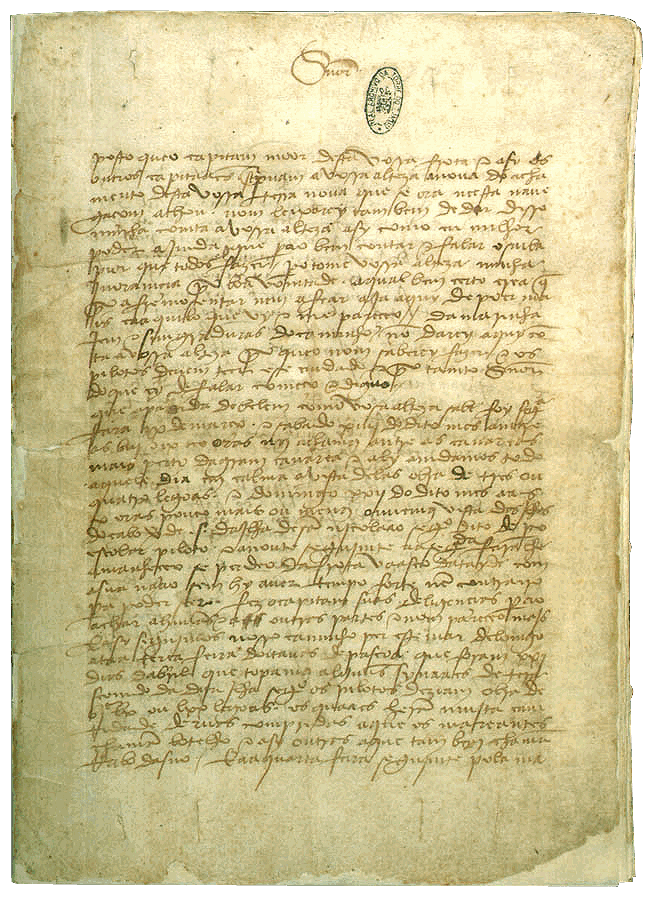

The repertoire was never the difficulty. Every one of those letters sits in ISO/IEC 8859-1, first published in 1987, which lists Portuguese in both its European and Brazilian forms among the languages it covers completely; and the same characters occupy the Latin-1 Supplement block, U+0080 to U+00FF, which has carried an unchanged repertoire since version 1.0 of the Unicode Standard in 1991. The difficulty was that the network moved bytes, not characters, and the eight-bit encodings in use disagreed about which byte meant which letter. A message typed under IBM code page 850 or code page 860 — the latter is the DOS code page named for Portuguese — and displayed under Windows-1252 or ISO 8859-1 produced not an accented word but a wrong one.
Netnews itself hedged. RFC 1036, the article format of December 1987, defined its structured fields in terms of printing ASCII and left the body's character set to RFC 822 and to local convention. MIME arrived afterwards — RFC 1341 in June 1992, revised as RFC 2045 to 2049 in November 1996, with RFC 2047 of the same month covering non-ASCII text in headers — and support for it spread through newsreaders unevenly and late. When the format was finally restated as RFC 5536 in November 2009 the rule was explicit: the character set for header fields is US-ASCII, and anything else must be MIME-encoded. By then the argument was of historical interest only.
The adaptation that period Lusophone computing settled on was simply to drop the accents. Portuguese remains legible without them in a way that many languages are not, so nao, voce, acao and Sao Paulo cost the reader almost nothing, while a mis-decoded accent costs the reader the word. The result for anyone working the archive today is that a single term exists in the record in several byte-forms at once: correctly encoded, stripped bare, and mangled into the substitution characters of whichever mismatch occurred. A search for São Paulo will not find Sao Paulo, and neither will find the mojibake.
One further layer complicates the search, and it postdates the traffic entirely. The Orthographic Agreement of 1990, signed in Lisbon on 16 December 1990 but applied in Brazil only from 1 January 2009 and obligatory from January 2016, removed the diaeresis from Brazilian spelling and dropped the acute accent from certain diphthongs, so that idéia became ideia and lingüiça became linguiça. A reader who types the modern spelling into an archive search is querying a corpus written under the older rules.
Where the readers were
The reason Brazilian identity is a standing subject rather than a provocation is demographic and well documented. Counting from the first census in 1872 to the year 2000, Brazil received about six million immigrants; between 1877 and 1903 alone almost two million arrived, at some seventy-one thousand a year. Italians account for the largest single decade in the series — 537,784 arrivals in 1894–1903, after 510,533 in the decade before — alongside continuing Portuguese migration, Spaniards, Germans settling Rio Grande do Sul from 1824, and Syrians and Lebanese, whose arrivals reach 45,803 in the decade 1904–1913. Their descendants' own groups are shelved a few doors down in this directory, at soc.culture.syria and soc.culture.lebanon.
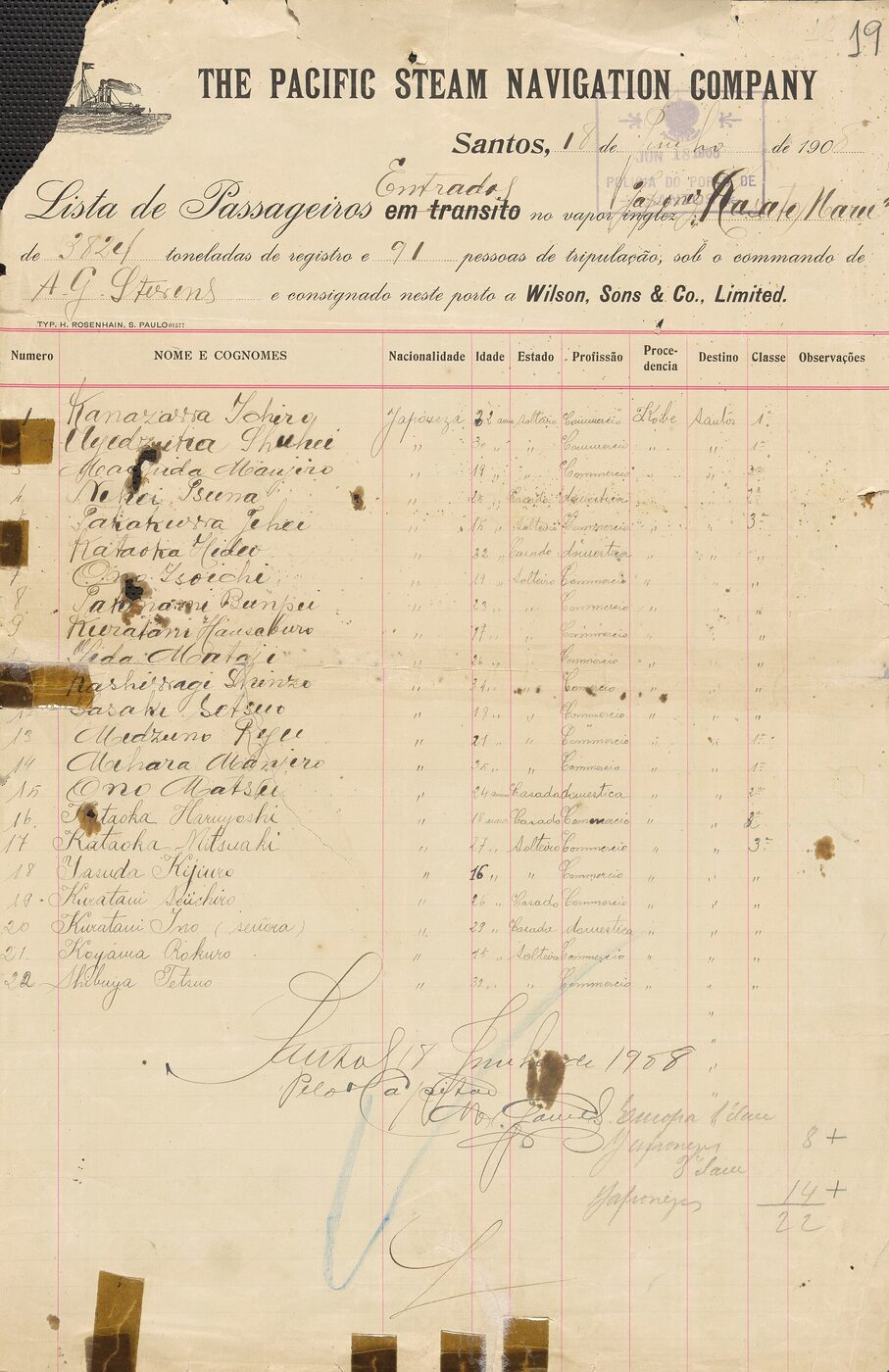
Japanese migration to Brazil began with a single documented sailing: the Kasato Maru docked at Santos on 18 June 1908 carrying 781 Japanese workers for the coffee plantations of the São Paulo interior. Arrivals reached 110,191 in the decade 1924–1933, and Japan's Ministry of Foreign Affairs put the number of Brazilians of Japanese descent at around two million in 2022, close to one per cent of the Brazilian population.

That flow later reversed. From the late 1980s the dekasegi movement took Japanese Brazilians to Japan for work; by 2007 there were 313,770 Brazilians legally resident in Japan, a figure that fell to 177,953 by 2014 after the financial crisis and stood at 211,840 in 2023. For the newsgroup this mattered in a specific way: it put a sizeable, Portuguese-speaking, Brazilian-identified readership twelve hours ahead of Brasília rather than behind it.
Where the readership sat overall can only be inferred, since no census of a newsgroup exists and none should be invented. The present shape of the Brazilian diaspora is at least documented: an estimated 5.18 million Brazilians abroad in 2024, with 2023 country figures of about 2,085,000 in the United States, 513,000 in Portugal, 263,200 in Paraguay, 230,000 in the United Kingdom, 210,470 in Japan, 170,400 in Germany and 143,500 in Canada. These counts are two decades later than the group's active years and should not be read back onto it; what they establish is that the population the group drew on was genuinely global rather than concentrated in one receiving country.
The practical effect on a newsgroup is a clock problem. Brazil alone spans four standard time zones, from UTC−02:00 on Fernando de Noronha to UTC−05:00 in Acre, and observed summer time from 1985 until it was abolished in 2019 — in the southern summer, so that the gap to Europe and North America widened and narrowed twice a year in the direction opposite to theirs. Add readers in Lisbon, London, Boston, California and Aichi and there is no hour at which the group is asleep and none at which it is all awake. A dispersed readership of that kind does not hold conversations so much as relay them: a thread is answered in shifts, each contributor arriving to a discussion that moved several steps while they slept, and the etiquette of quoting enough of the previous article to be intelligible — a Usenet habit everywhere — becomes a practical necessity rather than a courtesy.
The traffic between crises
Politics and currency reform are the parts of a culture group that get remembered; they are not the parts that filled it. Between the crises it ran on subjects far better documented than its politics.
Football supplied the shared calendar. Brazil is the only national team to have played in every edition of the World Cup without absence or play-off, and holds five titles — 1958, 1962, 1970, 1994 and 2002 — two of which fell squarely inside the group's life and one defeat, in 1998, with them. For a readership scattered across many time zones, a tournament is the rarest thing a dispersed community has: an event everybody watches at a known moment, followed by an argument everybody can join.
Carnival supplied the other calendar, and a movable one. Rio's carnival runs from the Friday before Lent, fifty-one days before Easter, to Ash Wednesday, forty-six days before it, so its date has to be recomputed every year. The parade has been judged competitively for far longer than it has had a permanent home: temporary stands were assembled and dismantled annually from 1952, and it was in 1983 that Governor Leonel Brizola commissioned Oscar Niemeyer to design the Sambadrome, which opened for the 1984 carnival. The Special Group schools parade there under LIESA on the Sunday and Monday. A scored competition between named schools generates the same structure of argument as a league table, which is to say an inexhaustible one. Samba's recorded history is older still: Pelo Telefone, released on 21 January 1917 and registered the previous November, is the record the National Library of Brazil counts as the first samba, though earlier recordings exist.
Music of the sort that travels with emigrants has an unusually well-dated history in Brazil, which is why threads about it could be argued on evidence. Bossa nova is generally traced to João Gilberto's guitar accompaniment on Elizeth Cardoso's 1958 album Canção do Amor Demais and to his own LP Chega de Saudade of 1959, which consolidated the style; the Consulate-General of Brazil presented Bossa Nova at Carnegie Hall on 21 November 1962, and the Getz/Gilberto album of 1964, made with Stan Getz and Antônio Carlos Jobim, won a Grammy. MPB emerged from 1966 in Rio de Janeiro out of the second generation of bossa nova. Tropicália followed with the collective album Tropicália: ou Panis et Circencis in 1968, made by Caetano Veloso, Gilberto Gil, Gal Costa, Tom Zé, the lyricist Torquato Neto, Os Mutantes and the arranger Rogério Duprat; Veloso and Gil were arrested on 27 December 1968, held for two months and then exiled to London, returning to Brazil in 1972.
Literature carried its own recurring argument about what represents the country abroad. Jorge Amado, born 10 August 1912, published Captains of the Sands in 1937, Gabriela, Clove and Cinnamon in 1958 and Dona Flor and Her Two Husbands in 1966, and his work has been translated into forty-nine languages in fifty-five countries — a body of translation large enough that many foreign readers of the group had met Brazil through him first. He died on 6 August 2001, inside the group's life, and the date belongs on any record of the period.
To this should be added the least glamorous function of a national group on Usenet: the reference desk. Questions about documents, travel, shipping, ingredients, spelling and the practicalities of living abroad recur across the archived soc.culture.* groups, and the long-lived FAQs such groups produced were the standard answer to them. That genre of traffic, rather than any single argument, is what kept the room occupied between the dated events listed above.
Context
Within the hierarchy the group's nearest relations were soc.culture.latin-america and soc.culture.portuguese, and traffic drifted across those borders in both directions. soc.culture.brazil was nonetheless its own place: a largely Portuguese-language community operating inside an overwhelmingly English-language medium, distinct from the Spanish-speaking groups around it and mildly tired of being filed with them.
Its decline followed the general Usenet curve of the 2000s, with a peculiarly Brazilian accent. When Google's social network Orkut launched in 2004, Brazilians adopted it with such enthusiasm that they eventually became its largest national user base, and the online sociability the newsgroup had carried moved wholesale to friendlier interfaces. The group's name survives in the Big Eight canon, but the crowd — as crowds do — went where the party was.
Reading soc.culture.brazil today
- Historical archive: Google Groups — soc.culture.brazil (coverage varies by group and era).
- Open in a newsreader:
news:soc.culture.brazil— the original site offered exactly this link, and it still works if your system has a newsreader registered for thenews:scheme. - Live access: point an NNTP newsreader at a modern server — see accessing Usenet today.
- The original news2mail e-mail subscription service ended in the mid-2000s and no longer operates.