soc.culture.syria
Syria and Syrians.
The Hafez-era group: politics handled with the caution the era demanded, diaspora conversation from every continent, and cultural threads — Damascene food, poetry, dialect maps — that carried the traffic politics could not.
Reference directories still carry the address — the Geometry.Net mirrors list it on their Syria culture pages — which is how most readers reach it today.
On this page
- The paperwork survives, which is unusual
- The charter, verbatim
- The rationale, and what it assumed
- The vote, April 1995
- What the ballot roll shows
- The line in the newsgroups file
- Who could write it: Syria's connectivity, in numbers
- What “caution” meant, in the record
- Mandate and independence, dated
- Union, separation, and 1963
- 1970, 1971, 1973
- Hama, 1982: the record, and where it disagrees
- The succession of 2000
- The Damascus Spring, June 2000 to autumn 2001
- Three subjects that ran the whole length of it
- Older than the argument: Damascus and Aleppo
- The archives: Ebla, Mari, Ugarit
- Palmyra
- The Umayyad century
- Six inscriptions
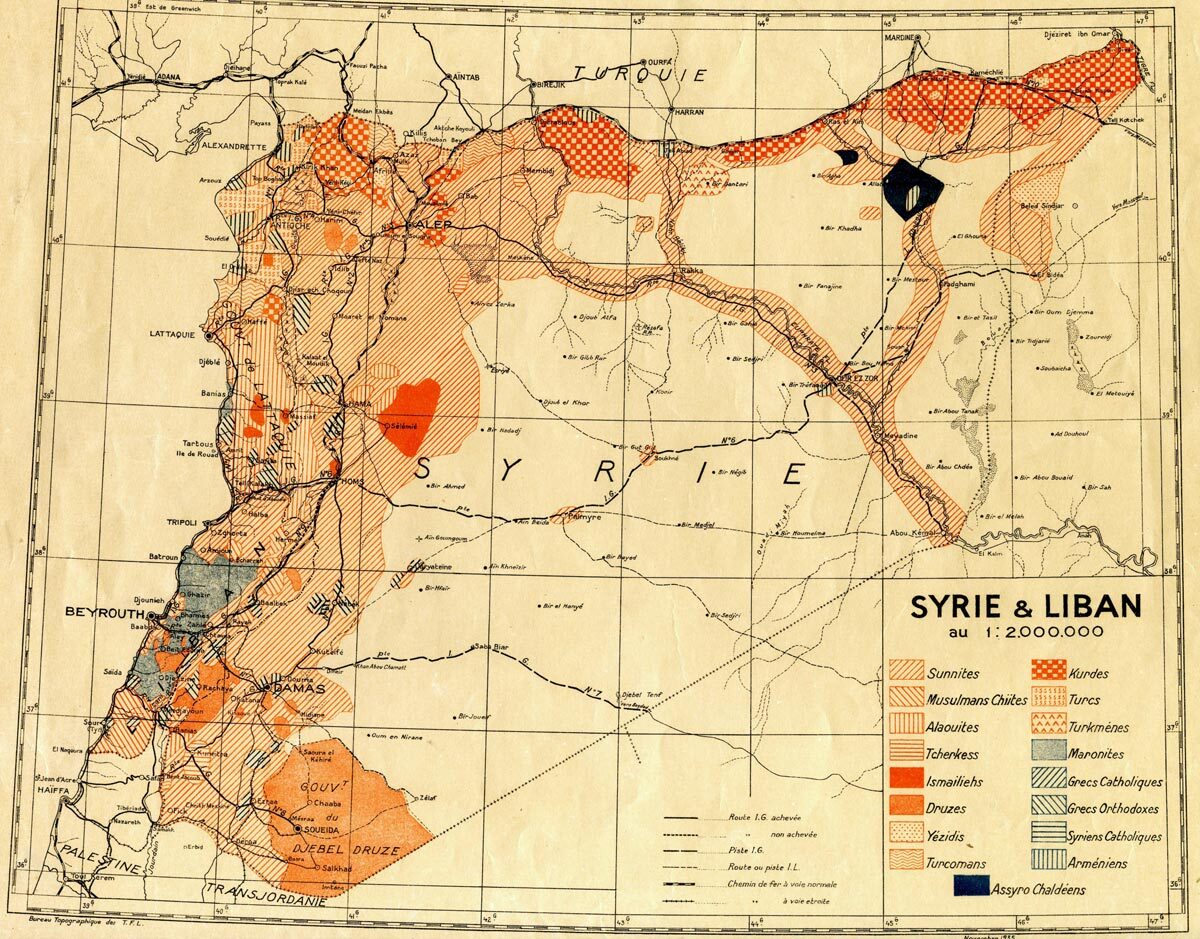
- A country of communities
- Dialects, and what a dialect map is for
- The food, which the charter listed by name
- Poetry, and where its poets lived
- The geography of the readership
- What the record does not show
- Scope and limits
The paperwork survives, which is unusual
Most of the groups in this directory left almost nothing behind but their names. soc.culture.syria is an exception, and the exception is worth stating plainly before anything else, because it is the only part of this page that rests on the group's own documents rather than on the history of its subject. The Internet Systems Consortium's mirror of news.announce.newgroups holds the complete administrative file for the group: a Request for Discussion, two Calls for Votes, and a Result, together with the newgroup control message that actually created it. Dates, names, wording and vote counts below are taken from those postings and are quoted from them.
The Request for Discussion was posted on 25 January 1995 by Thabet Birro, writing from an address at iu.net, and submitted jointly with Haisam Ido. Like every posting to that moderated group it carries an approval line from [email protected] — David C. Lawrence, then moderator of news.announce.newgroups, whose name recurs at every stage of this record. The header block is a small formal document in its own right:
- Newsgroup name: soc.culture.syria
- Status: unmoderated
- Languages: English, French, and transliterated Arabic
- Distribution: world
The proposal's own one-line summary described a group “intended to host a variety of articles dealing with issues relating to Syria and Syrians worldwide”, whose subjects would “cover a wide spectrum of affairs ranging from history and politics, to culture and economy”. Nothing in that sentence is remarkable; what is useful about it is that it was written down in January 1995 and has not been edited since.
The crosspost list is more informative than the summary. The RFD went to news.groups and news.announce.newgroups, as the rules required, and then to seven regional groups that already existed: soc.culture.arabic, soc.culture.iranian, soc.culture.jordan, soc.culture.kuwait, soc.culture.lebanon, soc.culture.maghreb and soc.culture.palestine. That list is a map of the neighbourhood as it stood at the moment the proposal was made — which parts of the region already had a room on Usenet, and which did not. Syria did not. The RFD said so in as many words, and the discussion period it opened was to run, in the proposal's own phrasing, for twenty-one to thirty days.
The charter, verbatim
The charter that went to the vote was, as the votetaker's note put it, “culled from the RFD written by the proponent of the group”. It is short, and it is reproduced here exactly as the Result posting carries it, because a charter paraphrased is a charter altered:
Soc.culture.syria will be open to all people who are interested in learning about, or contributing to the rich culture of glorious Syria. SCS will be the ideal means for exchanges dealing with the past, present and future of Syria as a part of the ever important region of the Middle East.
Beneath it the document set out the topics under three headings — Cultural Affairs and Human Affairs side by side in two columns, Science and Technology in a block below them. The list, in the order and the spelling the record preserves, runs:
- Cultural Affairs — Syrian Culture; History; Literature and Fine Arts; Music; Archaelogy; Natural Resources; Folklore; World Famous Syrian Cuisine.
- Human Affairs — Human and Civil Rights; Religion; Politics; The Peace Process; Macro and Micro Economics; Social Issues; Education; Tourism; The Latest Laws and Regulations.
- Science and Technology — The Latest on Technology; Current Scientific Research; Environment; Arabic Computing; General Computer Related Issues.
Three details in that list repay a second look. Archaelogy is misspelled, and the misspelling travelled unchanged from the RFD through both Calls for Votes, the Result and the newgroup control message: the charter of a Usenet group was whatever text the proponent typed, and nobody along the chain was empowered to tidy it. Two other slips were tidied, silently, when the votetaker culled the charter for the ballot — the RFD opens “the rich cutlure of glorious Syria” and lists “World's Famous Syrian Cuisine”, and the circulated text corrects both — which makes the survival of Archaelogy through four further postings the more conspicuous. The Peace Process, capitalised as a proper noun, dates the document as precisely as a stamp; in January 1995 the phrase needed no gloss. And Arabic Computing sits under Science and Technology, which is where, in 1995, it belonged: getting Arabic through the network at all was an engineering problem before it was a cultural one, and it is a subject owned on this site by the language-wide group soc.culture.arabic.
The RFD also included a paragraph of rules of conduct that did not survive into the circulated charter: discussion on the group would “observe debate etiquette and applicable netiquette”, and “personal attacks and foul language will not be acceptable”. In an unmoderated group this was a statement of hope rather than a mechanism, and the record shows no machinery for enforcing it, because there was none to have.
The rationale, and what it assumed
Under the heading RATIONALE the proposers gave two reasons, and the first of them is the more interesting because of what it takes for granted:
Firstly, there is no current newsgroup that deals with Syrian affairs and concerns. Due to the large number of Syrian emigres, SCS will be a necessary means for them to be actively involved in their homeland's affairs. Secondly, Syrian affairs are indeed of concern to many regional countries and parties. Syrians and non-Syrians alike, look to Syria for indications on the future of the entire region.
The group, in other words, was proposed for emigrants. Not incidentally, and not as an afterthought about who might also read it: the stated constituency was people outside the country who wanted a way of following and arguing about it. The RFD's own clause about languages points the same way — discussion “will be conducted in English as a first language”, with “occasional French and Arabic (using Latin characters)” expected to “help attract a wider readership”. A group about Syria was being designed, in advance, to be written mostly in English by people living somewhere else. The sections that follow explain why that was not a choice so much as an arithmetic.
The vote, April 1995
The Call for Votes went out on 24 March 1995 over the name of Robert Haas, writing for the Usenet Volunteer Votetakers — the standing pool of neutral third parties that ran Big-Seven ballots in this period. Votes were to be mailed to a dedicated address, posted votes were not counted, and the deadline was stated to the second: 23:59:59 UTC on 14 April 1995. A second and final Call for Votes, superseding the first, followed on 4 April. Both carried the proposed newsgroups-file line and the charter in full, so that nobody could vote on a moving target.
The passing rule of the day, under the Big-Seven voting guidelines then in force, had two limbs, and both had to be met: at least a hundred more valid YES votes than NO votes, and at least two-thirds of all valid votes in favour. The Result, posted on 18 April 1995 and appearing on the network with the following day's date, records the outcome in its subject line — soc.culture.syria passes 284:25. Counting the published roll gives the same numbers: 284 yes, 25 no, and two abstentions, which by the rules affected nothing. The margin was 259, comfortably over the hundred required, and the yes share was a little under 92 per cent, comfortably over the two-thirds. This was not a close-run group.
Creation followed the usual five-day wait. The newgroup control message was issued on 24 April 1995 at 14:30:16 GMT by David C. Lawrence, and its body is a model of the genre: a single sentence recording that the group “passed its vote for creation by 284:25 as reported in news.announce.newgroups on 19 Apr 1995”, then the line to paste into a newsgroups file, then the charter again. Every news administrator on the network then decided individually whether to honour it. Enough of them did that the group is still carried in the configuration files ISC distributes thirty years later, which is the part of that proposition this page can actually check.
The tally is worth setting beside its immediate neighbours, because the winter of 1994–95 was when the Mashriq filled in. soc.culture.jordan had passed 164:21, its result posted on 5 January 1995. soc.culture.iraq was proposed five days after Syria, on 30 January 1995, and passed 403:55 on 1 May. soc.culture.palestine, older, had passed 211:90, its result posted in November 1993. Syria's was not the largest vote in the neighbourhood — Iraq's was, six weeks later — and this page does not claim it was. Nor were its twenty-five no votes the fewest in absolute terms; Jordan drew twenty-one. What the four tallies do show is that Syria drew the smallest proportion of opposition of the four: eight per cent of its valid votes were against, as against eleven per cent for Jordan, twelve for Iraq and thirty for Palestine.
What the ballot roll shows
Votetakers of the period published the full list of voters, addresses and names included, precisely so that a result could be audited by anyone who doubted it. That convention, adopted for accountability in 1995, has left behind a dataset nobody at the time expected to be reading thirty years later: a snapshot of who, on the whole planet, could send an e-mail about Syria in April 1995.
The roll carries 311 addresses across the yes, no and abstain lists. Sorted by top-level domain, they fall out as follows:
- 132 in .edu — universities, overwhelmingly American, and by a wide margin the largest single block
- 83 in .com, in an era when that still meant mostly corporate and early consumer-service accounts
- 28 in .ca and 4 in .au
- 14 in .fr, 9 in .uk, 5 in .de, 2 each in .nl and .be, one each in .se, .no and .fi
- 6 in .tr and 3 in .il
- 9 in .net, 4 in .org, 4 in .gov, one in .mil and one in .us
- one in .br
Not one address on the roll was in the .sy domain. That is the single most load-bearing fact on this page about who wrote the group, and it needs no interpretation beyond the next section's figures. It is also worth noticing what the list is not: it is not a map of the Syrian diaspora. The largest communities of Syrian descent in the world were, and are, in South America, and South America contributed exactly one address to this ballot. A vote roll from 1995 records where the network reached, not where the people were.
Individual voters are not named here. They are named in the archive, which is public and was designed to be, but a page about a newsgroup has no need of a list of private people who once sent an e-mail about it, and the topic is one on which that discretion costs nothing.
One curiosity of the file deserves a footnote, since anyone who opens it will meet it. Filed among the four Syria postings, misplaced by whatever process assembled the archive, sits a second Call for Votes for soc.culture.yugoslavia from March 1991, complete with its own vote acknowledgement and its own Slovene sign-off. It has nothing to do with Syria. It is a reminder that these archives were swept together by hand and by script, and that reading them carefully means reading the headers, not just the text.
The line in the newsgroups file
Alongside the creation record, ISC distributes the canonical description files for the Big-8 namespace, and soc.culture.syria is still in them. The newsgroups file — the one that supplies the single-line description a newsreader shows next to a group name — carries the entry exactly as the 1995 Call for Votes proposed it (name and description are separated by a tab in the file itself):
soc.culture.syria— Syrian cultural matters and affairs.
The companion active file lists the group with the flag y, meaning unmoderated and open for posting. Thirty years on, the group has not been removed, renamed or moderated; it is still part of the namespace that news administrators agree to carry. The one-line description at the head of this directory page is the gateway's own, shorter wording, recorded when the gateway carried the group; the line above is the canonical one, and where the two differ the canonical one is the group's.
The neighbours' lines, from the same file, show how finely the branch was divided. soc.culture.arabic reads “Technological & cultural issues, *not* politics.” — the asterisks are in the file, and they are the residue of an argument. soc.culture.lebanon reads “Discussion about things Lebanese.”, soc.culture.iraq “Iraq, its society, culture and heritage.”, and soc.culture.palestine “Palestinian people, culture and politics.” Syria's line names culture and affairs and declines to say more, which turned out to be the durable choice.
Who could write it: Syria's connectivity, in numbers
The reason no Syrian address appears on the 1995 ballot is not subtle. Syria had no public internet in 1995. The connection arrived around 1998; CBS News, reporting on 10 July 1998, recorded that thirty-five organs of the Syrian government had been connected by that month. ADSL service became available in 2003. The group was three years old before the country it was named for was on the network at all, and eight before a domestic subscriber could get a broadband line.
The Internet World Stats series, compiled from the standard national returns, gives the shape of the ramp for the years that matter here:
- 2000 — 30,000 users, about 0.2 per cent of the population
- 2002 — 220,000 users, about 1.2 per cent
- 2005 — 800,000 users, about 4.2 per cent
- 2009 — 3,565,000 users, about 16.4 per cent
Set that beside the group's working life and the arithmetic is decisive. Through the whole of the 1990s, domestic participation was effectively zero. During the years the news2mail gateway carried the group to e-mail, between 2000 and roughly 2004, the entire online population of Syria went from thirty thousand people to a few hundred thousand — and those people reached the network through a state operator, a handful of licensed private providers, and public internet centres. Later reporting describes the terms on which those centres operated: approval from the security services to open, and an obligation to keep detailed records of customers' browsing. Voice over Internet Protocol was blocked outright. Web sites were blocked on political grounds, and people were arrested after reaching them.
The conclusion is a boring one and it is the right one: a newsgroup named for Syria was, for almost the whole of its life, written from outside Syria. That is not a judgement about the group; it is a description of the network.
What “caution” meant, in the record
This is the section on which the rest of the page depends, so its method is stated first. Everything below is a dated matter of public record, attributed to the body, court or publication that produced it. Nothing below is an inference about any person who posted to this newsgroup. The archive does not record who was writing from where, and this page does not guess.
The single most important legal fact of the group's era is the state of emergency. It was declared in 1963 and remained in force until April 2011 — forty-eight years, and every day of soc.culture.syria's active life. Under it, military courts applied martial law and special courts tried political cases outside the ordinary constitutional protections. The government's stated justification, recorded in United States State Department country reporting, was the continuing state of war with Israel over the Golan Heights. On 21 April 2011 legislative decree No. 53 abolished the Supreme State Security Court, the tribunal that had tried political cases.
The publishing environment was set at the same moment as the emergency. Accounts of the 1963 change describe massive censorship, the elimination of independent publishing centres, and the nationalisation of banks, the education system and industry, alongside large-scale confiscation of property and purges of the bureaucracy. Ten years later the 1973 constitution's Article 8 declared the governing party “the leading party in the society and the state”, a formula that the reform statements of 2000 and 2001 would ask, specifically, to have repealed.
Contemporary assessments by named organisations, each with its date, ran in one direction. Freedom House placed Syria in its Worst of the Worst section for 2009, with a rating of 7 for political rights and 6 for civil liberties. Human Rights Watch's World Report 2010 recorded that the authorities had arrested political and human rights activists, censored web sites, detained bloggers and imposed travel bans, that no political parties were licensed, and that emergency rule imposed in 1963 remained in effect. The OpenNet Initiative, testing in August 2009, found internet filtering pervasive in the political and internet-tools categories. Reporters Without Borders had listed Syria among its Enemies of the Internet since the list was created in 2006. The Committee to Protect Journalists, in 2009, ranked Syria third in its list of the ten worst countries in which to be a blogger.
Those are gradings. The record also contains a case, and it is the one that a page about a diaspora newsgroup is obliged to set down, because it concerns exactly the act of moving text from an emigre publication into a mailbox. BBC News reported on 21 June 2004 that a Syrian court had jailed Abdel Rahman al-Shaghouri, then 32, for two and a half years, on a charge recorded as “publishing false news that saps the morale of the nation”; he had downloaded material from a banned emigre web site and e-mailed it to others. He had been arrested in February 2003 and his computer equipment seized. Four other Syrians faced similar charges: the brothers Muhammed and Haytham Qutaysh and Yahia al-Aws, accused of sending false information abroad to an electronic newspaper based in the United Arab Emirates and by then held for eighteen months; and Masoud Hamid, detained since July 2003 after posting photographs of a Kurdish demonstration in Damascus on the internet. Amnesty International called for the release of all five. The lawyer for those four, Anwar al-Bunni, was quoted describing the verdict as “a political decision that quells the right of expression in Syria”.
That is what the word “caution” stands for in any honest description of this group, and it is why the word is a poor one: caution suggests a temperament, and what the record documents is a set of costs. A reader abroad weighing whether to post under a real name, and whether family at home might be visited about it, was not being cautious in a psychological sense. They were reading the same reports quoted above. What any individual actually did about it is not recoverable, and nothing here should be read as claiming otherwise.
Mandate and independence, dated
The country the group was named for is younger than most of its cities by several thousand years, and the modern chronology is short enough to give in full. Under the Ottoman Empire, Syria was not a state but a set of provinces. The wartime Sykes–Picot understanding of 1916 assigned the northern Levant to France; an Arab government under Faisal was established in Damascus after 1918 and did not last. On 25 April 1920 the Supreme Inter-Allied Council at San Remo granted France the mandate for Syria, including what is now Lebanon. Syrian forces met the French at Maysalun on 24 July 1920 and were defeated in a four-hour battle in which the war minister, Yusuf al-Azma, was killed; the French took Damascus the following day. The mandate instrument itself was drawn up between 1920 and 1922 and ratified in 1923.
What the mandate administered was not one country. It was subdivided into the states of Damascus (1920), Aleppo (1920), the Alawites (1920) and Jabal Druze (1921), the autonomous Sanjak of Alexandretta (1921), and the State of Greater Lebanon (1920), the last of which became Lebanon. The Great Syrian Revolt of 1925 to 1927 — begun in the Jabal Druze and joined across the country — was suppressed. Alexandretta was detached and annexed by Turkey in 1939, as the province of Hatay, and its loss remained a live grievance in Syrian public argument for the rest of the century.
Independence was proclaimed in 1941, during the war, and Syria was recognised as an independent republic on 1 January 1944, but the mandate power stayed on for another two years after that. The date Syria commemorates is 17 April 1946, the departure of the last French soldier — Evacuation Day, the national day.
.jpg)
Union, separation, and 1963
The first republic's politics were unstable in the way of many new states, and the most consequential experiment was a merger. The United Arab Republic was established on 1 February 1958, a union of Egypt and Syria proposed to Gamal Abdel Nasser by Syrian political and military figures. Referendums were held in both countries on 21 February 1958 and the result was announced on 22 February; Nasser became president of the new state. The Syrian half of it lasted three and a half years. A coup by Syrian officers on 28 September 1961 broke the union and restored an independent Syrian republic. Egypt kept the name United Arab Republic until 1971.
On 8 March 1963 the military committee of the Syrian branch of the Ba'ath Party seized power — the March 8 Revolution in the official nomenclature — a month after a related seizure of power in Iraq. The state of emergency dates from this moment, and so does the shape of the press and party system described above. A further intra-party coup in February 1966 changed the leadership again. In June 1967 Israel captured the Golan Heights, which remained the fixed point of Syrian foreign policy thereafter and the government's standing justification for the emergency.
1970, 1971, 1973
On 13 November 1970 Hafez al-Assad, then minister of defence, took power in a bloodless coup. He became prime minister on 21 November. The programme launched with it was called the Corrective Movement, or Corrective Revolution; a temporary regional command was set up at once, and the new government published its first decree on 16 November 1970. A presidential referendum was held on 12 March 1971 with a single candidate; the reported result was 99.2 per cent in favour on a turnout given as 95.3 per cent, and it is from this date that his presidency is formally counted.
A new constitution followed in 1973. It centralised appointment powers in the presidency, gave the president the appointment of the constitutional court, and in Article 8 defined the Ba'ath Party as the leading party in the society and the state.
The October War — Yom Kippur War, Ramadan War, the fourth Arab–Israeli war, depending on who is naming it — was fought from 6 to 25 October 1973, with Egypt and Syria attacking across the 1967 ceasefire lines and most of the fighting taking place in Sinai and on the Golan. The disengagement that followed was formalised by United Nations Security Council Resolution 350 of 31 May 1974, which established the Disengagement Observer Force still deployed on the Golan line. On 14 December 1981 the Israeli Knesset passed the Golan Heights Law by 63 votes to 21, applying Israeli law to the territory; the international community, and part of the Israeli opposition, treated the law as annexation. None of these positions is adjudicated here.
Hama, 1982: the record, and where it disagrees
Between 1976 and 1982 Syria experienced an armed Islamist insurgency, led by the Fighting Vanguard and, after 1979, by the Syrian Muslim Brotherhood, comprising assassinations, bombings and armed revolt. Its end came at Hama in February 1982, when the Syrian Army and the Defence Companies besieged the city. The fighting began at two in the morning on 2 February 1982, and the siege lasted twenty-seven days. The city was sealed before the operation began: communications, electricity and food supplies were cut, and journalists were excluded.
That blackout is the reason the casualty figures never converged, and it is why this page lists them rather than choosing between them. Each estimate below is given with the body or writer who produced it:
- Initial diplomatic reports from Western governments, relayed in the press in 1982: about 1,000 killed.
- Human Rights Watch, in a report published in 1990: between five and ten thousand.
- Amnesty International, in its initial estimate: between 10,000 and 25,000.
- Robert Fisk, who was at Hama shortly afterwards: 10,000 in his first account, revised to at least 20,000 in a later one.
- Patrick Seale, writing in The Globe and Mail: a minimum of 25,000.
- The Syrian Human Rights Committee: “over 25,000” in one report, and between 30,000 and 40,000 in another.
- The Syrian Network for Human Rights, in a fortieth-anniversary report in 2022: around 40,000 killed, with about 17,000 forcibly disappeared. The Syrian Human Rights Committee's figure for the disappeared is 15,000.
- Rifaat al-Assad, who commanded the Defence Companies, was reported to have boasted of killing 38,000 — a claim attributed to him rather than a finding by anyone.
The range runs from one thousand to forty thousand, the sources do not reconcile, and no figure is endorsed here. Accounts cited by Al Jazeera and by The National put the physical destruction at nearly two-thirds of the city. Hama is the event that most sharply divides accounts of modern Syria, it was thirteen years in the past when the newsgroup was created, and it was within living memory of everyone likely to be reading it. That is the whole of what this page says about it.
The succession of 2000
Hafez al-Assad died in office at the age of 69. The date is given as 10 June 2000 in the dedicated encyclopaedia article on his death and in the narrative of the article about him; his own infobox, and some summaries derived from it, give 11 June. Contemporary reporting supports the tenth. The discrepancy is a day and it is noted here rather than silently resolved. Forty days of mourning were declared in Syria and seven in Lebanon.
The succession was arranged quickly and in public. The constitution was amended to lower the minimum age for the presidency from forty to thirty-four, which was Bashar al-Assad's age. A referendum with a single candidate was held on 10 July 2000 and returned 97.29 per cent in favour. He took office on 17 July 2000 and was appointed commander-in-chief of the armed forces and regional secretary of the party.
This is the hinge of the group's life. The gateway that produced this directory carried soc.culture.syria to e-mail between 2000 and roughly 2004 — which is to say, it carried the group across the succession and the four years that followed it, the period in which what the succession would mean was still an open question.
The Damascus Spring, June 2000 to autumn 2001
The eighteen months after the succession are known as the Damascus Spring, and they are the most documented episode of open political argument in the group's era. Its characteristic institution was the muntada, plural muntadayat — a salon or forum, meeting in a private house, publicised by word of mouth, discussing politics and social questions. The phenomenon spread rapidly in Damascus and to a lesser extent in other cities. Long-standing opposition figures took part; so did intellectuals who insisted they were not political, among them the film-maker Omar Amiralay, along with members of the Communist Party and reform-minded party members. The best known of the forums were the Riad Seif Forum and the Jamal al-Atassi National Dialogue Forum.
The movement's demands were written down. The Statement of the 99 — also circulated as the Manifesto of the 99 — was signed by prominent intellectuals; the Committees of Civil Society formed alongside it; and in 2001 a Statement of 1000 appeared carrying a thousand signatures. Their demands were consistent: cancellation of the state of emergency and abolition of martial law and the special courts; the release of all political prisoners; the return of political exiles without fear of prosecution; the right to form political parties and civil organisations; and, increasingly, the repeal of Article 8.
The government's response came in two movements. In November 2000 it released hundreds of political prisoners and closed Mezze prison. In 2001 it closed the salons and prosecuted their organisers. Riad Seif and Ma'mun al-Homsi were sentenced by the Damascus Criminal Court to five years each, on charges recorded as attempting to change the constitution by illegal means and inciting racial and sectarian strife. Eight further activists — Riad al-Turk, Aref Dalila, Walid al-Bunni, Kamal al-Labwani, Habib Salih, Hasan Sa'dun, Habib Isa and Fawwaz Tello — were referred to the Supreme State Security Court and received sentences of between two and ten years. One forum, the Atassi, was allowed to continue until 2005.
How all of this was read from outside — whether as a thaw arrested or a thaw that had never been intended — is precisely the kind of argument a diaspora newsgroup existed to have, and it was happening in the years the gateway was forwarding the group to mailboxes. What was actually written in those threads is not preserved on this page, because it has not been verified here; the chronology above is.
Three subjects that ran the whole length of it
Lebanon. Syrian forces entered Lebanon on 31 May 1976, at the start of the Lebanese civil war, and the withdrawal was completed on 30 April 2005 — a presence spanning all but the last months of this group's active life. The end came quickly at the end: United Nations Security Council Resolution 1559 of 2 September 2004 called for the withdrawal of foreign forces, and the assassination of the former Lebanese prime minister Rafic Hariri on 14 February 2005 was followed within weeks by the demonstrations that preceded the withdrawal. Lebanon's own newsgroup and its own history belong to soc.culture.lebanon and are not retold here.
The Kurdish question. The pivot is a census. A special population count was ordered for the Jazira province in 1962 — accounts date the decree to 23 August and the enumeration to 5 October — on the stated ground that Kurds had entered Syria illegally from Turkey. Around 120,000 people in Jazira, some twenty per cent of Syria's Kurdish population, were stripped of citizenship despite holding Syrian identity cards; one account of the same events gives 100,000. Those affected were classed as ajanib, foreigners, or, if they had not taken part in the census at all, as maktumin, unregistered, a status lower still. Human Rights Watch recorded that the census had been conducted arbitrarily, classifying members of the same family differently. The stateless population grew with the generations: Refugees International put non-citizen Kurds in Syria at about 300,000, while Kurdish estimates ran to about 500,000. Riots at Qamishli on 12 March 2004, and their suppression, fell squarely within the group's life. Decree 49 of April 2011 granted citizenship to those registered as foreigners in Hasaka, and a presidential decree of 16 January 2026 recognised Kurdish as one of Syria's national languages and announced the restoration of citizenship to Kurdish Syrians. Both of those dates fall outside the group's working life and are given here only to close the chronology.
Sanctions, and the everyday version of them. The Syria Accountability and Lebanese Sovereignty Restoration Act was signed into United States law on 12 December 2003, inside the gateway's window. For readers abroad with family at home, however, the practical face of regional politics was rarely legislative text. It was visas, air routes, banking channels and the mechanics of sending money — the administrative weather of a diaspora, which leaves very little documentary trace and which no reference page can reconstruct after the fact.
Older than the argument: Damascus and Aleppo
It is a commonplace of writing about Syria that the country is young and its cities are old, and the commonplace is accurate. Damascus is described in the standard references as one of the oldest continuously inhabited cities in the world. Carbon dating at Tell Ramad on its outskirts suggests occupation in the second half of the seventh millennium BC, and there is evidence of settlement in the wider Barada basin from about 9000 BC, although no large-scale settlement stood inside what became the city walls until the second millennium. The name appears in the geographical list of Thutmose III in the fifteenth century BC, and in Akkadian spellings in the Amarna letters of the fourteenth. The city sits on a plateau in the eastern foothills of the Anti-Lebanon, some eighty kilometres inland from the Mediterranean, watered by the Barada, in a rain shadow that makes the surrounding orchards a deliberate human achievement rather than a natural one. Its standing nickname is the City of Jasmine.
Aleppo's claim is at least as old and possibly older: the site may have been inhabited since the sixth millennium BC. The first written record of it comes from the third millennium, in the Ebla tablets, where it appears as Ha-lam; the Hittites knew it as Halpa, and in the earlier second millennium it was the capital of the Amorite kingdom of Yamhad. It stood on the Silk Road, was Syria's largest city by population until Damascus overtook it in modern times, and by the middle of the sixteenth century had displaced Damascus as the principal market for goods reaching the Mediterranean — at one point in the Ottoman period it stood second only to Constantinople in the empire.
Two cities of that age, at opposite ends of a small country, with different trade orientations and different food, produce a standing axis of comparison that runs through every part of Syrian cultural life — cuisine most visibly, dialect most subtly, civic pride most loudly. The group's own charter listed cuisine among its topics. Which city is right about kibbeh is not a question a directory page is competent to settle, and the reader should be suspicious of any page that says it is.
The archives: Ebla, Mari, Ugarit
Three of the largest written archives to survive from the ancient Near East came out of Syrian soil, and all three were found within the last hundred years. They matter to a page about a newsgroup for one reason: they are the reason archaeology appeared, misspelled, in the group's charter, and the reason it is impossible to write honestly about Syria without spending a paragraph several thousand years before the state existed.
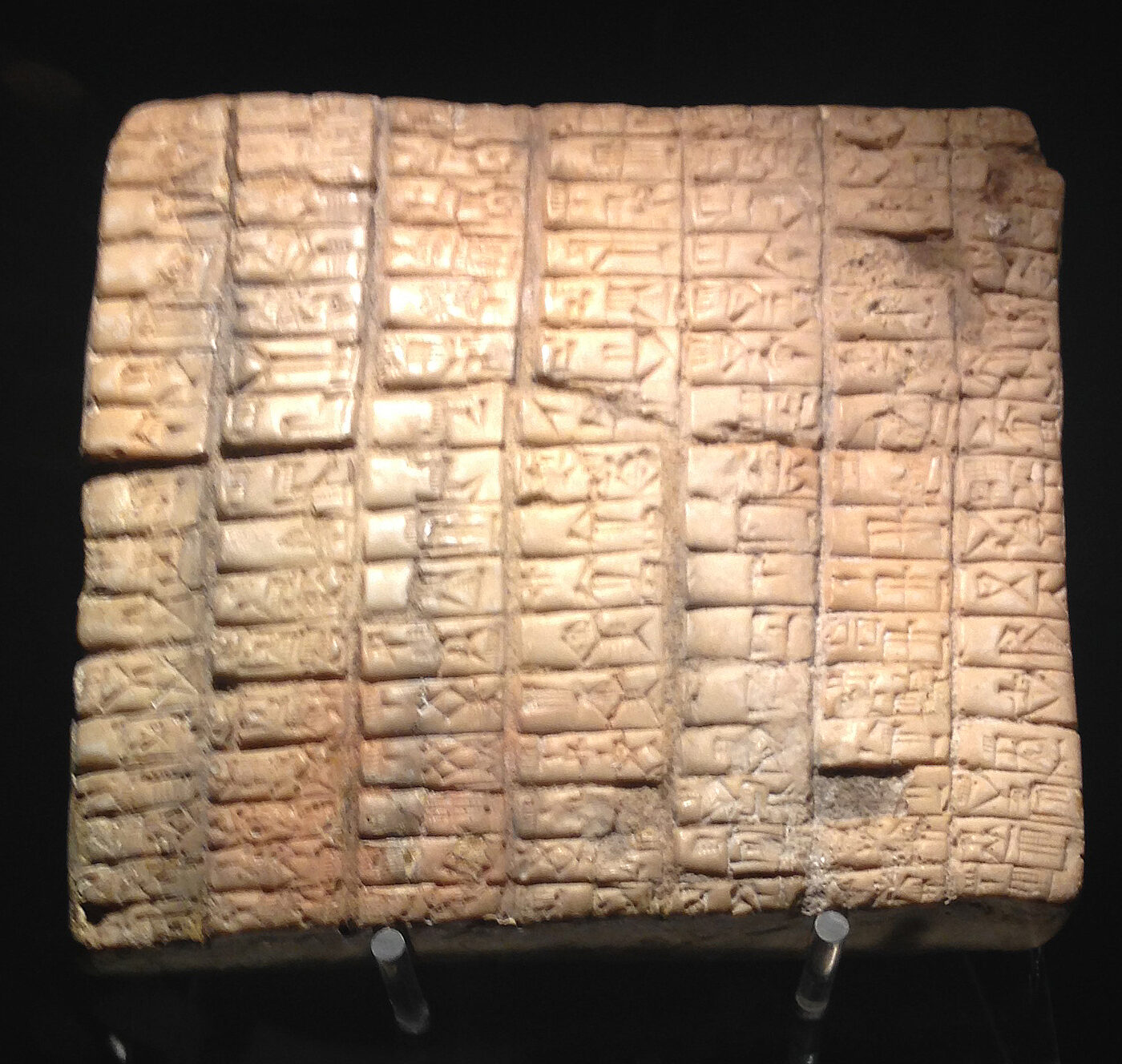
Ebla, the mound of Tell Mardikh south-west of Aleppo, has been excavated since 1964. Its royal palace burned in the third millennium BC, and the fire baked the clay tablets shelved inside it. About 17,000 cuneiform fragments were recovered, which reassemble into some 2,500 complete tablets; a second standard description of the same find counts as many as 1,800 complete tablets, 4,700 fragments and many thousands of smaller chips. The two ways of counting are given here rather than reconciled. The archive period is conventionally dated to roughly 2400 to 2300 BC, though an earlier dating has been argued. Most of the texts are administrative, but there are king lists, royal ordinances, edicts, treaties, gazetteers of place names, and literary and lexicographic material. The language, Eblaite, was previously unknown; the bilingual Sumerian–Eblaite word lists found among the tablets have been called the oldest known dictionaries. The tablets were found where they had fallen when their wooden shelves burned, the archive kept in orderly fashion in two rooms off an audience hall — one holding economic records, the other ritual and literary texts — which is how its arrangement could be reconstructed. It is, on the usual description, the oldest library yet found.

Ebla also supplies a cautionary tale about reading a new archive too fast. When decipherment began, Giovanni Pettinato advanced claims about connections between the tablets and the Hebrew Bible — names of patriarchs, of cities, of a deity — that produced a great deal of press excitement and are now discredited; the academic consensus is that the archive has no bearing on those questions. Extraordinary finds attract extraordinary readings, and the corrections take a generation to catch up.
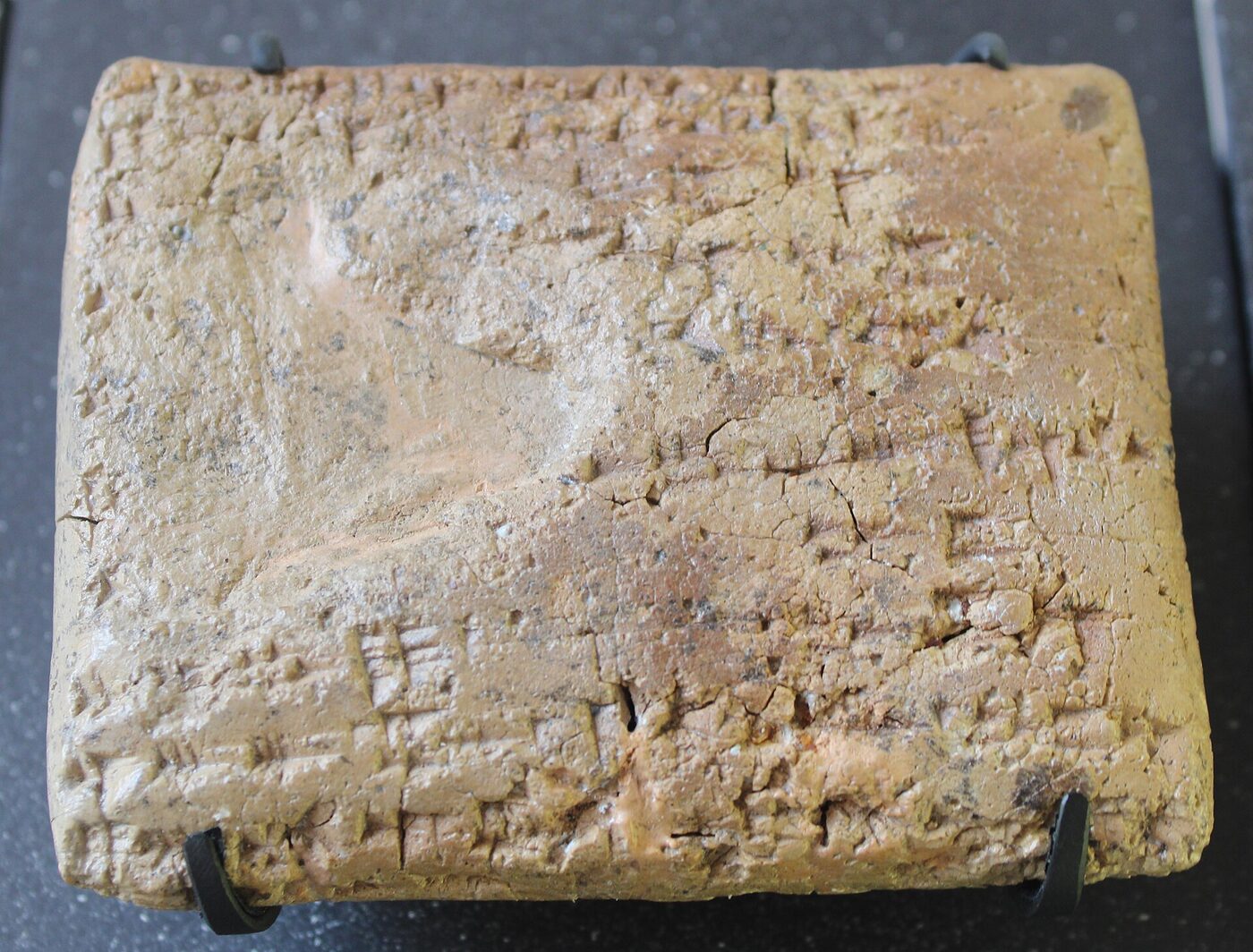
Mari, modern Tell Hariri on the Euphrates near the Iraqi border, was discovered in 1933 and excavated by André Parrot. It flourished as a trading state between about 2900 and 1759 BC, sitting astride the route between Sumer to the south and Ebla and the Levant to the west. Over 25,000 tablets were recovered from the burnt library of Zimri-Lim, written in Akkadian and covering a fifty-year span around 1800 to 1750 BC; more than three thousand of them are letters, and the rest administrative, economic and judicial. They document the state's administration, the diplomatic relations of the region's powers, and the wide trading networks of the eighteenth century BC.
Ugarit, on the coast at Ras Shamra, is the one with the largest consequences for everybody else. The city was destroyed in the early twelfth century BC and then forgotten so completely that its location was unknown until 1928, when a farmer ploughing a field near the port of Minet el-Beida broke into a tomb. A French expedition under Claude Schaeffer began excavating the following year. What it found was a scribal culture writing a previously unknown Northwest Semitic language in an alphabet of thirty letters, impressed with a cuneiform stylus but alphabetic in principle — dated to about 1400 BC on one reading and about 1300 BC on another. The Ugarit inscriptions are the earliest evidence anywhere of the systematic, large-scale administrative use of an alphabet: not a curiosity or an experiment, but a bureaucracy running on one. Abecedaries found at the site also give the earliest direct evidence of the alphabetical orders themselves — both the abc sequence that descends into Phoenician, Aramaic, Greek and Latin, and the hlḥm sequence associated with the South Semitic scripts.

Palmyra
Palmyra — Tadmor in both Aramaic and Arabic — sits in the central desert, on the caravan route between the Mediterranean coast and the Euphrates. Archaeological finds at the site reach back to the Neolithic; documents first mention the city in the early second millennium BC. It passed between empires and became a Roman subject in the first century AD, growing rich on the caravan trade, with Palmyrene merchants running colonies along the eastern routes and operating throughout the empire. The wealth paid for the Great Colonnade, the Temple of Bel and the distinctive tower tombs.
The city's population combined Amorite, Aramean and Arab elements, was organised around clans, and worshipped local Semitic, Mesopotamian and Arab gods. It spoke Palmyrene Aramaic and used Koine Greek for commerce and diplomacy — a working bilingualism visible on its inscriptions and a useful corrective to any tidy account of who spoke what in the ancient Levant. Palmyra reached its height in the 260s, when King Odaenathus defeated the Sasanian emperor Shapur I; his widow Zenobia, as queen regent, broke with Rome and established a short-lived Palmyrene empire. The emperor Aurelian levelled the city in 273, and Diocletian later restored it at reduced size. Its people became Christian during the fourth century and Muslim in the centuries after the seventh-century conquest, and Arabic replaced both Palmyrene and Greek.
The Umayyad century
For eighty-nine years Damascus was the capital of an empire that reached from Spain to the Indus. The Umayyad Caliphate governed from the city between 661 and 750; after the Abbasid victory the seat of Islamic power moved to Baghdad, and Damascus declined in importance until the Ayyubid, Mamluk and Ottoman periods restored it.
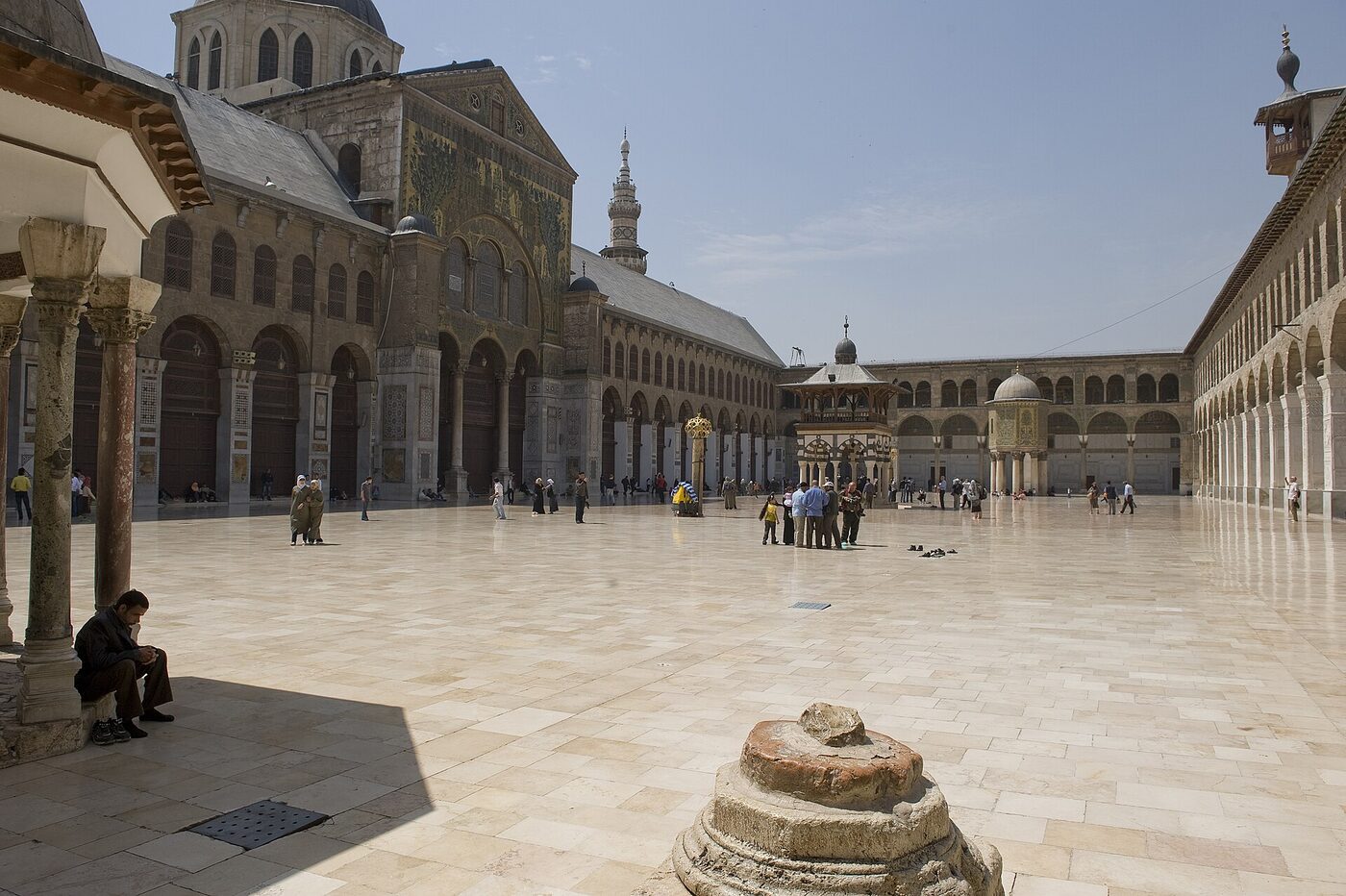
The clearest surviving artefact of that century is the Great Mosque of Damascus, the Umayyad Mosque, and the archaeology of its site is a compressed history of the region's religions. The ground has been used for worship since the Iron Age, when the Arameans built a temple there to Hadad, their god of rain. In the Hellenistic period the site was associated with Zeus. Under Roman rule it became the centre of the imperial cult of Jupiter and the largest temple in Roman Syria; the mosque's present walls are the inner walls of that temple. In 391 the emperor Theodosius I converted it into a cathedral, the seat of the second-ranking bishop of the patriarchate of Antioch. In 706 the caliph al-Walid I resolved to build a congregational mosque on the cathedral site, compensating the Christian community by returning other confiscated churches to it; the building was finished in 715, or on another account in 711. It is generally described as the oldest mosque still in use in its original form, and a tradition first recorded in the sixth century places the head of John the Baptist within it — a shrine honoured, then as now, by Christians and Muslims alike.

Six inscriptions
Syria accepted the World Heritage Convention on 13 August 1975, which made its sites eligible for listing. Six were inscribed, and their dates are worth setting against the group's own:
- Ancient City of Damascus — 1979
- Ancient City of Bosra — 1980
- Site of Palmyra — 1980
- Ancient City of Aleppo — 1986
- Crac des Chevaliers and Qal'at Salah El-Din — 2006, listed together
- Ancient Villages of Northern Syria, the so-called Dead Cities — 2011
Four of the six were already on the World Heritage list when soc.culture.syria was voted into existence in 1995; the other two were inscribed after the group had gone quiet. All six were placed on the List of World Heritage in Danger in 2013, which is also after the group's life and is recorded here as a date rather than discussed. Syria sat on the World Heritage Committee once, from 1989 to 1995.
A country of communities
There has been no official census on religion in Syria since the 1960s — the last full ones were taken in 1943 and 1953 — so every proportion below is an estimate rather than a count; the figures are those the standard reference sources carry. Sunni Muslims are the largest group, given at around three-quarters of the population and including Arabs, Kurds, Turkmens and Circassians. Alawites are the largest of the other Muslim communities, alongside Isma'ilis and Twelver Shia; Isma'ilis were put at 1.5 per cent of the population in a 1991 academic estimate. The Druze are about 3 per cent, concentrated in Sweida governorate and the Jabal al-Druze, with communities in Quneitra, Rif Dimashq and Idlib. The Christian population is divided among a long list of churches — Greek Orthodox, Melkite Catholic, Armenian Apostolic and Armenian Catholic, Syriac Orthodox and Syriac Catholic, Assyrian, Chaldean Catholic, Maronite, Latin Catholic and Protestant. There is a small Yazidi community. Of the ancient Jewish community of Damascus and Aleppo, fewer than three thousand people remained in 1987; United States State Department reporting records that by 2020 there were no known Jews left in the country.
The linguistic map is similarly layered. Arabic is the official language. Kurdish, Turkish, Neo-Aramaic, Syriac, Circassian, Chechen, Armenian, Greek and Domari are all spoken. Western Neo-Aramaic — the sole surviving remnant of what was once an extensive Western Aramaic-speaking area covering the Levant — is now spoken by the inhabitants of Maaloula and Jubb'adin, about sixty kilometres north-east of Damascus in the Qalamoun range of the Anti-Lebanon; a third village, Bakh'a, had its own and more conservative dialect. The Assyrian, Chaldean and Syriac communities, whose language preservation work has its own long history, had their own newsgroup and have their own page here at soc.culture.assyrian.
A soc.culture group named for a country rather than a people inherits all of this at once. That was the design of the branch and it was also its permanent difficulty: a namespace organised by state boundaries has to accommodate communities that do not stop at them, and the charter's silence about which Syrians it meant was, in that light, the sensible drafting.
Dialects, and what a dialect map is for
Spoken Arabic is conventionally sorted into five sedentary families — Peninsular, Mesopotamian, Levantine, Egyptian and Maghrebi — separated by distances that linguists compare to those among the Romance or the Germanic languages; a Moroccan and an Iraqi speaking their own varieties find each other very hard going. Levantine and Egyptian are the two prestige spoken varieties, the ones most widely understood across the Arabic-speaking world through film, television and song. Syrian Arabic falls within Levantine, with the Damascene and Aleppine dialects the best known.
The interesting fact about the Levantine map is that it does not follow the political one. The urban dialects of the big cities — Damascus, Beirut, Jerusalem — have far more in common with one another than any of them has with the countryside of its own state; and two social or religious groups within one country may differ from each other more than each does from its counterpart across a border. A dialect map drawn on national outlines is therefore the wrong map, which is a mildly subversive thing for a directory organised by country to have to record.
The continuity behind that map is deep and unusually well documented. The Damascus Psalm Fragment, dated to the ninth century or earlier, is an Arabic text written in Greek characters, which is why it preserves pronunciation: it shows extensive imāla, the fronting and raising of a vowel that still marks Levantine speech. The Swedish orientalist Carlo Landberg, writing about the vulgarisms in the memoirs of the twelfth-century Syrian writer Usama ibn Munqidh, observed that all of them are found in the spoken language of Syria today, and that the language of Usama's day was on the whole not very different from it. Classification remains unsettled even at the standards level: ISO 639-3 carried North Levantine as a separate language, code apc, until change request 2022-006 took effect on 20 January 2023, retiring South Levantine (ajp) by merging it into apc and renaming the entry simply Levantine Arabic.
None of this transmitted well through a network built for seven-bit ASCII, which is why so much of the writing about Syrian dialect on Usenet was itself conducted in English and in Latin-letter transliteration, and why the transliteration became a subject of dispute in its own right. That whole question — script, encoding and romanisation — belongs to soc.culture.arabic and is set out there.
The food, which the charter listed by name
The circulated charter's phrase was “World Famous Syrian Cuisine”, capitals and all — “World's Famous” in the RFD it was culled from — and it sat at the foot of the Cultural Affairs column. Immodest as a piece of drafting; defensible as a description.
The structure of a Syrian meal is the regional one: a spread of mezze served with bread before the main course, coffee afterwards with sweets or fruit. The repertoire leans on aubergine, courgette, garlic, lamb, sesame, chickpeas, fava beans, lentils, vine leaves, pickled turnips, olive oil, lemon, mint, pistachios and pomegranate; the standard reference note on the cuisine observes that many of its recipes are traceable to at least the thirteenth century.
Aleppo's contributions are the most distinct, and most of them are built on one ingredient: the Aleppo or Halaby pepper, ripened to burgundy, semi-dried, de-seeded and coarsely crushed. It gives muhammara, the pepper-and-walnut dip, and kebab halabi, of which about twenty-six variants are recorded — among them kebab karaz, lamb meatballs cooked with sour cherries, a dish that reliably astonishes anyone who has only met kebab in one form. Across the country the shared repertoire runs to kibbeh in its several constructions, makdous (pickled stuffed aubergines), fattoush, yalanji, vine leaves stuffed with rice and vegetables and served hot or cold, shakriyeh (lamb in yoghurt), and fatteh in a dozen variations distinguished by what is poured over the bread.
Whether the Damascene or the Aleppine version of any of it is definitive is, again, not settled here. It is the sort of argument that fills a culture group indefinitely and harmlessly, which is a good deal more than can be said for most of the other subjects on this page.
Poetry, and where its poets lived
Poetry in Arabic keeps a popular audience of a size that startles readers brought up on other literatures — verse quoted from memory in ordinary conversation, corrected by whoever is listening, and argued about with the seriousness elsewhere reserved for sport. A newsgroup whose charter named literature and fine arts among its topics was inheriting a live tradition, not a scholarly one.
Two modern figures dominate any account of Syrian poetry, and their biographies make the diaspora point better than any statistic. Nizar Qabbani was born in Damascus on 22 March 1923, worked as a diplomat and a publisher, and is widely described as Syria's national poet; his subjects ran from love and eroticism to feminism, Arab nationalism and the criticism of authority, in a register plain enough to be sung and quoted by people who read no other poetry. He died in London on 30 April 1998 — within the group's active life, and abroad.
Adonis — the pen name of Ali Ahmad Said Esber — was born on 1 January 1930 at Al Qassabin near Latakia, in what was then the Alawite State under the French mandate. He took the pseudonym at seventeen, after magazines had rejected work under his own name. He edited the journals Shi'r and later Mawaqif, and is credited with leading the modernist revolution in Arabic poetry in the second half of the twentieth century; The Guardian has described his influence on Arabic verse as comparable to Eliot's in English. He has lived in Paris since 1975.
The country's two most-cited modern poets, then, did most of their work outside it, and one of them died abroad during the years this group was running. That is the literary shape of the Syrian twentieth century, and it is the same shape as the newsgroup's.
The geography of the readership
Estimates of the number of people of Syrian descent living outside Syria range from 8 to 13 million. Most published tables of the Syrian diaspora are now dominated by displacement after 2011 — 2.3 million registered in Turkey, 1.28 million in Germany, half a million in Lebanon — and those figures belong to a period after this group had stopped mattering. The distribution that shaped its readership is the older one, and it points somewhere most readers do not expect.
The largest long-established communities of Syrian descent are in South America. For Brazil, the Ministry of Foreign Affairs has estimated the population of full or partial Syrian descent at around three to four million. A 2008 study by the Brazilian statistical institute, covering five states and the Federal District, found that 0.9 per cent of white Brazilian respondents reported family origins in the Middle East, a basis on which the figure is put at about a million. The two numbers answer different questions and cannot be reconciled; both are given here because dropping either would misrepresent the state of the evidence.
Argentina is second. The figure usually quoted is one and a half to two million by ancestry, though the source behind it is weaker than the Brazilian one, and the 2022 national census recorded just 1,324 Syrian-born residents — a reminder that ancestry counts and birthplace counts are different instruments. The migration itself is well documented: between 1891 and 1920, 367,348 people of Arabic heritage entered Argentina. At the ports they were registered as turcos, Turks, because Syria and Lebanon were then Ottoman territory. The misnomer stuck, and it is still the everyday word for Arab Argentines a century later.
North America's communities are smaller than either. The United States Census Bureau's ancestry estimate for 2016 gives 187,331 Syrian Americans; an estimated 64,600 Syrians emigrated to the United States between 1961 and 2000. The 2021 Canadian census gives 98,250. There are substantial communities in the Gulf states, in western Europe, in west Africa and in Australia.
Compare that map with the ballot roll of April 1995 and the mismatch is the point. Brazil, with the largest community in the world, contributed one address. The American-registered top-level domains — .edu, .com, .gov, .mil and .us — account for 221 of the 311 addresses between them, and .edu alone for 132, though .com in 1995 was not exclusively American. The people who could vote on the creation of a Syrian newsgroup in 1995 were, overwhelmingly, students and staff at North American universities. That is who the early network was, and it is a standing caveat on every diaspora newsgroup of the period, including this one.
What the record does not show
A page like this earns its keep by being explicit about its holes, so here they are.
There are no readership figures for soc.culture.syria. The best-known readership estimates for Usenet come from Brian Reid's surveys, which belong to the late 1980s and early 1990s and never covered this group. No subscriber count, no monthly article count and no traffic ranking is asserted here, because none has been verified.
No thread, subject line, poster or quotation from the group is reproduced anywhere on this page. Usenet archives of the period exist and are well known; what any of them holds for this particular group has not been checked here, and an unchecked claim about an archive is worth nothing. The lede above describes the kinds of subject the group carried, and the charter above lists the kinds it was created to carry; neither is a claim about any specific posting.
The administrative record is complete, but it is thin by nature: four postings in news.announce.newgroups and four messages in the control archive. There is no moderator, because the group was never moderated; there is no vacancy notice, no charter amendment, no removal proposal and no reorganisation vote. Beyond the creation message of 24 April 1995 the control archive holds two re-issues of it, on 1 May and 24 May, carrying the identical charter. It then holds one more item, and it is the only administrative event in the group's life after 1995.
On 4 November 2001 a message reached the network carrying the header Control: rmgroup soc.culture.syria and, as its entire body, the sentence “please remove the bogus newsgroup soc.culture.syria”. It is filed in the ISC archive under control.rmgroup. Its From line carries the name and address of a well-known German newsreader maintainer; the posting path runs through a consumer host in Quebec, and the message closes with a randomly generated one-line signature of the kind that accompanied the large volume of forged control traffic circulating that year. This page does not adjudicate who sent it. What can be said is what happened next, which is nothing: the group is in the current newsgroups and active files, under the same description and the same unmoderated flag, and no removal took effect. A directory that records vote counts should also record the one occasion on which somebody tried to erase the group and failed.
And there is a deeper limit, which the Hama figures illustrate better than any statement about Usenet could. When a place is sealed, the record thins, and the thinness is permanent: forty years later the estimates of what happened in one Syrian city in one February still range across a factor of forty. Writing about Syria on a public network in the 1990s and early 2000s was done, overwhelmingly, by people who were not there. That is a limit on what such writing can be evidence of. It is not a criticism of it — a diaspora talking about home is a primary source about a diaspora talking about home, which is a real and unrepeatable thing — but it is a limit, and readers arriving from a search should know it before they cite anything.
Scope and limits
Neighbouring subjects belong to neighbouring pages, and are deliberately not retold here. Arabic script, encoding and transliteration belong to soc.culture.arabic. Lebanon, Iraq, Jordan and Palestine have their own groups and their own pages, linked above; the Assyrian, Chaldean and Syriac communities have theirs. The soc.culture branch itself — how the hierarchy was made, how a group was voted into existence, what the Great Renaming did — is described on the branch page and on the hierarchy page, and the mechanics summarised above are given here only so far as they bear on this group's own file.
This page also carries a correction in its own history, and records it rather than quietly dropping it. An earlier version of the introductory text on this page claimed a specific number of live directory links pointing at it and called it the most-cited page in the culture branch. The number came from an unfiltered backlink report; most of the rows in it were spam-flagged, and once they were removed only a handful of clean referring links from two reference-directory hosts remained. The superlative was simply wrong. The claim was corrected at source, it is not repeated here, and this paragraph exists because a directory that asks to be trusted on dates and vote counts should be willing to publish its own errata.
Finally, the boundary of the subject. soc.culture.syria was created in April 1995 and its working life ran through the 1990s and the first half of the 2000s. The events that now dominate any enquiry about Syria — the war that began in 2011, and the fall of the government on 8 December 2024 — lie outside that life entirely. They are given on this page as dates, and only as dates, because they mark where the group's record stops rather than forming part of it. What the group holds is a record of an earlier country, written while its future was still an open question, by people who did not know what came next. That is the whole of its value, and it is not a small one.
Reading soc.culture.syria today
- Historical archive: Google Groups — soc.culture.syria (coverage varies by group and era).
- Open in a newsreader:
news:soc.culture.syria— the original site offered exactly this link, and it still works if your system has a newsreader registered for thenews:scheme. - Live access: point an NNTP newsreader at a modern server — see accessing Usenet today.
- The original news2mail e-mail subscription service ended in the mid-2000s and no longer operates.