soc.culture.cambodia
Cambodia’s people, culture and history.
A group shaped by the aftermath of the Khmer Rouge: family-tracing posts, refugee-community news from the diaspora’s centres at Long Beach and Lowell, tribunal debates, and the patient documentation of a culture the 1970s tried to erase.
The charter named the Khmer language explicitly, alongside Cambodia’s people, culture and history; classical dance and music belong to the same subject.
On this page
- Two votes: the one that failed on the margin, and the one that carried
- The charter, and the line that outlived it
- Who voted, and from where the votes came
- Who could post, and from where
- The readership abroad
- The country as a dated record: protectorate to independence
- 1969 to 1979
- 1979 to 1991: the Vietnamese period and the seat at the United Nations
- UNTAC, and the election of May 1993
- What was discussed
- Documentation as an organised discipline
- The court, its case numbers and its judgements
- Where the archive is the argument
- An abugida with no spaces
- The encoding, and the objection that followed it
- What that meant for a group posting in 1994
- Angkor, and the paperwork of its protection
- Objects, dealers and returns
- What a culture group carried
- What the record does not show
- Scope and limits
Two votes: the one that failed on the margin, and the one that carried
The administrative record for this group survives complete, which is not true of every group in this directory, and it tells a story the group's own charter does not. soc.culture.cambodia was not created at the first attempt. It was proposed in 1993, voted on in 1993, and defeated; it was proposed again a year later by a different hand, voted on again, and carried by a margin that made the first result look like an accident of arithmetic. Both attempts are preserved in the Internet Systems Consortium's mirror of news.announce.newgroups, with their dates, their tallies and their full rolls of voters.
The first Request for Discussion was posted on 11 June 1993 from an address at the University of California, Davis, its Organization header reading Cambodian News Service, and cross-posted to news.announce.newgroups, news.groups, soc.culture.asian.american, soc.culture.asean and the SEASIA-L mailing list's Usenet gateway at bit.listserv.seasia-l. Its statement of purpose was three lines long: to exchange news or information about Cambodia (Kampuchea), the people from Cambodia, or the language Cambodian (Khmer). Its rationale was one sentence: Prior to this group there was never a place to discuss these issues. Its closing admission was rarer still in a formal proposal, and worth quoting because it explains what happened next.
I do not have the ability to conduct voting, I would appreciate it if someone could volunteer. Hopefully voting will be able to start soon.
Someone did volunteer. A second RFD on 21 June 1993 recorded that the original proponent had asked another poster to take responsibility for the proposal and the subsequent Call for Votes, and that votetaker issued a first CFV on 8 July 1993, a second on 15 July and a third on 26 July. Voting ended at midnight Eastern Daylight Time on 4 August 1993. The result, posted on 10 August, was a failure — and a failure of a specific and instructive kind.
There were 96 votes in favor of the proposal and 21 opposed. [...] The proposal meets the requirement that at least two-thirds of the votes be in favor, but it falls short of the requirement that the plurality in favor exceed 100 votes. The proposal therefore fails.
Ninety-six to twenty-one is a supermajority of better than four to one. What defeated it was the other half of the Big-Seven passing rule, the flat requirement that yes votes exceed no votes by more than a hundred. That is a margin of seventy-five, and seventy-five is not a hundred and one. The Call for Votes had set out both conditions in advance, requiring that the yes votes outnumber the no votes by at least two to one and that there be at least a hundred more yes votes than no votes; the proposal met the first test comfortably and missed the second by a wide margin. The votetaker added the standard consequence — that under the Usenet guidelines no further proposal for a soc.culture.cambodia newsgroup should be made for at least six months. The mechanics of that rule, and why it had two halves, are set out on the soc.* hierarchy page and are not repeated here.
The second attempt began on 14 June 1994, ten months after the first had died, with an RFD posted from the Department of Computer Science at Queen Mary and Westfield College in the University of London. The cross-post list had grown and changed shape: soc.culture.laos, soc.culture.thai, soc.culture.vietnamese, soc.culture.asean, soc.culture.burma, soc.culture.asian.american and bit.listserv.seasia-l. A second RFD on 11 July carried a formal charter and three names at the foot of it, one of them the proponent of 1993 — the two campaigns had merged. The Call for Votes went out on 18 August 1994 under the banner of the Usenet Volunteer Votetakers, was superseded by a second CFV on 7 September, and closed at 23:59:59 GMT on 16 September 1994.
The result was posted on 19 September 1994: 312 yes, 22 no, 334 valid votes and fifteen invalid ballots. That is a margin of 290 where 100 was required, and a proportion of 93 per cent where two-thirds was required. The newgroup control message went out from the moderator of news.announce.newgroups on 26 September 1994 at 14:35:21 GMT and was reissued on 3 October. Thirteen months separated a proposal that failed on a margin of seventy-five from one that passed on a margin of 290.
The charter, and the line that outlived it
The charter that the 1994 ballot actually approved is short, and it is reproduced verbatim four times in the record — in the second RFD, in the Call for Votes, in the posted result of the ballot, and in the newgroup control message that created the group. It reads:
The purpose of this group is to exchange news and information about Cambodia (Kampuchea), its people, culture, history, and the Cambodian Language (Khmer). This will also be a forum for the Cambodians who have been scattered around the world (Australia, Canada, France, United Kingdom, and United States) to contact each other and find out information about their native country.
Two things in it are worth marking. The first is the place given to the language: Khmer is written into the purpose clause on the same footing as people, culture and history, an unusual specificity for a soc.culture charter, and one that the group would spend its whole life unable to honour in the script it referred to. The second is that the charter is a diaspora charter in its plain text: it names five countries, and the country it is about is not among them. It describes an audience already elsewhere, wanting to reach each other and to find out about a place most of them could not telephone cheaply, let alone log in to.
The proposal's rationale was equally direct about where the traffic had been coming from before 1994. It named the neighbours whose groups had absorbed Khmer topics: Discussions have been limited to "soc.culture.thai", "soc.culture.laos", "soc.culture.vietnamese", and "bit.listserv.seasia-l" (mailing list SEASIA-L). The pattern is visible in the cross-post headers of the RFDs themselves, which were addressed to exactly those groups. Two of them have their own pages here — soc.culture.thai and soc.culture.laos — and the regional umbrella that the RFD also cross-posted to is covered at soc.culture.asean.
The rationale then said, without ornament, why the proposers thought the group was needed:
Cambodia is a beautiful country in South East Asia, with rich fertile land, and culture. Unfortunately, Cambodia is well known for the wrong reasons: 'The Killing Field', 'The Khmer Rouge', and 'Pol Pot'.
Alongside the charter, the control message supplied the one-line description that news administrators were asked to paste into their newsgroups files:
soc.culture.cambodia Cambodia and its people.
The separator between the name and the description is a tab, as the newsgroups-file format requires. That line has not changed. It is still the entry for the group in the newsgroups file distributed from the same archive today, byte for byte as it was written in September 1994 — four words that have outlasted the gateway this directory was built from, most of the servers that carried the group, and the negotiation of an international criminal tribunal.
Who voted, and from where the votes came
The RESULT posting includes the complete roll of voters, address by address, as the Usenet Volunteer Votetakers' procedure required — the vote was public, and verifiable by anyone who cared to check. That roll is the only enumerated population this group has, and it can be counted. Tallying the top-level domain of the 312 yes addresses gives the following distribution. These are this page's own mechanical counts of the last component of each printed address, and they are offered as nothing more: an address is not a nationality, and in 1994 it was frequently not even a country of residence.
- .edu — 133, by a wide margin the largest bloc, and the ordinary shape of a 1994 Usenet electorate
- .com — 70
- .au — 21
- .org — 18
- .ca — 16
- .th — 9
- .fr — 7
- .net, .de, .uk — 6 each
- .gov — 5
- .jp, .us, .se — 2 each
- one each from .be, .ch, .co, .dk, .ie, .it, .kw, .nl, .sg
The absence is the finding. There is not one address in .kh on the roll, on either side of it, and there could not have been: the .kh country-code domain was not delegated until 20 February 1996, seventeen months after the vote closed, a date recorded in IANA's own root database. A group about Cambodia was voted into existence by an electorate containing, so far as its published addresses show, nobody in Cambodia.
The closest addresses to the country were in Thailand. All nine .th votes came from a small set of institutions — Thailand's National Electronics and Computer Technology Centre, Thammasat University and Assumption University — which is where the region's connectivity was, and where a great deal of the aid, research and refugee administration concerning Cambodia was also conducted. The Australian bloc of 21 is disproportionately large for the period and reflects a settled community; the sixteen Canadian and seven French addresses map onto two more of the five countries the charter named.
The failed 1993 ballot has a roll too, of 96 yes and 21 no votes, and the same absence holds there. What changed between the two votes was not the availability of Cambodian voters. It was the size of the campaign.
Who could post, and from where
The charter's assumption that its readers were abroad was not sentiment. It was infrastructure. For the whole of the period in which this group was busy, the number of people inside Cambodia who could post to Usenet was, statistically, close to nil.
The World Bank's published series for individuals using the internet as a percentage of population, compiled from International Telecommunication Union returns, records no measurable value for Cambodia before 1997. The first non-zero figure is 0.006 per cent in 1997 — six people in a hundred thousand. It reaches 0.047 per cent in 2000, 0.32 per cent in 2005 and 0.53 per cent in 2009, and does not pass one per cent until 1.26 per cent in 2010, by which time Usenet's own traffic had long since moved elsewhere. Whatever else soc.culture.cambodia was during its active decade, it was not a place where Cambodians in Cambodia talked to each other.
What connectivity there was ran through institutions rather than households, and the registry record is the part of it that can be dated. The country-code domain .kh was delegated on 20 February 1996; it was administered by Cambodia's Ministry of Posts and Telecommunications from 1997, and passed to the Telecommunication Regulator of Cambodia in September 2012. Registration under it is restricted to Cambodian companies, government agencies, organisations and citizens, and is made at the third level beneath second-level labels of the familiar kind. Two further specifics that circulate about the years on either side of that delegation — a pioneering e-mail relay dated to 1994, and a 64 kbps satellite link to Singapore dated to 1997 — are not asserted on this page, because neither could be verified against a source available for it.
The practical consequence for the group is easy to state and hard to overstate. A posting written inside the country was, for most of the group's life, an event. The ordinary participant was a student at an American university, an engineer at a company with a mail gateway, an academic in Paris or Sydney, or a member of an aid organisation — and the country under discussion was, to the network, a hole in the map with a domain name and almost no users behind it.
The readership abroad
If the group's readers were not in Cambodia, it is possible to say with some precision where they were, because the resettlement of Cambodians after 1975 is one of the better-documented refugee movements of the late twentieth century.
The United States admitted close to 158,000 Cambodians between 1975 and 1994, on the account given by the historian Sucheng Chan: about 149,000 of them as refugees, some 6,000 as immigrants and around 2,500 as humanitarian and public-interest parolees. Federal policy dispersed arrivals across many states, to spread the cost and encourage assimilation. It did not hold. Once people could travel and communicate, they moved to where relatives had been sent, where the work was, or where the weather was less alien, and the community reconcentrated: Long Beach in California, which holds the largest population of Cambodian ancestry anywhere outside Cambodia, and Lowell in Massachusetts, the second largest in the United States, which at the 2010 census held the highest proportion of residents of Cambodian origin of any place in the country, 12.5 per cent of its population. Later counts give the national population as 276,667 at the 2010 census and 361,760 by ancestry in the 2023 American Community Survey, of whom 151,167 were born in Cambodia.
France holds the oldest of the communities. Cambodians had been arriving since the later nineteenth century, when the country was a French protectorate — students, officials and members of the royal family at first, then about 2,000 during the First World War, then students and professionals after independence in 1953, many of whom stayed as the civil war began and sponsored relatives afterwards. The Paris region was the destination of choice for both the earlier and the later arrivals. The population was estimated at around 80,000 in 2020.
Australia settled roughly 10,000 refugees under a policy of geographical dispersal comparable to the American one, with the same result: communities took root in Sydney, Melbourne, Brisbane and Adelaide, and the Melbourne suburb of Springvale in particular. The 2021 census recorded 57,096 people claiming Khmer or Cambodian ancestry, the largest number in Victoria at 23,498. Canada and the United Kingdom, the remaining two countries named in the charter, held smaller communities on the same pattern.
Set the resettlement figures beside the vote roll and the group's character resolves. Twenty-one Australian addresses, sixteen Canadian and seven French, against 203 in .edu and .com, is what a diaspora looked like on a network still reached mainly through a university or an employer.
The country as a dated record: protectorate to independence
What follows is a chronology, not an interpretation. Every entry is a date and an event; the characterisations are attributed to whoever made them. A group whose charter promised history to a readership that had lost much of its own needs its background stated flatly, and the flat statement is also the only responsible register for this material.
Cambodia became a French protectorate when King Norodom signed a treaty of protection on 11 August 1863, a status that lasted ninety years with one interruption, the Japanese occupation of 1941 to 1945 and the brief Kingdom of Kampuchea proclaimed in March 1945. The demographic scale of the protectorate period is worth one figure: between 1874 and 1962 the population grew from about 946,000 to 5.7 million. Independence was granted on 9 November 1953, after a partial agreement in October and a campaign conducted largely by the King himself; the 1954 Geneva Conference on Indochina secured the withdrawal of Viet Minh forces from Cambodian territory. Neutrality was the declared basis of foreign policy through the 1950s and 1960s.
By the middle 1960s the eastern provinces were being used as bases by North Vietnamese and National Liberation Front forces operating against South Vietnam, and the port of Sihanoukville as a supply route. That is the situation into which the next decade opened.
1969 to 1979
The United States began a series of bombing raids inside Cambodia on 18 March 1969 under the codename Operation Menu, followed from 1970 to 1973 by a far larger campaign, Operation Freedom Deal. On 18 March 1970, one year to the day after Menu began, Prince Sihanouk was deposed while abroad in Beijing by a coup led by his prime minister and a cousin of his; the Khmer Republic followed, and with it a civil war. After 117 days of fighting around the capital, the government in Phnom Penh surrendered on 17 April 1975, five days after the United States mission had evacuated.
Democratic Kampuchea governed from 17 April 1975 until Vietnamese forces took Phnom Penh on 7 January 1979. The court later established to try its leaders defined the victims within its jurisdiction as those harmed by crimes committed in Cambodia by the Democratic Kampuchea regime between 17 April 1975 and 6 January 1979 — a period the court's own internal rules fix to the day.
The scale of the deaths is documented and the estimates differ, and the honest course is to give the ranges with their sources attached rather than a single number.
- Ben Kiernan estimates that between 1.671 and 1.871 million Cambodians died as a result of Khmer Rouge policy, or between 21 and 24 per cent of the 1975 population.
- The French demographer Marek Sliwinski calculated slightly fewer than two million unnatural deaths out of a 1975 population of 7.8 million, with 33.5 per cent of Cambodian men dying under the regime against 15.7 per cent of Cambodian women.
- A 2001 academic survey reports that the most widely accepted estimates of excess deaths range from 1.5 to 2 million, with figures as low as one million and as high as three million also cited, and that conventionally accepted estimates of deaths from executions specifically range from 500,000 to one million — described in that source as a third to one half of excess mortality during the period.
- Patrick Heuveline published an estimate in 2015 of 1.2 to 2.8 million excess deaths.
20 May is now observed annually in Cambodia as the National Day of Remembrance, a public holiday.
The relationship between the American bombing and the Khmer Rouge's rise is a question historians have argued in print for fifty years, and it is one of the arguments the group inherited. The positions on the record are distinct and should not be blurred. Kiernan has written that the Khmer Rouge would not have won power without U.S. economic and military destabilization of Cambodia, and that the movement used the bombing's devastation as recruitment propaganda and as an excuse for its policies. Michael Ignatieff, Adam Jones and Greg Grandin have similarly cited the intervention as a significant factor in increasing peasant support. David Chandler writes that the bombing had the effect the Americans wanted, breaking the communist encirclement of Phnom Penh, while also accelerating the collapse of rural society. Craig Etcheson agrees that the intervention increased recruitment but disputes that it was a primary cause of the victory. Sliwinski's demographic work attributes 17 per cent of total civil-war deaths to the bombing, noting that it was concentrated in underpopulated border areas. William Shawcross argued that the bombing and the ground incursion plunged the country into the chaos Sihanouk had spent years trying to avoid. Those are the documented positions; this page adjudicates between none of them.
1979 to 1991: the Vietnamese period and the seat at the United Nations
Vietnamese forces invaded in late December 1978 and captured Phnom Penh on 7 January 1979, installing the People's Republic of Kampuchea under a front composed of Khmer communists who had remained in or fled to Vietnam. On 15 July 1979 the new government passed Decree Law No. 1, under which Pol Pot and Ieng Sary were tried in absentia for genocide by a People's Revolutionary Tribunal, with an American defence lawyer appointed, and convicted. The war did not end: an insurgency against the Vietnamese presence continued until 1989, waged by the Khmer Rouge and by two non-communist resistance movements, which together formed the Coalition Government of Democratic Kampuchea.
That coalition held Cambodia's seat at the United Nations until 1993, with Chinese, American and Western support — a fact that has been argued about ever since and was argued about on this group. It is not disputed as a fact: a Chinese foreign ministry spokeswoman, defending Beijing's historical ties in 2009, put it that the government of Democratic Kampuchea had a legal seat at the United Nations, and had established broad foreign relations with more than 70 countries.
Peace talks opened in Paris in 1989 and concluded two years later. The Agreements on a Comprehensive Political Settlement of the Cambodia Conflict were signed in Paris on 23 October 1991. One editorial decision inside those agreements is documented and belongs here: in order to include the Khmer Rouge in the settlement, the major powers agreed to avoid using the word genocide to describe the events of 1975 to 1979. Nearly every senior figure in Cambodian politics in 1991 had at some point been allied with the movement, and there was correspondingly little appetite for trials. The United States had itself avoided the term until 1989, on the stated ground that it was counterproductive to finding peace.
UNTAC, and the election of May 1993
Security Council resolution 745 of 28 February 1992 established the United Nations Transitional Authority in Cambodia, which arrived in March 1992 and closed in September 1993. It was the first occasion on which the United Nations directly assumed responsibility for administering an outright independent state rather than monitoring or supervising one. It ran elections, operated its own radio station and its own jail, and was charged with promoting and safeguarding human rights nationally.
Its mandate, as set out at the time, was to canton, disarm and demobilise the country's fighting factions, confiscate weapons and military supplies, promote and protect human rights, oversee military security and maintain law and order, repatriate and resettle refugees and displaced persons, assist in mine clearance and in setting up mine-clearance and mine-awareness training, rehabilitate essential infrastructure, and assist economic reconstruction and development.
The scale: approximately 15,900 military personnel, 3,400 civilian police, 2,000 civilians and 450 United Nations volunteers, drawn from 46 contributing countries, with more than 50,000 Cambodians serving as electoral staff and some 900 international polling-station officers seconded from governments during the voting. The operation cost over 1.6 billion United States dollars, mostly in expatriate salaries. Demobilisation was suspended in September 1992 after the Khmer Rouge refused to participate, by which point about 50,000 soldiers from the other forces had disarmed.
Voting ran from 23 to 28 May 1993, mostly in school buildings and pagodas to keep costs down. The registered electorate was 4,764,618 and turnout was 89.56 per cent. FUNCINPEC took 58 of the 120 seats on 1,824,188 votes, the Cambodian People's Party 51 on 1,533,471, the Buddhist Liberal Democratic Party 10 and MOULINAKA one; 255,561 ballots were invalid. Counting ran from 29 May to 10 June, and the Security Council endorsed the result by resolution 840. The constituent assembly promulgated a new constitution on 24 September 1993, restoring the monarchy and installing a First and a Second Prime Minister at the head of a coalition.
The 1994 proposal for this group described that operation, in its own words, as the most costly United Nations operation in history, and listed among the subjects it expected the group to carry relief aids, human rights, political and economical developments, travel opportunities. The group was proposed in the year the transitional authority packed up and went home, by people who had watched it on the news from five continents.
What was discussed
A caution first, because it governs everything in this section. No archive of soc.culture.cambodia's threads was consulted for this page, and no specific thread, poster, argument or in-joke from it is documented in any source used here. What follows is not a description of the group's traffic. It is a description of the world the group was reading — the running stories that a diaspora newsgroup with this charter, in these years, could not have avoided.
The coalition installed in September 1993 was unstable from the start, and it ended in fighting between forces aligned with the two prime ministers that began in Phnom Penh on 5 July 1997. Pol Pot died on 15 April 1998 at a jungle headquarters near the Thai border. A contested general election followed later that year, and the last Khmer Rouge remnants surrendered soon afterwards; the guerrilla war that had run since 1979 finally stopped in 1998 and 1999.
One consequence of the events of 1997 belongs in a single dated sentence, because another page owns the subject: Cambodia had been due to enter the Association of Southeast Asian Nations alongside Laos and Myanmar in July 1997, its entry was delayed by the internal crisis, and it joined as the tenth member state on 30 April 1999. The bloc itself — its founding, its accessions, its working methods and the 1997 financial crisis — is the subject of soc.culture.asean and is not retold here.
Running underneath the news was the older argument, the one set out in the section above: how the Khmer Rouge came to power, what weight to give the American bombing, what Vietnam's role was before and after 1979, and how to regard the years in which the ousted regime and its coalition partners held the country's seat at the United Nations. These were live questions among historians throughout the group's lifetime, and they were live for a readership for whom they were not academic. The group's charter did not promise agreement, only a place to exchange news and information, and it is reasonable to assume — though not to assert as documented — that it got the mixture of hard information, rumour and partisan heat that homeland-politics threads carried across the whole soc.culture branch. That branch — the long shelf of national and regional groups that grew up after the Great Renaming reorganised Usenet in 1987 — is described on the soc.culture hub page.
What can be said with confidence about the quieter traffic is only what the charter and the RFD say: they promised news, information, culture, history, language and travel, and they promised a way for scattered people to find each other. A group that promises family contact to a refugee population is doing something specific, and the promise is in the founding document whether or not a single such posting survives.
Documentation as an organised discipline
Cambodia is one of a small number of countries where the recording of what happened became an organised profession with institutions, budgets, premises and a filing system. That story runs in parallel with the group's own decade, and it is the reason this page treats archives as its subject rather than its background.
It began with a private research project. The Cambodian Genocide Project was founded in 1981, and incorporated the following year, by an American law student who had spent 1980 as field director of a relief programme in Phnom Penh, on the proposition that the Khmer Rouge regime — which then still held Cambodia's United Nations seat — could be brought before the International Court of Justice under the Genocide Convention, to which Cambodia is a party. Through the 1980s the project's researchers, working from Yale, interviewed survivors, visited mass graves and extermination prisons, and collected hours of videotaped eyewitness testimony, while legal analyses were drafted for a case that any state party to the Convention could have filed. Approaches were made to governments that might file it; Australia's foreign minister spoke in favour of doing so, and, on the published account, the initiative was headed off through the United States State Department.
The route that worked was legislative. The same circle of researchers formed the Campaign to Oppose the Return of the Khmer Rouge, whose executive director worked with the staff of a United States senator on the Cambodian Genocide Justice Act, which passed Congress and was signed in 1994. The statute is short, and its provisions can be given from its own text. It declared it the policy of the United States to support efforts to bring members of the Khmer Rouge to justice for crimes against humanity committed in Cambodia between 17 April 1975 and 7 January 1979. It required the Secretary of State to establish, within ninety days, an Office of Cambodian Genocide Investigation inside the State Department, on pain of withholding the department's diplomatic and consular programme funds. It required that not less than 75 per cent of the money made available to that office be spent on activities inside Cambodia, authorised the office to contract with outside individuals and organisations to carry out its purpose, and obliged the President to report to Congress every six months on what the office had done and on new facts learned about past Khmer Rouge practices. On the published account of one of the participants, the office ran an open competition; the contract went to Yale University's Cambodian Genocide Program.
The programme opened a field office in Phnom Penh in 1995. On 1 January 1997 that office ceased to be a foreign university's outpost and became an independent Cambodian non-governmental organisation: the Documentation Center of Cambodia, generally known as DC-Cam. It holds what is described as the world's largest archive on the Khmer Rouge period — on the order of 155,000 pages of documents and 6,000 photographs — and its work has included a survey of mass grave sites, the collection of hundreds of eyewitness testimonies, the recovery of thousands of pages of the regime's own detailed records, a national genocide-education programme with a school textbook published in 2007, and the supply of material to researchers and to the court. Yale's Genocide Studies Program was founded in January 1998, in its own words, to expand the work begun in 1994 by the Cambodian Genocide Program.
Two features of that account deserve emphasis because they are unusual. The first is that the archive was built before there was a court to use it: DC-Cam was collecting and cataloguing for a decade before any tribunal sat. The second is that the institution was deliberately handed over — an American-funded programme became a Cambodian organisation on a fixed date, holding the material in the country the material is about. Both are decisions about custody, and custody is what an archive is.
The court, its case numbers and its judgements
In 1997 Cambodia's two prime ministers wrote jointly to the Secretary-General of the United Nations asking for assistance in bringing the surviving senior leaders of the Khmer Rouge to trial. What followed was not a court but a negotiation, and it lasted six years. The Cambodian National Assembly passed founding legislation in 2001; the agreement between the Royal Government of Cambodia and the United Nations was signed on 6 June 2003 and endorsed by the General Assembly; the Cambodian law was brought into line with the agreement in October 2004; thirty Cambodian and international judges were approved in May 2006; and the judges were sworn in in early July 2006, nine years after the request. For most of the years in which this newsgroup was active, in other words, the Extraordinary Chambers in the Courts of Cambodia existed as a proposal under negotiation rather than as a court.
The court that finally sat was a hybrid, built inside the Cambodian court system rather than beside it. Because Cambodian procedure is French in descent, investigations were conducted by co-investigating judges — one national, one international — who issued a closing order stating whether a case should go to trial. The Pre-Trial and Trial Chambers each had three Cambodian and two international judges; the Supreme Court Chamber had four Cambodian and three international. International judges were appointed by Cambodia's Supreme Council of the Magistracy from a list supplied by the United Nations Secretary-General. Prosecution was likewise doubled, a national and an international co-prosecutor sharing the office.
Its jurisdiction covered certain crimes under Cambodia's 1956 Penal Code, the Genocide Convention, crimes against humanity, grave breaches of the Geneva Conventions, offences under the Hague Convention for the Protection of Cultural Property in the Event of Armed Conflict, and offences under the Vienna Convention on Diplomatic Relations. Like every court the United Nations has taken part in establishing, it could not impose the death penalty. Its maximum sentence was life imprisonment.
The cases are numbered, and the numbers are how the record is cited.
- Case 001 — Kaing Guek Eav, also written Kang Kek Iew, who ran the S-21 security prison. Transferred to the court and indicted on 31 July 2007. On 26 July 2010 the Trial Chamber found him guilty of crimes against humanity and of grave breaches of the Geneva Conventions and sentenced him to 35 years, reduced to account for his unlawful detention by the Cambodian Military Court between 1999 and 2007 and for the time already served in the court's own custody. The Supreme Court Chamber replaced that sentence with life imprisonment on 3 February 2012. He died on 2 September 2020.
- Case 002 — indicted 15 September 2010 and severed into sequential trials. In Case 002/01, on 7 August 2014, the Trial Chamber convicted Nuon Chea and Khieu Samphan of crimes against humanity and sentenced both to life imprisonment. In Case 002/02, on 16 November 2018, the Trial Chamber convicted both again, the judgement including genocide — against the Vietnamese in both cases, and against the Cham in one. Nuon Chea died on 4 August 2019 with his appeal pending, and the Supreme Court Chamber terminated the remaining proceedings against him on 13 August 2019; his lawyers then asked the chamber to treat him as legally innocent and to vacate the trial judgement, on the ground that no appeal judgement had been issued. Khieu Samphan's appeal was rejected on 22 September 2022, the court's final judgement.
- Case 002, the accused who never received a verdict — Ieng Sary died on 14 March 2013 during trial and proceedings against him were terminated the same day; Ieng Thirith was found mentally unfit to stand trial in November 2011, on medical evidence of Alzheimer's disease, and died in August 2015.
- Cases 003 and 004 — the most contested part of the record. In each, the international co-investigating judge issued an indictment while the national co-investigating judge issued an order dismissing the same case, on the same day: 16 August 2018 in Case 004/2, 28 November 2018 in Case 003, 28 June 2019 in Case 004. Proceedings in Case 004/1 were terminated on 28 June 2018 and in Case 004/2 on 10 August 2020, and the Pre-Trial Chamber issued its considerations on the appeals on 7 April 2021 and 17 September 2021. Critics attribute the outcome to reluctance within the Cambodian government to try figures who changed sides late; the disagreement is on the record in the court's own split closing orders.
Five people were brought before the tribunal in Cases 001 and 002. Three were convicted, all sentenced to life imprisonment, and the tribunal concluded its work in 2022. The reach of its proceedings inside the country was substantial: more than 353,000 people observed or participated in the court's proceedings, including 36,493 at the Case 001 trial and appeal hearings and 98,670 across the 212 days of Case 002 hearings, with nearly 67,000 more attending community video screenings in rural areas. Between 2006 and 2012 the court spent 173.3 million United States dollars, of which Cambodia contributed 42.1 million and the United Nations 131.2 million. It was criticised throughout — for its pace, for its finances, for its handling of victim applications, and above all for Cases 003 and 004.
Where the archive is the argument
This is the point at which a directory page about a newsgroup ought to say what it is and is not.
Cambodia is a subject on which the archive is the argument. The tribunal's findings rest on documents that a non-governmental organisation spent a decade collecting and provenancing. The estimates of the dead differ between studies because they rest on different demographic reconstructions, and the reconstructions are cited, dated and attributed. The dispute over the bombing is conducted between named historians in published work. Even the settlement of 1991 turned partly on a decision about a word. In a subject of that shape, the difference between a record and a recollection is the whole difference, and a page like this one has an obligation not to blur it.
Two contemporaneous bodies of material were being made in the 1990s. One was assembled deliberately in Phnom Penh, catalogued, provenanced, indexed and eventually put before a court. The other accumulated by accident on a distributed message network, unedited, self-selected, written by whoever chose to write, and preserved only because Usenet happened to be archived. They are not comparable as evidence, and are not presented here as though they were. They are, however, contemporaneous, and each holds something the other does not: the archive holds the regime's own paperwork, and the network holds people arguing about it in the same season, in their own words, without an interviewer in the room.
What this page can show is precise and limited. It holds the group's administrative record, quoted above from primary documents, and its one-line description as it stands in the current namespace. It does not hold the group's articles. news2mail.com was a mail-to-news gateway, not an archive, and these directory pages are a reference to the groups it served rather than a copy of what passed through them. Anyone wanting the conversation itself must go to the third-party Usenet archives, and should expect the ordinary difficulties: patchy coverage before the mid-1990s, dependence on which server an article happened to pass through, and — in this group's case particularly — the near-certainty that any Khmer-script material has not survived the journey in a readable state. Those difficulties are set out in the two sections that close this page. A page that preserves no archive should say so in plain words, and should say what it verified and from where, which is the purpose of the last section here.
An abugida with no spaces
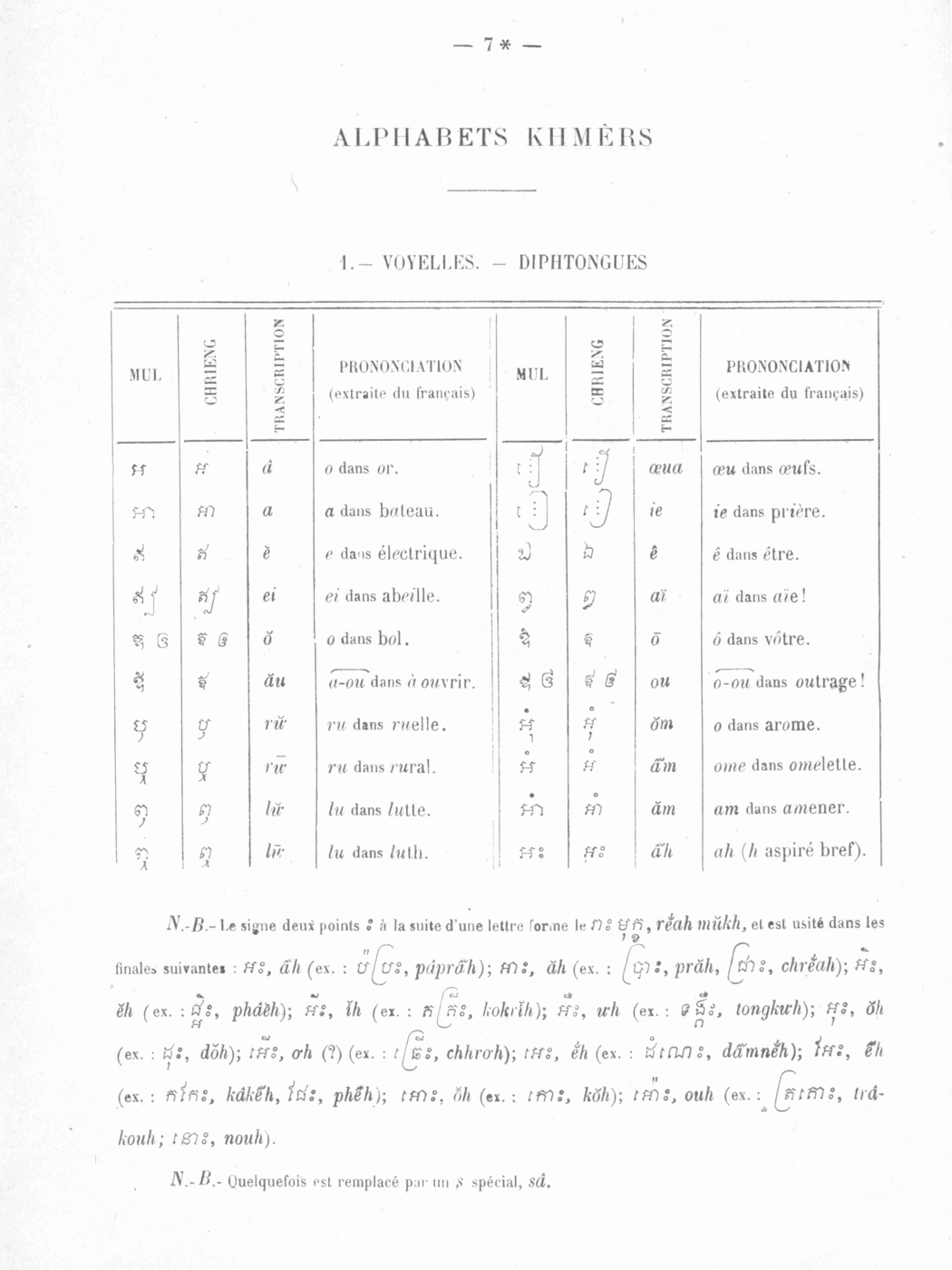
The charter named the Khmer language explicitly. The network could not carry it. The reasons are worth setting out in some detail, because Khmer is an unusually demanding case and because the difficulty is not only a question of character encoding.
Khmer script is an abugida, not an alphabet. Each consonant character carries an inherent vowel, one of two — â or ô — and that inherent vowel governs how the dependent vowel signs written around it are pronounced. Vowels are more often written as marks set above, below, before or after the consonant than as independent letters, and there are independent vowel characters as well for the cases that need them. Consonant clusters are stacked: the second, and occasionally the third, consonant is written in reduced form beneath the first. Modern Khmer uses 33 consonant characters where there were once 35, together with sixteen dependent vowel signs, fifteen independent vowels, a set of diacritics, its own numerals, its own currency sign, and its own punctuation — among it a full stop, a chapter-end mark, a duplication sign resembling the numeral two, an et cetera sign, and marks named for a cock's eye and for cow urine that open and close poetic and religious texts. Its ancestry runs from Brahmi through the South Indian Pallava script, and it has been in use since about 611.
None of that, on its own, would have been decisive. What was decisive is the convention that Khmer, like several of its neighbours, is written with no spaces between words. Spaces occur within a Khmer sentence roughly where an English writer would use a comma, and to set off items such as numbers and proper names; they do not mark word boundaries. Nearly every piece of text-processing software written in the 1980s and 1990s assumed, silently and everywhere, that whitespace separates words. Take the assumption away and three things break at once, not one. Encoding breaks, because the characters are not in the character set. Line-wrapping breaks, because a renderer with no word boundaries does not know where it may break a line. And search breaks, because a query matched against whitespace-delimited tokens will not find a string that was never tokenised — a problem that survives into any attempt to search a Usenet archive for Khmer text today.
One point of script history belongs here and is best stated once, precisely, and then left alone. The Thai and Lao scripts are relatives of Khmer rather than strangers to it: Thai descends from the Sukhothai script, which derives from Old Khmer, itself from Pallava. That is a matter for palaeographers, and the two languages' own encoding stories — Thai's national standard TIS-620 and its ISO successor, and Lao's conspicuous absence from any ISO/IEC 8859 part — are told on soc.culture.thai and soc.culture.laos respectively. The general question of how a seven-bit network handled the scripts of a continent is the subject of soc.culture.asian. This page keeps to Khmer.
One more feature of the script deserves recording for its own sake. Khmer numerals are a decimal positional system derived from the Hindu numerals, and the inscription from Sambor dated 683 carries what is, on the standard account, the earliest extant material evidence of zero used as a numerical figure — two centuries before its certain use in India. The script that no character set of 1994 could represent had been counting with a zero for thirteen hundred years.


The encoding, and the objection that followed it
The paper trail for encoding Khmer is public, and it is longer and more contentious than the outcome suggests.
A proposal to encode the Khmer script in ISO/IEC 10646 was circulated to the ISO working group on 22 January 1997 as document N1524, registered with the American committee as L2/97-040. It described itself as a minor revision of an earlier proposal by another author, it proposed to place Khmer at code points U+1400 to U+147F — not where it eventually went — and it carried, in its own preamble, a sentence that reads differently in hindsight: that there remained outstanding issues regarding the encoding of Khmer, and that participation of Cambodian experts will be very welcome. A second proposal followed on 30 July 1997. The committee minutes trace it from there: discussion at the joint meeting of August 1997, an ad-hoc report on Burmese and Khmer in March 1998, text for the registration ballot in May 1998, and the final draft amendment — ISO/IEC 10646-1 Amendment 25, Khmer — through October 1998 and April 1999.
The Khmer block was published with version 3.0 of the Unicode Standard in September 1999: 103 code points, occupying U+1780 to U+17DC and U+17E0 to U+17E9 within a block reserved from U+1780 to U+17FF. Among them is U+17D2, named coeng, the Khmer word for foot: an invisible control character that says the following consonant is to be written in subscript form. The whole stacking behaviour of the script is expressed through it.
Then the encoding was formally objected to by the country whose script it was. At the forty-first meeting of the ISO working group, held in Singapore, the Cambodian government submitted an official objection to the existing Khmer block in Unicode 3.0 and proposed a new encoding to replace it. The response paper, written on 2 December 2001 and published as L2/02-083, is unusually candid about what was at stake, and its list of concessions is worth quoting in summary because it is the rarest kind of standards document — one that concedes the substance and declines the remedy. It acknowledged that the coeng model requires additional storage, that it may sort and render more slowly, and that some people view the COENG encoding model as a foreign convention that is being forced on the modern Khmer language users and even as a cultural assault. It then argued that changing it would invalidate all existing Khmer Unicode data and implementations and would destabilise the standard by precedent, and concluded that the model should stand.
The settlement that followed gave Cambodia most of what could be given without reopening the block. Eleven characters proposed by the Cambodian delegation and absent from the 1999 repertoire — U+17DD and the series U+17F0 to U+17F9 — were added in version 4.0, published in April 2003, taking the block to 114 assigned characters. The lunar date symbols, which the coeng model demonstrably could not express, were given a block of their own rather than being forced into the existing one: Khmer Symbols, U+19E0 to U+19FF, 32 characters, proposed in February 2002 by a group including Cambodian authors and published with the same version 4.0. Two characters in the original block, U+17A3 and U+17A4, were deprecated — they had been intended for transliterating Pali and Sanskrit but were identical in appearance to an existing letter.
Encoding a script is not the same as being able to write it, and the last chapter of this story is recent. The standard did not adequately specify what constitutes a valid Khmer syllable or in what order a syllable's code points should be stored. The result was homoglyphic sequences — text that looks identical but is stored differently — and vendors devising their own incompatible definitions to fill the gap, leaving typists to produce whichever sequence happened to render correctly. The word for woman could be encoded twelve different ways, and the sequence in commonest use was not the one the spelling would lead a reader of the standard to expect. A document published in 2025 by authors at SIL International and the National Polytechnic Institute of Cambodia set out to close this, so that a given visual result has only one valid encoding. That is twenty-six years after the block was published, and thirty-one after the group was created.
What that meant for a group posting in 1994
Lay the encoding chronology against the group's own and the practical position is stark. soc.culture.cambodia was created in September 1994. Khmer was not encoded at all until September 1999 — five years into the group's life — and the encoding it got was one the Cambodian government formally objected to two years later. Fonts and rendering engines capable of stacking and reordering the marks correctly came later again, and the question of which byte sequence a correctly displayed word should consist of was still being settled a quarter of a century afterwards. For essentially the whole period in which this group was busy, a poster who wanted to write Khmer on Usenet could not.
The alternative was Latin letters, and Latin letters brought a problem of their own: Khmer has no single romanisation. Several systems are in official and scholarly use. The system of the United States Board on Geographic Names and the British Permanent Committee on Geographical Names was published in 1962, modified in 1971, and approved by the United Nations as a standard romanisation for Khmer in 1972; it was itself based on a 1959 system from the Service Géographique Khmer. The scheme of the United Nations Group of Experts on Geographical Names derives from it, and a modified system from Cambodia's own Geographic Department has been in use in the country since 1995. Alongside all of these runs the ad hoc, pronunciation-based transcription that internet users actually adopted, which has since acquired names of its own — Khmenglish, Khmerlish, and among younger Cambodians the term Sing Khmer for the hybrid written variety used on messaging platforms. It answers to none of the official systems and is based largely on English spellings of letters.
One consequence matters more than the others for anyone searching an archive now: because several Khmer sounds can be written with more than one symbol, it is not generally possible to recover the original Khmer spelling from a pronunciation-based Latin transcription. Even the transliteration systems do not preserve every distinction the script makes. A place, a temple or a surname can therefore appear in a 1990s archive under several spellings, none of them wrong and none of them findable from the others. A query typed in Khmer script will miss almost everything; a query typed in one romanisation will miss the threads that used another.
Printed romanisation of Khmer long predates the network — the columns headed Transcription in colonial-era dictionaries are the same expedient — but on Usenet it was not a scholarly convenience. It was the only way to write the language the charter named.

Angkor, and the paperwork of its protection
Angkor is the other subject on which the group's readers had a standing interest and a peculiar vantage point: the monuments were in a country most of them could not easily visit, and a good deal of what had been removed from them was in the cities where they lived.
The protection record is documentary and can be dated precisely. UNESCO inscribed Angkor on the World Heritage List in 1992 as dossier 668, under cultural criteria (i), (ii), (iii) and (iv), covering a property of 40,100 hectares — some 400 square kilometres which, in the World Heritage Centre's own description, consist of scores of temples, of hydraulic structures such as basins, dykes, reservoirs and canals, and of communication routes. In the same year, and by the same body, it was placed on the List of World Heritage in Danger, where it remained from 1992 to 2004. Conservation has been co-ordinated since 1993 through the International Co-ordinating Committee on the Safeguarding and Development of the Historic Site of Angkor, with India, Germany, Japan and UNESCO among its participants.
The Cambodian legal apparatus was built alongside it, and UNESCO's own file lists the instruments in sequence: a zoning and environmental management plan for the Region of Siem Reap and Angkor adopted on 28 May 1994; the Royal Decree creating the APSARA National Authority — the Authority for the Protection and Management of Angkor and the Region of Siem Reap — adopted on 19 February 1995; a law on the protection of natural and cultural heritage promulgated on 25 January 1996; a government decision of 16 September 2004 providing that all land in zones 1 and 2 of the site is State property; and a sub-decree of 9 May 2008 establishing a department of land-use and habitat management within the authority.
None of this was the beginning of the conservation effort, only its modern legal form. A Portuguese friar is the first recorded European visitor, in 1586; fourteen seventeenth-century inscriptions record Japanese settlement alongside the remaining Khmer, the best known of them left by a visitor who kept the Khmer New Year there in 1632. European archaeologists and ethnologists popularised the site in the 1860s, and from 1907 to 1970 the École française d'Extrême-Orient directed work at Angkor — clearing forest, repairing foundations and installing drains against water damage — while its scholars built the interpretative scholarship that underlies current understanding. Some temples have been dismantled stone by stone and reassembled on concrete foundations by the method of anastylosis, which solves one conservation problem by creating others.
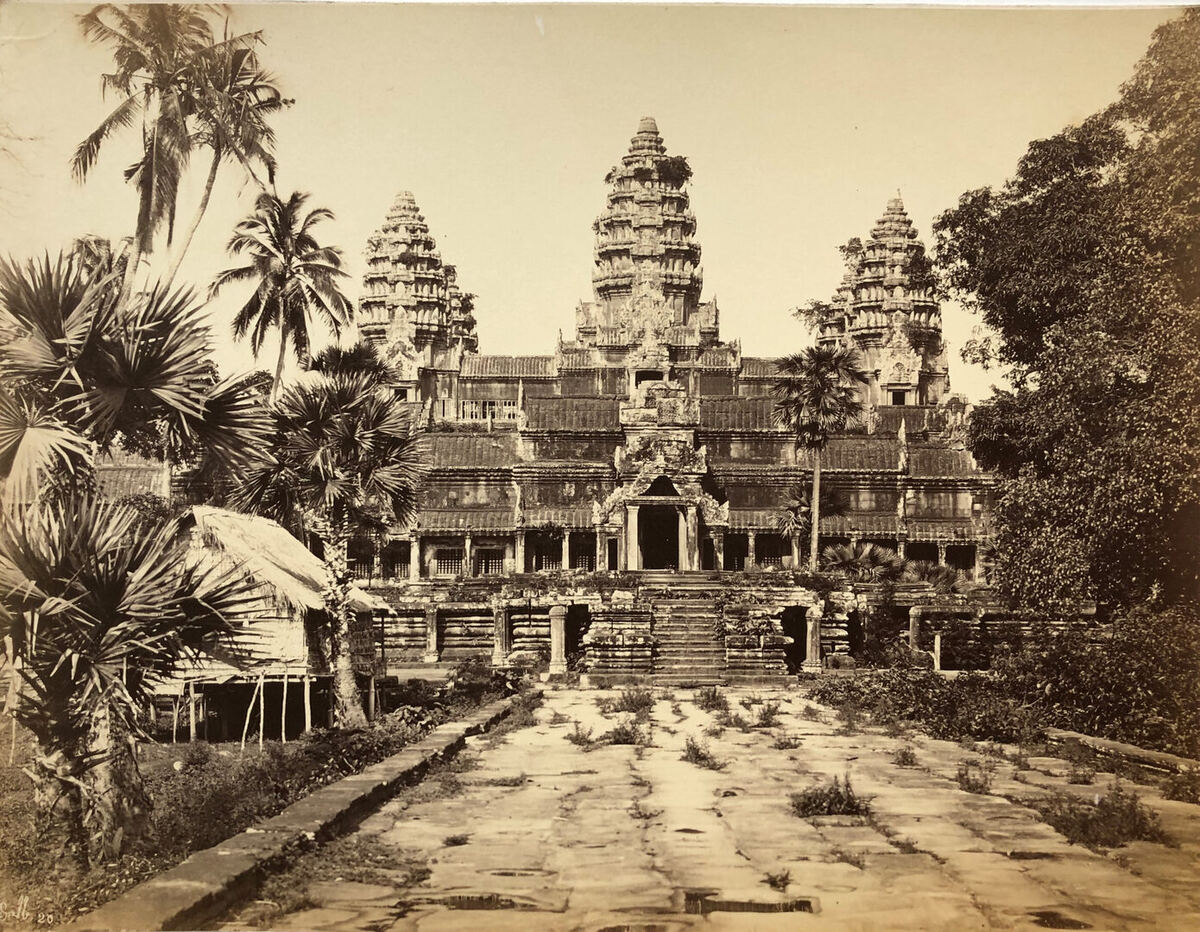

The pressures now recorded are the pressures of success. Visitor numbers of around two million a year fund part of the work and threaten the rest: the sandstone was not built for that volume of footfall, and hotel and restaurant construction draws on a water table whose depletion is documented as a risk to the stability of the sandy soils beneath the monuments, most acutely because the peak tourist season coincides with the dry season.
Objects, dealers and returns
Theft was the harder subject, and it is the one on which a diaspora readership was unusually well placed to have an opinion, because the objects were mostly not in Cambodia.
The Cambodian management authority put the position bluntly in 2005, in a statement that has been quoted ever since:
vandalism has multiplied at a phenomenal rate, employing local populations to carry out the actual thefts, heavily armed intermediaries transport objects, often in tanks or armored personnel carriers, often for sale across the Cambodian border.
Theft of archaeological objects within Cambodia has been greatly reduced since those comments were made. What has not gone away is the question of what should happen to the material already abroad, and the last fifteen years have produced a documented series of answers.
- 2011–2012. An attempted sale by Sotheby's of a statue of a Khmer warrior drew international attention to Koh Ker, the remote tenth-century capital from which it was said to have been removed; in March 2012 the United States and Cambodian governments filed court documents to seize it. A twin statue linked to the same site has been displayed at the Norton Simon Museum in Pasadena.
- 2019–2020. A British dealer long associated with the trade in Khmer antiquities was indicted in the United States for wire fraud and related offences connected with falsifying the origins of traded objects. He died in August 2020 before the case came to trial, so no court has convicted him and this page records only the indictment. Transfer of ownership to the National Museum of Cambodia of a collection attributed to him and valued at over 50 million dollars was completed on 18 September 2020.
- October 2021. A consortium of media organisations from Britain, the United States and Australia, working with the International Consortium of Investigative Journalists, used the dealer's own publications, sale records, museum records and documents from the trust structures he had established for inheritance purposes to identify 27 pieces linked to him in prominent collections. Objects associated with him, and with collectors and dealers connected to him, have been identified at institutions including the Metropolitan Museum of Art, the Brooklyn Museum, the Asian Art Museum in San Francisco, the National Gallery of Australia and the Art Gallery of New South Wales.
- November 2021. The Denver Art Museum agreed to repatriate four Cambodian antiquities voluntarily: three Khmer sandstone sculptures of the seventh and twelfth centuries and an Iron Age Dong Son bronze bell.
- June and August 2023. The dealer's estate settled a civil forfeiture action with the United States Department of Homeland Security for 12 million dollars, and 125 statues and other objects were returned. The National Gallery of Australia announced that it would return three bronzes of Avalokiteshvara and attendants, bought in 2011 for 1.5 million United States dollars and, on the gallery's account, dug up by looters in 1994 — the year the newsgroup was created. On the same account the dealer had required a non-disclosure agreement before handing over provenance information.
- December 2023. The Metropolitan Museum of Art agreed to return a further thirteen Cambodian antiquities that had passed through the same hands.
What made this a diaspora subject rather than a curatorial one is geography. A reader in Long Beach, Paris, Melbourne or Lowell could stand in front of a Khmer sculpture in a local museum in a way that a reader in Phnom Penh could not, and the question of provenance was therefore a question about their own city's institutions. Whether that question was actually argued in this newsgroup is not documented. That it was available to be argued, by exactly this readership, is a matter of record.
What a culture group carried
Charters that name culture and history are usually promising food, music, festivals and language lessons, and the surrounding material for this group is unusually rich because so much of it was nearly lost and then deliberately rebuilt.
Dance. Khmer classical dance, formally the Royal Ballet of Cambodia, is a court tradition of stylised hand movement and elaborate costume performed at coronations, weddings, funerals and holidays, its repertoire drawn from Khmer legend. It came close to extinction in the 1970s. What survived, survived through its practitioners: training was resurrected in the refugee camps in eastern Thailand by the few surviving dancers, and after 1979 dancers who had come out of hiding found one another and collectively reconstructed the repertoire, much of it recreated at the Royal University of Fine Arts in Phnom Penh. UNESCO proclaimed it in 2003 and inscribed it on the Representative List of the Intangible Cultural Heritage of Humanity in 2008, as element 00060.
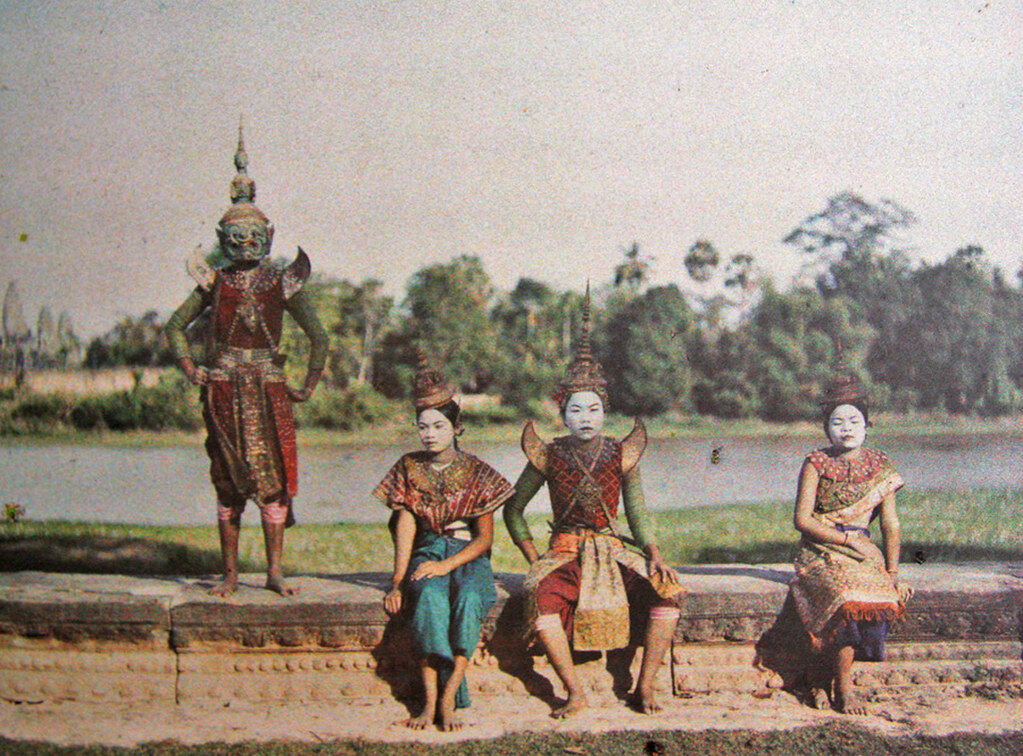

It is not the only Cambodian element on those lists, and the list itself reads as a summary of what a culture group would have had to talk about:
- Royal ballet of Cambodia — Representative List, 2008
- Sbek Thom, Khmer shadow theatre — Representative List, 2008
- Tugging rituals and games — Representative List, 2015, a multinational inscription
- Chapei Dang Veng — List in Need of Urgent Safeguarding, 2016
- Lkhon Khol Wat Svay Andet — List in Need of Urgent Safeguarding, 2018
- Kun Lbokator, traditional martial arts in Cambodia — Representative List, 2022
- Cultural practices and expressions linked to Krama, a traditional woven textile — Representative List, 2024
Music. Classical dance is accompanied by the pin peat ensemble, built around xylophones and metallophones — the lead roneat ek with bamboo or teak keys, the lower roneat thung, the brass-keyed roneat dek — with drums, gong circles and oboes, and a chorus that sings largely in the absence of instrumental accompaniment, its lyrics in verse and interspersed with sung particles.
Food. Khmer cooking is described as a culinary tradition of nearly two thousand years, and is conventionally divided into rural, elite and royal registers. Its borrowings are datable in outline: Indian merchants are recorded as introducing spices from about the second century, and the curry pastes built on lemongrass and galangal reached the royal kitchen from South India by way of Java; Portuguese arrivals in the early sixteenth century brought papaya, tomato, pineapple, peanut, cashew, avocado and sweet potato; the names of the wheat noodles carry Teochew loanwords; and in the decades after the Second World War many urban middle-class and elite households employed cooks trained in French cuisine. Its base note is fermented fish: prahok and the related mam and kapi, distinguished in Khmer by consistency and by ingredient, mam being fermented for more than a year with salt, roasted red sticky rice and palm sugar. The traffic ran outward as well as in. Between the ninth and fifteenth centuries the culinary influence of the Khmer Empire spread into what is now Thailand, Laos, Vietnam and Indonesia; from the eighteenth century the spices, curries and fermented foods of the Khmer Krom of the Mekong delta shaped the cooking of southern Vietnam; and Lao migration into Cambodia carried influence the other way. Along the Cambodia–Thailand border, dishes take more coconut milk, chilli and sugar than they do elsewhere in the country, while the northwest keeps remnants of the imperial kitchen, among them the steamed curry amok.
The historical record of that cooking is deeper than most cuisines can show. A passage in the Book of Sui describes the seventh-century Chenla diet as including butter, milk curds, powdered sugar, rice and millet, from which a sort of cake was made and soaked in meat juices at the start of a meal. Zhou Daguan, visiting in the late thirteenth century, listed onions, mustard, chives, aubergines, several gourds, amaranth, pomegranates, sugarcane, lotus flowers and roots, bananas, lychees and oranges. Archaeobotanical work at Angkor Wat and Ta Prohm has recovered rice, sesame, mung beans, crepe ginger, black and long peppers, and the peel of either citron or wild lime. And the transmission of that knowledge was documented as broken twice over: first by the mid-century habit among urban elite families of employing French-trained cooks, so that the children of those households did not learn to cook, and then by the civil war and the 1970s, during which ordinary cooking was reduced to a rice gruel and to whatever could be caught.
The calendar. Cambodian New Year — Choul Chnam Thmey — is a three-day public holiday beginning on 13 or 14 April, at the end of the harvest and before the rains, and shares its date with the solar new year kept across much of South and Southeast Asia. Its three days are named: Moha Sangkrant, on which families light candles and incense and pay homage; Veareak Vanabat, given to charity and to ceremonies for ancestors at the monasteries; and Veareak Laeung Sak, on which images of the Buddha and the household's elders are washed with perfumed water. Cambodians abroad, the sources note, frequently keep it at the nearest weekend rather than on the days themselves — a small and characteristic diaspora adjustment, and exactly the sort of thing a newsgroup posted about every April.
There is a neat closing of the circle in the calendar. The lunar dates that the Khmer script writes with its own symbols — the ones that could not be squeezed into the coeng model and had to be given a Unicode block of their own in 2003 — are the dates by which these festivals are reckoned.
What the record does not show
The honest ledger for this group is lopsided in a way that is now familiar across this directory. Its administrative half is essentially complete. Its conversational half is very nearly empty.
- No readership figures. Nothing quantitative about the group’s life survives — not subscribers, not articles carried, not traffic in any year. The 334 valid ballots of September 1994 are the only enumerated population the group has, and they count voters in one month, not readers over a decade and a half.
- No thread record. No specific discussion, argument, regular contributor, FAQ or in-joke from this group is documented in any source consulted for this page. None is named above.
- No moderator. The group was unmoderated from creation, as both the RFDs and the control message state, so there is no moderator's archive, no submission mailbox and no vacancy notice — the three kinds of document that give moderated groups a paper trail.
- Uneven archival coverage. Usenet archiving before the mid-1990s depends on collections assembled long after the fact, and coverage varies by group, by year and by the server an article happened to traverse. This group was created in September 1994, on the edge of that transition.
- Encoding damage, and the near-certainty of it here. Khmer had no encoding until 1999 and no settled canonical ordering until far later. Any Khmer-script material that did travel is unlikely to survive as readable text, and the absence of Khmer script in an archive is not evidence that none was posted.
- Romanisation scatter. Even the Latin-letter traffic resists searching, because Khmer names in Latin letters have no canonical spelling and a pronunciation-based transcription cannot be reversed into the original.
- No Cambodian addresses to trace. The vote roll contains none, the country had no measurable internet population before 1997, and the .kh domain did not exist until 1996. The group's own record cannot show what was posted from inside the country, because for most of its life almost nothing was.
There is also a limit of a different kind. Some questions about a group like this one — who felt able to say what, under what name, and who was reading over whose shoulder — are not answerable from an archive at all, and would not be answerable from a complete one. On this subject in particular they matter. This page does not attempt them.
Scope and limits
What this page asserts, it asserts from documents, and it is worth saying which.
The creation record — the RFD of 11 June 1993, the second RFD of 21 June, the Calls For Votes of 8, 15 and 26 July 1993, the RESULT of 10 August 1993 recording 96 to 21 and its stated reason for failure, the RFDs of 14 June and 11 July 1994, the Calls For Votes of 18 August and 7 September 1994, the RESULT of 19 September 1994 recording 312 to 22 with fifteen invalid ballots, and the newgroup control message of 26 September 1994 — was read in full from the Internet Systems Consortium's mirrors of the news.announce.newgroups and control archives. The charter, the rationale, the votetaker's explanation of the 1993 failure and the one-line newsgroups entry are quoted from those documents verbatim. The newgroup control message of 26 September 1994, timed at 14:35:21 GMT, and its reissue of 3 October, were read from the same archive's collection of control messages. The one-line description was matched against the newsgroups file distributed from that archive today and is unchanged, tab and all.
The domain tally of the 312 yes votes is this page's own mechanical count of the last component of the address printed on each line of the published roll, and is labelled as such throughout. It is not a count of nationalities and not reliably a count of locations.
Standards and registry facts were verified against the issuing bodies where possible: the .kh registration date of 20 February 1996 against IANA's root database; the Khmer and Khmer Symbols blocks, their code points, their version histories and the sequence of proposal documents against the Unicode Consortium's own published record, including the proposal of 22 January 1997 and the response paper of 2 December 2001 recording the Cambodian government's objection at the ISO working group's forty-first meeting. Angkor's inscription year, criteria, area, danger-list period and the sequence of Cambodian legal instruments protecting the site were taken from UNESCO's World Heritage Centre file for the property; the intangible-heritage inscriptions and their years from UNESCO's own list for Cambodia. Internet-penetration figures are from the World Bank's published series compiled from International Telecommunication Union returns, and are given only to the precision that series carries. The provisions of the Cambodian Genocide Justice Act are summarised from the enrolled text of the statute itself; the account of the Cambodian Genocide Project, of the approach to Australia and of the competition for the State Department contract is from a narrative published by one of the participants, and is attributed as such rather than stated as settled fact. The founding date of Yale's Genocide Studies Program is quoted from that programme's own statement. The remaining historical, demographic, judicial and cultural material is from encyclopaedic sources.
Two points are set down here because they are easy to get wrong. The first is that the group was not created by the 1993 vote: that ballot closed on 4 August 1993 and failed 96 to 21, a margin of seventy-five where the rule required more than a hundred, and soc.culture.cambodia dates from the second campaign and the ballot that closed on 16 September 1994. The second concerns early Cambodian connectivity. Three specifics that circulate about it — an e-mail relay beginning in 1994, a 64 kbps satellite link to Singapore in 1997, and the roster of providers and satellite routes set out in an International Telecommunication Union country case study of 2001 — are not asserted on this page, because none of them could be verified against a source available for it. What the sources do support is stated instead: that the .kh domain was delegated on 20 February 1996 and administered by the Ministry of Posts and Telecommunications from 1997, and that the published statistics record no measurable internet population before that year.
On the political and historical material the rule applied throughout is narrow and deliberate. State what happened and when. Give estimates as ranges with the study attached. Attribute every characterisation to whoever made it. Name no living individual, except the two exceptions this page makes openly: those a court has convicted, with the chamber and the date of the judgement given; and the authors of published estimates and characterisations, where attribution is impossible without them. Deliver no verdict. The events of 1975 to 1979 are the subject of a substantial scholarly literature, a national archive and a completed international criminal tribunal, all of which have better standing to characterise them than a Usenet directory has. The subject of this page is a newsgroup — what it was chartered to be, who voted it into existence, what the world it belonged to looked like, and what a reader can and cannot find out about it now.
Reading soc.culture.cambodia today
- Historical archive: Google Groups — soc.culture.cambodia (coverage varies by group and era).
- Open in a newsreader:
news:soc.culture.cambodia— the original site offered exactly this link, and it still works if your system has a newsreader registered for thenews:scheme. - Live access: point an NNTP newsreader at a modern server — see accessing Usenet today.
- The original news2mail e-mail subscription service ended in the mid-2000s and no longer operates.