soc.culture.ethiopia
Ethiopia and Ethiopians.
The Derg’s aftermath, the Eritrean separation, the 1998 border war and the politics of the EPRDF years, argued by a diaspora concentrated in Washington DC and scattered everywhere else.
Ge’ez-script encoding threads and coffee-ceremony explanations gave it texture beyond politics; the group spawned moderated and misc siblings preserved alongside.
On this page
The group and its era
soc.culture.ethiopia was one of the soc.culture hierarchy’s African groups, spanning a decade in which almost everything about its subject was renegotiated. The civil war ended on 28 May 1991, when the EPRDF entered Addis Ababa; Mengistu Haile Mariam had left the country for Zimbabwe days earlier. Eritreans voted on separation between 23 and 25 April 1993, independence was declared on 27 April and UN membership followed on 28 May. A new constitution came into force on 21 August 1995. Fighting between the two states ran from 6 May 1998 to 18 June 2000 and was closed by an agreement signed at Algiers on 12 December that year. The general election of 15 May 2005 and the disputed count that followed came at the end of that decade.
Almost none of this could have been written from inside Ethiopia. Telecommunications were a state monopoly throughout, and internet use was still around 0.75 per cent of the population as late as 2010, so the people best placed to post were abroad. The largest Ethiopian population in the United States is in the Washington DC metropolitan area, estimated at anywhere from 75,000 to 250,000. Israel was a second centre: the airlift of 24–25 May 1991 carried 14,325 Ethiopian Jews there in some thirty-six hours, days before the capital changed hands. Europe and the Gulf held much of the rest of a diaspora put at over 2.5 million. news2mail carried the group to e-mail between 2000 and 2004.
Who could post: the country and the network
How many people at home could reach the network at all is the measure of who was in a position to write to a national newsgroup. The country-code domain .et was delegated on 15 October 1995, according to IANA’s root zone database, and is sponsored by the state operator — the Ethiopian Telecommunications Corporation then, Ethio telecom after its renaming. A delegation record is an administrative act rather than a measure of access, but it fixes the year the country acquired a namespace of its own: four years after the change of government, four before the Ge’ez script entered Unicode.
The access figures sit in the World Bank’s development indicators, which carry the International Telecommunication Union’s series for individuals using the internet as a share of population. For Ethiopia it reads 0.0017 per cent in 1996, 0.015 per cent in 2000, 0.11 per cent in 2003, 0.22 per cent in 2005 and 0.75 per cent in 2010; in absolute terms, about 360,000 users in 2008, under half of one per cent of the population.
The supply side explains that curve. Telecommunications were a state monopoly: one carrier, which was also the sole internet service provider and the seller of .et domain names. The government announced in June 2018 that it would open the sector to private investment; the first private operator licence was issued in May 2021, well over a decade after the newsgroup’s active years.
The consequence for the group is structural rather than incidental. A national newsgroup whose subject population had a domestic connection rate measured in hundredths of a percentage point was necessarily written from outside it: from university and employer networks in North America and Europe, later from commercial dial-up accounts there. Readers inside Ethiopia existed — a few hundredths of one per cent of a population of tens of millions is still thousands of individuals — but they were the exception. The archive is a diaspora record about home rather than a record made at home.
What was discussed
The constitutional settlement of the EPRDF years was a standing subject. The 1995 constitution organised the state into regions drawn largely on ethno-linguistic lines and, in Article 39, granted every nation, nationality and people an unconditional right of self-determination up to and including secession. Whether that recognised the country as it was or remade it into something else was disputed then and is disputed now, along lines the settlement itself drew. Eritrea’s separation, endorsed in the referendum by 99.83 per cent of those voting on a turnout above 93 per cent, stayed live for years after the vote.
The structure that argument turned on can be set out factually. The constitution divided the country into nine regional states, drawn to correspond with nations, nationalities and peoples rather than with the provinces of the imperial and Derg periods; Addis Ababa was given a status of its own, and Dire Dawa became a chartered city alongside it in 2004. Regional councils had first been elected on 21 June 1992 under the transitional arrangements. Article 5 gave all Ethiopian languages equal state recognition while making Amharic the working language of the federal government; Article 40(3) vested land in the nations, nationalities and peoples and barred its sale. An upper chamber, the House of Federation, represented those groups by name.
During the border war the group and its Eritrean counterpart did what diaspora newsgroups generally did in that conflict: they relayed. Official statements, press copy and rebuttals reached readers with few other quick sources, and each side’s claims were available to the other. Casualty figures for the war remain widely divergent. Displacement was heavy — some 650,000 people within Eritrea alone by May 2000 — and both governments expelled or deported tens of thousands.
The Ge’ez script was a practical obstacle. It is an abugida of twenty-six base consonants, written in seven vowel orders, and none of it fitted the seven-bit text a Usenet article carried. Ethiopic characters were not encoded in Unicode until version 3.0, in 1999, and software support followed later still. Until then, writing Amharic or Tigrinya online meant the usual pre-Unicode repertoire: transliteration into Latin letters by one scheme or another, fonts passed from reader to reader, and text that displayed only where both ends had the same setup. No scheme was standard, which made the choice among them part of the work.
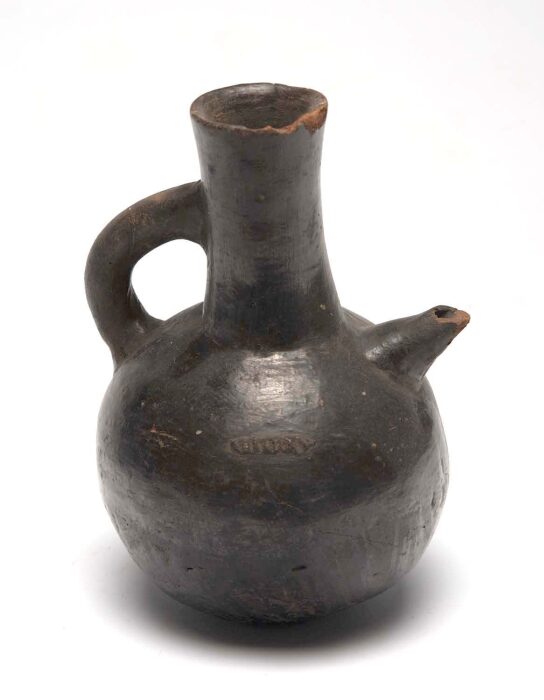
Calendar and festival questions arrived with the seasons. The Ethiopian calendar runs twelve months of thirty days and a thirteenth of five or six, sits seven or eight years behind the Gregorian count, and begins on 11 September; Timkat falls on 19 January. Squaring those dates with a working week set by another calendar is ordinary diaspora business. Food and music came with it: the coffee ceremony, with green beans roasted in the room, brewed in a jebena and served in three rounds — abol, tona, baraka — is the kind of thing explained to outsiders and argued over among insiders.
A dated record
What follows is the era’s chronology as dated events and nothing more. Several items precede both the newsgroup and the gateway. No causal claim is made by the ordering.
- 12 September 1974 — the Derg deposes and imprisons Emperor Haile Selassie. He died at the Jubilee Palace on 27 August 1975; the killing was made public in 1994.
- 1983 to 1985 — famine. USAID put the death toll at more than 300,000, the historian Alex de Waal at 400,000 to 500,000, other compilations at 300,000 to 1.2 million. Some 7.75 million people were recorded as affected and 400,000 left the country.
- 23 October 1984 — a BBC television report from northern Ethiopia is broadcast.
- November 1984 to January 1985 — Operation Moses carries Beta Israel from Sudan to Israel by way of Brussels; published accounts differ on the closing date and give between about 6,500 and 8,000 people. Operation Joshua brings 494 more in 1985.
- 7 December 1984 — the Band Aid single is released, initial copies having gone out from 3 December; the Live Aid concerts follow on 13 July 1985.
- 1985 and 1986 — about 600,000 people are moved under the resettlement programme.
- 22 February 1987 — a new constitution takes effect and the People’s Democratic Republic of Ethiopia replaces the Derg government, whose leadership stayed in office until September.
- 21 June 1992 — the first regional council elections.
- 8 December 1994 — the constitution is adopted by the Constituent Assembly.
- 15 October 1995 — the
.etdomain is delegated. - September 1999 — Unicode 3.0 is published, adding the Ethiopic block.
- 31 July 2000 — Resolution 1312 establishes the United Nations Mission in Ethiopia and Eritrea.
- April 2002 — the Eritrea–Ethiopia Boundary Commission delimits the border, awarding Badme to Eritrea.
- 6 December 2003 — Haddis Alemayehu, the modern Amharic novelist, dies aged ninety-three.
- March 2005 — Unicode 4.1 adds the Ethiopic Supplement and Ethiopic Extended blocks.
The famine years matter to the group without appearing in it: they precede Usenet’s reach into the region, but they produced the refugee movement from which much of the later readership came, resettled in part through channels opened by the United States Refugee Act of 1980.
The script on the wire
The encoding problem determined what the archive now contains. In the international register of character sets maintained by IANA — the list from which a message declares its charset — there is no entry for Ethiopic at all. Arabic had ISO-8859-6 and Hebrew ISO-8859-8; the Ge’ez script never acquired a registered eight-bit encoding. Vendors and font makers therefore each mapped the syllabary onto the printable range of an eight-bit font in their own order, so that two correspondents using different Ethiopic fonts exchanged nonsense.
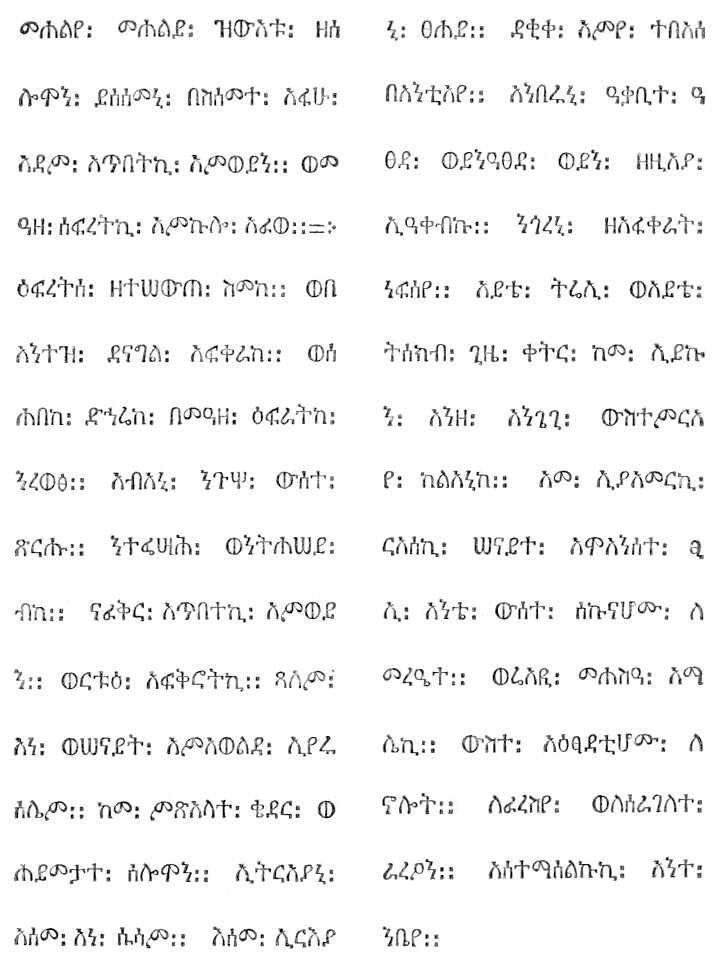

Unicode ended the ambiguity in principle. Version 3.0, published in September 1999, admitted the script in the block named Ethiopic at U+1200 to U+137F: 384 code points, 345 assigned at first and 358 now. Its ISO 15924 identifier is Ethi, numeric 430. Three further blocks followed, all after the years in which such groups were busiest: Ethiopic Supplement (U+1380 to U+139F) and Ethiopic Extended (U+2D80 to U+2DDF) in version 4.1 of March 2005, Ethiopic Extended-A (U+AB00 to U+AB2F) in version 6.0 of October 2010, and Ethiopic Extended-B (U+1E7E0 to U+1E7FF) in version 14.0 of September 2021.
Encoding a script and being able to use it are different things. The chain from keyboard to screen had to hold at every link: an input method that could compose the fidel from a Latin keyboard, a font containing the glyphs, a newsreader willing to send eight-bit or MIME-encoded text rather than plain ASCII, and a news server that did not mangle it in transit. In practice the dependable medium remained Latin transliteration, and there is no universally agreed romanisation of Amharic.
That has a direct consequence for anyone searching the surviving archive. A personal or place name may occur in half a dozen Latin spellings — a vowel written one way or another, ejectives marked with an apostrophe or left unmarked, gemination doubled or not — and a search on one will miss the rest. Searching for strings of Ge’ez characters returns very little from the 1990s material, because very little of it was ever sent that way; the practical method is to try several transliterations of the same word.
Calendar, clock and the festival year
The offset from the Gregorian count derives from a different calculation of the year of the Incarnation: the Alexandrian reckoning associated with Annianus, made around 400, rather than that of Dionysius Exiguus adopted later in the west. Leap years fall every fourth year without exception, so Pagumé, the thirteenth month, has six days in one year out of four and five in the others.
New Year falls on 11 September, except in the year preceding a Gregorian leap year, when it falls on 12 September; the turn of the Ethiopian millennium was therefore 11 September 2007, three years after the news2mail gateway closed. Timkat falls on 11 Terr, which is 19 January and 20 January in a leap year; the procession carries the tabot, the altar tablet of every Ethiopian church, wrapped in cloth on a priest’s head. UNESCO inscribed the festival on its Representative List of the Intangible Cultural Heritage of Humanity in 2019.
Time of day differs as well. Ethiopian usage counts a modified twelve-hour clock from dawn rather than from midnight, so that seven in the morning by East Africa Time is one o’clock in the morning; conversion in either direction is a matter of six hours. Ethiopia keeps UTC+03:00 and observes no summer time. For a readership split across countries, a plain statement of when something happened could therefore be ambiguous in two directions at once — which calendar, and which clock.
The fasting calendar sets much of the year’s rhythm for Orthodox households: all Wednesdays and Fridays are fast days, along with the whole of Lent and further periods beyond it, and abstention covers all animal products — which is why an extensive vegan repertoire exists as ordinary food rather than as a speciality.
Church, manuscript and the Ge’ez inheritance
The church whose calendar that is dates its own foundation to the fourth century, when Christianity was adopted at Aksum under King Ezana, with Frumentius — remembered in Ethiopia as Selama, Kesaté Birhan — as its first bishop. From then until 1959 the Ethiopian church was administratively part of the Coptic Orthodox Church of Alexandria, its metropolitan appointed from there. Five Ethiopian bishops were consecrated in 1948; in 1959 Pope Cyril VI crowned Basilios as the first Patriarch of Ethiopia. The church counts between 38 and 51 million adherents inside the country.
Its liturgical language is Ge’ez, which has not been a spoken vernacular for centuries, and its scriptural canon is the largest of any church: eighty-one books, forty-six of the Old Testament and thirty-five of the New. The chant tradition, zema, is attributed to Saint Yared in the sixth century. The two Garima Gospels, at the Abba Garima monastery near Adwa, were long dated on palaeographic grounds to about 1100; radiocarbon testing placed Garima 2 at roughly 390 to 570 and Garima 1 at roughly 530 to 660, making them the oldest surviving Ethiopian manuscripts of any kind.
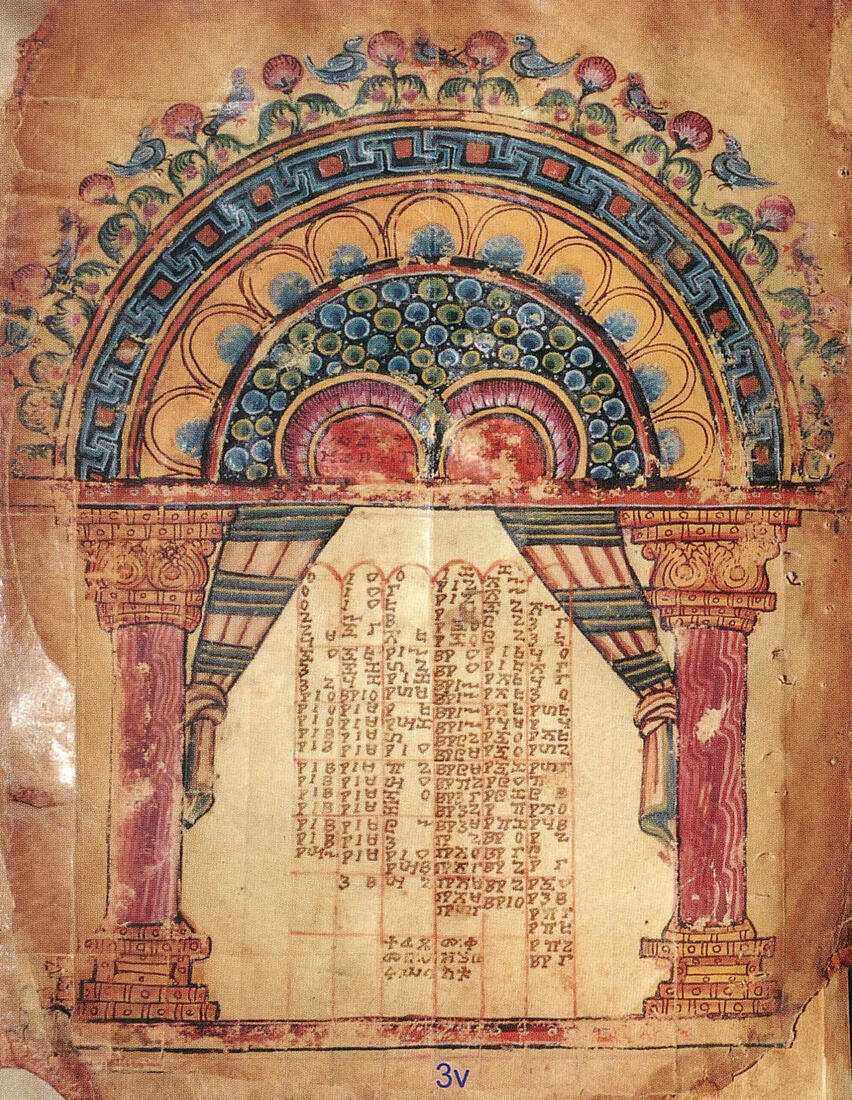

A second text carries much of the country’s historical self-description: the Kebra Nagast, which traces the Solomonic line to Menelik, son of Solomon and the Queen of Sheba. It was rendered into Ge’ez between 1314 and 1322 from an Arabic version of about 1225. Modern scholarship treats it as material assembled to legitimise a dynasty that came to power in the thirteenth century; many Ethiopian Christians regard it as history.
The cultural traffic
Coffee, and what can be said about it
Coffea arabica is native to the highland forests of south-western Ethiopia, and the province of Kaffa is one proposed origin of the word itself. The story of the goatherd who noticed his animals grazing on the berries does not appear in print before 1671, when the Maronite scholar Antoine Faustus Nairon published it in Rome — and in his telling the herder is in Arabia; the name Kaldi appears to be a twentieth-century addition. There is no confirmed evidence of coffee being drunk anywhere before the fifteenth century, by which time the practice was established among Sufi communities in Yemen.

The table
Everyday cooking is built on injera, a sourdough flatbread some fifty centimetres across made from fermented teff, a grain native to the Ethiopian highlands. On it goes wot, the stew that begins with red onions cooked dry, then niter kibbeh, spiced clarified butter, then berbere, the chilli blend that also carries cardamom, fenugreek, coriander, cloves, ginger, nutmeg, cumin and allspice. Kitfo, minced beef raw or barely warmed with mitmita and niter kibbeh, is a Gurage dish.
Music, and the reissue that changed its audience
Ethiopian modal practice is organised around qenet, whose four principal modes are tezeta, bati, ambassel and anchihoy. The instruments most often named are the krar and begena, lyres of six and ten strings; the masenqo, a single-string bowed lute; the washint, a bamboo flute; and the kebero, the drum of the Orthodox liturgy. Secular highland music has long been carried by itinerant professionals, the azmari. What changed the music’s audience outside the country during precisely the years such groups were busiest was the Éthiopiques reissue series, begun in 1997 on the Paris label Buda Musique and compiled by Francis Falceto, which returned recordings from the 1960s and 1970s — Mahmoud Ahmed, Mulatu Astatke, Tilahun Gessesse and others — to circulation.
Letters
Written Ge’ez literature begins with the Christianisation of Aksum and has a recognised high period dated from the fourteenth century onward, its most productive reign that of Zara Yaqob (1434–1468); the earliest grammar and dictionary of Amharic in a European language were made by Abba Gorgoryos (1595–1658) with Hiob Ludolf. Haddis Alemayehu, born 15 October 1910 and died 6 December 2003, published in 1968 the novel known in English as Love to the Grave, generally treated as the classic of the modern Amharic novel; its Amharic title is transliterated several different ways in English sources, which is the romanisation problem in miniature. Baalu Girma’s Oromay appeared in 1983.
Running
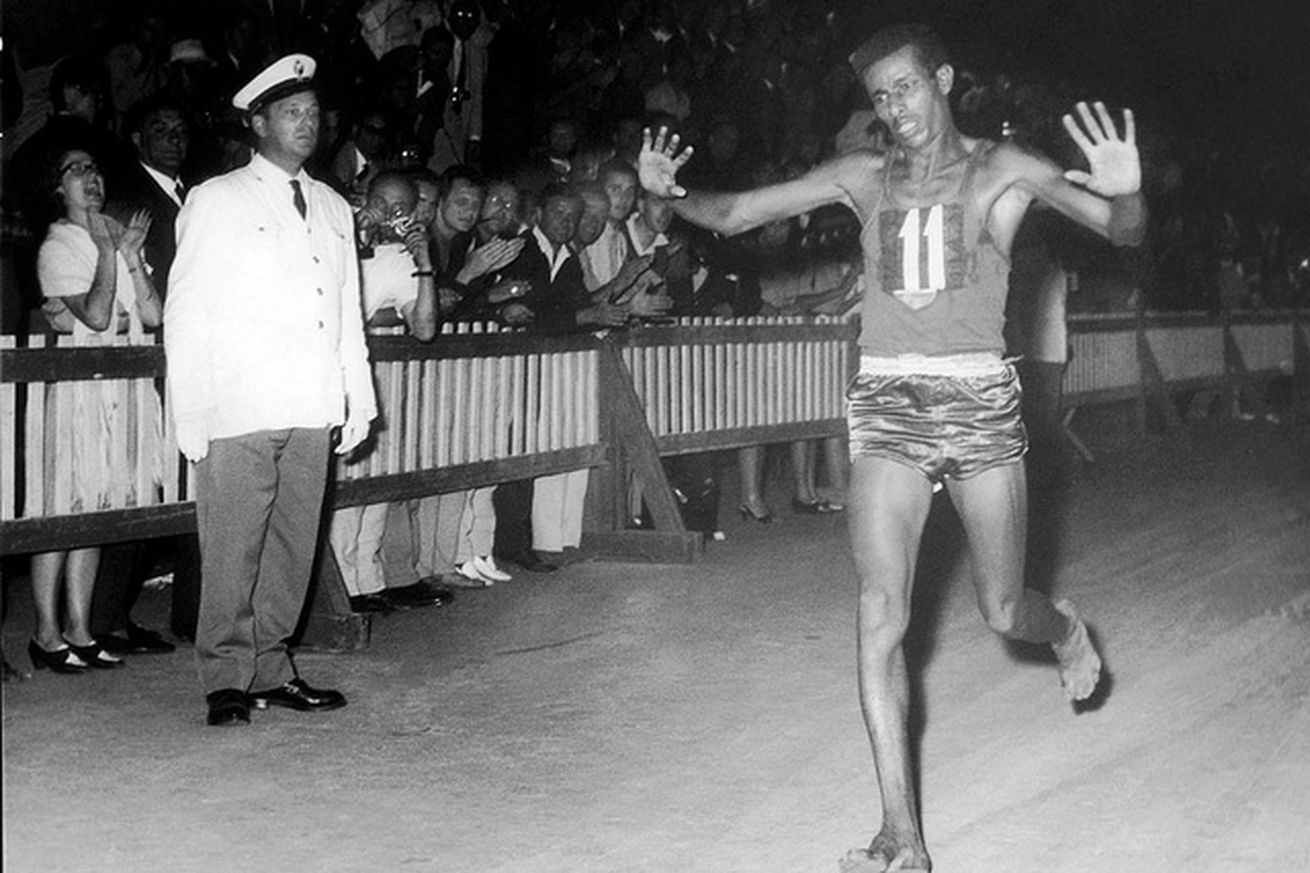
Ethiopia first competed at the Olympic Games in Melbourne in 1956. Abebe Bikila won the marathon in Rome on 10 September 1960, running barefoot and setting a world best, and won it again in Tokyo in 1964; Mamo Wolde took the marathon in 1968 and Miruts Yifter the 5,000 and 10,000 metres in 1980. Within the newsgroup’s own years, Derartu Tulu won the women’s 10,000 metres at Barcelona in 1992 and at Sydney in 2000, and Haile Gebrselassie the men’s 10,000 metres at Atlanta in 1996 and Sydney in 2000. Ethiopia’s Summer Games total stands at 24 gold, 16 silver and 22 bronze medals, every one of them in athletics.

Where the readership was
The United States census of 2000, taken in the middle of the group’s life, recorded about 68,001 people reporting Ethiopian ancestry; American Community Survey estimates for 2007 to 2011 put the Ethiopia-born population at about 151,515, and the 2023 estimates give 372,804 of Ethiopian ancestry and 278,182 born in Ethiopia. Arrivals averaged around 5,000 a year between 1992 and 2002.
Beyond the Washington area, census counts and community estimates identify a consistent set of secondary centres: Minneapolis–Saint Paul, with an official count of 34,927; Dallas–Fort Worth at around 44,600 officially and about 50,000 by community estimate; Seattle at 25,000 to 40,000; and Columbus, Ohio, and Clark County, Nevada, at about 40,000 each. Official and community figures diverge widely in every case, for the ordinary reasons: ancestry questions are self-reported, and the second generation may or may not be counted in them.
Israel is the second large concentration and the best documented, because the movements were organised and counted. Operation Moses carried Beta Israel out of Sudan over some seven weeks from late November 1984, accounts giving between about 6,500 and 8,000 people; Operation Joshua brought 494 more in 1985, and Operation Solomon followed in May 1991. The World Jewish Congress puts total emigration from Ethiopia to Israel since 1948 at 50,700, and Israel counted about 177,600 citizens of Ethiopian descent in 2024. Some three million Amharic speakers live outside the country altogether.
A readership spread across Addis Ababa, Washington, Tel Aviv, London, Toronto and the Gulf has no common working day, and that changes the shape of a newsgroup rather than merely inconveniencing it. Ethiopia keeps UTC+03:00 all year; the eastern United States is seven hours behind it in the northern summer and eight in winter. A message written at the end of the working day in Addis Ababa arrives in Washington in the middle of its morning. There is no hour at which such a group is quiet and none at which it is fully assembled, and an exchange that would run its course in one evening on a single-country group instead unrolls over two or three days, which Usenet’s store-and-forward design carried without difficulty.
Context
Two siblings are preserved in this directory alongside the open group: soc.culture.ethiopia.moderated and soc.culture.ethiopia.misc. On Usenet that shape — an unmoderated original, a moderated room and a catch-all for the rest — almost always marks a group whose volume and temperature had outgrown a single address. The particular history behind these two is not recorded here; only the general pattern is stated.
The group sits in this directory among the continental and East African entries, near soc.culture.african and soc.culture.somalia. Like most soc.culture groups it lost traffic to web forums and social platforms during the 2000s.
Several things a reader arriving from a country resource page may be looking for postdate the archive entirely. The Ethiopian millennium fell on 11 September 2007. The United Nations mission on the border was wound up by Resolution 1827 of 30 July 2008, and Ethiopia’s governing coalition announced on 5 June 2018 that it would implement the boundary decision in full. The federal map has since been redrawn by referendum: Sidama became a region on 18 June 2020, the South West Ethiopia Peoples’ Region on 23 November 2021, and the Southern Nations, Nationalities and Peoples’ Region was divided on 18 August 2023.
What survives is a contemporaneous and unedited record of how a dispersed population described and disputed events at home while the outcomes were open. It settles nothing. The questions argued in it — the federal arrangement, the border, and the terms in which the recent past should be described — remain matters of live political disagreement, on which this page takes no position.
Reading soc.culture.ethiopia today
- Historical archive: Google Groups — soc.culture.ethiopia (coverage varies by group and era).
- Open in a newsreader:
news:soc.culture.ethiopia— the original site offered exactly this link, and it still works if your system has a newsreader registered for thenews:scheme. - Live access: point an NNTP newsreader at a modern server — see accessing Usenet today.
- The original news2mail e-mail subscription service ended in the mid-2000s and no longer operates.