soc.culture.jewish
Jewish culture, religion and life worldwide.
One of Usenet’s oldest culture groups — old enough that its creation predates the news.announce.newgroups archive — spanning religious practice (with soc.culture.jewish.holocaust and related moderated offshoots for gravest topics), Yiddish and Hebrew language, food, humour and diaspora life on every continent.
Its multi-part FAQ, maintained for over a decade, ran to twelve archival files and twenty-one numbered sections, and was written jointly by laypeople from across the Jewish movements.
On this page
- The line in the newsgroups file
- The parenthesis as namespace engineering
- Where the paperwork begins, and where it does not
- soc, not talk: the specific case
- January 1992: the reorganisation that did not happen
- The soc.culture.jewish.* branch
- Siblings outside the branch
- What a moderated charter forbade
- The subject the charter names: practice and observance
- The calendar and how it is reckoned
- Text and the methods of studying it
- Three languages with different histories
- A right-to-left script on a seven-bit network
- Writing Hebrew in Latin letters
- Communities, and where they were
- Volume, crossposting and abuse: what the documents record
- Forged control messages, 1998 and 2001
- The FAQ and the Reading Lists
- Shamash, and the mail side of the network
- How the branch ended
- What the record does not show
- Scope and limits
The line in the newsgroups file
The one-line description that a news administrator's software shows beside this group has not changed in more than thirty years. In the newsgroups file distributed today by the Internet Systems Consortium, which mirrors the Usenet administrative record, the entry reads in full:
soc.culture.jewish Jewish culture & religion (cf. talk.politics.mideast).
Most soc.culture.* descriptions are a noun phrase and a full stop. This one is a noun phrase, a full stop, and a redirection. The abbreviation cf. is doing work that no other line in the culture branch is asked to do: before a reader has seen a single article, the namespace has told them that one class of subject belongs somewhere else.
The wording is older than the file it now sits in. The earliest surviving control message for the group, preserved in the ISC control archive and dated 23 May 1991, carries the description as its entire body, punctuated very slightly differently — Jewish culture & religion. (cf. talk.politics.mideast), with the full stop inside rather than outside. The sentence and its parenthesis have travelled together, essentially unaltered, from the era of UUCP dial-ups to the current active file.
The parenthesis as namespace engineering
What the parenthesis meant in practice can be reconstructed exactly, because the group's own participants wrote it down repeatedly and the documents survive.
talk.politics.mideast is a real group, still listed, described in the same file as Discussion & debate over Middle Eastern events. Its earliest surviving control message comes from the same May 1991 sweep as this group's, nine minutes later. The two lines were designed to be read together: a group about a people and a religion, and next to it a group about a conflict, with the culture group's own description pointing at the door.
The pointer was a standing feature of the community's self-documentation, not an afterthought. The index to the first section of the group's long-running Frequently Asked Questions document lists, among its questions, When should I post to talk.politics.mideast?, Is it appropriate to discuss Israel in soc.culture.jewish?, What topics are appropriate for S.C.J? and What topics are not appropriate for S.C.J? Four of the twenty-one questions in that section are boundary questions. A group that had no trouble with its boundary would not have needed them.
The same instinct appears in every formal proposal the branch produced, and in the group's own reference document before them. The FAQ's answer to What topics are not appropriate for S.C.J? opens with the rule and its reasons: Middle East politics, especially international issues concerning Israel, belong in talk.politics.mideast (T.P.M), not S.C.J. You certainly should not crosspost between S.C.J and T.P.M. Discussions of internal Israeli politics belong in soc.culture.israel (S.C.I). A 1995 Request for Discussion for a filtered companion group reproduced that passage almost word for word, stating that it was taking the parent group's charter from the FAQ. The successful proposal of 2000 put the same rule into its charter as a prohibition, and it is set out in the section on that charter below.
Whether the redirection worked is a separate question from what it was for, and the surviving documents answer the first one plainly: the proposals that cite the boundary all cite it because it was being crossed. The interest of the line is that it records an intention. Somebody, at the moment the group entered the renamed namespace, decided that a culture group should be given an explicit exit route for the argument most likely to consume it, and wrote that route into the one field every news server on earth would copy.
Where the paperwork begins, and where it does not
For Big-Eight groups created after about 1990 the administrative record usually survives in full: the Request for Discussion, the Call for Votes, the RESULT with its tally, and any later moderator-vacancy notice are all filed under the group's name in the news.announce.newgroups archive. For soc.culture.jewish there is no such file. The directory that holds soc.culture.jewish.holocaust, soc.culture.jewish.moderated, soc.culture.jewish.parenting, soc.culture.jewish.publications, soc.culture.jewish.singles and a reorganisation proposal returns nothing at all for the parent group; the request is answered with a 404. The group predates the archive.
What does survive is the control-message record, and it is worth setting out precisely, because it is a good illustration of how thin the early evidence is. The ISC control archive holds four newgroup messages for soc.culture.jewish and one rmgroup. None of them is the message that created the group.
- 23 May 1991 — issued from a machine at Compass, Inc. of Wakefield, Massachusetts, distribution world, body consisting solely of the description line. Part of a bulk reissue: the equivalent message for talk.politics.mideast bears the same date and a timestamp nine minutes later.
- 26 April 1992 — from the University of Maine Department of Computer Science, distribution umcs. A local message, creating the group on one site's server.
- 9 November 1994 — from a machine at the University of Texas Medical Branch, body a single stray character.
- 21 September 1995 — from a Swiss news host, body reading For your newsgroups file: followed by the group name.
- 4 November 2001 — an rmgroup, discussed below, which no Big-Eight process authorised.
Two of these are housekeeping by individual administrators; one is an accident; one is a forgery. The 1991 message is a snapshot of an already-existing group rather than a creation, and the archive simply does not reach back past it. Anyone who wants the group's founding vote, if there was a vote, will not find it here.
soc, not talk: the specific case
The split between soc.* and talk.* is the property of the hierarchy rather than of any one group, and it is told at length on the soc.* hierarchy page: soc.* took social subjects, talk.* took open-ended argument, and the line was drawn partly for reasons of cost and propagation rather than pure taxonomy. This page adds only the specific case, which is unusually well documented because the participants argued about it in public for a decade.
The 2000 proposal for a moderated companion opened with a dating: Soc.culture.jewish has been part of Usenet since the Great Renaming. The group's own FAQ goes one step further back and names the predecessor outright: In the early years of Usenet, there was only one Jewish newsgroups, and it was named net.religion.jewish. In the late 1980s, the Usenet namespace was reworked in what was called the "Great Renaming". The surviving control archive does not reach that far — its earliest message for this group is dated May 1991, four years after the event — so the older name rests on the group's own published account of itself rather than on a control message. That account was maintained under a named editor for a decade and is the best evidence there is.
The reasoning is recorded in the same place. Renaming net.religion.jewish into talk.religion.jewish was resisted, the FAQ says, because it was believed that talk. groups would have lower propagation and be less likely to be carried by administrators; the response was to propose that the group be moved into the soc.culture.* hierarchy instead. That is the general economics of the branch, described on the hierarchy page, stated for this one group by the people who made the argument. Set against it was a categorical objection, and it was put with complete clarity in January 1992 by a proponent seeking to move the religious traffic out:
Judaism is a religion. Regardless of the differences between Orthodox, Conservative, Reform, and other paths, Judaism remains, first and foremost, a religion. The Jewish religion exists, and is the same, despite and without regard to geographic borders and ethnic differences.
The FAQ carried the question in its first section, phrased as a challenge: Why soc.culture.jewish? Wouldn't soc.religion.jewish be more appropriate? Its own answer calls the name a net.historical relic and closes the argument rather than settling it: while Jews have argued forever about whether Judaism is more of a "culture" or a "religion" or a something else, the choice of name for this newsgroup is not proof of anything. What the placement did settle was the traffic's default company: filed under culture, the group sat on a shelf with one entry per country and people, and inherited that shelf's habits — recipes, language questions, diaspora correspondence — alongside the questions of law and observance that a religion group would have had to itself. The parent group was itself never moderated, and the record is consistent on the point: no moderation flag in any of its control messages, an unmoderated entry in the current active file, and a decade of proposals whose whole purpose was to build a filtered alternative beside it rather than to filter it.
January 1992: the reorganisation that did not happen
On 8 January 1992 Jonathan B. Horen of Renaissance Software in Los Altos, California, posted a Request for Discussion to news.announce.newgroups, news.groups, soc.culture.jewish and ba.israelis, proposing to break the group into five. It is the single most informative surviving document about how the group's own readers understood their subject, and it is worth setting out in full because none of it happened.
- soc.culture.israel — Internal Israeli subjects (other than politics)
- soc.culture.jewish.american — Internal issues for American Jews
- soc.religion.jewish — Religious issues for all Jews
- talk.politics.israel — Internal Israeli politics (general)
- talk.politics.israel.intifada — Internal Israeli politics (Jewish/Arab)
All five were to be unmoderated. The preliminary charters are as revealing as the names. The culture group for Israel was to cover Music, art, theatre, dance, cooking, movies, sports, literature, and job information. The American group's illustrative topics were Xmas, Easter, AIDS, drug-use, where to live, and where to find kosher food — a list that reads as an accurate inventory of what a minority community actually discusses. The religion group was to cover Orthodox, Conservative, Reform (as well as anywhere to the right, left, or in-between of these reference points).
The proposal's structural argument was that the existing group was doing four jobs at once, and that the jobs did not belong together: religion is not geography, culture is not politics, and the politics of one dispute is not the politics of a region. The RFD promised a second posting two weeks later and a Call for Votes thirty days out, dated by the proponent in both calendars at once — on Rosh Hodesh Adar I (4 February 1992). It closed with an instruction that has aged into a period artefact: Please direct all discussion to news.groups, and please direct all flames to /dev/null.
No second RFD, no Call for Votes and no RESULT for the reorganisation survives in the archive. The file holds the January 1992 posting twice over and nothing else. Whatever happened in news.groups that winter, the five-way split was not carried out. One of the five names arrived separately and later: soc.culture.israel passed its own vote 153 to 40, as reported to news.announce.newgroups on 12 November 1993, and was created by control message on 18 November 1993 with the description it still carries, Israel and Israelis. Its charter offered a forum for the discussion Israeli society, culture and politics; presentation of news about Israel, and as a forum for debate among Israelis and other interested persons. soc.religion.jewish was never created; the current newsgroups file has no such entry.
The soc.culture.jewish.* branch
What the community built instead was a set of narrow, mostly moderated descendants, each carved out by a separate vote. The paperwork for all of them survives with dates and tallies, and the pattern it shows is consistent: the branch grew by subtraction, taking out the subjects that were being crowded out of the parent rather than adding new ones.
soc.culture.jewish.holocaust (moderated). Proposed on 12 February 1994 by Daniel Aldrich of the University of North Carolina at Chapel Hill, with a second RFD on 9 March 1994 from Rick Horowitz of California State University, Fresno. The charter described a repository for material on the Shoah drawn from both the personal testimony of survivors and their families and the work of historians and observers, and stated explicitly that the group would not be a forum for discussing whether the Shoah happened. Named as initial moderators were Bob Michael of Dartmouth, Rick Horowitz and Daniel Aldrich. The vote was taken by Jan Isley for the Usenet Volunteer Votetakers and the RESULT was posted on 14 April 1994: 430 YES votes and 42 NO votes, for a total of 472 valid votes, with 2 abstentions and 10 invalid ballots. The RESULT carried the newsgroups line A factually accurate forum on the Holocaust. (Moderated), but the control message that actually created the group, issued a week later on 21 April 1994, published a shorter one — The Shoah. (Moderated) — and that is the line the group carried for the rest of its life, down to the Big-8 Management Board's investigation of its silence in 2011.
soc.culture.jewish.parenting (moderated). Proposed on 1 August 1995 by a five-person planning committee working with sixteen named advisers drawn from misc.kids, soc.culture.jewish and two Jewish mailing lists. The newsgroups line was Issues in raising children in a Jewish context. The RFD is unusually candid about why a new group was wanted: the parent group, it said, is focused more on halachic questions and, alas, political discussions, and parenting threads there tend to get diverted, focusing less on socio-cultural parenting issues, and more on whatever religious/halachic intricacies they may have raised. The charter listed the submissions that would not be accepted, including posts criticising a parent for any circumcision decision and medical arguments for or against circumcision — a specific, hard-won boundary rather than a general appeal to civility. The vote, taken by Michael Handler, passed 348 to 28 on 14 October 1995.
soc.culture.jewish.publications (proposed moderated). Warren Burstein posted an RFD on 5 October 1994 for a group into which the growing number of Jewish mailing lists could post their traffic, on the reasoning that they had begun posting it into soc.culture.jewish instead and were cluttering up the newsgroup. The proposed mechanism was mechanical rather than editorial: list operators would register an address, and anything from that address would be approved. No CFV or RESULT survives. The RFD is the only document in the file.
soc.culture.jewish.singles (proposed unmoderated). Proposed on 22 November 1994 by Gedaliah Friedenberg, for a forum covering personal ads, publicity of singles events, and support for Jewish single parents. Ron Dippold took the vote, and the RESULT of 7 March 1995 is one of the most instructive documents in the branch: 586 YES votes and 388 NO votes, for a total of 974 valid votes — and the group failed. Under the rules of the day a proposal needed both a margin of at least 100 and at least two-thirds of valid votes in favour. The margin was 198, comfortably clear; two-thirds of 974 is roughly 650, and 586 is not. A group with a two-hundred-vote majority did not get made, which is precisely what the supermajority rule existed to do.
soc.culture.jewish.moderated. Two attempts, five years apart. The first, on 14 December 1995 from Harvey S. Cohen, proposed a group that would be technically moderated but whose moderator would be simply be software to reject all cross-posted articles, on the argument that between two and three hundred messages a day were reaching the parent group and more than half were entirely off-topic. It also stated the political objection to human moderation directly: There is general agreement that no one individual should be able to censor s.c.j. That proposal did not reach a vote. The second, from Russell Steinthal of Columbia University on 5 April 2000, with a second RFD on 12 May and votes taken by Dave Cornejo, passed 212 to 34 on 9 July 2000 and the group was created by control message on 17 July 2000. Its newsgroups line was Discussion of Jewish culture and religion. (Moderated) — deliberately close to the parent's.
Read together, the branch is an argument about how much structure a community should impose on itself. Nothing in it was a general-purpose split of the kind soc.genealogy.* underwent; every one of these groups exists to take one specific thing out of the parent — testimony, children, mailing-list traffic, personal advertisements, crossposts — while leaving the parent open to anyone. The 2000 RFD said as much about its own name: soc.culture.jewish.moderated was the overwhelming favorite of current soc.culture.jewish readers in a straw poll, and maintains consistency with the existing soc.culture.jewish.* hierarchy (which, of itself, is a historical namespace oddity).
Siblings outside the branch
Three further Jewish groups in the Big Eight sat outside the soc.culture.jewish.* subtree, and the branch's own documents keep pointing at them.
soc.culture.israel, created November 1993, absorbed the traffic the 1992 reorganisation had wanted to separate. Every later charter in the branch uses it as a destination.
soc.genealogy.jewish passed 395 to 85, as reported on 3 November 1994, and was created by control message on 7 December 1994 with Susan King as moderator. Its charter is a piece of network archaeology in itself: the group was to be the Usenet manifestation of JewishGen, an existing Jewish genealogy conference which is gated between an Internet mailing list and a Fidonet conference. Its stated purposes included surname and locality queries, Yizkor books and landsmanshaftn from the old country, identifying relatives lost in the Holocaust, and giving survivors a means of preserving family information. It is the only Jewish group in this family still listed as active and moderated in the current ISC files.
rec.humor.jewish (moderated) passed 395 to 27, with the RESULT posted on 21 May 1998. It was filed under rec.* rather than soc.*, and after a sequence of removal RFDs beginning on 6 September 2010 the Big-8 Management Board posted the RESULT removing it on 23 January 2011; the rationale records that its own moderators had asked for it to be closed. The charter of soc.culture.jewish.moderated names it as an equally or more appropriate destination for some subjects — though only in the text the Board reproduced in 2025. The 2000 proposal as posted names soc.humor.jewish at that point, a group that never existed, and the slip stood in the archive for a quarter of a century.
Beyond the Big Eight the picture is wider still, and the current newsgroups file records the remains of it: an israel.* national hierarchy with groups for jobs, food, Internet service providers and a first-century Judaism discussion list gatewayed as israel.lists.ioudaios-l; aus.religion.judaism for Australian Jewry; free.uk.jewish.culture and free.uk.jewish.vegetarian; alt.religion.jewish.daf-discuss, a moderated group for the daily Talmud portion; alt.languages.yiddish; and a French-language alt group for the upkeep of Yiddish, Ladino and Judaeo-Arabic. The same file also records a cluster of alt.* groups whose descriptions are straightforwardly abusive. They are named here in the aggregate and not individually, for the reason given at the end of this page.
What a moderated charter forbade
The charter adopted for soc.culture.jewish.moderated in 2000 is the most complete statement the community ever produced of where it thought its own boundaries lay, and because the Big-8 Management Board reproduced it in full in the 2025 notice removing the group, it survives twice over in the official record, the two texts differing only in a handful of words. Its positive clause is a single sentence: This is a moderated newsgroup for the discussion of all aspects of Judaism, including its history, philosophy, culture, practice, and law. Everything else is exclusion.
The charter listed as inappropriate: articles crossposted to more than three groups, or to a list of banned groups the moderators would maintain; discussion whose only connection to Judaism was the Jewish identity of a participant or a subject; political discussion, including Israeli, Middle Eastern, and Arab politics, except where it carried substantive Jewish content; discussion connected to Judaism solely through a relationship to Israel; offensive or derogatory statements aimed at any individual or group; posts denying or questioning the existence, scope, or extent of the Holocaust, and responses to them; proselytising or witnessing for any non-Jewish religion, and responses to it; discussion of the beliefs or doctrines of groups affirming that Jesus was or is the Jewish Messiah, and responses to that; binary attachments, except small ones included for authentication; and commercial posts for non-Jewish items.
The recurring construction is worth noticing, because it is the charter's most carefully drafted feature. Several prohibitions bar not only a class of post but the replies to it, while explicitly permitting discussion of how to respond to it. The example the charter itself gives of a permitted line is Discussion of how Jews can or ought to respond to such ideas. A moderator could thereby remove an argument without removing the group's ability to talk about the argument.
The charter was also candid about a limitation few Usenet groups admitted to. Its final clause provides that the primary language of the newsgroup is English, asks posters using other languages to translate, and notes that the moderators may reject any post which is in a language which no member of the moderation panel understands. For a group whose subject spans Hebrew, Yiddish, Ladino, Judaeo-Arabic and a dozen national vernaculars, that is a real constraint, stated plainly.
The accompanying moderation policy has the texture of a written constitution. Moderators' own submissions went through the same approval process; no moderator could approve their own post. Suspension required at least three prior warnings and could not exceed one month; a second suspension needed one warning, could last up to a year, and required a two-thirds vote of the panel. Any single moderator's decision could be appealed to the whole panel, decided by majority — but an article once approved and posted could not be cancelled. Guidelines had to be posted to the group regularly. Moderators were added by majority vote and could be removed for cause by two-thirds.
The mechanics were partly automatic. A pre-screening script rejected inappropriate crossposts and binaries outright, forwarded flagged articles for human review, and passed through anything from a poster on an auto-approval list. Posters generally joined that list after five consecutive approved submissions and could be removed from it by majority vote, with immediate eligibility to earn their way back. Everything else went to one randomly selected moderator, who could return it for reassignment or escalate it to the full panel; rejections were to come back with suggestions, where possible, for how the post might be made acceptable. The whole apparatus was written by volunteers for a single newsgroup, and it runs to more words than the charter it enforces.
The subject the charter names: practice and observance
Beneath the administrative history sits the actual subject, and the group left an unusually precise record of what that subject was, because its readers wrote a reference work about it. The Frequently Asked Questions document maintained for the group was organised into twelve archival files and twenty-one numbered sections, and the section list is effectively a syllabus of what people asked: network and newsgroup introduction; who we are; Torah; halachic authority; Jewish holidays; Jewish dietary law and kashrut; Shabbat observance; woman and marriage; Jewish worship; conversion, intermarriage and Who is a Jew?; miscellaneous practice questions, itemised as dress, sex and purity, writing, practices towards others, death and burial, charity, sacrifices and symbols; Jewish thought; Jews as a nation; Jews and Israel; Churban Europa; antisemitism and rumours about Jews; countering missionaries; Reform and Progressive Judaism; miscellaneous; references and getting connected; and children and Judaism.
That list explains the group's characteristic difficulty. Judaism, as its practitioners describe it, is a system of practice governed by law — halakha, from a root meaning to walk or to go, and usually rendered as Jewish law — derived from the written Torah and the oral tradition, elaborated in the Talmud and codified in works such as Maimonides' Mishneh Torah and Joseph Karo's Shulchan Aruch, written in Safed in 1563 and printed in Venice two years later. A question about whether a particular kitchen arrangement is acceptable, or what may be carried on the Sabbath, is not a question of opinion within that system; it is a question with an answer, and the answer depends on which authority one accepts.
The group contained people who accepted different authorities. Orthodox Judaism holds the Torah, written and oral, to have been revealed at Sinai and faithfully transmitted since. Conservative Judaism, also known as Masorti, regards halakha as binding but historically developing, and applies historical-critical scholarship to it. Reform Judaism — also called Liberal or Progressive — treats Jewish law as non-binding and the individual as autonomous. Reconstructionist Judaism, developed from Mordecai Kaplan's account of Judaism as an evolving civilisation, formed within Conservative Judaism, seceded in 1955 and founded a rabbinical college in 1967. Karaite Judaism recognises only the written Tanakh and rejects rabbinic oral tradition entirely. Secular and cultural Jews accept none of these authorities. The earlier version of this entry described Orthodox, Conservative, Reform, Reconstructionist and secular participants arguing in one room, and the FAQ's own statement of purpose — to present Judaism from all Jewish movements in a non-pejorative fashion — is written for exactly that readership.
Put those readers in one unmoderated room and the arithmetic is unavoidable: any question of practice generates several correct answers, each correct within its own system, and the disagreement about which system applies is itself a permanent thread. Answers came from whoever was reading, which was the group's strength and its standing difficulty; the FAQ addressed the problem by disclaiming its own authority, telling readers to make no assumption about the accuracy or authoritativeness of its answers and that in all cases, it is always best to consult a competent authority--your local rabbi is a good place to start. The 1995 parenting proposal named the resulting noise explicitly, listing Reform/Conservative/Orthodox bickering among the things its moderation was designed to filter out, alongside circumcision flamewars, antisemitic attacks and missionary activity. The parenting charter went further and barred any post attacking, showing a lack of respect for, or questioning the fundamental Jewish validity of an individual's outlook, affiliation, or practices — a rule aimed squarely at the group's structural problem.
Two subject areas recur in every document. The dietary laws, kashrut, govern which foods may be eaten and how they must be prepared, and are practical enough to generate endless specific questions: what a kitchen requires, what a given certification means, what happens when the rules meet a hotel, an aeroplane or a university canteen. And Shabbat, the seventh-day rest that in Jewish reckoning begins at sunset on Friday, generates a parallel literature of practical cases, since the question of what constitutes prohibited work admits of indefinitely many modern instances — a subject on which a network of computer professionals was, predictably, willing to write at length.
The calendar and how it is reckoned
The festival cycle set the group's annual rhythm, and it is worth stating how the Hebrew calendar actually works, because it is one of the few subjects in this article that is simultaneously religious, mathematical and computational — which is to say, exactly the sort of thing Usenet was good at.
It is a lunisolar calendar: months follow the moon, years follow the sun. A common year has twelve lunar months of 29 or 30 days, totalling 354 days; because that falls short of the solar year, a thirteenth month is inserted in seven years out of every nineteen. Those are years 3, 6, 8, 11, 14, 17 and 19 of the cycle, which is the Metonic cycle and is known in Hebrew as the machzor katan, the small cycle. In a leap year the twelfth and thirteenth months are named Adar I and Adar II; Adar I always has 30 days.
Month lengths were originally fixed by observation of the new crescent, certified by witnesses. Between roughly the year 70 and the twelfth century those empirical criteria were replaced by arithmetic. The modern scheme is built on the molad, a calculated mean conjunction, using a mean lunar month of 29 days, 12 hours and 793 parts, where an hour is divided into 1080 parts and one part is three and one-third seconds. The reckoning is anchored to the molad tohu, placed on the evening of Sunday 6 October 3761 BCE in the proleptic Julian calendar; the year count is anno mundi, and adding 3760 or 3761 to a Common Era year gives the Hebrew year, depending on whether the date falls before or after Rosh Hashanah.
On top of that sit the postponement rules, the dehiyyot, four conditions under which Rosh Hashanah is pushed forward. If the molad falls at or after noon it is postponed by a day. If it would fall on a Sunday, Wednesday or Friday it is postponed — the rule of lo ADU, an acronym for not the first, fourth or sixth day of the week. Two further rules, remembered by the mnemonics GaTaRaD and BeTUTeKaPoT, handle specific cases in common years and years following a leap year. The consequence is that a common year may have 353, 354 or 355 days and a leap year 383, 384 or 385, and that determining the shape of any given year requires a small program rather than a lookup.
Two things follow for the group. First, the calendar produced a genuine seasonal rhythm in the traffic: practical and liturgical questions clustered ahead of Passover and ahead of the autumn High Holy Days, and the FAQ carried a whole section on the holidays. Second, calendar conversion is a self-contained programming problem with an exact answer, and a readership of programmers who observed the calendar was very well placed to argue about implementations of it. This is the point at which the group's two constituencies — people who kept the calendar and people who wrote code — were the same people.
Text and the methods of studying it
The methods by which Jewish texts are studied are, unusually among religious traditions, methods designed to be argued with, and this shaped what the group looked like from the outside.
The Talmud is the central text of rabbinic Judaism after the Hebrew Bible. It consists of the Mishnah, the first written collection of the oral traditions, compiled in the late second or early third century, and the Gemara, the commentary upon it. Its distinguishing quality as a document is that it preserves disagreement: it records the teachings and the conflicting opinions of many generations of rabbis, and does not always resolve them. A tradition whose foundational text is an argument transcript produces readers who argue in a particular way, by citation and counter-citation, and that habit is visible in any archive of the group.
The physical page reinforces it. The standard printed layout — Gemara or Mishnah in the centre, Rashi's commentary on the inner margin, the Tosafot on the outer, further notes around the edges — was fixed by Daniel Bomberg in Venice in the 1520s, following the model of the Soncino family printers. Bomberg was a Christian Hebraist and the first non-Jewish printer of Hebrew books; his pagination has been followed for five centuries. The Vilna edition, typeset by the Widow Romm and Brothers in the 1870s and 1880s, comprises 25 volumes and 2,711 double-sided folios and remains the standard text; a page reference given as a tractate name and a folio number works in essentially every edition in print.
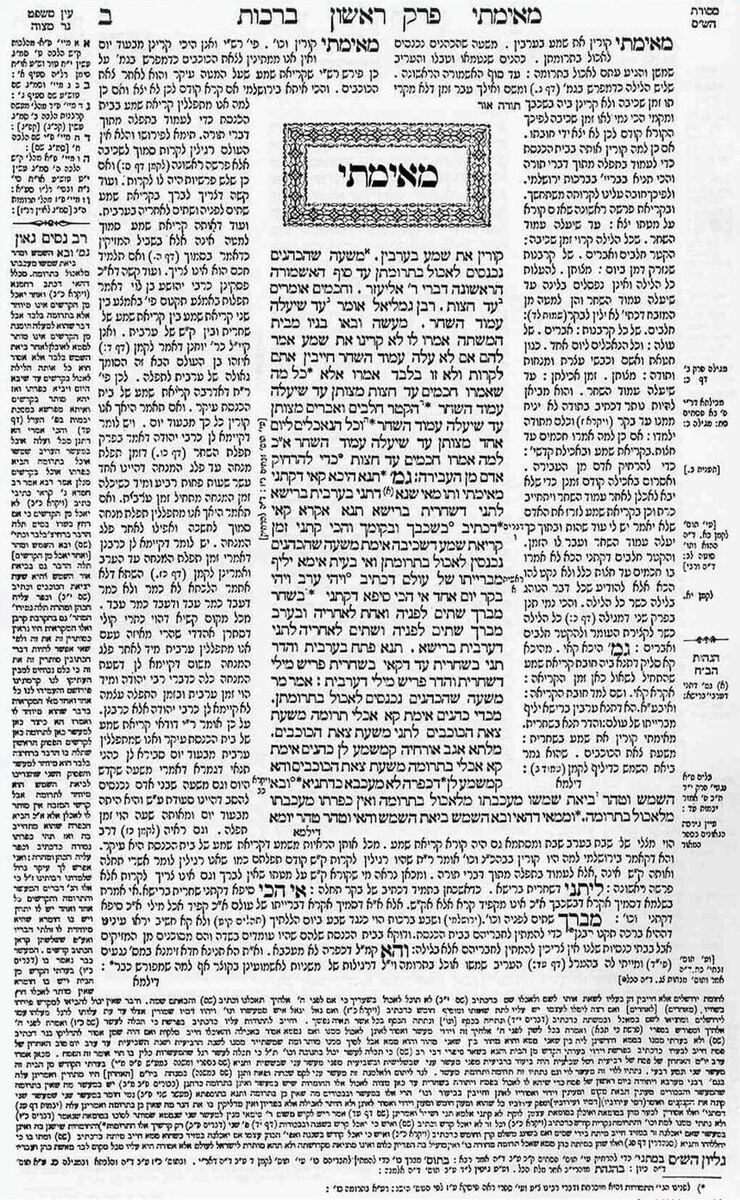

That fixed pagination made possible a synchronised worldwide reading cycle. Daf Yomi assigns one folio a day, covering all 2,711 pages of the Babylonian Talmud in roughly seven and a half years, so that participants anywhere are on the same page on the same day. Usenet did not invent that; it merely gave it an address, and one of the alt.* groups in the current newsgroups file is a moderated forum for the daily portion.
The same fixed-reference habit governs the annual public reading of the Torah, divided into weekly portions and chanted from a scroll with cantillation marks that are not written in the scroll itself and must be known by the reader. Between the weekly portion, the daily folio and the festival calendar, a substantial part of Jewish practice runs on a shared schedule — which is one reason a worldwide asynchronous discussion medium suited it so well. Everyone was, in a quite literal sense, on the same page.
Three languages with different histories
The group's subject involves at least three Jewish languages with genuinely distinct histories, all of them written in the same script and none of them mutually intelligible with the others.
Hebrew. The Hebrew alphabet is a unicameral abjad of twenty-two letters, five of which take a different form at the end of a word; it descends from the Imperial Aramaic alphabet, itself derived from Phoenician. Vowels are optional, written as points below and around the consonants, and are normally omitted outside liturgical texts, poetry and books for learners. Hebrew survived for centuries as a written and liturgical language rather than a vernacular, and was revived as a spoken language in Europe and the Levant from the late nineteenth century. Its regulator, the Academy of the Hebrew Language, was established by the Israeli government in 1953 at the Hebrew University of Jerusalem.
Yiddish. A West Germanic language that originated among Ashkenazi communities in the Holy Roman Empire in the Middle Ages: High German in structure, fused with substantial Hebrew and Aramaic material and, in most varieties, elements of the surrounding Slavic languages. It is written in the Hebrew alphabet, which it adapts by pressing several consonant letters into service as vowels. Before the Second World War it had eleven to thirteen million speakers. Some eighty-five per cent of the approximately six million Jews murdered in the Holocaust were Yiddish speakers; the language has fewer than 600,000 today. Its de facto standardising body is YIVO, founded in 1925 as the Yiddish Scientific Institute in the city then called Wilno and now Vilnius, whose Rules of Yiddish Orthography were first published in 1935 and remain the most cited such system, though far from the only one in use.
Ladino. Judaeo-Spanish, also called Judezmo or Espanyol, is a Romance language derived from Castilian Old Spanish, carried out of Iberia by Sephardic Jews after the expulsions of the 1490s and spread through the Ottoman Empire, the Balkans, North Africa and beyond. Its historic printed form was Rashi script — a typeface based on fifteenth-century Sephardic semi-cursive handwriting, named after the commentator whose works are conventionally set in it — and its handwritten form was Solitreo, a Sephardic cursive quite unlike the modern Israeli one. It has also been written in Greek, Cyrillic and Perso-Arabic characters, and in Turkey largely in the Turkish variant of the Latin alphabet. Salonica was its great centre: the 1928 Greek census recorded 62,999 native speakers, and 50,000 Salonican Jews were deported during the Holocaust. Roughly fifty thousand speakers remain worldwide, most of them elderly, and the language is classed as severely endangered.
To these should be added Judaeo-Arabic, a family of Arabic ethnolects used by Jewish communities and written in Hebrew characters, in which a substantial medieval philosophical and legal literature was composed. A single group nominally covering Jewish culture and religion therefore covered a Germanic language, a Romance language, a Semitic language revived from liturgical use, and a set of Arabic varieties — sharing one alphabet and very little else. The French-language alt group in the current newsgroups file that exists for the upkeep of Yiddish, Ladino and Judaeo-Arabic together is a reasonable summary of how those languages are usually grouped: by script and by community, not by descent.
A right-to-left script on a seven-bit network
Every one of those languages is written right to left, in a script with no capital letters, on a network built to move printing ASCII. This is the most checkable technical story attached to the group, and none of it is guesswork: the standards, the RFCs and the Unicode version history are all public.
The constraint was inherited from mail. RFC 822, the 1982 standard for Internet text messages, states that the message body is simply a sequence of lines containing ASCII characters and defines its character class as any ASCII character, 0 to 127. RFC 1036, the December 1987 standard for Usenet article interchange written by Mark Horton and Rick Adams, describes news format as a subset of that Internet standard, simplified to allow simpler software to handle it. Nothing above code point 127 was contemplated. As late as 2009, when RFC 5536 replaced RFC 1036, the rule for headers was still stated flatly: The character set for header fields is US-ASCII. What changed in 2009 was that MIME was finally recognized as an integral part of Netnews.
Before Unicode, Hebrew reached the network through a small set of eight-bit code pages, each incompatible with the others. Code page 862 was the DOS Hebrew page, used in Israel. ISO/IEC 8859-8, Latin/Hebrew alphabet, was first published in 1988 and revised in 1999; it covers all the Hebrew letters but none of the vowel points, and IBM assigned it code page 916. Windows-1255 is mostly an extension of it, adding the vowel points as combining characters together with further punctuation and the sheqel sign. Apple shipped its own Mac OS Hebrew encoding. A file was therefore not simply in Hebrew; it was in one of at least four mutually unintelligible Hebrews, and getting it wrong produced a screen of Latin punctuation.
The definitive contemporary statement of how to move Hebrew through Internet mail is RFC 1555, Hebrew Character Encoding for Internet Messages, published in December 1993 by H. Nussbacher of the Israeli Inter-University Computer Center and Y. Bourvine of the Hebrew University. It required Hebrew text to be converted to ISO-8859-8 and then encoded with MIME quoted-printable, preferably, or base64. Its central table lists four common Hebrew encodings side by side — a PC eight-bit set, an IBM EBCDIC set, a 7-bit Ascii mapping and ISO 8859-8 — and the seven-bit column is the one that matters here: it assigns the twenty-seven letter forms to decimal 96 through 122, which is to say the grave accent and the lower-case Latin alphabet. On a strictly seven-bit path, Hebrew travelled disguised as English lower case.
RFC 1555 also settled the harder question, and settled it by giving up: The default directionality of the text is visual. Visual order means the sender's software reverses the text before transmission and the receiving terminal displays it left to right without knowing it is Hebrew at all. It works, it is trivial to implement, and it breaks the moment anything else has to happen to the text — searching, sorting, quoting a reply with an angle bracket prefix, or mixing in a single English word. RFC 1555 warns about the quoting problem specifically.
The alternative was set out in the companion memo, RFC 1556, Handling of Bi-directional Texts in MIME, published the same month by the same author. Building on ECMA TR/53 of June 1992, it defined suffixed charset names to declare the mode: an -i suffix for implicit directionality, in which an algorithm derives direction from the characters and their position relative to their neighbours, and an -e suffix for explicit directionality, in which control sequences interleaved with the text state it outright. Hence ISO-8859-8-i and ISO-8859-8-e alongside plain ISO-8859-8, whose default the memo left as visual. Both suffixed names were registered, and the shape of what survived is visible in the WHATWG Encoding Standard, which records what browsers actually do: plain ISO-8859-8 carries the alias visual and swallows the explicit -e label, while ISO-8859-8-I remains a separate encoding carrying the alias logical. The explicit variant was folded back into the default; the implicit one became the name for logical order.
Unicode dissolved the code-page problem and formalised the direction problem. The Hebrew block occupies U+0590 to U+05FF and was in the standard from the beginning: 52 code points were assigned in Unicode 1.0.0, published in October 1991, and one of them was moved out to the Alphabetic Presentation Forms block at U+FB00 to U+FB4F in version 1.0.1 of June 1992, during the merger with ISO 10646. Alphabetic Presentation Forms today holds 46 Hebrew characters alongside Armenian and Latin ligatures. Thirty-one further Hebrew characters — the cantillation marks used for chanting scripture — arrived in Unicode 2.0 in July 1996, with four more in 4.1 in March 2005, one in 5.0 in July 2006 and one in 11.0 in June 2018. The block's own listed source is ISO 8859-8, and it is documented as serving Hebrew, Yiddish, Ladino and other Jewish diaspora languages.
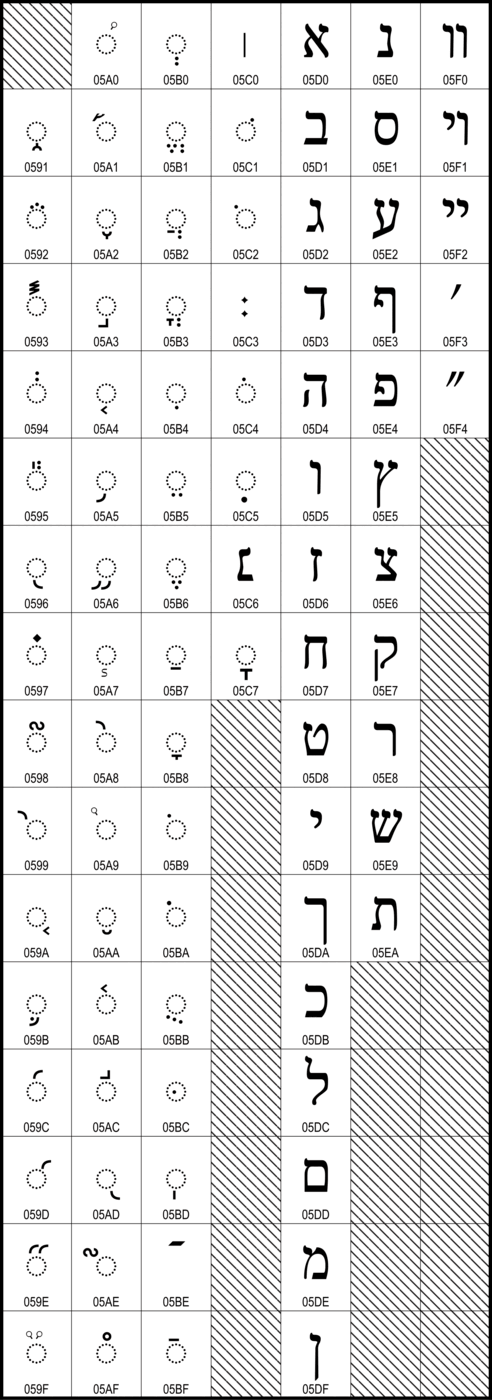

Direction is handled by the Unicode Bidirectional Algorithm, specified in Unicode Standard Annex 9. Characters are classified as strong, weak, neutral or explicit formatting, and text is stored in logical order — the order it is read — with the algorithm computing the visual order at display time. Where the algorithm gets it wrong, explicit formatting characters override it: the left-to-right and right-to-left marks at U+200E and U+200F, embeddings, overrides, isolates, and a pop character at U+202C that terminates the most recent of them. From Unicode 6.3, of September 2013, the embeddings were discouraged in favour of isolates, on the finding that embeddings had too strong an effect on the surrounding text. The problem the algorithm exists to solve is exactly the one a Usenet poster met when quoting a Hebrew sentence inside an English reply.
A comparable story attaches to Arabic script, which shares the right-to-left problem and almost none of the encodings; it is told on the soc.culture.arabic page. Cyrillic, whose difficulty was code-page proliferation without the direction complication, is covered on soc.culture.russian.
Writing Hebrew in Latin letters
Because none of the above worked reliably, the practical answer for most of the group's life was to not use Hebrew script at all, and to write Hebrew and Yiddish words in Latin letters. This is not a Usenet expedient but a scholarly discipline with competing standards, and the competition is the point: there is no single correct romanisation, and any two posters could disagree about a spelling in good faith.
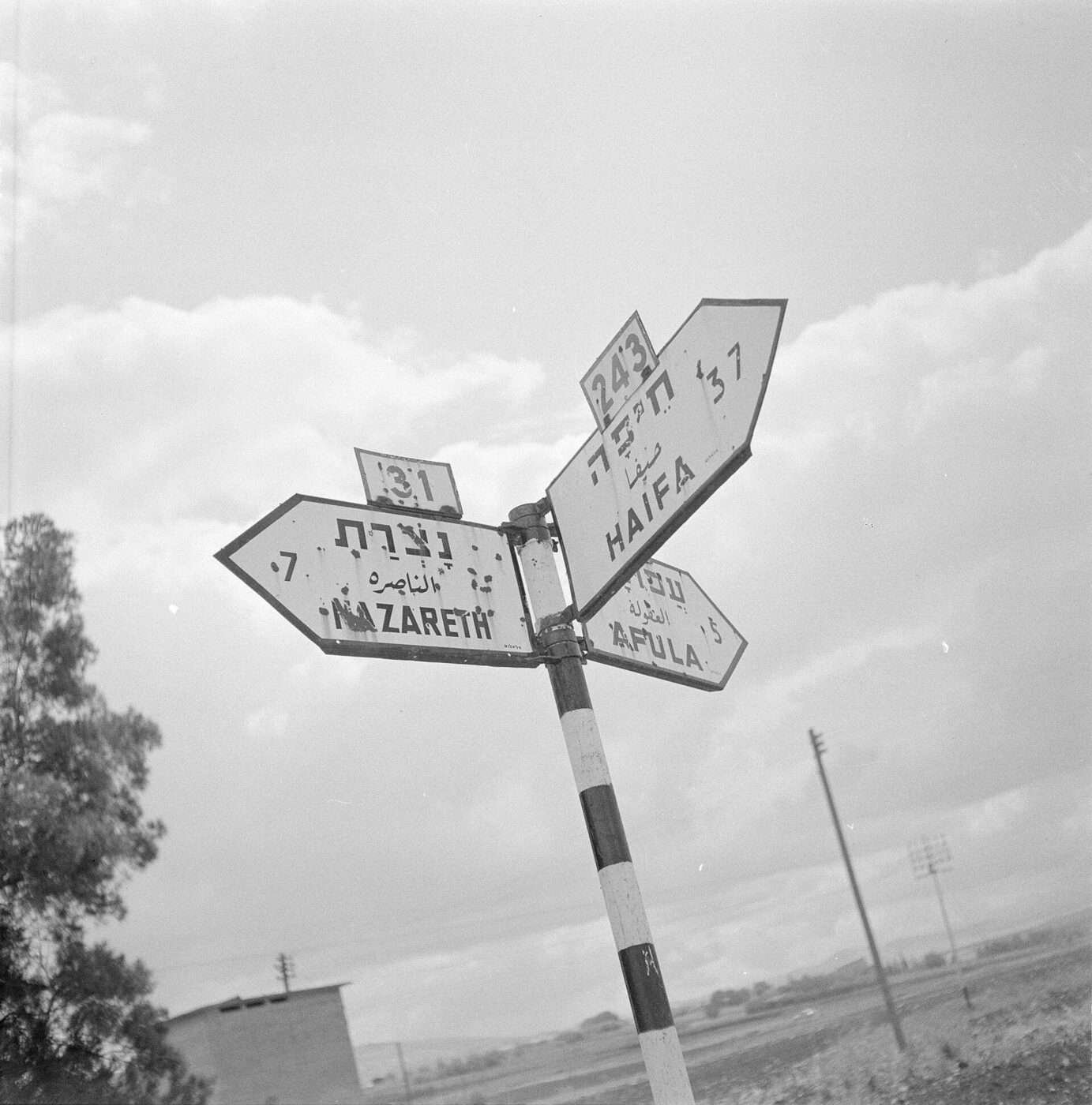
The formal systems include ISO 259 of 1984 and its simplified successor ISO 259-2 of 1994; a phonemic draft, ISO 259-3, which was never adopted as a standard; the Society of Biblical Literature's system, in academic and general variants; and the ALA-LC romanisation used by libraries. The Academy of the Hebrew Language issued transcription rules in the 1950s, updated and augmented them with a simplified version in 2000, and replaced them with a new system altogether in 2006; the 2006 system was adopted as a United Nations standard in 2007, though signage and documents using the older conventions long outlived it. Geographic names follow BGN/PCGN of 1962, approximately equivalent to the UNGEGN system of 1977, both being based on Academy recommendations. For Yiddish, the YIVO transliteration is the reference in pedagogical and scholarly contexts, though other systems are house standards for various publishers.
None of these was designed for a keyboard with no diacritics. What a seven-bit network produced instead was a set of ad hoc conventions — consonant digraphs for sounds Latin has no letter for, apostrophes standing in for glottal stops and for the letter ayin, doubled letters marking a dagesh — and the resulting spellings varied by the writer's own pronunciation. Ashkenazi and Sephardi pronunciations differ enough that the same Hebrew word is romanised differently by observant writers of different backgrounds, which is why standard English carries both Shabbat and Shabbos, both kosher and kashér, for the same underlying words. A group whose readers spanned both traditions was always going to spell inconsistently, and did.
Scholarship had faced the same problem a decade before Usenet's culture groups existed, and solved it in the same direction. The machine-readable Hebrew Bible in circulation through the 1980s and 1990s was the Michigan-Claremont text: a transcription of the Biblia Hebraica Stuttgartensia made at the University of Michigan in 1981 and 1982 under H. Van Dyke Parunak of Michigan and Richard E. Whitaker of the Institute for Antiquity and Christianity at Claremont, funded by the Packard Foundation and the University of Michigan. It encoded a pointed, accented Hebrew text — consonants, vowels and cantillation — entirely in plain ASCII, and it became the basis of the Westminster Leningrad Codex. Whatever a newsreader could or could not display, the Hebrew Bible itself had already been rendered into the character set Usenet was built on.

Communities, and where they were
A group filed under culture rather than religion inherits the whole geography of the subject, and the geography here is exceptionally wide. The major groupings and several of the smaller ones are documented well enough to name without qualification.
- Ashkenazi communities consolidated in the tenth century in the Rhineland and northern France, migrated eastward under successive persecutions, and by the sixteenth century were concentrated in the Kingdom of Poland and its successor territories, which remained the demographic centre of Ashkenazi Jewry until the Holocaust. Yiddish was their vernacular.
- Sephardic communities are those of the Iberian peninsula and their descendants, dispersed after the expulsions of the late fifteenth century, chiefly into the Ottoman lands, North Africa, Italy, the Netherlands and England. The term also came to cover the wider set of communities that adopted Sephardic liturgy and legal custom.
- Mizrahi is the collective term, meaning eastern, for the Jewish communities of the Muslim world — Iraq, Iran, Yemen, Syria, Egypt, the Maghreb and Central Asia — many with continuous local histories far older than either of the above.
- Romaniote Jews are a Greek-speaking community, among the oldest in Europe and historically distinct from the Sephardim who arrived in Ottoman Greece after 1492.
- Bene Israel in the Konkan region of western India moved into Bombay, Pune, Ahmedabad and Karachi from the later eighteenth century; their first Bombay synagogue opened in 1796. The Cochin Jews of Kerala are older still, mentioned by Benjamin of Tudela in the twelfth century.
- Beta Israel, the Ethiopian Jewish community, historically inhabited more than five hundred villages in the Amhara and Tigray regions; most emigrated to Israel through government initiatives beginning in 1979.
- The Kaifeng community in Henan, China, may have numbered around 2,500 in the early centuries of its settlement, and maintained Jewish practice for several centuries in near-complete isolation from the rest of the diaspora.
The consequence for the group was practical rather than sentimental. A question about liturgy, food or naming custom might get four incompatible and equally authentic answers, because the questioner had not said which tradition they meant. Working out which community a poster was writing from was a routine first move in any thread, and the group's own reference documents are structured to accommodate the divergence rather than to resolve it: the FAQ's stated purpose, in its own words, was to provide information about Judaism from all Jewish movements in a non-pejorative fashion, and it was written, again in its own words, by cooperating laypeople from the various Judaic movements.
Volume, crossposting and abuse: what the documents record
Two contemporaneous measurements of the group's traffic survive, both in group-creation proposals, and both should be read as what they are: figures asserted by proponents making a case, not independent audits. They are nonetheless the only numbers there are.
The December 1995 RFD stated that Between two hundred and three hundred messages per day are posted to soc.culture.jewish. More than half are entirely off-topic. It identified the mechanism precisely: off-topic messages originated elsewhere, were crossposted in, and then followups continued to arrive because the group was in the Newsgroups line. It also identified why this mattered more than it might today — This would not be a problem if all readers had software with suitable killfile capabilities. In the real world, though, most readers will not have such software for several years. The killfile, a list of patterns a newsreader uses to suppress articles, had existed since Larry Wall's rn, but was not yet universal.
The April 2000 RFD supplied a harder number: one survey showed that 689 of 1445 articles posted over a one week period were crossposted to more than three groups, a phenomenon which often leads to floating flamewars. Just under half the week's traffic, by that count, was multi-group. The same paragraph named the third component of the problem alongside volume and crossposting: articles that were anti-Semitic. That is the proponents' own word, in a formal proposal published through the moderated news.announce.newgroups.
This page states the fact and stops there. That soc.culture.jewish, like Jewish spaces elsewhere on Usenet, attracted sustained antisemitic abuse is documented in the group's own charters, in the removal notices of the Big-8 Management Board, and in the surviving control-message archive; it was a feature of the medium and it is part of the record. None of it is reproduced here, in any form, including by naming the groups whose descriptions in the current newsgroups file consist of it.
Holocaust denial is documented separately in the same sources, because the community treated it as a distinct problem requiring a distinct remedy. The 1994 charter for the moderated Holocaust group stated that the group would not be a forum for discussing whether the Shoah happened, and directed readers who wished to debate the point to other groups, naming alt.revisionists, soc.history and alt.skinheads. The parent group's FAQ and the 1995 and 2000 charters repeat the direction in the corrected form, alt.revisionism. That is the group from which the Nizkor Project grew: founded by Ken McVay as a central web-based archive of the documentary material its users had assembled, gifted to B'nai Brith Canada in 2010, and still holding both the documents and a selected archive of the newsgroup's postings. The pattern is worth stating precisely, because it is a genuine finding about how these communities organised: the refutation work was done in an argumentative unmoderated group next door, while the moderated group existed so that testimony and scholarship could proceed without re-arguing the premise.
Forged control messages, 1998 and 2001
The control archive preserves something the discussion archives do not, and it is one of the few places where an attack on the group can be quantified exactly without reproducing a word of its content.
The archive records 89 newgroup control messages for soc.culture.jewish.holocaust in 1998 and 98 for soc.culture.jewish.parenting. Most of them are forgeries, and the forgeries identify themselves. Sixty-seven of the Holocaust group's and seventy-two of the parenting group's, dated between 26 August and 18 November 1998, share one template: each purports to come from the moderator of news.announce.newgroups; each carries a PGP signature block and the organisation line The Cabal; each announces that the moderated group has passed a vote for creation as an unmoderated newsgroup; and each cites a different invented tally. Reading the file in sequence, one sees the same group pass by 91 to 17, then by 140 to 23, then by 230 to 1, then by 188 to 0, over three months. Every one of them closes with the same one-word signature, the calling card of the Meow Wars, the crapflooding campaign that ran from 1996 to about 1998 and swamped many Usenet groups with volume rather than argument. That the template is a forgery needs no cryptography to establish: the genuine reissues for the same two groups, signed with the hierarchy's own key and carrying the word moderated in the control line, were going out in parallel throughout the same three months, and they account for every one of the remaining messages of 1998.
The intent is legible from the mechanics. A forged newgroup message that declares a moderated group unmoderated is an attempt to make servers drop the Approved: requirement, which is the only thing standing between a moderated group and everybody. The two groups targeted were the Holocaust testimony group and the Jewish parenting group: the two groups in the branch whose entire purpose was to be moderated.
The second episode is smaller and stranger. Just after midnight GMT on 4 November 2001, four rmgroup control messages were injected from a single host within eighteen seconds of one another: soc.culture.jewish at 00:36:08, soc.culture.jewish.holocaust at 00:36:14, soc.culture.jewish.moderated at 00:36:20 and soc.culture.jewish.parenting at 00:36:26. Each carried the same one-line body asking administrators to remove the group as bogus, and each bore in its From line the name of a well-known Usenet software maintainer, together with a nonsense signature line that differed from message to message. No Big-Eight process authorised any of them, and their archive numbers — close together but not consecutive, with other groups interleaved between them — show them to be part of a scripted run across the namespace rather than four separate acts. They had no effect. soc.culture.jewish appears in the current ISC active file, and the two moderated groups survived another decade and another quarter-century respectively before being removed properly.
The episode is a neat illustration of what Usenet's control-message system actually was. A control message was never a command; it was a request, honoured or ignored by each administrator's configuration. Forging one was trivial. The system held anyway, for three decades, because enough administrators configured their servers to honour only signed messages from the hierarchy's own key — which is why an anonymous rmgroup at half past midnight deleted nothing at all.
The FAQ and the Reading Lists
The reference documents the group produced outlived the group's active life and were, for years, among the more heavily used Jewish resources on the early web. Their history is documented on their own pages.
They began in 1993, and by their own account were initially developed to support the readers of the USENET newsgroup soc.culture.jewish by providing answers to some commonly answered questions, as well as a set of reference reading. There were two documents, not one: the Frequently Asked Questions proper, and a separate set of Reading Lists offering books on Jewish topics, with the standing caveat that no book substitutes for instruction from one's own rabbi. The FAQ ran to twelve archival files and twenty-one numbered sections, listed earlier on this page, plus a separate FAQ on Jewish resources by mail order and computer.
The composition method was deliberate and is stated on the index page: the FAQ was written by cooperating laypeople from the various Judaic movements, and aimed to present Judaism from all Jewish movements in a non-pejorative fashion. For a subject where the denominations disagree about the authority of the answers, a jointly written reference document is a considerable feat of committee work, and the fact that it held together for a decade is the substantive achievement.
Distribution matched the era exactly. The documents were posted periodically to the newsgroup and into the *.answers system — the mechanics of which are described on the soc.answers page — and were available by FTP, by web, and by an autoresponder that would send any part of the FAQ or Reading List by e-mail on request. A reader with nothing but a mail connection could obtain the whole thing, which for a large part of the world in the mid-1990s was the only way to obtain anything.
The documents were maintained by Daniel P. Faigin, whose copyright notice runs from 1993 through the early 2000s, and were hosted by Shamash. They were reachable at their own domain by 2000, which put the group's reference material on the web under a name of its own while the group itself was still running on NNTP.
Shamash, and the mail side of the network
One institution recurs in nearly every document quoted on this page, and it is easy to miss because it appears only as part of an address. Shamash, described in the FAQ's own credits as the Jewish Internet Consortium, ran from nysernet.org, the New York State Education and Research Network. It hosted the FAQ, it hosted the mailing lists, and it gave several of the group's most active contributors their addresses.
The 1995 RFD for the parenting group lists, as a matter of procedure, the mailing lists to which the proposal had to be circulated, and the list is a snapshot of Jewish life on the pre-web Internet: mail.jewish and mail.liberal-judaism, both at nysernet; tor-ch, run from the Jewish Theological Seminary; bridges; a list for intermarriage; an adoption list at Cornell Law School; a twins list; cj-l at the University at Albany; utj; and a list called our kids at the Ohio Supercomputer Center. The RFD's own text notes that the planning committee was assisted by a mailing list consisting of 16 advisors drawn from misc.kids, soc.culture.jewish and the mail.judaism and mail.liberal-judaism mailing lists.
Two of the branch's proposals were, in substance, attempts to manage the boundary between news and mail. The 1994 publications RFD existed because mailing lists had begun posting their traffic into the newsgroup; its proposed remedy was a register of list addresses whose output would be approved automatically. And soc.genealogy.jewish was created explicitly as the Usenet face of a conference already gated between an Internet mailing list and a Fidonet echo — three different networks carrying one conversation, in 1994.
This directory is itself a product of that same plumbing: news2mail was a mail-to-news gateway, and the branch's history shows why such things were built. Readers on thin or intermittent connections, readers behind institutional firewalls that passed mail and nothing else, and readers in countries where NNTP feeds were scarce all reached the same conversations by post. The rest of the culture branch is indexed on the soc.culture.* hub.
How the branch ended
The parent group is still there. Everything built around it has been removed, in three separate administrative actions, each documented.
soc.culture.jewish.holocaust went first. A Moderator Vacancy Investigation was posted on 17 June 2011 by Steve Bonine for the Big-8 Management Board, with a rationale of one sentence: Probe posts to this group resulted in bounces. The notice recorded that the group was sporadically active between April 1994 and early 2001. It was removed by signed control message on 3 September 2011, one of 23 moderated groups deleted in a batch the Board called the Great Downsizing; the stated criterion was that the groups have had no on-topic traffic for years and that the vacancy investigations posted between 29 May and 17 June 2011 had precipitated no interest in retaining the newsgroups.
soc.culture.jewish.parenting was removed on 18 June 2025, among 89 moderated groups deleted after a sequence of four removal RFDs beginning on 3 January 2025. The rationale given was that the groups could not be used for discussion because they had no moderator, most had not had one for a long time, and revival was unlikely.
soc.culture.jewish.moderated was handled separately and at greater length. Removal RFDs were posted on 30 May and 13 June 2025, with a Last Call for Comments on 18 July; the RESULT of 1 August 2025 records a Board vote of three in favour of deletion and one not voting, and the rmgroup control messages went out from 11 August 2025. The rationale is the fullest obituary any group in this branch received: the group had no moderator address assigned and had seen no posts since 2016; its website had been defunct since at least 2013; and on 28 March 2025 Daniel Faigin, the most recent moderator that the Board was able to identify and reach, said he no longer used Usenet and asked whether the group could be archived and closed to new submissions. The notice observes that an unmoderated group still exists which could in principle be used for the same discussion, and then quotes the 2000 RFD's description of that group's problems back at itself, in parentheses, without further comment.
The parent group's own decline is not recorded by any vote or notice, because nothing has to be filed when a group simply empties out. The earlier version of this entry described soc.culture.jewish thinning through the 2000s as mailing lists, web forums and eventually social media absorbed its functions, and as unsolicited bulk posting overwhelmed unmoderated groups generally; that is the pattern across the culture branch, and it is carried here as a general statement because no document in this branch fixes a date for it. What the documents do record is the same pressure measured from inside: the 1995 proposal counted the off-topic share of the traffic, the 2000 proposal counted the crossposted share, and the 2025 removal notice records that the moderated alternative had seen no posts since 2016 and that its website had been dead since at least 2013.
What remains in the current ISC files is three entries: soc.culture.jewish, unmoderated; soc.culture.israel, unmoderated; and soc.genealogy.jewish, moderated and still carrying the flag. The branch that the 2000 proposal called a historical namespace oddity has been reduced back to the single line it started as, parenthesis and all.
What the record does not show
The honest boundaries of this account are worth stating explicitly, because the absences are as characteristic as the survivals.
- The group's creation. There is no RFD, CFV or RESULT for soc.culture.jewish. The news.announce.newgroups archive does not cover its creation, and the earliest control message that survives, from May 1991, is a bulk reissue of a group already in existence. No founding date, no proponent and no vote tally can be given.
- Its pre-Renaming name, from the administrative record. The group's own FAQ states that it began as net.religion.jewish and was carried into soc.culture at the Great Renaming, and that account is used above. It is not corroborated by a control message: the surviving control archive begins in May 1991, four years too late, and the ISC control-old net.* directory holds no file for the earlier name — though that directory is a thin and largely later collection and proves nothing either way.
- Readership and traffic. The only figures are the ones proponents put in proposals in 1995 and 2000, quoted above with that caveat. No independent readership survey, subscriber count or article count is asserted here.
- Individual threads and posters. No thread title, quotation or poster is attributed to the group on this page except where it appears in a formal, signed, archived administrative posting. Everything quoted above comes from an RFD, a CFV, a RESULT, a control message, a Board notice or the group's own published FAQ.
- The 1992 reorganisation's fate. The proposal survives; the discussion does not. Why the five-way split failed, and whether it was withdrawn, voted down or simply abandoned, is not in the file.
- The unmoderated group after 2016. soc.culture.jewish remains in the active file, but no assertion is made here about what, if anything, currently passes through it.
Scope and limits
A page about this group has to state its own rules, because the subject is one on which positions are irreconcilable and bad-faith writing is common.
This entry documents a newsgroup: its line in the newsgroups file, its administrative paperwork, its descendants, its reference documents and the standards environment its languages had to survive. Where it describes religious practice, it describes it as practitioners describe it, and attributes contested characterisations to whoever made them. Where it quotes, it quotes signed documents in the public administrative record and identifies them by date.
It takes no position on any political question, and it is not the place to look for one. The group's own description line directs the argument about the Middle East to talk.politics.mideast; the 2000 charter excluded Israeli, Middle Eastern and Arab politics from a group whose subject was Jewish culture and religion. This page follows the same rule, for the same reason: a page about a culture group that becomes a page about a conflict has stopped documenting its subject.
It reproduces no antisemitic material, in any quantity, from any source. That such material was posted to this group and to its neighbours is documented in the sources cited above and is stated here as fact. Its content is not reproduced, quoted, characterised in detail or linked, and the newsgroups whose names and descriptions in the public newsgroups file consist of such material are referred to only in the aggregate. This is an editorial rule, applied deliberately and stated here so that its effect on the page is visible.
Group descriptions elsewhere on this site are editorial summaries; the line quoted at the start of this article is not. It is the live entry in the Internet Systems Consortium's newsgroups file, reproduced exactly, punctuation included, and it is the one line in this article that the group wrote about itself.
Reading soc.culture.jewish today
- Historical archive: Google Groups — soc.culture.jewish (coverage varies by group and era).
- Open in a newsreader:
news:soc.culture.jewish— the original site offered exactly this link, and it still works if your system has a newsreader registered for thenews:scheme. - Live access: point an NNTP newsreader at a modern server — see accessing Usenet today.
- The original news2mail e-mail subscription service ended in the mid-2000s and no longer operates.