soc.culture.malaysia
Malaysia: three languages, one argument.
Malaysian life — the Mahathir years, the 1997 crisis and Reformasi, alongside food-court rankings disputed with national seriousness.
Malay in Latin script passed a seven-bit network intact; Jawi, Chinese and Tamil each met a different limit. No archive of the group’s messages is kept here.
On this page
The group and its era
soc.culture.malaysia sat in the national stretch of the soc.culture.* hierarchy, unmoderated like almost all of it, its character set by whoever could reach a news server. Malaysia had academic networking from early on: MIMOS began internet service in 1987 with RangKoM, linking the universities, and conceived JARING in 1992, a 64 kbit/s leased line to the United States following that November. General use arrived later — the first Malaysian internet survey, run in October and November 1995, counted about 20,000 users in a population of some 20 million, and penetration reached 2.6 per cent in 1998 — so for much of the group’s life those best placed to post were Malaysian students and professionals abroad, writing alongside a growing number at home.
A second date fixes the same period from a different direction. IANA’s root database gives 8 June 1987 as the registration date of the country-code domain .my, whose delegation is held by MYNIC Berhad of Cyberjaya, Selangor. That is the year MIMOS began its service, as the country’s sole provider and to universities. TM Net, set up by Telekom Malaysia in 1995, launched the second national dial-up service on 1 November 1996 under the short code 1515. The domain thus preceded any connection a household could buy by most of a decade, which is the practical shape of the problem for anyone at home wanting to reach a news server.
What made the period unusual was policy rather than plumbing. The Multimedia Super Corridor, inaugurated on 12 February 1996, rested on a founding principle that government censorship of the internet would not be permitted. Print stood on different ground: under the Printing Presses and Publications Act 1984 a newspaper required a permit from the Home Affairs Minister, normally for a year at a time, with absolute discretion to grant, revoke or suspend it. The gap between the two regimes shaped Malaysian online life, and a globally carried newsgroup inherited part of it.
The measured series disagree in detail and agree in shape. The World Bank’s indicator for individuals using the internet, compiled from ITU returns, gives Malaysia 0.15 per cent of the population in 1995, 2.31 per cent in 1997, 12.3 per cent in 1999, 21.38 per cent in 2000 and 34.97 per cent in 2003; other counts published for the same years are lower, and every mid-1990s figure rests on a small survey rather than a census. Access also needed a telephone line, and fixed lines stood at about 18 per 100 people in 1996 and 20 per 100 in 1998. On that series fewer than one Malaysian in a hundred was online before 1997, and the shift homeward can be dated no more precisely than the numbers allow.
A dated record
What follows is a chronology and nothing more: dated events of the era, set down without argument about cause and without any party characterised. Several predate the group’s life on the network entirely, and were part of what its participants took as given rather than of what they witnessed.
- 31 August 1957 — independence of the Federation of Malaya; 16 September 1963 — the formation of Malaysia; August 1965 — Singapore separated from the federation and became an independent country.
- 13 May 1969 — the 13 May incident. A state of emergency and a curfew were declared on 15 and 16 May; the National Operations Council, established on 15 May, was the supreme decision-making body for the following eighteen months, with parliamentary rule restored in February 1971.
- 31 August 1970 — the Rukun Negara was introduced.
- 1971 to 1990 — the New Economic Policy ran its twenty-year term.
- 1 January 1982 — at 23:30 local time on 31 December 1981, clocks in Peninsular Malaysia were advanced by thirty minutes, from UTC+7:30 to UTC+8, matching East Malaysia.
- 27 October 1987 — Operation Lalang; approval was given for the arrest of 106 people under the Internal Security Act, later increased to 119. On 28 October the publishing permits of The Star, the Sunday Star, Sin Chew Jit Poh and Watan were revoked, and returned on 22 March 1988.
- 17 May 1997 — the opening ceremony for Cyberjaya, the nucleus of the corridor, was held by Mahathir Mohamad.
- 27 June 1998 — Kuala Lumpur International Airport was inaugurated and opened to traffic.
- 11 to 21 September 1998 — the Commonwealth Games were held in Kuala Lumpur, the first in Asia, with some 3,638 athletes from 70 nations in 214 events across 15 sports; the opening ceremony was at Bukit Jalil National Stadium.
- 23 September 1998 — the Communications and Multimedia Act 1998 received royal assent; it commenced on 15 October 1998 and came into force on 1 April 1999, with certain sections following on 1 April 2000.
- 31 August 1999 — the Petronas Towers were officially opened; completed in June 1996, they were the world’s tallest buildings until Taipei 101 surpassed them in 2004.
- 29 November 1999 — a general election was held for all 193 seats of the Dewan Rakyat, returning Barisan Nasional with 148 seats, Barisan Alternatif with 42 and Parti Bersatu Sabah with 3.
- 20 January 2003 — police removed four servers and fifteen personal computers, valued at RM150,000, from the office of an online newspaper in Kuala Lumpur, following a complaint about comments left by readers.
Two items bear directly on a networked group. The clock change of 1982 gave the whole country a single time, which is not true of every country a soc.culture group is named for. The permit revocations of October 1987, and their reversal five months later, are the documented working of the licensing power described above.
What was discussed
Mahathir Mohamad was prime minister from 16 July 1981 to 31 October 2003 — effectively the whole of the group’s active life — and his government’s decisions supplied its standing agenda. In the Asian financial crisis the ringgit fell from above 2.50 to the US dollar to under 4.57 on 23 January 1998. In September 1998 the currency was fixed at 3.80, overseas trade in the ringgit was stopped, residents’ transfers abroad were restricted and foreign portfolio funds given a minimum one-year stay period; aid offered by the IMF was refused. The decision broke with the orthodoxy applied elsewhere in the region, and was argued over before anyone knew how it would end.
The political sequence ran in the same weeks. Anwar Ibrahim, deputy prime minister and finance minister, was dismissed from the cabinet on 2 September 1998 and expelled from UMNO the following day; his Declaration of Reformasi came on 8 September, and he was arrested on 20 September and detained without trial under the Internal Security Act. He was sentenced in April 1999 to six years’ imprisonment, and later to a further nine years on a separate charge, to be served after the first; the Federal Court overturned that conviction and he was released on 2 September 2004. Reformasi used the internet alongside the opposition press, with sites carrying material the permit system kept out of newspapers; a newsgroup named for the country stood in the same unlicensed space.
Ethnic politics was the other constant. The Bumiputera framework — a term Parliament began using in 1965, resting on the special position recognised in Article 153 and given economic form by the New Economic Policy adopted after 1969 — provided for quotas in scholarships, the civil service and business licences, and was defended and criticised by participants who sat on every side of it. The record is of positions held, not of a conclusion reached.
Between the set pieces ran the ordinary business of a country group: requests for news from particular towns, questions about visas and schooling, notices of events abroad, and the rankings of hawker stalls and food courts, pursued with the seriousness the subject demands and settled no more often than the political threads. English was the practical common medium, with Malay and Chinese also in use; the character-encoding conventions of Usenet in that period handled non-Latin script poorly, so transliteration was common across the hierarchy.
The framework in its published terms
The constitutional and economic arrangements argued over in the group exist as published instruments and can be stated as such. Article 153 of the Constitution makes it the responsibility of the Yang di-Pertuan Agong to safeguard the special position of the Malays and the natives of Sabah and Sarawak and the legitimate interests of other communities. It provides for reserved quotas in the federal public service, in scholarships and educational and training privileges, and in permits and licences for particular trades; university places were added by later amendment.
Two further dates belong to the same instrument. The Reid Commission, drafting the constitution, recommended that the preferences be reviewed after fifteen years, Parliament deciding whether to retain, reduce or discontinue them; the review that would have fallen in 1972 did not take place. In 1971 Parliament amended the Sedition Act so that questioning Article 153 became an offence, including for members of Parliament otherwise protected in debate.
The economic programme has its own figures. The New Economic Policy ran from 1971 to 1990 on two stated objectives, national unity and the restructuring of society to eliminate the identification of race with economic function, with poverty eradication as its other prong; its best-known target was to raise bumiputera ownership of corporate equity from 2.4 per cent to 30 per cent by 1990. It was succeeded by the National Development Policy of 1991 to 2000, and framed thereafter by Vision 2020, announced by Mahathir Mohamad in 1991, which set developed-nation status by 2020 as the goal and an average of 7 per cent real growth a year from 1990 as the arithmetic required to reach it.
Three scripts on a seven-bit network
Malay in its Latin form, Rumi, is written with the twenty-six letters of the basic Latin alphabet and no diacritics at all. That is a consequence of the 1972 spelling reform, when Malaysia adopted the New Rumi Spelling and Indonesia the Perfected Spelling System in a joint effort to harmonise the two orthographies; earlier practice had used breves on certain vowels in Malaysia and macrons and acute accents in Indonesia. For a network built to carry seven-bit Latin text the consequence was that Malay passed through intact. That was an unusual position in the culture hierarchy: French, Polish, Vietnamese and Turkish all need letters outside ASCII, and their posters stripped accents or watched them arrive as other characters, while Malay needed no convention at all, its standard orthography being already inside the seven-bit set.
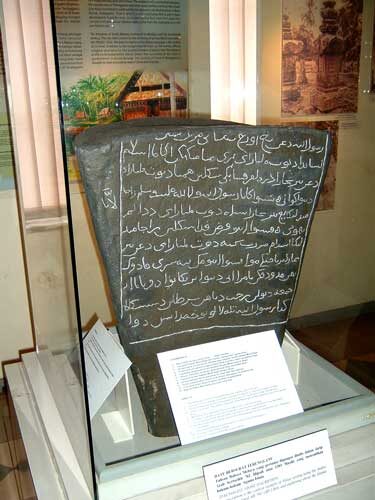
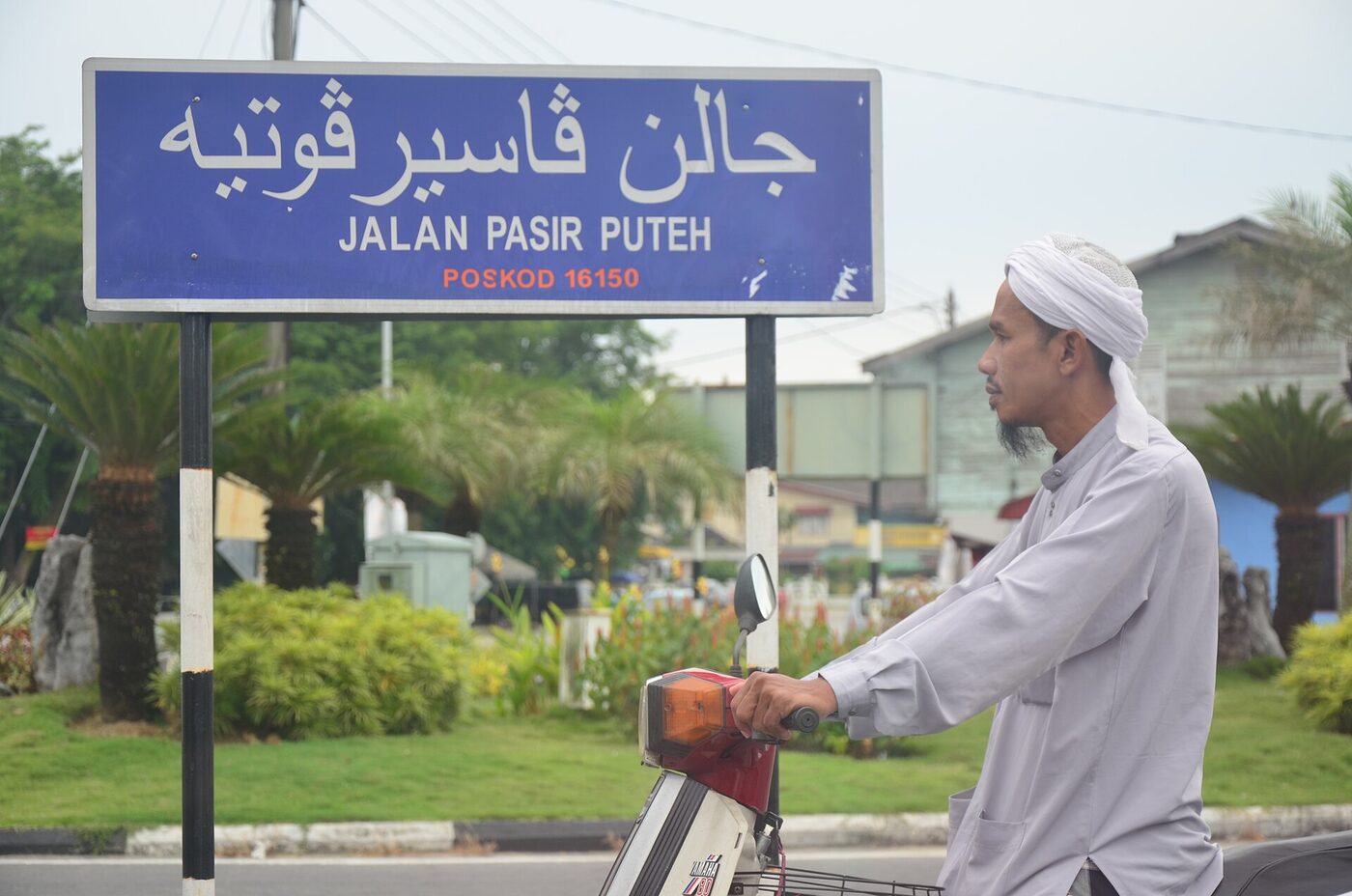
Jawi, the Arabic-script orthography for the same language, is the other writing system. It adds six letters to the Arabic alphabet — ca, nga, pa, ga, va and nya — for sounds Arabic does not have. The earliest surviving evidence of Jawi writing in the Malay world is the Terengganu Inscription Stone, found in 1887 at Kampung Buluh, Kuala Berang, and dated by different scholars to 702 AH (1303 CE) or 789 AH (1387 CE); it was returned to the Terengganu State Museum in 1991. Rumi was adopted officially alongside Jawi at the Kongres Bahasa of 1954, Jawi was removed from the national curriculum in the mid-1980s, and section 9 of the National Language Act 1963/67 preserves its use in religious and cultural contexts.

Encoding Jawi was harder than encoding Malay. Five of the six additional letters have code points in the main Arabic block, but the sixth, ga at U+0762, lies in Arabic Supplement, the block running from U+0750 to U+077F, which Unicode did not add until version 4.1 in 2005. For most of the group’s life, then, a complete Jawi text had no complete standard encoding to be written in, quite apart from whether any newsreader of the day would have set it right to left; the eight-bit code pages that preceded Unicode were built for Arabic itself.
Chinese was a different problem with a documented solution. Traditional characters were normally encoded in Big5, defined by Taiwan’s Institute for Information Industry in 1984 and named for the five firms that collaborated on it; simplified characters used GB 2312-80. Both are double-byte schemes, and the trailing byte of a Big5 pair may fall between 0x40 and 0x7E, on top of ordinary ASCII letters and punctuation, so any gateway that touched those bytes could corrupt the text around them. The answer on Usenet was to go seven-bit deliberately: HZ, specified in RFC 1843 of August 1995 by F. Lee of Stanford University, carried GB 2312 text using ~{ to enter Chinese mode and ~} to leave it, mixing Chinese and ASCII in a file no eight-bit-hostile path could damage. Unicode had encoded 20,902 CJK ideographs in the block U+4E00 to U+9FFF in version 1.0.1 of 1992.
Tamil had neither advantage. TSCII, the Tamil Script Code for Information Interchange, grew out of mailing-list practice in the mid-1990s — a dedicated discussion list was set up in 1997 — and places ASCII in the lower 128 positions with Tamil in the upper 128, which is exactly what a seven-bit path removes. It was not registered with IANA until 2007. Unicode had carried a Tamil block, U+0B80 to U+0BFF, since version 1.0.0 in 1991, with the range U+0B82 to U+0BCD taken directly from the 1988 ISCII standard; but TSCII stores characters in visual order and Unicode in logical order, so text in one is not mechanically text in the other.

The consequence for a reader searching the archive today follows from all three. Rumi Malay and English survive as they were typed, and the 1972 reform means a word spelt in 1995 is spelt the same way now, so ordinary search reaches it. Text posted in Chinese characters or Tamil script cannot be assumed to have survived its path intact, and where it did not, no search in the script itself will find it; the transliterated forms are worth trying instead. Jawi should not be expected at all — not because it was not read, but because for most of the period there was no settled way to send it.
Where the readers were, and what time it was there
Malaysia keeps a single time zone, eight hours ahead of UTC, and has done since 1 January 1982; East Malaysia had been on UTC+8 since 12 September 1945, and on that offset from 1 January 1933 until the Japanese occupation, while the peninsula ran on UTC+7:30 from 1 September 1941 and again from 12 September 1945 until the change. A group named for the country therefore had one home clock but no single working day: Kuala Lumpur evening is British afternoon, seven or eight hours behind according to the season, and the small hours on the North American west coast, fifteen or sixteen hours behind.
Where the readers actually were can only be approached through migration statistics, and the usable ones are later than the period in which such groups were most used. The 2001 census of the United Kingdom recorded 49,886 Malaysian-born residents; the 2006 Australian census recorded 92,335. Singapore holds much the largest concentration: a World Bank figure for 2010 puts Singapore residents of Malaysian origin, permanent residents and citizens included, at 385,979. United Nations estimates for 2019 distribute the diaspora as 1,278,839 in Asia, 191,784 in Oceania, 142,348 in Europe, 103,455 in the Americas and 13,726 in Africa. These count migrants rather than readers and postdate the years in question, but they indicate the shape of the dispersion: regional first, Anglophone second.
A readership spread across that map has no quiet hours. Singapore keeps the same clock as Kuala Lumpur; eastern Australia is two or three hours ahead of it, Britain seven or eight behind and the North American west coast fifteen or sixteen. What that produced in any particular thread is a question for the archive rather than for this page.
The traffic between the crises
Most of what a culture group carries is not politics, and here the non-political subjects are the better documented. Malaysian cuisine is conventionally described in eight traditions — Malay, Chinese, Indian, Sabahan, Sarawakian, Peranakan, Eurasian and the Javanese-influenced — and nasi lemak, rice steamed in coconut milk and served with fried anchovies, peanuts, cucumber, egg and sambal, is frequently called the national dish. The mamak stall, run by Tamil Muslims and the source of nasi kandar, is described as a Malaysian institution; the kopitiam is its Chinese-run counterpart, selling noodles, rice dishes, bread and kuih alongside its drinks.
Argument about food in this setting is usually argument about place, and laksa is the clearest case, because the varieties are named for where they are made: Penang asam laksa, built on mackerel and soured with tamarind; the curry laksa of Selangor and Kuala Lumpur, with fried tofu, cockles, long beans and mint; Sarawak laksa, whose spice mixture is found in no other state’s; Johor laksa, eaten with spaghetti in a gravy of grilled wolf herring and thick coconut milk; laksam in Kelantan and Terengganu, flat rice-flour noodles in a white gravy of boiled fish and coconut milk; Kelantan laksa, made sweeter with palm sugar. Which dishes are shared with Indonesia, Thailand, the Philippines and Singapore, satay and rendang among them, is a related argument.
Sport supplied dates rather than opinions. The Thomas Cup, first contested in 1948-49, was won by Malaya in 1949, 1952 and 1955 and by Malaysia in 1967 and 1992; Malaysia has contested the final tie fourteen times and lost nine, more finals lost than any other country. The country’s first Olympic medal came at Barcelona in 1992, a bronze in the men’s doubles won by Razif Sidek and Jalani Sidek; at Atlanta in 1996 Cheah Soon Kit and Yap Kim Hock took silver in the same event and Rashid Sidek bronze in the singles. Those four results fall inside the group’s active years, as does the Commonwealth Games fortnight of September 1998.
The festival calendar is the other standing business, and in Malaysia it is federal and state at once. Kaamatan, the harvest festival of the Kadazan, Dusun, Murut, Rungus, Lundayeh and Paitan peoples, falls on 30 and 31 May and was gazetted a public holiday for North Borneo on 9 May 1960. Gawai Dayak, kept by the Iban, Bidayuh, Kayan, Kenyah, Kelabit and Orang Ulu, falls on 1 and 2 June; it was gazetted on 25 September 1964 and first officially celebrated on 1 June 1965. Thaipusam, on the full moon of the Tamil month of Thai, is a holiday in Kuala Lumpur, Johor, Negeri Sembilan, Penang, Perak, Putrajaya and Selangor and not elsewhere, its principal observance being at Batu Caves. The Muslim, Chinese, Hindu, Buddhist and Christian calendars each contribute their own dates. Whether tomorrow is a holiday therefore has a different answer in different states, which for a dispersed readership is a question worth asking in public.
Behind all of it sits a common stock of reference. P. Ramlee, born at Sungai Pinang in George Town, Penang, on 22 March 1929 and dead at forty-four in Setapak, Kuala Lumpur, on 29 May 1973, acted in 62 films, directed 33 and composed some 360 songs. The language has its institution and its date as well: Dewan Bahasa dan Pustaka was founded as Balai Pustaka in Johor Bahru on 22 June 1956, renamed at the Third Malay Literary and Language Congress that September, and publishes Kamus Dewan, the standard dictionary of the national language.
The press, the permit and the wire
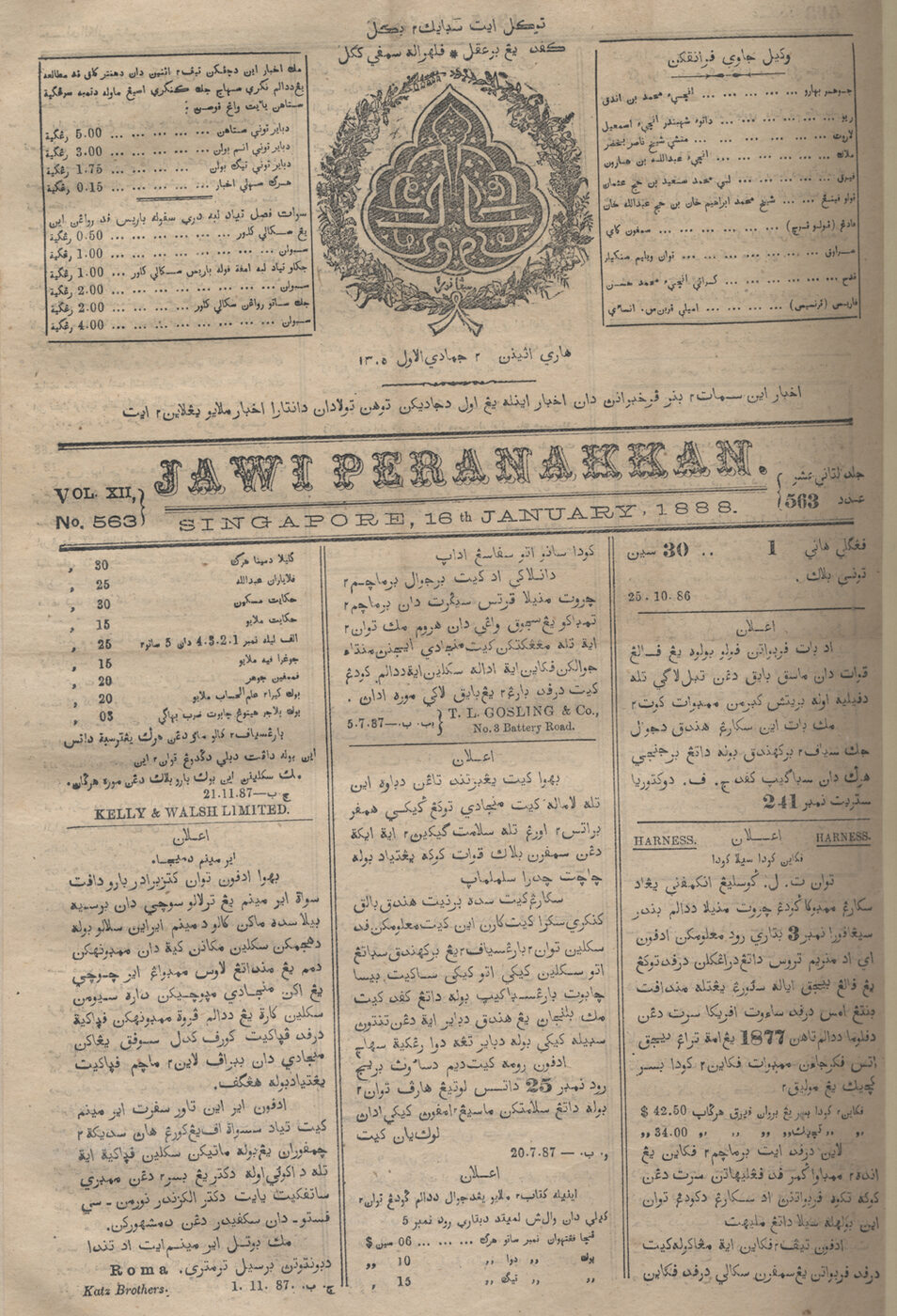
The Malay-language press is older than any arrangement above. Jawi Peranakan, published between 1876 and 1895 and printed in Jawi script, is described in the Wikimedia Commons record of the copy reproduced below as the first newspaper written entirely in Malay; that copy is dated 16 January 1888.

Party newspapers ran on the same permits. Harakah, published by the Malaysian Islamic Party, began as a weekly in March 1987 and had become twice-weekly by September 1998; in January 2000 it had a circulation of 368,000 copies, which was to be reduced to 100,000 for two months to comply with the Home Ministry’s ruling on its distribution.
The statutory frame around the online medium arrived in the same years. The Communications and Multimedia Act 1998 received royal assent on 23 September 1998, commenced on 15 October 1998 and came into force on 1 April 1999, establishing the Malaysian Communications and Multimedia Commission as regulator of the converged industry. The undertaking given for the corridor and the statute governing the medium were thus in place at once.
Steven Gan received the Committee to Protect Journalists’ International Press Freedom Award in 2000, the International Press Institute named Malaysiakini a Free Media Pioneer in 2001, and the seizure of servers and computers on 20 January 2003 is listed above with the rest of the chronology.
Context
The group did not sit alone. soc.culture.singapore covered the neighbour with which Malaysia shares a border and a partial history, and soc.culture.asean took the regional frame. How much traffic crossed between the three the surviving record does not measure; the hierarchy put them within reach of the same readers, and the crisis was regional before it was national.
The more distinctive feature was structural. Many soc.culture groups were written chiefly from abroad about a place their authors had left; here both halves wrote in a medium that lay, by the government’s own undertaking, outside the licensing regime governing newspapers. The same opening was used more formally when Malaysiakini was founded on 20 November 1999 by Steven Gan and Premesh Chandran, who set out to use the MSC pledge to create a space for uncensored journalism.
What survives in the archives, where coverage holds, is a contemporaneous, unedited record of Malaysians arguing about a currency decision, a dismissal and a trial, and the terms of the country’s ethnic settlement, while the outcomes were open.
Reading soc.culture.malaysia today
- Historical archive: Google Groups — soc.culture.malaysia (coverage varies by group and era).
- Open in a newsreader:
news:soc.culture.malaysia— the original site offered exactly this link, and it still works if your system has a newsreader registered for thenews:scheme. - Live access: point an NNTP newsreader at a modern server — see accessing Usenet today.
- The original news2mail e-mail subscription service ended in the mid-2000s and no longer operates.