soc.culture.singapore
Singapore, efficiently discussed.
Singlish defended and deplored, national service stories, hawker-food rankings conducted with scholarly rigour, and politics discussed with the careful precision the subject demanded.
A moderated sibling is preserved alongside.
On this page
The group and its era
soc.culture.singapore sat in the national tier of the soc.culture.* hierarchy, unmoderated as almost all of it was, and its character was set by two circumstances. Singapore was connected early and well: dial-up grew out of the Teleview–SingNet service, the private TechNet network passed to Pacific Internet, and the national Singapore ONE project — announced in June 1996, commercially launched in June 1998 — was available nationwide by that December. SingTel's ADSL service, launched in 1997, was rolled out nationwide in August 2000; by April 2001 six broadband providers served more than 300,000 users.
The second circumstance was regulatory. From 1996 the Singapore Broadcasting Authority monitored internet content; service providers were licensed by it and so came under an Internet Code of Practice, which defined prohibited material as content objectionable on grounds of public interest, public morality, public order, public security or national harmony, or otherwise prohibited by applicable Singapore laws. Usenet was a distributed medium held on servers everywhere, which put a newsgroup named for the country in a different position from a website published in it.
Together these produced the era's characteristic feature. A substantial share of the posting came from Singaporeans abroad — students and young professionals in Britain, Australia and the United States, at universities where Usenet lived and an account cost nothing — and the group was known as a place where political discussion ran franker than the domestic press of the day. No traffic figures survive to put a number to either half of that.
Who could post, and from where
The country-code domain supplies the earliest checkable date. IANA's root database records .sg as delegated on 19 October 1988, sponsored today by the Singapore Network Information Centre — a delegation older than the World Wide Web. What it did not yet imply was a public network. TechNet was started in 1989 as a research and development network for academic use at the National University of Singapore, funded by the National Science and Technology Board; it became the country's first internet service provider, was acquired in 1995 by SembMedia, a division of the Sembawang Group, renamed Pacific Internet Corporation, and began commercial operations in September 1995. The third of the early providers, Cyberway, was bought by StarHub on 21 January 1999.
The World Bank series for individuals using the internet, as a percentage of the population, dates the opening of the gate closely:
- 1991 — 0.16 per cent
- 1994 — 1.19 per cent
- 1995 — 2.87 per cent
- 1996 — 8.35 per cent
- 1997 — 13.5 per cent
- 1998 — 19.6 per cent
- 1999 — 24.2 per cent
- 2000 — 36 per cent
- 2002 — 47 per cent
- 2004 — 62 per cent
Fewer than three Singaporeans in a hundred were online in 1995, the year Pacific Internet went commercial, and TechNet before it had served academic users; the account a Singaporean posted from inside the country in the early years was therefore much like the university account the students abroad were using. Commercial dial-up widened the home side from late 1995, and the share of the population online passed a third in 2000, inside the years the news2mail gateway operated.
What was discussed
National service was a permanent seam. Compulsory service for male citizens and permanent residents dates from the National Service (Amendment) Bill of 14 March 1967; from 1971 full-time service ran two years or two and a half by educational qualification, and by December 2004 it had been reduced to two years, followed by reservist obligations capped at forty for enlistees and specialists and fifty for commissioned officers. Around those facts sat the practical questions — enlistment and posting, deferment while studying overseas, reservist recall from abroad — and the longer argument over what the obligation asked of whom.
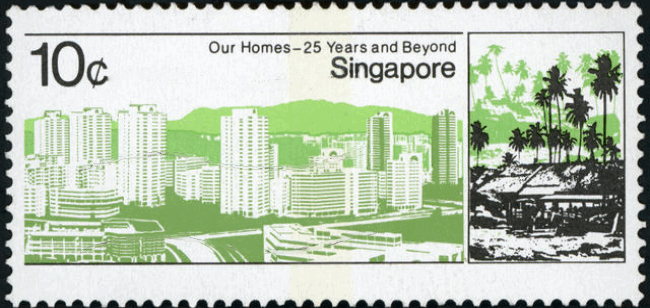
Education produced the same density: the Primary School Leaving Examination and the streams it fed, the O- and A-level courses beyond, and the private tuition sector alongside them, discussed by parents, by recent products of the system, and by people comparing it with wherever they now lived. Housing ran a close second. The Housing and Development Board, formed in February 1960, had by 2000 housed 88 per cent of the resident population; Central Provident Fund savings had been usable for flat purchase since 1968; the Ethnic Integration Policy of 1989 capped the ethnic proportions within an estate; and upgrading schemes and a resale market opened to unmarried buyers over thirty-five in 1991 supplied endless particulars.
Underneath the housing sat the savings system, which has a dated architecture of its own. The Central Provident Fund was established on 1 July 1955 as a compulsory savings scheme, with employer and employee each contributing 5 per cent; the rate was raised progressively to 25 per cent on each side by 1985, and the employer share was cut to 10 per cent in the recession of 1986. Withdrawals were opened to housing in 1968, extended to medical expenses in 1984, given a member-directed investment option in 1986, bounded by the Minimum Sum Scheme annuity in 1987, and attached to MediShield insurance from 1990. Each of those changes altered what a member could take out, for what, and at what age.
.png)
Language was argued about as seriously. Singlish was defended as a marker of belonging, deplored as an obstacle to being understood elsewhere, and analysed by readers who knew what a contact language was; official campaigns supplied the occasions, from the ban on Singlish commercials on radio and television in August 1993 to the Speak Good English Movement of 2000. The hawker-food rankings ran on the same energy, stall by stall, with the seriousness a community brings to a subject it considers settled and outsiders do not.
The Asian financial crisis of 1997 arrived as live news. Singapore's downturn was a short recession beside those of Thailand, Indonesia and South Korea; the Monetary Authority of Singapore allowed a gradual twenty per cent depreciation of the currency, the National Wage Council pre-emptively agreed Central Provident Fund cuts to lower labour costs, and the economy recovered in less than a year. Readers abroad followed regional collapse and domestic response at once, and the crisis drew the economic threads together with the political ones — a dominant-party system discussed by people whose exposure to its decisions differed widely.
Four languages, three scripts, seven bits
English, Malay, Mandarin and Tamil are the four official languages, and the Constitution designates Malay the national language. The census records which language households actually spoke most frequently at home, and the group's active years sit between two of those counts: in 1990 the shares were English 18.8 per cent, Mandarin 23.7, Malay 14.3 and Tamil 2.9; by 2010 they were English 32.3, Mandarin 35.6, other Chinese varieties 14.3, Malay 12.2 and Tamil 3.3; by 2020 English had reached 48.3 per cent. English was designated the first language of the education system in 1987 and is the medium of instruction for almost all subjects, so a newsgroup written in English was written in the schoolroom language of everyone and the household language of a minority that was still growing.
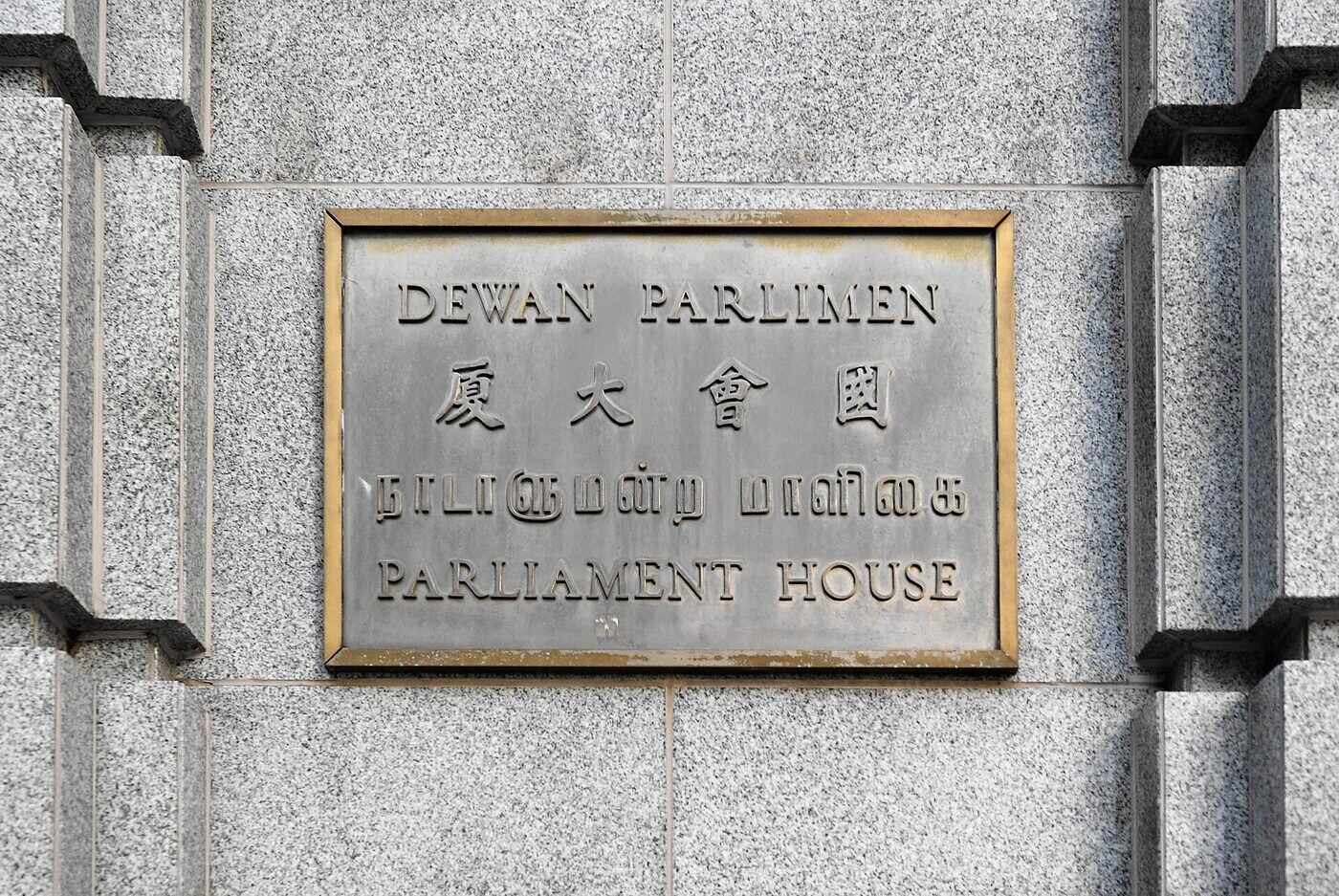

Two campaigns bracket the period. The Speak Mandarin Campaign was launched on 7 September 1979 by Prime Minister Lee Kuan Yew and run by the Promote Mandarin Council; its stated initial goal was that young Chinese Singaporeans would stop speaking topolects within five years and that Mandarin would become the language of choice in public places within ten. Chinese households giving Mandarin as their principal language rose from 13.1 per cent in 1980 to 35 per cent in 2000, and the last Cantonese television programmes were phased out in 1981. The Speak Good English Movement was launched on 29 April 2000 by Prime Minister Goh Chok Tong, having been trailed in the National Day Rally speech of 1999.
Script came with the languages. Written Chinese in Singapore is simplified, through three rounds of its own: 498 characters promulgated by the Ministry of Education in 1969, 2,287 in 1974, and the 49 remaining divergences from the mainland set removed in 1976, with the mainland's 1986 revisions adopted in 1993. Malay is written in Rumi, the Latin orthography adopted alongside Jawi by the Kongres Bahasa of 1954 in the Federation of Malaya; Jawi, the Arabic-based script, keeps its extra letters in the Arabic block of Unicode, U+0600 to U+06FF, present since version 1.0.0 in 1991 — the letter Jawi uses for the sound p sits at U+06A4.
Usenet carried none of that natively. RFC 1036, Standard for Interchange of USENET Messages, by M. Horton and R. Adams, December 1987, required an article to be a valid RFC 822 message, which in practice meant printing ASCII. English and Rumi Malay pass through such a pipe unharmed. Chinese and Tamil do not. GB 2312-80, the mainland standard of 6,763 Chinese characters, and Big5, defined in 1984 by Taiwan's Institute for Information Industry and named for the five computer firms that collaborated on it, are both double-byte eight-bit sets, and the eighth bit did not survive every hop of a 1990s news feed. The workaround for Chinese was HZ, designed in 1989 by Fung Fung Lee at Stanford and codified as RFC 1843 in 1995: it wraps GB 2312 inside printable ASCII, opening with ~{ and closing with ~}, so that the message looks like plain text to everything that handles it. Tamil converged more slowly, on TSCII, whose lower 128 code points are plain ASCII and whose upper 128 are Tamil; it grew out of a thicket of incompatible font encodings in the mid-1990s, acquired a dedicated mailing list in 1997, and was registered with IANA only in 2007.
Unicode admitted all three scripts early, long before the software caught up. The Tamil block, U+0B80 to U+0BFF, was in Unicode 1.0.0 of October 1991, its original layout taken from the ISCII standard of 1988. CJK Unified Ideographs, U+4E00 to U+9FFF, arrived with 20,902 characters in Unicode 1.0.1 of June 1992. UTF-8, the encoding that eventually made all of them safe to post, was sketched by Ken Thompson on 2 September 1992 and first presented at the USENIX conference in San Diego from 25 to 29 January 1993; it became RFC 2279 in 1998, was restricted to its present form by RFC 3629 in November 2003, and did not overtake every other encoding on the web until 2008.
This group ran in English, so its text is ordinary ASCII and an ordinary string search reaches it. Groups that argued in Chinese or Tamil over the same years left archives whose bytes may match no query a modern reader would think to type, and whose transliterated stretches match no spelling in particular. That is a fact about the transport rather than about the languages: Singapore's Chinese-language public sphere was online at the same time and by a different door — Lianhe Zaobao, formed on 16 March 1983 from the merger of the Singapore editions of two older dailies and printed in simplified characters, put up its website in August 1995, the month Pacific Internet went commercial. The Tamil daily Tamil Murasu had been publishing since 2 May 1936.
The dated record
What follows is a chronology and nothing more: dated events of the country and the network across the period this page covers, set down without argument. Entries before 1990 predate the newsgroup era described above; the last entry postdates both that era and the e-mail gateway this directory documents.
- 1 July 1955 — the Central Provident Fund is established.
- 16 September 1963 — Singapore joins Malaysia.
- 9 August 1965 — Singapore becomes independent.
- 7 September 1979 — the Speak Mandarin Campaign is launched.
- 1 January 1982 — the clocks go forward half an hour and Singapore Standard Time becomes UTC+08:00.
- 1985 — Central Provident Fund contribution rates reach 25 per cent from employer and employee alike; the employer rate is cut to 10 per cent in 1986.
- 1987 — the Minimum Sum Scheme annuity is introduced, and a demerit system for hawker-stall hygiene begins.
- December 1987 — RFC 1036 fixes the format of a Usenet article.
- 19 October 1988 — the
.sgdomain is delegated. - 1989 — TechNet begins as an academic network at the National University of Singapore.
- 28 November 1990 — Goh Chok Tong becomes Prime Minister.
- January 1991 — the Constitution is amended to provide for popular election of the President for a six-year term.
- 14 August 1991 — Parliament is dissolved; the general election follows on 31 August.
- 1992 — the Singapore Literature Prize is established.
- 28 August 1993 — the first presidential election by popular vote is held; the inauguration follows on 1 September.
- 1994 — the national football team takes the Malaysian league and cup double, and withdraws from the Malaysian competitions in 1995.
- August 1995 — Lianhe Zaobao launches its website; Pacific Internet begins commercial operations the following month.
- 14 April 1996 — the S.League is established.
- 16 December 1996 — Parliament is dissolved; nomination day is 23 December and polling day 2 January 1997, the only Singapore election to span two calendar years.
- 21 January 1999 — StarHub purchases Cyberway.
- 29 April 2000 — the Speak Good English Movement is launched.
- 18 October 2001 — Parliament is dissolved; the general election follows on 3 November.
- 1 March 2003 — the first SARS patient is admitted to Tan Tock Seng Hospital; the World Health Organization issues a global alert on 15 March and removes Singapore from its list of infected areas on 31 May. The outbreak is recorded as 238 cases and 33 deaths.
- 12 August 2004 — Lee Hsien Loong becomes Prime Minister.
- 16 December 2020 — UNESCO inscribes hawker culture in Singapore as intangible cultural heritage.
Four of those entries fall inside the window in which this gateway carried the group to e-mail subscribers, between 2000 and 2004: the launch of the Speak Good English Movement, the 2001 general election, the SARS outbreak and the change of prime minister. The rest is inheritance.
Where the readers were
No count of the group's readership exists, and no count of Singaporeans abroad from the same years is precise enough to stand in for one. The nearest sourced distribution is much later. The United Nations Department of Economic and Social Affairs put the number of Singaporeans living outside the country at 340,751 in 2019 — 91,002 in Malaysia, 64,739 in Australia, 58,432 in the United Kingdom, 39,018 in the United States, 23,524 in Indonesia, 12,799 in China and 12,582 in Canada. Singapore government figures for 2025 give 221,600 citizens resident abroad. Both postdate the gateway years by more than a decade and neither describes it. What they do show is that the three largest destinations outside the immediate region are the three the group's composition was known for, in countries whose university systems ran Usenet as a matter of course.
Dispersal of that shape has a mechanical effect, and the clock makes it measurable. Singapore has kept UTC+08:00 since 1 January 1982, when the clocks went forward half an hour from UTC+07:30 to follow Peninsular Malaysia, which had standardised on UTC+08:00 the year before; it observes no daylight saving. That leaves London seven or eight hours behind by season, the American west coast fifteen or sixteen hours behind, and the Australian east coast two or three hours ahead. A group with real readerships in all four zones has no closing time and no common working day: a post written over breakfast in Singapore reaches Britain before the morning and the American west coast the previous afternoon. The structural result is a thread that advances in shifts rather than in exchanges, and in which a reply twelve hours later is not late.
Food, sport, song and the calendar
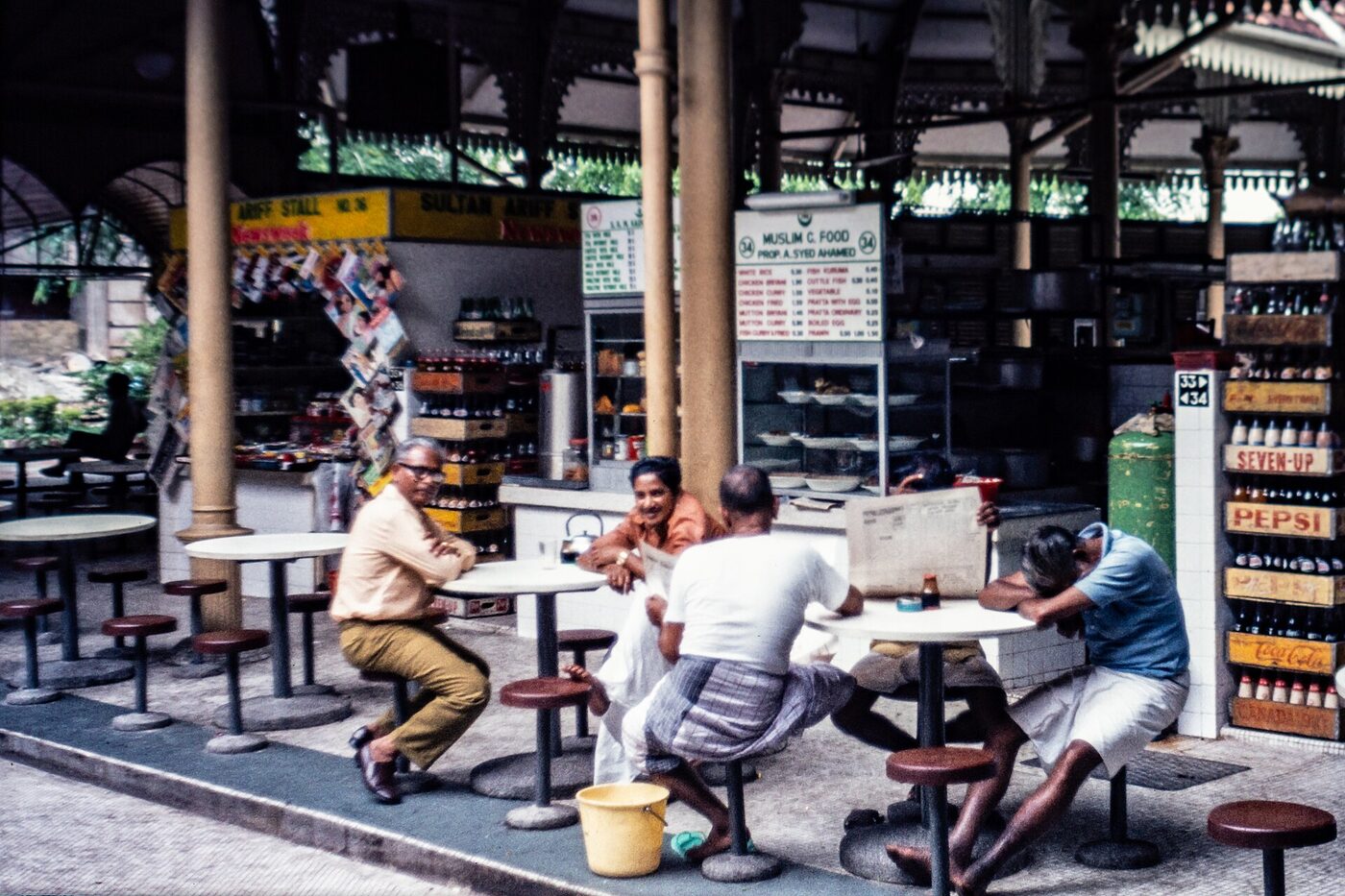
Between crises a culture group runs on its calendar and its enthusiasms, and those are better documented than its politics. Hawker centres exist because street hawkers were resettled indoors after the rapid urbanisation of the 1950s and 1960s. A demerit points system for stall food and hygiene was introduced in 1987, and stalls display a hygiene grade running from A down to D. Singapore submitted hawker culture for international recognition in 2019 and UNESCO inscribed it on 16 December 2020, describing the centres as community dining rooms where people of diverse backgrounds gather. All of that postdates the gateway years.

Hainanese chicken rice is widely counted a national dish of Singapore and is claimed with equal conviction across the causeway. The dispute is documented in ministerial statements — Malaysia's tourism minister in 2009, its finance minister in 2018 — and has a name in the academic literature, gastronationalism. Both instances postdate the gateway, and the argument is older than the citations that happen to carry dates; the neighbouring soc.culture.malaysia sat one line away in the same hierarchy.
Football supplied an argument with a date on it. Singapore's team played in the Malaysian league and cup and won the Malaysia Cup twenty-four times between 1921 and 1994; after taking the league and cup double in 1994 it withdrew from the Malaysian competitions, in a dispute over gate receipts, and the domestic S.League was established on 14 April 1996. The Olympic record was the other fixture: a silver in lightweight weightlifting at Rome in 1960, then no medal at all for forty-eight years until the women's table tennis team took silver at Beijing in 2008, with a first gold, in the 100 metres butterfly, on 12 August 2016. The whole life of the newsgroup falls inside that gap.
The music of the group's own generation had a name. Xinyao was a Mandarin song genre of the late 1970s and 1980s, its name a compression of the words for Singapore and song, its subjects friendship, school and adolescence. It reached radio in April 1982 through a programme of local songwriters, was the subject of a seminar in September 1982, put its first song on the charts in 1983, and produced an album in 1984 that sold thirty thousand copies; the Xinyao Festival of September 1985 filled the World Trade Centre auditorium, tickets gone by August. Audiences and sales fell away through the 1990s.
Literature had an institution of the same vintage. The Singapore Literature Prize was established in 1992 and is awarded every two years in all four official languages, organised by the Singapore Book Council with the support of the National Arts Council; it was not awarded in 1999 or 2002, for economic reasons.
The year itself was shared out. Eleven public holidays are gazetted under the Holidays Act — New Year's Day, two days of Chinese New Year, Good Friday, Labour Day, Vesak Day, Hari Raya Puasa, Hari Raya Haji, National Day on 9 August, Deepavali and Christmas — chosen, in the official account, after consultation with community and religious leaders; several others, among them Thaipusam, Easter Monday, Boxing Day and Mawlid, had been dropped by 1968. Six of the ten occasions move with lunar, lunisolar or ecclesiastical reckoning, so their dates have to be computed and announced each year. For a readership living in other countries none of those dates appears on the local calendar, which gives a national newsgroup an annual agenda owing nothing to the news.
Context
A moderated counterpart, soc.culture.singapore.moderated, is preserved in this directory as the era's group lists recorded it. Regionally the group belonged to the cluster around soc.culture.asean, which took the association as a whole, with soc.culture.malaysia next door. How much traffic crossed between the three is not something the surviving record measures; the hierarchy did put them within reach of the same readers, and the histories they covered overlap.
The larger pattern recurs across the archive. Through the 1990s a national newsgroup was hosted nowhere in particular and read most freely by the part of a population that had left; the most candid public forum about a country was therefore often the one sited outside it. Singapore's version is legible because the domestic infrastructure was good rather than absent: whatever distance the traffic carried was not a matter of who could get online.
Two limits belong with the rest. Nothing above is drawn from the group's own postings: the dated material here comes from the public record of the country and of the network — IANA's root database, the World Bank's penetration series, the census, the RFC series and the Unicode standard — and it describes the conditions the group ran in rather than the group. And the surviving archive is uneven, as all Usenet archives are; where it is silent this page says so rather than filling the gap.
Reading soc.culture.singapore today
- Historical archive: Google Groups — soc.culture.singapore (coverage varies by group and era).
- Open in a newsreader:
news:soc.culture.singapore— the original site offered exactly this link, and it still works if your system has a newsreader registered for thenews:scheme. - Live access: point an NNTP newsreader at a modern server — see accessing Usenet today.
- The original news2mail e-mail subscription service ended in the mid-2000s and no longer operates.