soc.culture.slovenia
Slovenia and Slovenians.
Independent since 1991 after the shortest of the Yugoslav wars, Slovenia’s group covered the transition years, EU and NATO accession in 2004, the tolar giving way to the euro, and a culture the group insisted was Alpine first and Balkan by administrative error only.
Language threads (dual grammatical number, dialect maps) and karst-and-mountains travel advice anchor its quieter archive.
On this page
The group and its era
soc.culture.slovenia was an unmoderated group in soc.culture.*, the corner of Usenet that allotted each nation — and a fair number of aspirations to nationhood — a discussion space of its own. It belonged to the cluster that the Yugoslav dissolution produced: soc.culture.yugoslavia carried the federation's arguments through the wars, and the successor states acquired groups of their own as the decade went on, readerships sorting themselves along the new borders.
Slovenia was quick to get online by post-socialist standards. ARNES, the country's academic and research network, was established in 1992, and the universities in Ljubljana and Maribor gave students and researchers early access. The group's other constituency posted from a good deal further away: a nation of two million keeps a diaspora several generations deep, and for readers in Cleveland, Buenos Aires or Sydney a text-only newsgroup was the cheapest bridge home yet devised. Traffic ran in English and Slovene, sometimes within a single thread.
The documentary anchor for that early start is the domain record. IANA’s root database lists the country-code top-level domain .si as delegated on 1 April 1992, with ARNES named as its sponsoring organisation — the same year the institute itself was set up, and the same year the state was admitted to the United Nations. ARNES went on to operate the national internet exchange and, from 1994, SI-CERT, the Slovenian computer emergency response team.
Its temperament distinguished it from its neighbours. The groups covering the republics to the south became some of the most embattled territory on Usenet during the 1990s, while soc.culture.slovenia stayed comparatively calm — the fighting had moved off Slovenian ground almost at once, and the bitterest arguments followed the fronts. Cross-posted disputes still blew through from time to time; no group in that corner of the hierarchy was ever entirely upwind of them.
Who could post, and from where
Access decides the composition of a culture group more surely than its charter does, and for Slovenia it can be given in numbers. The series the World Bank publishes from ITU data — individuals using the internet, as a percentage of population — records nothing above zero for Slovenia before 1993, and then runs as follows across the years in which such groups were busiest.
- 1993 — 0.4 per cent
- 1995 — 2.9 per cent
- 1997 — 7.6 per cent
- 1999 — 12.6 per cent
- 2000 — 15.1 per cent
- 2001 — 30.2 per cent
- 2003 — 31.9 per cent
- 2005 — 46.8 per cent
Set against a resident population that the 2002 census put at 1,964,036, those percentages describe a small and very specific readership at the start. Under three per cent in 1995 means a domestic online population of the order of fifty or sixty thousand people, at a date when the network ARNES had been set up to run served the universities in Ljubljana and Maribor and the research institutes. Only around the turn of the century does the figure cross into the general population, and by then the web had already begun to draw conversation away from newsreaders.
The comparison that matters is with the countries its readers actually lived in. The same ITU series gives the United States 16.4 per cent in 1996 and 43.1 per cent in 2000; Canada 15.1 per cent in 1997 and 51.3 per cent in 2000; Australia 16.4 per cent in 1997 and 46.8 per cent in 2000; and Argentina 0.3 per cent in 1997 and 7.0 per cent in 2000. Through the middle of the decade the North American and Australian diaspora was proportionally better connected than the homeland, so a group nominally about Slovenia was, in its early years, weighted towards people writing about it from outside. The Argentine community, formed by the political emigration after 1945, was on those figures the least likely of the four to be reading anything on Usenet at all.
A readership distributed like that has no common working day. Ljubljana keeps Central European Time, one hour ahead of UTC and two in summer. Cleveland and Toronto sit at UTC minus five, Buenos Aires at UTC minus three, Sydney and Melbourne at UTC plus ten: six, four and nine hours from Ljubljana respectively when neither end is on summer time. An evening post from Ohio landed in Slovenia in the small hours; an Australian reply to the same thread arrived a further day out. Usenet’s store-and-forward design absorbed that better than any synchronous medium could, but it left a signature on the traffic: threads that unrolled over days rather than minutes, and no single national news cycle governing any of it.
What was discussed
Its staples were the staples of the hierarchy. News from home was summarised and argued over for those who could not read it locally; prospective visitors and exchange students asked their questions; and family history proceeded at its usual patient pace — surname origins, parish records, the search for a village a great-grandparent had left and never named to the children. Recipe requests and food nostalgia did their reliable service as portable identity.
The diaspora gave the group much of its texture. Slovene emigration ran in distinct waves — economic migrants to the American industrial belt before the First World War, political refugees to Argentina after 1945 — and their descendants arrived carrying different vocabularies and different silences. Cleveland, the informal capital of Slovene America, stood for one musical inheritance in the Cleveland-style polka of Frankie Yankovic; posters closer to Ljubljana were likelier to invoke Laibach. The group had room for both.
The politics it carried were real and unfinished. The transition raised questions with long roots: the return of property nationalised after the war, and the standing of wartime memory itself, in a country where Partisan and Home Guard dead both have graves and grandchildren, and where the mass killings of repatriated Home Guard members in 1945 could be publicly commemorated only from 1990. The decade added grievances of its own — the 1992 removal of thousands of residents from other former republics from the register of permanent residents, who became known as the erased (izbrisani), and an unresolved maritime boundary with Croatia. On all of this the group did what Usenet did: it argued, at length, among people for whom none of it was abstract.
The dated record
What follows is a chronology and nothing more: what happened and when, in the terms the standard reference sources use. The Ten-Day War of 1991 and the accessions of 2004 are the two clusters of dates a reader of this archive will most often want fixed.
- April 1990 — Slovenia holds its first multi-party elections, won by the DEMOS coalition.
- 23 December 1990 — plebiscite on independence: turnout 93.31 per cent, with 95.71 per cent of those voting in favour, equivalent to about 88.5 per cent of the whole electorate. The final results are proclaimed on 26 December.
- 25 June 1991 — the declaration of independence.
- 27 June to 7 July 1991 — hostilities between the Yugoslav People’s Army and Slovenian territorial and police forces. By Slovenian estimates the JNA had 44 dead and 146 wounded, Slovenian forces 19 dead and 182 wounded; six Slovenian and twelve foreign civilians were killed, and 4,692 JNA soldiers and 252 federal police officers were captured.
- 7 July 1991 — the Brioni Agreement, signed on the Brijuni islands, ends the fighting and defers implementation of independence by three months; all Yugoslav military units are to leave Slovenia by the end of October.
- 8 October 1991 — the Slovenian tolar is introduced.
- 26 October 1991 — the withdrawal of Yugoslav army units from Slovenia is completed.
- 23 December 1991 — the National Assembly adopts the Constitution of the Republic of Slovenia.
- 15 January 1992 — Slovenia is recognised by all member states of the European Community.
- 1 April 1992 — the
.sitop-level domain is delegated. - 22 May 1992 — Slovenia is admitted to the United Nations, on the same day as Croatia and Bosnia and Herzegovina.
- 16 April 2003 — the Treaty of Accession is signed at the Stoa of Attalus in Athens by the existing EU members and ten acceding states.
- 29 March 2004 — Slovenia joins NATO, together with Bulgaria, Estonia, Latvia, Lithuania, Romania and Slovakia.
- 1 May 2004 — Slovenia joins the European Union, together with Cyprus, the Czech Republic, Estonia, Hungary, Latvia, Lithuania, Malta, Poland and Slovakia.
- 11 July 2006 — the permanent conversion rate is fixed at 239.640 tolars to the euro.
- 1 January 2007 — the euro replaces the tolar.
Two things about the list bear on what the archive can contain. The plebiscite and the war both predate any measurable public internet use in Slovenia — the ITU series shows nothing above zero before 1993, and 0.4 per cent then — so whatever was written here about 1990 and 1991 was written in retrospect. The two accessions of 2004 fall inside the window in which the news2mail gateway operated; the euro changeover of 2007 falls entirely outside it.
Writing Slovene on a seven-bit network
Slovene belongs to the western subgroup of the South Slavic branch, and is a language in its own right rather than a variety of Serbo-Croatian: its highest mutual intelligibility is with the transitional Kajkavian dialects, and comprehension with the standard Serbo-Croatian varieties is limited by differences of vocabulary, grammar and pronunciation. It has roughly two and a half million native speakers, keeps the dual as a living grammatical number alongside singular and plural, and is conventionally described as having anywhere between seven and fifty dialects depending on how finely the count is drawn. It is written in a Slovene adaptation of the Latin alphabet devised by the Croatian linguist Ljudevit Gaj in 1835, taken up by Slovene writers in the early 1840s and sole official orthography by about 1850. Three of its letters carry the caron: č, š and ž.
Those three letters are the whole of the problem. RFC 822, the 1982 standard for internet text messages on which netnews was built, states plainly that the body of a message is a sequence of lines containing ASCII characters, and defines a character as one of the values 0 to 127. RFC 1036, the December 1987 standard for the interchange of Usenet messages, inherited that frame. A newsgroup article in its original conception simply had no room for č.
The eight-bit escape routes came in incompatible varieties. ISO/IEC 8859-2, first published in 1987 and generally called Latin-2, covers Slovene along with the other Latin-script Central European languages. Under DOS the equivalent was code page 852, labelled DOS Latin 2 in Microsoft’s own mapping tables; under Windows it was Windows-1250. All three encode the same three letters, and all three put them in different places. Lower-case š is byte B9 in ISO 8859-2, 9A in Windows-1250 and E7 in code page 852; ž is BE, 9E and A7 respectively; č happens to coincide at E8 in ISO 8859-2 and Windows-1250, but sits at 9F in code page 852.

The failure mode this produced is still visible in the archives. If a poster sent Latin-2 bytes and the reader’s software assumed Latin-1 — the western European default that most software of the period fell back to — then B9 rendered as the superscript one, BE as the vulgar fraction three quarters, and E8 as e-grave. A surname written Prešeren arrived as Pre¹eren; Bohorič arrived as Bohoriè. Nothing in the protocol told the receiving newsreader which of the three code pages had been used, and the machinery for saying so — the MIME charset parameter — arrived only with RFC 1341 in June 1992, was revised as RFC 1521 in September 1993 and again as RFC 2045 in November 1996, and was adopted by newsreaders unevenly for years after that.
The practical alternative was to strip the diacritics and write plain c, s and z. That is perfectly legible to a Slovene reader, who supplies the missing marks from context without effort, and it survives every gateway and every code page unaltered. It is also why a search of the surviving archive is an unreliable instrument: the same word may appear correctly encoded, stripped to bare Latin letters, or mangled into mojibake, and a byte-exact query finds only one of the three. Unicode ended the underlying problem rather than the archival one. The three letters live in the Latin Extended-A block, U+0100 to U+017F, in the standard since Unicode 1.0 — č at U+010D, š at U+0161, ž at U+017E — but the bulk of this group’s traffic predates general Unicode use on Usenet.
The written tradition behind the arguments
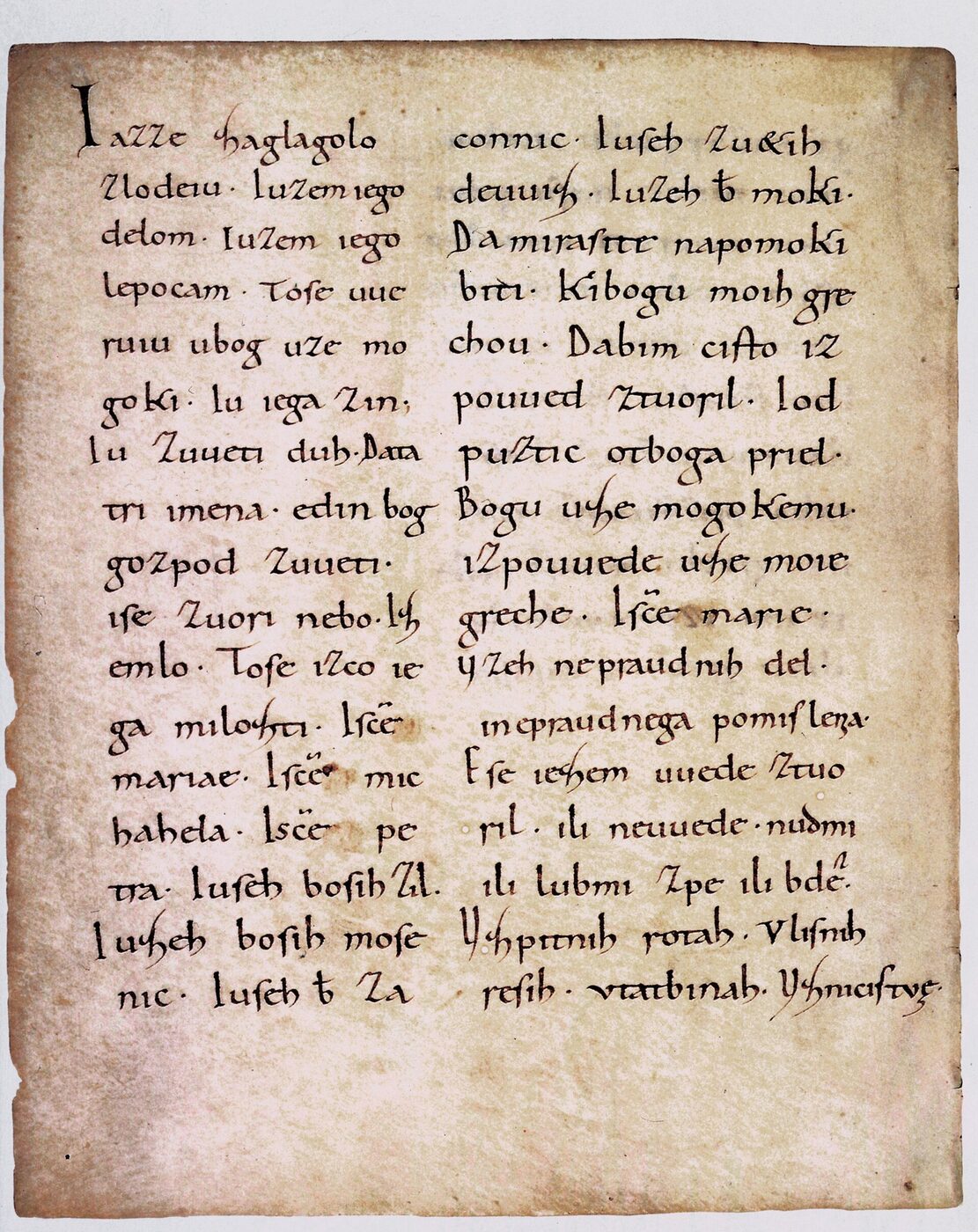
The habit of writing Slovene sounds with whatever letters were available is a great deal older than the network. The oldest surviving text in the language, the Freising manuscripts, was written between 972 and 1039 and most probably before 1000: three theological texts on parchment, comprising sermons on sin and repentance together with confessional formulae. They are the first continuous text in any Slavic language written in the Latin script, and they have been held at the Bavarian State Library in Munich since 1803.

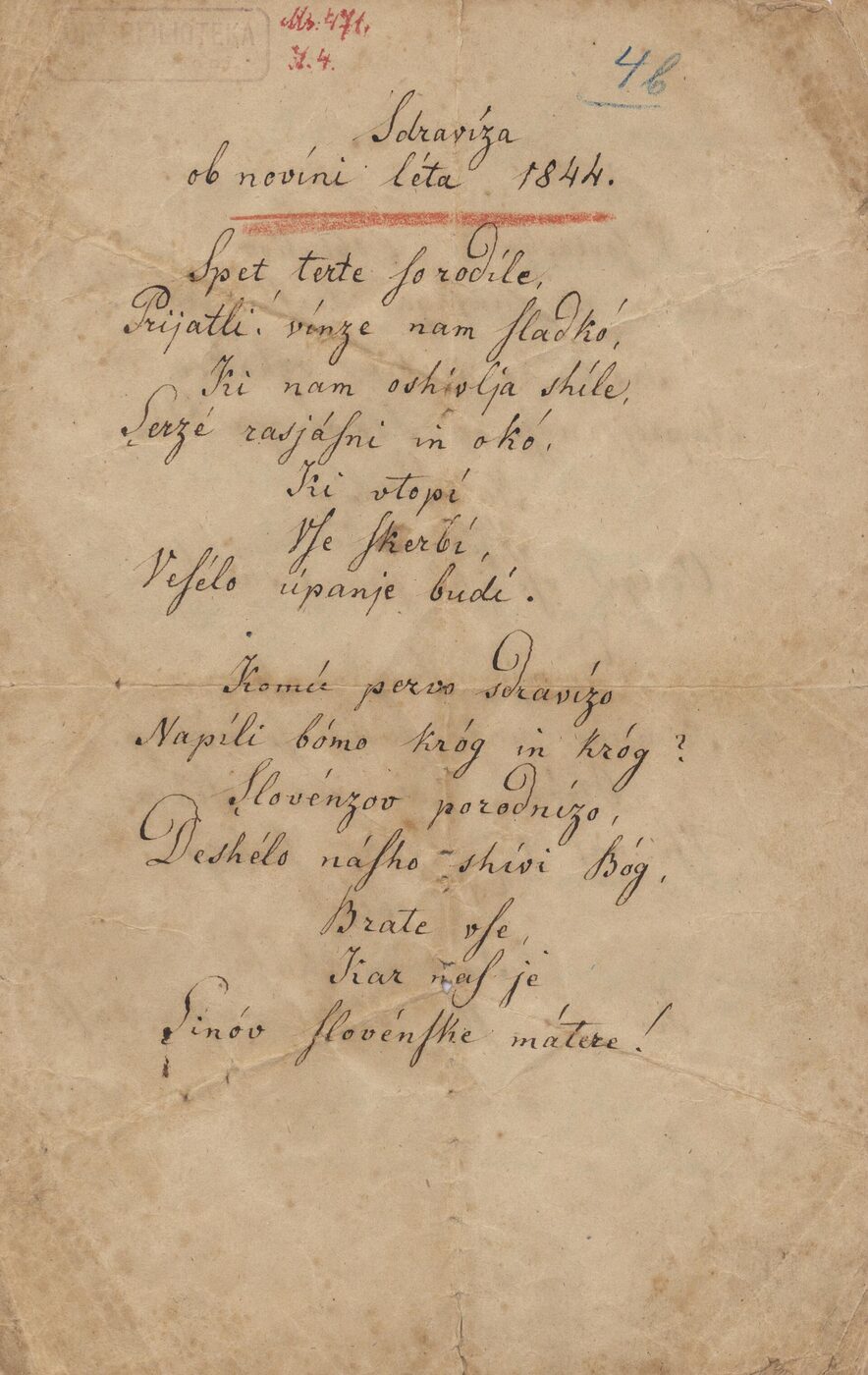
Printing arrived with the Reformation. Primož Trubar, 1508 to 1586, wrote the first two books in Slovene, the Catechismus and the Abecedarium, which were printed in 1550 at Schwäbisch Hall by Peter Frentz. The orthography they and their successors used is now called the Bohorič alphabet, after Adam Bohorič, whose Articae horulae succisivae — the first grammar of Slovene — was printed in 1583 and published in 1584. It solved the caron problem by not having carons: the sounds now written č, š and ž were spelled with h-digraphs instead — zh for č, sh for ž. Anyone who has read a Usenet post in stripped ASCII will recognise the underlying manoeuvre.
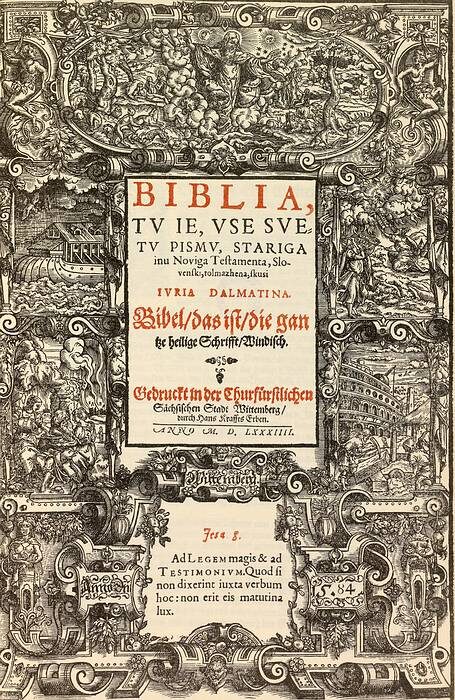
Jurij Dalmatin’s complete translation of the Bible into Slovene, printed in the Bohorič alphabet at Wittenberg, followed in 1583, with 1584 on its title page. The Bohorič system held until Gaj’s alphabet displaced it in the 1840s. Reformation Day, 31 October, has been a Slovenian civic holiday and a work-free day since 1992, which is the calendar’s acknowledgement that the language’s standard form and its first printed books came out of the sixteenth-century Protestant milieu.
The nineteenth century supplied the figure a culture group reaches for by reflex. France Prešeren, born 3 December 1800 and died 8 February 1849, wrote Zdravljica in 1844; it was published with changes in 1848. Its seventh stanza, beginning Žive naj vsi narodi, was adopted as the anthem in 1989 and became the national anthem of the independent state in 1991. Prešeren Day, 8 February, is the Slovenian cultural holiday, established as such in 1944 and work-free since 1991 — a state holiday marking the death of a poet.

The calendar, the kitchen and the scoreboard
Between the crises, most of what a culture group carries is calendar and catalogue. The Slovenian state holidays give the fixed points: 8 February for Prešeren Day; 27 April, the Day of Uprising Against Occupation, marking the establishment of the Liberation Front in 1941; 25 June, Statehood Day, for the 1991 declaration; 15 August, the Assumption, a work-free day since 1992; 31 October, Reformation Day; and 26 December, Independence and Unity Day, which commemorates the proclamation of the plebiscite results in 1990.
The movable end of the calendar belongs to Shrovetide. Kurentovanje at Ptuj, in the north-east, was first organised in its modern form on 27 February 1960 by Drago Hasl and others; its central figure, the kurent, wears a heavy sheepskin costume hung with cowbells and carries a wooden club, and the noise is understood to drive out winter. The door-to-door rounds of the kurents were inscribed on the UNESCO Representative List of the Intangible Cultural Heritage of Humanity in 2017 — long after the newsgroup, and long after the custom.
Music supplied the other perennial. The Avsenik Brothers Ensemble was formed in 1953 at Begunje na Gorenjskem by Slavko and Vilko Avsenik, and its 1955 instrumental Na Golici, released in German-speaking markets as Trompetenecho, is by some accounts the most played instrumental piece in history; the ensemble is credited with sales of more than 32 million records, more than any other Slovene act. That is the Alpine end of the tradition, and not quite the same inheritance as the Cleveland-style polka, which developed separately in the American Slovene communities.
Food arguments in culture groups are rarely only about food, and Slovenia supplies a documented case. The Carniolan sausage, kranjska klobasa, appears in German as early as Katharina Prato’s Süddeutsche Küche, whose first edition dates from 1858; Slovenia entered it in the European register of protected geographical indications in January 2015, over objections from Austria, Germany and Croatia. The registration postdates the newsgroup by a decade; the argument underneath it, over which national kitchen a regional dish belongs to, is older than the network.
The Lipica stud farm on the Karst plateau, founded in 1580 by Charles II, Archduke of Inner Austria, gave the Lipizzan breed its name; like the sausage, the breed is today associated with more than one successor of the Habsburg lands — Austria, Bosnia and Herzegovina, Croatia, Hungary and Slovenia at once.
Sport gave the group its datable triumphs. Slovenia first competed as an independent nation at the 1992 Winter Olympics in Albertville, and won its first medals at Barcelona later that year: two rowing bronzes, in the men’s coxless pair, taken by Iztok Čop and Denis Žvegelj, and in the men’s coxless four. Its first Olympic gold medals came at Sydney in 2000, when Čop and Luka Špik won the double sculls and Rajmond Debevec won the 50 metre rifle three positions — a result that falls squarely inside the years the news2mail gateway was carrying groups to e-mail. In winter sport the reference point is Planica, where a jumping hill was built on the slope of Mount Ponca before 1930 and the Bloudek Giant was completed in 1934; the first ski jump over 100 metres in history was made there in 1936 by Sepp Bradl.
Context
The map of Slovene speakers has never matched the map of Slovenia, and the group inherited the difference. The Carinthian Slovenes of southern Austria, whose rights under the 1955 State Treaty stayed contentious enough that the dispute over bilingual place-name signs outlasted the newsgroup era; the Slovene communities of Trieste and Gorizia in Italy; a smaller population along the Rába in Hungary — all predate the Slovenian state by a very long way. Threads about them were not foreign affairs; for many readers they were family.
Those communities have dates of their own, and the group inherited the arithmetic as well as the sentiment. The Carinthian plebiscite of 10 October 1920 assigned the disputed zone of southern Carinthia to Austria on a 59 per cent majority, in an area whose population was predominantly Slovene-speaking; Article 7 of the Austrian State Treaty of 1955 set out the rights of the Slovene and Croat minorities, and the bilingual place-name dispute it failed to settle escalated from the 1970s onwards. The Austrian census of 2001 recorded 13,109 Slovene speakers in Carinthia, against a figure of roughly 137,000 in 1818. In Italy, the 1971 census counted 52,194 Slovene speakers in Friuli-Venezia Giulia while Slovenian estimates ran to between 83,000 and 100,000; the minority’s legal position there rests on the London Memorandum of 1954 and the Treaty of Osimo of 1975, and since 1991 on bilateral agreements with Slovenia rather than with Yugoslavia. In Hungary, the Rába Slovenes around Szentgotthárd speak the Prekmurje dialect. None of these figures is uncontested; minority counts seldom are.
The wider diaspora can be counted with the same caution. The 2000 United States census recorded 175,099 people identifying as Slovenian, with Ohio the largest concentration; earlier returns had counted 183,431 people of Slovene mother tongue in 1910 and 208,552 in 1920, and in 1914 Cleveland was reckoned the third most populous Slovene city in the world after Trieste and Ljubljana. The Canadian census of 2016 counted 40,470 people of Slovene origin, 26,485 of them in Ontario. The Australian census of 2001 recorded 14,189 people of Slovenian origin, rising to 16,093 in 2006. Argentina is generally reckoned at around 30,000 by ancestry, concentrated in Buenos Aires and in Bariloche, Mendoza, Paraná and Córdoba. Those four communities have their own directory pages here — soc.culture.canada, soc.culture.australian and soc.culture.argentina among them.
Like the rest of soc.culture.*, the group thinned as the web arrived and national portals and forums took over conversation that no longer needed a newsreader. What its archive preserves is the 1990s from an unusual angle: a small new state explaining itself in real time — to its emigrants, to its neighbours, and now and then to itself.
For the neighbouring groups in the same corner of the hierarchy, see soc.culture.yugoslavia, soc.culture.croatia and soc.culture.austria; the full roster is on the soc.culture hierarchy page, and the story of the hierarchy itself belongs to the soc.* overview.
Reading soc.culture.slovenia today
- Historical archive: Google Groups — soc.culture.slovenia (coverage varies by group and era).
- Open in a newsreader:
news:soc.culture.slovenia— the original site offered exactly this link, and it still works if your system has a newsreader registered for thenews:scheme. - Live access: point an NNTP newsreader at a modern server — see accessing Usenet today.
- The original news2mail e-mail subscription service ended in the mid-2000s and no longer operates.