soc.culture.bosna-herzgvna
Bosnia and Herzegovina.
Created during the 1992–95 war, this group carried siege diaries, refugee tracing requests and news relays at a time when those functions barely existed elsewhere online.
Post-Dayton, it settled into diaspora conversation across all three constituent peoples — with the group name’s truncated spelling (an 8.3-era artifact) faithfully preserved.
On this page
The group and its era
The group was carrying traffic by late 1992, within months of the independence referendum and the outbreak of fighting that April. That timing places it in a small class of newsgroups whose creation tracked a state's arrival rather than a hobby's: the soc.culture.* hierarchy, built on the comfortable assumption that a national culture is a settled thing to be discussed at leisure, suddenly had to make room for a country whose borders were being decided by force.
It did not arrive into empty space. soc.culture.yugoslavia predated the federation's dissolution and continued alongside it, as did groups for the other successor states, and heavy crossposting meant the same argument frequently ran across several of them at once. Period directories gave the group the one-line description "The independent state of Bosnia and Herzegovina" — with independent doing rather more work in 1992 than directory descriptions usually ask of an adjective.
As for the vowel-starved name: early news software capped each dot-separated component of a group name at fourteen characters, and "bosna-herzgvna" fits that ceiling exactly. The compression looks odd in an age of cheap bytes, but it guaranteed the group could propagate to every server, however elderly.
The country’s own name is a compound of two historical regions, Bosna i Hercegovina, and the newsgroup component discards the conjunction along with most of the vowels of the second half; the site’s soc.culture overview sets out where that ceiling came from. Nor did the group sit alone on the shelf: soc.culture.yugoslavia, soc.culture.croatia and soc.culture.slovenia all have pages in this directory.
What was discussed
In the war years the group functioned as much as a wire service as a conversation. Readers with access to agency feeds and broadcast monitoring retyped and forwarded what they could; those with contacts inside the country posted secondhand accounts of conditions in particular towns; appeals circulated for medicine, for money, and above all for information — whether a district had been shelled, whether relatives had reached a third country. Strangers running lookups on other strangers' behalf were a routine sight.
It was never only a bulletin board. The same events arrived in incompatible versions, and threads over responsibility, over the reliability of atrocity reports and over the war's causes could run for weeks, crossposted into neighbouring groups until the original question was archaeological. Identity was argued as fiercely as territory: the status of Bosnian as a language, the revival of "Bosniak" as a formal designation, and what mixed families were supposed to call themselves now.
After 1995 the register changed. Threads turned to the machinery the peace had produced — two entities, a three-member presidency, international high representatives — and to the trials at The Hague, followed closely and read very differently by different readers. Around the politics ran the durable staples of any diaspora group: sevdalinka recordings, football results, recipes, the 1984 Winter Olympics remembered, and the practical grind of documents, citizenship and visits home.
What the relaying depended on at the far end deserves recording. Oslobođenje, the Sarajevo daily founded on 30 August 1943, was printed every day but one across the 1992–95 siege, and took the University of Missouri journalism school’s honour medal in 1995 for that run. A newsgroup that retyped and forwarded could only be as good as the reporting somebody else was still managing to produce, and some of that reporting was being produced inside the city its readers were asking about.
Context
That any firsthand word got out at all was an infrastructural achievement. Bosnia's connectivity was thin before the war and worse during it; much of what reached the internet from the region travelled over improvised links, among them the ZaMir network — za mir, "for peace" — a store-and-forward e-mail system run by anti-war groups, with nodes in Zagreb and Belgrade from 1992 and, from 1994, a server in besieged Sarajevo that came to serve several hundred users.
The unmoderated group also sat within a wider ecology of Bosnia channels. The moderated misc.news.bosnia carried vetted postings, and the BosNet mailing list compiled digests from agency reports, reaching Usenet as bit.listserv.bosnet. The division of labour was rough but real: the moderated channels delivered the news, and soc.culture.bosna-herzgvna was where people argued about what it meant.
The war it documented ended with the Dayton Agreement in December 1995; the siege of Sarajevo, which shadowed so much of the group's early traffic, was not formally declared over until early 1996 and is commonly described as the longest siege of a capital city in modern warfare. The Bosnian war was among the first to be followed, disputed and grieved over in real time on the open internet, and this group was one of the rooms in which that happened.
Who could post, and from where
The most useful fact about reading this group is not in the group. For almost the whole of its wartime life, Bosnia and Herzegovina had no public internet to speak of. The federation’s country-code domain, .yu, had been delegated on 15 June 1989, with the University of Maribor and the Jožef Stefan Institute — both in Slovenia — as registrants. Bosnia’s own .ba was not delegated until 14 August 1996 on IANA’s root zone record: eight months after the Paris signature, and nearly four years after the group was already carrying traffic. Its sponsoring organisation was, and remains, the University Tele-Informatic Center in Sarajevo — an academic body, not a commercial provider.
The penetration series tells the same story in numbers. The World Bank’s indicator for individuals using the internet, compiled from the International Telecommunication Union’s database, carries a zero for Bosnia and Herzegovina in 1990 and no value at all for 1991 through 1995. It resumes in 1996 at 0.015 per cent of the population — roughly one person in six or seven thousand — then 0.06 per cent in 1997, 0.19 per cent in 1999, 1.08 per cent in 2000, 2.65 per cent in 2002 and 3.97 per cent in 2003, reaching 15.5 per cent only in 2004. Fixed telephone penetration, the substrate dial-up needed, stood at 22.35 per cent as late as 2001.
The arithmetic leaves little room for doubt about the group’s composition. Through the years its archive is most cited for, the number of people inside the country who could open a newsreader and post was statistically indistinguishable from none. The traffic was written from outside — university and employer accounts in western Europe and North America, later the dial-up services refugee populations reached long before anyone in Tuzla or Bihać did — while firsthand material from inside came in relayed across a gateway by somebody else. That is not a criticism of the archive but the instruction for reading it: a culture group for a country whose residents were almost entirely offline is a diaspora record with domestic insertions, and the two have to be told apart.
The record, dated
What follows is a chronology and nothing more. It is confined to instruments, institutions and dated monuments, because those are the items that can be given a date and a document without characterising anybody. It is not an account of the fighting, of which this directory is not a competent source.
- 18 November 1990 — first round of the republic’s first multi-party general elections; the group did not yet exist.
- 15 October 1991 — declaration of sovereignty by the republic’s parliament.
- 29 February and 1 March 1992 — independence referendum; official turnout 63.7 per cent, with 99.7 per cent of votes cast in favour.
- 3 March 1992 — declaration of independence.
- April 1992 — recognition by the European Community and the United States.
- 22 May 1992 — the Republic of Bosnia and Herzegovina admitted as a member state of the United Nations.
- 25–26 August 1992 — the National and University Library, then housed in the Vijećnica in Sarajevo, burned with much of its holdings; the building reopened in 2014.
- 22 February 1993 — Security Council Resolution 808 decides that an international tribunal shall be established.
- 25 May 1993 — Security Council Resolution 827 adopts the tribunal’s statute, formally creating the ICTY at The Hague.
- 9 November 1993 — the bridge at Mostar, completed in 1566, collapsed under shelling; the reconstruction opened on 23 July 2004.
- 18 March 1994 — the Washington Agreement, creating the Federation of Bosnia and Herzegovina.
- 1–21 November 1995 — talks at Wright-Patterson Air Force Base near Dayton, Ohio; the agreement is initialled on 21 November.
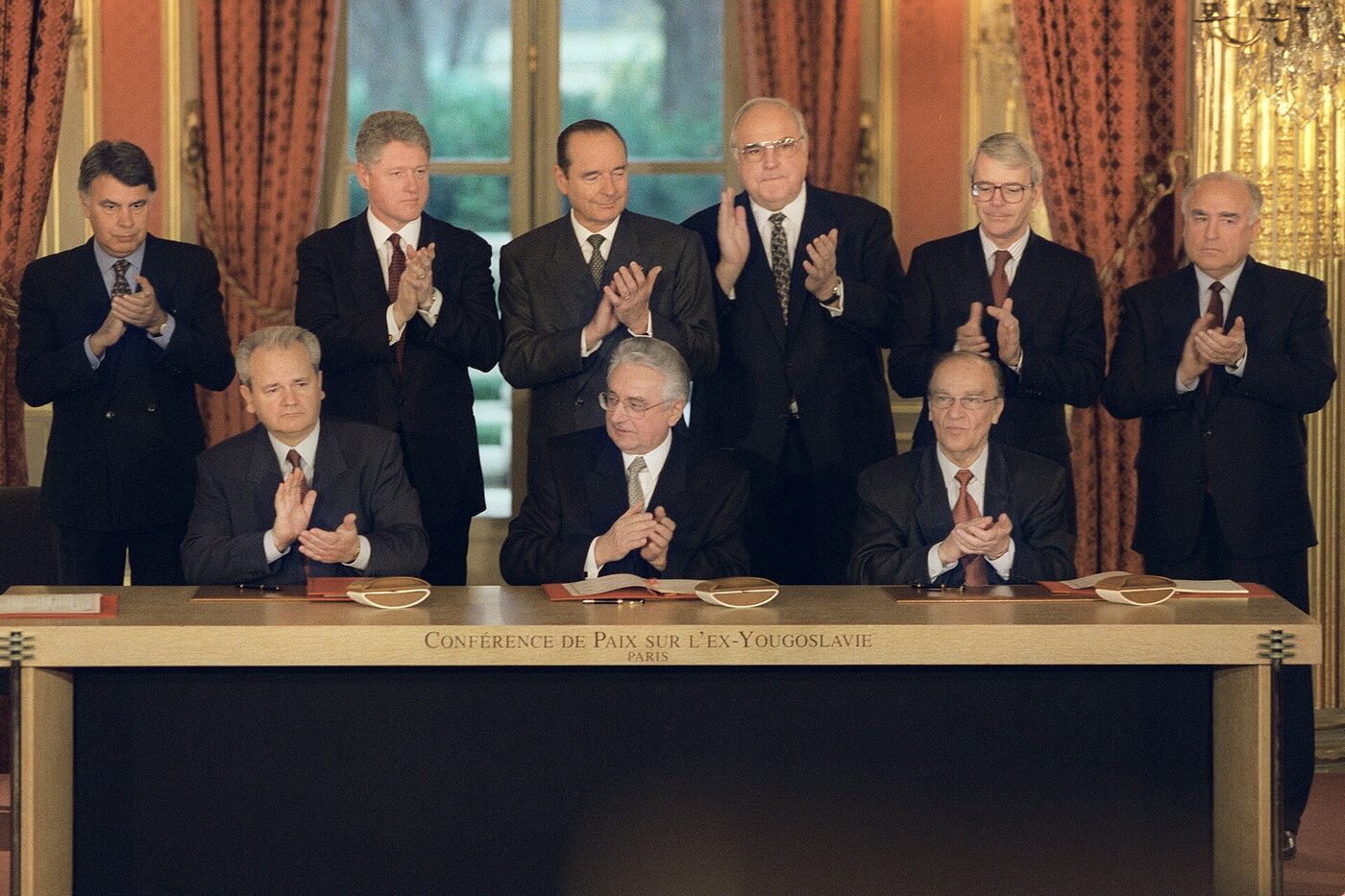
- 14 December 1995 — the General Framework Agreement signed in Paris; Annex 4, the constitution, takes effect the same day.
- 5 March 1999 — final arbitral award on the disputed Brčko section of the inter-entity boundary.
- 8 March 2000 — the statute of the Brčko District takes effect.
- 29 November 2017 — the ICTY issues its final judgment; 31 December 2017 — the tribunal formally ceases to exist.
Everything down to the library fire of August 1992 predates the traffic described above, which the group was carrying by late that year; every entry after the Paris signature postdates the settlement, and the two from 2017 fall more than twenty years after the traffic that watched the tribunal open. That gap is the point. Nothing in the group was written with the end of this list in view.

The state the settlement built
The constitution that governs Bosnia and Herzegovina is Annex 4 of the General Framework Agreement, and it entered into force with the signature on 14 December 1995. It is short, and the shape it gives the state accounts for most of the specialised vocabulary in the group’s post-1995 traffic.
The state consists of two entities — the Federation of Bosnia and Herzegovina and Republika Srpska — with the Brčko District, settled separately by arbitration, brought into the constitutional text by the first and so far only amendment in 2009. The Presidency has three members: one Bosniak and one Croat elected from the Federation, and one Serb elected from Republika Srpska. The Parliamentary Assembly has two chambers: a House of Representatives of 42 members elected by proportional representation for four-year terms, and a House of Peoples of 15 delegates appointed by the entity parliaments in three groups of five, Bosniak, Croat and Serb. Those three are named in the text as the constituent peoples; citizens who are none of the three fall into a residual category the document calls Others.
None of that is contested description; it is what the annex says. It is set out here because a reader arriving from a directory listing will meet the words entity, inter-entity boundary line, constituent people, House of Peoples and high representative in thread after thread from 1996 onwards, and without Annex 4 to hand those threads are close to unreadable.
Writing the language on a seven-bit wire
The language question is best handled by stating the technical facts and stopping there. What is spoken and written in Bosnia and Herzegovina is a pluricentric language with mutually intelligible standard varieties that carry separate names — Bosnian, Croatian, Serbian, and later Montenegrin. ISO 639-3 assigns them the codes bos, hrv, srp and cnr, with hbs as the inclusive macrolanguage code. Ivo Andrić received the Nobel Prize in Literature in 1961, recorded by the Nobel Foundation under Yugoslavia and with Serbo-Croatian given as his language; a Declaration on the Common Language issued in 2017 by writers and academics from all four countries, and signed after publication by more than ten thousand people, restated the pluricentric position. That declaration postdates the group’s active life by two decades, and no formulation here should be read as taking a side in an argument its posters conducted for themselves.
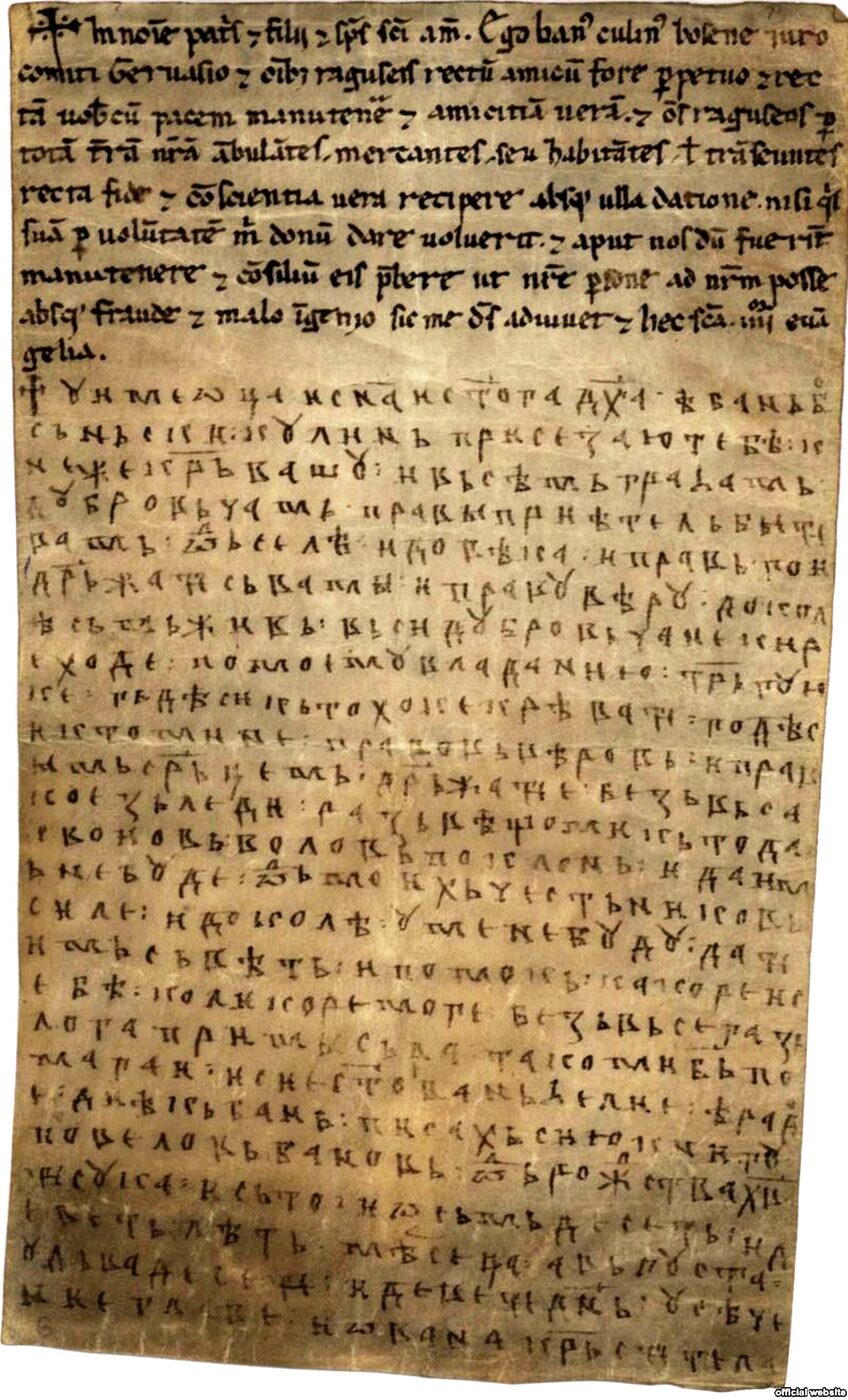
Two alphabets are in current use, Gaj’s Latin and Cyrillic, and an older Cyrillic variant lies behind them. The Charter of Ban Kulin of 29 August 1189, a trade agreement with the Republic of Ragusa, is written in two languages: a Latin text, and a loose Slavic translation in an old form of Shtokavian set down by a scribe named Radoje in bosančica, the Bosnian variant of Cyrillic that stayed in use into the nineteenth century.

None of this fits into seven bits, and for most of the group’s life seven bits was what the wire offered. The regional answer had been YUSCII, an informal name for a set of Yugoslav national standards built on ISO 646. The Latin variant, JUS I.B1.002, kept the ASCII code points and overwrote the less-used punctuation: the position of @ holds Ž, the four positions running from the opening square bracket through the caret hold Š, Đ, Ć and Č, and the matching lower-case run through the tilde holds ž, š, đ, ć and č. Two companion standards, JUS I.B1.003 and I.B1.004, did the same for Serbian and Macedonian Cyrillic, mapping the digraph letters onto the Latin q, w, x and y. The scheme had one virtue — unlike a code page it degraded into something a reader could still puzzle out — and two costs: programmers lost the brackets and braces their source code needed, and text crossing between a YUSCII terminal and a plain ASCII one came out with its letters turned back into punctuation.
The eight-bit successors were ISO/IEC 8859-2, first published in 1987 and known informally as Latin-2 (the IANA charset name is ISO-8859-2), code page 852 for MS-DOS, and Windows-1250, with ISO 8859-5 and Windows-1251 for the Cyrillic side. Usenet’s own specification did not arbitrate: RFC 1036 of December 1987 required printing ASCII in the header fields it defined and said nothing at all about the character set of the body, leaving that to the transport — and feeds that stripped the eighth bit were a routine hazard well into the 1990s.
The repertoire was never the problem. Latin Extended-A, the Unicode block from U+0100 to U+017F, has been in the standard since version 1.0 in 1991, when it was called European Latin, and it holds every accented letter this Latin alphabet needs; Latin Extended-B carries the digraph characters from U+01C4 to U+01CC, catalogued as Croatian digraphs matching Serbian Cyrillic letters; and the Cyrillic block from U+0400 to U+04FF was also in version 1.0, with 192 characters assigned. What was missing was any confidence that the path from a poster’s terminal to a stranger’s newsreader would carry them intact.
So the habit that developed was to strip the accents and hope. A single c stood for both ć and č, s for š, z for ž, and d or dj for đ. The consequence for anyone searching the archive today is direct: a query in correctly spelled Bosnian will miss most of the traffic, a query in stripped form will miss the rest, and the stripped forms are ambiguous in ways no query expansion resolves. Mismatched code pages add a third layer, in which the same message survives as text on one archive server and as mojibake on another. Serious work here means searching both spellings of every name, every time.
Where the readership actually was
More than 2.2 million people were displaced by the war, and the readership is best understood as a function of where those people went. The most thorough public accounting is Mapping the Bosnian-Herzegovinian Diaspora, published in 2018 by the International Organization for Migration with the country’s Ministry of Human Rights and Refugees, and written by Hariz Halilovich, Jasmin Hasić, Dženeta Karabegović, Ajlina Karamehić-Muratović and Nermin Oruč.
Totals differ sharply according to what is counted. Estimates in circulation run from roughly two million people abroad to about four million once later generations are included, and no single number should be quoted as settled. The distribution is less disputed than the total: the largest European populations are in Germany, Austria, Slovenia, Switzerland, Sweden and the Netherlands, and the largest outside Europe in the United States, Canada and Australia. Americans of Bosnian descent were put at around 350,000 in a 2020 estimate, and the St Louis metropolitan area holds the largest single concentration in the United States, with some 40,000 refugees reported to have settled there from the 1990s onward.
A readership distributed like that has no home hour. From the Australian east coast to the American Pacific is a spread of seventeen to nineteen hours depending on the season, with Sarajevo, Germany and Sweden bunched in the middle and the largest American concentration seven hours behind them. The effects are structural rather than anecdotal: there was no evening at which the group was all present and no night at which it was all asleep, so threads unrolled at the pace of a reply per reader per day rather than at conversational speed, and a post that said this morning was ambiguous unless it named a place. For the relay function the same dispersion was an asset — a report entering at any hour found somebody awake to read it.
The traffic between the crises
An outsider remembers the politics of a wartime culture group; the fixed material any culture group argues over is food, recordings, results, anniversaries and books. This directory does not quote threads it has not read, so what follows is that material and its dates, not a claim about particular posts.
The musical centre of gravity is sevdalinka, the slow, ornamented song form, added to UNESCO’s Representative List of the Intangible Cultural Heritage of Humanity in 2024 — three decades after the period in which such groups were most used. The literary canon at issue was largely a Yugoslav-era one, Andrić and Meša Selimović — born in Tuzla in 1910, dead in Belgrade in 1982 — chief among its disputed property. The Sarajevo Film Festival, whose first edition ran from 25 October to 5 November 1995 while the siege was still on and which had a ten-day predecessor in October 1993, gave the calendar an annual fixture that has run every year since.
Sport supplies the dates most often produced from memory. The 1984 Winter Olympics were held in Sarajevo from 8 to 19 February 1984, with 49 nations and 1,273 athletes; Yugoslavia’s Jure Franko took silver in the men’s giant slalom. The football team’s first appearance at a major tournament came much later, at the 2014 World Cup. Heritage supplies the rest: the stećci, medieval tombstones inscribed by UNESCO in 2016 as a selection of some 4,000 monoliths across 28 sites, twenty of them in Bosnia and Herzegovina; the Old Bridge area of Mostar, inscribed in 2005; and the Sarajevo Haggadah, an illuminated Passover service book made in Catalonia around 1350 and sold to the National Museum in Sarajevo in 1894, designated a national monument on 17 January 2003.
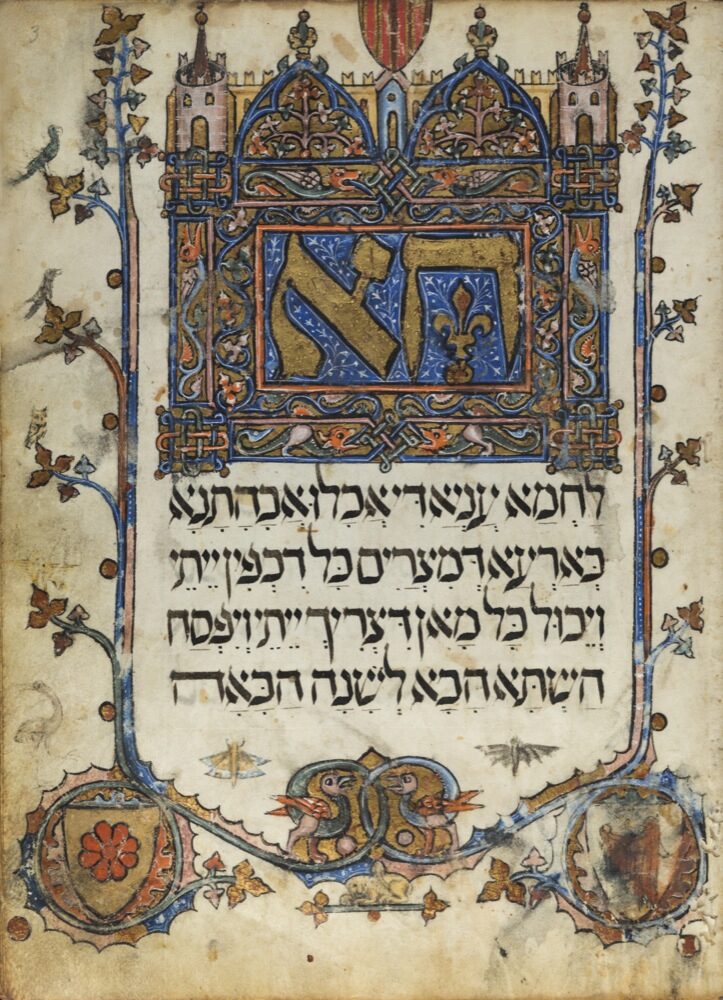

Several of those honours postdate the group’s active life by a decade or more, which matters when reading the archive: the posters were arguing about an inheritance whose international standing was then unsettled, and in some cases about objects whose survival was in question. The ordinary traffic is what tells you who the group was between the emergencies.
An archive written before the ending was known
The archive most readers reach has a shape worth knowing. Deja News began capturing Usenet in March 1995; Google acquired the collection and Google Groups became operational in February 2001, with holdings reaching back to 1981 through donated tape collections rather than any continuous feed. Coverage of any particular group before 1995 therefore depends on who happened to keep tapes, and is uneven. For this group that is an unhappy fit: its first two and a half years, the stretch its reputation rests on, are the least reliably preserved part of it. Google Groups stopped supporting new Usenet content on 22 February 2024, so what survives is now a fixed body rather than a growing one.
What gives that body its value is a property no later account can have: every message in it was written by somebody who did not know how the thing would end. The judgements in it were formed without the tribunal record, without the 1995 settlement, often without knowing whether a particular town still stood. That makes the archive excellent evidence of one thing and poor evidence of another. As a record of what was known, believed, feared and disputed on a given date by a dispersed population with partial information, it is close to unmatched for its period; as a source for what actually happened it is superseded by three decades of documentary and judicial work, and should not be used.
Reading soc.culture.bosna-herzgvna today
- Historical archive: Google Groups — soc.culture.bosna-herzgvna (coverage varies by group and era).
- Open in a newsreader:
news:soc.culture.bosna-herzgvna— the original site offered exactly this link, and it still works if your system has a newsreader registered for thenews:scheme. - Live access: point an NNTP newsreader at a modern server — see accessing Usenet today.
- The original news2mail e-mail subscription service ended in the mid-2000s and no longer operates.