soc.culture.australian
Australian culture and society.
From Vegemite defence to native-title debates, soc.culture.australian covered Australian life for locals and expats. Its 1990s threads on republic vs. monarchy and on Aboriginal reconciliation track the national conversation of that decade closely.
The group maintained long-running FAQ posts for migrants and travellers that were, for years, among the better practical guides available online.
On this page
- The group's own paperwork
- Before the Internet: how news reached Australia at all
- 23 June 1989: the far end of every link
- What the link cost, and what that did to a news feed
- The hierarchy next door, and who sent readers where
- Where the readers were
- The record in dates: federation and the immigration law
- The record in dates: the migration programmes
- The record in dates: a referendum, a dismissal, another referendum
- Aboriginal and Torres Strait Islander Australia: the documented record
- Language and script
- What a culture group carried: the fixed points of the year
- The decade the group talked its way through
- What the record does not show
- Scope and limits
The group's own paperwork
What survives of this group's creation is not the argument but the receipt. The Internet Systems Consortium mirrors the Usenet control traffic, and its file for soc.culture.australian is short: six newgroup messages, one rmgroup, and nothing else. The earliest is dated 12 November 1990 at 01:54:11 GMT, cross-posted to soc.culture.ctl and control, and carries an Approved: header from an address at genbank.bio.net, a machine whose Organization line reads “GenBank Online Service” and whose path into the network ran through the host that carried the bionet biology groups. Its body opens with a single line of provenance — that the group was passed by vote on 4 November — and then sets out the charter in full.
The charter is worth having in front of you, because it is not the usual thing:
Australia is a country which claims to be “multi-cultural”. Its society is made up from the indigenous people of Australia, immigrants from many nations, and their descendants. Hence the group charter does not attempt to define or limit what is meant by “Australian culture”; the purpose of this newsgroup is to provide a forum for the discussion of any subject related to Australia and its society and culture - past, present and future.
Input regarding other peoples in the region, including New Zealanders, who do not currently have their own newsgroup, will be welcome, although it is expected that issues raised will be relevant to Australian culture and society.
Three things stand out. The scare quotes around multi-cultural are the proposal's own, and they are doing work: the charter declines to say what Australian culture is, and says so deliberately, which in a hierarchy full of charters that enumerate a nation's language, faith and cuisine is unusual. The second paragraph is a piece of housekeeping — a temporary annexation of the neighbours, made necessary by a gap in the namespace. And the moderation line reads, in its entirety, MODERATION: No.
The New Zealand clause dated quickly. A Call for Discussion for a New Zealand group was posted on 25 February 1991, cross-posted to soc.culture.australian among others; it proposed a charter covering “news, politics, Maori and Pacific Island culture, music, sport, events, films, telly, jobs, farming” and, further down the same list, bungy jumping and pavlovas. The result posted on 16 April 1991 recorded 244 valid votes, 217 in favour and 27 against — clear of the Big-Eight thresholds of the day, which required 100 more YES votes than NO and at least two-thirds of all valid votes cast. Within five months of the Australian group opening for business, the second paragraph of its charter had lapsed into history.
What the archive does not hold is the Australian group's own paperwork. The ISC copy of news.announce.newgroups has no file for soc.culture.australian at all; its weekly lists of new groups begin on 18 February 1991, and a group carried on 4 November 1990 falls just outside the collection. The Request for Discussion, the Call for Votes and the result — the tally, the names of the voters, the arguments over the name — are not there. This page therefore gives no vote count for the group, because none is recoverable from the surviving record, and a plausible number is worse than no number at all.
The remaining control messages are ordinary housekeeping and are interesting only as a picture of how a 1990s newsgroup actually spread. The same newgroup and charter went out again on 11 December 1990; a one-line re-issue came from a Massachusetts company's news server on 23 May 1991, another from a UUCP site in Germany on 18 June 1991, and one more on 26 April 1992 from a University of Maine machine with Distribution: umcs, which is to say a message meant to travel no further than that campus. A group did not arrive everywhere at once. It arrived where an administrator noticed it was missing and said so.
The last message in the file is the odd one. On 4 November 2001 an rmgroup for soc.culture.australian was injected through a Quebec host, purporting to come from an address associated with the tin newsreader, with the body “please remove the bogus newsgroup soc.culture.australian” and a randomly generated sentence for a signature. It carried no Big-Eight authority and it achieved nothing: the group had been carried for eleven years by then, and the standard control configuration for the Big Eight drops every unsigned newgroup and rmgroup for those hierarchies, honouring only messages that verify against the news.announce.newgroups key. The current ISC namespace files still list the group. In the active file the entry reads soc.culture.australian 0000000000 0000000001 y — the trailing y meaning local posting permitted — and in the newsgroups file it occupies one tab-separated line, the group name, a tab, and the description:
soc.culture.australian Australian culture and society.
Four words for a continent. That line, and the charter above it, are the whole of the group's formal self-description; everything else on this page is the world it sat in.
The one fact the paperwork does not state, because in 1990 it went without saying, is the group's reach. soc.culture.australian belonged to the soc.* branch of the Big Eight, the hierarchies that a full news feed anywhere in the world carried as a matter of course, and like nearly all of soc.culture.* it was unmoderated. That reach is the whole practical difference between this group and the domestic hierarchy described further down: a Big-Eight group turned up on a server in Ohio or Oslo without anybody in Australia having to arrange it.
Before the Internet: how news reached Australia at all
Australia had computer networking for a decade and a half before it had the Internet, and the shape of what came first explains a great deal about what came after. From the mid-1970s, computer-science departments strung links together: the Universities of Melbourne and Wollongong exchanged files between two Unix machines over a dial-up line, and out of that grew the Australian Computer Science Network, universally called ACSnet, run out of Melbourne and Sydney.
ACSnet ran on software developed at the University of Sydney and known as SUNIII — Sydney University Network, version three — later reworked as MHSnet. Technically it resembled UUCP: it moved electronic mail, files and netnews efficiently over links that were not permanently up, adding dynamic routing and a hierarchical namespace that UUCP's hardwired bang paths lacked. It was connected to the pre-Internet global mail community through gateways to UUCP and other protocols, and it gave Australia the domain .oz, later folded into .oz.au when the country-code domain arrived.
The published description of the national infrastructure before 1989 contains one sentence that is, for present purposes, the important one: groups of hosts throughout the country exchanged mail and files on a periodic schedule using the SUNIII software, with several international dial-up links around the country passing the traffic onward where required. That is the mechanism. Nothing about it is continuous. A store-and-forward network polls, gathers what has accumulated, opens a call, ships the batch and hangs up; and the international calls, which in that period ran through the Overseas Telecommunications Commission's dial-up service, were the calls you most wanted to keep short. Usenet articles reached Australian readers in bundles, at intervals set by whoever was paying the phone bill, and a thread arrived in the way a mailbag arrives.
Two other pieces of the pre-1989 landscape belong on the record. CSIRONET, which began in 1963 out of the CSIRO's Division of Computing Research, had by 1976 connected more than fifty computers and more than 250 terminals around Australia. And in 1986 the South Pacific Education and Research Network, SPEARnet, got off the ground under the direction of a university computing centre in Queensland; it was modelled on Britain's JANET and used the Coloured Book protocols — a reminder that the eventual victory of the Internet protocols was not obvious at the time to anyone in the southern hemisphere.
The domain came before the connection. IANA's root database gives 5 March 1986 as the registration date for .au, delegated to a network programmer at the University of Melbourne some three years before Australia had a permanent Internet link of any kind, and administered for years afterwards on a voluntary basis. That sequence — namespace first, wire later — is unusual, and it is a fair summary of how Australian networking was done in the 1980s: by university staff, ahead of the money.
The candid explanation for the delay is on the record too, from a contemporary who worked on the systems concerned and whose remark the standard history quotes: asynchronous store-and-forward networking over UUCP and ACSnet was so successful at delivering the core services — file transfer, mail and news — that the inability to log in to a remote machine interactively was a minor issue, and the cost-benefit equation for most people was not there. Australia adopted the Internet protocols not when they became available but when the arithmetic changed.
23 June 1989: the far end of every link
The arithmetic changed because somebody else paid. By late 1988 the technical committee working for the Australian Vice-Chancellors' Committee had satisfied itself that a national academic network was viable, and approval to proceed was given in about May 1989. The international leg came together in parallel, through the Pacific Communications programme at the University of Hawaii, which proposed to NASA a research infrastructure project extending IP connectivity to Australia and other countries in the Pacific. NASA offered to fund half the cost of a 56 kbit/s satellite link from Hawaii to Australia. In June 1989 the University of Melbourne leased a 56 kbit/s bitstream service to the University of Hawaii, and on 23 June 1989 the connection was completed, in a laboratory at the University of Melbourne, using a Proteon P4100 router borrowed from Hawaii and a Sun 4/260. At the Hawaiian end of the link it was still 22 June.
That date is the one Australia keeps. It is the country's first permanent TCP/IP connection to the Internet, and everything on the network in Australia after it — including every article that ever appeared in this newsgroup from an Australian server — descends from a circuit that a foreign space agency half-paid for because a Hawaiian research programme asked.
AARNet, the Australian Academic and Research Network, was established in the same year by the Vice-Chancellors' Committee. In 1990 it built a national backbone from Brisbane to Perth, each link initially 48 kbit/s, starring out from a hub at the international landing point in Melbourne, and connections were established to a succession of Australian universities and to the CSIRO, most of them by May 1990. AARNet's own history describes the design as multi-protocol at the start — IP alongside DECnet and X.25 — so that the existing ACSnet and SPEARnet worlds could be accommodated rather than abandoned; the standard scholarly account of the period says instead that the decision was taken from the outset to carry IP and nothing else. The two accounts agree on the outcome: within a few years AARNet was an IP network and nothing else.
The capacity figures deserve to be read slowly, because they are the physical setting of this newsgroup's Australian half. Traffic volume doubled roughly every eight months. The original 56 kbit/s link to the United States, at near saturation, was supplemented in late 1990 by a new 128 kbit/s circuit direct to FIX-West in San Francisco — there was no more capacity on the original circuit to Hawaii, and relocating the American end to the west coast was cheaper — upgraded to 256 kbit/s in April 1991, with a request for 512 kbit/s lodged that November. The national backbone links went to 2 Mbit/s in 1991. By 1992 AARNet connected 40,000 computers.
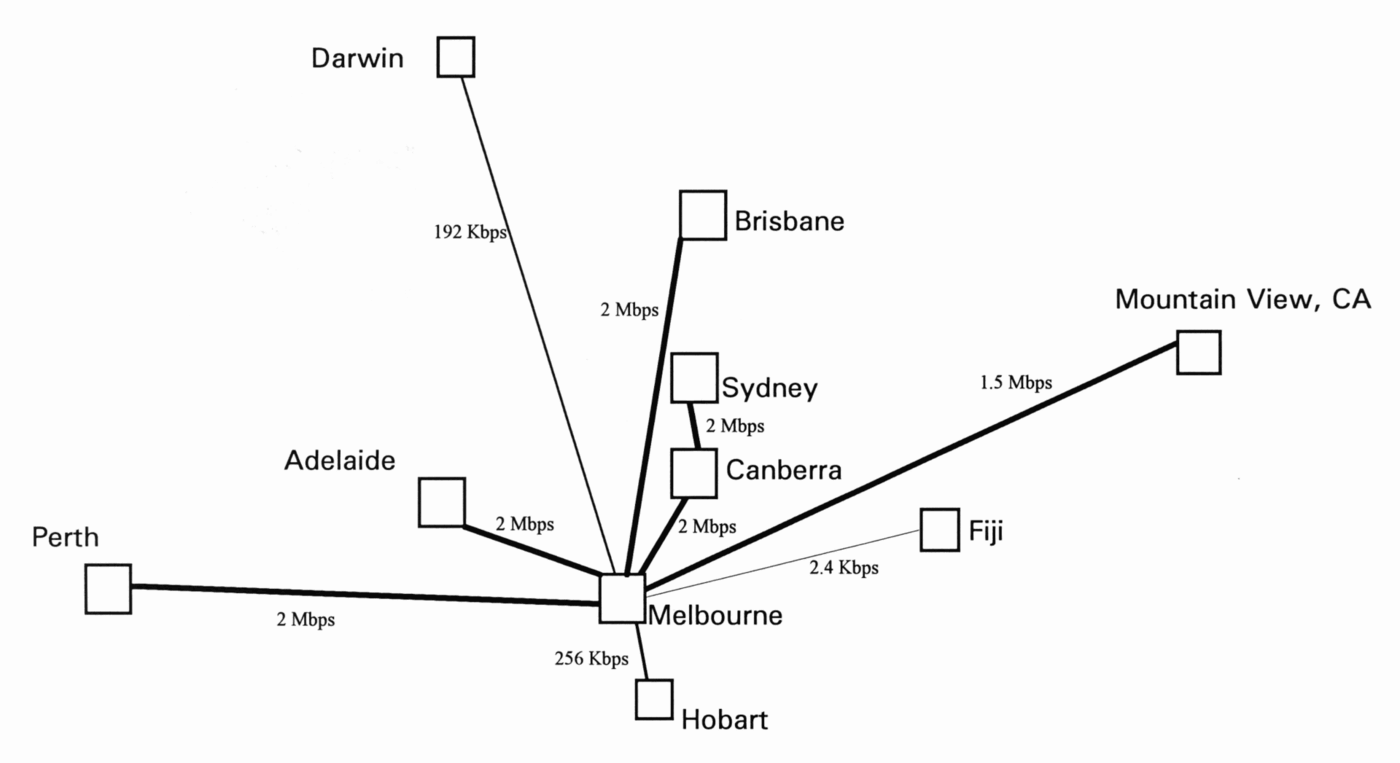

By 1995, when the network was sold, the main capital-city backbone links ran at 2 Mbit/s, the link to the Northern Territory at 256 kbit/s and the one to Tasmania at 512 kbit/s, and AARNet's entire international capacity — the whole of Australian academic and research traffic with the rest of the planet — was 4.5 Mbit/s. Every newsgroup on earth, this one included, arrived through that.
What the link cost, and what that did to a news feed
From the beginning the cost of the international link to the United States was the single biggest item in AARNet's budget. This is the fact around which Australian network culture organised itself for the next twenty years, and it has a direct bearing on Usenet, because a full news feed is, seen from an Australian server, almost pure inbound international bulk traffic: megabytes arriving from elsewhere, continuously, whether or not anybody reads them.
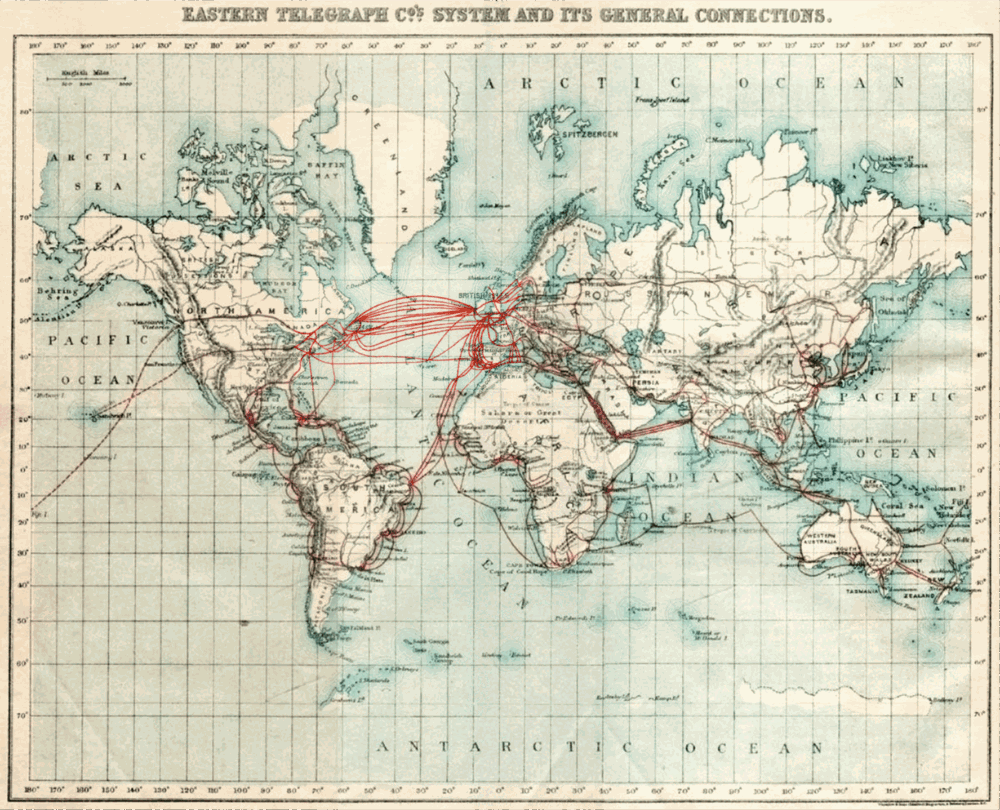

The charging models followed the cost. The standard scholarly history of the Australian Internet records that charging to member institutions changed from a levy to a volume-based tariff in about 1992; AARNet's own twentieth-anniversary history dates the decisive step to January 1995, when a volume-based charging scheme was introduced for members' incoming international usage in a bid to recoup some of the cost of the offshore links, and adds that user-pays charging for the international link was not popular with members. The two accounts differ on the year and agree on the direction: at some point in the first half of the 1990s, traffic from overseas stopped being a fixed subscription and started being a meter.
Public access ran alongside the academic network almost from the beginning, and the dates are checkable without being tidy, because the early services did not all offer a permanent full-IP connection. Pegasus Networks' foundation chief executive has said the company began offering public dial-up access in June 1989, locally at first and nationwide from 14 September 1989, operating from Byron Bay and later Brisbane, and exchanging mail and newsgroups with the outside world by UUCP and TCP/IP — at first by direct dial-up to the United States, later through ACSnet. The principals of a Perth service reported offering comparable commercial services before obtaining full IP connectivity around 1992. The Australian Bureau of Statistics, taking the stricter definition, identified connect.com.au, which commenced operation in 1992, as the country's first commercial Internet provider. The not-for-profit Australian Public Access Network Association, founded in 1992, ran many small volunteer hosts for bulletin boards and newsgroups before developing into a low-cost access provider for its members. Newsgroups appear in almost every one of those descriptions: for the first Australian public services, news was not a sideline but a substantial part of the product, and therefore a substantial part of the bill.
The commercial layer was metered from the start. AARNet opened a value-added reseller programme in May 1994 — the first reseller was connect.com.au — and the resellers were charged under a per-megabyte scheme, with the volume of what they pulled across the Pacific the quantity that mattered. By June 1995 AARNet was serving over three hundred smaller providers, about a fifth of its total traffic was theirs, and the Vice-Chancellors' Committee concluded it had built something it did not want to run. In May 1995 it sold the commercial customer base and the operating network to Telstra, which paid the Committee a one-off $3.8 million for the goodwill of the commercial customer base and agreed to reduce tariffs, provide round-the-clock customer service and raise transmission capacity from 4.5 to 6 Mbit/s. AARNet2, built over an Optus ATM network, went into service in 1997.
What follows for Usenet has to be stated carefully, because it is the point where documentary history shades into mechanism. No feed ledger for any Australian news server survives in the archives consulted for this page, and this page does not invent one. But the mechanism is not in doubt. Before 1989, news moved into Australia in scheduled batches over dial-up links whose international minutes somebody paid for by the minute; after 1989 it moved over a shared international circuit measured first in tens and then in hundreds of kilobits per second, which from 1992 or 1995 — take your pick of the two histories — was billed by the megabyte at the receiving institution. A news feed is exactly the kind of traffic that such a regime punishes: large, continuous, inbound and, unlike a researcher's file transfer, nobody's specific request.
The pressure eased slowly and late. The Southern Cross Cable, whose construction began in July 1999, was in customer use by November 2000, with each cable initially carrying 120 Gbit/s — the first genuine loosening of the trans-Pacific bottleneck, and it arrived in the same season as the Sydney Olympics, at the far end of the decade in which such groups were most used. The habit of mind outlasted the scarcity by years: an OECD comparison in October 2008, covering the countries where more than half of broadband offers carried bitrate or data caps, found Australia one of four of the thirteen in which every single plan option carried a download cap, and ranked it first by a wide margin on the average price charged per additional megabyte once the cap was reached, at US$0.103 — the next highest, Ireland, charged US$0.018. Australians counted bytes long after most of the world stopped, because for the first fifteen years of their network there was nothing else to do.
The hierarchy next door, and who sent readers where
Australia had its own Usenet hierarchy, and it was not a token one. The current ISC namespace files list 148 groups under aus. — against 139 under soc.culture. for the whole world — covering everything from aus.bushwalking and aus.rail.models to aus.legal.moderated and aus.media-watch, and including aus.flame, whose one-line description in the namespace file is “Abusive noise, posted by morons.” The obvious question, which every reader of this page eventually asks, is why a country with that much domestic namespace needed a worldwide group as well. The answer is documented, in the hierarchy's own paperwork, and it is not a matter of folklore.
First, the administration. In 1993 aus.* control messages went out over a University of Wollongong address, and a batch on 24 June 1994 came from munnari.oz.au, the University of Melbourne machine at the centre of Australian networking. From 2 April 1998, in the words of its own FAQ, the hierarchy was maintained by an organisation known as ausadmin, a volunteer effort whose operational staff and facilities were provided by a Sydney access provider, with its own website, its own PGP key and aus.net.news as its administrative group. The arrangement holds to this day: the standard control.ctl file drops any newgroup or rmgroup for aus.* from any source, and honours only messages that verify against the ausadmin signature.
Second, the rules — and the arithmetic is the interesting part. A proposer sent a Request for Discussion to ausadmin by e-mail rather than posting it; ausadmin reviewed and, if satisfied, posted it to aus.net.news; discussion ran twenty-one days; a Call for Votes then opened a fourteen-day e-mail ballot counted automatically. A group passed if at least two-thirds of respondents voted YES and there were at least twenty more YES votes than NO. Then five days for public examination of the result, then the control message. The two-thirds test is exactly the Big Eight's; the margin is not. Where a worldwide group needed a hundred net YES votes, an Australian one needed twenty. That is not laxity, it is scale: a national hierarchy draws its electorate from one country, and a threshold calibrated for the whole network would have made group creation in Australia nearly impossible. The FAQ also enforced the old fourteen-character limit on each component of a name, apologising for it as “an unfortunate anachronism, but one we have to live with”.
Third, the screening question, which is the one that matters here. Before accepting a proposal, ausadmin asked the proposer to “consider whether your topic is uniquely Australian or has enough Australian content to justify a regional newsgroup rather than a global one” — followed by the deflating example that there is not much point to an Australian Coca-Cola newsgroup, since you can buy Coke around the world. The division of labour was a test applied case by case, and its mirror image appears in the aus.general FAQ, which as updated in February 1996 printed a routing table for anyone who had posted in the wrong place. Under “Where should I post, then?” it sent flames to aus.flame, political discussion to aus.politics, censorship on the net to aus.net.policy — and this:
General questions about Australia: soc.culture.australian
The same FAQ answered the question of who was allowed to post in the domestic group by telling non-Australians they were welcome if their subject was of specific interest to Australians, and adding: “If it's of interest to everybody, post it to the appropriate group in alt, comp, misc, news, rec, sci, soc or talk.” Read the two documents together and the settlement is explicit. The domestic hierarchy took the domestic detail; the worldwide group took the general question, the outsider, the intending migrant and the expatriate — the traffic for which a group that propagated only patchily beyond Australasia was no use at all.
Carriage is the other half of the answer, and the hierarchy admitted it in writing. Regional groups travel only as far as individual administrators choose to carry them, and the aus.* FAQ told proposers so plainly: creating a group successfully requires it to be created on a majority of the servers that carry the hierarchy, many site administrators accept the ausadmin signature and create new groups automatically, and many do not, so that follow-up action asking news administrators to add the group by hand is sometimes required. If that was the position within Australia, the position in Ohio or Oslo needs no elaboration. A reader outside Australasia who wanted an Australian conversation had one dependable address, and it was the Big-Eight one.
A worked example survives in the control archive, PGP-signed and dated. The newgroup for aus.sport.cricket, issued on 12 November 1999, carries a charter “culled from the vote result announcement” in which the proposer sets out the case at length: during the World Cup the worldwide cricket group was inundated, and while the geographical diversity of its posters was its greatest strength, that could also be its hindrance for anyone wanting to read about Sheffield Shield matches or teams in the Sydney metropolitan area. The new group, the proposal says, would “complement the international level of discussion” rather than replace it. That is the whole Australian answer to the two-hierarchies question, written down by somebody who had to justify it to an electorate.
Where the readers were
The overseas half of this group's readership is not countable, but the pool it was drawn from is. The 2001 census of the United Kingdom recorded 107,871 residents born in Australia, concentrated in London; the 2000 census of the United States enumerated 60,965 Australian-born residents, of whom 15,315 were American citizens. Neither figure counts readers of anything. Both sit on the far side of the working day from Sydney, which is the property that matters.
The home half is countable in a different way. The World Bank series for individuals using the Internet, compiled from ITU returns, puts Australia at 2.2 per cent of the population in 1994 and 3.3 per cent in 1996 — and then 16.4 per cent in 1997, 30.8 in 1998, 40.8 in 1999, 46.8 in 2000 and 52.7 in 2001. The country went from a research network to a majority-online population inside five years, and it did so during precisely the years in which such groups were busiest.
That makes soc.culture.australian unusual within its own branch. A good many soc.culture.* groups spent their first decade as diaspora rooms in which the country itself was barely represented, because the country itself was barely on the network; some of them, like soc.culture.yugoslavia, served populations scattered by war, with all that implies for the temperature of the discussion. Australia was on the network from 1989 and its households joined early. This group was carried mostly from home, with expatriates a large and audible minority rather than the whole of it.
The composition of the diaspora is part of the same picture. Australians abroad in this period were for the most part students, emigrants and working travellers who had left a functioning country for their own reasons and could return to it. That is a different starting position from the one behind several of the group's neighbours in the hierarchy, and the difference is a fact about the populations rather than a judgement about the conversations they had.
The inbound flow mattered as much as the outbound. The World Bank puts Australia's international migrant stock at 22.9 per cent of the population in 2000 — a figure that had sat between 22 and 24 per cent since 1990 — so a substantial share of the home readership had a country of origin of its own and, in this hierarchy, a group for it. A conversation about Australian culture conducted in soc.culture.* was therefore also, structurally, a conversation between people with two group subscriptions.
For expatriates the group had a plain utility that is easy to forget now. Before Australian newspapers were reliably online — and the connectivity figures above show how late that was — a worldwide newsgroup was one of the few places to get news from home with commentary attached. Election nights and sporting finals were followed at long distance through other people's posts, at the speed at which other people typed them. A question asked over breakfast in Melbourne collected its answers overnight, and an argument could run for days without a pause simply by being handed westward around the planet.
A readership arranged like that has no closing hour, and that is the practical logic behind the periodically reposted FAQ that soc.culture.* groups kept in circulation. A group fielding the same migration, visa and travel questions from people in the wrong hemisphere is better served by a document on a posting schedule than by a thread that nobody awake can answer.
The record in dates: federation and the immigration law
The chronology below is set out as a record of what happened, not of what was said about it. What was said about it belongs to the archive, and this page does not paraphrase arguments it cannot quote.
The Commonwealth of Australia came into being on 1 January 1901, when the Constitution took effect and six self-governing colonies became states. It was made by referendum: votes on the draft constitution were held in four colonies in June 1898, and although all four returned majorities, New South Wales law required at least 80,000 affirmative votes and the number was not reached. A premiers' conference in early 1899 amended the draft — limiting the Braddon clause, which guaranteed the states three-quarters of customs revenue, to ten years; requiring the federal capital to be in New South Wales but at least a hundred miles from Sydney — and second referendums through 1899 and 1900 carried in every colony.
Among the first federal parliament's first acts were the Immigration Restriction Act 1901 and the Pacific Island Labourers Act 1901. The first is the founding instrument of what became known as the White Australia policy. Its mechanism was the dictation test: an immigration officer could require any arrival to write out a passage of fifty words in a European language of the officer's choosing. After Japanese objections the wording was amended in 1905 to any prescribed language, but no other language was ever prescribed, so European languages remained the only ones authorised. The device was borrowed from Natal and adopted after objections from the British government, which feared that an explicitly racial bar would offend British subjects in India and Britain's ally Japan. Its administration was not ambiguous: the first administrator of the Act instructed customs officers in 1903 that it was not desirable that anyone should pass the test, and that a person likely to pass in English should be tested in another language. A companion statute of the same year, the Post and Telegraph Act 1901, required any ship carrying Australian mail to employ only white crews — a detail worth noting on a page about communications infrastructure.
The dismantling took a quarter of a century and can be dated in stages. In 1947 the Chifley government relaxed the Act to allow non-Europeans to settle permanently for business reasons. The Migration Act 1958 abolished the dictation test outright. After a review of immigration policy in March 1966 the Holt government opened migration to non-Europeans judged “well-qualified”, cut the residence period for citizenship from fifteen years to five to match that for Europeans, and removed discriminatory provisions from family reunification; in July 1966 the prime minister stated publicly that Australia no longer had a White Australia policy but a restricted immigration policy. The Whitlam government legislated in 1973 to remove race entirely as a component of immigration selection, and the Racial Discrimination Act 1975 made racially based selection criteria unlawful. That statute mattered later in ways nobody drafting it in 1975 predicted; it reappears in the native title cases below.
The record in dates: the migration programmes
The exclusion ran alongside the largest planned immigration programme in Australian history, and the two are not separable. The Assisted Passage Migration Scheme was created in 1945 by the Chifley government and its first Minister for Immigration, Arthur Calwell, as part of the “populate or perish” policy — a phrase produced by a country that had just spent three years believing it might be invaded. Adults paid ten pounds in processing fees for the passage and children travelled free, which is where the enduring nickname came from; migrants were required to stay two years or repay the fare, and the return voyage cost at least £120, a sum most could not raise. The scheme peaked in 1969, when more than 80,000 people used it; the fare rose to £75 in 1973; the scheme ended in 1982. Over a million Britons settled in Australia under it, and about 250,000 went home again.
Britain was not the whole of it. Hundreds of thousands of displaced Europeans arrived from 1947, and assisted migration was progressively extended beyond the British Isles. The emblem of the period is the Snowy Mountains Scheme, whose construction officially began on 17 October 1949 and was completed in 1974: sixteen major dams, nine power stations, two pumping stations and 225 kilometres of tunnels, pipelines and aqueducts, built by over 100,000 workers drawn from more than thirty countries, around two-thirds of them immigrants, many from nations that had been at war with one another five years earlier. It cost A$820 million, and the official death toll of workers on the scheme stands at 121. Since 1945, more than seven million people have settled in Australia.
Those two programmes together — the exclusion and the intake — are the setting in which the 1990 charter refuses to define Australian culture. The country the newsgroup was created to discuss had spent forty-five years being rebuilt by immigration while a statute on the books said who could not come, and had finished repealing the last of it only fifteen years before the group opened.
The record in dates: a referendum, a dismissal, another referendum
Three constitutional events sit inside the group's memory, one of them just outside its lifetime and two of them inside.
On 27 May 1967 Australians voted on two questions. The first, to increase the size of the House of Representatives, failed, carrying only one state and about forty per cent of the national vote. The second, the Constitution Alteration (Aboriginals) Bill 1967, removed the words that had excluded Aboriginal people from population counts for constitutional purposes and that had barred the federal parliament from making laws for Aboriginal people in the states. It was carried with 90.77 per cent of votes cast and majorities in all six states, the largest affirmative vote for any Australian referendum, and became law on 10 August 1967. It is also among the most widely misdescribed events in Australian public memory — it is frequently said to have given Aboriginal people citizenship and the federal vote, and it did neither, both having other histories — and the practical effects took some years to appear.
On 11 November 1975 the Governor-General, Sir John Kerr, dismissed the Prime Minister, Gough Whitlam, after the Senate had deferred supply, and commissioned the Leader of the Opposition, Malcolm Fraser, as caretaker prime minister on the understanding that he would immediately call a general election. Supply passed the Senate within hours; parliament was dissolved for a double dissolution; the election of 13 December 1975 returned the caretaker government with the largest majority to that date. No constitutional amendment followed: the Senate's power to block supply and the Governor-General's power to dismiss a prime minister both remain, and neither has since been used to remove a government. In Australia the event is known simply as the Dismissal.
On 6 November 1999 Australians voted on two more questions: whether to become a republic with a president appointed by a two-thirds majority of the members of the Commonwealth Parliament, on the model endorsed by the Constitutional Convention of February 1998, and whether to insert a preamble into the Constitution. The republic question was defeated with 45.13 per cent in favour and 54.87 per cent against, and carried no state; the preamble did worse, at 39.34 per cent. Some 11,785,000 votes were cast, a turnout of 95.10 per cent, of which about 0.86 per cent were informal. This is the only one of the three that fell squarely inside the years in which such groups were busiest, and it is the reason the republic argument is the thing readers most often expect to find in the archive.
Aboriginal and Torres Strait Islander Australia: the documented record
This section reports findings and dates, attributing each to the body that produced it. It adjudicates nothing. It also observes a convention: in many Aboriginal and Torres Strait Islander communities the names and images of people who have died are not used, and this page accordingly names no individual in this section, uses no photograph depicting Aboriginal or Torres Strait Islander people anywhere, and refers to the leading land case by its legal citation, which is how the courts and the legislation refer to it.
Antiquity. Thermoluminescence dating published in Nature in 1990 placed human occupation of a rock shelter in western Arnhem Land at about 50,000 years; those age estimates were queried at the time and afterwards. Excavations at the same site in 2012 and 2015, carried out in partnership with the local Aboriginal corporation, produced a paper in Nature in July 2017 arguing for occupation by 65,000 years with an uncertainty of about 6,000 years. That later estimate has been contested in the archaeological literature — over site stratigraphy and the integrity of the dated deposits — and the excavating team has defended it. Both the claim and the dispute are part of the record.
Treaty and reconciliation. On 12 June 1988, at the Barunga Festival in the Northern Territory, Aboriginal leaders presented Prime Minister Bob Hawke with a statement painted on a 1.2-metre square panel, calling for recognition of land rights and for the Commonwealth Parliament to negotiate a treaty recognising prior ownership and continued occupation. Hawke responded that he wished to conclude a treaty by 1990; no treaty followed. In 1991, as his last act as prime minister, he hung the Barunga Statement in Parliament House, where it remains. The final report of the Royal Commission into Aboriginal Deaths in Custody was published in April 1991 and made 339 recommendations, among them the initiation of a formal process of reconciliation; the Council for Aboriginal Reconciliation Act 1991 was passed on 2 September 1991, establishing a council with a deliberate ten-year life. The Act ceased to be in force on 1 January 2001. Separately, the Aboriginal and Torres Strait Islander Commission Act 1989 took effect on 5 March 1990, creating ATSIC as the body through which Aboriginal and Torres Strait Islander people were formally involved in government programmes affecting them; ATSIC was dissolved on 30 June 2005.
Native title. On 3 June 1992 the High Court decided Mabo v Queensland (No 2), holding that native title to land survived the Crown's acquisition of sovereignty where it had not been extinguished, and rejecting the proposition that the continent had been terra nullius at settlement. The proceedings had begun in 1982; an earlier round, Mabo v Queensland (1988), had held ineffective a Queensland statute of 1985 that purported to extinguish the claimed title, on the ground that it was inconsistent with the Racial Discrimination Act 1975. The Native Title Act 1993 received royal assent on 24 December 1993 and commenced on 1 January 1994, establishing the National Native Title Tribunal and a process for claims. On 23 December 1996 the High Court decided Wik Peoples v Queensland by four to three, holding that the pastoral leases before it did not confer rights of exclusive possession, that native title rights could therefore coexist with them, and that where the two were inconsistent the pastoral rights prevailed. The Native Title Amendment Act 1998, known in the debate as the ten-point plan, followed.
Bringing Them Home. The National Inquiry into the Separation of Aboriginal and Torres Strait Islander Children from Their Families was established by the federal Attorney-General on 11 May 1995 and conducted by the Human Rights and Equal Opportunity Commission. It received 777 submissions, including 535 from Indigenous individuals and groups, 49 from churches and 7 from governments. Its report, Bringing Them Home, ran to 680 pages and was tabled in federal Parliament on 26 May 1997. The inquiry found that between one in three and one in ten Indigenous children had been forcibly removed from their families and communities in the period from approximately 1910 to 1970, that in certain regions and periods the figure was greater, and that not one Indigenous family had escaped the effects of forcible removal. The accompanying community guide stated that the violations “were an act of genocide, aimed at wiping out indigenous families, communities, and cultures”. The report's own estimate of at least 100,000 children was derived by applying its upper bound to the Aboriginal population recorded in 1994, and both the estimate and the inquiry's evidentiary standards were publicly disputed afterwards — by the responsible minister in a 2000 submission to a Senate committee, and by writers on both sides, one influential 2001 essay arguing that the lower bound was the likelier figure and putting the total at 20,000 to 25,000 over six decades. The inquiry's own position was that, given the trauma its witnesses had experienced, their testimony was deliberately not subjected to cross-examination.
Apology, and after. On 26 August 1999 the federal Parliament passed a Motion of Reconciliation expressing “deep and sincere regret that indigenous Australians suffered injustices under the practices of past generations, and for the hurt and trauma that many indigenous people continue to feel as a consequence of those practices”; an amendment that would have replaced the regret with an unreserved apology was moved and not passed. Corroboree 2000 was held at the Sydney Opera House on 27 and 28 May 2000, and on 28 May more than 250,000 people walked across the Sydney Harbour Bridge in the Walk for Reconciliation, streaming across for nearly six hours; comparable walks followed in Brisbane, Adelaide, Hobart, Perth and Melbourne, the Melbourne event drawing 300,000. On 13 February 2008 — four years after this site's gateway closed — the Parliament of Australia issued a formal apology to the Stolen Generations, moved as a motion which the House of Representatives adopted unanimously and the Senate passed the same day. On 26 May 2017 the First Nations National Constitutional Convention at Uluru, the culmination of thirteen Regional Dialogues held between December 2016 and May 2017 involving more than 1,200 Aboriginal and Torres Strait Islander representatives, adopted the Uluru Statement from the Heart, calling for a First Nations Voice enshrined in the Constitution and a Makarrata Commission to supervise agreement-making and truth-telling. A referendum on constitutional enshrinement of the Voice was held on 14 October 2023 and was not carried: 6,286,894 formal votes in favour and 9,452,792 against, roughly 39.9 per cent to 60.1 per cent, with no state recording a majority in favour and the Australian Capital Territory the only jurisdiction to do so.
The words moved too. The statutes of 1989 and 1991 say Aboriginal and Torres Strait Islander. Indigenous Australians came into wide general use later, and First Nations later again; the 1967 ballot paper said “the Aboriginal Race” and a campaign badge of the same year said “Vote Yes for Aborigines”. Posts in the archive carry whichever term was current when they were written, which is a fact about the archive rather than about the posters, and one that anybody searching it needs to know.


Language and script
Australian English is a documented variety with its own reference apparatus, not a set of deviations from something else, and the group's language threads had that apparatus to appeal to. The Macquarie Dictionary, first published in 1981, is widely treated as the standard reference for Australian English. The Australian National Dictionary, a historical dictionary on the model of the OED, was published by Oxford University Press in 1988 out of a project begun at the Australian National University in the late 1970s; its evidence is drawn from dated and referenced quotations from over 9,000 Australian sources, and the second edition of 2016 records the history of 16,000 Australian words, phrases and meanings, with new attention to terms deriving from Aboriginal languages and culture and to Aboriginal English. A poster who claimed that some usage was “not a real word” could be, and was, answered from a shelf.
The languages of Aboriginal and Torres Strait Islander Australia are a larger and sadder set of numbers, and the honest position is that the counts vary with the definition. More than 250 distinct languages are recorded as having been spoken on the continent, and scholarly estimates of the pre-colonial total range from about 250 at the low end to as many as 363. By the start of the twenty-first century fewer than 150 remained in daily use, the great majority endangered; a 2020 assessment found that of the barely more than one hundred still spoken, ninety per cent were considered endangered, and thirteen languages are still being acquired by children. Seven of the most widely spoken — Warlpiri, Murrinh-patha and Tiwi among them — retain between one and three thousand speakers each. These are not figures about the newsgroup. They are figures about the country the newsgroup was about, and about a body of language work that has produced grammars, dictionaries and school materials over the same decades.
That language work produced writing systems, and the writing systems are where the network's limits show. Practical orthographies developed for Australian languages routinely need characters that English does not use. Yolŋu Matha, the language family of north-east Arnhem Land, is written with the letter eng, ŋ, and with vowels carrying a diaeresis. Pitjantjatjara and its neighbours mark retroflex consonants by underlining, giving ḻ, ṉ, ṟ and ṯ. Neither set exists in ASCII, and neither exists in the eight-bit code pages that followed.
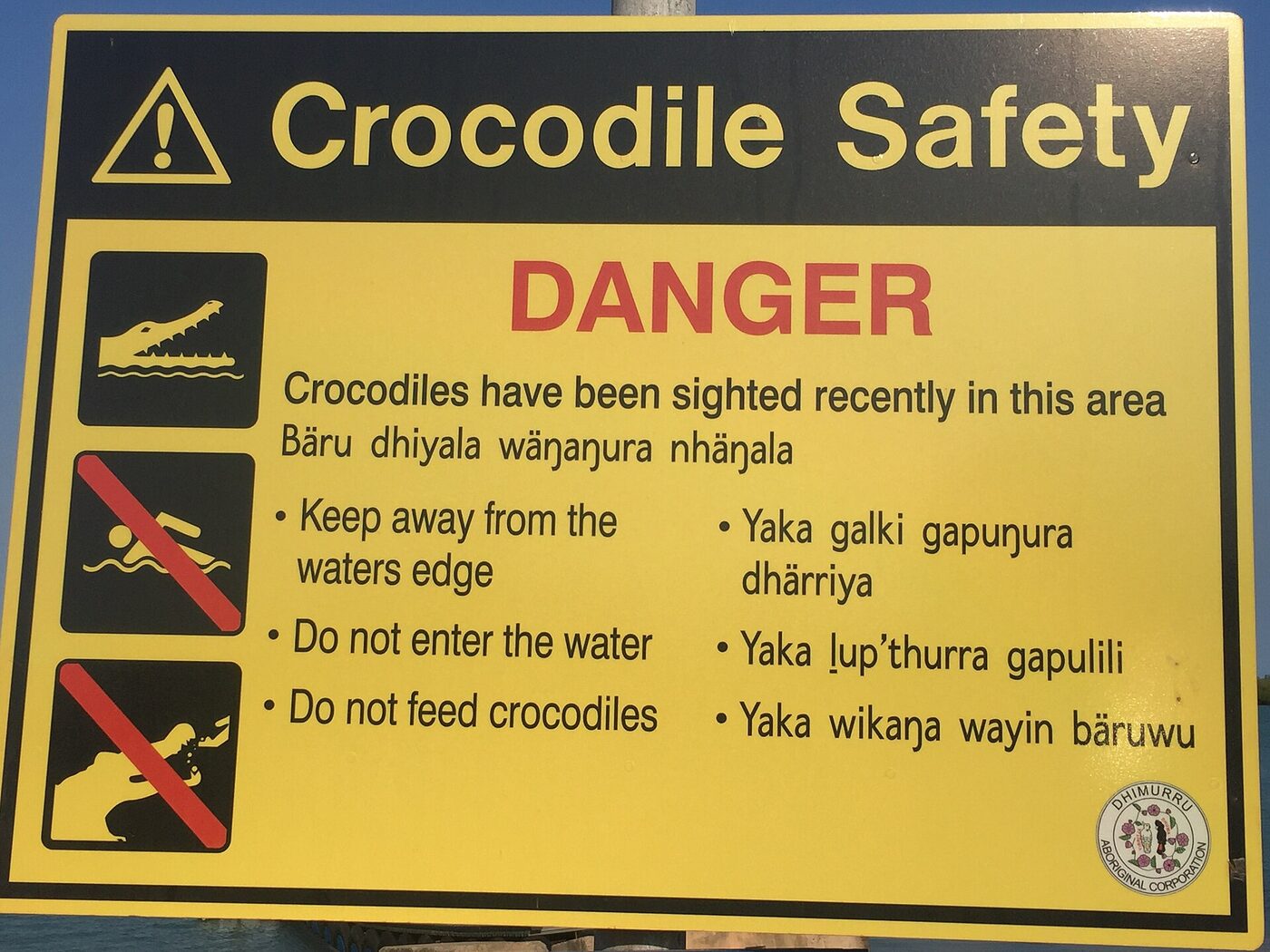

The constraint was formal. RFC 1036 of December 1987, the standard for the interchange of Usenet messages, required an article to be a valid mail message under RFC 822, whose text is defined over the ASCII repertoire, values 0 to 127. English as written in Australia needs nothing outside that range, which is why Australian English cost the network precisely nothing; the eight-bit successors, ISO/IEC 8859-1 and Windows-1252, added western European accents and nothing more. Eng was in Unicode from the beginning, at U+014A and U+014B, in a block whose name in version 1.0 of 1991 was European Latin and which is now called Latin Extended-A. The underlined letters had to wait for Latin Extended Additional, U+1E00 to U+1EFF, whose characters were added in version 1.1 in 1993. Neither was of much practical use until newsreaders and servers handled eight-bit text and MIME dependably, which took most of the decade. In the meantime posters wrote ng for eng and plain letters for underlined ones, as people had been doing on typewriters for fifty years.
The consequence falls on whoever searches the archive now. Spellings are not stable across two decades of posting: Yolŋu appears as Yolngu, Koori as koorie or goori, and place names moved with official usage. The dual name Ayers Rock / Uluru was gazetted on 15 December 1993 — the first officially dual-named feature in the Northern Territory — and the order was reversed to Uluru / Ayers Rock on 6 November 2002. A search on the modern form finds the later posts and quietly misses the earlier ones, which is the sort of silent failure that makes archival search results look thinner and more recent than the archive actually is.
What a culture group carried: the fixed points of the year
Every soc.culture.* group has a calendar, and Australia's is unusually well institutionalised, which meant the group's recurring arguments had documented anniversaries to hang on. Sport was the reliable engine: cricket in general and the Ashes in particular could sustain a thread for the length of a tour, the two rugby codes and Australian Rules brought their sectional loyalties into the group intact, and trans-Tasman needling with the readers of soc.culture.new-zealand ran in both directions as a standing fixture. Language did steady trade as well — slang explained for newcomers, regional vocabulary compared, and Australian English defended, with some relish, against visitors who mistook a variety for a collection of errors. The institutions and the reference works behind all of that are set out below.
Sport. The first Test match between England and Australia was played at Melbourne in March 1877. The Ashes date from Australia's victory at the Oval in 1882 — its first Test win on English soil — and from the satirical obituary in The Sporting Times announcing that English cricket had died and that “the body will be cremated and the ashes taken to Australia”; the English captain's vow to regain them attached the name to the 1882–83 tour and it never came off. Domestic first-class cricket has been played for the Sheffield Shield since the 1892–93 season, the first match beginning in Adelaide on 16 December 1892. The Victorian Football League was founded on 2 October 1896 as a breakaway from the Victorian Football Association, played its first season in 1897, and renamed itself the Australian Football League in 1990 after expanding beyond Victoria. Rugby league's Sydney premiership dates from the formation of the New South Wales Rugby League in 1908; the National Rugby League was formed in 1998 out of the settlement of the Super League split. And the Melbourne Cup has been run at Flemington since 1861, on the first Tuesday in November since 1875, with race day a public holiday across much of Victoria since 1876.
Music and the national day. Triple J's listener poll began as a countdown of all-time favourites broadcast on 5 March 1989, was rested and relaunched in 1993 as an annual poll of the year's songs, and from 1998 was consistently held on 26 January — Australia Day. In 2017 the station announced it would move the poll to the fourth weekend of January, and the first countdown under the new arrangement was broadcast on 27 January 2018. Fixing a national listener poll to a contested national date guaranteed an annual argument about both, and the group inherited it every January of its busiest decade.
Food. Vegemite was developed by the food chemist Cyril Callister in Melbourne for the Fred Walker Company in 1922 and first sold in shops on 25 October 1923; the brand passed to the American company Kraft after Walker's death in 1935 and returned to Australian ownership in 2017. The pavlova is the standing trans-Tasman dispute, and the documented position is more interesting than either national claim. In December 2010 the Oxford English Dictionary's revised entry dated the first recorded recipe under that name to New Zealand in 1927, in a book called Davis Dainty Dishes published by the Davis Gelatine company — where the recipe is for a multi-coloured jelly rather than a meringue — and an earlier dish of the same name had appeared in a Davis Gelatine book published in Sydney in 1926. Food historians on both sides of the Tasman have traced the modern meringue dessert's ancestry back to the Austro-Hungarian Spanische Windtorte and to the German-American meringue and cream desserts that followed it. None of this has ever settled anything, and it was never going to.
Books and film. “Waltzing Matilda” was written in 1895 by Banjo Paterson in western Queensland, to a tune a companion played from memory. The Miles Franklin Award has been given since 1957, its first winner Patrick White's Voss; White received the Nobel Prize in Literature in 1973, the only Australian to have done so. Australian novelists took the Booker Prize in 1982, 1988, 2001, 2003 and 2014. In film, The Story of the Kelly Gang of 1906 was inscribed on the UNESCO Memory of the World Register in 2007 as the world's first full-length narrative feature film; production then dwindled almost to nothing by the early 1960s until government intervention — the Australian Film Development Corporation, established under the Gorton government, and the Australian Film Commission, which replaced it in 1975 — produced the revival known as the Australian New Wave, which ran to the mid-to-late 1980s and gave the country both its art cinema and its exploitation cinema at the same time.
Fauna. The continent's biological isolation is a matter of published percentages: the Commonwealth's 2016 State of the Environment report on biodiversity records that 69 per cent of mammal species, 46 per cent of birds, 94 per cent of amphibians and 93 per cent of reptiles found in Australia are endemic to it. The thylacine's last recorded specimen died in captivity in 1936. And the standing cautionary tale of Australian environmental management is documented to the individual animal: 102 cane toads were imported from Hawaii to Gordonvale in north Queensland in June 1935 to control native beetles damaging sugar cane, one dying in transit; some 62,000 toadlets had been bred and released by March 1937; the population was estimated at over 200 million by 2011; and there is no evidence that they ever affected the numbers of the beetles they were brought in to eat.
The decade the group talked its way through
The politics of the 1990s supplied the group's heavier traffic, and the events are dated even where the threads are not.
The federal election of March 1996 changed the government after thirteen years, from Paul Keating's to John Howard's, and brought with it a sustained public argument about immigration, multiculturalism and the telling of Australian history — the same argument, in different vocabulary, that the 1990 charter had declined to prejudge. One Nation was launched at Ipswich in Queensland on 11 April 1997 and registered federally on 27 June that year, with restriction of immigration central to its platform; it polled second at the 1998 Queensland state election and won the third-highest vote in both houses at the 1998 federal election, taking a single Senate seat. What was said about all this in the newsgroup is in the archive; this page does not characterise it.
On 28 April 1996 a gunman killed 35 people and wounded 23 at Port Arthur in Tasmania, the deadliest mass shooting by a lone gunman in modern Australian history. Twelve days later, on 10 May 1996, the Australasian Police Ministers' Council agreed the National Firearms Agreement, which prohibited most automatic and semi-automatic weapons and established a temporary buyback funded by an increase in taxation; the buyback took in over 650,000 firearms at a cost of about $230 million. The subsequent research literature does not agree with itself: a 2006 study in Injury Prevention found faster falls in firearm deaths and firearm suicides and a decade without mass shootings following the reforms; studies published in 2007, 2008 and 2009 found no significant effect on firearm homicide, or argued that firearm suicides had already been declining before 1996; and those papers have in turn been criticised on methodological grounds. That disagreement is itself a documented fact, and it is the reason the topic was so durable on a network with a large American population: the cross-posted gun-control threads of the late 1990s put participants from two countries in a room where each found the other's starting assumptions genuinely incomprehensible.
The Sydney Olympic Games of September 2000 fell squarely inside the working years of the news2mail gateway — a home event followed from abroad, for once, rather than the reverse — and arrived in the same season as the first trans-Pacific fibre capacity that made following it from abroad plausible.
Then the group declined on the ordinary curve for an unmoderated Big-Eight group. Web forums took the practical traffic, newspaper sites took the news function, and spam took a good deal of what was left. Australia's own aus.* hierarchy thinned in parallel, its remaining namespace preserved in checkgroups messages that describe a considerably livelier network than the one still running. The group outlived the gateway, as most groups did, with the signal thinning year on year.
What the record does not show
An honest reference page should be explicit about its gaps, and this one has several that no amount of further searching would close.
- The founding vote. No Request for Discussion, Call for Votes or result for soc.culture.australian survives in the ISC archive, whose weekly new-group lists begin in February 1991. The control message asserts that the group passed on 4 November 1990; the tally behind that assertion is not in the public record consulted here.
- Readership. There are no subscriber numbers for this group. The readership surveys that produced order-of-magnitude estimates for a handful of large Usenet groups in the early 1990s do not give a usable figure for it, and the census and connectivity numbers quoted above bound the pool of possible readers without counting a single one.
- The FAQ. soc.culture.* groups characteristically kept periodic informational postings in circulation, and the mirrors that once carried them are not what they were: the aus.* administration site linked both the MIT FAQ archive and a local mirror of it hosted by AARNet, and neither now returns such a collection. No copy of this group's own periodic postings could be retrieved for this page from the sources reachable from it, which is a statement about the mirrors rather than about what the group once posted.
- Volumes and feeds. Not one Australian site's news feed configuration or transfer log from the relevant period turned up in the archives consulted. The charging regimes described above are documented; their specific effect on any specific server's newsgroup list is not, and is presented here as mechanism rather than as evidence.
- Threads. No thread title, poster, quotation or message count appears anywhere on this page, for the sufficient reason that the archive is the place to read them and this is not the archive.
Scope and limits
What is described here is a newsgroup and the world it belonged to. The Big-Eight machinery that created it — the Great Renaming, the votetakers, the arithmetic of group creation, what moderation actually meant — is described on the soc.* hierarchy page, and the history of the culture branch as a whole belongs to its hub page. Neither is repeated here.
Australia's regional relationships are stated here only as facts of geography and policy; the Asian continent has its own group and its own page at soc.culture.asian. Sport as a Usenet subject belongs to rec.sport.*; sport appears above only as a national institution with dates. And the aus.* hierarchy is described here only as far as its documented relationship with this group requires, which is to say through its own administrative paperwork rather than through its content.
What remains, when the machinery and the neighbours are subtracted, is a room that existed for fourteen years before this site's gateway opened and outlasted it by many more: a single worldwide address for one country's culture and society, created by a charter that pointedly refused to say what that meant, carried at the far end of the longest and for many years the thinnest link on the network, and used by people on both sides of it to argue about a country that was in the middle of deciding several things at once. The archives hold the middle of that process, not its ends.
Reading soc.culture.australian today
- Historical archive: Google Groups — soc.culture.australian (coverage varies by group and era).
- Open in a newsreader:
news:soc.culture.australian— the original site offered exactly this link, and it still works if your system has a newsreader registered for thenews:scheme. - Live access: point an NNTP newsreader at a modern server — see accessing Usenet today.
- The original news2mail e-mail subscription service ended in the mid-2000s and no longer operates.