soc.culture.belarus
Belarus and Belarusians.
From the 1994 election of Lukashenka onward, the group tracked a country sliding from post-Soviet opening into managed autocracy, with diaspora posters increasingly carrying the conversation as domestic access narrowed.
Language threads on Belarusian vs. Russian usage, Taraškievica orthography and the white-red-white flag give the archive lasting documentary value.
On this page
- The group's own paperwork
- Forged newgroups, and the end of the record
- Two orthographies
- Łacinka, the third written form
- What could be typed, and what could be sent
- The language question
- Chernobyl on Belarusian territory
- The dated political record
- Who could post
- Where the readers were
- What a culture group carried
- What the record does not show
- Scope and limits
The group's own paperwork
For most of the groups in this directory the founding documents are gone. For this one they are complete. The Internet Systems Consortium's mirror of the moderated group news.announce.newgroups holds a single file of about seventy kilobytes for soc.culture.belarus containing the Request for Discussion, both Calls for Votes and the result; the parallel control-message archive holds the newgroup and rmgroup control messages received in the group's name, from a forgery dated April 1996 to a deletion notice of June 2025. Everything in this section is taken from those two files, and the dates, tallies and wordings are theirs.
The Request for Discussion was posted on 8 April 1996 and cross-posted to news.announce.newgroups, news.groups, soc.culture.baltics, soc.culture.polish, soc.culture.soviet, soc.culture.ukrainian, soc.genealogy.slavic and talk.politics.soviet, with notices to two mailing lists: a Belarus list hosted at the University of Tennessee and the Former Soviet Union list at Sovset. The later Calls for Votes swapped soc.culture.russian.moderated for soc.culture.russian in the distribution and dropped talk.politics.soviet to a notice. The rationale was arithmetic and unadorned: over ten million Belarusians in the republic, it said, plus a further three and a half million in the diaspora, and no Usenet group addressing the subject — soc.culture.soviet being, in the proposal's own words, the only possibility, but at best, it is a very, very broad forum.
What was proposed was a moderated group, which for soc.culture.* was the exception rather than the rule. The reason given was short and entirely characteristic of 1996: The need for a moderated group is best explained by a taking a casual look at the many off-topic postings in other, non-moderated usenet groups. We would like to avoid such problems from the start.
The charter then did something no other charter in this directory does. Before defining the group, it apologised for its own spelling:
The spelling of "Belarusian" in this document conforms to our understanding of the official spelling. We use this spelling out of a expression of solidarity, even though some of us feel "Belarusan" should be the spelling in English. Possibly, efforts will be initiated to change the spelling to "Belarusan."
A group about a language written in two competing norms opened its constitution by conceding that its own name had two spellings in English, and reserving the right to change its mind. The substance followed:
Soc.culture.belarus is a moderated newsgroup for the free exchange of information and opinions on Belarusian culture, language, history, economics, science, and other topics related to Belarus.
An enumerated list of what belonged there followed, and it is worth reading as a statement of what a national newsgroup in 1996 expected to be for. Posts appropriate to the group were to include, among others:
- informational posts about Belarus culture, history and the like;
- language issues related to Belarusian;
- discussion of education, health and environment;
- discussion of politics and elections;
- relations between Belarus and other countries, so long as the discussion stayed relevant to Belarus;
- issues related to members of the Belarusian diaspora;
- questions and information about genealogy within the historical territory that has been Belarus;
- Belarusian cuisine;
- The effects of Chornobyl on Belarusians and the environment;
- discussion of minority issues, including language, within Belarus;
- job opportunities within Belarus.
Two items in that list are the whole page. The language question was written into the charter as a standing subject; so was the accident, under the Ukrainian-derived spelling Chornobyl, in a document that had already spent a paragraph on how to spell things. The charter also stated a principle in a form that reads oddly now and read plainly then: Free speech exists within the context of Belarus as a topic as defined in this charter.
The moderation machinery was specified in unusual detail. The panel was to number a minimum of four and a maximum of seven. A moderator rejecting a submission had to return it in full with an explanation, usually within forty-eight hours, copying every other moderator; a two-thirds majority of the panel could overturn the decision. New moderators required the consent of two-thirds of the sitting panel and could be removed by the same margin, and a moderator wishing to retire had to announce it publicly a month in advance. Submissions were to run to no more than seventy-five characters a line, carry at least a third original text, and be cross-posted to no more than four groups in total. Signatures were to be short and real names preferred. The panel undertook to explore whether robomoderator software could speed the queue.
The vote followed the standard Big-8 ritual described on the soc.* hierarchy page and not repeated here. A neutral votetaker from the Usenet Volunteer Votetakers issued the first Call for Votes on 24 May 1996 and a second and last on 3 June, running the UseVote 3 software; the ballot closed at 23:59:59 UTC on 14 June. The result was posted on 17 June 1996 with the subject line RESULT: soc.culture.belarus moderated passes 164:19. There were 183 valid votes and 44 invalid ones. Both thresholds were met with room to spare: two-thirds of valid votes in favour, and at least a hundred more yes votes than no.
After the mandatory five-day objection period, the newgroup control message went out on 24 June 1996, PGP-signed, naming a submission address and a moderator contact address on the machine solar.rtd.utk.edu — the same host as the Belarus mailing list — and listing five moderators where the Request for Discussion had named four. It carried the line that would travel with the group through every directory listing for the next twenty-nine years:
soc.culture.belarus All things about Belarus. (Moderated)The Request for Discussion also printed a paragraph on each proposed moderator, and those paragraphs place the newsgroup inside a small cluster of English-language web resources about the country assembled by the same volunteers at the same moment: a Virtual Guide to Belarus and its city guides, a site about Minsk, and a page collecting information about Belarus on and off the net. The charter promised a home page of the group's own as well, to hold the charter and whatever FAQ or moderation-policy updates followed. A newsgroup, a mailing list and a handful of web pages, built by the same few people, is the ordinary shape of national-topic infrastructure on the mid-1990s internet.
A newsgroup and a mailing list sharing a host is not a small detail. It meant that the group's submission path was e-mail from the first day, which mattered a great deal for a readership whose home country, as the connectivity figures below show, was several years away from ordinary internet access.
Forged newgroups, and the end of the record
The control-message archive is untidy, and the untidiness is the most interesting thing in it. The earliest newgroup message for soc.culture.belarus is dated 1 April 1996 — two and a half months before the ballot closed, and reached the archive on the 4th — and offered a different one-line description: The culture of Belarus. It was issued over the name of the moderator of news.announce.newgroups, and it was not his.
Between 4 April and 6 June 1996 a series of rmgroup messages went out to undo it, each carrying the same three sentences: The recent newgroup for this group in my name was a forgery. soc.culture.belarus is widely considered a bogus newsgroup given that it has not been approved by accepted USENET group creation procedures. Please remove the group from your active file. That message was re-sent at least a dozen times over two months, which is what cancelling a forged group across a distributed network looked like before cryptographic signatures on control messages were universally honoured.
On 4 May 1996 a second party tried again from a Netcom account, repeating the same one-line description and appending a disclaimer that the sender was not the moderator of news.announce.newgroups. The rmgroups resumed. Only on 24 June, a week after the result was published, did a signed newgroup message create the group that the vote had actually authorised — moderated, with the charter culled from the result posting and attached in full.
The file then jumps to the autumn of 1998, and to ninety-five further newgroup messages. Sixty-nine of them are forgeries of a new kind. Issued between 29 August and 20 November over the same borrowed name, they declare soc.culture.belarus an unmoderated newsgroup, and each carries a different invented tally and a different invented result date — 178:34 as reported on 28 August 1998 in one, 302:53 on 26 August in another, 343:27, 297:18, 59:0, and so on through dozens of variations. No result posting matching any of them appears in the archived news.announce.newgroups file for this group, which contains only the 1996 sequence. All sixty-nine carry an Organization header reading "The Cabal", an X-No-Archive header and a one-word sign-off. The remaining twenty-six messages, sent between 31 August and 29 November, are the answer to them: PGP-signed re-issues of the genuine creation, each repeating the true line — moderated, passed 164:19 as reported in news.announce.newgroups on 17 June 1996 — with the charter attached in full. The forgeries arrived in bursts, twenty-two of them on 29 August and twelve on 8 November; the corrections came steadily, one or two at a time, over three months. What the record supports is the discrepancy, not a verdict on who sent what; a further rmgroup of 4 November 2001, from an unrelated address, described the group as bogus and asked administrators to drop it.
The end is dated and unambiguous. A Big-8 Management Board proposal to remove a large batch of moderatorless moderated groups ran through three Requests for Discussion — 3 January, 2 February and 11 March 2025 — and a Last Call for Comments on 5 May 2025, with the result announced on 21 May: eighty-nine moderated groups to be deleted. The board's vote was three in favour of deletion and one not voting. The rmgroup control message went out on 18 June 2025 and was repeated on 19 and 25 June and 18 July, each issue paired with a duplicate signed under the legacy Big-8 PGP key for the benefit of servers still honouring it. It gave the reason plainly:
Currently, these groups cannot be used for discussion because of the lack of a moderator. Most of these groups haven't had a moderator for a long time and have been unused for years. We consider it unlikely that they will ever be revived with a new moderator.
soc.culture.belarus appears in that list of eighty-nine, between soc.culture.basque and soc.culture.hawaii, and it is accordingly absent from the current ISC newsgroups and active files, where soc.culture.baltics, soc.culture.belgium and soc.culture.russian all still stand. A moderated group without a moderator is a locked room: submissions go to an address nobody reads, and nothing propagates. The board's decision recorded, twenty-nine years after the vote of 164 to 19, that the room had been locked for a long time.
Two orthographies
Belarusian is written in two competing norms, and the distance between them is not merely a matter of spelling. This is the fact that makes the group's subject unusual, and it is worth establishing carefully, because the difference is routinely described as orthographic when most of it is grammatical.
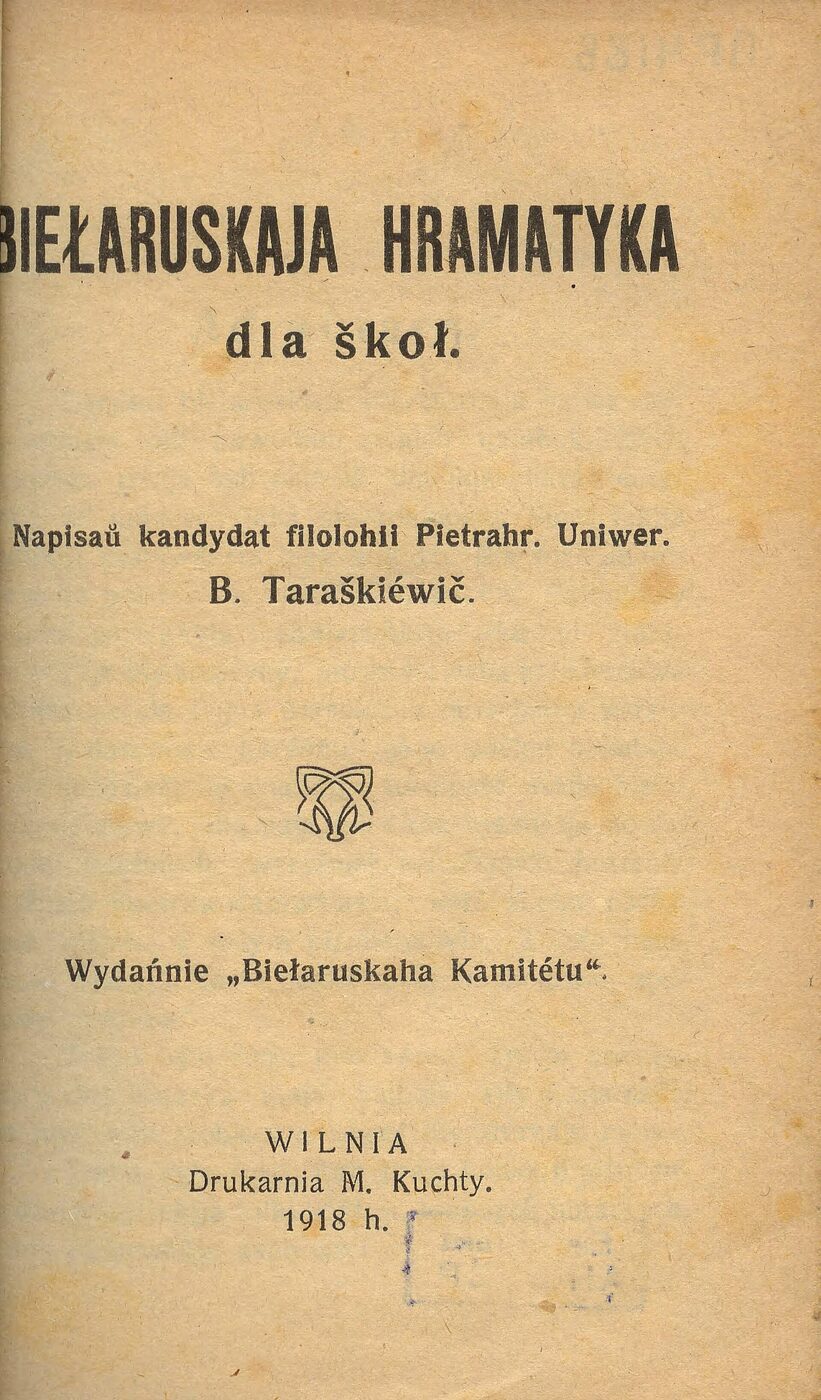
The first codification was published in Vilnius in 1918 as Biełaruskaja hramatyka dla škoł — a Belarusian grammar for schools — by Branisłaŭ Taraškievič. Its first edition was set in the Latin alphabet, with a Cyrillic version following shortly after. Several rival proposals were in circulation at the same moment, including grammars by Balasłaŭ Pačopka and a joint effort by Anton Luckievič and Jan Stankievič; Taraškievič's won out as the most thoroughly grounded and the best supplied with teaching exercises, and it was the norm in official use until 1933. Its name in Belarusian, Taraškievica, may date from before the Second World War; those who write it today more often call it the classical orthography, an alias introduced around 1994.
.jpg)
The revision came in stages and the stages are dated. An international conference on Belarusian orthography met in Minsk in 1926; a Linguistic Committee of academicians worked on the problem from 1927 until its work was stopped in 1929 with the end of the Belarusification policy, its results published in 1930 regardless. A separate group at the Belarusian Linguistic Institute began work in 1930 on a different proposal, opening by repudiating the "national democracy" its authors held to underlie the earlier committee's work. On 5 May 1933 the Central Committee of the Communist Party of the Byelorussian SSR formed a Political Committee to revise the Russian–Belarusian dictionary and the orthographic rules; it consisted principally of politicians, and included no linguist.
The project was published in the party newspaper Zviazda on 28 June 1933. A decree of the Council of People's Commissars of the Byelorussian SSR followed on 28 August 1933, and the new rules acquired the status of law on 16 September 1933, from which date schools and publishers were required to follow them. The decree was titled, in translation, On Changing and Simplifying Belarusian Spelling, and the officially announced reasons for it were four: that the pre-1933 grammar maintained artificial barriers between the Russian and Belarusian languages; that the reform would cancel the effects of Polonisation; that it would remove archaisms, neologisms and vulgarisms attributed to the "national-democrats"; and that it would simplify the grammar. The reform is the subject of its own article as the Belarusian orthography reform of 1933.
The decree's title says spelling; the changes went considerably further. In his 1936 critique — the standard source for the count, and one written from western Belarus by a scholar who rejected the reform outright — Jan Stankievič numbered twenty-five changes, of which one was strictly orthographical and twenty-four bore on grammar as well as orthography. Among the changes usually listed: the soft sign ceased to be written to mark assimilated softness and between doubled consonants; the particle nie and the preposition biez were written invariantly rather than as pronounced; loanword spelling was regulated, with the vowel reduction known as akanye preserved in all but ten words, those exceptions themselves abolished in 1959; the treatment of Central European l was changed; the genitive singular ending of certain masculine nouns was fixed as -a, as in Russian, rather than -u; and vernacular personal-name forms were replaced by canonical Orthodox ones. The reformed norm acquired a colloquial name at the turn of the 1990s: narkamaŭka, from narkam, the abbreviation for a people's commissar.
Positions on the reform are documented and they do not agree. Stankievič's account was that the removal of artificial barriers had moved Belarusian morphology and syntax toward their Russian counterparts and pushed indigenous features out of use; he also observed, against his own case, that some of the changes moved Belarusian closer to other Slavonic languages rather than to Russian, which would hardly have been the goal. Set against that, the strengthening of the morphological principle in the orthography — one of the reform's substantive changes — had itself been proposed during the 1920s, which is to say that the reform's contents and the circumstances of its adoption are two different questions.
Taraškievica did not disappear in 1933. Its legitimacy was never accepted by parts of the Belarusian scene in western Belarus, then under Poland, nor by the emigration that left after 1944, and the rejection was framed explicitly as opposition to Russification. It became the diaspora's working norm; the only large-scale use of the pre-1933 grammar on Belarusian territory after the 1930s came during the German occupation of 1941–44, a fact that later gave polemicists on the other side a permanent stick. Having rejected everything after 1933, however, its users were left with the unresolved problems of the pre-1933 grammar and no agreed standard.
The revival is also dated. During perestroika a movement for the return of Taraškievica formed, and by the early 1990s it was in use alongside the official norm. A conference of journalists and publishers using the classical orthography met in Vilnius on 14 June 1992; an Orthography Improvement Committee worked in 1991–92 and published proposals in 1993; and in 2005 a working group of four produced a standardisation published as Belarusian Classical Orthography. That codification was taken up by the newspaper Naša Niva, the journal ARCHE, and the Belarusian services of Radio Free Europe and Radio Polonia. Belarusian Wikipedia exists in both norms, in two separate editions.
The two norms have since acquired formal recognition in the machinery of the internet itself. On 27 April 2007 the Internet Assigned Numbers Authority registered the variant subtag tarask, making the full language tag for Belarusian in the classical orthography be-tarask. It is a small administrative act and a precise one: the registry that tags languages for software concluded that the difference between the two norms was large enough to need a code of its own.
The official norm has meanwhile moved, slightly, in the other direction. A spelling reform bringing certain official spellings closer to Taraškievič's system was decided on 23 July 2008 and came into effect on 1 September 2010 — seventy-seven years, to within a fortnight, after the 1933 rules became law.
Łacinka, the third written form
Belarusian also has a Latin alphabet with a documented history of its own, called Łacinka. It resembles the Sorbian alphabet and borrows from Polish and Czech: carons on the sibilants (č, š, ž), acutes for palatalised consonants (ć, ń, ś, ź), a barred l (ł) for the hard lateral, and a u with a breve (ŭ) for the sound Belarusian Cyrillic writes with ў. It has no soft sign; palatalisation is carried by a diacritic on the preceding consonant instead.
Its origins are in the sixteenth century, when Ruthenian passages began to be quoted in Latin script inside Polish and Latin texts, with no standard and Polish spelling conventions pressed into service. Belarusian Catholics used the Latin script increasingly through the seventeenth century, in parallel with Cyrillic. In the nineteenth century a number of writers of Polish cultural background used it in Belarusian works, and Kastuś Kalinoŭski used it exclusively in his newspaper Mužyckaja prauda — six issues in 1862–63.
It was then banned. Between 1859 and 1905 the Russian authorities prohibited Łacinka outright, with the stated purpose of forcing a switch to Cyrillic and, preferably, to Russian; the ban ended with the October Manifesto of 1905, and both scripts were then in active concurrent use in Belarusian books and newspapers until the 1930s. The most-cited example is the weekly Naša Niva, which between 10 November 1906 and 31 October 1912 issued each number in both alphabets, under a subheading announcing that it was printed weekly in Russian and in Polish letters. Conditions could also reverse: during the German occupation of the western part of Belarus in 1914–18, Łacinka was the only script permitted in native-language lessons, Cyrillic being banned there.
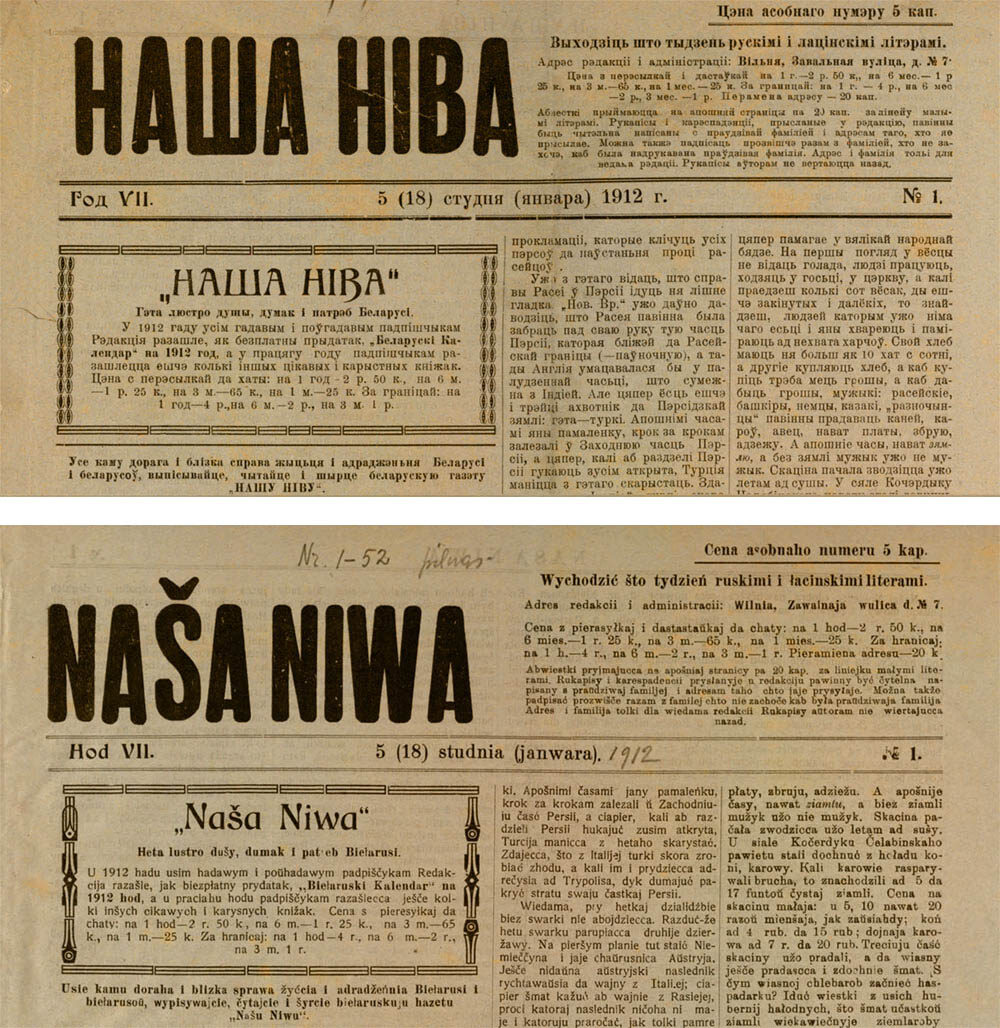

The Latin alphabet itself passed through three documented forms. The variant of roughly the 1840s to the 1920s used the Polish digraphs — cz, sz — and had no settled representation of the short u at all, different authors printing a cursive u, a ŭ, a ú or a û. From about 1907 the digraphs gave way to the diacritic letters č, š and ž, and ŭ was standardised; this is the variant used in Taraškievič's 1918 grammar. From about 1937 w was replaced by v, giving the form still in use, and the one the IETF language tag be-Latn denotes. That the digraph and diacritic spellings sometimes appeared side by side in a single newspaper text is documented, an example surviving from the newspaper Jednaść, which is a fair summary of how settled the question was.
Two further scripts belong in the list for completeness: Belarusian was written in the Arabic alphabet by the Lipka Tatars and in the Hebrew alphabet by Belarusian Jews. Neither is a live option for a keyboard in 1996, but both are part of the answer to the question of how many ways this language has been written down. A separate state romanisation, the Instruction on transliteration of Belarusian geographical names with letters of Latin script, is close to Łacinka but treats Cyrillic л differently, so that the same Latin string can represent two different Belarusian words depending on which system produced it.
Łacinka has not stopped. In February 2023, on International Mother Language Day, Naša Niva — by then publishing from outside the country — launched a machine-converted Łacinka edition of its website, which is the same idea as the 1906 dual printing carried out by other means.
What could be typed, and what could be sent
All of the foregoing had a blunt consequence for a newsgroup in 1996, and the charter faced it head on. Its rules on language are worth quoting in full, because they are the only place in this directory where a charter specifies a character encoding by RFC number:
Submissions must be in English, Belarusian, or Russian. If in Belarusian or Russian, they should be transliterated or in KOI-8 (RFC-1489). There is a problem with posts in Belarusian in KOI-8 in that there is no agreed to mapping for "y neskladovae" and "i". This issue will be addressed and resolved through discussions on this newsgroup and will be included in the forthcoming FAQ.
The complaint is exactly correct, and it can be checked against the standard. RFC 1489, Registration of a Cyrillic Character Set, was published in July 1993 by the Relcom Development Team and registers the MIME character set koi8-r, described in the memo itself as the de facto standard for Unix and global network applications in the former Soviet Union. The RFC prints its complete mapping table from the upper half of the code range to Unicode. That table contains no entry for U+045E or U+040E — the short u, ў, which Belarusian calls u nieskładovae — and none for U+0456 or U+0406, the dotted i that Belarusian uses where Russian writes и. The two letters that most visibly distinguish written Belarusian from written Russian were the two letters the registered encoding did not have.
The successors closed the gap only partly, and not in Belarusian's favour first. RFC 2319, Ukrainian Character Set KOI8-U, of April 1998, replaced eight box-drawing characters with the four Ukrainian letters Ґ, Є, І and Ї in both cases, which supplied the dotted i but still no short u. The variant that covers Belarusian, KOI8-RU, replaces ten box-drawing positions instead and adds Ў alongside the Ukrainian four; it was assigned an IBM code page number but never became an RFC, which is why the charter could cite a document for KOI-8 and still have to explain what was missing from it. The international standard ISO/IEC 8859-5 does carry both letters and names Belarusian among the languages it covers, and Microsoft's Windows-1251 covers Belarusian too; the wider account of how those code pages competed, and of what mismatched encodings do to an archive, belongs to this directory's soc.culture.russian page and is not retold here.
Unicode had the repertoire long before any of this was practical. The short u is encoded at U+040E, CYRILLIC CAPITAL LETTER SHORT U, and U+045E, CYRILLIC SMALL LETTER SHORT U, in the main Cyrillic block. The Łacinka letters are spread across Latin Extended-A: ł at U+0142, ć at U+0107, ń at U+0144, ś at U+015B, ź at U+017A, č at U+010D, š at U+0161, ž at U+017E, and ŭ at U+016D, LATIN SMALL LETTER U WITH BREVE. The Unicode Character Database gives the age of every one of those code points as version 1.1, published in 1993 — and 1.1 is the earliest value that file records, the characters of versions 1.0.0 of 1991 and 1.0.1 of 1992 being folded into it. Every letter either orthography needs, in either script, was in the standard before the group was proposed. What was missing was not the code points but the eight-bit encodings, the fonts and the mail and news software in between. The Latin Extended-A block's role for the other languages of the region is covered on this directory's soc.culture.baltics page.
The charter's remaining instruction shows what the practical fallback was, and how little the moderators thought of it: Visual approximations of Cyrillic Belarusian and Russian are strongly discouraged for the body of the message as they are essentially indecipherable. Use in signatures or other short usage is acceptable. That is a ruling against the improvised transliterations in which people mimicked Cyrillic letterforms with Latin ones, and it tells you that they were common enough to need a rule.
So the position at the group's founding can be stated exactly. Three languages were permitted by the charter: English, Belarusian and Russian. Two written norms of Belarusian existed, the reformed and the classical. Two scripts were available for it, Cyrillic and Łacinka. And one transmission method was named in the charter, with transliteration as the alternative and a documented gap in the named encoding for the two letters Belarusian most needs. What the group's traffic actually contained is a separate question, and this page does not answer it. No survey of the archive by language, orthography or script has been carried out for this article, and no count of posts in any of them is asserted here. What is recorded is what was available and what the charter permitted.
The language question
Behind the orthographies sat the plainer question of which language was spoken at all, and here the documentary record is statistical rather than typographic.
The post-war trajectory is documented in the sources as a matter of school policy. In the 1955–56 school year, by the count in a 1962 study later republished in Minsk, 95 per cent of schools in the republic taught primarily in Russian and 5 per cent primarily in Belarusian. A 1958 all-Union law on schools, adopted in the republic in 1959, allowed parents to opt out of studying the "second language of instruction", which in a Russian-language school meant Belarusian.
The turn came with perestroika. The Supreme Soviet of the Byelorussian SSR ratified a Law on Languages on 26 January 1990, requiring the strengthening of Belarusian in state and civic structures, and a National Language Programme was created the same year to support a gradual increase in its use over ten years. The constitution adopted on 15 March 1994 named Belarusian the sole state language and gave Russian the status of a language of inter-ethnic communication. The implementation was itself contested: the 1992–94 language law was described by its opponents at the time as "landslide Belarusification" and as undemocratic.
The referendum of 14 May 1995 put the matter to a vote. The first of its four questions asked whether Russian should be assigned status equal to Belarusian. The official figures record 4,017,273 votes in favour and 613,516 against — 86.8 per cent of valid votes — with 192,693 ballots invalid or blank on that question, out of 4,823,482 votes cast from an electorate of 7,445,820, a turnout of 64.8 per cent. On the same ballot, economic integration with Russia was approved by 87.0 per cent, new state symbols in place of the white-red-white flag and the Pahonia by 78.6 per cent — the replacement flag being prescribed shortly afterwards by presidential decree No. 214 of 7 June 1995 — and a power for the president to dissolve parliament by 81.4 per cent. The co-official status of Russian was restated in the constitutional text approved in 1996.
The census figures compiled by the republic's statistical authorities give the following, for mother tongue and for the language spoken at home. In 1970, 6,899,088 people, or 76.6 per cent, named Belarusian as their mother tongue; in 1979, 69.8 per cent; in 1989, 65.6 per cent. From 1999 the census asked both questions: in 1999, 73.7 per cent named Belarusian as mother tongue and 36.7 per cent spoke it at home; in 2009, 53.2 and 23.4 per cent; in 2019, 54.1 and 26.0 per cent. Summaries of the 2019 census are also widely quoted in the form that Belarusian is perceived as the native language by about 60 per cent of the population while about 25 per cent use it in everyday life; the two framings rest on different denominators and both circulate. Whichever is used, the gap between the language people claim and the language they speak is the measurable quantity, and it is large.
The education statistics are the ones most often cited. In Minsk, the share of first-year pupils taught in Belarusian is recorded as falling from 58.6 per cent in 1994 to 4.8 per cent in 1998; by 2001 most of the major cities had no Belarusian-medium schools at all, Minsk retaining twenty. In 1999, 17 per cent of pupils in the country attended Belarusian-language elementary schools; in 2016 the figure is given as 13 per cent. As of 2016 no university in the country provided instruction in Belarusian. Broadcast hours have been counted too: in 2011, Russian-language output on the state television package amounted to 35,302 hours against 626 hours in Belarusian, or 1.7 per cent of air time. Annual circulation of Belarusian-language publications between 1990 and 2020 is reported as falling from 312 million to 39.6 million for magazines and from 9.3 million to 3.1 million for books and brochures.
Assessments of what those figures mean are attributed to the bodies that made them and are not adjudicated here. The Francišak Skaryna Belarusian Language Society has catalogued categories of alleged violation of the rights of Belarusian speakers, covering public services, access to legislation, education, media presence and commercial information. The United States State Department's 2016 country report recorded "discrimination against … those who sought to use the Belarusian language". The United Nations Special Rapporteur on the situation of human rights in Belarus has reported that "in practice the Belarusian language is subjected to systematic marginalization", that "marginalization of the Belarusian language and discrimination against those who use it are systemic across State institutions", and that violations against Belarusian-language users have increased since August 2020. In August 2021 the Belarusian PEN Centre, the Union of Belarusian Writers and the Belarusian Association of Journalists were liquidated, and the Ministry of Justice applied to the Supreme Court for the liquidation of the Skaryna Language Society.
None of this was visible in 1996, and most of it postdates the years in which the group carried traffic. It is here because the charter made language an explicit subject of the group and because a reader coming to the archive needs to know what the argument was about.
Chernobyl on Belarusian territory
The charter's topic list named the effects of the accident on Belarusians and the environment. Fifteen years earlier the reactor had been on the other side of a republican border that no longer existed in the same form, and the consequences had come north.
The accident occurred on 26 April 1986 at a plant in the Ukrainian SSR some sixteen kilometres beyond the border with the Byelorussian SSR, and the weather of the following days carried the greater part of the release northwards. Estimates of how much of the contamination deposited within the Soviet Union fell on the Byelorussian SSR vary with method and source. Reports from Soviet and Western scientists are cited for a figure of about 60 per cent; the Library of Congress country study of 1995 and subsequent press accounts give about 70 per cent, and the same sources describe about a fifth of Belarusian land, chiefly farmland and forest in the south-east, as affected. Against both, the 2006 TORCH report held that up to half of the volatile particles landed outside the territory of the three republics altogether. What survives every version is that the majority of the Soviet deposition fell on a republic that did not host the reactor. Among the measures taken in the first days, rain was deliberately seeded over some 10,000 square kilometres of Belarus by the Soviet Air Force to bring particles down before the cloud reached populated areas; heavy black rain is recorded as falling on Homiel.
Caesium-137 is the usual measure of the long-lived part, and the mapping compiled for the Chernobyl Forum's expert group on the environment and published by the International Atomic Energy Agency in 2006 gives Belarus, band by band: about 29,900 square kilometres, or 14.4 per cent of the country, at 37 to 185 kilobecquerels per square metre; 10,200 square kilometres, or 4.9 per cent, at 185 to 555; 4,200 square kilometres, or 2.0 per cent, at 555 to 1,480; and 2,200 square kilometres, or 1.1 per cent, above 1,480. Summed, a little over a fifth of the national territory lies above the lowest threshold. Ukraine's figures in the same table are 37,200 square kilometres, or 6.2 per cent of its area, in the lowest band, and Russia's 49,800, or 0.3 per cent. Quoting the Belarusian proportion without the threshold it belongs to is where most of the familiar misquotation begins.
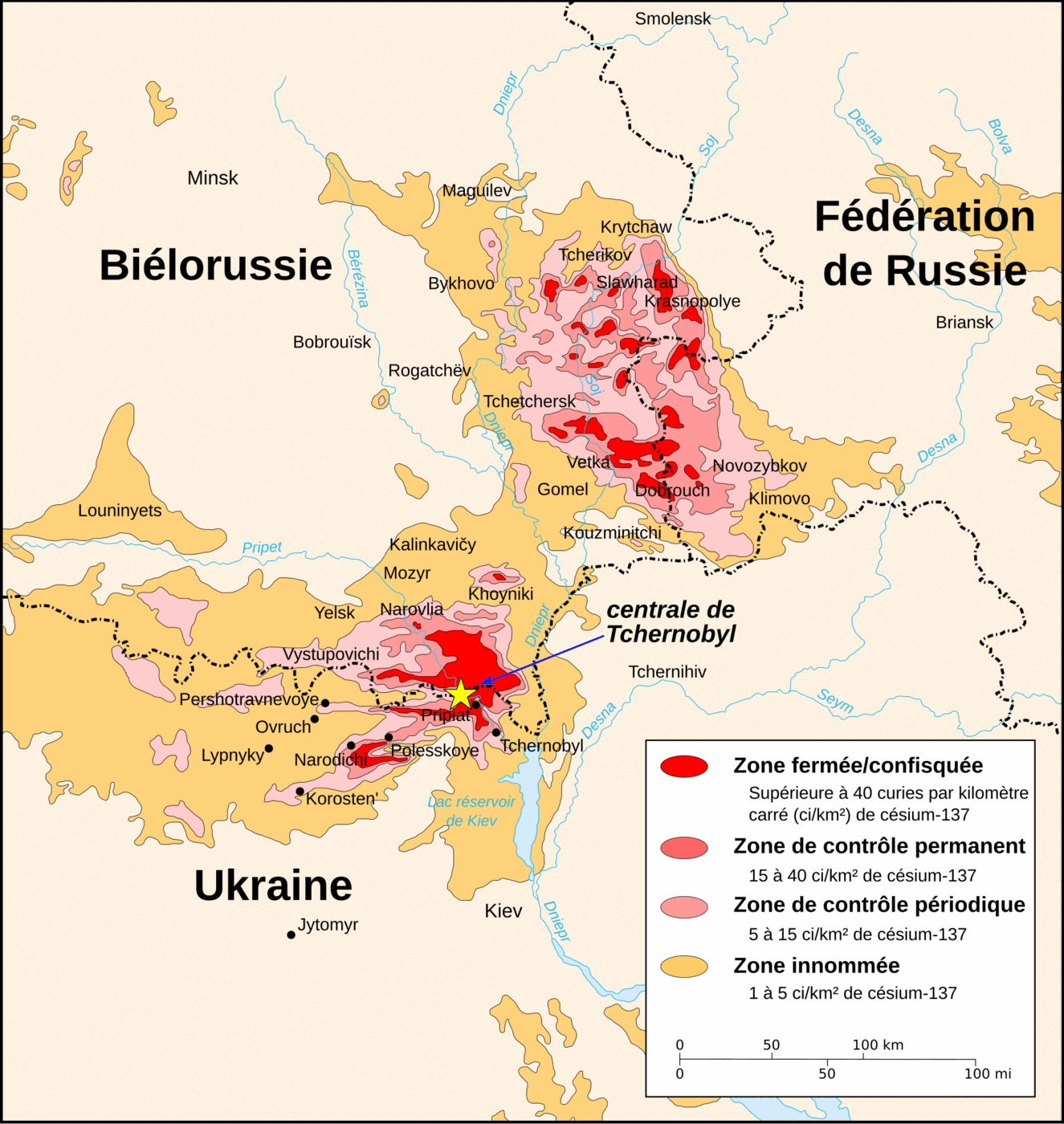

Reports from Soviet scientists, corroborated by the International Chernobyl Project, put 28,000 square kilometres across the three republics above 185 kilobecquerels per square metre, with 830,000 people living in that area, and about 10,500 square kilometres above 555, of which roughly 7,000 lay in Belarus against 2,000 in Russia and 1,500 in Ukraine, with about 250,000 people living in it. Agriculture and forestry lost land on a corresponding scale: 784,320 hectares of agricultural land and 694,200 hectares of forest were taken out of production, much of it since returned to use at higher cost.
Resettlement was protracted and its administrative record is precise. Two years after the accident, the Belarusian portion of the exclusion zone was extended over more heavily contaminated ground and a reserve closed to the public was established there: the Polesie State Radioecological Reserve, created on 18 July 1988 with an initial area of 1,313 square kilometres. More than 22,000 people had lived on that ground in 96 settlements before the accident. In 1993 the reserve was enlarged by a further 849 square kilometres to 2,162, making it the largest nature reserve in the country and one of the largest in Europe. It is crossed by the Pripyat and adjoins the Ukrainian exclusion zone.
The financial record is also attributable. The Chernobyl Forum reported that Belarus spent more than 13 billion United States dollars on the consequences of the accident between 1991 and 2003, and a 2005 estimate of the total cost to Belarus over thirty years is given as 235 billion dollars.
On health the sources disagree, and the disagreement is itself part of the record. On the finding that is least disputed: childhood thyroid cancer, rare before the accident at an expected global incidence of roughly 0.1 to 2.2 cases per million children under fifteen a year, began rising in Belarus and Ukraine three to four years afterwards, overwhelmingly of the papillary type, with the greatest increase among those youngest at the time of exposure and most cases reported in Homiel region, the most heavily contaminated area. The pre-accident rate among Belarusian children is given as under one per million; by 1995 the rate in Homiel region is reported at 1,000 per million per year. An estimated 95 per cent of ingested iodine-131 reached people through milk, which is why children, with smaller thyroid glands, took the largest doses.
On mortality the estimates diverge by orders of magnitude and each belongs to the body that produced it. A draft summary report of the Chernobyl Forum in September 2005 — a group comprising the IAEA, the World Health Organization, the UN Development Programme, other UN bodies and the governments of Belarus, Russia and Ukraine — set the deaths then attributable at about fifty, being forty-seven workers who died of acute radiation syndrome and nine children who died of thyroid cancer, and added that up to 4,000 people could eventually die of radiation exposure among the 600,000 most heavily exposed. The full WHO health-effects report of April 2006 added a further 5,000 possible eventual deaths in contaminated areas of the three countries, giving an upper limit of 9,000 among the 6.9 million most exposed. A 2006 Greenpeace report estimated 10,000 to 200,000 additional deaths in the three countries between 1990 and 2004 and was criticised for relying on non-peer-reviewed material. A 2009 volume published by the New York Academy of Sciences concluded from a literature analysis that 985,000 deaths worldwide between 1986 and 2004 were attributable to the release; it drew severely critical reviews in the specialist press and from the Academy's own reviewers, one of whom judged its value to be negative on the ground that its bias would be evident only to specialists.
On congenital anomalies the weight of the cited evidence runs the other way: no significant evidence of a change in prevalence linked to the accident has been found in Belarus or Ukraine, studies in Sweden and Finland found no association, the EUROCAT database covering nearly a million European births found no impact, and the IAEA states that there has been no increase in birth defects. Statistical anomalies have nonetheless been reported and published, including a peak in Down syndrome births in West Berlin nine months after the main fallout and an unusually high count in Belarus in January 1987, in the latter case with no subsequent upward trend. The honest summary is that the range of published estimates is wide, that the bodies producing them disagree about method as much as about number, and that a reader who wants a single figure will have to choose whose method to accept. The Chernobyl disaster has its own literature and this page does not adjudicate it.
The practical consequence for the newsgroup was of a different order. The recuperative programmes that took children from contaminated districts abroad for clean-air summers were, through the 1990s, among the most numerous points of contact between Belarus and well-wishers in Western Europe and North America, and a charter that listed the accident as a standing subject was describing a live administrative reality, not a historical one.
The dated political record
The group's subject is a state whose constitutional arrangements changed twice in the two years before it was founded, and both changes were disputed. The record can be set out by date and by the body that assessed it.
Before 1991 there was the Byelorussian SSR, a founding constituent republic of the Soviet Union from 1922 and, unusually, a founding member of the United Nations in 1945 — one of two Soviet republics, with the Ukrainian SSR, admitted among the original fifty-one members in their own right. Before that there had been the Belarusian People's Republic, proclaimed in 1918 and surviving thereafter as a Rada in exile, whose anniversary on 25 March gave the argument about which past counted a fixed place in the calendar. Older claims reached back further, to the principality of Polatsk and to the Grand Duchy of Lithuania, and the mass graves at Kurapaty on the edge of Minsk — where people were shot by the NKVD between 1937 and 1941, and which were investigated and partly exhumed in 1988 — ran through every discussion of the Stalin period. Estimates of the number of victims there range from 30,000, given by the republic's own attorney general, through 100,000 in a standard reference work, to figures between 102,000 and 250,000 published in the newspaper article that brought the site to public attention. The site was placed on the register of cultural properties as a first-category heritage object in 2004.
Independence came in stages: a Declaration of State Sovereignty on 27 July 1990; the change of the state's name and status through August and September 1991, with the name Republic of Belarus fixed by a law of 19 September; and the accords signed on 8 December 1991 in Białowieża Forest, on Belarusian territory, by which the leaders of Russia, Ukraine and Belarus declared the Soviet Union dissolved and founded the Commonwealth of Independent States.
The constitution of 15 March 1994 made the country a presidential republic, and the first presidential election was held under it on 23 June 1994 with a second round on 10 July. Six candidates contested the first round. The official second-round result gave the winner 4,241,026 votes, or 80.61 per cent, against 748,329, or 14.22 per cent, for the runner-up; turnout was 78.97 per cent in the first round and 70.60 per cent in the second. It is commonly described as the only free election held in the country since it left the Soviet Union.
The referendum of 14 May 1995 and its four approved questions are set out above. The second referendum, held on 24 November 1996, put seven questions: four from the president and three from the Supreme Council. The presidential set proposed moving Independence Day from 27 July to 3 July, adopting a redrafted constitution, permitting the unrestricted sale of land, and abolishing the death penalty. The official figures record the constitutional question carrying with 5,175,664 votes for and 689,642 against — 88.2 per cent of valid votes on that question, and 70.45 per cent of the registered electorate — on a turnout given as 84.1 per cent; the Independence Day change carried; unrestricted land sale was rejected, with 84.4 per cent of valid votes against, and abolition of the death penalty with 81.8 per cent against. All three questions put by the Supreme Council were rejected. Under the new text the unicameral Supreme Council was replaced by a bicameral National Assembly, presidential decrees acquired the force of law, and the president's term then running was extended from 1999 to 2001; the amendments are summarised in the constitutional literature as strengthening the presidency, and were signed into law on 28 November 1996. This is the vote recorded as the 1996 Belarusian referendum.
Assessments of it are on the record and are divided along institutional lines. Russia and some other members of the Commonwealth of Independent States were the only OSCE participants to recognise the results, the grounds given for withholding recognition being violations of electoral norms and the use of the state-owned media; the OSCE Parliamentary Assembly held that the vote fell far short of democratic standards. The Belarusian Helsinki Committee published a catalogue of irregularities in Minsk in 1996, whose entries include the late formation of local referendum commissions, the removal of the chairman of the Central Commission for Elections and National Referendums before the vote, ballots printed by the presidential administration without passing through the commission, and the funding of the referendum from sources outside the state budget. Seven judges of the Constitutional Court and its chairman resigned in protest, as did the prime minister, the minister of labour and a deputy foreign minister. Around sixty deputies of the Supreme Council who rejected the new constitution continued to sit, and were recognised as the legitimate parliament by a number of states. Contemporary press described the sequence as a bloodless coup, and the exiled Rada of the Belarusian Democratic Republic said in 2016 that the referendum's results were legally invalid. The presidential side's position, stated at a press conference on 25 November 1996, was that the referendum had been conducted faultlessly.
The union treaties with Russia run in parallel and are best given as a list, since they are frequently conflated:
- 6 January 1995 — Agreement on a Customs Union.
- 21 February 1995 — Agreement on Friendship, Good Neighbourly Relations and Cooperation.
- 2 April 1996 — Treaty on the Establishment of a Community, founding the Community of Belarus and Russia. This was signed six days before the Request for Discussion for this newsgroup was posted.
- 2 April 1997 — Treaty on the Union between Belarus and Russia.
- 8 December 1999 — Treaty on the Creation of a Union State of Russia and Belarus.
The instruments provided for monetary union, equal rights, single citizenship and a common foreign and defence policy. Monetary union has repeatedly been deferred and no date has been set for a referendum on the draft constitution of the union.
Of the elections after 1994, the record is that none has been assessed as free and fair by the OSCE. For the presidential election of 9 August 2020 the organisation did not deploy an observation mission at all, having received no timely invitation — the Belarusian foreign ministry's invitation is dated 15 July, less than a month before polling. The Central Election Commission announced 4,661,075 votes, or 81.04 per cent, for the incumbent and 588,619, or 10.23 per cent, for the second-placed candidate. All opposition candidates appealed for the result to be invalidated. On 1 September 2020 United Nations human rights experts, in a statement issued through the Office of the High Commissioner for Human Rights, cited more than 450 documented cases of torture and ill-treatment of people detained during the protests that followed. The mandate of a UN Special Rapporteur on the situation of human rights in the country continues to report, and its findings on the language question are quoted above.
By 2020 the newsgroup had long stopped being a place where any of this was argued. It is set out here because the group's charter named politics and elections as standing subjects, and because a reader working through what survives of the traffic needs the dates against which to read it.
Who could post
A newsgroup is only as national as its readers' connectivity allows, and for most of this group's active life the connectivity inside the country was thin. The dates can be given.
The country-code top-level domain .by was delegated on 10 May 1994, according to the registration date in the IANA root database — two years before the group existed, and a year before the state operator was founded. Beltelecom, the national telecommunications enterprise, dates from 1995, is wholly owned by the state and operated through the telecommunications ministry, is the sole provider of fixed telephony, and holds the exclusive interconnection with internet providers outside the country: every backbone channel to networks abroad runs through it. The IANA record today lists the ccTLD manager as a Minsk limited company and the administrative contact as the Operational and Analytical Center under the Aegis of the President of the Republic of Belarus.
Access itself lagged. Until 2005–06 broadband was available only in a few major cities; outside them the options were dial-up from the state operator or mobile data. The operator introduced a consumer ADSL brand in 2006, available in all administrative centres by 2008. The penetration figures for the years in which such a group might still have been read are correspondingly modest and, as usual, do not agree with each other. A 2006 survey of 1,500 adults found a third of the population using the internet, split 38 per cent urban to 16 per cent rural. A study published by the UN Conference on Trade and Development for the same year put the figure at 56.5 per cent. The International Telecommunication Union gave internet penetration for 2009 as 27 per cent, against 29 per cent for Russia and 17 per cent for Ukraine; Internet World Stats gave 47.5 per cent for June 2010. In mid-2009 there were more than 22,300 Belarusian websites, of which roughly 13,500 carried .by domain names.
One further figure from the same 2010 country profile belongs here precisely because of what it is not: the OpenNet Initiative reported that Russian was the most widely used language by Belarusians on the internet, followed by Belarusian, English and Polish. That is a statement about the national internet in 2010, not about this newsgroup at any date, and it is not offered as a proxy for one.
The regulatory record that can be dated precisely is later than the years in which such groups were most used. A media law taking effect in February 2009 required domestic and foreign websites to register with the Information Ministry or be blocked. A presidential decree of 2010, numbered 60, provided for the registration of internet resources, for lists of sites to be blocked, and for further restrictive measures; a law effective 6 January 2012 required commercial sites selling to citizens to operate from within the country under a .by domain, and required providers, including Wi-Fi operators, to register users. Requirements on internet cafés to record customers' identities and the sites they visited date from 2007. Earlier constraints are harder to document with the same precision, and this page does not assert them.
The practical effect for a group founded in 1996 is the one its own architecture anticipated. The submission address was an e-mail address on the same machine as a Belarus mailing list, and the list had been built for readers who had e-mail and nothing else. A newsgroup whose home readership could realistically reach it only by mail is, in miniature, the premise this site's own mail-to-news gateway was built on.
Where the readers were
The Request for Discussion put the diaspora at three and a half million against a domestic population of over ten million. That was the proposal's own figure and is quoted as such; what is better documented is that the readership abroad was not one population but at least two, with different assumptions about almost everything.
The older layer was formed by the post-war emigration, largely displaced persons who left in the 1940s, and it built institutions that outlasted it by decades. Belarusian refugees and former soldiers of the Anders Army reached Britain and France after the war and established cultural and religious centres in London and Paris; a Belarusian secondary school named after Janka Kupala operated at Regensburg in western Germany from 1945 to 1950. In Canada the same wave founded the Belarusian Canadian Alliance in 1948, the oldest Belarusian diaspora organisation. In the United States the largest concentrations settled in metropolitan New York, in New Jersey — Highland Park and South River in particular — and around Cleveland, Chicago, Los Angeles and Detroit. The London centre produced the Francis Skaryna Belarusian Library and Museum, formally established on 15 April 1971 and still the only library outside the country collecting exclusively in Belarusian studies; its holdings include about twenty books printed before 1800, among them two copies of the Statute of the Grand Duchy of Lithuania.
It was in these communities that the pre-1933 orthography stayed in continuous use, as did the white-red-white flag and the Pahonia, which were the state symbols from 1991 until the referendum of 1995 replaced them. A person who learned to write Belarusian in Cleveland in 1960 and a person who learned it in Minsk in 1985 had been taught two different systems, and neither had been given a reason to regard the other's as correct.
The later layer was economic, leaving after 1991 for work rather than politics. Its members had grown up with Russian as the language of public life and the reformed orthography as the only one taught in school. When two such populations meet in one moderated newsgroup, the disagreements tend to be less about what happened than about which premises have to be stated before a sentence can begin — which is, as it happens, a fair description of why the charter's authors wanted moderators at all.
What a culture group carried
The charter's list of on-topic subjects — books, cuisine, genealogy, minority questions, jobs — describes the ordinary business of a soc.culture group, and the branch-level account of what that business looked like belongs to the soc.culture.* hub. What follows is the material specific to this one: the things a reader of the archive will find referred to and may need identified.
Printing and the two-norm publishing history
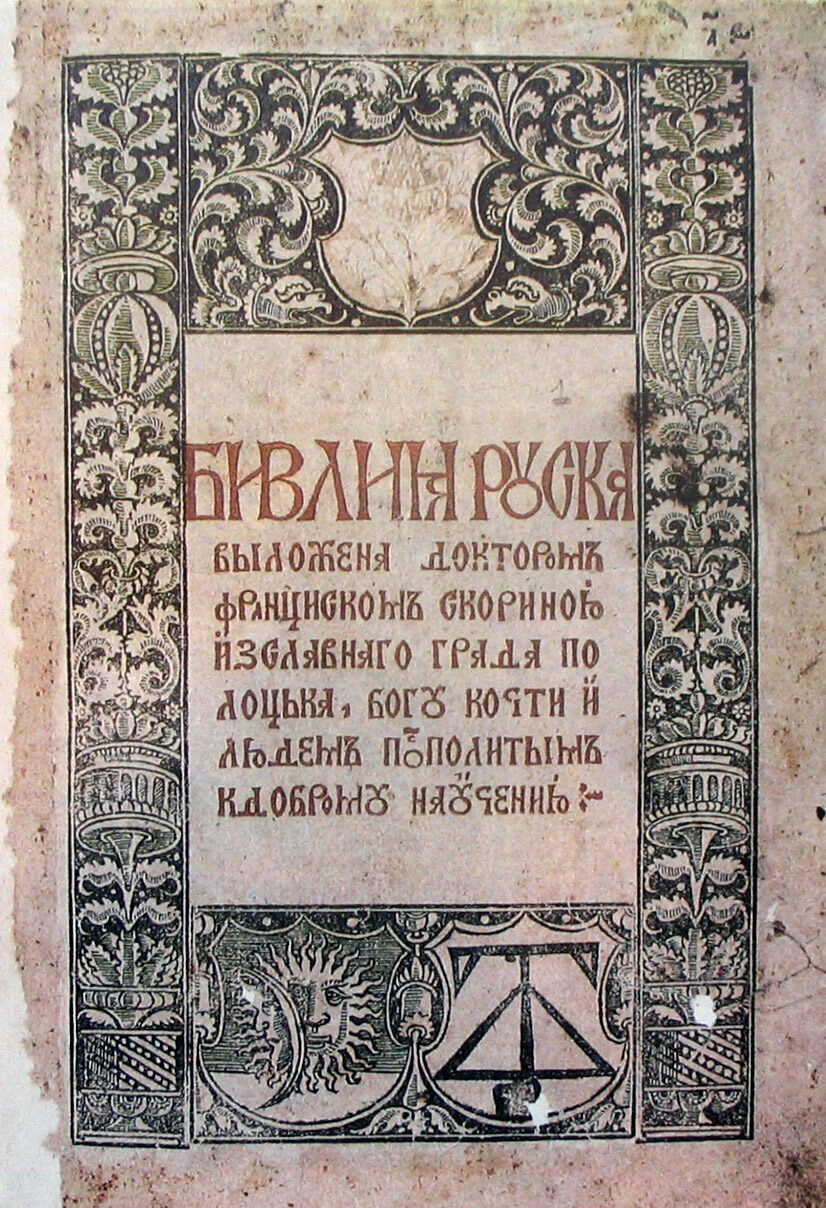
Belarusian printing begins with Francysk Skaryna of Polatsk, who rented a press in Prague and issued his first book, the Psalter, on 6 August 1517, following it with further books at intervals over the next two years and completing a translation of the Bible in twenty-three books by 1519. In 1522 he opened the first printing house in Vilnius and published The Little Travel Book, followed by the Apostol in 1525. He is why the London library carries his name, and why the language society in Minsk does too.

The modern period turns on one newspaper. Naša Niva was founded in 1906, with its first issue dated 23 November, and the years before the October Revolution are known in Belarusian literary history as the Naša Niva period for the writers it published. It appeared weekly until 1915, was re-established in 1991, and moved between monthly, weekly and fortnightly schedules through the 1990s. It used the classical orthography until 2008. Between 1906 and 1912 it printed each issue in both alphabets. Its website was blocked in July 2021, its editors were prosecuted, and it was designated an extremist formation by the interior ministry in January 2022; it has published from outside the country since, and added the machine-converted Łacinka edition in 2023. A reader who encounters the same Belarusian text in two spellings and two scripts in the same archive is looking at the ordinary consequence of a publishing history in which both were normal.
Folk tradition
Two elements of Belarusian ritual practice carry international listing, which makes them the easiest to state precisely. The Rite of the Kalyady Tsars, or Christmas Tsars, was inscribed by UNESCO in 2009 on the List of Intangible Cultural Heritage in Need of Urgent Safeguarding. It is celebrated in the village of Semezhava in the Minsk region, on the old Julian calendar; about 500 men take part each year, of whom seven are chosen to play the Kalyady Tsars in a folk drama called Tsar Maximilian. The celebration in honour of the Budslau icon, the Budslau fest, was inscribed on the Representative List in 2018. The list is short because inscription is slow, not because the tradition is.
Food
The cuisine's documented shape is Slavic with long Lithuanian and Polish admixture from the centuries within the Grand Duchy and the Polish–Lithuanian Commonwealth, and it is organised around the potato to a degree that has become the national joke about itself. More than three hundred potato dishes are recorded, the country is regularly ranked at or near the top for potato consumption per head at around 160 kilograms a year, and the pejorative bulbashi, from bulba, potato, was applied to Belarusians in both the Russian Empire and the Soviet Union. Draniki, pancakes of grated potato, are the usual candidate for national dish.
Around them sit machanka, khaladnik, zrazy, halubtsy, cold meat rolls, fried raw pork sausage, blini, and lazanki — flour dumplings with stewed meat, related to lasagne and borrowed long ago. Wheat does not do well in the climate, so the bread is sour rye and the traditional spirit, harelka, was distilled chiefly from rye malt. Buckwheat was widespread enough that Belarus is described as the likely centre of Europe's buckwheat culture. Legumes supplied the protein, notably kamy, a purée of peas or beans with melted lard. Fish means lake fish — zander above all, carp, and smoked or stuffed eel from the north-western lake country — with herring the standing exception from the Baltic trade. A traditional dinner was two dishes, soup and a main course, and farm children carried their father's lunch to the fields in a two-compartment clay pot called a sparysh.
Genealogy
The charter's phrasing on genealogy was careful and deliberate: questions and information about family history within the historical territory that has been Belarus. That formula acknowledges that the relevant borders moved repeatedly — the partitions of the late eighteenth century, the settlement after the Polish–Soviet War in 1921 that left almost half the territory in Poland, the changes of 1939, and the post-war line — and that a village a correspondent's grandparents left may have been recorded in Polish, Russian, Belarusian, Yiddish or Lithuanian, in Cyrillic or Latin script, under either orthography. Anyone searching a name in such an archive has to try several spellings and accept that one search will not find everything.
What the record does not show
The administrative record for this group is unusually complete. The record of what was said in it is not, and the distinction should be stated plainly rather than papered over.
This page does not know how many articles the group carried, in any year or in total. It does not know how many people read it or how many subscribed. It has no thread titles, no poster names beyond those printed in the founding documents, and no quotations from the traffic. It does not know in what proportions English, Belarusian and Russian were used, nor which orthography or which script appeared in the Belarusian that was posted, nor how often the moderators fell back on transliteration or waived their own rule against it. It does not know whether the FAQ promised in the charter — the one that was to resolve the mapping of the short u and the dotted i — was ever written, nor whether the robomoderator was ever tried.
It does not know when the last article was posted. The Big-8 board's 2025 rationale says only that the groups it removed had lacked a moderator for a long time and had been unused for years, which is a statement about a class of eighty-nine groups and not a date for this one.
Everything asserted above about the group itself comes from documents the group's own process produced: the Request for Discussion of 8 April 1996, the two Calls for Votes, the result of 17 June 1996, the control messages, and the deletion notice of June 2025. Everything asserted about the country comes from sources named in the sentence that carries it. Where the two might be joined by inference — where it would be easy and satisfying to write that a group whose charter worried about the short u must have argued about orthography — the inference has not been made.
Scope and limits
This page covers soc.culture.belarus and the documented history of its subject. It does not cover the Baltic states, which are not what Belarus is: Estonia, Latvia and Lithuania have their own group and their own account at soc.culture.baltics, and the fact that the Request for Discussion here was cross-posted there is a fact about Usenet distribution lists, not about geography. The Russian language's own history, and the encoding wars that shaped how Cyrillic survived in the archives, belong to soc.culture.russian; what appears above about Russian is confined to its legal status in Belarus and to the two Belarusian letters that the Russian-designed encodings omitted.
On the contested matters — the conduct of the referendums of 1995 and 1996, the status of the 1933 reform, the mortality attributable to the 1986 release, the position of the Belarusian language — this page reports what named bodies and named sources have said and by what date, and does not choose between them. Where two figures are in circulation, both are given with their provenance. Where a body's assessment is quoted, it is quoted as that body's assessment. No characterisation of the country's trajectory is offered here, and none should be read into the ordering of the dates.
Living individuals are not named. The moderators, the proponent and the votetaker of 1996 were volunteers who put their addresses in a public document thirty years ago, and the political figures in the dated record are matters of public office; neither is a reason for a directory page to attach names to them now.
What is left, when all of that is subtracted, is documented rather than remembered: a small, moderated, e-mail-fed newsgroup, created in June 1996 by 164 votes to 19, carrying a one-line description that said All things about Belarus, run by a panel of four to seven volunteers under a charter that had thought carefully about character encodings, and removed from the Big-8 list by administrative decision in June 2025 for want of a moderator. The name stood on that list for twenty-nine years. How much of that time it carried traffic is not recorded here, because the record that would settle it has not been found.
Reading soc.culture.belarus today
- Historical archive: Google Groups — soc.culture.belarus (coverage varies by group and era).
- Open in a newsreader:
news:soc.culture.belarus— the original site offered exactly this link, and it still works if your system has a newsreader registered for thenews:scheme. - Live access: point an NNTP newsreader at a modern server — see accessing Usenet today.
- The original news2mail e-mail subscription service ended in the mid-2000s and no longer operates.