soc.culture.burma
Burma / Myanmar: politics, culture and people.
Under a censoring junta, Burma had almost no domestic internet; this group was one of the few public online spaces where Burmese exiles, activists and scholars exchanged news — 8888 anniversaries, Aung San Suu Kyi’s detentions, sanctions debates.
The name question itself (Burma vs. Myanmar) was a permanent thread, treated by participants as the political statement it was.
On this page
- The paperwork, and the two attempts to make it exist
- Burma or Myanmar: the name in the address
- A control message that did not stick
- A dated record: 1948 to 2015
- The findings made about 2017, and what followed
- What was discussed
- Writing from outside the country
- The exile press of the same years
- The script question
- What a culture group carried
- The campaign that ran through the same wires
- The neighbours in the namespace
- What the record does not show
- Scope and limits
The paperwork, and the two attempts to make it exist
Most Usenet groups leave behind very little except the file cards of their own creation, and for soc.culture.burma those file cards happen to be complete. The Internet Systems Consortium's mirror of the news.announce.newgroups archive holds the whole sequence for this name, and it is longer than most, because the group had to be proposed twice.
The first attempt is dated 21 October 1991. It was posted by a proponent writing from a university in Louisiana and cross-posted to news.announce.newgroups, news.groups, soc.culture.misc, soc.culture.asean, soc.culture.asian.american and soc.culture.thai. Its charter was one sentence long, and it did not pretend to be neutral:
To promote exchange of information and ideas on all aspects of Burmese culture and society, and DEMOCRACY MOVEMENT.
The capitals are in the original. So is the justification, which turned on an absence: there was, the request for discussion said, no newsgroup directly related to the country, and the nearest thing to one was soc.culture.asean — a poor fit, because, as the proposal put it in another burst of capitals, Burma was NOT a member of ASEAN. That remained true for nearly six more years; the country acceded to the bloc on 23 July 1997, alongside Laos, and the institutional account of that accession belongs to the ASEAN page rather than to this one.
Nothing follows the 1991 request in the archive. No call for votes, no result, no control message: the proposal simply lapsed, as a great many did in the years when a Big-Seven group required a proponent with the stamina to carry a proposal through weeks of public discussion in news.groups and then a full month of balloting.
The second attempt arrived on 16 November 1993, from a proponent posting through a netcom.com account, and it was aimed more precisely: news.announce.newgroups, news.groups, alt.config and soc.culture.thai. The reasoning is worth setting out, because it explains what the group was for. Discussion of Burma on Usenet, the proposal said, was at that point “relegated to soc.culture.thai and bit.listserv.seasia-l”. Neither was satisfactory. Posting to the Thai group was inappropriate not only because it was a group about a different country, but because it was a group about a country “whose industrial and political activities vis-a-vis Burma are often called into question”; the proposal reported that some people found the arrangement comparable to having to discuss Tibet on a group about China. As for the mailing list, open discussion there was discouraged by the list owner, whose stated purpose was the distribution of non-opinion-based news rather than argument about it.
The discussion period ran about three weeks, and the charter visibly grew during it. The two paragraphs of November had become four by the time the vote opened, and it is the longer version that the archive preserves, quoted in the call for votes, in the result and finally in the control message that created the group:
soc.culture.burma will be an unmoderated forum for the posting of any and all news, opinion, discussion and information relating to any aspect of Burmese politics, ethnicity, life, culture, religion, travel, society or war.
It will be a forum in which diverse opinions and unfettered debate will be encouraged, without regard to political, philosophical, religious or personal bias.
It will serve to hasten the end of the informationally-repressive circumstances affecting the Burmese people and land and anyone interested in them.
No commercial offers of any kind will be permitted on soc.culture.burma, though information of the nature of money-saving travel tips will be allowed as long as they do not constitute any direct offers to sell any services or merchandise.
Three things had been added to the November draft. Religion and travel were written into the enumerated subject list. An explicit pledge of unfettered debate “without regard to political, philosophical, religious or personal bias” was inserted, which is the sort of clause a charter acquires when someone in news.groups has asked who exactly the group is for. And a commercial ban was added, with a carve-out for money-saving travel tips that reads today like a small artefact of 1993, when a Usenet group about a closed country was also, incidentally, one of the few places to ask how one might get into it.
The third paragraph is the unusual one. Charters in soc.culture.* generally describe a subject; this one describes an intention. To “hasten the end of the informationally-repressive circumstances” is a purpose rather than a scope, and it is about as close as the branch comes to a mission statement written into the namespace itself.
The vote was conducted by a neutral third party under the banner of the Usenet Volunteer Votetakers. A first call for votes went out on 7 December 1993, a second and final one on 15 December, both cross-posted well beyond the usual administrative groups — to soc.culture.thai, bit.listserv.seasia-l, soc.culture.afghanistan, soc.culture.bangladesh, soc.culture.europe, soc.culture.japan, soc.culture.pakistan, soc.culture.malaysia, soc.culture.indonesia, alt.india.progressive and soc.rights.human. That last address is a fair indication of the readership the proposal expected. Voting closed at 23:59 GMT on 2 January 1994.
- 253 votes received.
- 11 discarded as duplicates or superseded.
- 4 invalid ballots not corrected.
- 238 valid votes counted: 227 yes, 11 no.
Both Big-Seven conditions were met comfortably — at least a hundred more yes votes than no votes, and at least two-thirds of the valid votes in favour. The result was posted on 3 January 1994 under the subject line RESULT: soc.culture.burma passes 227:11, the mandatory five-day period for challenging the count passed without incident, and the moderator of news.announce.newgroups issued the newgroup control message on 10 January 1994. A second, identical newgroup message went out on 19 August 1994, the routine re-issue that helped the name reach servers which had missed it the first time.
The control message carried the one-line description that news administrators were to paste into their newsgroups file. That line is still the description in the ISC configuration files today, more than three decades later, unchanged to the full stop:
soc.culture.burma Politics, culture, news, discussion about Burma.
Burma or Myanmar: the name in the address
Everything above is ordinary Usenet bureaucracy. What makes this particular file remarkable is that the bureaucracy was, for once, adjudicating a live political question — and that its answer became permanent.
On 18 June 1989 the State Law and Order Restoration Council promulgated the Adaptation of Expressions Law. A commission had been appointed to review the country's place names as rendered in English; its output replaced the English name of the state, so that the Union of Burma became the Union of Myanmar, and respelt a long list of place names, Rangoon becoming Yangon to reflect the fact that the “r” sound is no longer used in standard Burmese and has merged with a “y” glide. Adjectival and ethnic forms moved with it: Burmese was to give way to Myanma or Myanmar, and Burman, for the majority ethnic group, to Bamar. The country's name in Burmese was not altered at all. What changed was how it was to be written in English.
The commission's stated grounds are on the record. Its general aim was to correct English spellings of the country's place names, discarding those chosen by British colonial authorities in the nineteenth century in favour of forms closer to Burmese pronunciation. For the name of the state in particular, two reasons were given: that Myanma had been the country's official name in Burmese since independence in 1948, and English usage should be aligned with it; and that Myanma was more inclusive of minorities than Bama. A final “r” was appended in English to represent the low tone in which the Burmese word is pronounced, a choice based on received pronunciation and other non-rhotic English dialects, in which “ar” without a following vowel is read as a long “a”.
Adoption abroad divided, and stayed divided for the whole of the group's life. The United Nations endorsed the change five days after it was announced. The Association of Southeast Asian Nations and the governments of China, India, Japan, Germany, Australia, Canada and Russia came to use Myanmar. The United States continued to say Burma, its State Department attributing the choice to support for the party held to have won the 1990 election, a party that opposed the new name; the British government likewise cited the elected party's preference. News organisations split along much the same line and moved at different times: the Financial Times switched at the start of 2012, citing increasing international acceptance, and the BBC in 2014, while other outlets settled on formulas of the “Myanmar, also known as Burma” kind. Some historians adopted a third convention, using Burma for the period before the coup of 1988 and Myanmar afterwards, and argued that this was the most politically neutral option available — a convention which, as its critics point out, contradicts the government's own intention, the 1989 renaming having been meant to apply retrospectively to the country's entire history.
The objections were of two kinds. Opposition parties and human-rights organisations argued that Myanmar was not in fact more inclusive but merely the literary register of Bama, and that minorities, many of whom did not speak Burmese, had grown accustomed to the English name Burma and read the new one as an assertion of majority dominance. A second line of criticism was technical: only four language scholars sat on the 1989 commission, the remainder being military officers and civil servants, and the appended “r” produced, in rhotic varieties of English, a pronunciation nowhere near the Burmese one. In April 2016, shortly after taking office, the country's newly installed civilian leader took a more relaxed public view, saying that foreigners were free to use either name because nothing in the constitution required one in particular. By then the question had been open for twenty-seven years.
Now the structural point, which is the reason this page exists in the form it does. A Usenet newsgroup name is not a label that can be edited. It is an identifier propagated to thousands of independently administered servers by control message, and there is no rename operation in the protocol. Changing a group's name means creating a new group and removing the old one — two separate proposals, each with its own request for discussion, its own call for votes and its own argument in news.groups, and each requiring administrators the world over to act on the resulting control messages. In practice a name settled at creation is a name settled for good.
The proponents knew this, and the argument was had before the vote rather than after it. The call for votes contains a paragraph found in very few charters anywhere in soc.culture.*, setting out explicitly why the address said .burma:
The questions raised during the discussion period had to do with the use of the name .burma as opposed to .myanmar. The decision to go with .burma was based on three factors: first, every Burmese respondent to the RFD supported the group as soc.culture.burma; second, as another poster pointed out, .burma is much more familiar and therefore practical to netnews users; and, third, because no one voiced solid objections to .burma. A few posters asked about the proper use of name, but did not object to .burma.
That is the whole of the deliberation, and it produced a decision that could not afterwards be revisited. From January 1994 onwards the older English name was a permanent feature of the network's namespace, carried in every article header, every archive index and every list of groups, irrespective of what any individual poster wrote in the body of a message.
The archive supports the point by its silences. There is no request for discussion, no call for votes and no control message for soc.culture.myanmar anywhere in the ISC record: the name was never proposed, either as a replacement or as a parallel group. In the current ISC active file, which lists 45,003 groups across every hierarchy the file tracks, exactly four group names contain any form of the country's names. One is soc.culture.burma. One is alt.fan.countries.burma. One, nctu.club.myanmar, sits in the local hierarchy of a Taiwanese university. The fourth, alt.pets.reptiles.snakes.pythons.burmese, is about a snake. On Usenet, in other words, the naming argument was settled once, by 238 e-mailed ballots in December 1993, and never reopened.
This directory's page name follows the address and nothing else. It records what the newsgroup was called. It takes no position on what the country should be called.
A control message that did not stick
The group's control archive has two further entries after the 1994 re-issue. The first is trivial and local: a newgroup message posted in June 1995 by an administrator at a large American computer manufacturer, carried only within that company's own network, which is the sort of housekeeping a site does when a group has failed to appear on its own servers.
The second is instructive. On 4 November 2001 an rmgroup control message for soc.culture.burma was posted, cross-posted to soc.config, soc.control and soc.groups, carrying the text “please remove the bogus newsgroup soc.culture.burma” and, beneath it, a signature line of grammatically well-formed nonsense. The From and Approved headers named a well-known Usenet software maintainer who had nothing to do with it.
Nothing happened. The reason is in the configuration file that every well-run news server consults. For the Big Eight hierarchies, the standard control.ctl distributed with INN instructs servers to drop every newgroup and rmgroup message from every sender, and then makes a single exception: messages from the Big-8 administrative address, PGP-signed and verified against the news.announce.newgroups key. A removal request from an arbitrary address, without that signature, is not a decision; it is noise. soc.culture.burma is still in the newsgroups file and still in the active file.
The episode is a small mirror of the naming question. The same immovability that fixed the older name in the address also meant that nobody who objected to the group — on whatever grounds — could make it go away by asserting that it should. On this network, both the name and its persistence were properties of the infrastructure rather than of anyone's opinion about them.
A dated record: 1948 to 2015
The group's traffic is only legible against a chronology, and the chronology is the country's. What follows is a list of dated events, each drawn from the record that establishes it, offered as a reading aid rather than as an interpretation. Every one of these is a subject the archive returns to.
- 4 January 1948 — independence from Britain, as the Union of Burma.
- 2 March 1962 — the military replaces the civilian government with a Union Revolutionary Council; the beginning of one-party rule and of the army's dominance of politics. Contemporary accounts note that in the 1950s the country had one of the freest presses in Asia, with some thirty daily newspapers in Burmese, Chinese, English and Indian languages.
- 1962 — the Printers and Publishers Registration Law requires every printer and publisher to register and to submit copies of their publications to a Press Scrutiny Board. The pre-publication regime built on it was not dismantled until 2012; the head of the censorship body said on its abolition that censorship had begun on 6 August 1964 and ended forty-eight years and two weeks later.
- 1974 — the state is reconstituted as the Socialist Republic of the Union of Burma.
- 8 August 1988 — the day on which the nationwide protests known since as the 8888 Uprising peaked; they had begun earlier that year and were organised largely by students of the Rangoon Arts and Sciences University and the Rangoon Institute of Technology.
- 18 September 1988 — the State Law and Order Restoration Council takes power, establishing direct military rule.
- 27 September 1988 — the National League for Democracy is founded.
- 18 June 1989 — the Adaptation of Expressions Law changes the state's English name and respells many place names.
- 20 July 1989 — the party's general secretary is placed under house arrest without charge or trial. She was released on 10 July 1995 after six years; placed under house arrest again on 23 September 2000 and released on 6 May 2002; and arrested again on 30 May 2003, the day of an attack on her convoy at Depayin in which at least seventy people associated with the party were killed, remaining in detention until 13 November 2010. The total is generally given as some fifteen years of detention across the twenty-one years from 1989 to 2010.
- 27 May 1990 — general elections, the first multi-party polls since 1960, held to elect a 492-seat constitutional committee. Ninety-three parties fielded 2,297 candidates, nineteen of those parties representing particular ethnic communities. The National League for Democracy took 392 seats; the army-favoured National Unity Party took 21 per cent of the vote and 10 seats; the Shan Nationalities League for Democracy took 23, the Arakan League for Democracy 11 and the Mon National Democratic Front 5. Turnout is given as 72.6 per cent. The results were never implemented.
- 1995 — BBC and Voice of America radio broadcasts into the country begin to be jammed.
- 1996 — the Computer Science Development Law requires all computer equipment to be approved by the Ministry of Communications, Posts and Telegraphs, and makes the distribution, transfer or acquisition of information held to undermine state security, national solidarity or national culture a criminal offence. The importing or use of a modem without permission carries penalties reported at up to fifteen years' imprisonment. A Television and Video Act of the same year requires owners of televisions, satellite receivers and video recorders to hold licences from the same ministry, and a Motion Picture Law licenses film-making.
- 18 November 1996 — Visit Myanmar Year opens with a ceremony in Yangon. The government had hoped for around 500,000 visitors and later revised the figure to about 250,000; the opposition called for a tourism boycott, on the argument that revenue would sustain the government rather than change it.
- 23 July 1997 — accession to ASEAN, together with Laos.
- 15 November 1997 — the ruling council is reconstituted as the State Peace and Development Council.
- 2000 — the first internet connections inside the country are established. In the same year the council issues an Internet Law prohibiting the posting of writings harmful to state interests.
- 2002 — the Wide Area Network Order.
- 30 April 2004 — the Electronic Transactions Law attaches prison terms of seven to fifteen years to receiving, sending or distributing information touching state security, law and order, community peace and tranquillity, national solidarity, the national economy or national culture.
- August to October 2007 — the protests known as the Saffron Revolution, triggered on 15 August by the removal of fuel subsidies and the resulting price increases. The government cut internet access on 28 September; the shutdown is variously reported as complete from 29 September to 4 October, with access in Yangon restored by 6 October.
- 2 May 2008 — Cyclone Nargis makes landfall, driving a storm surge some forty kilometres up the densely populated Irrawaddy delta; the recorded death toll is at least 138,373.
- 10 and 24 May 2008 — a constitutional referendum, the second date covering townships worst affected by the cyclone. On 15 May the government announced approval by 92.4 per cent of voters. The constitution reserves a quarter of the seats in the legislature for serving military officers, and requires more than 75 per cent support in both houses to amend, with a national referendum on top of that for certain sections.
- 7 November 2010 — general elections under the new constitution, boycotted by the National League for Democracy.
- 30 March 2011 — the State Peace and Development Council is formally dissolved, ending more than two decades of direct military rule.
- August 2012 — the Ministry of Information lifts the requirement that print media submit material for pre-publication approval; films remain subject to prior censorship.
- 8 November 2015 — general elections; the National League for Democracy wins a supermajority of the elected seats.
By the later entries in this list the newsgroup was largely quiet, and the reader should not imagine an archive that follows the chronology to its end. The list is here because the group's subject did not stop when its traffic did, and a reference page that ended in 2005 would misrepresent what it is a page about.
The findings made about 2017, and what followed
The events of 2017 in Rakhine State, and those since 2021, fall well outside the group's active life. They are recorded here because named international bodies have made findings about them, and because a page on a newsgroup whose charter names Burmese ethnicity as a subject would be evasive to omit them. What follows is the documented record: which body, on what date, in which instrument, and in whose words. Nothing here is this page's own characterisation, and no judgement of any kind is offered.
On 24 March 2017 the United Nations Human Rights Council adopted resolution 34/22, “Situation of human rights in Myanmar”. Its operative paragraph 11 reads, in part:
Decides to dispatch urgently an independent international fact-finding mission, to be appointed by the President of the Human Rights Council, to establish the facts and circumstances of the alleged recent human rights violations by military and security forces, and abuses, in Myanmar, in particular in Rakhine State …
The mission reported to the Council in document A/HRC/39/64, dated 12 September 2018. Its own summary states that it focused on Kachin, Rakhine and Shan States since 2011, and that it “established consistent patterns of serious human rights violations and abuses” in those states, “principally committed by the Myanmar security forces, particularly the military”, adding that “many violations amount to the gravest crimes under international law” and recommending that named senior generals be investigated and prosecuted in an international criminal tribunal.
On 27 September 2018 the Council adopted resolution 39/2, whose paragraph 22 decided
to establish an ongoing independent mechanism to collect, consolidate, preserve and analyse evidence of the most serious international crimes and violations of international law committed in Myanmar since 2011, and to prepare files in order to facilitate and expedite fair and independent criminal proceedings …
The numerical estimates that circulate belong to the studies that produced them, and should be carried with their attributions. Surveys conducted by Médecins Sans Frontières, reported on 14 December 2017, put the number killed in the first month after 25 August 2017 at at least 6,700, of whom 730 were children. A separate study conducted in January 2018, extrapolating statistically from surveys of 3,321 refugee households at Cox's Bazar in Bangladesh, estimated at least 25,000 killed, along with figures for sexual violence, beatings and burnings. United Nations reporting put the number who fled or were driven into Bangladesh at more than 700,000 as of September 2018. The government of the day dismissed such findings as “exaggerations”.
Legal proceedings followed on two tracks. On 11 November 2019 The Gambia, with the support of the fifty-seven states of the Organisation of Islamic Cooperation, instituted proceedings against Myanmar at the International Court of Justice under the Genocide Convention; on 23 January 2020 the Court ordered provisional measures requiring Myanmar to prevent genocidal acts against the Rohingya and to preserve evidence. On 14 November 2019 the International Criminal Court authorised an investigation, jurisdiction resting on Bangladesh being a party to the Rome Statute while Myanmar is not.
A coup on 1 February 2021 removed the elected government the day before parliament was to be sworn in, declared the results of the November 2020 election invalid and vested power in a military council under a year-long state of emergency. Telecommunications were cut on the night of the coup; daily internet curfews ran from 15 February, and on 15 March mobile internet was shut down nationwide, leaving only fibre-to-the-home connections. On 8 March 2021 the operating licences of five news organisations were revoked, among them two of the exile outlets described further down this page; the licence of a third was revoked in October 2022.
On 21 December 2022 the United Nations Security Council adopted resolution 2669 (2022) at its 9,231st meeting, by twelve votes to none with three abstentions — China, India and Russia. It expressed deep concern at the state of emergency, demanded an immediate end to all forms of violence and called for the release of all arbitrarily detained prisoners.
What was discussed
A great deal of the traffic was relay rather than conversation. Wire-service stories, human-rights reports, statements from exile organisations and compiled digests were posted for a readership with few other ways of following the country day by day. Chief among the digests was BurmaNet News, an e-mail service that aggregated wire copy and exile-press reporting; accounts of early online activism list it with other listservs as a means of circulating news that would otherwise have been inaccessible in the countries concerned, and its archive was still being cited as a source in coverage of the country a decade later. In this mode the group functioned less like a discussion board than a clippings service with an argumentative letters page attached.
The arguments returned to a familiar set of questions. Whether isolation or engagement was likelier to move the government was the perennial one, sharpened by the tourism drive of 1996 and by the boycott campaigns described below. Whether the country's future should be unitary or federal was the other, and on that question posters from the Karen, Shan, Kachin, Mon, Rakhine, Chin and other communities held positions that did not always match those of the Burman-majority opposition, let alone the government's. The 1990 results are a reminder that this was never an abstraction: nineteen of the ninety-three parties contesting that election represented particular ethnic communities, and several of them won seats.
Posters sympathetic to the state's case — stability, unity, development on its own terms — appeared as well, as the charter's promise of unfettered debate had contemplated. And, as in most exile forums concerning a country under a security apparatus, speculation about who was writing from where became a recurring genre of its own — a genre this page quotes none of, for the reasons set out near the end.
Not everything was politics. The charter had explicitly listed culture, religion and travel, and the group used the licence: threads on food, festivals and film, requests for language help, students hunting sources on everything from colonial-period administration to classical music, and the standing diaspora business of where to find ingredients in a foreign city. All of it ran in romanised Burmese or in English, for reasons that were technical before they were anything else.
Writing from outside the country
The group's dependence on the diaspora was structural rather than incidental, and the dates make the position plain. soc.culture.burma was created in January 1994. The country's own top-level domain, .mm, was delegated by IANA on 4 February 1997, three years later. The first internet connections inside the country were established in 2000, six years after the group existed and at a point when Usenet's text hierarchies were already past their peak. For the whole of the period in which such groups were most used there was, simply, nowhere inside the country to post from.
There is a small naming artefact in the domain record too. Before the renaming the ISO 3166 alpha-2 code for the country was BU; the code was changed to MM in December 1989, BU being retained only as a transitionally reserved entry, and no .bu top-level domain was ever assigned. The country's Usenet address and its internet address were therefore settled on opposite sides of the 1989 renaming, and only one of them was capable of being changed.
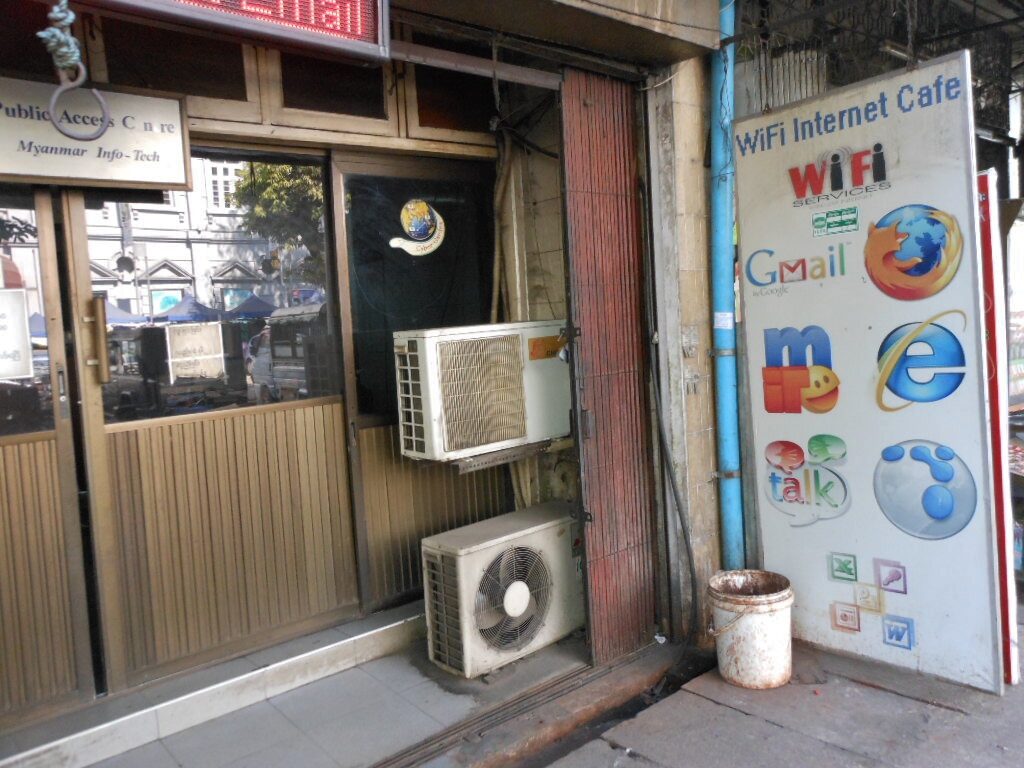
What connectivity there was arrived awkwardly. A company run by two Australian residents of the country established the first internet access there in 1997; DNS service for .mm was contracted out, and in February 2002 those name servers were compromised and .mm traffic redirected for three days to a page demanding a detained student leader's release. The state telecommunications operator took management of the .mm namespace back at the beginning of 2005, and the last of the private services was closed by the government in its turn, leaving the state operator as the sole provider of internet and e-mail.
The legal framework was explicit throughout. The Computer Science Development Law of 1996 made equipment subject to ministerial approval and criminalised the handling of information deemed to undermine state security, national solidarity or national culture; a Television and Video Act of the same year licensed televisions, satellite receivers and video recorders. The Internet Law of 2000 forbade the posting of writings harmful to state interests. The Wide Area Network Order followed in 2002 and the Electronic Transactions Law in 2004, the latter attaching sentences of seven to fifteen years. Reporters Without Borders reported the importing and use of an unauthorised modem as carrying penalties of up to fifteen years' imprisonment. Foreign broadcasting was treated as a comparable problem: BBC and Voice of America radio transmissions were jammed from 1995.
.jpg)
The scale, when access finally came, stayed small for a long time. Internet World Stats recorded 534,930 users in June 2012, one per cent of the population. Of the country's roughly 40,000 connections in that year, most were ADSL circuits, with the remainder dial-up, satellite and WiMax; forty-two cities had access, but the number of users outside Yangon and Mandalay was reported as just over ten thousand. The OpenNet Initiative's August 2012 assessment recorded selective filtering in the political and internet-tools categories and substantial filtering in the social category; Reporters Without Borders had listed the country as an internet enemy in 2011. Only after the licensing of foreign mobile operators did penetration move, reaching a reported 12.6 per cent in November 2015.
A non-scientific survey of Burmese bloggers taken in 2009 found that 52 per cent wrote from inside the country and 48 per cent from abroad. It is a shaky number and its author said so, but it is the only quantitative glimpse of the split that this page has been able to find, and it describes a period fifteen years after the newsgroup was created, when the balance had already moved decisively towards the inside.
For a newsgroup the consequence is easy to state and hard to overstate. Posting required a news server, which in practice meant an account held at a university, an employer or a commercial provider outside the country. The group's population was therefore drawn from the outflow that followed 1988 and from the older communities it joined — the 2014 census counted 1,418,472 former residents in Thailand alone, about seventy per cent of the country's overseas population, with some half a million in Malaysia and further communities in the United Kingdom, Japan, Singapore, Australia, India and the United States — together with foreign academics, aid workers and journalists on the beat. Roughly 150,000 refugees have lived in nine official camps along the Thailand–Myanmar border; Thailand's own account, as host to both that population and much of the exile press, belongs to soc.culture.thai and is not retold here.
The exile press of the same years
The same conditions produced a body of exile media, founded outside the country and directed back into it, whose material the group relayed and whose readership overlapped with its own. A group about a country, written from outside it, running alongside a press about a country, published from outside it, is not a coincidence but the same constraint expressing itself twice.
- The Irrawaddy — founded in 1990, initially under the title Burma Issues, by a Rangoon University student activist who had left the country after the imposition of martial law in 1988 and set up the Burma Information Group in Bangkok. It circulated at first among foreign embassies, human-rights groups and the exile community. The offices moved to Chiang Mai in 1995–96, the publisher was renamed the Irrawaddy Publishing Group in 1999, and an online service launched in 2000. A bureau opened in Rangoon in 2012 after the ending of pre-publication censorship. The English print edition ceased in September 2015 and the Burmese one in January 2016; the publication licence was revoked in October 2022. (Some accounts date the magazine's first year to 1993 rather than 1990; the discrepancy is noted rather than resolved.)
- The Democratic Voice of Burma — began broadcasting into the country in July 1992 from studios in Oslo, transmitting by shortwave from a Norwegian transmitter. Satellite television broadcasts began on 28 May 2005, funded in part by non-governmental foundations; the organisation described it as the first free and independent Burmese-language television channel. Multimedia operations inside the country began openly in 2012, and terrestrial digital broadcasting on the state multiplex on 24 March 2018. Its licence was among those revoked in March 2021.
- Mizzima — established in New Delhi in August 1998 by journalists in exile who had taken part in the 1988 protests; the name derives from the Pali word for “middle” or “moderate”. A liaison office was later opened in Chiang Mai. It operated from exile for close to fifteen years and was the first exiled outlet to register and open an office in Yangon during the reform period. Its licence was revoked in March 2021.
The moment at which this apparatus overtook the newsgroup can be dated fairly precisely. During the protests of September 2007 the pictures that reached the outside world came from bloggers inside Yangon who had got round the filters, and were picked up by mainstream news organisations because nobody else could obtain them; Mizzima, which republished one of them, reported more than fifty thousand accesses to its website that day. Days later the state cut internet access altogether. That is a different information economy from the one the group was built for. A clippings service maintained by exiles for exiles is what you build when nothing at all comes out; by 2007 things came out, and the bottleneck had moved.
The same shift emptied the newsgroup. The exile outlets built their own websites; web forums and mailing lists absorbed the argument; and the group thinned along with the rest of Usenet's text hierarchies, which were losing readers everywhere in the same years and for reasons that had nothing to do with Burma. What remains in the archives is a long plain-text record of exile politics in the 1990s.
The script question
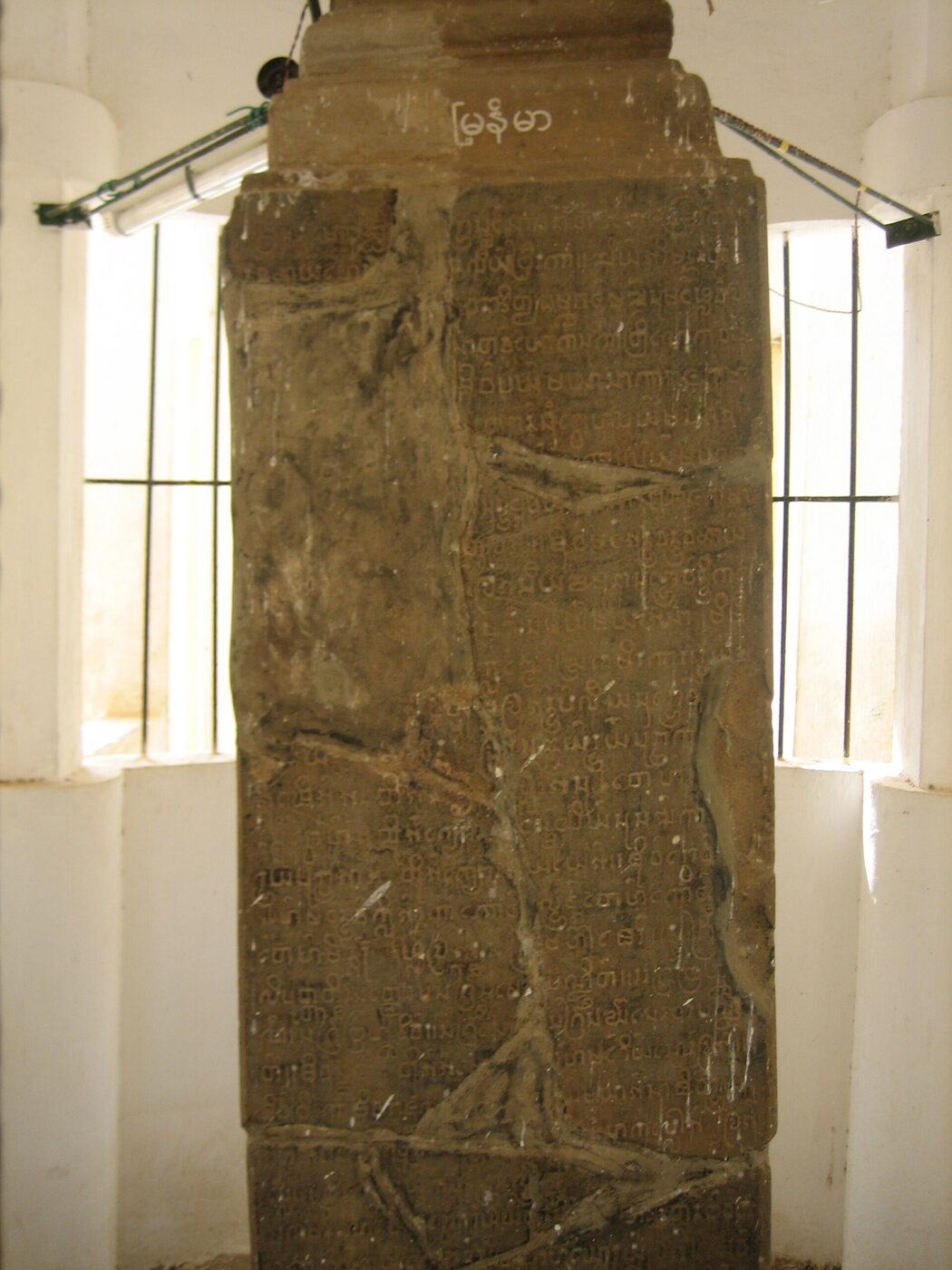
Burmese is written in an abugida descended, through the Mon–Burmese script, from the Brahmic family; its characteristic rounded letterforms are conventionally explained by the writing surface, since palm leaves tear along their grain under a straight stylus stroke. The earliest Burmese writing survives as kyauksa, inscriptions cut into stone; the Myazedi inscription of 1113, which carries the same proclamation in Old Burmese, Pali, Old Mon and Pyu on two stone pillars at Bagan, is both an important early example of the language and the key that allowed Pyu to be deciphered. It is listed on UNESCO's Memory of the World Register.

Getting that script onto a screen took a very long time, and the delay shaped what the newsgroup looked like. Burmese is a complex-text-layout script: the position and shape of a mark depend on its context, and vowel signs are stored in one order and displayed in another. Support for complex text rendering did not reach ordinary desktop computers until Windows XP Service Pack 2 in 2004, and no Burmese font using that machinery existed until 2005.
The character-set side moved earlier but not by enough. Comments and proposals on encoding the script were circulating in the standards committees from April 1993; the Myanmar block, U+1000 to U+109F, entered Unicode with version 3.0 in September 1999, carrying seventy-eight characters. A further seventy-eight were added in version 5.1 in 2008 and four more in 5.2 in 2009, filling the block; the implementation of the script was substantially revised in the process. For the whole of the group's productive life, therefore, there was no dependable way to put Burmese script into a Usenet article and expect anybody else to be able to read it. The traffic ran in English and in romanised Burmese, and since no single romanisation of Burmese is in general popular use — the Myanmar Language Commission's transcription system is a linguists' tool rather than a street convention — a single name could reach the group in several spellings, and often did. The wider question of scripts, transliteration and vocabulary across the region is soc.culture.asian's subject and is not pursued here.
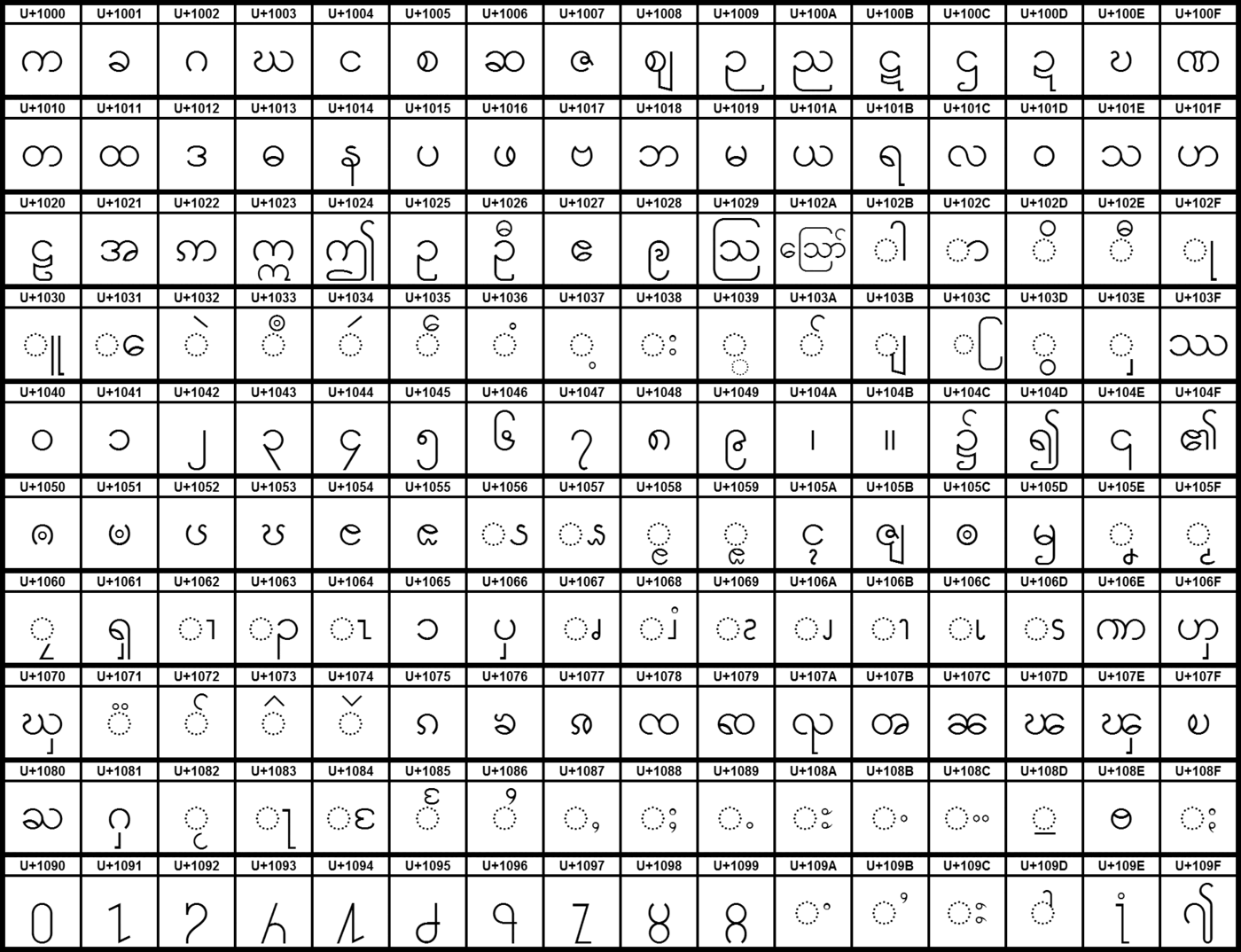

What happened next split the record rather than tidying it. Because Western sanctions kept the international font and platform vendors largely out of the country, localisation was developed locally and without much external co-ordination. A series of fonts appeared in the 2000s that were partly, but only partly, Unicode-compliant: they used some of the code points as specified and others not, an arrangement the Unicode Consortium describes as an ad hoc font encoding. Zawgyi, released on 4 December 2007 by a Mandalay type foundry, became overwhelmingly the most widespread of them, to the point where handset manufacturers shipped it in place of the compliant system fonts.
The costs were documented at length. Zawgyi and Unicode text render as garbled nonsense to one another, so producers routinely posted the same content twice. Because the encoding was less efficient than the standard, it needed more code points than Burmese had been allotted, and took them from the part of the block reserved for the other languages of Myanmar — which is to say that the workaround for one language crowded out the others. The same word could be encoded several different ways, making Zawgyi text difficult to search, sort or analyse. Unicode eventually assigned the special script code Qaag purely to tag text as Zawgyi for migration purposes, and the International Components for Unicode gained a transliterator to convert it.
The government designated 1 October 2019 as the date for the switch to Unicode. A full transition was expected by some to take about two years; the estimate was overtaken by events. The Usenet material escapes the whole problem, being romanised. Much of the Burmese-language web published in the intervening decade does not, and still has to be searched in both encodings — an archival consequence that will outlive everyone who chose a font.
What a culture group carried
The charter listed culture, religion and travel first among equals with politics, and it is worth setting out what that meant, because the material is old and deep and none of it is invented for this page.
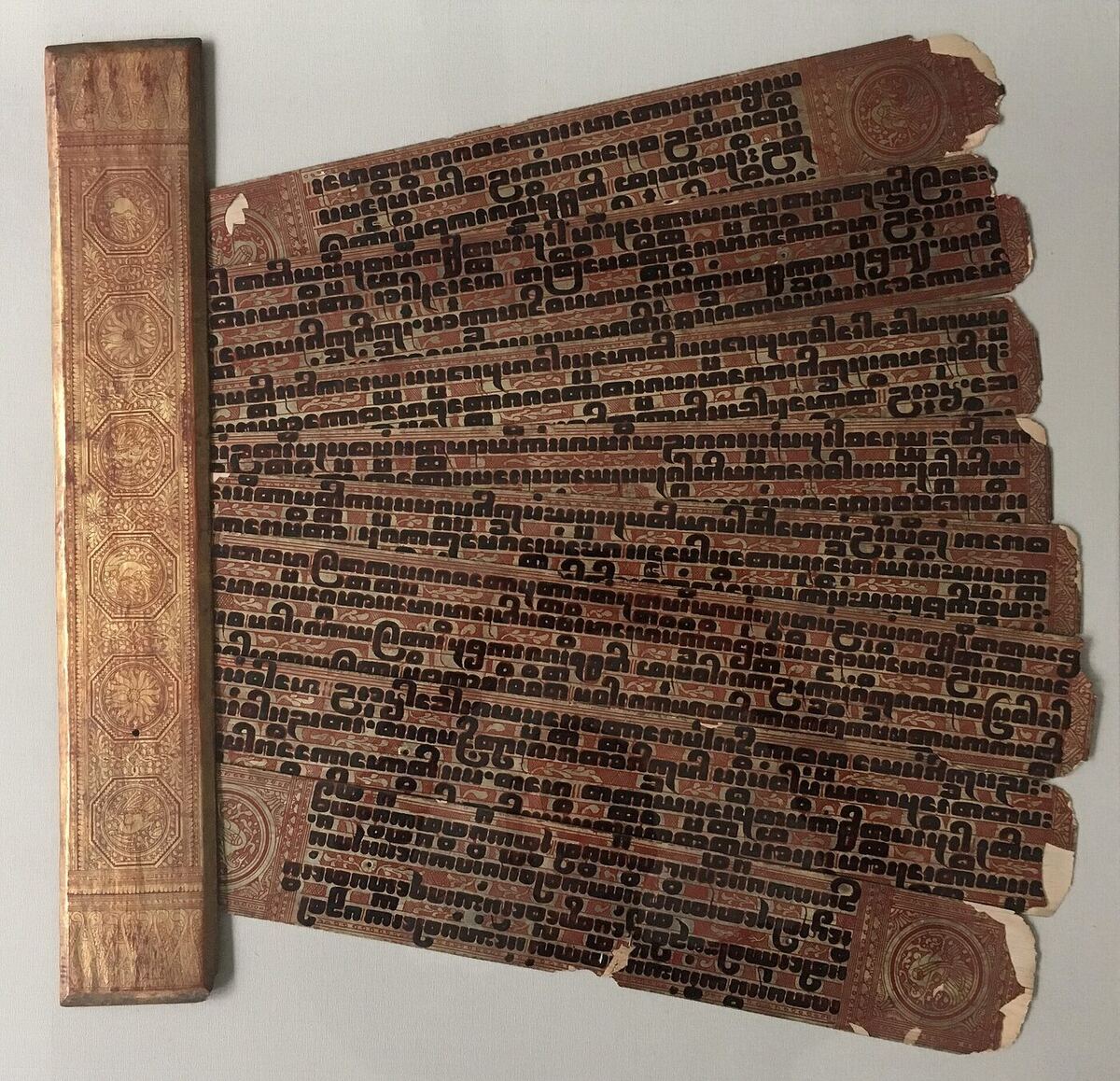
Burmese literature spans over a millennium and, unlike the literatures of several of its neighbours, drew its learned vocabulary chiefly from Pali rather than Sanskrit. Its earliest forms are the stone kyauksa; palm-leaf manuscripts, peisa, followed. The earliest surviving poetic work is dated to 1455. Four principal verse genres had emerged by the fifteenth century, and legal literature developed in two forms, one a body of treatises appearing before the thirteenth century, the other compilations of brief case narratives serving as guides and precedents for rulers. The chronicle tradition produced the Maha Yazawin in 1724, the Hmannan Yazawin or Glass Palace Chronicle, compiled by royal appointment from 1829, and the Konbaung Set Yazawin, published in 1905.

The first printing press arrived in 1816, sent by the Serampore Mission, and helped loosen centuries of composition in verse. Under colonial rule the literary centre of gravity moved from the court to the universities: the Burma Research Society was founded in 1910, the first Burmese novel appeared in 1904 — its author working, disarmingly, from The Count of Monte Cristo — and in the decade before the Second World War the Hkit san or “testing the times” movement at the University of Rangoon produced a deliberately shorter, plainer prose. George Orwell, a former colonial policeman in the country, published Burmese Days in 1935, which is how a great many English-language readers first encountered the place, for better and worse. After independence a state translation society was founded in 1947 and merged in 1963 into a government publishing house; the first volume of the Burmese Encyclopedia appeared in 1976.
Food and festival are the other standing business of a soc.culture group, and this one had good material. Mohinga, a fish soup with rice noodles eaten for breakfast and by now at any hour, is generally named as the national dish. Lahpet, fermented or pickled tea, is eaten rather than drunk and is served to visitors as a gesture of hospitality; the practice of eating tea is largely particular to this region. Thingyan, the new year festival, falls in mid-April, runs four or five days and is conducted very largely by throwing water.
The heritage record is short and recent. UNESCO has inscribed two sites in the country: the Pyu Ancient Cities — Beikthano, Hanlin and Sri Ksetra, remains of a society that flourished from about 200 BCE to 900 CE — listed in 2014 as site 1444, and Bagan, seat of the kingdom that first unified the region and now a cultural landscape of more than three thousand monuments on both banks of the Irrawaddy, listed in 2019 as site 1588. Fifteen further properties stand on the country's tentative list. Both inscriptions post-date the group's active years by a decade or more, which is itself a fact about how long the country spent outside the ordinary machinery of international cultural administration.
The campaign that ran through the same wires
The group did not sit alone. It was one component of an apparatus — newsgroups, mailing lists, gopher servers and the first activist websites — that carried an international campaign at a moment when very few campaigns had any online component at all. Accounts of the period routinely count the mid-1990s Free Burma campaign among the earliest international human-rights campaigns organised substantially over the internet.
The Free Burma Coalition was created in 1995 as an umbrella body, led from a graduate programme at the University of Wisconsin–Madison and drawing principally on American students. It took over an existing consumer boycott of PepsiCo, which severed its remaining business ties in the country in 1997, and campaigned for the withdrawal of corporations more broadly; contemporary accounts credit it with contributing to the departure of more than forty multinationals, among them ARCO, Unocal and Texaco. Whether such campaigns achieved what they intended is precisely the argument the newsgroup was having, and this page does not settle it.
The legal end of the same campaign is documented with more precision. Massachusetts enacted a selective-purchasing law restricting state agencies from buying goods and services from companies doing business with the country, modelled on legislation that had earlier targeted apartheid South Africa. In Crosby v. National Foreign Trade Council, 530 U.S. 363 (2000), decided on 19 June 2000, the Supreme Court of the United States struck it down unanimously, on the ground that federal sanctions legislation pre-empted the state statute. Selective-purchasing ordinances, shareholder resolutions and corporate withdrawals were debated on the network in the same threads that reported them, which is a reasonably good description of what the early activist internet was for.
The neighbours in the namespace
soc.culture.burma belongs to a recognisable sub-species of the branch: the group whose country was in a prolonged emergency and whose diaspora turned it into a news service by necessity. soc.culture.afghanistan and soc.culture.yugoslavia carried the same load in the same years, and the first of those was among the groups the 1993 call for votes was cross-posted to, which suggests the proponents knew exactly which shelf they were putting their group on.
The branch itself was older than any of them. soc.culture.* took its shape from the Great Renaming of 1987, the reorganisation that sorted Usenet into the hierarchies it still uses and gave each country, people and region a place of its own. Most of those places were filled by expatriates trading recipes and homesick argument. A few were not, and this was one of them.
What distinguished the Burmese case was duration. In the Yugoslav groups the crisis was an event with a shape, and the group-creation votes themselves became political occasions as the map changed. Here the emergency was a standing condition that had begun in 1962 and did not end within the group's lifetime, and the group settled into covering it the way one covers weather rather than the way one covers a war.
Its immediate neighbours in the namespace tell the rest of the story. soc.culture.thai was the venue it seceded from, and remained the nearest thing to a regional general-interest group for its subject matter. soc.culture.asean was the bloc's group, and became a plausible home for the country's affairs only in 1997. soc.culture.asian held the continental and linguistic questions. And the family history — how soc.culture.* came to exist at all, how its groups were made and how they behaved — belongs to the branch hub, which is where the general account lives.
What the record does not show
It is worth being explicit about the shape of the evidence, since this page rests on primary documents for some claims and on nothing at all for others.
What survives is the administrative record: two requests for discussion, two calls for votes, a result with a full roll of voters, four control messages and a line in a configuration file. That record is unusually complete for a soc.culture group, and every date, tally and quotation drawn from it above comes from it directly.
What does not survive, or has not been found, is almost everything else. There is no reliable message count for the group, no subscriber estimate, no readership survey and no traffic series. No group FAQ has come to hand; the by-newsgroup FAQ archive that would settle the question was not reachable when this page was written. There was no moderator, the group being unmoderated by charter, and so no moderator's records. No charter revision, moderation proposal or reorganisation request appears in the archive after January 1994: the only later entries of any kind are a site-local newgroup message re-issued inside one company's network in June 1995 and the unsigned removal attempt of November 2001, which failed.
Nor does this page quote any posting. No thread title, poster name, message text or message count appears anywhere above, because none has been verified, and a plausible invention would be worth less than nothing on a page that people cite. Where an assertion about the group's contents is made — that a great deal of the traffic was relayed news, that the federal question recurred — it is the kind of general statement that the charter, the proposal's own description of the gap it was filling, and the documented conditions of the period support, and it is offered at that level of generality deliberately.
Two further absences are findings in their own right. The ISC archive contains no proposal, at any date, to rename the group or to create a parallel one under the newer name; and the current namespace contains no Big-Eight group under that name either. Both were checked for this page, and both are negatives rather than gaps.
Scope and limits
This page is about a newsgroup. The historical, legal and demographic material above is here because it is what the group's traffic was made of and what its constraints were made of, not as a general account of the country, which is not this site's business.
Where international bodies have made findings, those findings are reported with the body named, the date given and the instrument identified, in the body's own language where it is quoted. Figures are attributed to the studies that produced them and carry those studies' own descriptions of their method. Characterisations are attributed to whoever made them. This page adjudicates none of it, endorses none of it and offers no advice of any kind.
On the question that gives the group its name, the position taken here is procedural rather than substantive: the address is soc.culture.burma because 238 people voted on it in December 1993, and a Usenet address cannot afterwards be edited. This directory uses the address as it exists, and expresses no view on what the country should be called in English.
Adjacent subjects are covered elsewhere and not duplicated here: the regional bloc and its institutional handling of its members at soc.culture.asean, Thailand at soc.culture.thai, the continental and script questions at soc.culture.asian, and the machinery of the branch itself at soc.culture.*.
Reading soc.culture.burma today
- Historical archive: Google Groups — soc.culture.burma (coverage varies by group and era).
- Open in a newsreader:
news:soc.culture.burma— the original site offered exactly this link, and it still works if your system has a newsreader registered for thenews:scheme. - Live access: point an NNTP newsreader at a modern server — see accessing Usenet today.
- The original news2mail e-mail subscription service ended in the mid-2000s and no longer operates.