soc.culture.croatia
Croatia and Croatians.
Founded amid the 1991–95 war, with all the intensity that implies: front-line news relays, diaspora mobilisation, and ferocious crossposted arguments with neighbouring groups.
Peacetime brought normal life back: dialect maps, klapa music, coastal-travel advice and EU-accession debate.
On this page
The group and its era
The soc.culture.* hierarchy was laid out on the comfortable assumption that nations are stable things: one group per country, filed alphabetically. Yugoslavia tested the filing system. soc.culture.yugoslavia predated the federation's collapse, and as the state came apart its readership did too, with successor groups put through the mainstream hierarchies' usual proposal-and-vote machinery at a moment when names, borders and flags were precisely what people were fighting over. soc.culture.croatia was one result.
Its early population skewed the way early-1990s Usenet always did: students, academics and émigrés posting from university accounts abroad, since connectivity at home was scarce until Croatia's academic network, CARNet, brought the internet into the country early in the decade. Domestic voices multiplied as access spread. Like nearly all of soc.culture.*, the group was unmoderated — a design choice whose consequences the archive records in full.
The dates behind that sentence are on the public record. The body that became CARNet, the Croatian Academic and Research Network, was constituted on 3 October 1991 to coordinate a national academic computer network; the first international link, from Zagreb to the University of Vienna, was brought into service on 17 November 1992 at 64 kbit/s; and IANA's root database gives 27 February 1993 as the registration date of the .hr country-code domain, naming CARNet as its sponsoring organisation. The country's first internet was an academic one, and it arrived while the events the group was founded to argue about were still in progress.
How thin the domestic base remained can be read off the World Bank's series for individuals using the internet as a share of population, which puts Croatia at about 0.5 per cent in 1995, 3.3 per cent in 1998 and 6.6 per cent in 2000, passing 30 per cent only in 2004. For most of the group's first decade, arithmetic alone made it likelier that a given poster was reading from a university or workplace account abroad than from a home connection inside the country. The balance shifted during the years this gateway ran.
By the years this gateway carried it, the group had settled into middle age. The wartime function was over, web forums were siphoning off casual readers, and what remained was a durable core of regulars for whom the group was simply where the conversation happened, in English and Croatian by turns.
Who could reach the network
Croatia's first internet came through the academic sector: CARNet was the registry for .hr as well as the operator of the backbone, and its rules require a connection to Croatia — citizenship, permanent residence or a registered company — for every category of second-level name except com.hr. An academic-first network means the earliest domestic voices in a group like this one were disproportionately staff and students at institutes and faculties, and that the general public arrived later, by dial-up and then by consumer broadband; ADSL was introduced in Croatia in 2000 by the incumbent operator, Hrvatski Telekom.
The diaspora had no such waiting period. An emigrant with a university or employer account in western Europe, North America or Australia was already sitting on a network that carried Usenet, and could post years before a relative in Zagreb could.
A mail gateway of the sort this site ran between 2000 and 2004 sat in the same gap: where an NNTP feed was unavailable, e-mail was not, and subscribing a mailbox to a newsgroup put the traffic within reach of anyone who could receive mail at all.
What was discussed
Language was a reliable engine of traffic. What the language should be called — Croatian, or a variant of Serbo-Croatian — was never a merely technical question, and posters knew it; the dispute has a documented history running back through the 1967 Declaration on the name of the language and well beyond. Orthography reform, loanwords and the merits of purism all fed the same long argument.
History threads cut deepest. The Second World War and its aftermath — Jasenovac, Bleiburg, the competing arithmetic of the dead — returned on a steady rotation, each participant arriving with sources and leaving with them intact. The group settled none of it; no forum has. What it did, at its best, was put people raised on one national curriculum in direct contact with people raised on another.
Quieter staples ran alongside. Genealogy queries from second- and third-generation emigrants — a surname, a village, a grandfather's parish — were constant, as were questions about citizenship by descent and requests for help with a half-inherited language. Football supplied the reliable exception to fractiousness: the national team's third place at the 1998 World Cup was one subject on which the group could celebrate more or less in unison.
Its threads travelled, too: by the early 2000s the longer-running arguments over religion and history routinely arrived and left crossposted well beyond the Balkans, having joined the general weather of the hierarchy.
Because the arguments crossed borders, so did the filing. This directory keeps separate pages for the predecessor group at soc.culture.yugoslavia and for the neighbouring soc.culture.bosna-herzgvna, with the full roster at soc.culture. Reading any one of those archives in isolation gives a partial view of a conversation that was, in practice, shared.
Writing Croatian on a seven-bit network
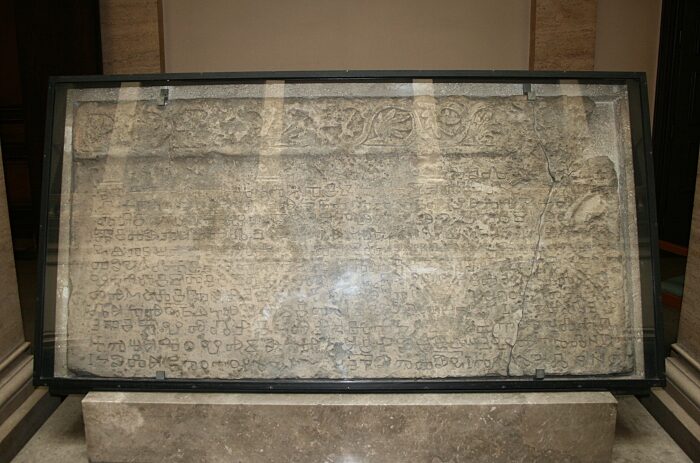
Croatian is written in Gaj's Latin alphabet, thirty letters: the twenty-two basic Latin letters other than q, w, x and y, five letters carrying diacritics — Č, Ć, Đ, Š and Ž — and three digraphs, dž, lj and nj, which the orthography counts as single letters. The Latin script is not the language's only historical vehicle: Glagolitic served Croatian church and legal texts for centuries, and the Latin alphabet now used was devised by Ljudevit Gaj in 1835, reaching its final form only later in the nineteenth century.

None of the five diacritic letters existed on the network that carried the group. Usenet's interchange standard, RFC 1036 of December 1987, defined articles by reference to the mail format of RFC 822 of 13 August 1982, in which a message body is described as a sequence of lines containing ASCII characters. Five of the alphabet's thirty letters therefore had no representation at all in a strictly conforming article, and the two that differ only by the shape of an accent — č and ć — collapse into the same substitute.
Eight-bit code pages existed, and they disagreed. ISO/IEC 8859-2, the standard published in a first edition in 1987 and generally called Latin-2, covers Croatian; so does Windows-1250, which has all of Latin-2's printable characters and more but assigns some of them to different byte values; and so does IBM code page 852, the MS-DOS set, which is different again despite also being spoken of as Latin-2. A post composed under one of the three and read under another produced the familiar scatter of wrong letters, and posts that passed through software assuming plain ASCII simply lost the high bit. A seven-bit workaround existed: the JUS standard I.B1.002, known as YUSCII and locally as CROSCII, reassigned ASCII punctuation positions to the accented letters, at the cost of rendering ordinary English text unreadable.
What did take hold was stripping. Writers dropped the diacritics and wrote c for both č and ć, s for š, z for ž and dj for đ, a habit that long outlived its technical cause and is still visible in text messages and comment threads. Unicode had in principle solved the problem before the group existed: the Latin Extended-A block has been in the standard since version 1.0, whose first volume was published in October 1991, and it contains č at U+010D, ć at U+0107, đ at U+0111, š at U+0161 and ž at U+017E. Unicode reached ordinary newsreaders far later than 1991, so the archive contains all the stages at once.
The consequence for anyone searching that archive now is practical. A single word may appear in accented form, in stripped form and in one or another mangled eight-bit form within the same thread, so searching the group means trying the accented spelling, the accent-free spelling and the dj-for-đ variant in turn, and treating every result set as partial.
Context
The group's lifetime tracks the country's documented arc. Croatia declared independence in June 1991; international recognition came in January 1992 and United Nations membership that May; large-scale fighting in the Croatian War of Independence ended in 1995, and the peaceful reintegration of the Danube region was completed in 1998. Readers did not learn this sequence afterwards from books — they lived it in the group, in real time and in argument.
The other half of the context is the Croatian diaspora, among Europe's larger ones relative to the home population. Successive emigrations — economic, political and wartime — had planted communities in Germany, Austria, Australia and across the Americas, and the group functioned as their common room: a place where Zagreb, Toronto and Melbourne kept the same hours.
The milestones kept arriving after the period in which such groups were most used had passed: NATO membership in 2009, European Union accession in 2013. By then the conversation had largely moved to web forums and, later, social media, following the general drift of Usenet's diaspora groups. The newsgroup outlived the war, this gateway and most of its own arguments' urgency; the archive preserves all three.
The dated record
The chronology below is given as a record of dated events, without characterisation of any party and without attribution of responsibility.
- 19 May 1991 — a referendum on independence is held in Croatia.
- 25 June 1991 — the Croatian parliament adopts the declaration of independence.
- 7 July 1991 — the Brioni Agreement is signed on the Brijuni islands by representatives of Slovenia, Croatia and Yugoslavia under European Community sponsorship; a three-month moratorium on implementation of the independence declarations follows.
- 8 October 1991 — the moratorium expires and the Croatian parliament severs the remaining ties with Yugoslavia.
- 15 January 1992 — the European Community extends diplomatic recognition.
- 22 May 1992 — Croatia is admitted to membership of the United Nations.
- 12 November 1995 — the Erdut Agreement is signed at Erdut, providing for a transitional administration in eastern Slavonia, Baranja and western Sirmium, for the return of refugees and displaced persons, and for joint implementation committees and a joint council of municipalities.
- 21 November 1995 — the Dayton Agreement is initialled at Wright-Patterson Air Force Base in Ohio.
- 14 December 1995 — the Dayton Agreement is signed in Paris by the Republic of Bosnia and Herzegovina, Croatia and the Federal Republic of Yugoslavia.
- 15 January 1996 — United Nations Security Council Resolution 1037 establishes the Transitional Administration for Eastern Slavonia, Baranja and Western Sirmium (UNTAES).
- 15 January 1998 — the UNTAES mandate ends.
- 1 April 2009 — Croatia becomes a member of NATO.
- 1 July 2013 — Croatia accedes to the European Union, and Croatian becomes an official language of the Union.
Everything down to the 1998 entry predates the years in which this gateway carried the group, and the last two entries postdate the period in which such groups were most used; readers who lived through the middle of the list were arguing about it in the present tense, while readers who arrived later met it as history. The Erdut Agreement and the Dayton Agreement are separate instruments with separate scopes, signed a month apart.
The language question, as a sequence of documents
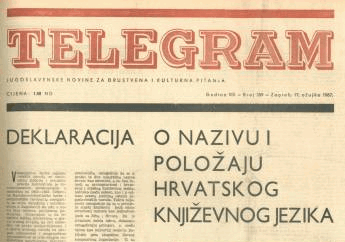
The dispute the group returned to most often has an unusually well-documented paper trail, and the least partisan way to describe it is to list the documents and their dates. The Vienna Literary Agreement of 1850 set a shared dialect basis. The Declaration on the Name and Status of the Croatian Literary Language appeared in the Zagreb weekly Telegram, number 359, dated 17 March 1967. Its signatories were institutions rather than individuals: Matica hrvatska, the Croatian Writers' Association, Croatian PEN, departments of the Yugoslav Academy and of the philosophy faculties in Zagreb and Zadar, the Old Church Slavonic Institute, and the association of literary translators of Croatia.
The Declaration's own formulation is worth stating precisely, because it is often summarised in one direction or the other: it affirmed that the Serbian and Croatian standards were linguistically the same while demanding separate standards, each under its own national name, and equal treatment for the Croatian standard in the state administration, in public and mass communication, and in the language of the army. Its demands were rejected at the time; they were substantially reflected in the Yugoslav constitution of 1974.

After 1991 the standards were codified separately, and the international code registries followed. The ISO 639-1 code sh for Serbo-Croatian was deprecated in 2000 on the ground that separate codes existed for the individual languages, a status the ISO 639 Joint Advisory Committee reaffirmed in 2005; ISO 639-3 treats the same entity as a macrolanguage. In ISO 639-2 the older bibliographic code scr for Croatian was deprecated in favour of hrv on 28 June 2008. Within Croatia, the Hrvatski pravopis issued by the Institute of Croatian Language and Linguistics received the education ministry's sole seal of approval in 2013. On the fiftieth anniversary of the 1967 text, a Declaration on the Common Language was drawn up in 2017 taking the opposite position on naming.
All of the post-1991 items in that list, and the 2017 declaration in particular, postdate the years in which such groups were busiest. This page records that the documents exist, who issued them and when; it takes no position on the questions they address, which are live and which the newsgroup did not settle.
Where the readers were
Croatia's own resident population, as recorded by the Croatian Bureau of Statistics, was 4,437,460 at the 2001 census, 4,284,889 in 2011 and 3,871,833 in 2021. The communities abroad are counted separately, and by several different methods.
The German figures are the most precisely dated, because Germany counts resident foreign nationals annually. Croatian citizens resident in Germany numbered 153,146 in 1993, 176,251 in 1994, 223,819 in 2001 and 229,172 in 2004. Croatia's State Office for the Croats Abroad and the Croatian Catholic missions put the total including naturalised residents and their descendants above 500,000. In the United States, the American Community Survey recorded 420,763 people of full or partial Croatian descent in 2007 and the revised 2010 census 414,714; diaspora bodies cite about 1.2 million on a broader definition. Canada's census recorded 114,880 people of Croatian ethnic origin in 2011 and 133,965 in 2016. Australia's 2021 census recorded 164,362 reporting Croatian ancestry, a count that postdates the group's active years but describes a community established mainly by migration in the 1960s and 1970s.
South American figures should be read differently. The often-quoted totals of roughly 250,000 in Argentina and 400,000 in Chile are estimates of descent rather than counts of census self-identification, and they refer largely to communities founded by nineteenth- and early twentieth-century emigration. The distinction matters for reading the archive: a group whose readership includes both recent emigrants and fourth-generation descendants carries two quite different kinds of question.
The institutions predate the network by a century. The Croatian Fraternal Union, founded in 1894 and headquartered at Pittsburgh, is the oldest and largest Croatian organisation in North America and publishes Zajedničar in English and Croatian. Usenet did not create a diaspora press; what it added was a channel with no print schedule, no editor and no postal delay.
The time zones did the rest. Zagreb keeps Central European Time, one hour ahead of UTC and two in summer, as do Berlin and Vienna; Toronto is on Eastern Time, five hours behind UTC; Buenos Aires is three hours behind; Perth is eight ahead and Melbourne ten, eleven in the southern summer. A post written over breakfast in Zagreb reached an evening reader in Melbourne and a pre-dawn one in Toronto, and a reply was waiting by the time Zagreb woke. There was no hour at which the group was asleep, so its longer disputes ran without the pauses a single-time-zone forum imposes.
The traffic between the crises
The bulk of a culture group's traffic is the ordinary material of a national culture, and that material is better documented than its arguments are.
Music supplied a steady share of it. Klapa, the Dalmatian a cappella tradition, is sung in four parts — first tenor, second tenor, baritone and bass — and has had a dedicated annual festival at Omiš since 1966; UNESCO inscribed it on the Representative List of the Intangible Cultural Heritage of Humanity in 2012. The same list carries bećarac from eastern Croatia and the nijemo kolo of the Dalmatian hinterland, both inscribed in 2011, and two-part singing in the Istrian scale, inscribed in 2009; ojkanje singing was placed on the List in Need of Urgent Safeguarding in 2010. Every one of those inscriptions postdates the group's active years: the practices are old, the paperwork is recent.
The festival calendar supplied arguments of its own. The Sinjska alka, an equestrian competition at Sinj in which riders at the gallop aim a lance at a suspended ring, has been held since 1715, falls on the first Sunday in August and was inscribed by UNESCO in 2010. The festivity of Saint Blaise at Dubrovnik, the Za Križen procession on the island of Hvar, the carnival bell ringers of the Kastav area and the spring procession of the Ljelje from Gorjani were all inscribed in 2009. The Dubrovnik Summer Festival, a secular fixture of a different kind, has run since 1950.
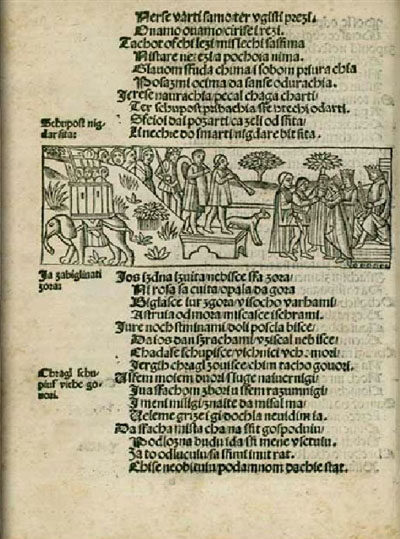
Literature threads reached back much further than the twentieth century. Marko Marulić finished Judita on 22 April 1501; it was first printed in Venice by Guglielmo da Fontaneto on 13 August 1521, and the second edition, edited by the Zadar librarian Jerolim Mirković and dated 30 May 1522, was illustrated with nine woodcuts. The poem runs to 2,126 dodecasyllabic lines in six books, and its author described it on the cover as laid out in Croatian verses.

Food ran through everything, as it does in every culture group, and the regional split between the continental north and the Mediterranean coast supplied a permanent low-grade dispute about what counted as national cooking. The multinational Mediterranean diet inscription of 2013 lists Croatia among its states party; the gingerbread craft of northern Croatia was inscribed separately in 2010, so the two culinary halves are recognised under separate headings.
Sport delivered the group's reliable truces, and two of them fall inside the years this gateway carried it. In July 2001 Goran Ivanišević, then ranked outside the top hundred and admitted to the draw on a wild card, won the Wimbledon men's singles title — the only man to have won a Grand Slam singles title from a wild card. At the 2002 Winter Olympics in Salt Lake City, Janica Kostelić won three gold medals and a silver in alpine skiing, the first Winter Olympic medals won by any athlete from Croatia. Croatia has competed at the Eurovision Song Contest as an independent state since its debut in 1993, which gave the group an annual and entirely low-stakes argument.
Coastal-travel questions were the other constant, and the economics behind them are visible in the trade statistics. World Bank figures put Croatia's international tourism receipts at about 32 per cent of total exports of goods and services in 1999, around 40 per cent in 2001 and 2002, and about 46 per cent in 2005. The Adriatic season resumed after the war on that scale, and a group with a large potential summer readership spent a good deal of each spring answering questions about ferries, islands and where to stay.
Reading soc.culture.croatia today
- Historical archive: Google Groups — soc.culture.croatia (coverage varies by group and era).
- Open in a newsreader:
news:soc.culture.croatia— the original site offered exactly this link, and it still works if your system has a newsreader registered for thenews:scheme. - Live access: point an NNTP newsreader at a modern server — see accessing Usenet today.
- The original news2mail e-mail subscription service ended in the mid-2000s and no longer operates.