soc.culture.haiti
Haiti and the Haitian diaspora.
Aristide’s returns and removals, the embargo years, and a diaspora in New York, Miami and Montreal writing home in Kreyol, French and English.
The group’s language threads — Kreyol orthography above all — have lasting reference value.
On this page
The group and its era
soc.culture.haiti was one of the national groups of the soc.culture.* hierarchy: carried by any server that took the feed, and shaped by whoever turned up to post. Who turned up was decided by infrastructure. Internet access inside Haiti was scarce for the whole of the group’s active life — as late as 2015 only about an eighth of the population were counted as internet users — so a newsgroup named for Haiti was written almost entirely from outside it: from New York, Miami, Boston, Montreal and Paris.
The delegation record puts a date on that scarcity. The country-code domain .ht was entered in the IANA root database on 6 March 1997, and the sponsoring organisation recorded against it is not a telephone company but the Consortium FDS/RDDH — the Faculté des Sciences of the Université d’État d’Haïti with the Fondation Réseau de Développement Durable d’Haïti, a university faculty and a development foundation holding the national domain between them. The World Bank series for individuals using the internet gives Haiti 0.23 per cent of the population in 2000, 0.34 per cent in 2001, 0.89 per cent in 2002 and 1.65 per cent in 2003, passing five per cent only in 2004. Fewer than one Haitian in a hundred was counted as an internet user before 2003.
Those years coincided with an unusually compressed political sequence, which the group absorbed as news. Jean-Bertrand Aristide was elected on 16 December 1990 and inaugurated on 7 February 1991; he was deposed on 29 September 1991. Embargoes followed, the United Nations adding an oil and arms embargo in June 1993, and Security Council Resolution 940 of 31 July 1994 authorised all necessary means to restore the elected government. A multinational force began landing at Port-au-Prince on 19 September 1994 and Aristide returned in October. He was inaugurated for a second term on 7 February 2001 and left the country at the end of February 2004, in circumstances disputed then and since.
The news2mail gateway carried the group to e-mail between 2000 and 2004, placing its subscribers in front of that second term and its end. The group’s arc was the ordinary one: growth through the 1990s, a plateau, then a drift to web forums and diaspora news sites.
What was discussed
Politics was argued with the intensity of people whose relatives were directly affected by every turn, and from every available position. Recurring subjects included the embargo years and what they did to ordinary households; the intervention of 1994 and what outside force could restore; elections, boycotts and disputed counts; and, from 2001, the crisis that closed the second term. The diaspora had itself been formed in successive waves — the Duvalier decades, a peak of departures in the early 1980s, continued emigration through the 1990s — and threads drew the crossposting familiar from the political end of Usenet.
The language question ran in parallel and has the more durable reference value. Haitian Creole had been written to competing systems — the McConnell–Laubach orthography of 1940 and its revisions — before a standard was fixed through the Institut Pédagogique National in 1979, and the 1987 constitution established Kreyol alongside French as an official language, the one language all Haitians hold in common. All of that was live on the group: which spellings to follow, how to render the grave accents of è and ò on equipment that often would not produce them, and whether to write in Kreyol, French or English — a choice read as carrying signals about schooling, class and intended audience.
Vodou drew a standing genre of explanatory posting: the relation between service to the lwa and the Catholicism most practitioners also profess, and the correction of newcomers arriving with the version supplied by foreign films and paperbacks. The spelling was itself part of the argument, practitioners and scholars having moved away from the Anglophone form and its popular associations.
Music and art were a constant presence. Kompa, the modern méringue dance style built by Nemours Jean-Baptiste from 1955 and carried by emigrants to the United States, Canada and France, had its partisans; so did mizik rasin, twoubadou and rara, the painters and the writers of both literatures. Behind all of it stood the revolution of 1791–1804 and the independence declared on 1 January 1804, the permanent frame against which the rest was argued.
Context
In several of the cities that supplied the posters, the Haitian population is a major community in its own right: the New York metropolitan area, Miami-Dade, the Boston area, Greater Montreal, and France. For a population of that size, spread across several countries and three languages, a newsgroup open to anyone with a feed was one of very few shared public addresses that cost nothing to reach and belonged to no institution or party.
Haitian usage has a name for that dispersal. Through the 1990s the diaspora was commonly called the dixième département, the tenth department, Haiti then being divided into nine; when a real tenth department, Nippes, was carved out of Grand’Anse in 2003, the phrase shifted to onzième département. The clock also worked in the group’s favour: Haiti keeps Eastern Standard Time at UTC-5, the zone of New York, Miami, Boston and Montreal, so four of the five principal centres of readership shared a working day with Port-au-Prince, and only the French end, six hours ahead, read the previous evening’s traffic the next morning.
That is also what makes the surviving traffic a linguistic record as much as a political one. The group was written in Kreyol, French and English, at the period when Kreyol orthography was settling into general use among writers schooled to write French. Everyday written Kreyol of that kind is not well represented in the published sources of the decade.
The regional frame belongs to soc.culture.caribbean, and the Montreal end of the conversation touched soc.culture.quebec; the borders were crossed freely by crosspost. What the archives preserve, where they preserve it, is a contemporaneous account of how a dispersed nation argued about its own country while the outcomes were open.
The network the country had
Usenet reached a reader through a feed, and a feed needed a machine with a standing connection and someone to pay for it. Haiti was credited with 555 internet hosts in 2012, and with about 50,000 fixed telephone lines in use in the same year, for a population then above ten million. International traffic ran through a single Intelsat earth station on the Atlantic Ocean satellite as of 2010, and the registry that received the domain in 1997 counted 3,371 names registered under .ht as of 31 October 2022.
Such growth as came arrived on mobile networks rather than fixed ones. Against those 50,000 landlines, 2012 recorded some 6.1 million mobile lines covering 61.6 per cent of the population, while mobile broadband subscriptions stood at 15,781, or 0.2 per cent; the providers named as serving the country are NATCOM, Hainet and Digicel Haiti. A country that acquires its first mass connectivity by handset, and late, acquires it after the period in which Usenet was a general-purpose public medium.
The percentage series estimates individuals using the internet rather than counting subscriptions, and the host figure counts named machines, by 2012 already a poor proxy for anything.
Writing Kreyol in seven bits
The orthography fixed in 1979 is unusually economical in its use of accents, which matters for what happened to it on the network. The standard alphabet runs to thirty-two symbols; c and u are not independent letters and appear only inside the multigraphs ch, ou, oun and ui; and the only accent mark retained from French practice is the grave, on è and ò. The change of status came with the Act of 18 September 1979, in the same year the Institut Pédagogique National established the official orthography.
Both of those letters sit inside the oldest and best supported eight-bit set in the Latin world. ISO/IEC 8859-1 was published as ECMA-94 in March 1985 and as an ISO standard in 1987; it encodes 191 Latin characters, the full grave series among them. When Unicode was first defined its opening 256 code points were taken directly from ISO 8859-1, so è and ò have stood in the Latin-1 Supplement block since the standard’s first version. Written Kreyol therefore never waited on a new Unicode block or a national code page, as the languages of non-Latin scripts did.
The obstacle was transport rather than repertoire. RFC 1036 of December 1987, the standard for the interchange of Usenet messages, required articles to be valid Internet mail messages in the sense of RFC 822 and specified printing ASCII for fields such as the message identifier. MIME supplied the escape route — RFC 1341 in June 1992 and the RFC 2045 to RFC 2049 series in November 1996 — with quoted-printable and base64 to carry arbitrary octets through seven-bit paths, and RFC 2047 encoded-words for header text. News software took this up unevenly, and a poster unsure what the far end would do had a cheap remedy to hand.
The remedy was to drop the accent. That is inexpensive in French, where a missing acute rarely produces a different word, and expensive in Kreyol, where e and è, and o and ò, are separate letters of the alphabet: removing the mark merges two letters rather than blurring one. French posted in the same threads asked in one respect for more than Latin-1 could give — the ligature œ is absent from ISO/IEC 8859-1 and was added only in ISO/IEC 8859-15 of 1999, and in the Windows-1252 set commonly substituted for Latin-1.
The consequence for anyone searching the surviving archive is direct. The same Kreyol word may appear accented, unaccented, garbled by a mismatch between Latin-1 and Windows-1252, or still wrapped in quoted-printable a later indexer did not decode, and a query in one form will not match the others. A reader using this material as a corpus has to search every spelling of every word, and to treat the absence of a hit as evidence of nothing.
Independence and the indemnity, as dated record
The events the group treated as its permanent frame are given here as a record and not as an argument. Every item in the first list predates the newsgroup by more than a century and a half.
- 14 August 1791 — a Vodou ceremony at Bois Caïman, traditionally taken to mark the beginning of the revolution.
- 18 May 1803 — the last day of the Congress of Arcahaie, at which the first purely Haitian flag was adopted; the date is kept as Flag and Universities Day.
- 18 November 1803 — the Battle of Vertières, the last major engagement against the French expeditionary army.
- 1 January 1804 — independence declared, the country taking back the Taíno name Haiti.
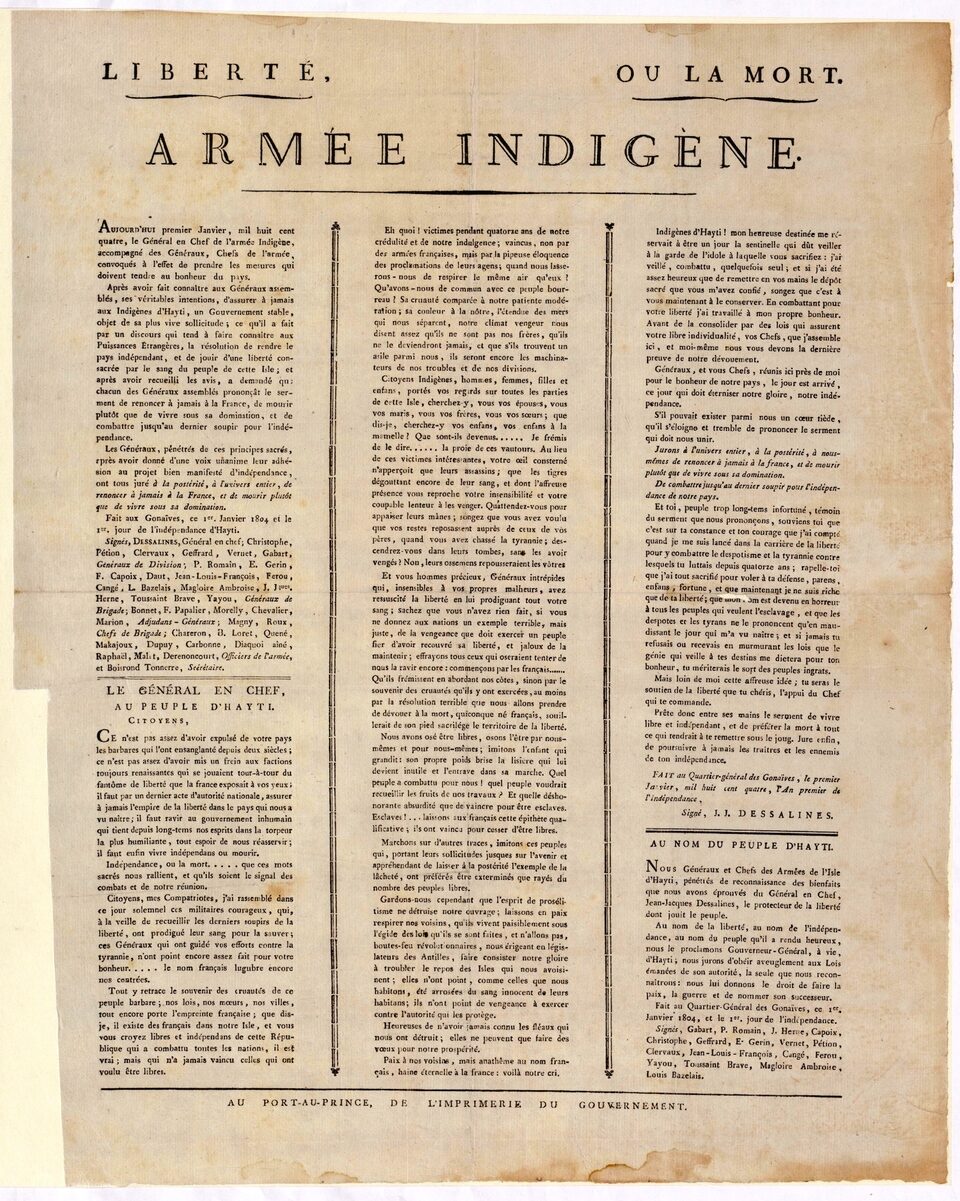

The two known surviving printed copies of the declaration were located in The National Archives at Kew by the historian Julia Gaffield, in 2010 and 2011; the printed poster is catalogued there as MFQ 1/184. The identification came two centuries after the event, and after the gateway years had ended.
Recognition by France came at a price.
- 17 April 1825 — an ordinance of Charles X offered recognition in exchange for an indemnity of 150 million francs, payable in five annual instalments; a French squadron of fourteen warships carrying 528 cannon lay off the coast.
- 1825 — to meet the first instalment Haiti borrowed from the French bank Ternaux Gandolphe et Cie, the arrangement since described as the double debt: an indemnity serviced by a loan raised to pay it.
- 12 February 1838 — France agreed to reduce the sum to 90 million francs, payable over thirty years.
- 1862 — the United States recognised Haitian independence, fifty-eight years after the declaration.
- 1883 — the last payment on the reduced indemnity is generally dated, the French government acknowledging receipt of the 90 million in 1888; a 2022 analysis by the New York Times traces the final payment on the associated borrowing to 1947, made to the National City Bank of New York.
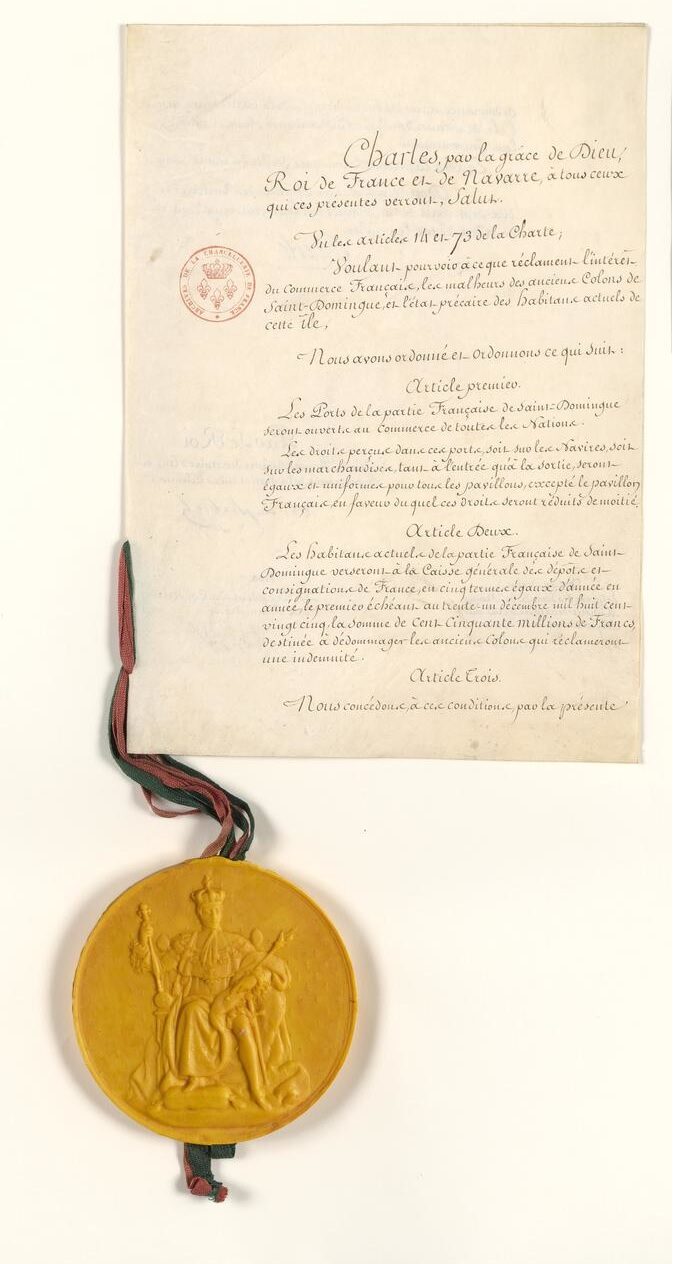

The sums are stated in the francs of their day; published estimates of their present-day value differ widely by method, and none is reproduced here.
The occupation of 1915 to 1934
The occupation is the other long fact standing behind the group’s political traffic, and is given here as dates alone. It ended in 1934, decades before Usenet existed.
- 28 July 1915 — 330 United States Marines landed at Port-au-Prince.
- September 1915 — the Haitian-American Convention was concluded, providing for American oversight over a ten-year term; an additional agreement of 1917 extended it to twenty years.
- 17 November 1915 — the capture of Fort Rivière ended the first Caco war.
- 1918 — a referendum approved a new constitution by 98,225 votes to 768; it permitted foreign ownership of Haitian land for the first time.
- 1918 to 1920 — the second Caco war, from the rebellion led by Charlemagne Péralte to the death of Benoît Batraville.
- 6 December 1929 — at Les Cayes, Marines fired on a crowd of about 1,500; accounts give between 12 and 22 Haitians killed and 51 injured.
- 28 February 1930 — the commission appointed by President Hoover, generally called the Forbes Commission, arrived in Haiti.
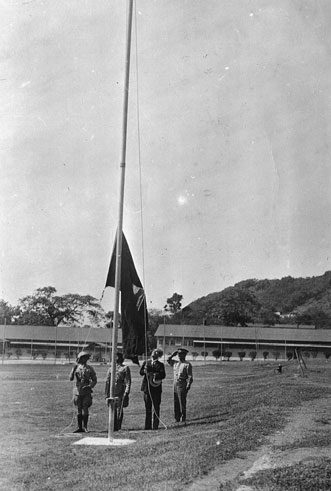
- 1 August 1934 — the occupation formally ended; the last Marine contingent left on 15 August 1934, after a formal transfer of authority to the Garde.

Dates before, inside and after the gateway years
The account above covers the sequence from 1990 to 2004 that the group read as news. Because no creation date for the newsgroup is recorded here, the dates around it are placed against the one interval this page can state precisely: the news2mail window of 2000 to 2004.
- 22 April 1971 — Jean-Claude Duvalier became President for Life at the age of nineteen, on his father’s death. Decades before the window.
- 7 February 1986 — the Duvaliers left Haiti for France aboard a United States Air Force aircraft.
- 26 February 1986 — the blue and red bicolour was readopted, the black and red design used from 1964 under the two Duvalier presidencies being set aside.
- 29 March 1987 — the constitutional referendum recorded 1,258,980 votes in favour and 2,167 against, out of 1,261,334 cast.
- 2003 — Nippes was created out of Grand’Anse as a tenth department. Inside the window.
- 1 January 2004 — the bicentenary of the declaration of independence. Inside the window, and in its final months.
- 12 January 2010, at 16:53 local time — an earthquake of magnitude 7.0 with its epicentre about 25 kilometres west of Port-au-Prince, near Léogâne; the Centre d’Art and Holy Trinity Cathedral were among the buildings extensively damaged. After the window.
- 16 January 2011 — Jean-Claude Duvalier returned to Haiti after twenty-five years; he died on 4 October 2014. After the window.
Nothing in that list is offered as an explanation of anything else in it; it marks which events a newsgroup archive could contain and which it cannot.
Where the readership was
Numbers for the diaspora are easier to find for the years after the group than for the years during it, and should be read with their dates attached.
In the United States the census recorded 813,186 people of full or partial Haitian descent in 2010 and 1,138,855 in 2020, the five largest states in 2022 being Florida, at 544,043 or 2.4 per cent of the state population, then New York, Massachusetts, New Jersey and Georgia. On 2020 five-year American Community Survey estimates the metropolitan figures were Miami–Fort Lauderdale–West Palm Beach 335,708, or 5.5 per cent of that metropolitan population; New York–Northern New Jersey–Long Island 229,028; Boston–Cambridge–Quincy 73,627; and Orlando–Kissimmee–Sanford 61,201.
In Canada the concentration is sharper. The 2016 census counted 165,095 people of Haitian origin, of whom 143,165 lived in Quebec, more than 86 per cent of the national total and 1.8 per cent of Quebec’s population; the 2021 census gave 178,990 nationally. Migration from Haiti to Quebec began in 1963 and rose steeply between 1968 and 1973, by the end of which Haiti supplied 8.4 per cent of Quebec’s immigration, second among source countries.
The largest single concentration outside the United States is on the same island. The Dominican Republic’s 2013 census counted 458,233 Haitian-born residents, about 5 per cent of the population; the national immigrant surveys put people of Haitian origin at 668,145 in 2012 and 751,080 in 2017, or 7.1 and 7.4 per cent. Those surveys postdate the group, and Spanish was not among its three working languages.
Totals for France and its Caribbean departments circulate without a year attached and are left out here. For the whole dispersal the usual estimate is 1.5 to 2 million people of Haitian ancestry living outside Haiti. Remittances measure it indirectly: World Bank figures for personal transfers received by Haiti run from 986 million United States dollars in 2005 to 1.61 billion in 2012, between 11.7 and 14.1 per cent of gross domestic product in every year of that span.
None of these counts is a readership figure. They give the size and shape of the population the posters were drawn from, which is the most census material can do for a newsgroup.
Painting, letters and the calendar
The Centre d’Art and after
The institutional history of twentieth-century Haitian painting has a clear starting point. The Centre d’Art, at once centre, school and gallery, was founded in Port-au-Prince in 1944 by the American watercolourist DeWitt Peters with prominent Haitian collaborators; Hector Hyppolite and Wilson Bigaud were among the painters associated with it. Sequins came into general use on the Vodou service flags, the drapo, during the same decade. In 1973 the Saint-Soleil movement was founded as a rural arts community by Jean-Claude Garoute and Maud Robart.
Two literatures
The literary tradition divides by language and by generation, and its landmarks are firmly dated. La Revue indigène appeared in 1927; Jean Price-Mars, 1876 to 1969, published Ainsi parla l’Oncle in 1928, defending Vodou as a religion and challenging an elite reading of the country as European. Jacques Roumain’s Gouverneurs de la rosée followed in 1944, and the magazine La Ruche was founded in 1945. Frankétienne, 1936 to 2025, published Dézafi in 1975, widely considered the first modern novel written entirely in Haitian Creole, and the play Pèlin-tèt in 1978; he is one of the principal figures of the movement called spiralism. Dézafi precedes the group by two decades and is the reference point for the question of whether Kreyol was a language to publish in.
The diaspora produced its own canon in the group’s own decades. Dany Laferrière, born in Port-au-Prince on 13 April 1953, moved to Canada in 1976 and published his first novel in 1985; he was elected to the Académie française on 12 December 2013. Edwidge Danticat, born in Port-au-Prince on 19 January 1969, published Breath, Eyes, Memory in 1994 and Krik? Krak! in 1995, a National Book Award finalist that year. Laferrière writes in French and Danticat in English.
The calendar and the table
Between crises a culture group runs on the calendar. Carnival precedes Lent; Rara follows it, a street procession music performed through the Lenten weeks and above all in Easter week, built on the cylindrical bamboo trumpets called vaksin with drums, maracas and bells made from recycled tins. Elizabeth McAlister’s Rara! Vodou, Power, and Performance in Haiti and its Diaspora, University of California Press, 2002, treats the form in Haiti and in New York together. 18 May is kept as Flag and Universities Day, for the Congress of Arcahaie of 1803; 1 January is independence day and the day of soup joumou, the squash soup eaten to mark the end of colonial rule, whose attendant practices UNESCO inscribed on its Representative List of the Intangible Cultural Heritage of Humanity in December 2021.
The one national team
Sport supplied the other fixed calendar. Haiti won the CONCACAF Championship in 1973, the only Caribbean winner in the ten editions of that tournament held between 1963 and 1989, and so qualified for the 1974 World Cup. On 15 June 1974, at the Olympiastadion in Munich, Emmanuel Sanon scored shortly after the break against Italy and ended Dino Zoff’s run of 1,142 minutes without conceding an international goal; Italy won 3–1. Poland beat Haiti 7–0 on 19 June and Argentina 4–1 on 23 June.
Reading soc.culture.haiti today
- Historical archive: Google Groups — soc.culture.haiti (coverage varies by group and era).
- Open in a newsreader:
news:soc.culture.haiti— the original site offered exactly this link, and it still works if your system has a newsreader registered for thenews:scheme. - Live access: point an NNTP newsreader at a modern server — see accessing Usenet today.
- The original news2mail e-mail subscription service ended in the mid-2000s and no longer operates.