soc.culture.caribbean
Life in the Caribbean.
A pan-regional group covering the anglophone, francophone, hispanophone and Dutch Caribbean: carnival calendars, cricket, hurricane season threads that turned into mutual-aid boards, and diaspora life in Toronto, London, New York and Miami.
Music threads — soca, reggae, zouk, dancehall lineages — were carried on with scholarly seriousness.
On this page
- A sea, not a state
- The group's own paperwork
- What the namespace shows: four children and one long forgery
- An archipelago on a point-to-point network
- Why a store-and-forward network suited a sea
- Cables, monopolies and the arithmetic of landfall
- One federation failed
- One survived: the machinery of region
- The University of the West Indies, and why the registries sat on campus
- Four European languages and the creoles
- Writing the region's languages on a seven-bit network
- What an umbrella carried
- The diaspora that read it
- The decade as home news
- What the record does not show
- Scope and limits
A sea, not a state
Almost every group in the soc.culture.* branch answered to a nation-state. The map did the editorial work: one country, one group, one flag in the header. soc.culture.caribbean answered instead to a body of water, and to the roughly thirty island states, overseas departments, dependencies and mainland-rim territories that surround it. Its subject was spoken in four European languages and a much larger number of creoles, held no single passport, and had no capital city. The four words of the newsgroups-file description, Life in the Caribbean., were either admirably concise or wildly optimistic, depending on the week.
An umbrella group of this kind is a particular sort of Usenet object, and its problems are worth naming at the outset. A country group knows who its members are, because a state defines them. A regional group has to work out its own boundaries in public: whether Guyana, Suriname and Belize belong to a Caribbean forum despite sitting on the South American and Central American mainland; whether the francophone departments of Martinique and Guadeloupe belong to an English-medium group; whether the Bahamas, several hundred kilometres north of the Antilles proper, are inside or outside. The group's charter answered none of these questions, and the region's own institutions answer them differently from one another, which is itself the most useful thing to know about the subject.
The mechanics of how a soc.* group was proposed, voted and created, and what the branch was for, belong to the hierarchy's own pages and are not restated here; see soc.culture.* for the family and its history. What follows is specific to this group: its paperwork, the extraordinarily uneven arrival of network access across the islands it covered, the regional institutions that made a pan-Caribbean forum thinkable at all, and the readership that turned out to sit mostly outside the region it described.
The group's own paperwork
The administrative record survives, and it is unusually clean. The Internet Systems Consortium's mirror of Usenet control messages holds the newgroup message for this group, issued by David C. Lawrence from rpi.edu and dated 26 November 1991 at 13:30:06 GMT. Its opening sentence is the whole result:
soc.culture.caribbean is an unmoderated newsgroup which passed its vote for creation by 127:26 as reported in news.announce.newgroups on 21 Nov 1991.
That tally repays a moment's arithmetic, because the guidelines for creating a group in the Big Seven set two conditions and this vote cleared one of them with a single vote to spare. Two conditions had to hold at once: the margin of YES over NO had to reach a hundred, and YES had to be at least double NO. The second condition was never in doubt: 127 against 26 is close to five to one, and 127 of 153 valid votes is a little over 83 per cent. The first was met exactly at the edge. The margin was 101, against a minimum of 100; had one of those 127 voters marked a NO ballot instead, the tally would have read 126:27, a margin of 99, and the Caribbean would have had no umbrella group on Usenet in 1991.
The same message carries the line that news administrators were asked to paste into their servers, and it is the line the directory still shows at the head of this page:
For your newsgroups file:
soc.culture.caribbean Life in the Caribbean.
It then reproduces the charter, described in the message as culled from the call for votes. This is the group's constitutional text, and the whole of it runs to three sentences:
This group will provide a forum for discussions on cultural, social, economic, and political aspects of caribbean life. The official language of this newsgroup will be English. Persons who wish to target only a non-English language group in the caribbean may post in the desired language.
The lower-case caribbean is the proposer's, and is left as found. The substance is in the second and third sentences. A charter that has to declare an official language, and then immediately provide for posting in another, is a charter written by people who knew exactly what kind of region they were proposing a group for. It is also, as it happens, the same settlement the region's own governments arrived at: the Caribbean Community conducted its business in English alone into the 1990s and added its other languages one accession at a time.
The record has a coda. On 4 November 2001 an rmgroup control message for soc.culture.caribbean was distributed, calling for the removal of what it described as a bogus newsgroup. It was posted under the name and address of a well-known news-software maintainer and carried, in place of a signature, a randomly generated sentence of the sort characteristic of forged control traffic of that period. Nothing came of it. The group is still listed as active and open for posting in the ISC configuration files, and the newsgroups file there still carries the identical four-word description issued in 1991 — a line of text that has now outlived several of the telephone monopolies described below.
One thing the archive does not hold is the discussion that produced all this. The ISC mirror of news.announce.newgroups has no directory for soc.culture.caribbean at all, so neither the Request for Discussion nor the Call for Votes of 1991 is preserved there. The vote total, the date, the charter and the description survive only because the newgroup message quoted them, which is a reasonable summary of how much of Usenet's early paperwork has come down to us.
What the namespace shows: four children and one long forgery
An umbrella group is defined as much by the groups later carved out from under it as by its own charter, and the Caribbean carve-outs form a striking pattern. Four island groups passed votes in the years that followed, and the ISC control archive gives each of them a tally and a date:
- soc.culture.puerto-rico — passed 355:23, reported 1 April 1994.
- soc.culture.cuba — passed 308:25, reported 21 July 1994.
- soc.culture.dominican-rep — passed 242:17, reported 12 May 1995.
- soc.culture.haiti — passed 165:18, reported 11 August 1995.
Every one of those electorates was larger than the one that created the umbrella itself, which is the ordinary shape of Usenet growth between 1991 and 1995. The more interesting fact is which islands are missing. All four groups are for Spanish-speaking or French- and Creole-speaking territories. Not one soc.culture group for an anglophone Caribbean country was ever created by a vote the hierarchy recognised: there is no soc.culture.trinidad, no soc.culture.barbados, no soc.culture.guyana, and the current ISC newsgroups file lists none of them. For the English-speaking Caribbean, from 1991 until the end of Usenet's active life, the umbrella was the address.
Jamaica is the one case where somebody tried, and the surviving record of the attempt is unusually complete. The ISC control archive does hold a file for soc.culture.jamaican, and it is far larger than the one for the umbrella group: something over a hundred control messages, none of which created anything. The sequence opens on 1 April 1996 with a newgroup message issued in David C. Lawrence's name, offering the newsgroups line soc.culture.jamaican Come back to Jamaica and feel all right and a body announcing that anyone at all could create a newsgroup in any hierarchy. Three days later a message in the same name answered it:
The recent newgroup for this group in my name was a forgery.
soc.culture.jamaican is widely considered a bogus newsgroup given that it has not been approved by accepted USENET group creation procedures. Please remove the group from your active file.
That removal was reissued at roughly weekly intervals through April and May 1996 and again in early 1998, and the argument resumed in August 1998, when a fresh run of newgroup messages appeared, one of them announcing a vote passed 153:19. Signed removals carrying the identical repudiation followed within weeks, and newgroup and rmgroup messages alternated into the following November. The hierarchy's own bookkeeping settled it. The periodic Bogus Usenet Groups list posted from news.announce.newgroups — the edition of 3 July 2000 is the last held in the ISC mirror — enumerates groups widely considered not to exist in the eight Usenet hierarchies, and lists soc.culture.jamaican with the reason given as no proposal. The group appears in neither the current ISC newsgroups file nor the current active file. It is the only anglophone Caribbean country group the archive records at all, and it never existed.
The explanation for the wider absence is not mysterious, and it is the same explanation that runs through the rest of this page. A group-creation vote needed at least a hundred people with news access, a mail address a votetaker would accept, and enough interest to send a ballot — and in practice comfortably more than a hundred, since every NO vote had to be outweighed. Cuba's diaspora in the United States, Puerto Rico's population of American citizens with American campus accounts, the Dominican community in New York and the Haitian communities of Miami, New York and Montreal each cleared that bar. The anglophone islands were smaller, their diasporas were dispersed across three countries rather than concentrated in one, and their own connectivity, as the next sections show, arrived late. What they shared instead was a set of genuinely regional institutions — a cricket team, a university, a customs union, an examinations council — and a regional forum suited them better than fifteen national ones would have.
The three island groups that this directory holds are covered on their own pages and are not retold here: soc.culture.cuba, soc.culture.puerto-rico and soc.culture.haiti. Elsewhere in the namespace the region appears in fragments: a run of alt.fan.countries.* stubs for Anguilla, Antigua, Aruba, the Bahamas, Barbados, Belize, Dominica, Grenada, Guadeloupe, Guyana, Jamaica, Martinique, Montserrat, Saint Kitts, Saint Lucia and Saint Vincent, every one of them carrying the description No description.; French-language groups for the Antilles and for the Guadeloupean, Martinican, Guianese and Haitian creoles, alongside france.guadeloupe, france.martinique and france.guyane; a moderated commercial news feed at clari.world.americas.caribbean, described as news of the Caribbean island nations; and, in the recreational hierarchy, rec.travel.caribbean, whose own newsgroups line reads Travel to the islands of the Caribbean, sans pirates. and whose subject is treated on its own page rather than this one.
An archipelago on a point-to-point network
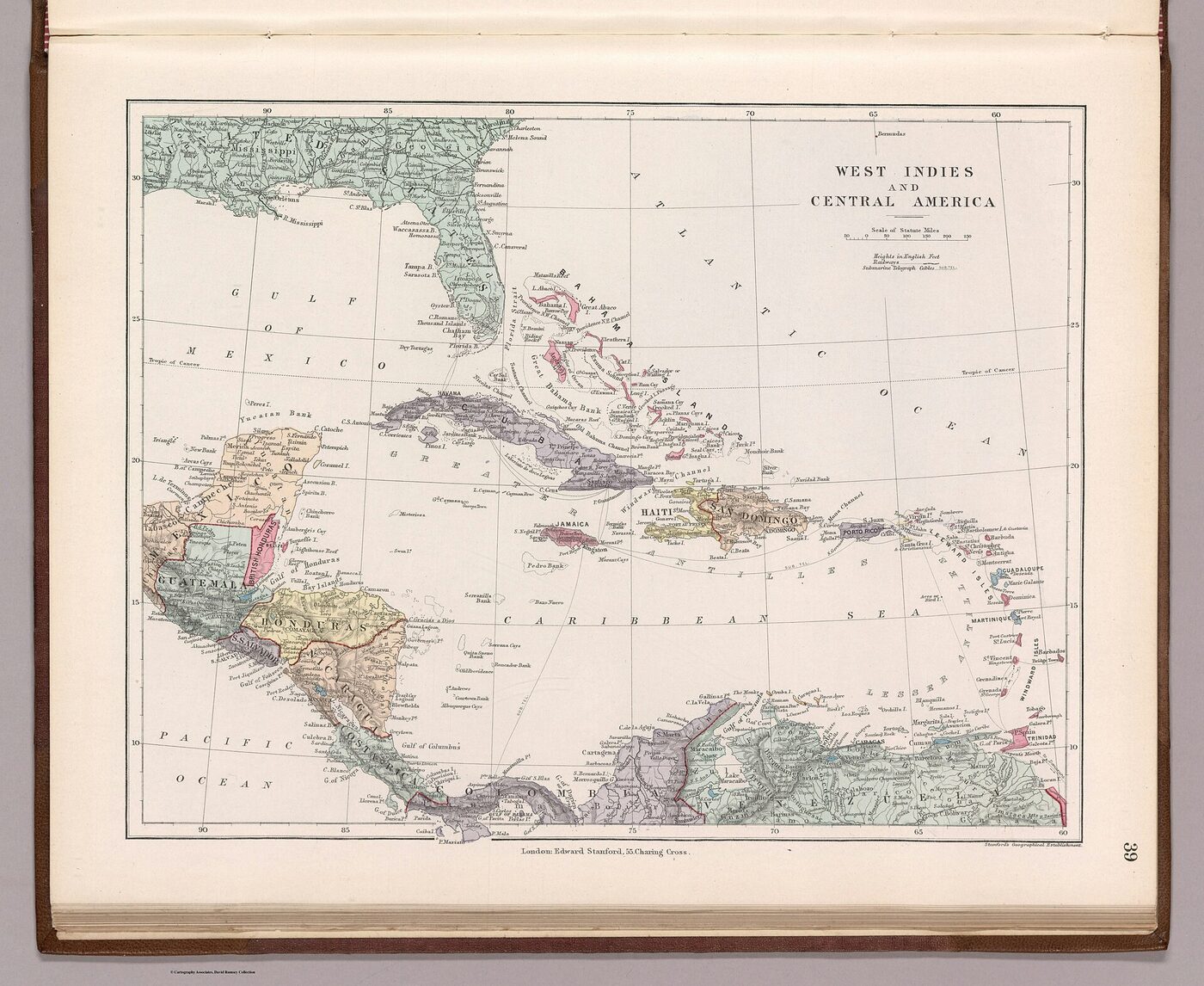
Usenet was built out of point-to-point links between named machines. Every article that reached a reader in Bridgetown or Willemstad had crossed a specific wire, or a specific telephone call, paid for by a specific institution. In a region of small states with separate telecommunications monopolies, separate regulators, separate currencies and separate submarine-cable landings, that made the question of who could take part almost entirely a question of infrastructure. The paperwork, as usual, ran well ahead of the wires.
IANA's root database gives an exact delegation date for every country-code domain, and read as a series the Caribbean dates tell the story plainly. Ten of them were delegated on a single day, 3 September 1991: .ag Antigua and Barbuda, .bb Barbados, .bs the Bahamas, .bz Belize, .dm Dominica, .kn Saint Kitts and Nevis, .lc Saint Lucia, .sr Suriname, .tt Trinidad and Tobago and .vc Saint Vincent and the Grenadines. The Dominican Republic's .do had come nine days earlier, on 25 August 1991, and Jamaica's .jm followed on 24 September 1991. The whole cluster therefore predates the group's creation vote by two or three months.
.jpg)
The rest arrived over the following two decades, in an order that has more to do with administration than with population. Cuba's .cu and Grenada's .gd were both delegated on 3 June 1992; the Netherlands Antilles received .an on 9 September 1993; Guyana's .gy on 13 September 1994; Anguilla's .ai on 16 February 1995; the Cayman Islands' .ky on 3 May 1995 and the United States Virgin Islands' .vi on 31 August 1995; Aruba's .aw on 20 February 1996 and Guadeloupe's .gp on 21 October 1996. Haiti's .ht and Montserrat's .ms were both delegated on 6 March 1997 — Montserrat's in the middle of the volcanic emergency that was burying its capital — and Martinique's .mq three weeks later, on 28 March 1997. Curaçao's .cw did not exist until 20 December 2010, delegated after the Netherlands Antilles dissolved on 10 October 2010 and the .an domain began its long wind-down. The earliest date in the entire region belongs to Puerto Rico, whose .pr was delegated on 27 August 1989, two years ahead of the 1991 cluster and for the obvious reason: it sat inside the United States network.
A delegated domain is a database entry, not a connection, and the gap between the two could be years. Cuba is the plainest case: .cu existed on paper from June 1992, but Cuba's first connection to the Internet, a 64 kbit/s link to Sprint in the United States, was established in September 1996 — a full four years later. The general rule for the region is that the domain came first, the academic link came second, commercial dial-up came third, and adequate international capacity came last, in some places well after Usenet had stopped mattering.
Why a store-and-forward network suited a sea
The technical reason a newsgroup could serve this region at all, years before most of it had anything resembling good connectivity, is that Usenet was not an online service. It was a store-and-forward network, and the distinction is the whole of the argument.
An interactive service requires a live circuit for the duration of the session: the user is connected to a distant machine, and the connection has to hold. A store-and-forward network requires no such thing. Articles were batched into files, compressed, and handed from one machine to the next whenever a link happened to be available; the receiving machine unpacked the batch, filed each article into the groups named in its header, and forwarded what its neighbours had not yet seen. The classic implementation, UUCP over dial-up, made this concrete: a site placed a telephone call, exchanged compressed batches of news and mail in both directions, and hung up. Nobody had to be at the keyboard. The call could be placed at three in the morning, when long-distance tariffs were lowest, and if the call failed the batch simply waited for the next attempt.
For a region of small, expensive, intermittent international links, this was close to the ideal transport. The cost of carrying a newsgroup was a function of total bytes and call minutes, not of how many people read it or when. A site with one nightly call to a well-connected neighbour could serve a whole campus or a whole country. Articles arrived late — hours or days, depending on how many hops from the sources of traffic — but they arrived complete, and lateness in a discussion group is an inconvenience rather than a failure. The same property that made Usenet feel sluggish in Cambridge, Massachusetts made it usable in places where a permanent circuit to North America was either unaffordable or did not exist.
The propagation model had a second consequence that shows up directly in this group's own record. A newgroup control message was a request, not a command: every administrator decided, machine by machine, whether to honour it. The ISC archive of control traffic for soc.culture.caribbean accordingly contains not only Lawrence's network-wide message of November 1991 but three local re-issues in the months that followed, each confined to a single site or campus by a distribution header — one from Stanford University on 3 December 1991, one from a business school in New York on 1 April 1992, and one from a university computer science department in Maine on 26 April that year. These are administrators creating the group on their own servers by hand, after the original control message had either not arrived or not been honoured. It is a small and entirely unglamorous piece of evidence about how the network actually spread: not by fiat, but one machine at a time, as individual administrators decided a group was worth the disk space.
The article format itself was fixed early and stayed fixed. RFC 1036, Standard for Interchange of USENET Messages, by Mark Horton and Rick Adams, was published in December 1987 and governed the wire format for the whole of this group's active life. Its constraints are discussed further below, because for a region with four written European languages and several creoles standardised in the same decades, they were not a technicality.
Cables, monopolies and the arithmetic of landfall
Capacity followed cable, and cable followed commercial arithmetic rather than population. For much of the anglophone Caribbean the incumbent was the same company throughout: Cable & Wireless, whose regional network included the eastern Caribbean's first fibre system and whose Jamaican subsidiary provided fixed-line and international services with no competitor at all before liberalisation. Jamaica's 1999 agreement to open the telecommunications market was followed in 2001 by the issue of mobile licences to Digicel and to Oceanic Digital, trading as MiPhone; Digicel launched in Jamaica in April of that year. A single company setting the international tariff for a string of small markets is a fair description of the environment in which Caribbean readers of a Usenet group were making their arrangements.
The fibre arrived in stages, and each stage has a date. The East Caribbean Fiber System, a repeaterless system of 1,730 kilometres running in ten segments from the British Virgin Islands to Trinidad and interconnecting fourteen eastern Caribbean islands — Tortola, Anguilla, St Martin, St Kitts and Nevis, Antigua, Montserrat, Guadeloupe, Dominica, Martinique, St Lucia, Barbados, St Vincent, Grenada and Trinidad — was first installed in September 1995. AMERICAS-II, carrying traffic between Florida, the US Virgin Islands, Puerto Rico, Martinique, Curaçao, Trinidad and Tobago, Venezuela, the Guianas and Brazil, entered service in August 2000. The Americas Region Caribbean Ring System, ARCOS-1, an 8,400-kilometre ring landing in the Bahamas, the Turks and Caicos Islands, the Dominican Republic, Puerto Rico, Curaçao and a chain of mainland points, was built in two phases, in service from September 2001 and March 2002 respectively.
Those dates are worth setting against the group's own arc. Usenet's period of greatest usefulness to this readership ran from the early 1990s to the early 2000s. The first regional fibre landfall in the eastern islands came in late 1995; the ring that finally gave the northern Caribbean real capacity came in 2001 and 2002, which is to say at the point when web forums were already taking the traffic. For most of its life, a group whose subject was a sea was reachable from within that sea only in patches.
Cuba is the outlier at both ends. It had no fibre landing at all until the ALBA-1 cable to Venezuela was laid in 2011 and opened to public users in January 2013; before that, total bandwidth between Cuba and the global Internet was 209 Mbit/s upstream and 379 Mbit/s downstream, carried by satellite and by ageing telephone circuits. Argument about Cuba on this group and its successors was therefore conducted, for structural reasons rather than editorial ones, almost entirely among people who were not in Cuba.
Two of the smallest territories eventually found that their delegations were the most valuable thing they had been given, though the money arrived long after the newsgroup years. Registrations under Anguilla's .ai opened on 16 February 1995 and were a curiosity for two decades; a 2018 report put total revenue from selling .ai domains at about US$2.9 million, and in 2023 the Government of Anguilla collected roughly US$32 million in .ai fees, which amounted to more than a tenth of the territory's gross domestic product. Montserrat's .ms, delegated on 6 March 1997, has had a quieter commercial career. The two cases together are a reasonably exact illustration of how little the value of a delegation had to do with the connectivity of the place delegated.
One federation failed
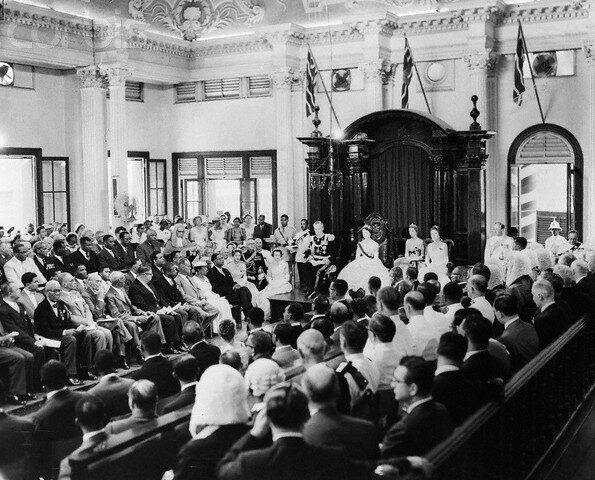
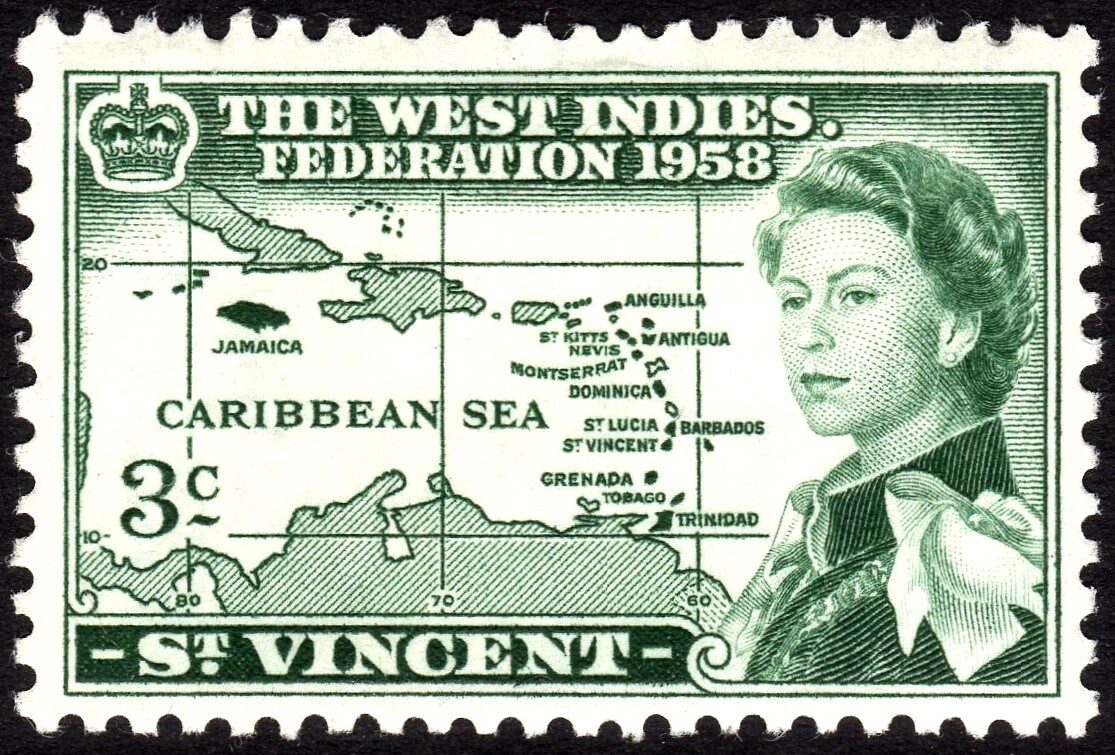
The political version of the pan-Caribbean idea has a short and very precisely dated history, and it is the essential background to any regional forum. The West Indies Federation existed from 3 January 1958 to 31 May 1962. It was an internally self-governing federal union of ten provinces, all of them British colonial possessions, intended by London and by pan-Caribbean nationalists alike to proceed to independence as a single state. Chaguaramas in Trinidad was named as the federal capital, but the site was part of a United States naval base, and Port of Spain served as the capital in practice for the whole of the federation's existence.
Federal elections were held on 25 March 1958. The West Indies Federal Labour Party won 26 seats to the Democratic Labour Party's 19, and Sir Grantley Adams of Barbados became prime minister. The result contained the federation's problem in plain sight: neither Norman Manley of Jamaica nor Eric Williams of Trinidad and Tobago had contested a federal seat, both preferring to remain in control of their own island power bases, and Alexander Bustamante had likewise declined to stand, leaving the leadership of his federal party to the Trinidadian Ashford Sinanan. The leaders of the two largest provinces had signalled in public that they did not regard the federation as the place where power would sit.
.jpg)
The end came by referendum. On 19 September 1961, Jamaican voters were asked whether Jamaica should remain in the Federation of the West Indies. On a turnout of 61 per cent from an electorate of 777,965, 217,319 voted yes and 256,261 voted no: 54 per cent for leaving. Eric Williams is recorded as concluding that one from ten left nothing rather than nine — that without Jamaica no federation was possible — and on 14 January 1962 his party passed a resolution rejecting any further involvement. The union was dissolved on 31 May 1962. Jamaica became independent on 6 August 1962 and Trinidad and Tobago on 31 August 1962. No political union of comparable ambition has been attempted in the region since, and the federation has been argued over ever since by people who were not born when it collapsed.

One survived: the machinery of region
What replaced federation was economic and intergovernmental rather than constitutional, and unlike the federation it is still running. The chain of instruments is continuous. Three heads of government — Errol Barrow of Barbados, Forbes Burnham of British Guiana and V. C. Bird of Antigua — signed the Agreement of Dickenson Bay on 15 December 1965, establishing the Caribbean Free Trade Association. The original starting date was postponed to bring Trinidad and Tobago in, and CARIFTA came into effect on 1 May 1968; the Treaty of Chaguaramas later declared that it would cease to exist on 1 May 1974, though the last accessions to its successor ran on to July of that year.
That successor was the Caribbean Community. The Treaty of Chaguaramas was signed on 4 July 1973 by Barbados, Guyana, Jamaica and Trinidad and Tobago, and took effect on 1 August 1973. CARICOM today has fifteen member states and eight associate members, with its secretariat in Georgetown, Guyana. A revised Treaty of Chaguaramas was signed at Nassau on 5 July 2001 to provide for a single market and economy; the CARICOM Single Market was implemented on 1 January 2006 by Barbados, Belize, Guyana, Jamaica, Suriname and Trinidad and Tobago, and on 3 July 2006 by Antigua and Barbuda, Dominica, Grenada, St Kitts and Nevis, St Lucia, and St Vincent and the Grenadines.
Around CARICOM stands a dense layer of other regional bodies, most of them older than the newsgroup and several of them older than most of its readers:
- The Caribbean Examinations Council, formed in 1972 as a regional examination board — which is to say that a large share of the anglophone Caribbean has sat the same secondary-school papers for half a century.
- The Organisation of Eastern Caribbean States, created on 18 June 1981 by the Treaty of Basseterre, named after the capital of Saint Kitts and Nevis.
- The Eastern Caribbean dollar, which replaced the British West Indies dollar of the defunct federation at par in 1965 and is still the currency of the OECS members.
- The Association of Caribbean States, formed on 24 July 1994 on a recommendation of the West Indian Commission, and deliberately wider than CARICOM: it takes in the Spanish- and French-speaking Caribbean and the mainland rim.
- The Caribbean Court of Justice, established on 16 April 2005 and seated in Port of Spain.
CARICOM's own language history is the closest institutional parallel to this group's charter. English was its sole working language into the 1990s. Suriname, Dutch-speaking with Sranan Tongo as its lingua franca, joined on 4 July 1995; Haiti, French- and Creole-speaking, joined on 2 July 2002; Spanish was added as a fourth official language in 2003. Haiti's membership was effectively suspended from 29 February 2004 until early June 2006 following the coup of 2004, and its officials were readmitted after the presidential election that followed. An English-medium newsgroup with a clause permitting other languages was, in other words, not an anomaly but an accurate reflection of how the region's own institutions were built.
The University of the West Indies, and why the registries sat on campus
The one federal-scale institution that outlived the federation, and the one that put many of the region's first machines on the network, is the University of the West Indies. It was founded in 1948 as the University College of the West Indies on the recommendation of the West Indies committee of the Asquith Commission, chaired by Sir James Irvine, and was seated at Mona, about five miles from Kingston, on the site of Gibraltar Camp, which had housed Gibraltarian evacuees during the war. It began in a special relationship with the University of London and achieved independent university status in 1962 — the same year the federation dissolved. One regional project ended and the other came of age within months of each other.
It is a genuinely multi-campus institution rather than a national university with outposts. Mona dates from 1948; St Augustine in Trinidad from 1960, built on the former Imperial College of Tropical Agriculture; Cave Hill in Barbados from 1963, moving to its present site in 1967; Five Islands in Antigua and Barbuda from 2019. The university serves eighteen English-speaking countries and territories, with an Open Campus covering the contributing states that have no physical campus of their own. Its faculty of law was established at Cave Hill in 1970, with the first year of the degree taught at each campus and at the University of Guyana — a structure adopted explicitly to create a regional profession as well as a regional faculty.
The connection to this page is not decorative, and it can be read straight out of IANA's delegation records. The ccTLD manager for .jm is the University of the West Indies at Mona, with Mona Information Technology Services listed as the administrative and technical contact. The manager for .tt is the University of the West Indies, Faculty of Engineering, at St Augustine. The manager for .gy is the University of Guyana at Turkeyen; for .bs, the University of The Bahamas in Nassau; for .cw, the University of Curaçao. Five Caribbean country-code registries, in other words, are run from university campuses to this day.
That pattern is not unique to the Caribbean — universities ran national registries almost everywhere in the first decade of the domain system — but it is unusually persistent here, and it explains the shape of early participation. Where a territory's first reliable network access sat on a campus, the first readers and posters were the people with campus accounts: staff, postgraduates, computing services. The remaining islands with no campus of their own were, in network terms, dependent on somebody else's.
Four European languages and the creoles
The formal linguistic map of the region is four European official languages laid over a much older creole substrate whose legal standing varies island by island. English is official across the Commonwealth Caribbean and Guyana; Spanish in Cuba, the Dominican Republic and Puerto Rico; French in Haiti and in the French overseas departments; Dutch in Suriname and the Dutch Caribbean. Beneath that map sit languages spoken by far more people than the official ones, several of which were still acquiring a settled spelling while this newsgroup was running.
Haitian Creole has the fullest paper trail. An attempt at standardisation was made in the early 1940s under President Élie Lescot, when the American literacy specialist Frank Laubach and the Irish Methodist missionary H. Ormonde McConnell developed a standardised orthography; it was regarded highly in some quarters and was generally not well received. The official orthography came in 1979, established by the Institut Pédagogique National, and in the same year the Act of 18 September 1979 permitted the use of Creole in schools as both instrument and object of instruction. The Constitution of 1987 raised Haitian Creole to official standing alongside French. The modern orthography is phonemic, is composed of thirty-two symbols, has no q and no x, and retains exactly one accent mark: the grave, in è and ò.
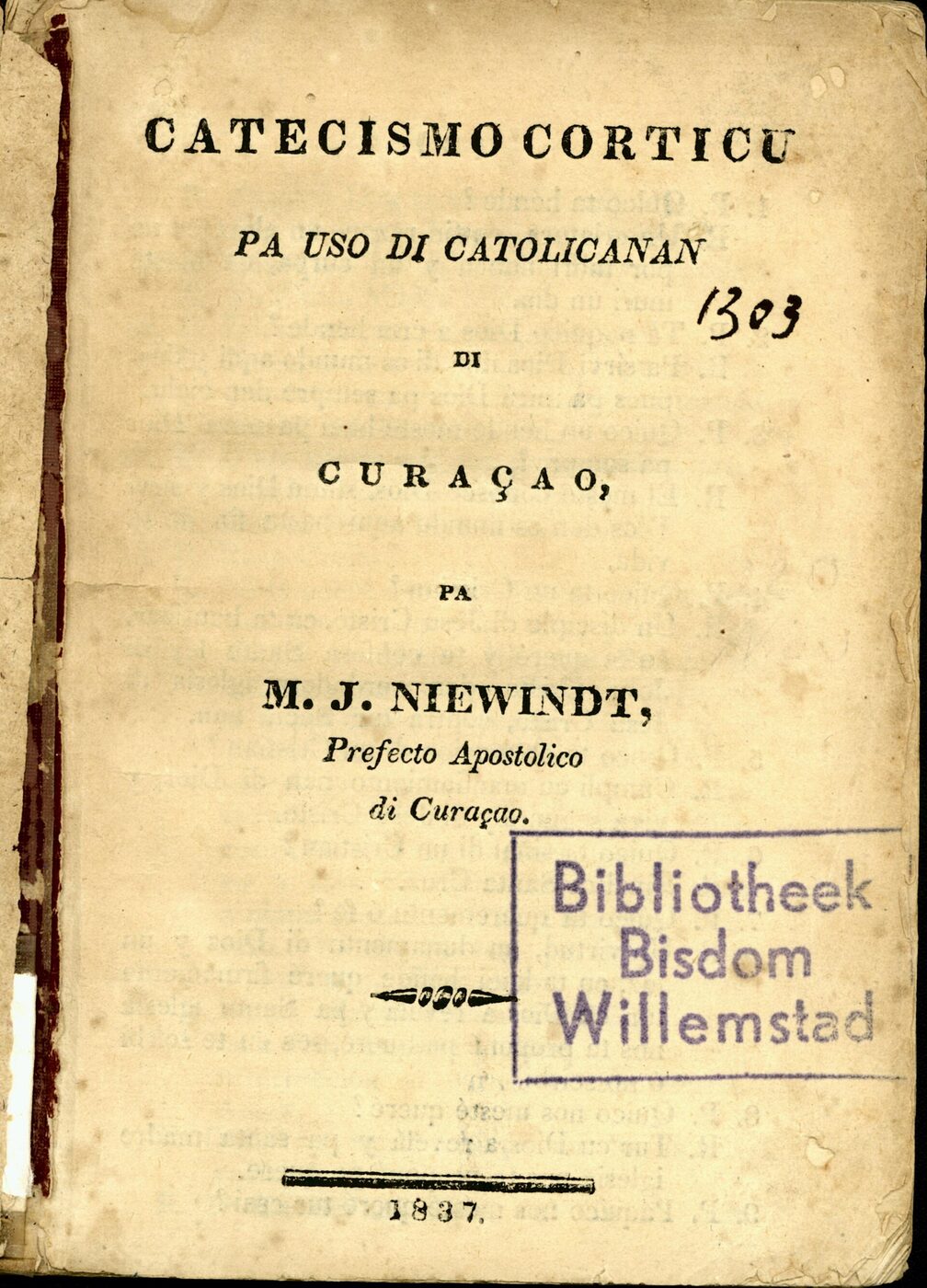
Papiamento is the language of Aruba, Bonaire and Curaçao, a Portuguese-based creole heavily influenced by Spanish and Dutch, and it has the longest printed record of any Caribbean creole: the first book printed in the language was the Catecismo Corticu pa uso di catolicanan di Curaçao, a brief Catholic catechism printed in 1837, and the first newspaper in it, Civilisadó, appeared in 1871. Its modern history is a study in what happens when a language is standardised late and by more than one government. Curaçao and Bonaire officially adopted the phonetic Römer-Maduro-Jonis spelling in 1976; Aruba approved a more etymology-based spelling in 1977, presented by an orthography commission under Jossy Mansur. The two standards disagree from the name of the language downwards — Papiamentu in Curaçao and Bonaire, Papiamento in Aruba; k where the other writes c; a final u where the other writes o. Official status followed much later: Aruba from May 2003 and the then Netherlands Antilles from 7 March 2007. After the Netherlands Antilles dissolved on 10 October 2010, the Caribbean Netherlands kept Dutch as its official language, with Papiamentu recognised on Bonaire and English on Saba and Sint Eustatius.

Sranan Tongo, the English-based creole of Suriname, is the first or second language of something over half a million people there and is considered both an unofficial national language and a lingua franca; it holds no official status against Dutch. Jamaican Patois likewise has no official status. Its standardisation began in earnest only in 2002, when the Jamaican Language Unit was set up at the University of the West Indies at Mona to begin standardising the language, with the stated aim of supporting Jamaicans who do not speak English fluently but receive the services of the state only in English. The unit adopted and modified a phonemic system first proposed by the linguist Frederic Cassidy in 1961, now known as the Cassidy/JLU orthography.
All of this was live argument during the group's years, and an English-medium forum could carry only part of its own subject: the hispanophone and francophone Caribbean were served, where they were served at all, by groups of their own. What the charter's language clause did was leave the door open rather than claim the room.
Writing the region's languages on a seven-bit network
Usenet inherited its message format from internet mail, and mail was built for seven-bit US-ASCII. RFC 1036, the December 1987 standard for the interchange of Usenet messages by Mark Horton and Rick Adams, defines articles by reference to RFC 822 and restricts header material such as full names to "any printing ASCII characters from space through tilde". MIME, the mechanism that made anything else legal, was published as RFC 1341 in June 1992 and restated as RFC 2045 to RFC 2049 in November 1996. Netnews formally caught up only in November 2009, when RFC 5536 required conformance to MIME and stated that "the character set for header fields is US-ASCII", with non-ASCII characters to be encoded using the MIME mechanisms. For most of this group's life, eight-bit text worked in practice and was guaranteed by nothing.
By the standards of the hierarchy, the Caribbean drew a good hand. Spanish, French and Dutch all fit inside ISO 8859-1, the Latin-1 code page that western European and North American Usenet had settled on by default, and so do the accented letters the region's creoles need: the è and ò of Haitian Creole, and the è, ò and ù of Papiamentu together with the acute accent it uses to mark irregular stress. No Caribbean language required a code page that the region's likely news feeds did not already carry. Compared with hierarchies whose subject languages needed Latin-2, Cyrillic or a non-alphabetic script, that is a substantial piece of luck.
The luck ran out at the point where the accent stopped being cosmetic. In Haitian Creole the grave accent before n is contrastive: en spells a nasal vowel, èn an oral vowel followed by a consonant, and the same pairing holds for on against òn. A transport that stripped the accent did not merely make a word look wrong; it turned it into a different word. Papiamentu has a comparable exposure, since the grave accent is what separates è from e, ò from o and ù from u. Any Caribbean text that passed through a gateway or a newsreader that flattened eight-bit characters came out the other side systematically misspelled in a way that a reader of the language would notice immediately and a search engine would not.
The one Caribbean creole standardised during the group's own lifetime is also the one immune to the problem, and the immunity is by design rather than by accident. The Cassidy/JLU orthography for Jamaican writes long vowels by doubling the letter — ii, aa, uu — writes its diphthongs as ie, uo, ai and ou, and marks nasal vowels with a following -hn. It uses no diacritic at all. A system built on Cassidy's principle that a creole should not borrow the spelling conventions of its lexifier turned out, incidentally, to be perfectly transportable over a seven-bit link.
The practical consequence for anyone reading the surviving archive is the familiar one. The same Creole or Papiamentu word may sit in the record in accented and unaccented forms, and those are different strings to a search engine. Subject lines are the least reliable part of any post: header text was formally US-ASCII, non-ASCII in headers required RFC 2047 encoded-words, and not every newsreader of the period decoded them, so an accented subject line in the surviving record cannot be assumed to show what its author typed.
What an umbrella carried
No thread titles, post counts or named posters from this group are documented anywhere reachable, and none are invented here. What can be described honestly is the kind of traffic an umbrella group of this remit was built to carry, and the regional institutions that gave it something to be about. The charter named four categories — cultural, social, economic and political — and the region supplied each of them with subjects that were genuinely shared rather than merely adjacent.
Cricket is the clearest case, because it is the one pan-Caribbean institution that ordinary regional life treats as jointly owned. The West Indies cricket team joined the Imperial Cricket Conference in 1926 and played its first Test against England at Lord's on 23-26 June 1928, becoming the fourth Test nation. It predates the West Indies Federation by thirty years and has outlived it by more than sixty. Its players are drawn from a chain of fifteen Caribbean nation-states and territories with a combined population of around six million, and its governing body, Cricket West Indies — formerly the West Indies Cricket Board — is composed of six associations: Barbados, Guyana, Jamaica, Trinidad and Tobago, the Leeward Islands and the Windward Islands. Their membership crosses four sovereignties: the Leeward Islands association alone takes in two sovereign states, three British Overseas Territories, one United States territory and one Dutch constituent country. The team won the first two Cricket World Cups, in 1975 and 1979, and the World Twenty20 in 2012 and 2016.
Joint ownership is what makes an argument possible. Selection, captaincy, the distribution of fixtures among the islands and the decline of the 1990s and 2000s are questions on which every territory has standing to complain, which is a different and more productive footing than spectating. There is a neat closing of the circuit in the sponsorship record, too: the regional team's shirt carried Cable & Wireless from 2000 to 2004 and Digicel from 2005 to 2018 — the same two companies whose tariffs governed whether anyone in the region could read a newsgroup about it. Cricket as a Usenet subject, with its own groups and their own history, belongs to the recreational hierarchy and is treated on this directory's rec.sport.* pages rather than here.
Music crossed the islands in every direction and did so faster than any institution. Calypso originated in Trinidad and Tobago among Afro-Trinidadians during the early to mid-nineteenth century and had spread to the rest of the Antilles by the mid-twentieth. Soca, the "soul of calypso", originated in Trinidad and Tobago in the 1970s as an offshoot of calypso with Afro-Trinidadian and Indo-Trinidadian influences; its father was Garfield Blackman, who performed as Lord Shorty and later as Ras Shorty I, and who first defined and named the music. The steelpan is a Trinidadian instrument. Zouk was pioneered by the French Antillean band Kassav' in the early 1980s, and musicians from Martinique and Guadeloupe later developed it, in the zouk-love form, into something close to indistinguishable from compas. These lineages cross language boundaries that no political institution in the region has crossed, and tracing them is exactly the sort of question a pan-regional forum is better placed to carry than a national one.
Carnival supplies a calendar rather than a genre, and the calendar is regional and diasporic at once. Trinidad's pre-Lenten Carnival, Barbados's Crop Over, which began on the sugar plantations as a way of marking the end of the yearly harvest, and Junkanoo in the Bahamas, Jamaica and Belize are separate festivals with shared elements of masquerade, drumming, dance and parade. Their overseas counterparts are fixed points of the diaspora year: the Notting Hill Carnival has taken place in London since 1966, and Caribana has run in Toronto since 1967, first performed as a gift from Canada's Caribbean community for the Canadian Centennial. The Atlantic hurricane season, by convention 1 June to 30 November, provided the region's other annual calendar, and the one that most reliably turned a discussion group into something more urgent.
The rest is the ordinary business of a diaspora forum: comparison and provenance disputes, in which the question of whose island's version of a dish or a rhythm came first is a half-serious argument of effectively infinite renewability; the harder question of who counts as Caribbean, argued with more edge; people tracing relatives and former schoolmates along the migration routes; outsiders arriving with questions; and, before island newspapers had websites, the passing on of home news to readers abroad, a function common to soc.culture.* groups across the hierarchy. Travel enquiries and the practicalities of visiting the region belong to rec.travel.caribbean, linked above, and are treated on that page.
The diaspora that read it
The readership of this group sat disproportionately outside the region, and the reason is arithmetic rather than sentiment: for most of the group's life, Caribbean populations in New York, Toronto, London and Miami were both large and well connected, while the islands were neither. The migrations that produced those populations are well dated.
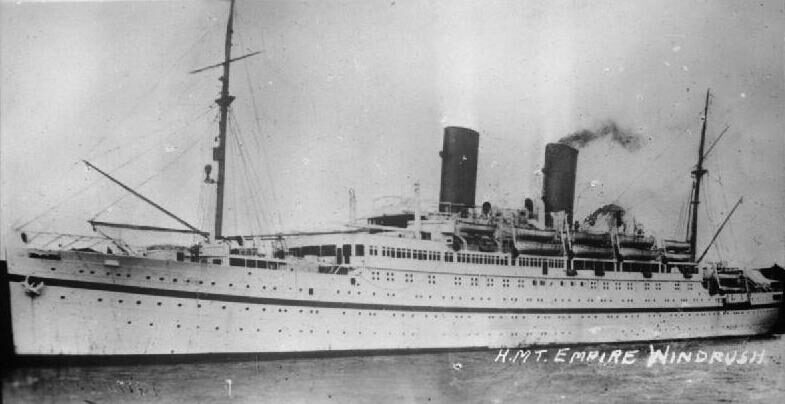
Britain first. The British Nationality Act 1948 created the status of Citizen of the United Kingdom and Colonies, giving people across the colonies a right of entry and settlement, and until 1962 there was no immigration control on such citizens at all. The troopship Empire Windrush arrived at the Port of Tilbury in June 1948; her passengers disembarked on 22 June, the date now commemorated in Britain as Windrush Day, and of the 1,027 passengers aboard, 802 gave their last place of residence as a country in the Caribbean. She was not the first such voyage — the Ormonde had reached Liverpool from Jamaica with 241 passengers on 31 March 1947, and the Almanzora also arrived that year — but hers is the name that became shorthand for the whole movement. The route was progressively closed: the Commonwealth Immigrants Act 1962 imposed the first controls, and the Immigration Act 1971, in force from 1 January 1973, effectively ended it.

North America absorbed the later and larger waves, and the United States census series for the Caribbean-born population is the single most useful table for understanding this group's shape. It stood at 193,922 in 1960; 675,108 in 1970; 1,258,363 in 1980; 1,938,348 in 1990; 2,953,066 in 2000; and 3,465,890 in 2009. The 1990 figure is the relevant one: at the moment soc.culture.caribbean was created, close to two million Caribbean-born people were living in the United States, overwhelmingly in the New York and Miami metropolitan areas, in a country where university and workplace network access was already ordinary. Miami and New York City are also, with Boston and Orlando, among the few major American cities in which black residents of Caribbean origin outnumber black residents of multigenerational American descent. In Canada, 749,155 people reported Caribbean or West Indian origins in the 2016 census, most of them in Toronto and Montreal.
Set those numbers beside the connectivity dates and the group's centre of gravity is no longer surprising. In 1991, when the vote passed 127 to 26, the population most able to vote in it was not in the Caribbean. Much of what the group carried was addressed home rather than sent from home, and that asymmetry — a forum about a place, written largely from elsewhere, and read there too — is the single most characteristic feature of soc.culture.* groups for emigrant regions.
The wider frame is the Atlantic diaspora, and this page states the connection once and leaves the rest where it belongs. The Caribbean's African-descended population arrived through the same trade that populated much of the Americas, and the continental side of that story, together with the pan-African discussion that Usenet carried, is the subject of soc.culture.african and is not retold here.
The decade as home news
The years the group spanned were not quiet ones for the region, and for subscribers abroad the events were not foreign stories but home news received at one remove — which is a particular and uncomfortable way to receive news.
On Montserrat, the Soufrière Hills volcano became active on 18 July 1995, the first eruption there since the turn of the twentieth century. Southern Montserrat, including the capital Plymouth, was evacuated three times and then permanently, on 3 April 1996; by August 1997 much of the south of the island, most of Plymouth included, had been buried by pyroclastic flows; a large eruption on 25 June 1997 killed nineteen people and completely destroyed the island's airport, which lay directly in the path of the main flow. About 7,000 people, two-thirds of the population, left Montserrat, of whom some 4,000 went to the United Kingdom. The territory's country-code domain was delegated in the middle of all this, on 6 March 1997.
Cuba passed through the economic contraction that followed the dissolution of the Soviet Union and the emigration crisis of 1994; Haiti passed from the coup of 1991 to the restoration of 1994 under international escort, joined CARICOM in 2002, and had its membership effectively suspended from 29 February 2004 until 2006 after the coup of that year. Both subjects produced long adversarial threads that began from irreconcilable premises and ended nowhere in particular. Neither is adjudicated here, and neither is retold here: they are the business of soc.culture.cuba and soc.culture.haiti, whose own pages in this directory carry them at length, as the question of Puerto Rico's political status is carried on soc.culture.puerto-rico. The umbrella group's service in such arguments was to carry them, not to settle them.
What happened to the group afterwards is the ordinary Usenet story with regional colour. Island newspapers reached the web in the late 1990s and took back the wire-service function; web forums and later social media absorbed the arguments and the family-tracing; and the pan-regional frame dissolved into per-island and per-genre spaces, much as its subscribers had dispersed in the first place. The group was never removed. It survived a forged removal request in 2001 and it is still listed as active, which on Usenet is what survival looks like.
What the record does not show
The honest inventory of gaps is short and worth stating plainly, because this is a page that universities cite.
- No discussion record. The ISC mirror of news.announce.newgroups holds no directory for soc.culture.caribbean, so neither the Request for Discussion nor the Call for Votes of 1991 survives there. Everything known about the proposal comes from the newgroup message's own summary of it.
- No proposer named. The surviving control message names the person who issued it and the vote result; it does not name who proposed the group or who took the vote.
- No readership figures. No subscriber count, no traffic measurement and no per-island readership estimate for this group is known to survive. Brian Reid's Usenet readership surveys of the early 1990s covered the network broadly, but no figure for this group is quoted here because none has been verified.
- No thread-level record. No thread title, no poster name, no quotation and no message count from this group is reproduced on this page, because none could be verified. Where the kinds of traffic are described above, they are described as kinds.
- Uncertain authorship for two pieces of forged control traffic. The rmgroup message of 4 November 2001 for this group, and the newgroup messages of 1996 and 1998 for soc.culture.jamaican, were all posted under the names of other people, and messages issued in those same names repudiated them. This page reports what the messages say, and what the hierarchy's own bogus-groups list concluded; it does not assert who actually sent them.
None of this is unusual. Groups of this kind produced enormous quantities of writing and almost no documentation about themselves, and the honest value of a page like this one lies in being exact about the surrounding world rather than inventive about the group.
Scope and limits
This page covers soc.culture.caribbean as a regional umbrella: its charter and creation record, the connectivity conditions across the archipelago that determined who could take part, the regional institutions that made a pan-Caribbean forum coherent, the region's languages and their fit with the network's character set, the diaspora that supplied most of the readership, and the kinds of traffic the group's remit made available.
It deliberately does not cover several adjacent subjects that this directory holds elsewhere. The soc.culture.* branch itself — how its groups were proposed and voted, what the hierarchy was for, how it declined — is on the branch page linked at the top of this article. The three island groups beneath this one carry their own countries in depth, including Cuba's politics and emigration, Puerto Rico's status question, music and diaspora, and Haiti's language and political history. Travel to the region is the subject of rec.travel.caribbean. Cricket as a Usenet subject, rather than as a Caribbean institution, belongs to the recreational hierarchy's sport pages. The continental African side of the Atlantic diaspora belongs to soc.culture.african.
Where this page states a date, a tally, a delegation record or an institutional fact, it comes from the Internet Systems Consortium's Usenet control archive and configuration files, IANA's root database, the RFC series, or standard reference accounts of the region's history. Where it describes what a group carried, it describes categories rather than claiming knowledge of particular postings. The distinction is the whole of the method.
Reading soc.culture.caribbean today
- Historical archive: Google Groups — soc.culture.caribbean (coverage varies by group and era).
- Open in a newsreader:
news:soc.culture.caribbean— the original site offered exactly this link, and it still works if your system has a newsreader registered for thenews:scheme. - Live access: point an NNTP newsreader at a modern server — see accessing Usenet today.
- The original news2mail e-mail subscription service ended in the mid-2000s and no longer operates.