soc.culture.kuwait
Kuwait and its people.
Created on 9 November 1994, after a ballot that passed 143:39, and preceded from April 1994 by alt.culture.kuwait. The group settled into Gulf-life threads: diwaniya culture, expatriate questions and regional politics.
A moderated sibling is preserved alongside.
On this page
- The group's own paperwork
- What the 1994 ballot recorded
- Before soc.*: the alt.culture.kuwait months
- Pearls, dhows and the long trade
- 1938: a council and a well
- Independence, and a constitution with a deadline
- The Assembly, suspended and restored
- The franchise, 1962 to 2005
- 1990 to 1991, and what a newsgroup could not have carried
- The fires, and what came after them
- The diwaniya
- The population question
- The bidoon, as the record and the named organisations state it
- The dialect
- Poetry, sawt and the sea in the ear
- The sea, kept as an exhibit
- The table and the calendar
- Football
- What the record does not show
- Scope, sources and limits
The group's own paperwork
Unlike most of the rooms preserved in this directory, soc.culture.kuwait has a complete birth certificate. The archive of news.announce.newgroups kept on the Internet Systems Consortium's Usenet file server holds the entire creation sequence in the order it happened, with the dates the network's own software stamped on it: a Request for Discussion posted on 15 September 1994; a first Call for Votes on 11 October; a second and last call on 26 October; and a result posted on 3 November 1994. The matching archive of control messages holds what came next — the newgroup message that actually brought the group into being, sent on 9 November 1994 by David C. Lawrence, then moderator of news.announce.newgroups, and reissued on 16 November and again on 9 December for the benefit of sites that had missed it.
The proposal came from inside the country. The Request for Discussion was posted by an author signing as maraya, from an address at sci.kuniv.edu.kw, with the Organization header reading Kuwait University / Math Dept. — a mathematics department in Kuwait City proposing a room on a network whose administrative traffic was overwhelmingly North American. It was cross-posted to six groups: the two procedural rooms, news.announce.newgroups and news.groups, and four rooms in the branch itself, namely soc.culture.arabic, soc.culture.lebanon, soc.culture.maghreb and soc.culture.misc. There was, at that date, no Kuwaiti room in the Big Eight to post it to; that was the point of the exercise.
The charter it proposed was one sentence long, and the group has never had another:
To provide a forum for the discussion of Kuwaiti culture, society, and history.
Beneath that sentence the document set out, in two neat columns, a list of twenty-one further subjects introduced with the formula Other topics include (but are not limited to) the following: poetry and theatre; music and traditions and beliefs; technological issues and humour; radio and television and fine art; books and dance; cinema and food; crafts and games; sports and publications; toys and antiques; news and business; and education. The list was carried forward unchanged into both Calls for Votes, into the result, and into the creation message itself, which reproduced it under the heading The charter, culled from the call for votes. Charters on Usenet were often written to survive an argument rather than to describe a room. This one reads like a table of contents.
The one-line description that goes in a news server's newsgroups file — the text a reader actually sees beside the group's name in a list of thousands — was fixed at the same time, and appears verbatim in the first Call for Votes of 11 October 1994:
soc.culture.kuwait Kuwaiti culture, society, and history.
That line has not changed. The newsgroups file distributed today from the same server carries it word for word, comma for comma, and the accompanying active file still flags the group with the letter y, meaning unmoderated and open for posting. Thirty-one years is a long run for a sentence written to fit in eighty columns.
What the 1994 ballot recorded
The result posted on 3 November 1994 was headed RESULT: soc.culture.kuwait passes 143:39, and its arithmetic is set out in the document: 143 votes in favour, 39 against, 182 valid ballots in total, three abstentions and one ballot rejected for containing no vote statement. Both of the Big Eight's thresholds were cleared with room to spare. The margin in favour was 104, against a requirement of at least a hundred more yes votes than no votes; the proportion in favour was a little under 79 per cent, against a requirement of two-thirds. A five-day period followed in which irregularities could be raised, and none was; hence the creation message six days after the result.
As the procedure of the day required, the votetaker — Ron Dippold, posting under the banner of the Usenet Volunteer Votetakers — published every valid ballot by address and name. The roll can therefore be counted, and the count is worth stating narrowly. Of the 143 ballots in favour, fourteen carried addresses in the .kw domain: five at Kuwait University, spread across three of its machines, and nine at a single host in the gulfnet.kw domain. None of the 39 ballots against carried a Kuwaiti address. The remainder of the yes votes came overwhelmingly from university and commercial accounts in North America and Europe, with a scattering elsewhere — Japan, New Zealand, South Africa, Greece, the Czech Republic.
The mechanics were as unglamorous as the arithmetic. Ballots went by electronic mail to a voting alias at qualcomm.com; the message had to contain one of two fixed sentences, or the word abstain; the votetaker's software acknowledged each ballot by return, and it was the voter's responsibility to check that the acknowledgement arrived. The last call for votes carried a short appended list of four addresses whose acknowledgements had bounced, under the heading that they need not vote again. That is the level at which a newsgroup was built in 1994: four undeliverable e-mails, itemised in public, in a document that also had to explain what a two-thirds majority was.
What the roll establishes is narrow and should not be stretched. It shows that in October 1994 a small number of people in Kuwait had working e-mail, read a Usenet control group closely enough to notice a Call for Votes, and answered it inside three weeks; and that a great many more people who cared about the proposal were reading from abroad. It measures neither readership nor traffic. A companion count for the ballot of February 1996, which is both larger and more informative about where the group's constituency sat, is set out on the sibling page and is not repeated here.
The roll has one further use, which is that names recur. Three of the people who voted yes in 1994 appear again fifteen months later in the paperwork of the moderated companion group: the proponent of that later proposal, the volunteer who mentored it through the procedure, and one of the three moderators it named. Only the mentor is identified by an identical e-mail address in both documents; the other two are matched by personal name at different addresses, one of them within the same university domain. A vote roll is a poor census, and a name is weaker evidence than an address, but the recurrence is a serviceable record of who was paying attention.
There is a contrast here that ought to be stated plainly rather than smoothed over. The open group passed in November 1994 by 143 votes to 39. Its filtered companion, soc.culture.kuwait.moderated, passed in February 1996 by 149 to 40 — a larger vote, on both sides, for the room with a door on it than for the room without one. Why a national community should turn out in greater numbers to charter a filtered annexe than to charter the original, and what the branch thought filtering would buy, is that page's subject and is treated there at length. It is not retold here.
Before soc.*: the alt.culture.kuwait months
The Big Eight proposal of September 1994 was not the community's first attempt at an address. Five months earlier the same author, named in the header as Maraya Altuwaijri and posting from the same Kuwait University department, issued a control message on 28 April 1994 creating alt.culture.kuwait, with the proposed description Kuwaiti Culture, Society and History — three words away from the line that would be voted on in the autumn. The alt.* hierarchy required no ballot, only a control message and the tolerance of news administrators, which made it the obvious first stop and the obvious first mistake.
The group was removed the same day. Tim Pierce, posting from an address at Amherst College, sent two rmgroup messages forty-one seconds apart, one against each of the newgroup messages that had gone out, with a body of exactly four words: Not discussed in alt.config. That is the whole of alt.*'s constitutional law — a group is supposed to be aired first in alt.config, the hierarchy's discussion room, and one that is not may be shot on sight by anyone who cares to.
What followed over the next month is preserved in the control archive and is a small museum of the period's manners. On 2 May a newgroup message appeared over Pierce's address with his surname spelt Peirce, his signature file altered by a few words, and a body reading Not necessary to discuss in alt.config. A news administrator at the University of Tennessee, David DeLaney, answered it on 8 May with an rmgroup quoting the altered text back; a newgroup then appeared over DeLaney's own address on 10 May, quoting the same passage; and on 17 May DeLaney posted in public to disown it, remarking that he had not sent it. Both men's messages in the sequence name a third party as the author of the forgeries. Neither accusation is adjudicated here, and this page names nobody as a forger. What the sequence demonstrates is that Usenet's creation machinery ran on the honour system, and that in alt.* the honour system had gaps wide enough to drive a newsgroup through.
It ended on 24 May 1994, when a news administrator at Virginia Tech — whose machine appears in the original message's routing header as the hop immediately upstream of Kuwait University — issued a newgroup with an explanation attached rather than a slogan. The group, he wrote, had been created improperly by a new news administrator in Kuwait who had only recently obtained a feed into the university; it had been removed at once by the usual alt.config quarters; but it had begun getting a modest amount of traffic regardless, and had since been raised properly in alt.config, where the only objection recorded was the forgery. He asked that it not be removed again, and closed by describing the message as an attempt to repair the damage. On 12 September 1994 Altuwaijri reissued the newgroup once more, this time with the description reworded to Kuwaiti culture, society and history. — and three days later posted the Request for Discussion for the Big Eight group.
What that episode implies about when and how Kuwait joined the network is a separate question, and one that deserves contemporaneous connectivity surveys rather than a single administrator's aside; it is handled on the sibling page. For the present purpose the sequence has a simpler moral. The community tried the informal route, was rebuffed on procedure, spent a month in a forgery war it had not started, and then went and did it the long way: a Request for Discussion, twenty-six days of formal discussion before the ballot opened, a twenty-one-day voting period, and a published roll. The long way took five months and produced a group that is still in the world's newsgroups files today. alt.culture.kuwait is also still there, and its description in the current master list now reads, with some finality, Use soc.culture.kuwait instead.
The group's later administrative record is thin and mostly uneventful. On 4 November 2001 a forged rmgroup message asked administrators to remove what it called the bogus newsgroup soc.culture.kuwait; it was sent over the name and address of a German news administrator, from a host in Quebec, and it carried the string of nonsense as a signature line that marks the mass forgeries of that year. It had no effect on the group's standing: soc.culture.kuwait remained in the master lists and is in them still. Four Kuwaiti rooms were meanwhile opened in alt.* in November 1998 by a single poster — alt.kuwait, alt.kuwait.news, alt.kuwait.irc and alt.kuwait.icq — of which the third is still described in the master list as IRC is very popular in Kuwait. The Big Eight group outlived all the argument about it.
Pearls, dhows and the long trade
Everything in the charter's twenty-one topics presupposes a country, and the country's own record is the material this page exists to carry. It begins at sea. Kuwait's settlement is conventionally dated from the middle of the eighteenth century, with the selection of Sabah I bin Jaber usually placed in 1752; within a generation the town had made itself a transit port between India, Muscat, Baghdad, Persia and the Arabian interior, and by the late 1700s it sat on an established trading route from the Gulf to Aleppo. Its opportunity was its neighbour's misfortune. During the Persian siege of Basra between 1775 and 1779, merchants took refuge in Kuwait and were partly instrumental in the expansion of its boatbuilding and trade; the Indian routes to Baghdad, Aleppo, Smyrna and Constantinople were diverted through the town, and the East India Company was diverted to it in 1792. The flight of Basra's leading merchants to Kuwait is credited with holding Basra's commerce back well into the 1850s.
What Kuwait built with that windfall was ships. It became the centre of boatbuilding in the Gulf, and its vessels carried a reputation across the Indian Ocean; by the mid-nineteenth century it was exporting an estimated eight hundred horses a year to India. Under Mubarak Al-Sabah, whose reign began in 1896 and who signed the agreement of January 1899 that placed Kuwait's foreign relations in British hands in exchange for an annual subsidy of 15,000 Indian rupees, the town acquired the nickname Marseille of the Persian Gulf and a population that was Arab, Persian, African, Jewish and Armenian at once. The trading families of that period educated their sons abroad more than their Gulf contemporaries, and were noted by European visitors for using European office systems and typewriters.
The other pillar was pearling, and its scale is the fact most often lost. At its height Kuwait's pearl fleet regularly put out between 750 and 800 vessels in a season, supplying a European luxury market that at that moment had nowhere else to go. It ended inside a decade. The Great Depression removed the demand; the Japanese invention of the cultured pearl removed the premium; and the trade blockade imposed by Ibn Saud from 1923 until 1937 removed much of what remained of the caravan business. Some merchant families left in the early 1930s. When Freya Stark visited in 1937 she wrote about the extent of the poverty she found, describing it as having settled on the town both by sea, where the pearl trade continued to decline, and by land, where the blockade harmed the merchants; at the time oil was discovered most of Kuwait's inhabitants were impoverished.

Two things follow from that collapse which matter for everything below. The first is that Kuwait's transformation was not gradual: the pre-oil economy did not decline into the oil economy, it failed outright and was replaced. The second is that the merchant families, whose financial power had until then held the ruling family's authority in check — the state depended on their money — lost that leverage the moment the state acquired a revenue of its own. Both propositions are matters of interpretation among historians of the Gulf, and both are consistent with the sequence of dates.
1938: a council and a well
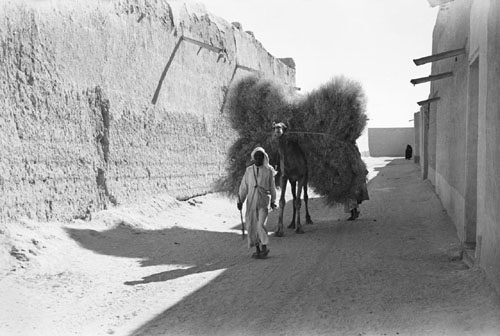
Two things happened in Kuwait in 1938 and they are usually told separately. On 22 February oil was struck for the first time, in the Burgan field. Four months later the country held its first election.
.jpg)
The Majlis movement began early that year, when a group of businessmen started calling for political reforms, including better public services and a greater share in government. In late February an activist was publicly flogged after being accused of graffiti and anti-government propaganda; despite reassurances, several of the people he had named fled to Iraq. An underground movement formed and published its reform proposals in the Iraqi newspaper Az-Zaman on 3 April. Other Iraqi papers took up the cause, and the sheikh wrote to the Iraqi press telling it to stop interfering in Kuwaiti affairs. Under the resulting pressure — and after the British Political Agent, Gerald de Gaury, was authorised to suggest to the sheikh that a council be created — the idea moved from unthinkable to arguable, and then, once the businessmen learned of the British advice, to unavoidable.
On 29 June 1938 three leading businessmen formally asked the sheikh to create an elected council; on the same day the heads of 150 prominent families met and elected fourteen members from a field of twenty. The elected members convened at the Mejlis on 4 July and demanded recognition; after an unsuccessful attempt to buy off individual members with privileges, Sheikh Ahmad Al-Jaber Al-Sabah consented on 6 July and recognised the body as the Legislative Council, and the crown prince, Abdullah Al-Salim Al-Sabah, was elected its speaker. It lasted under six months. The British considered the powers granted too broad, particularly the council's role in approving foreign treaties and the executive authority given to its speaker, and a meeting on 15 October settled that the sheikh alone would negotiate and sign such agreements but that the council must approve them to give them force of law. The council then dismissed the sheikh's chief secretary — a man who had effectively been the country's government for four decades — and moved to take control of oil revenue. It was dissolved on 21 December 1938.
What followed is recorded in two accounts that do not quite meet, and both are set down here rather than blended. Fresh elections were held on 24 December 1938 for a council enlarged from fourteen members to twenty, with the electorate widened from 150 to 400; thirteen of the fourteen members elected in June were returned. On one account the sheikh then presented the new council with a revised constitution converting it from an executive body into an advisory one and giving him a veto, the council refused to approve it, and he dissolved it on 7 March 1939, with arrests of former members following within days. On another account, given in the record of the later National Assembly, the 1938 body was dissolved in 1939 after one member was found in possession of a letter, signed by other members and addressed to King Ghazi of Iraq, requesting Kuwait's immediate incorporation into Iraq. The two accounts agree on the arrests and on the year; they are not reconciled here. The Al Sabah is described as having become Kuwait's dynastic monarchy in 1938.
Those six months are cited in almost every subsequent Kuwaiti argument about representation, by every side, which is a reasonable definition of a founding episode. The country that would spend the 1990s debating the powers of its National Assembly had elected a legislature, watched it collide with both the ruler and the protecting power over exactly the question of who controls the oil money, and seen it dissolved — all before the first barrel was exported.
Independence, and a constitution with a deadline
Crude oil was exported for the first time in 1946. A major public works programme began in 1950; by 1952 Kuwait was the largest oil exporter in the Persian Gulf, and the growth attracted a workforce drawn especially from Palestine, Egypt, Iran and India. The body founded in 1953 to manage the government's surpluses, the direct ancestor of the Kuwait Investment Authority, is generally described as the world's oldest sovereign wealth fund — a state deciding, within seven years of its first export cargo, that the money would run out.
Independence came on 19 June 1961 with the ending of the British protectorate. Kuwait applied to join the Arab League two days later; on 25 June Abd al-Karim Qasim claimed Kuwait for Iraq. British troops landed on 1 July; an Arab League force from Saudi Arabia, the United Arab Republic, Jordan, Sudan and Tunisia began arriving on 10 September; the British completed their withdrawal on 10 October. Kuwait was admitted to the Arab League on 20 July 1961, with the Iraqi delegation walking out of the meeting in protest. At the United Nations the Soviet Union vetoed a British Security Council resolution on respect for Kuwaiti independence on 7 July 1961 and vetoed the country's renewed application for membership on 30 November; Kuwait was admitted on 14 May 1963, and Iraq formally recognised it on 4 October 1963.
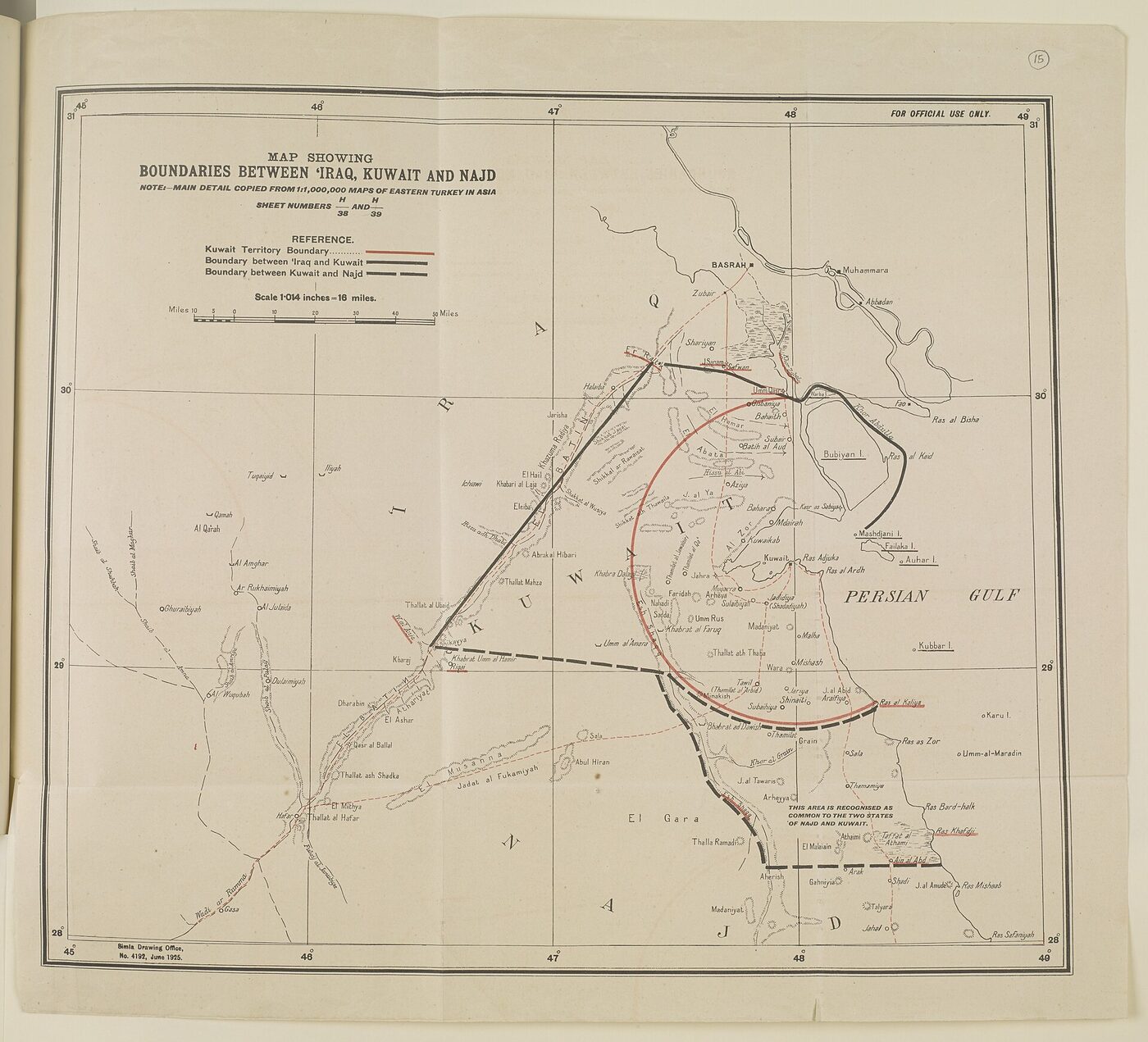

The constitution was written under that shadow and on a visible clock. The emir appointed a committee on 26 August 1961 to draft a law on elections to the Constitutional Convention; the law was issued on 6 September; elections to the convention were held on 30 December 1961; the convention opened on 20 January 1962; and the constitution was promulgated as Law Number 1 on 11 November 1962. It runs to 183 articles in five chapters. Article 6 defines the system of government as democratic, under which sovereignty resides in the people, the source of all powers; Kuwait is defined as a hereditary emirate in the descendants of Mubarak Al-Sabah, which codified the semiformal practice, running since 1915, of alternating power between the lines of Mubarak's sons Jabir and Salim. Islam is the religion of the state and the sharia a main source of legislation — a formulation whose indefinite article has been the subject of parliamentary argument ever since, with Islamist members pressing for the. Elections to the first National Assembly were held on 23 January 1963. Kuwait was the first Arab state in the Persian Gulf to establish a constitution and a parliament.
The rights the document grants are extensive on paper — personal liberty, equality before the law, freedom to hold beliefs and express opinions, freedom of the press, inviolability of the home, prohibition of the torture and deportation of citizens, the presumption of innocence, freedom to form associations and trade unions, judicial independence — together with a set of social entitlements that underwrite the country's welfare system. Those rights and obligations apply to citizens; the remainder of the population has few political and civil rights and restricted access to the benefits of the state. Article 181 provides that no part of the constitution may be suspended except under martial law and within the limits the law defines, and that even then the National Assembly must continue to meet and the immunity of its members must not be violated. That article is the hinge on which the next sixty years turn.
The Assembly, suspended and restored
The National Assembly consisted of fifty deputies elected for four-year terms by single non-transferable vote, sitting alongside cabinet ministers appointed by the emir, who were members of it as well; the constitution limited the cabinet to sixteen. Set beside the parliaments of the other Gulf monarchies it is commonly described as having held considerably more formal and informal power. Under Article 107 the emir may dissolve it by decree, giving his reasons, though not again on the same grounds, and elections must follow within two months.
That is the constitutional machinery. The record of its use runs as follows. On 29 August 1976 Emir Sabah Al-Salim Al-Sabah suspended the Assembly together with four articles of the constitution concerned with political and civil rights, namely freedom of the press and the dissolution of the legislature; the articles and the Assembly were restored in 1981. In 1982 the government submitted sixteen constitutional amendments, among them a power to declare martial law for an extended period and provisions to enlarge the legislature and lengthen its terms, and formally dropped them in May 1983 after several months of debate. On 3 July 1986 Emir Jaber Al-Ahmad Al-Sabah suspended several articles and the Assembly again. The pro-parliament movement that arose in 1989 and 1990 took its name — the Constitutional Movement — directly from the demand for a return to constitutional life.
The government's answer to that movement was a partial one. National Council elections were held on 10 June 1990 for a body only half of which was elected, created by the emir in an attempt to appease protesters; 574 candidates contested the fifty elective seats, the opposition called for a boycott, and turnout was recorded at 62.3 per cent. Seven weeks later the country was invaded, and the question of the National Council became academic.
The Assembly returned after the war. Elections were held on 20 October 1992; 275 candidates stood, turnout was 83 per cent, independents won the largest number of seats, candidates opposed to the government took 31, and the new Assembly exercised its constitutional right to review every emiri decree issued during the years of dissolution. Press restrictions had been lifted earlier that year. The account given by the Inter-Parliamentary Union holds that American support for the ruling family during the Gulf War was made conditional on the restoration of democracy, and that the emir agreed to it at the Jeddah conference of October 1990; the point is contested by other accounts of the period, and is recorded here as attributed rather than settled.
The story did not end with the newsgroup. From 2006 to 2024 the Assembly was dissolved thirteen times, and on 10 May 2024 Emir Mishal Al-Ahmad Al-Jaber Al-Sabah suspended seven articles of the constitution, mainly those concerning parliament, together with the Assembly itself; the emiri decree stated that the suspension was intended for a period not exceeding four years, and cited inaction, corruption, bribery, vote purchasing and political deadlock. Readers of soc.culture.kuwait in the 1990s were arguing about the powers of a chamber that, at the time of writing, is not sitting.
The franchise, 1962 to 2005
The other half of the parliamentary question was who could vote for it. Under the law passed after independence the franchise was confined to men over the age of twenty-one who could show that their family had been resident in Kuwait before 1920 — a rule that, at the 1992 election, produced a registered electorate of 81,440, or about 14 per cent of the citizenry, in a country whose total population was then a little over two million. Some 67,724 of those registered voters cast a ballot.
Attempts to widen it began almost at once and failed repeatedly. A bill to enfranchise women was put to parliament in 1963 and overturned; another was considered in 1973 and overturned; in 1984 the emir and the crown prince, who was also prime minister, both announced themselves in favour, and bills failed again in 1985 and 1986. In 1996 five hundred women stopped work for an hour in the first organised demonstration of the campaign, and small demonstrations continued for years afterwards. In May 1999 the emir issued a decree granting women the vote and the right to stand for office; parliament, entitled under the constitution to overrule an emiri decree, did so six months later, and no election fell within the interval. Women protested outside voter registration centres in 2002; at the 2003 election they organised mock ballots that allowed hundreds of women to cast symbolic votes for real candidates; in March 2005 a thousand people surrounded the parliament building.
On 17 May 2005 the bill passed, by 37 votes to 21. Four years later, at the general election of May 2009, four women were elected to the fifty elective seats: Aseel al-Awadhi, Rola Dashti, Massouma al-Mubarak and Salwa al-Jassar. None was returned in 2013, and the last woman elected resigned in May 2014; Safa Al Hashem, elected in 2012 and again in 2016, was the first woman to serve two consecutive terms, and lost her seat in 2020.
This was live argument during the years such groups were busiest, and it had articulate defenders on every side of it — a fact worth stating flatly, because the outcome is now known and the debate consequently reads as more one-sided in retrospect than it was at the time. A country group in the 1990s was a place where that argument was conducted by people who did not know how it would end.
1990 to 1991, and what a newsgroup could not have carried
Iraqi forces entered Kuwait on 2 August 1990. A Kuwaiti figurehead, Alaa Hussein Ali, was installed at the head of a provisional government, and the annexation of the country was announced on 8 August and completed later that month, when northern Kuwait was merged into Iraq's Basra Governorate and the south declared a governorate of its own; sources differ over which date to treat as the annexation proper. The occupation ran seven months. Half the population, native and foreign-born, left during it, including some 400,000 Kuwaitis and several thousand foreign nationals, and other states evacuated their citizens on a scale that has few parallels: the Indian government flew out more than 170,000 of its nationals in almost 488 flights over fifty-nine days.
Inside the country, information moved badly and by hand. Radio carried transmissions from Baghdad, many Kuwaiti television channels were shut off, and the Um Alaish satellite ground station complex — inaugurated in October 1969 as the first of its kind in the Middle East, and expanded with a second station in 1977 and a third in 1981 — was destroyed. A civilian resistance formed, composed predominantly of ordinary citizens who lacked training and supervision, and its casualty rate is recorded as far exceeding that of the coalition forces and of Western hostages; the underground was answered with summary executions and torture. Its communications were improvised: satellite telephones were smuggled across the Saudi border to establish a line to the exiled government at Taif, and informational pamphlets and a clandestine newspaper, Sumoud al-Sha'ab — Steadfastness of the People — became some of the only available sources of news from outside. Accounts of the period note that Kuwaitis and foreigners, and people of different genders and classes, worked in the resistance together in ways that cut across the society's usual divisions.
The coalition's aerial bombardment began on 17 January 1991 and the ground assault on 24 February; the coalition halted its advance after a hundred hours, and the occupation of Kuwait ended on 26 February 1991. Immediately after the liberation the United Nations demarcated the Iraq–Kuwait boundary under Security Council Resolution 687 on the basis of the agreements of 1932 and 1963, and in November 1994 Iraq formally accepted it — a date that falls, as it happens, in the same month the newsgroup was created.
It is worth being exact about what a newsgroup could and could not have been during that period. soc.culture.kuwait did not exist in 1990 or 1991; it was voted into being three and a half years after the invasion and nearly four years after the liberation, and the archive that preserves its founding documents holds nothing but control messages after November 1994. Nothing can therefore be said here about what its early traffic contained. What can be said is what was live in the country during the years it did exist: reconstruction, compensation, the health effects of the smoke, the return or non-return of communities that had left, and a parliament that had just been restored. As for where else the subject might have gone in the war years, the branch's general room for the region, soc.culture.arabic, was already carried in the Big Eight list by January 1993 — its one-line description at that date read Technological & cultural issues, *not* politics., which is a limit rather than an invitation. Iraq's own side of the record belongs to soc.culture.iraq, and the movement of people the war produced across the region touches soc.culture.jordan, both of which are preserved here.
The fires, and what came after them
The single largest item of reconstruction was the oil-well fires, and the figures are worth stating carefully because they are frequently rounded into inaccuracy. Explosive charges were placed on wells as early as December 1990. Systematic sabotage began on 16 January 1991, as the allied air strikes commenced; satellite imagery detected the first smoke on 8 February; and the number of fires peaked between 22 and 24 February with the start of the ground offensive. Estimates of the number of wells fired run from 605 to 732, with a further thirty-four wells destroyed by heavy coalition bombing in January; the Kuwait Petroleum Company's own estimate as of September 1991 was 610 fires out of a total of 749 facilities damaged or on fire. Whatever the exact figure, it amounted to roughly half of all the oil-well fires in the history of the petroleum industry, and temporarily damaged or destroyed approximately 85 per cent of the wells in every major Kuwaiti field.
Concerted firefighting could not begin until April, in part because land mines had been laid around the wells and had to be cleared first. During the uncontrolled phase, which ran from February to April, various estimates put the daily burn at between four and six million barrels of crude and between seventy and a hundred million cubic metres of natural gas. Seven months in, 441 facilities had been brought under control and 308 had not. The last well was capped on 6 November 1991. The direct cost of extinguishing the fires was about 1.5 billion US dollars, and the total quantity of oil burned is generally put at around a billion barrels, or a little under one per cent of the country's reserves.
The residue was as consequential as the flames. By the Kuwaiti oil minister's estimate, between twenty-five and fifty million barrels of unburned oil from damaged facilities pooled into approximately 300 oil lakes, contaminating some 40 million tonnes of sand and earth; the mixture of desert sand, spilled oil and soot set into layers of hard crust — tarcrete — over nearly five per cent of the country's land area. Separately, and in the same weeks, oil was released into the Gulf in what is counted among the largest spills on record; the quantity was probably around four million barrels, and the main source was identified by coalition forces as the Sea Island terminal in Kuwait, which discharged some seventy to eighty thousand tonnes a day for a week. Remediation on land was led by the Kuwait Institute for Scientific Research together with the Arab Oil Company, and included trials of petroleum-degrading bacteria on the lakes. Vegetation in most contaminated areas adjoining the lakes began recovering by 1995, though the dry climate has partly solidified some of the lakes and the oil has continued to sink into the sand, with potential consequences for a country whose groundwater resources are small.
Damage assessment, the pace of repair, the health effects of the smoke and the eventual compensation claims were the country's dominant public subject for years afterwards, and they reached readers abroad as they reached everyone else. Whether and how they were discussed in this particular newsgroup is not established by any source consulted for this page, and is not asserted.
The diwaniya
The institution most often reached for as the offline analogue of a Kuwaiti newsgroup is the diwaniya, and the comparison is close enough to be worth setting out properly rather than in passing. The word descends, by way of the Persian divan, from a term for a formal room of sitting and negotiation, and the same root gives the council chamber, the government department and the long cushioned bench along its wall. In its Kuwaiti form it is both a place and an event: the reception room, traditionally an extension built onto a family house, and the gathering held in it. Much of the descriptive literature on it is thinly sourced, and what follows is given as the common characterisation rather than as established fact.
Observers distinguish several kinds. The family diwan is described as the oldest form, hosted by a household and presided over by its elders from the head of a hall usually arranged in a U, and used for weddings and funeral rites as well as for talk. The public or political diwaniya is described as a twentieth-century development, arising as Kuwaitis began seeking political rights and representation in a system that had grown more absolutist than the consultative arrangement said to have preceded it. The casual diwaniya is a standing appointment among friends of an age, with cards, shisha, football on the television and, latterly, video games. Most run from after the evening prayer until around eleven; the private and youth varieties are described as keeping no hours at all. Tea and Arabic coffee are served at every one of them, which is the only universal rule anybody records.
What makes the institution politically consequential, on this account, is that it is a standing, distributed, unbookable public sphere that no ministry convenes. It is described as the core of the country's social, business and political life — where associates are introduced, alliances formed and business proposals delivered to people whom custom obliges to sit and listen. At elections it becomes the campaign itself: lists of the influential diwaniyas in each district are drawn up from the first day, and candidates schedule visits to them in the weeks before the poll. It is the reason the phrase the root of Kuwait's consensual political system attaches to it in the descriptive literature — a claim about lineage that is made often and demonstrated rarely, and which is recorded here as the common characterisation rather than as a finding.
Two episodes are usually invoked to give the claim purchase, and they are worth naming with the caveat attached. The reform movement of 1938 that produced the Legislative Council organised in a country that had no political parties, no domestic press of its own and no formal venue for opposition; the Constitutional Movement of 1989 and 1990 campaigned under the same constraints, and the National Council election of June 1990 was the state's answer to it. That the diwaniya circuit was the medium in both cases is the standard telling. This page has not been able to verify the mechanism from a source it would rely on, and so states the association without asserting it.
The comparison to a newsgroup is therefore not merely decorative. Both are unbookable rooms whose membership is defined by who turns up; both derive their authority from continuity rather than from any charter; both are hospitable to the newcomer and merciless to the bore. The differences are equally instructive. The diwaniya has a host, and a host is a moderator with a doorway. It is also, in its classical form, a room in which a man receives his business colleagues and male guests, and the question of women's participation in it has itself been a subject of study. A newsgroup had neither host nor doorway, which is precisely what part of the community would go to the trouble of voting about in 1996.
The population question
Kuwait's demography is the standing subject that no account of the country can leave out and none can summarise briefly. Non-citizens have been the larger part of the population since the 1970s, and the census series states it without ambiguity: non-Kuwaitis were 69.1 per cent of the population in 1975, 72.3 per cent in 1985, 58.5 per cent in 1995, 60.8 per cent in 2005 and 67.7 per cent in 2015. The 1995 dip is not a policy success but a war: the non-Kuwaiti population recorded in 1990 was above 1.57 million, and in 1993 it was under a million. As of 2024 the totals were about 4.82 million people, of whom roughly 1.53 million were citizens and 3.29 million foreign nationals from more than a hundred countries.
The legal architecture underneath those numbers is the sponsorship system generally called kafala, under which a migrant worker's residence and employment status are bound to a specific employer for the period of residence, giving that employer substantial authority including the ability to approve or deny a change of job and permission to leave the country. Its origins are disputed among the scholars who study it, and the disagreement is worth showing rather than resolving: Gilbert Beaugé argues that it originated from an old Bedouin custom of granting protection to visitors; Anh Longva suggests it is a well-anchored Kuwaiti tradition; Omar al-Shehabi argues that the modern system was a product of the British colonial era, introduced by administrators who regarded migrant labour as both a necessity and a problem needing regulation and control. The system has been criticised at length by human rights organisations, which document passport confiscation, non-payment of wages and restrictions on movement; it has also been the subject of bilateral negotiation, most visibly the labour agreement concluded with the Philippines in May 2018 after a diplomatic crisis, which prohibited passport confiscation and guaranteed one day off a week.
The composition of the workforce follows from the same architecture. Employment of citizens is concentrated overwhelmingly in the state: public sector salaries and subsidies account for more than 70 per cent of government spending, and public sector wages alone for some 12.4 per cent of GDP, the highest such figure in the Gulf Co-operation Council — the basis on which Kuwait is regularly characterised in the literature as a rentier state. Non-citizens supply most of the private-sector and domestic labour force. Within the citizen population, women's labour force participation is comparatively high: 53 per cent in 2013, slightly above the world average and much higher than the regional one, with Kuwaiti women outnumbering working Kuwaiti men. Indians and Egyptians are the largest expatriate communities, and Christians — most of them from Kerala — form the second largest religious group, at an estimated 17.9 per cent of the population in 2020.
Two further movements of people belong to the record because they were within living memory for the group's readers. The Palestinian community in Kuwait was among the largest anywhere in the Gulf: figures of roughly 357,000 to 400,000 before the invasion are given by different sources, in a country whose total population in 1990 was a little over two million. More than 200,000 Palestinians left during the occupation, and nearly 200,000 more were pressed to leave in 1991; those who left were Jordanian citizens. And in the decades after independence, successive naturalisations of Bedouin immigrants — as many as 200,000 by 1980, with estimates of up to 400,000 in total — have been described by the United Nations, by scholars and researchers, by political activists and by members of the ruling family as politically motivated. Those are attributed characterisations, and are set down here as such.
The bidoon, as the record and the named organisations state it
The most contested question in the whole demographic file concerns the bidoon — bidoon jinsiya, without nationality — the stateless residents of Kuwait. The following is set out strictly as the record and the named organisations state it, with their figures attributed and their disagreements left visible, because there is no version of this subject on which the sources agree and none is going to be manufactured here.
The sequence of dates is not in dispute. From 1965 until 1985 the bidoon were treated as Kuwaiti citizens and guaranteed citizenship, with free access to education, healthcare and the other privileges of citizenship, and they made up a reported 80 to 90 per cent of the Kuwaiti army through the 1970s and 1980s. In 1985, at the height of the Iran–Iraq War and following an assassination attempt on Emir Jaber Al-Ahmad Al-Sabah, they were reclassified as illegal residents and denied citizenship and its accompanying privileges. Since 1986 the government has refused to grant them documentation, including birth and death certificates, identity cards, marriage certificates and driving licences, and they face restrictions in employment, travel and education, including exclusion from state schools and universities. By 2004 they accounted for about 40 per cent of the army. Under Article 4 of the nationality law they remain eligible for naturalisation; in 2018 the government stated an intention to naturalise up to 4,000 a year, a figure outside observers considered unlikely.
The counts are disputed and the disputes are the point. In 1995 Human Rights Watch reported 300,000 stateless bidoon in Kuwait, a figure subsequently repeated by the British government; the same 1995 report stated that the totality of the treatment of the bidoon amounted to a policy of denationalisation of native residents, and that denial of citizenship to them clearly violates international law. In October of that year the British member of parliament George Galloway told the House of Commons that there were more than 300,000 bidoon and that half of them, 150,000, had been driven into refugee camps in the desert across the Iraqi border. In 2013 the British government estimated the number of documented bidoon at 110,729, without offering a total; the Kuwaiti government's own figure for documented bidoon is 93,000. Several human rights organisations argue that Kuwait is violating international law by committing ethnic cleansing and genocide against the bidoon; the Kuwaiti government has published responses to those reports disputing them. There is no official national census disclosing sectarian affiliation, and the widely repeated figure that between 60 and 80 per cent of the bidoon are Shia is an estimate.
The gap between 93,000 and 300,000 is not a rounding error and cannot be split. It reflects a disagreement about who counts as bidoon, about who is a concealed foreign national, and about what the state's own registers record — and it is exactly the sort of disagreement that a country newsgroup of the period would have been expected to carry. This page documents the arguments and does not join them. It also does not claim that this group carried them: the subject was live in Kuwait throughout the group's life, but no archived posting has been verified for it, and none is described here.
The dialect
The everyday register of the group was almost certainly Arabic in Latin transliteration, because Usenet's transport was a seven-bit medium and Arabic script did not survive it reliably; that problem, and the conventions the region's posters devised to work around it, belong to soc.culture.arabic and are treated there. What such transliteration was carrying, across the region, was the spoken language, and in this room's case that meant Kuwaiti Arabic: a variety of Gulf Arabic sharing phonetic features unique to the dialects of the Arabian Peninsula and differing from Modern Standard Arabic in ways that a written medium makes conspicuous.
The clearest of those differences are the reflexes of two Classical Arabic consonants. Classical *q surfaces in Kuwaiti as a g sound, and Classical *k as the ch of church; the first may be fronted further, towards a j sound, next to front vowels. In a script-poor medium those shifts are the first thing a transliterating writer has to decide about. The grammar diverges too: subject–verb–object order is used more often than the verb-first order usual in Modern Standard Arabic, almost all of the classical case endings are omitted, the dual grammatical person is not used though dual nouns survive, feminine forms in the second and third person plural are not used, and the definite article al- is realised as el-. Kuwaiti also uses a set of particles before verbs which, because they occur only there, are often classified as aspectual rather than as copulas.
Internally the dialect is not one thing. Researchers divide it into urban and Bedouin varieties, the latter reckoned the more linguistically conservative and the former, which has novel features not shared by surrounding dialects, the more prestigious. The urban speech is divided into four sub-dialects — Sharq, Jibla, Failicha and Fintaas, each named for a district or an island — and the Bedouin speech into two, Jahra and Dimna. The standard demonstration is the word for sugar, which historians and researchers use as a shibboleth because it comes out with three different pronunciations in the Sharq, Fintaas and Jibla forms. The vocabulary records the port: loanwords from Persian, Turkish, English, Italian, Hindi-Urdu and Swahili are all documented, which is a lexicon shaped by the same routes as the horse trade and the pearl fleet.
Kuwait is diglossic, as the Arab world generally is. One researcher's account identifies four varieties in use: Classical Arabic for the Qur'an and the older literature; Modern Standard Arabic for formal communication and school education, which Kuwaitis encounter for the first time when they start school and which is accordingly described as their second language; Kuwaiti Arabic for daily life and as the symbol of Kuwaiti identity; and an educated standard mixing the last two, used on radio and television and in informal academic talk. After interviewing speakers of Kuwaiti, the same researcher reports that for many of them speaking Kuwaiti is the most important criterion of being considered Kuwaiti. The dialect has also travelled further than most: Kuwait's television drama industry is the largest and most active in the Gulf and produces a minimum of fifteen serials a year, which has carried the Kuwaiti dialect to audiences as far away as Tunisia, and is why a form of speech belonging to a small country is recognisable across the Arabic-speaking world.
Poetry, sawt and the sea in the ear
The charter put poetry first on its list of further topics, ahead of music, theatre and everything else, which is not an accident of alphabetisation — the list is not alphabetical. Verse in the Arabian Peninsula divides broadly into the classical tradition and the vernacular one, and the vernacular one is nabati: poetry that stems from the spoken Arabic of the peninsula rather than from the classical rules of literary Arabic, known also as the people's poetry and as Bedouin poetry. Its composers worked in structures, themes, metres and rhymes similar to the pre-Islamic qasida, and examples of the form are referenced by Ibn Khaldun in the Muqaddimah, first published in 1377. Among the historically prominent practitioners is Ibn Li'bun, who lived from 1790 to 1831 and is known along the eastern coast of the peninsula as the Prince of the Nabati Poets; a good deal of the region's traditional song derives from his verse.
Nabati was long an aural art, transmitted by memory — researchers report encountering Bedouin who can memorise twenty thousand poems — and recited at gatherings over coffee, with deliberate pauses, repeated words and lines for emphasis, and an echoing technique in which the audience shouts the lines back at the reciter. It was not decorative. It was used to declare war, to seek peace and to resolve tribal disputes, and was a key element of communications in the region before the twentieth century, after which it lapsed with the development that followed the discovery of oil. It has since enjoyed a considerable renaissance as a medium of both poetry and song, promoted particularly in the United Arab Emirates through broadcast competitions and a dedicated academy. Writing it down is itself a modern departure from the practice of the poets who made it.
Kuwait's musical tradition is likewise a maritime inheritance. The country is the birthplace of the sawt genre, and it shares with Bahrain the fijiri, the vocal repertoire of the pearl divers of eastern Arabia, sung by a lead voice against a chorus and clapping and accompanied by the small double-headed mirwas drum and the jahlah, a clay pot played with both hands. Kuwaitis were the first commercial recording artists in the Persian Gulf region, with the earliest known Kuwaiti recordings made between 1912 and 1915, and the country is widely considered the centre of traditional music in the Gulf and the pioneer of contemporary Khaliji music.
Kuwait's modern literary standing rests on a comparable head start. Beginning in 1936 it was the first Gulf Arab country to grant scholarships in the arts; Mojeb al-Dousari is the earliest recognised visual artist of the region and is regarded as the founder of portrait art in it; and the magazine Al Arabi, first published in December 1958 and funded by the state, went on to become the most popular magazine in the Arab world, printing around a quarter of a million copies a month. Kuwait's press was described as one of the freest in the world, and writers came to the country for that reason, the Iraqi poet Ahmed Matar among them, who left Iraq in the 1970s for what the record describes as its more liberal environment. Ismail Fahd Ismail, author of more than twenty novels and numerous short story collections, was one of the first Kuwaiti writers to achieve success across the Arab world; Laila al-Othman, Taleb al-Refai, Taibah Al-Ibrahim, Najma Idrees and Fatimah Yousif al-Ali belong to the same shelf of pioneering writers. And underneath all of it sits the folklore, which is exactly what a seafaring town would produce: among its standing figures is Bu Darya, a malevolent and colossal half-human, half-amphibian creature who preyed on those out at sea, and who is understood to symbolise the dangers awaiting sailors.
The sea, kept as an exhibit
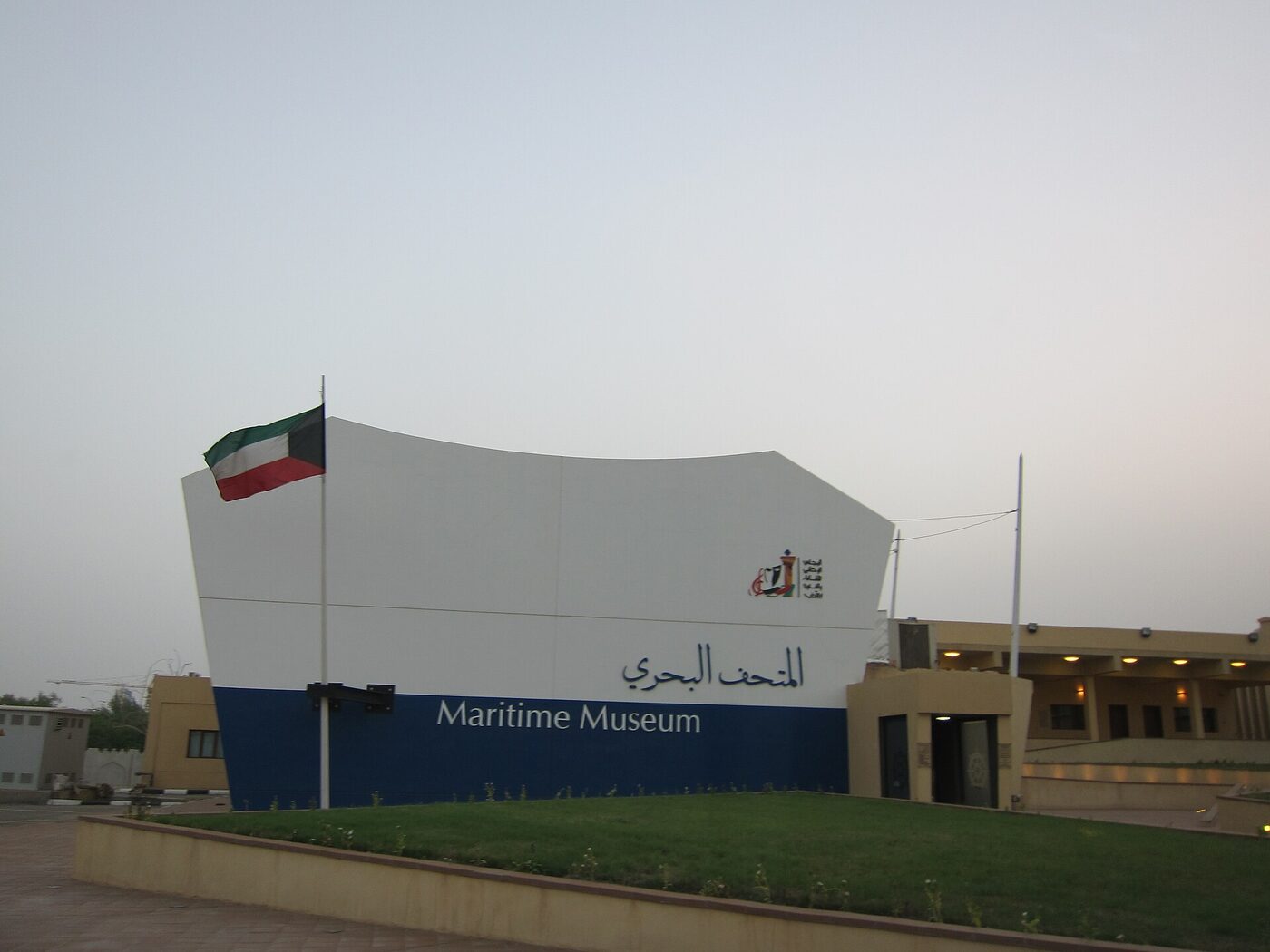
What happened to the pre-oil economy after 1946 is that it became heritage, and Kuwait's museum estate is unusually dense with it. The Kuwait Maritime Museum presents the country's maritime heritage in the pre-oil era. Several traditional dhows are open to the public: Fateh Al-Khayr, built in 1938 — the year of Burgan and of the Legislative Council — survives as a museum ship, and Al-Hashemi-II, commissioned by Husain Marafie, planned from 1985 and laid down in February 1997, is entered in the Guinness Book of World Records as the largest wooden dhow ever built and holds a marine museum of its own. She cost more than thirty million dollars, is nearly eighty-four metres long, and has never been floated, although she was built using traditional caulking and other methods of making a hull watertight.
Sadu House is the institution devoted to Bedouin weaving, the geometric hand-woven textile art called al sadu, made on a ground loom for tents and their coloured dividers, storage bags and animal trappings. In Kuwait the craft has two settings: the desert, where the weaving was done by women, and the town, where a different weaving was undertaken by men, who made the cloth for the bisht, a man's cloak. The Al Sadu Project began in 1978 as a private initiative by a group of concerned Kuwaitis who wished to preserve a fast-disappearing craft; Sadu House was established by the Al Sadu Society in 1980; and in 1991, soon after the liberation, the project was transformed into the Al Sadu Weaving Co-operative Society, owned and run by the weavers and artisans themselves. In 2020 the traditional weaving of al sadu in Saudi Arabia and Kuwait was inscribed on UNESCO's Representative List of the Intangible Cultural Heritage of Humanity, and Qatar was included in the same inscription in 2025.
The Kuwait National Museum, designed by the architect Michel Ecochard and established in 1983, comprises five buildings set around a central garden, their arrangement parallel to the plan of the vernacular Arab courtyard house, with the main buildings connected by elevated walkways; its four sections are a folk heritage hall, a hall of archaeology, a planetarium and a dhow. Bait Al-Othman is the largest museum specialising in Kuwait's history; the Tareq Rajab museums and the Dar al Athar al Islamiyyah cultural centres, the latter established in 1980, hold Islamic art, books and manuscripts, ceramics, glass, metalwork, textiles and carpets, coins and scientific instruments. The archaeology comes largely from Failaka, the island at the mouth of Kuwait Bay that has been continuously inhabited since the Bronze Age and that the Greeks, arriving in the fourth century BC under Alexander the Great, named Ikaros. Scholars of Gulf museums note that Kuwait's estate differs from its neighbours' in provenance: in contrast to the top-down approach of other Gulf states, museum development in Kuwait is read as reflecting a greater sense of civic identity and demonstrating the strength of a civil society that has produced many independent cultural enterprises. That reading is an interpretation; the ownership pattern it rests on is not.

The table and the calendar
Kuwaiti cuisine is described in the reference literature as a fusion of Arabian, Iranian and Mesopotamian cooking, and belongs to the wider eastern Arabian kitchen. Its most prominent dish is machboos, basmati rice seasoned with spices and cooked with chicken or mutton. Fish matters more than in most of the region's cuisines, which is what a pearling and trading port would be expected to produce: mutabbaq samak, fish served over rice cooked in well-spiced fish stock, is described as a national dish, and the standing local favourites are hamour, the grouper, typically served grilled, fried or with biryani rice; safi, the rabbitfish; maid, the mullet; and sobaity, the sea bream. The bread is khubz, a large flatbread baked in a special oven and often topped with sesame seeds; it is commonly called Iranian khubz, because the bakers in the country's many local bakeries are mainly Iranian.
The calendar's most characteristic observance in this part of the Gulf is Gargee'an, kept on the thirteenth, fourteenth or fifteenth night of Ramadan, when children dressed in traditional attire go from door to door singing traditional songs and collecting sweets and nuts from the neighbours. The tradition has existed for hundreds of years, is kept by Sunni and Shia alike, and is deeply rooted across eastern Arabia — in Kuwait, Bahrain, Qatar, Iraq and the Qatif and Al-Ahsa districts of Saudi Arabia. The songs ask for blessings on the youngest child of the household. It is the kind of observance an expatriate population keeps up at a distance, and the kind of subject a country newsgroup existed to make discussable; what this particular group did with it is not on the record.
Football
Football is the most popular sport in the country, and Kuwait's record in it belongs to a specific and now-closed period. The national side won the Arabian Gulf Cup at its inception in 1970 and again in 1972, 1974, 1976, 1982, 1986 and 1990 — seven titles in the tournament's first ten editions, in a period when only Kuwait and Iraq won it at all — and later extended the tally to a record ten with wins in 1996, 1998 and 2010. It reached the final of the AFC Asian Cup in 1976, won the tournament in 1980 on home soil, beating South Korea 3–0 in the final, and took third place in 1984 on penalties after a drawn play-off with Iran. In 1982 it reached the World Cup finals in Spain, drew 1–1 with Czechoslovakia and lost to England and France, going out in the group stage; that remains its only appearance. Its highest FIFA ranking, twenty-fourth, was reached in December 1998. Domestically the fixture of record is the Al-Arabi–Qadsia derby.
The invasion cut across all of it. Sheikh Fahad Al-Ahmed Al-Jaber Al-Sabah — a member of the ruling family and a military officer, founder of the Kuwait Olympic Committee and of the Asian Handball Federation, and president of the Olympic Council of Asia from 1982 — was killed by Iraqi forces at Dasman Palace on 2 August 1990, the first day of the invasion; the accounts of exactly how he died differ, and no version is adopted here. The football association's headquarters and facilities were damaged, all competitions in the country were suspended, players were displaced or went into exile, and the national team had to miss the qualifiers for the 1992 Asian Cup entirely. The recovery is dated by results: the Gulf Cup of 1996 and a semi-final at the Asian Cup the same year, which is to say during the years the newsgroup existed, when the readership had something to argue about that was not politics.
Later decades were less kind, and for administrative rather than sporting reasons. Kuwait was suspended by FIFA in 2007, in 2008 and again on 16 October 2015, the last time because FIFA did not recognise a new sports law in the country. The 2015 suspension ran until 6 December 2017, saw the hosting of the Gulf Cup moved to Qatar, and cost the national side the qualifying campaigns for the 2018 World Cup and the 2019 Asian Cup; by the time it was lifted the team had fallen from 139th in the world rankings to 189th.
What the record does not show
The creation file for soc.culture.kuwait is unusually complete. The file for its life is empty, and the gap deserves whole sentences rather than a shrug.
No traffic figure, readership estimate, subscriber count or article count has been established for this group. No archived thread is cited on this page, and no thread title, poster or exchange is described, because none has been verified for it. Who posted most, what the room's recurring arguments actually were, whether it was busy or quiet in any given year, whether it had a Frequently Asked Questions posting or a regular contributor who kept it in order — all of that is unknown from the sources consulted, and inventing it would be worth less than admitting it. The archive that documents the group's creation in such detail contains, after 3 November 1994, only control messages.
Several plausible things are also unestablished. The common assumption that a group named for a country is written substantially from inside it is left here as an assumption; the 1994 ballot roll is the only quantitative evidence this page offers on the question, and fourteen ballots is not a readership. Nor can the ordinary shape of a country group's traffic be asserted for this one from general knowledge of the branch: the topics named in the charter are what the founders proposed to discuss, not a record of what was discussed. The one contemporaneous statement about the group's atmosphere that does survive is not this page's to use — it is the rationale attached to the 1996 proposal for the moderated companion, written by a party to that argument, and it is quoted and weighed on the sibling page rather than borrowed here as description.
Three things can be said with confidence. The group existed as a real, propagated Big Eight newsgroup, created by an authorised control message on 9 November 1994 and carried by news servers worldwide. It is still there: the current master newsgroups and active files distributed from the Internet Systems Consortium carry soc.culture.kuwait, unmoderated, with its original description intact, which is more than can be said for a great many of its neighbours — including its own moderated sibling, which is not in the current newsgroups file at all. And the news2mail gateway whose roster produced this directory listed it among the groups it delivered by e-mail between 2000 and 2004.
Scope, sources and limits
This article draws on three kinds of record, and it is worth saying which claim rests on which. The group's own paperwork — the Request for Discussion, the two Calls for Votes, the result, the published ballot roll and the charter quoted verbatim above — comes from the archive of news.announce.newgroups on the Internet Systems Consortium's Usenet file server. The creation message of November 1994, the alt.culture.kuwait sequence of April to September 1994, the alt.kuwait.* creations of November 1998 and the forged removal attempt of November 2001 come from the matching archive of Usenet control messages; the group's present status and one-line description come from the newsgroups and active files distributed from the same place. Everything about the country comes from standard reference accounts, is used only where they exist, and is stated with their attributions attached.
Where those reference accounts disagree with each other, the disagreement is shown rather than settled. That applies to the date on which the annexation of 1990 should be dated, to the reason the second Kuwaiti council was dissolved in 1939, to the number of wells fired in 1991, to the size of the Palestinian community before the invasion, and to the number of bidoon. It also applies to a claim this page has deliberately left out: one reference account states that Kuwaiti women had the vote when voting was introduced in 1985, which contradicts the rest of that same account and every other source consulted, and is therefore omitted rather than repeated.
Four limits are worth marking explicitly. First, quotations from Usenet documents are exact or absent: the charter, the newsgroups line and the four-word rmgroup body are reproduced as they stand, and nothing has been tidied. Second, the counts drawn from the 1994 ballot roll are counts of e-mail addresses in a document from October and November 1994, not counts of people, readers or posters; where this page says three participants recur in the 1996 paperwork, one of those is an address match and two are name matches, and the distinction is stated where the claim is made. Third, several of the country's most consequential figures — the number of bidoon, the number of wells fired, the scale of the naturalisations, the origin of the sponsorship system — are disputed between named parties, and this page reports the range and the disputants rather than choosing between them. Fourth, and most important for the register of this page: the political questions described here are live and contested, and describing an argument is not the same as taking part in it. Kuwait's politics, the occupation and its consequences, and the position of the bidoon are documented above as the record and the named organisations state them. No verdict is offered on any of them, and none should be inferred.
One point has to be settled before anything else, because this group is often assumed to be older than it is. It was not reborn out of the 1990 invasion, and nothing in it discusses that war first-hand, because it did not exist until 9 November 1994. The community's earlier attempt at an address, alt.culture.kuwait, dates only from April 1994. Nothing survives of what the room said about the events of 1990 and 1991, and this page does not supply it.
The branch this group belonged to, and the mechanics by which such groups were proposed, argued over and voted into existence, are described on the soc.culture.* index. The group thinned through the 2000s as the rest of the hierarchy did, its traffic going first to web forums and then to social platforms. What remains is a room whose founding documents survive in full and whose conversation does not — a contemporaneous address for a small country's argument with itself, kept open while nobody knew how any of it would turn out.
Reading soc.culture.kuwait today
- Historical archive: Google Groups — soc.culture.kuwait (coverage varies by group and era).
- Open in a newsreader:
news:soc.culture.kuwait— the original site offered exactly this link, and it still works if your system has a newsreader registered for thenews:scheme. - Live access: point an NNTP newsreader at a modern server — see accessing Usenet today.
- The original news2mail e-mail subscription service ended in the mid-2000s and no longer operates.