soc.culture.iraq
Iraq, its people and its history.
Through sanctions, the 2003 invasion and the years after, soc.culture.iraq carried a conversation between exiles, expats and — as connectivity allowed — Iraqis at home, across Arabic, Kurdish and English.
The archive spans the whole arc: 1990s embargo hardship, invasion-eve fear and hope, and the sectarian years, argued in real time by people with family on the ground.
On this page
- The group's own paperwork
- What the ballot recorded
- A group created in 1995, and what that governs
- The connectivity question, which is this page's own
- The diaspora the group was addressed to
- The state, in dates
- 1990 to 2003, and the resolutions by number
- The mortality estimates, and why they conflict
- 2003 and after, in attributed estimates
- The sectarian years, 2006 to 2008
- 2014 to 2017
- Mesopotamia, and the museum
- The sites, and what left them
- The destruction of 2014 to 2017, dated
- Music, and the maqam
- The dialect, and the languages in the room
- The written record, and what happened to it
- Arabic in a seven-bit medium: Iraq's own case
- What the record does not show
- Scope and limits
The group's own paperwork
soc.culture.iraq is one of the newsgroups in this directory whose birth certificate survives intact. The archive of news.announce.newgroups kept on the Internet Systems Consortium's Usenet file server holds the whole creation sequence in the order it happened, with the dates the network's own software stamped on it: a Request for Discussion posted on 30 January 1995; a first Call for Votes on 5 April; a second and final call on 14 April; and a result posted on 1 May 1995 under the subject line RESULT: soc.culture.iraq passes 403:55. The matching archive of control messages holds what came afterwards, which is the part that actually created the group.
The proposal came from outside Iraq. The Request for Discussion was posted from a corporate Hewlett-Packard address in Britain, with the Organization header reading simply Hewlett-Packard, and it was cross-posted to eight groups: the two procedural rooms, news.announce.newgroups and news.groups, plus soc.history and five rooms in the branch itself, namely soc.culture.arabic, soc.culture.lebanon, soc.culture.jordan, soc.culture.maghreb and soc.culture.palestine. That crosspost list is the group's own account of its neighbourhood, and it is worth noting what is not in it: there was no Iraqi room in the Big Eight to post it to, which was the point of the exercise.
The header block of the RFD set out the proposal in five fields — name, status, languages, distribution and summary — and one of them is unusual enough to quote. Under the heading for the group's languages the document reads:
Languages: English and transliterated Arabic.
A newsgroup that names its writing system in its founding paperwork is telling you something about the medium it expected to live in, and the point is taken up in its own section below.
The charter that followed has never been replaced, and it survives word for word through the two Calls for Votes, the result and the creation message:
soc.culture.iraq is intended to be an unmoderated worldwide forum for the discussion of the rich heritage, literature, history and cultural attributes that give Iraq (former Mesopotamia) its unique historical identity.
Two further paragraphs follow it. The first says the group would exchange ideas and opinions regarding any topic that is relevant to the Iraqi affairs in general, past, present and future. The second is a house rule with nobody to enforce it: soc.culture.iraq will be open to all people to express their opinions freely, Internet netiquette will be observed and no foul language will be accepted on that forum. The group was unmoderated, as the paperwork states in its own status line, so that sentence had exactly the force of a notice pinned to an open door. It is not clear that anyone expected otherwise; charters on Usenet were regularly written to survive an argument in news.groups rather than to govern a room.
Beneath the charter the document lists sixteen subjects in two columns, introduced with the formula Topics of discussion will include but are not limited to. Read across the two columns, in the order they appear on the page, they are: culture and heritage; literature; language, glossed in the original as local dialect; art and music; native dishes; tourism; archaeology; education; social values; history; human rights; networking; natural resources; politics; research; and sanctions. Country-group charters of that period tend to list food, music and language and stop. This one lists human rights and sanctions in the same typographic gutter as native dishes and tourism, which is a fair description of what a room about Iraq in 1995 was going to have to carry.
The one-line description that goes in a news server's newsgroups file, the text a reader actually sees beside the group's name in a list of thousands, was fixed in the first Call for Votes of 5 April 1995 and appears there in the tab-separated form the file demands:
soc.culture.iraq Iraq, its society, culture and heritage.
That line has not changed. It stands unaltered in the newsgroups file ISC publishes today, and the active file beside it still carries the flag y — unmoderated, open for posting. A sentence written to fit inside eighty columns has outlasted most of what it described.
What the ballot recorded
Voting closed at 23:59:59 UTC on 26 April 1995 and the result was published five days later. There were 403 YES votes and 55 NO votes, for a total of 458 valid ballots, with two abstentions and five ballots rejected as invalid. The rejection reasons are printed beside the addresses in the usual dry style: four for an invalid address, one because the message contained no vote statement. The passing rule is restated in the document itself, in the wording of the period: YES votes must be at least two thirds of all valid votes, and there must also be at least 100 more YES votes than NO votes. Both conditions were met with room to spare.
The result file carries two smaller details that are worth preserving because they show the machinery working. The first is a line reading that soc.culture.iraq passed on Fri Apr 7 06:55:29 1995 — a timestamp generated by the counting program, nineteen days before the ballot actually closed, and not a second result. The second is a paragraph of self-reported error: the votetaker records that owing to a mistake on his part, people who voted on 24 April may have received an acknowledgement intended for someone who voted on the 25th, that of the fourteen people who voted on the 24th two reported receiving the wrong one, and that he regretted the error. Usenet's vote procedure was run by volunteers on the honour system, and it published its own mistakes.
Under the tallies the file prints the full roll: every voting address, with the name attached where the voter supplied one, sorted alphabetically and divided into YES, NO, abstained and invalid. The vote was conducted by the Usenet Volunteer Votetakers, a standing pool of neutral third parties, and publishing the roll was the mechanism by which anyone could check the arithmetic. Thirty years later it doubles as something the vote was never meant to produce: a dated, machine-readable snapshot of who, in the spring of 1995, had both an interest in a newsgroup about Iraq and an e-mail address that worked.
Read as such a snapshot it should be read carefully. These are counts of addresses in a document from April 1995, not counts of people, readers or posters; one host at a single American university supplies twenty-one of the 458 ballots, and the 458 addresses resolve to only 321 distinct domains. With those caveats stated, the distribution is stark. Of the 458 valid ballots, 179 are at .edu addresses and 42 in the Canadian country-code domain; 35 are British, of which 29 are at academic .ac.uk sites; 110 are at .com addresses, a category that in 1995 means a mixture of employers and the first consumer providers, with fourteen ballots from a single one of the latter. A further thirteen are at .net, nine at .org and six at United States government or military addresses. Continental Europe, Australia and Japan supply most of the remainder: ten in France, nine in Australia, seven in Germany, six each in Sweden and the Netherlands, four in Norway, three in Finland, and single figures elsewhere.
And then the part that governs the rest of this page. Not one of the 458 addresses is in .iq. Not one is in the country-code domain of any Arab state, or of Iran. The only addresses on the roll in any Middle Eastern country-code domain are four: two in Turkey and two in Israel. A vote about whether to create a worldwide forum for the discussion of Iraq was decided, unanimously as to geography, by people sitting in North America, Europe and Australasia.
A group created in 1995, and what that governs
The date matters more here than on most pages in this branch, because soc.culture.iraq is frequently assumed to be older than it is. It is not a survivor of the events it is best remembered for discussing. The newgroup control message that brought it into existence was sent on 8 May 1995 by the moderator of news.announce.newgroups and reissued on 15 May and again on 8 June for the benefit of sites that had missed it: four years and nine months after Iraqi forces entered Kuwait, four years and two months after the ceasefire that ended the fighting, and four years after the uprisings that followed it.
Nothing in this group is therefore first-hand testimony about 1990 or 1991. Whatever was said in it about those years was said in retrospect, by people who already knew how the fighting had ended and were living with the embargo that followed. The proposal says as much itself. Its rationale, reproduced verbatim in both Calls for Votes and in the result, argues that issues regarding Iraqi affairs are at the moment scattered among various news groups, that Iraqi issues have taken a new form of urgency since the Gulf war, and that there is enough interest in such a newsgroup due to the presence of a large Iraqi community in Europe and the United States. That is a document written in the aftermath, proposing a room for the aftermath.
Where Usenet actually put the war of 1991 was elsewhere, and the control archive dates that too: alt.desert-storm was created by control message on 17 January 1991, the day the air campaign began, in the hierarchy that required no vote and no waiting period. The Big Eight's procedure, with its thirty days of discussion, its twenty-one to thirty-one days of voting and its five-day waiting period after the result, was structurally incapable of responding to a war at the speed of the news; alt.* existed precisely to absorb that mismatch. Kuwait's own side of 1990 and 1991, and what a newsgroup could and could not have carried during them, is set out on soc.culture.kuwait, whose room was voted into being in November 1994 and is not retold here.
One episode from later in the group's life is worth recording, because it is the only interruption in the file. A message dated 4 November 2001, injected through a news server in Quebec, carried a Control header asking administrators to remove the group. Its body was a single sentence: please remove the bogus newsgroup soc.culture.iraq. It was not an isolated act. The same night, within ten minutes of it, materially identical removal messages went out against soc.culture.arabic, soc.culture.assyrian, soc.culture.jordan, soc.culture.kuwait and soc.culture.lebanon. None of them carried the authority the hierarchy recognises, which for a Big Eight group is the moderator of news.announce.newgroups, and none of them took. The group is in the current master newsgroups and active files, unmoderated, with its 1995 description intact. The neighbouring soc.culture.assyrian records its own side of the same night.
The connectivity question, which is this page's own
The ballot roll is a single snapshot. The reason it looks the way it does is a matter of public record, and it is the single most important fact about this newsgroup: for essentially the whole of its active life, Iraq was one of the least connected countries on earth, and a forum named for Iraq was therefore written almost entirely from outside Iraq.
The chronology is specific. The country-code top-level domain .iq entered the root zone on 9 May 1997, the day after the group's second birthday, and for years it did very little. Public internet access inside the country was banned outright in 1997 and 1998 and permitted only from 1999, and then through a single route: Uruklink, also known as the State Company for Internet Services, a state-controlled provider that was initially the sole internet service provider in the country. In 2002 some home access was allowed and internet cafes opened in Baghdad, with many websites blocked. One contemporary estimate, carried in the Statesman's Yearbook, put the number of Iraqis using the internet in 2002 at about 25,000, in a population then of well over twenty million.
The delegation of the domain itself then went into a limbo that had nothing to do with Iraq. The party to whom .iq had been delegated was imprisoned in Texas on charges unrelated to the domain, and was convicted in 2005; the domain could not be administered from a United States prison. Redelegation to Iraq's national communications and media commission was approved by ICANN in 2005, and the Internet Assigned Numbers Authority published its report on the redelegation on 5 August 2005. Iraq's national domain was therefore effectively unusable for most of the decade in which a national domain would have been most use to it.
The figures on the other side of 2003 show how far there was to come. The number of internet users recorded for 2009 is 325,900, which places Iraq 126th in the world; for 2012 the figure is about 2.2 million, or 7.1 per cent of the population, ranking 179th in the world by penetration. In the same year Iraq had 26 internet hosts and 243,712 allocated IPv4 addresses, fewer than eight per thousand people. Fixed telephone lines stood at 833,000 in 2005 and 1.9 million in 2012; mobile subscriptions, starting from nothing, reached nine million in 2005 and 26.8 million in 2012. The mobile network, not the fixed internet, is what actually connected the country, and it arrived after the newsgroup's active years.
Set that beside the medium. Usenet in the 1990s was carried by university computer centres, research institutes, corporate networks and the early commercial providers. Every one of those categories was, in Iraq, either absent, state-run or embargoed; dual-use restrictions under the sanctions regime covered the sort of equipment a news feed runs on. There is no plausible reading of the record in which soc.culture.iraq was substantially written from inside the country before 2003, and the ballot roll of 1995, with its 458 addresses and its zero from the region, is the earliest direct evidence of that.
What follows is not that the group was inauthentic but that it was diasporic, in the plain sense that the people who could reach it were the ones who had left, or whose parents had, or who were studying and working abroad. That is the honest frame for everything else on this page: the history below was argued over by people with family on the ground and no way to hear from them quickly, in a room their relatives could not enter.
The diaspora the group was addressed to
The exile population the RFD invokes had been accumulating for decades before the newsgroup existed, in layers that each ended up somewhere different. The oldest layer is the one that had already gone: the Jewish community of Baghdad, among the oldest continuously attested Jewish communities anywhere, of whom between 120,000 and 130,000 were airlifted to Israel by way of Iran and Cyprus in the operation of 1951 and 1952. By the end of the 1950s the community that had supplied a large share of Baghdad's merchants, musicians and civil servants had substantially ceased to exist in the city.
Later layers left for later reasons: opponents of successive governments from the 1960s onwards, people displaced by the Iran-Iraq war of the 1980s, Kurds displaced by the campaigns of 1987 and 1988, and a large wave after 1991. Iran alone provided refuge for 1.4 million Iraqis during and after the war of 1991, though many did not settle there permanently. Through 2002, more than 32,000 Iraqi refugees had been resettled in the United States, joining a non-refugee population already there.
The country figures usually quoted today mostly postdate 2003 and therefore describe a larger diaspora than the one that wrote the newsgroup, and they are quoted with wide margins because nobody counts a dispersal in progress accurately. Standard reference accounts give roughly 455,000 people of Iraqi origin in Germany, between 250,000 and half a million in the United Kingdom, about 146,000 in Sweden and about 160,000 recorded in the United States, with substantial populations in Iran, Jordan, the Emirates, Canada and Australia. Estimates of the total number who have left Iraq range from 1.2 million to four or five million, a spread of a factor of four that reflects genuine uncertainty rather than carelessness. Movement into Jordan is treated on soc.culture.jordan, which owns that country's account.
The composition matters as much as the count, because the diaspora carried the country's plurality with it. Sunni and Shia Arabs, Kurds, Turkmens, Circassians, Armenians, Yazidis, Mandaeans and the Assyrian, Chaldean and Syriac Christian communities are all represented in it. The Mandaeans, described in the reference accounts as the last practising Gnostic community of the region, numbered around 70,000 before 2003 and have since almost entirely left. The Assyrian, Chaldean and Syriac community, whose modern history is largely an Iraqi history and whose account is theirs rather than this page's, has its own room in this directory at soc.culture.assyrian, created by control message on 6 June 1995, a month after this one.
The state, in dates
What follows in this and the next four sections is chronology and attribution: dates, resolutions by number, findings of named bodies, and estimates credited to the studies that produced them. The arguments about cause and responsibility were had at length while the outcomes were unknown. They are not had here.
- April 1920 — the mandate for Mesopotamia is assigned to Britain at the San Remo conference; the Kingdom of Iraq is founded on 23 August 1921 under effective British administration.
- 3 October 1932 — the Anglo-Iraqi treaty of 1930 comes into force, Iraq becomes formally independent and is admitted to the League of Nations. The population of the kingdom is given as 2.8 million in its early years and 6.5 million at its end.
- 14 July 1958 — the monarchy is overthrown by a military coup, the king is killed and a republic is declared, ending the Hashemite Arab Federation with Jordan that had been formed five months earlier and was formally dissolved on 2 August.
- February 1963 and 17 July 1968 — two Ba'athist seizures of power, the second of which establishes the one-party state that governs until 2003.
- 22 September 1980 to 20 August 1988 — the Iran-Iraq war, beginning with the Iraqi invasion of Iran and ending with a ceasefire brokered by the United Nations. Casualty estimates vary widely and are given in reference accounts as ranges rather than figures; the war is described there as the deadliest conventional war ever fought between the regular armies of developing countries.
- 16 March 1988 — a large-scale chemical attack on Halabja during the Anfal campaign, with the dead estimated at between 3,200 and 5,000. A United Nations investigation afterwards concluded that mustard gas and unidentified nerve agents had been used against Kurdish civilians.
- February to September 1988 — the Anfal campaign in the Kurdish north. A 1993 report by Human Rights Watch, based on documents captured by Kurdish fighters during the uprisings of 1991, described it as genocide and estimated between 50,000 and 100,000 deaths; a Kurdish party's own claim is 182,000; a 2007 ruling by a court in The Hague held that the documentary evidence before it was insufficient to establish the charge of genocide. All three are on the record and are stated here as findings and claims, not as a verdict.
Almost all of that predates the group. It is set out because the diaspora that wrote soc.culture.iraq was produced by it, in layers, and because history is one of the sixteen subjects the charter names.
1990 to 2003, and the resolutions by number
The sanctions regime is the single subject the group's charter names that no other charter in this branch names, and it ran for almost exactly the group's first eight years.
- 2 August 1990 — Iraqi forces enter Kuwait.
- 6 August 1990 — Security Council Resolution 661, adopted four days after the invasion, imposes a comprehensive trade embargo on Iraq and occupied Kuwait, excepting supplies intended strictly for medical purposes and, in humanitarian circumstances, foodstuffs.
- 17 January to 28 February 1991 — the air campaign begins on 17 January, the ground offensive on 24 February, and the coalition halts its advance after a hundred hours.
- 1 March to 5 April 1991 — uprisings in the south and the Kurdish north are suppressed by the government.
- 3 April 1991 — Resolution 687 sets the comprehensive post-war terms, including the elimination of weapons of mass destruction and extended-range missiles and the demarcation of the Iraq-Kuwait boundary; it lifts the prohibition on foodstuffs but keeps the embargo otherwise in force. Iraq accepts its provisions on 6 April.
- From 1991 — a no-fly zone north of the 36th parallel, patrolled under Operation Provide Comfort until that operation ended on 31 December 1996 and under Operation Northern Watch from 1 January 1997. The Kurdish region passes into de facto self-rule under that air cover.
- August 1992 — a southern no-fly zone to the 32nd parallel, extended to the 33rd in 1996, flown as Operation Southern Watch until March 2003. France took part in the no-fly zones until 1998.
- 15 August 1991 and 19 September 1991 — Resolutions 706 and 712 offer a limited oil-for-food arrangement that is not taken up.
- 14 April 1995 — Resolution 986 establishes the Oil-for-Food programme. It cannot be implemented until Iraq signs a memorandum of understanding in May 1996; the programme starts in December 1996 and the first shipments of food arrive in March 1997, with medicines following in May. Sixty per cent of Iraq's twenty-six million people were solely dependent on its rations. In the Kurdistan Region the programme was administered by the United Nations rather than by the government in Baghdad.
- 16 to 19 December 1998 — four days of air strikes by the United States and the United Kingdom, stated at the time to be over Iraq's compliance with Security Council resolutions and its interference with the weapons inspectors.
- 17 December 1999 — Resolution 1284 creates UNMOVIC in place of UNSCOM and removes the ceiling on Iraqi oil exports. Its inspectors enter Iraq in November 2002 and withdraw in March 2003.
- 14 May 2002 — Resolution 1409 establishes a goods review list for dual-use items and pre-approves other civilian imports.
- 20 March 2003 — the invasion begins. Operation Southern Watch ends the same month and Operation Northern Watch stands down on 1 May.
- 22 May 2003 — Resolution 1483 lifts the trade sanctions imposed in 1990, other than the arms embargo, and provides for the winding up of the Oil-for-Food programme, whose humanitarian functions pass to the occupying authority. The programme is formally terminated on 21 November 2003.
- 15 December 2010 — a series of resolutions returns control of oil and gas revenue to the Iraqi government from 30 June 2011 and ends the remaining activities of the programme. Iraq's Chapter VII obligations concerning the return of Kuwaiti and third-state nationals are rescinded by Resolution 2107 in June 2013, and in December 2021 Iraq's central bank announces that the 52 billion dollars of war reparations owed to Kuwait have been paid in full.
Two further items belong to the record of the programme rather than to the record of the embargo. In 2004 and 2005 the Oil-for-Food programme became the subject of a major corruption investigation which implicated individuals and companies in many countries; the United Nations inquiry of 2005 found that the programme's own director had accepted 147,184 dollars in bribes, which he denied. And by the late 1990s the Iraqi economy was showing modest growth, gross domestic product rising from 10.8 billion dollars in 1996 to 30.8 billion in 2000, without a corresponding rise in the standard of living for most of the population; national income per head in 2000 has been estimated at about 1,000 dollars, less than half what it was in 1990.
The mortality estimates, and why they conflict
The humanitarian effect of the embargo was measured while it was in force and measured again afterwards, and the published estimates conflict by an order of magnitude. This section reports the studies and their numbers, attributed and with their ranges given as ranges. It does not adjudicate between them, and the reader should be warned that no source consulted for this page does so to everyone's satisfaction either.
- The International Study Team, 1992. An independent nationally representative household survey conducted in 1991, published in the New England Journal of Medicine in September 1992, found mortality among children under five rising from 43.2 per 1,000 live births before the fighting to 128.5 per 1,000 during the first eight months of 1991, which extrapolates to approximately 46,900 excess deaths between January and August 1991.
- The 1995 Baghdad survey. A small survey conducted by the Food and Agriculture Organization, representative of Baghdad's neighbourhoods, reported an under-five mortality rate of 206 per 1,000 by August 1995; a letter in The Lancet in December 1995 extrapolated from it to approximately 567,000 deaths of children under five. This is the figure that entered general circulation, and it is the one its own authors subsequently qualified.
- The authors' own follow-up, 1997. One of the 1995 study's co-authors carried out reinterviews in 1996 and 1997 and reported in The Lancet that sixty-five deaths recorded in 1995 were not reported in 1996, that of twenty-six women reinterviewed nine child deaths were confirmed and thirteen were not, and that four miscarriages and stillbirths had been recorded as deaths. The 1996 survey produced 38 deaths per 1,000, less than a fifth of the 1995 figure, and the author concluded that an accurate estimate probably lay between the two.
- Garfield, 1999 and 2000. A statistical model drawing on twenty-two field studies, thirty-six nutritional assessments, demographic estimates from nine sources and a range of official and press reporting estimated a likely 227,000 excess deaths among children under five by March 1998, described as an average of about sixty excess deaths a day; the same author revised the estimate to 350,000 in 2000 on new data, and separately cautioned that the Baghdad studies could not be used as a national estimate because mortality is likely to be higher outside a capital city.
- The UNICEF Iraq Child and Maternal Mortality Survey, 1999. Survey data from nearly 40,000 households, collected with Iraqi government and Kurdistan Region field workers and analysed in The Lancet in 2000 and in Population Studies in 2003, found under-five mortality rising from 56 per 1,000 in 1984 to 1989 to 131 per 1,000 in 1994 to 1999, which extrapolates to between 400,000 and 500,000 excess deaths among children under five. The survey was conducted as two separate exercises, one in the fifteen southern and central governorates and one in the three northern autonomous governorates, which were under the same embargo but a different administration.
- The inquiry of 2005 and the reply of 2007. The independent committee that examined the Oil-for-Food programme argued that Iraq's own census of 1997 made the surge in mortality reported by the 1999 survey implausible and raised the possibility that its data had been tampered with. In 2007 the survey's analysts replied in Population Studies that the census had used a format rejected elsewhere as unreliable, that the 1999 figure closely matched the independent survey of 1991, and that falsification on the required scale would have distorted the pattern of birth intervals in a way not observed.
- Dyson and Cetorelli, 2017. A paper in BMJ Global Health, titled with a nod to the proverb about lies and statistics, observed that several surveys conducted after 2003 put under-five mortality for 1995 to 2000 in the vicinity of 40 per 1,000, which would imply no major rise in child mortality during the sanctions period at all, and argued that the commonly cited survey data had been rigged.
Around those numbers sits a documented record of conditions that is less contested than the arithmetic. A United States Defense Intelligence Agency study of January 1991 assessed Iraq's water treatment system as particularly vulnerable to the embargo, noted that supplies of chlorine and aluminium sulphate were critically low and their importation embargoed, and predicted epidemics of such diseases as cholera, hepatitis and typhoid if the position held. The proportion of Iraqis with access to clean drinking water is estimated to have fallen from about ninety per cent in 1990 to forty-one per cent in 1999. Two successive United Nations humanitarian coordinators in Baghdad resigned in protest at the programme they were administering, in October 1998 and in 2000, as did the head of the World Food Programme in Iraq.
The attribution of those conditions is itself disputed in the same reference accounts, and both sides of it are set out there. Some commentators held that responsibility lay with the government in Baghdad rather than with the embargo, pointing to the lower excess mortality recorded in the UN-administered north; others answered that the two halves of the country were not comparably situated, differing in aid per head, in war damage to infrastructure and in the ease with which the northern borders could be crossed. This page reports the argument and does not join it.
One consequence, whichever way a reader inclines, is a matter of institutional record. A 2015 article in International Affairs traced the Security Council's move away from comprehensive sanctions towards targeted measures from the mid-1990s onwards, and attributed a significant part of that change to the controversy over the Iraq programme. Iraq is the case that ended comprehensive sanctions as an instrument, and the dispute over the numbers is part of why.
2003 and after, in attributed estimates
The casualty estimates for the period after March 2003 conflict at least as sharply as those for the embargo, and for a reason that is worth stating plainly: they measure different things by different methods. Population-based studies extrapolate from random household samples and produce large numbers with wide confidence intervals; body counts tally individually recorded deaths and are certain to be undercounts. Both are reported below as their authors reported them.
- Iraq Family Health Survey, 2008. Conducted by employees of the Iraqi Health Ministry across 9,345 households and published in the New England Journal of Medicine in January 2008: an estimated 151,000 deaths due to violence from March 2003 to June 2006, with a 95 per cent uncertainty range of 104,000 to 223,000.
- The Lancet survey, 2006. Household survey data giving 654,965 excess deaths through the end of June 2006, of which 601,027 were estimated to be violent, with a 95 per cent confidence interval on the violent deaths of 426,369 to 793,663. A death certificate was produced for 92 per cent of the reported deaths in households asked for one.
- The Opinion Research Business poll, 2007. A survey of about 2,000 Iraqi adults conducted from 12 to 19 August 2007, estimating 1,033,000 violent deaths with a range of 946,000 to 1,120,000; 22 per cent of respondents reported losing one or more members of their household.
- PLOS Medicine, 2013. Household survey data giving approximately 460,000 excess deaths through June 2011, of which 405,000 were attributed to the conflict with a 95 per cent confidence interval of 48,000 to 751,000, plus at least 55,000 further deaths in families who had emigrated and were missed. More than sixty per cent of excess deaths were violent; gunshot wounds accounted for 63 per cent of the violent ones.
- Body counts. The Iraq Body Count project documents between 186,901 and 210,296 violent civilian deaths in its table. The Iraqi Health Ministry recorded 87,215 violent deaths between 1 January 2005 and 28 February 2009, with no figures for the first two years of the war; the Associated Press combined that with other sources to reach at least 110,600 by April 2009. The classified military records released in 2010 record 109,032 deaths, of which 66,081 are classified as civilian. The United Nations recorded 34,452 violent deaths in 2006 alone from morgue, hospital and municipal data. The Costs of War Project at Brown University put violent deaths from March 2003 to October 2018 at between 268,000 and 295,000, including 182,272 to 204,575 civilians on the Iraq Body Count figures.
Displacement was recorded alongside the deaths and is less disputed. In October 2006 the Office of the United Nations High Commissioner for Refugees and the Iraqi government estimated that more than 370,000 Iraqis had been displaced since the start of that year, bringing the total number of Iraqi refugees above 1.6 million. By 2008 the recorded total had risen to more than 4.7 million people, over sixteen per cent of the population; the High Commissioner estimated on 29 April 2008 that two million had fled to neighbouring countries and 2.7 million were displaced within Iraq. A United Nations tally of September 2007 recorded Syria and Jordan absorbing 44 per cent of displaced Iraqis worldwide.
The sectarian years, 2006 to 2008
The escalation has a date and an address. At about 6:44 in the morning on 22 February 2006 the al-Askari Shrine in Samarra, a tenth-century building holding the mausoleums of the tenth and eleventh Shia imams and one of the holiest sites in Shia Islam, was severely damaged by bombing. There were no casualties in the blast itself. What followed was a wave of attacks on Sunni civilians by Shia militants and on Shia civilians by Sunni militants, which reference accounts date as the beginning of the civil war and close on 15 May 2008. In September 2006 the Secretary-General of the United Nations stated that if the patterns of discord and violence continued the Iraqi state was in danger of breaking up; by late 2007 the American National Intelligence Estimate described the conflict as having elements of a civil war. Violence declined sharply during 2008.
One episode of that period belongs on this page rather than on a general one, because it is about books. Al-Mutanabbi Street in Baghdad, named for the tenth-century poet and lined with booksellers and outdoor stalls, is the street behind the saying that Cairo writes, Beirut publishes and Baghdad reads. On 5 March 2007 a bomb there killed at least twenty-six people and destroyed much of the trade; the Shabandar Cafe, open since 1917 and a meeting place for Baghdad's writers and politicians for ninety years, was destroyed with its library, and five members of the owner's family were killed. The street was officially reopened on 18 December 2008 and the booksellers returned.
The political record of the same years is briefer to state. A new constitution was approved in a referendum on 15 October 2005 by a 78 per cent overall majority, with support varying widely between regions. American forces withdrew at the end of 2011. The insurgency did not end with either.
2014 to 2017
Mosul, Iraq's second city, fell between 4 and 10 June 2014 to a force whose size reference accounts give variously as 800 to 1,500 and as 1,500 to 5,500 fighters; an estimated 500,000 civilians left the city. The prime minister called for a national state of emergency on 10 June, and parliament did not grant it, many legislators boycotting the session because they opposed expanding his powers. At its height the Islamic State held 56,000 square kilometres of Iraqi territory containing about 4.5 million people. By early July 2015 twenty per cent of Iraq's roughly 10,000 archaeological sites were under its control, a fact taken up in the section below.
The counter-offensive to retake Mosul, named Operation We Are Coming, Nineveh, began on 16 October 2016; the assault on the city proper began on 1 November, full liberation of the eastern half was declared on 24 January 2017, the western offensive opened on 19 February, and victory in the city was declared on 10 July with clearance operations continuing to 20 July. It was described by the coalition's commanding officer at the time as the most significant urban combat to take place since the Second World War. In December 2017, when the Islamic State had lost all its territory in Iraq, the government declared victory.
The displacement of the Assyrian, Chaldean and Syriac communities from the Nineveh Plains in 2014, and of the Yazidis of Sinjar in the same summer, are part of that period's record. The first of those is that community's own account and is told on soc.culture.assyrian, which owns it; this page notes it and does not retell it.
All of this postdates the newsgroup's active life by roughly a decade. It is set out because a reference page about a room named for Iraq that stopped its account in 2003 would be describing a country that no longer exists, and because the archive's readers arrive with the later history already in their heads.
Mesopotamia, and the museum
Archaeology is one of the sixteen subjects the charter names, and for Iraq it is not a specialist taste. The territory contains the heartlands of Sumer, Akkad, Babylonia and Assyria; the earliest known corpus of written literature anywhere is Sumerian; and one of the several suggested origins of the modern state's own name is a Sumerian city of its own.
That city is Uruk, known today as Warka, in Muthanna governorate, ninety-three kilometres north-west of Ur and a hundred and eight south-east of Nippur. It is the type site of the Uruk period and had a leading part in the early urbanisation of Sumer in the mid-fourth millennium BC; at its peak around 3100 BC it may have held up to 50,000 residents, with 80,000 to 90,000 in its environs, making it the largest urban area in the world at the time. It was penetrated throughout by a canal system that one description calls Venice in the desert. The first excavations were made there in 1850 and 1854 by a British traveller, and the site has been dug intermittently ever since.
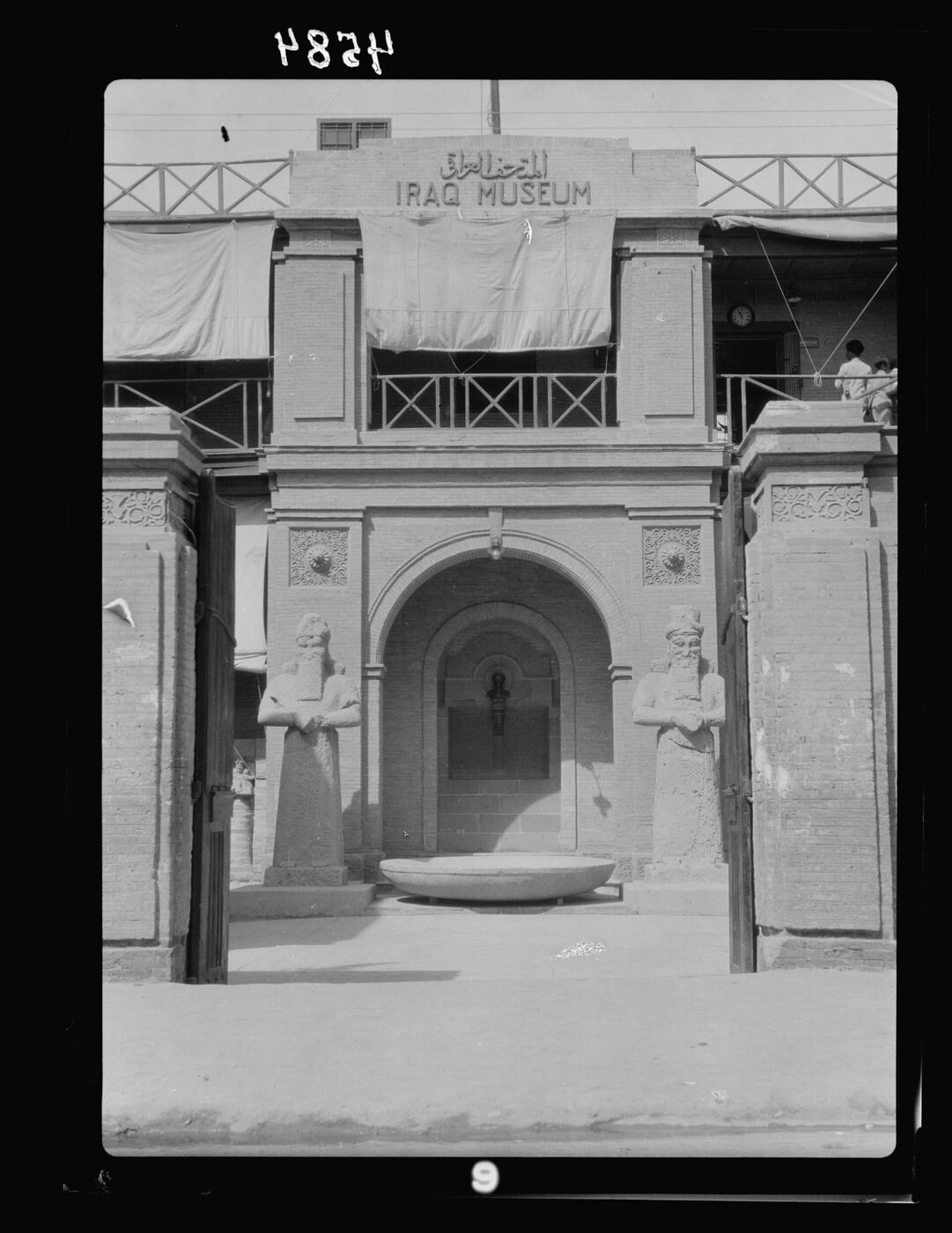
The Iraq Museum in Baghdad was established in 1926, moved in 1966 to a purpose-built two-storey building of 45,000 square metres in the Al-Salihiyyah neighbourhood of the Al-Karkh district, and holds a collection variously estimated at 170,000 to 200,000 objects across twenty-eight galleries and vaults. Because of the British connection with the museum's founding, its exhibits have always been labelled bilingually in Arabic and English.
._Baghdad._Views%2C_street_scenes%2C_and_types._The_Iraq_museum._Front_entrance_LOC_matpc.15998.jpg)
What happened to it between 10 and 12 April 2003 is documented in unusual detail, and the detail matters because the first reporting was badly wrong. An investigation begun on 21 April by a United States Marine colonel concluded that there had been three separate thefts by three distinct groups over four days. Museum staff returned to the building on 12 April; a guard force was not deployed around the museum until 16 April. Forty pieces were taken from the public galleries, mostly the more valuable ones, of which thirteen had been recovered by January 2005; approximately 3,100 excavation-site pieces were taken from the above-ground storerooms, of which about 3,000 were recovered. The thefts were not uniformly discriminating: an entire shelf of fakes was taken while an adjacent shelf of much greater value was left undisturbed.
On the numbers, the correction is the point. For weeks after the event news organisations reported that as many as 170,000 catalogued lots, or 501,000 pieces, had been looted; the figure derived from the confusion of the first days and from empty display cases whose contents the curators had themselves removed before the war. The accurate figure was around 15,000 items, including some 5,000 cylinder seals. That is a smaller catastrophe than the one first reported and a very large one nonetheless, and both halves of that sentence are part of the record.
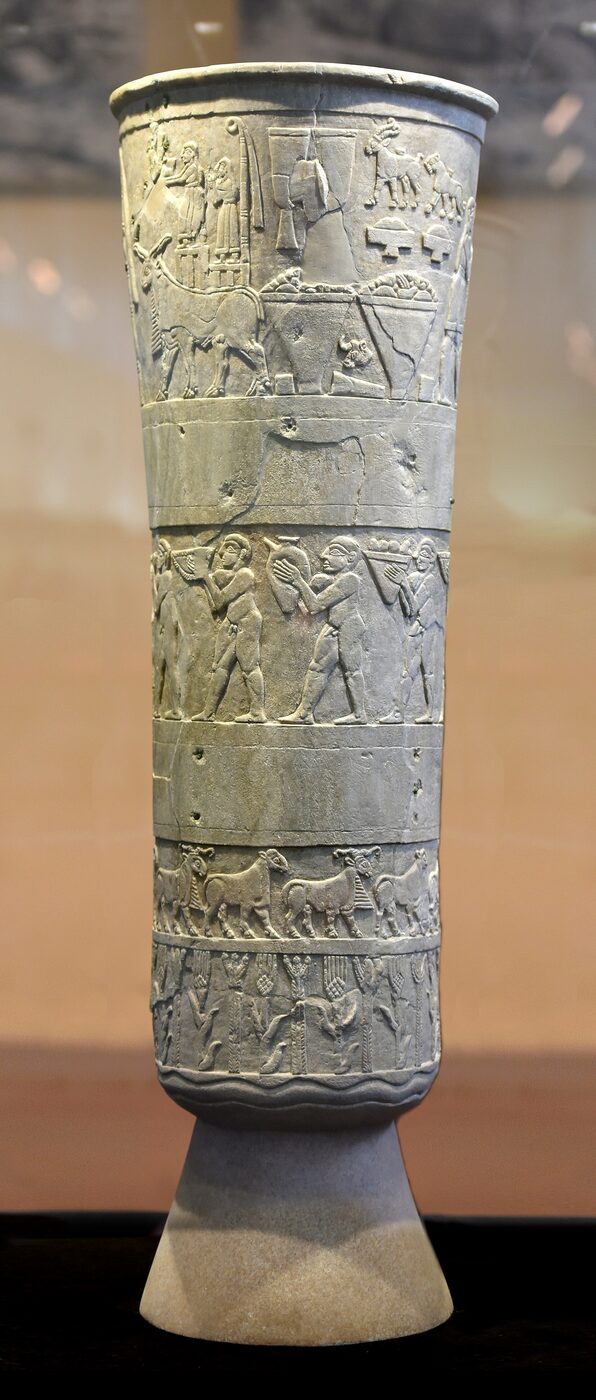
Recovery has been long and partial. On 7 May 2003 nearly 40,000 manuscripts and 700 artefacts were reported recovered; on 7 June the Nimrud gold, never looted at all, was announced to have been preserved in a vault of the Iraqi Central Bank. The Warka Vase, a carved alabaster vessel of about 3000 BC catalogued as IM19606 and one of the earliest surviving works of narrative relief sculpture, was returned under an amnesty on 12 June 2003 in fourteen pieces — the number in which it had originally been excavated — and has since been restored and put back on display. At an opening in February 2009 the antiquities minister said that 6,000 of the 15,000 looted items had been returned; in 2012, when Germany returned forty-five relics, the museum's director general put the number still missing at up to 10,000. In August 2021 the United States returned 17,000 artefacts, most of them from a single private collection. The museum was officially reopened on 28 February 2015, and now also holds material taken from the Mosul Museum.
.jpg)
The sites, and what left them
The museum thefts were, in quantity, the smaller loss. Iraq's archaeological sites number in the thousands and cover the country; perhaps 25,000 of an estimated half a million were registered at the time of the invasion, and most were unguarded. A satellite-imagery study covering 9,729 square kilometres of southern Iraq located 1,838 recorded sites and found that looters concentrated on the ones yielding the most marketable objects. Estimates of the number of artefacts looted from sites between 2003 and 2005 run from 400,000 to 600,000 items, which is thirty to forty times the number taken from the museum.
The named sites recur across the reporting. Umma was descended on as soon as the bombing began and is now pockmarked with hundreds of ditches and pits; at Isin more than two hundred looters' pits are arranged around the former temple of Gula, yielding cuneiform tablets, cylinder seals and votive tablets, some of which have been priced in the tens of thousands of dollars; the great ziggurat at Nippur was cut by three major looters' pits, the first in more than forty years of excavation there. Umm al-Hafriyat, Umm al-Aqarib, Bismaya, Larsa, Bad-tibira and Adab appear on the same lists. Ur and Nippur were placed under coalition protection and Hatra was guarded by a local tribe; at Babylon a camp of 150 hectares was built for 2,000 troops, in the course of which the brick pavement leading to the Ishtar Gate was smashed by tracked vehicles and archaeologically rich subsoil was bulldozed to fill sandbags.
Nor did the traffic begin in 2003. At least 4,001 artefacts are recorded as looted from Iraqi sites in the aftermath of the war of 1991, and nine of the country's thirteen regional museums were looted and burned during the uprisings of that spring. Iraq had been unusually exposed for a long time: the absolute ban on the export of antiquities lapsed after independence, and until the mid-1970s Iraq was one of very few countries that did not prohibit the antiquities trade at all.
The outflow was tracked, in fragments. By the end of 2003, 1,900 Iraqi antiquities had been confiscated in neighbouring states: 1,450 in Jordan, 38 in Kuwait, 36 in Syria and 18 in Saudi Arabia. Britain alone seized three to four tonnes of plundered material between 2004 and 2006. The Archaeological Institute of America has estimated the annual revenue from looted Iraqi antiquities at between ten and twenty million dollars.
The destruction of 2014 to 2017, dated
What followed after 2014 was not looting for sale, or not only that. It was recorded, and much of it was recorded by its authors, which is why it can be dated to the day.
- December 2014 — parts of the citadel at Tal Afar are blown up.
- January 2015 — large parts of the ancient wall of Nineveh in the al-Tahrir neighbourhood of Mosul are destroyed; further sections, including the Mashka and Adad gates, follow in April 2016. The face of the winged bull at the Nergal Gate is defaced in 2015.
- 26 February 2015 — a video is released showing the destruction of antiquities in the Mosul Museum.
- 7 March 2015 — Kurdish sources report the bulldozing of Hatra, a fortified Parthian-era city inscribed by UNESCO for the way Hellenistic and Roman architecture blends there with eastern decoration. It was recaptured on 26 April 2017; most of its temples were found relatively unharmed, their interior inscriptions and sculpture smashed and looted.
- April 2015 — a video is released showing the destruction of Nimrud. By the time the site was retaken, ninety per cent of its excavated zone, including the Assyrian royal palace, the ziggurat and its lamassu figures, had been destroyed. A rescue project funded by the Smithsonian Institution has since worked two seasons on site, training Iraqi archaeologists and documenting and collecting what remains.
- Between June 2014 and February 2015 — at least 28 historic religious buildings are plundered or destroyed in Mosul alone.
- The libraries — the Central Library of Mosul was rigged with explosives and burned; the university library, the Mosul Museum library, a Sunni Muslim library and a 265-year-old Dominican monastery library were burned or stripped. The losses included Iraqi newspapers from the early twentieth century, Ottoman maps and books, and collections given by about a hundred of the city's families.
- 21 June 2017 — the Great Mosque of al-Nuri, built in the late twelfth century and the building from which the caliphate had been proclaimed three years earlier, was blown up along with its leaning minaret. Its reconstruction, funded by the United Arab Emirates at 50.4 million dollars in partnership with UNESCO, Iraq's culture ministry and ICCROM, laid its foundation stone on 17 December 2018, and the rebuilt mosque has since reopened.
On 12 February 2015 the Security Council unanimously adopted Resolution 2199, a set of legally binding measures against the financing of terrorism which also condemned the destruction of cultural heritage in Iraq and Syria; UNESCO subsequently characterised destructions in Mosul as violations of it.
Music, and the maqam
Between the crises there is a repertoire, and the charter names it: art and music in one column, literature and native dishes beside them. The Iraqi form that has the strongest documentary standing is the Iraqi maqam, whose roots are traced to the Abbasid caliphate of the eighth to thirteenth centuries, when the empire was governed from Baghdad.
Its performing ensemble is called the chalghi al-Baghdadi and is built around a qari, the singer, with the santur, the joza, a goblet drum and a cello, and sometimes the oud and the naqqarat. A complete concert is a fasl, named after the maqam it opens with: Bayat, Hijaz, Rast, Nawa or Husayni. The focus is on the poem rather than the instruments, sung in classical Arabic or in the Iraqi dialect, in which case it is called zuhayri; the texts are frequently drawn from classical Arabic poetry, al-Mutanabbi and Abu Nuwas among the poets most often set. Because of who lives in Iraq, the same repertoire is performed with Arabic, Persian, Turkish, Armenian, Hebrew, Turkmen and Aramaic lyrics, each community using it in its own language.
UNESCO inscribed the Iraqi maqam on its Representative List of the Intangible Cultural Heritage of Humanity in 2008, at the third session of the intergovernmental committee, as element number 00076. That is thirteen years after the newsgroup was created and well after its busiest years, which is worth saying because it is a reminder of the order of events: the tradition was being argued about in public online long before the international machinery got round to registering it.
The dialect, and the languages in the room
Language is one of the sixteen subjects in the charter, glossed there as local dialect, and the gloss is doing work. Mesopotamian Arabic, also called Iraqi Arabic, divides into two groups whose names are themselves the illustration: gelet and qeltu, the two ways of saying I said. Gelet is a Bedouin-derived variety spoken by Muslims, settled and unsettled alike, in central and lower Mesopotamia and by nomads in the rest of the country; qeltu is an urban variety spoken by non-Muslims in that same region, Baghdad included, and by the settled population of upper Mesopotamia whatever their community. Baghdadi Arabic belongs to the gelet group, and the sound change that names it is the pronunciation of the standard letter qaf as a hard g. Recent speaker estimates put the gelet varieties at about twenty million and the qeltu varieties at about eleven million, some thirty-two million in total, distributed across Iraq and into Syria, south-eastern Turkey, Iran and Kuwait.
A dialect map of that kind is also a map of communities, which is why a thread about one word can become a thread about who lived where, and since when. Both groups carry a heavy Eastern Aramaic substrate, and through it influence from Sumerian and Akkadian, with later layers from New Persian, Turkic including Ottoman Turkish, Mongolic and Greek. Judeo-Iraqi Arabic is classed as a third variety and is now spoken almost entirely outside Iraq. Cooking works the same way as vocabulary, and for the same reason.
Arabic is not the only language the room had to accommodate. Central Kurdish, or Sorani, is one of the two official languages of Iraq alongside Arabic. Iraqi Turkmens are the third largest ethnic group in the country, with their traditional homeland in the Kirkuk and Nineveh provinces. Syriac remains a liturgical and community language of the Assyrian, Chaldean and Syriac Christians, whose script has its own account on soc.culture.assyrian. A single unmoderated group named for the country was, in principle, the meeting place for all of them, which is a considerable demand to make of a plain-text medium.
The written record, and what happened to it
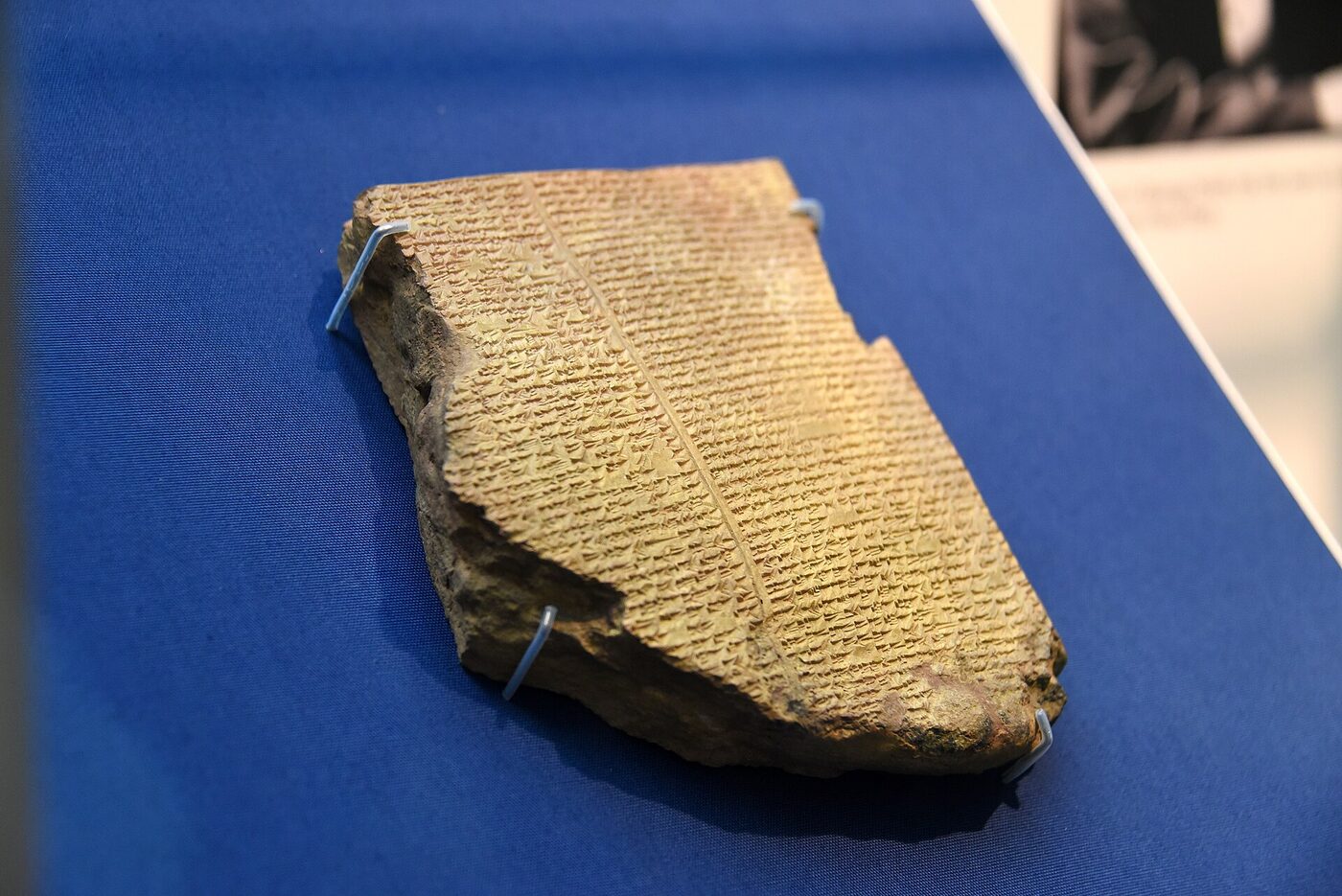
The literature runs from the earliest surviving corpus in the world to the present, and Iraq is one of the few places where that is a plain statement rather than a boast. Sumerian literature constitutes the earliest known corpus of recorded literature, preserved and extended in Akkadian; the Epic of Gilgamesh is conventionally described as the earliest surviving notable work of literature. Its most famous single tablet, the flood tablet from the library at Nineveh, has been in the British Museum since the nineteenth century, which is itself a fact about how Mesopotamian material has travelled.

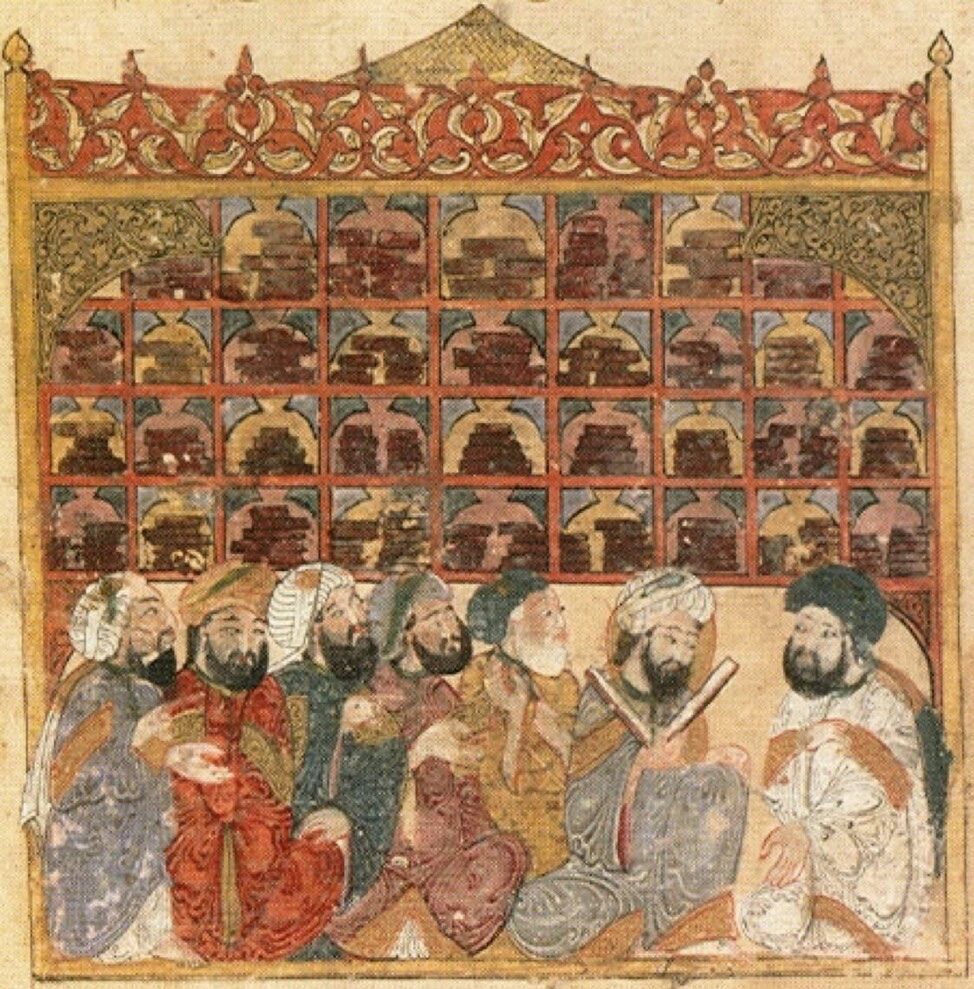
Under the Abbasids, Baghdad held the House of Wisdom, a public academy and intellectual centre, and the literary culture of the period produced, in Basra, al-Hariri, whose Maqamat became one of the most copied and most illustrated books in Arabic. Most of that output survives in manuscript rather than in print: a survey published in 2014 estimated that Iraq holds approximately 100,000 Arabic and Islamic manuscripts, roughly half of them in the Iraqi Manuscripts House in Baghdad and the remainder dispersed among public, private and religious libraries around the country.

The twentieth century added the modern canon. Iraqi poets were among the first in Arabic to write free verse, in the movement that reshaped the poetry of the language in the late 1940s, and the country's prose and drama developed alongside it. The state then took an interest in both directions at once. In the late 1970s prominent writers were provided with an apartment and a car and guaranteed at least one publication a year, in exchange for literature that supported the ruling party; publishing was centralised under the state culture ministry, and the volume was large, with 5,279 books published between 1975 and 1979, 7,309 between 1985 and 1989 and 1,875 in 1990 alone. The other direction is recorded in human rights documentation, which counts more than 500 journalists, writers, poets and intellectuals executed or killed between 1968 and 2003, and hundreds more driven into exile. An exile literature developed from the late 1980s onwards out of exactly that.
One archive of the period surfaced by accident. In May 2003 a collection of 2,700 books and tens of thousands of documents belonging to Iraq's Jewish community was found in the flooded basement of the intelligence service's headquarters in Baghdad; it was removed for conservation to the United States, and its eventual disposition has been argued about ever since. It is a fair emblem for this section: the record exists, it is not where it was made, and what should happen to it is not this page's to say.
Arabic in a seven-bit medium: Iraq's own case
Usenet was specified to carry text that a computer of the early 1980s could handle without argument, which means the ASCII range of 0 to 127, and Arabic is not in it. The general story of how Arabic script was got through that gap, from the early seven-bit standards through ISO/IEC 8859-6 and Windows-1256 to Unicode, is the umbrella group's subject and is told at soc.culture.arabic. So is the improvised Latin-and-digits convention now catalogued as Arabizi, in which numerals stand for the sounds with no Latin equivalent: 3 for ayn, 7 for haa, 2 for hamza. What follows is only the part that is Iraq's own.
Start with the paperwork, because this group declared its position in advance. The languages line of the January 1995 RFD reads English and transliterated Arabic: not Arabic, transliterated Arabic, written in the Latin alphabet. That is a founding document conceding, before the group existed, that the script of the country it was named for could not be relied on to survive the wire.
Iraq's particular difficulty is that its own pronunciation pulls transliteration away from the standard spelling. In the gelet varieties, Baghdadi among them, the standard qaf is a hard g; a writer transliterating from speech therefore produces a g where a writer transliterating from Modern Standard Arabic produces a q, and neither is wrong. The same divergence runs through place names, where the transliteration in general use is often the one that reached English through Ottoman Turkish or through British administration rather than through the local pronunciation. Basra, Kerbala, Karbala, Najaf, Mosul, al-Mawsil, Tikrit and Anbar all appear in the record in more than one form, the definite article sometimes attached, sometimes hyphenated and sometimes dropped altogether.
Then there are the other scripts. Kurdish in Iraq is normally written in the Kurdo-Arabic alphabet, while the Latin Hawar alphabet introduced in 1932 is the standard in Syria and Turkey and is also used to some extent in Iraqi Kurdistan; a Kurdish word posted to the group could therefore arrive in either of two orthographies, or in a third improvised for the keyboard to hand. Syriac has hands of its own and its own encoding history. A single plain-text room addressed to a country with two official languages and several liturgical ones had no mechanism for any of it beyond the goodwill of the sender and the luck of the reader's software.
The consequence for anyone searching the archive today is direct and unglamorous. A place, a family name, a dish or a maqam may sit in the record under half a dozen spellings, none canonical and none retrieving the others; a query in Modern Standard spelling will miss the dialect transliteration and vice versa; and Arabic that was posted as eight-bit text may sit there as byte sequences that no query in any script will match. Searching the group's archive rewards several spellings and reading around a thread rather than trusting a single query, which is a tedious method and the only one that works.
What the record does not show
The creation file for soc.culture.iraq is unusually complete. What the group then did with the address is undocumented here, and that absence is worth stating plainly rather than passing over.
Nothing quantitative about the group's life has been established: not its readership, not its subscriber numbers, not how many articles it carried in any year. No thread title, poster, quotation or exchange appears on this page, because none has been verified for it. The questions a reader would most want answered are exactly the ones that cannot be — whether the room was busy or quiet in a given year, which arguments recurred, whether anyone maintained a Frequently Asked Questions posting, whether the politics crowded out everything else. Answering any of them would mean inventing them. After the result of 1 May 1995 the administrative archive holds control messages and nothing else.
Several plausible things are also unestablished. The charter's sixteen topics are what the founders proposed to discuss, not a record of what was discussed; a charter is a prospectus. The crosspost lists on the RFD and the two Calls for Votes show which rooms the proponents considered adjacent, not where the group's traffic later went. The 458 ballots of April 1995 are the only quantitative evidence this page offers about who was reachable, and 458 ballots are not a readership; they are 458 addresses that worked in one month of one year.
It is also worth saying what the absence of Iraqi addresses on that roll does and does not prove. It shows that the electorate which created the group contained nobody voting from an Iraqi or neighbouring Arab-state address in April 1995, which is exactly what the connectivity figures would predict. It does not prove that no Iraqi inside Iraq ever read or posted to the group, which would be a much stronger claim and is not made here; from 1999 onwards a route existed, and what went down it is not recorded anywhere this page could find.
Three things can be said with confidence. The group existed as a real, propagated Big Eight newsgroup, created by an authorised control message on 8 May 1995 and carried by news servers worldwide. It is still there: the current master newsgroups and active files distributed from the Internet Systems Consortium carry soc.culture.iraq, unmoderated, with its original one-line description unchanged, and the removal attempt of November 2001 came to nothing. And the news2mail gateway whose roster produced this directory listed it among the groups it delivered by e-mail between 2000 and 2004, which is a small fact with a large implication: for some readers this group arrived as post, not as news.
Scope and limits
This article draws on two kinds of record and it is worth saying which claim rests on which. Everything about the group itself — the Request for Discussion of 30 January 1995, the two Calls for Votes, the result of 1 May, the published ballot roll, the charter and the newsgroups line quoted verbatim, the creation message of 8 May and its reissues, the removal attempt of November 2001, and the group's present status — comes from the archives of news.announce.newgroups, of Usenet control messages, and of the master newsgroups and active files, all kept on the Internet Systems Consortium's Usenet file server. Quotations from those documents are exact or absent; the counts drawn from the ballot roll are counts of e-mail addresses in a document from April 1995, not counts of people.
Everything about the country comes from standard reference accounts and is stated with their attributions attached. Where those accounts disagree, the disagreement is shown rather than settled: that applies to the excess mortality of the sanctions period, where the published estimates differ by an order of magnitude and one widely quoted figure was qualified by its own authors; to the casualties after 2003, where population-based studies and body counts are measuring different quantities by different methods and are reported here separately; to the size of the diaspora, where the range runs from 1.2 million to five million; to the characterisation of the Anfal campaign, where a human rights report and a court ruling reached different conclusions on the same documents; and to the number of objects taken from Iraqi sites, where the published range is 400,000 to 600,000 and the honest answer is that nobody knows.
Four limits are worth marking explicitly. First, no living person is named anywhere on this page. The proposer of the group, the votetaker, the moderator who issued the creation message, the officer who investigated the museum thefts, the researchers behind the mortality studies and the officials quoted in the reference accounts are all identified by role or by the institution or journal that published them, and readers who want the names will find them in the sources named. Second, the political questions described here are live and contested, and describing an argument is not the same as taking part in it: the sanctions, the wars, the occupation, the sectarian violence and the destruction of antiquities are documented above as the record and the named bodies state them, no verdict is offered on any of them and none should be inferred. Third, this page does not tell its neighbours' stories: 1990 and 1991 as Kuwait experienced them belong to soc.culture.kuwait, the Assyrian, Chaldean and Syriac account belongs to soc.culture.assyrian, and the Arabic language and its script belong to soc.culture.arabic. Fourth, several figures quoted above are themselves estimates carried in reference works rather than primary measurements, and are labelled as estimates wherever that is the case.
How the branch worked — how a name was proposed, argued and voted into being — is set out on the soc.culture.* index. Like the rest of the branch, the group thinned through the 2000s, its traffic going first to web forums and then to social platforms, and the archive it left behind is a stratum rather than a going concern. What remains is a room whose founding documents survive in full and whose conversation does not: an address opened in 1995 for a country that was, at that moment, almost entirely unable to reach it, kept open by people who had left, while nobody knew how any of it would turn out.
Reading soc.culture.iraq today
- Historical archive: Google Groups — soc.culture.iraq (coverage varies by group and era).
- Open in a newsreader:
news:soc.culture.iraq— the original site offered exactly this link, and it still works if your system has a newsreader registered for thenews:scheme. - Live access: point an NNTP newsreader at a modern server — see accessing Usenet today.
- The original news2mail e-mail subscription service ended in the mid-2000s and no longer operates.