soc.culture.jordan
The Hashemite Kingdom of Jordan.
A smaller Levantine group covering Jordanian society: tribal and urban identities, the Palestinian-Jordanian weave, Petra and Wadi Rum for the travellers, and careful political discussion from an era when careful was the operative word.
University students abroad supplied most of the traffic, giving the archive a distinct generational voice.
On this page
- The group's own paperwork, complete
- The charter, verbatim
- The rationale, and the week it was written in
- What the ballot roll shows about who was reading
- Who could post: Jordan's own network record
- The kingdom, as a dated record: to 1967
- 1970 to 1999: the record the group was created to discuss
- Who was in the room: a demography made of arrivals
- Bedouin, Circassian, Chechen, Christian
- Language (Local dialect)
- Food, hospitality and the rest of the repertoire
- Archiology: Petra, the antiquities and the tourism economy
- Education and the universities
- How much traffic there was, and how we can tell
- The region around it
- A forged rmgroup, and how carriage actually worked
- What the record does not show
- Scope, sources and limits
The group's own paperwork, complete
Most of the smaller groups in this directory have to be described from the outside, because nothing they generated about themselves survives. soc.culture.jordan is an exception, and an unusually clean one. The archive of news.announce.newgroups mirrored on the Internet Systems Consortium's Usenet file server holds the group's entire creation sequence, and the matching archive of Usenet control messages holds the message that actually brought the group into existence. Between them they supply dates, names, a charter, a rationale, a tally, and — because of how Usenet counted votes — a complete list of everyone who voted and where they were writing from.
The proposal came from Loai Said, writing from a netcom.com address and giving his organisation as JordanNet. His Request for Discussion was approved into news.announce.newgroups by that group's moderator, David C. Lawrence, and appeared on 2 November 1994. It named the group, declared it unmoderated and world-distribution, and summarised the subject as discussion and debate on issues of interest to Jordanians and others interested in Jordanian culture, politics, education, recipes and tourism. Discussion was to run in news.groups from 1 to 22 November 1994. The vote that followed was taken by Ron Dippold at qualcomm.com under the banner of the Usenet Volunteer Votetakers, the standing pool of neutrals who ran most Big-Eight ballots of the period.
The sequence, as the archive records it:
- 2 November 1994 — Request for Discussion posted to news.announce.newgroups and news.groups, with followups directed to news.groups.
- 1 December 1994 — first Call for Votes, ballots to be sent by e-mail to a voting alias at qualcomm.com.
- 14 December 1994 — second and last Call for Votes, carrying a Supersedes header for the first.
- 22 December 1994, 23:59:59 UTC — the deadline for ballots.
- 5 January 1995 — RESULT posted: soc.culture.jordan passes 164:21.
- 11 January 1995 — newgroup control message issued by David C. Lawrence, reissued on 18 January and again on 11 February.
The arithmetic is worth setting out because the Big-Eight rules of the day had two conditions and both had to be met. There were 164 votes to create and 21 against, 185 valid ballots in all. Creation required that yes votes be at least two-thirds of all valid votes, and that there be at least 100 more yes votes than no votes. The proposal cleared the first condition at a little under eighty-nine per cent and the second by a margin of 143. The RESULT reports the two numbers first, states both rules in its own words immediately afterwards, and then notes the five-day discussion period during which irregularities could be alleged. No allegation appears anywhere in the surviving record, and the newgroup message followed six days later.
That five-day pause, and the fact that a successful vote created nothing by itself, are branch-wide mechanics described at soc.culture.* and not repeated here. The branch itself is older than the group by some years: the soc.* hierarchy in its modern form dates from the Great Renaming of 1987, which sorted Usenet into the top-level branches it kept ever after and gave every country, in principle, a claim to a room of its own. The roster filled in gradually, one ballot at a time, and soc.culture.jordan arrived near the end of that slow completion of the Arab world's row. What matters for this page is that it is one of the minority of groups in this directory whose entire origin can be read rather than inferred.
The charter, verbatim
The same charter text appears in the Request for Discussion, in both Calls for Votes, and — copied across by the moderator with the note that it was culled from the call for votes — in the newgroup control message itself. It reads:
soc.culture.jordan is intended to be an unmoderated discussion newsgroup to exchange ideas, and opinions regarding The Hashemite Kingdom of Jordan, her people, her politics, and her culture. The group will welcome all people, and accept all opinions. Topics of discussion will include but are not limited to:
Politics · Culture · Music · Language (Local dialect) · Food · Tourism · Archiology · Education · Art · Books · Human Rights · Social values · History · Networking · Research · Water resources
The discussions will be in English.
The topic list is laid out in the original as two columns of eight, and the spelling of Archiology is the proposer's; it is reproduced here because a charter is a document and not a draft. Beyond the spelling, the list repays reading. It is not the generic culture-group menu. Water resources appears in a sixteen-item list of what a national newsgroup is for, which for a country of Jordan's hydrology is a statement of priorities rather than a curiosity. Networking appears in a proposal written in 1994 by a man whose own organisation was called JordanNet. Human Rights and Politics sit in the same list as Food and Music, and the sentence immediately above them — that the group will welcome all people and accept all opinions — is the only moderation policy an unmoderated group could have.
The last line is the one that settled a question much of the rest of the branch spent years arguing about. The discussions will be in English. Written into the charter, put to the vote and carried, it removed at a stroke the script and encoding problem that dominated several neighbouring groups. Those arguments — how to get Arabic through a transport designed for seven-bit US-ASCII, and which of the competing Latin transliterations to use — belong to soc.culture.arabic and soc.culture.iraq, which own that subject in this directory.
Separately from the charter, each Call for Votes and the RESULT carry the one-line description that news administrators were asked to paste into their servers' newsgroups files:
soc.culture.jordan All topics concerning The Hashemite Kingdom of Jordan.
That line is still there. The newsgroups file distributed from the ISC's configuration directory today carries it unchanged, word for word, more than three decades after it first appeared in the call for votes of 1 December 1994. Its neighbours in the same file are of the same vintage and the same terseness: soc.culture.iraq is described as Iraq, its society, culture and heritage, soc.culture.palestine as Palestinian people, culture and politics, soc.culture.lebanon as Discussion about things Lebanese, soc.culture.syria as Syrian cultural matters and affairs, soc.culture.israel as Israel and Israelis, and soc.culture.arabic — which came earlier and had learned something — as Technological & cultural issues, *not* politics.
The rationale, and the week it was written in
The Request for Discussion carries a section headed RATIONALE, and it is the most informative page in the file, because it explains what the proposer thought was missing. Neighbouring countries, it observes, already had their groups — it names soc.culture.turkish, soc.culture.israel, soc.culture.arabic, soc.culture.lebanon and alt.culture.kuwait — but none of them was the place to discuss local issues usually of concern to Jordanians alone. It then gives two reasons for expecting the group to work: the number of Jordanians on the net, and the number of non-Jordanians interested in the peace process and in developments in the country.
Buried in the same paragraph is the group's prehistory. A mailing list had existed for some time, the RFD says, but many members had had to unsubscribe because of the volume filling their mailboxes. The first Call for Votes names it obliquely by announcing that after the CFV appeared on news.announce.newgroups it would be forwarded to a JordanNews-L owner address at netcom.com. So the group was not a new community. It was an existing mailing list migrating to news because mail could not carry its traffic — the reverse of the arrangement in soc.genealogy.*, where groups were deliberately gatewayed to mailing lists so that researchers on thin e-mail-only links could take part.
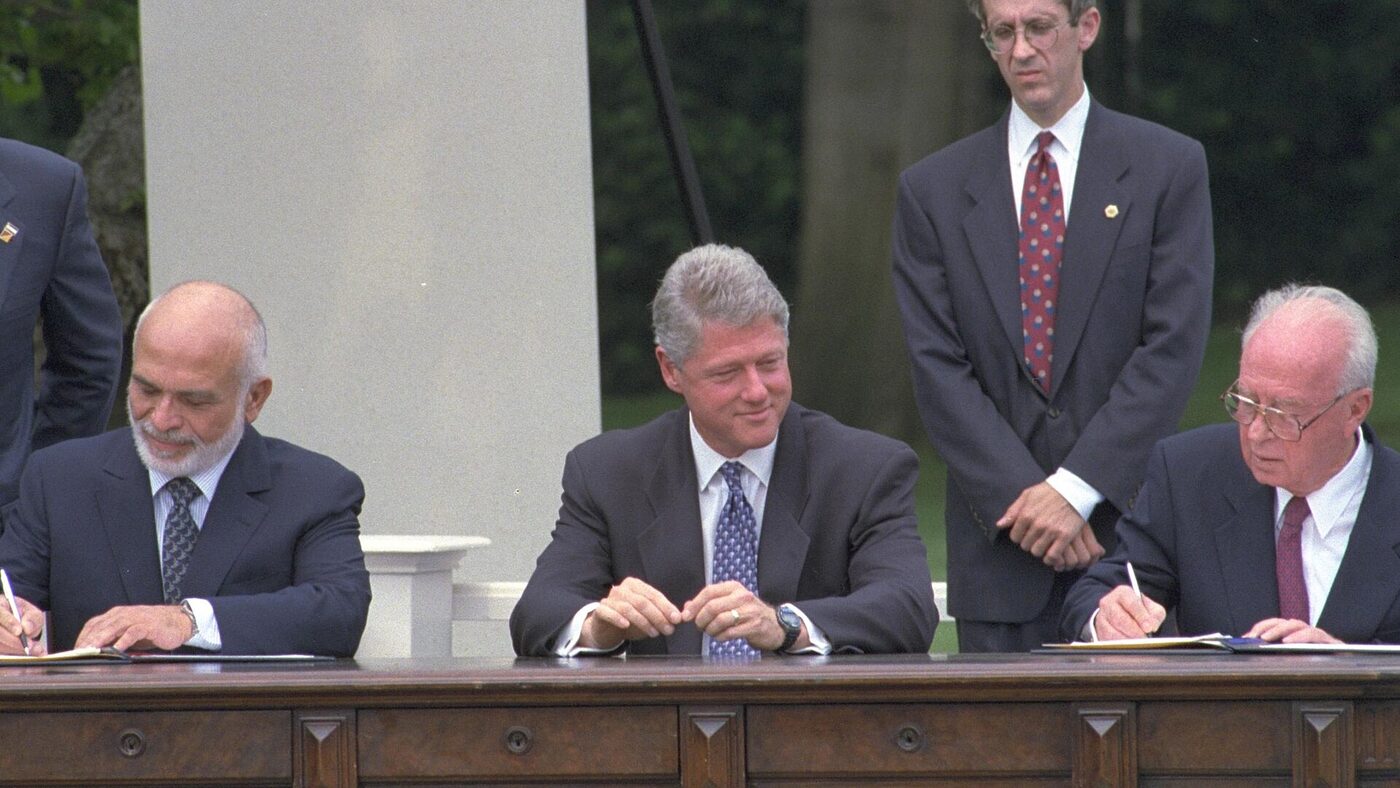
The timing is a matter of record and can be stated without inferring anything about motive. The Israel–Jordan peace treaty was signed at the Arabah crossing on 26 October 1994. The Request for Discussion for soc.culture.jordan was posted on 2 November 1994, seven days later, and it mentions the peace process by name in its rationale. The group was proposed in a fortnight when Jordan was more discussed abroad than it had been in years, and its founding document says as much.
The crossposting is equally informative about the neighbourhood the proposal understood itself to be joining. The RFD as archived carries a Newsgroups line naming news.announce.newgroups, news.groups, talk.politics.mideast, soc.culture.israel, soc.culture.arabic and soc.culture.lebanon; its own list of where it said it would be posted adds alt.culture.kuwait, which the header does not. By the time of the first Call for Votes five weeks later the distribution had changed: talk.politics.mideast was dropped, and soc.culture.palestine and soc.culture.kuwait were added — the latter created only on 9 November 1994, three weeks earlier, and still so new that the receiving server filed the Call for Votes as its article number 287. A proposal for a quiet national room was thus announced simultaneously in five other national rooms, which is precisely the mechanism, and the structural weakness, that soc.culture.kuwait.moderated exists on this site to describe.
_-_PM_YITZHAK_RABIN_AND_JORDAN'S_KING_HUSSEIN_SIGN_THE_PEACE_TREATY.jpg)
What the ballot roll shows about who was reading
Usenet's vote-taking convention required the votetaker to publish the full roll — every voter's e-mail address and, where the ballot supplied one, their name — so that anyone could check the count. The second Call for Votes says so in terms: addresses and votes of all voters will be published in the final voting results list. It was a transparency measure with an unintended archival consequence: thirty years later the roll is still the single best evidence anyone has about who was reading a group of this kind, and for soc.culture.jordan it survives complete.
Of the 164 addresses that voted to create the group, 84 ended in .edu. Counting also the university addresses that do not — McGill, Waterloo, Alberta, Saskatchewan, Guelph, Western Ontario, Ryerson and York in Canada; Monash, La Trobe, Queensland University of Technology, the University of Technology Sydney and Melbourne in Australia; Oxford and Surrey in the United Kingdom; Delft and the Vrije Universiteit in the Netherlands; Bilkent in Turkey; the Université catholique de Louvain in Belgium; Nancy and Eurecom in France; Ben-Gurion in Israel; the Fachhochschule at Mannheim in Germany and Charles University in Prague — the academic share comes to 113 of 164, or a shade under seven in ten. Iowa State University alone supplied a dozen addresses. Seventeen top-level domains are represented on the yes side.
The remainder is a fair cross-section of what non-academic Internet access looked like in December 1994: eight addresses at netcom.com, two CompuServe numeric accounts, two at AOL, and a scattering of the early public-access systems — panix, portal, blkbox, grex, m-net, phantom, io. There are corporate addresses at Hewlett-Packard, Cisco, Adobe, Apple, Ericsson and Tektronix, a freenet in Edmonton, and one address at a United States Army installation. The twenty-one no votes came from a narrower population: fourteen commercial and seven academic addresses, no other top-level domain appearing at all, and the academic seven all at universities and research centres in the United States and Canada. The roll records votes and nothing else; no ballot carries a reason, and none is offered here.
The most telling entry in the roll is the one that is absent. Not a single ballot, on either side, came from an address in the .jo domain. The reason is in the next section, and it is not a subtle one.
Who could post: Jordan's own network record
The country-code top-level domain .jo entered the root zone on 23 November 1994. It is administered today by Jordan's Ministry of Digital Economy and Entrepreneurship, whose address on the IANA delegation record is at the Eighth Circle in Bayader Wadi Al-Seer, Amman — a district named, as it happens, for one of the Circassian villages described further down this page. The date is worth holding next to the group's paperwork: the discussion period for the Request for Discussion closed on 22 November 1994, the domain was delegated the following day, and the first Call for Votes went out on 1 December. Jordan's newsgroup and Jordan's top-level domain were created within about seven weeks of each other, and the group's ballot closed while the domain was still, for practical purposes, an entry in a table.
A delegation is not connectivity, and connectivity is not access. Jordan's population at the 1994 census was about 4,139,500. Consumer Internet service inside the kingdom followed over the second half of the 1990s rather than preceding the group, and the shape of the later curve indicates how thin the early years must have been: the Telecommunications Regulatory Commission put Internet penetration at 29 per cent at the end of 2009, 38 per cent at the end of 2010 and 50.5 per cent at the end of 2011, reaching 63 per cent in 2013 and 76 per cent by 2015. Comparable official figures for the 1990s are not readily available, which is itself part of the answer. When the country did come online it did so substantially through shared access rather than household lines; Irbid, the university city in the north, has been recorded in the Guinness Book of World Records for having the highest number of Internet cafés per head of population in the world.
What existed instead, and in quantity, was a population abroad. Jordan's higher-education system has been an export as much as a domestic service: the country has ten public universities, nineteen private universities and fifty-four community colleges, and in 2016 more than 200,000 students were enrolled each year with a further 20,000 Jordanians pursuing higher education abroad, chiefly in the United States and Europe. The same channel was open a generation earlier, and the ballot roll of December 1994 is what it looked like from the inside.
The labour channel ran alongside it. Jordan exported skilled workers to the Gulf states throughout the 1970s and 1980s; remittance flows grew rapidly in that period and remain a major source of external funding, reaching $3.8 billion in 2015 and making Jordan the fourth-largest recipient in the region. A country with a large, well-educated and highly mobile population outside its borders is exactly the country whose newsgroup gets written from outside its borders, and the arithmetic of the ballot roll is not a mystery requiring explanation so much as a demographic fact showing up in a text file.
For those readers there was also a practical vacuum to fill. The domestic media of the day were substantial but local: some twenty television broadcast stations by 1995 with ninety-six repeaters, more than 1.6 million radio receivers by 1997 and 560,000 television sets by 2000, six daily newspapers, fourteen weeklies and a few hundred other periodicals. None of it reached a reader in Ames or Adelaide, and for most of the group's life there was no Jordanian newspaper website to consult either. A newsgroup in which someone at home might answer a question about home was, for a few years, a genuinely scarce facility.
The kingdom, as a dated record: to 1967
The group's charter put History in its topic list, and the history in question is unusually well dated. What follows is chronology, not interpretation; the events below are contested in their meaning by serious people, and this page takes no position on any of them.
The territory east of the Jordan was Ottoman until the First World War. The Tanzimat land and tax reforms of 1864 brought some prosperity back to agriculture and to abandoned villages, and the accompanying administration, conscription and taxation provoked resistance: the Shoubak revolt of 1905 and the Karak revolt of 1910 were both suppressed. The Hejaz Railway, the only line the Ottoman Empire built and ran entirely itself, was carried the length of Transjordan and reached Medina on 1 September 1908, 1,300 kilometres from Damascus, making the region a stopover for pilgrims. The Great Arab Revolt began in 1916; Faisal entered Damascus in October 1918 and set up an Arab-led administration in the Occupied Enemy Territory Administration East; the short-lived Arab Kingdom of Syria followed, and after its surrender to French troops at Maysalun on 24 July 1920 the French occupied only the northern part of Syria, leaving Transjordan in a period of interregnum. Abdullah, a son of Sharif Hussein of Mecca, arrived a few months later, and under the Transjordan memorandum to the Mandate for Palestine the territory became the Emirate of Transjordan under a Hashemite emir. Abdullah's rule dates from 11 April 1921.
Independence came by treaty and by parliamentary act. The Treaty of London was signed by the British government and the Emir of Transjordan on 22 March 1946 as the mechanism for recognising full independence upon ratification by both parliaments; the League of Nations recognised Transjordan's impending independence on 18 April 1946 at its last meeting; and on 25 May 1946 the Transjordanian parliament ratified the treaty and re-designated the Amir as King, creating the Hashemite Kingdom of Transjordan. 25 May remains Jordan's independence day, although the mandate legally ended on 17 June 1946 when the ratifications were exchanged in Amman. An application to join the United Nations was vetoed by the Soviet Union on the ground that the state was not fully independent of Britain; a further treaty in March 1948 removed the remaining restrictions on sovereignty, and Jordan was finally admitted to the United Nations on 14 December 1955. The constitution under which the kingdom still operates dates from 11 January 1952.
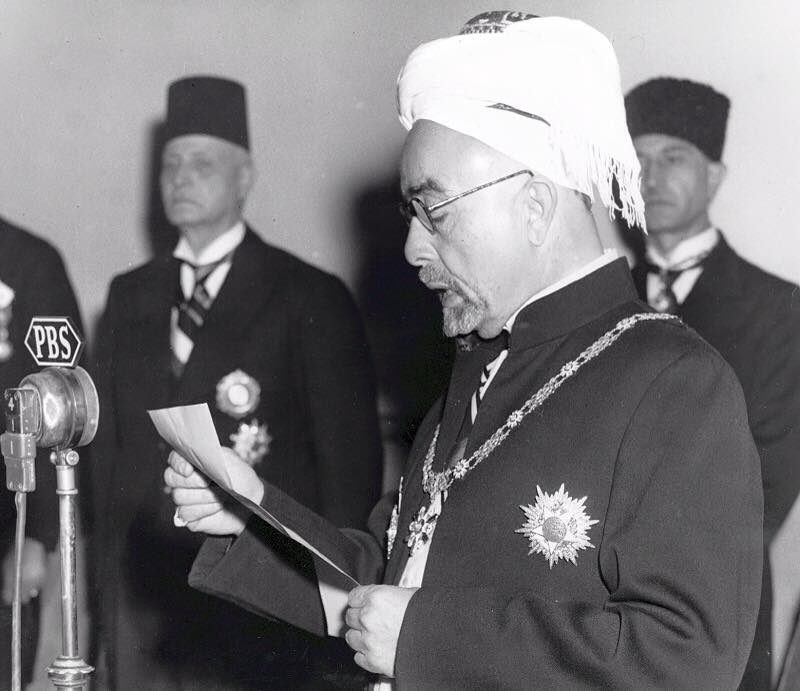

The 1948 war changed the country's size and composition together. Transjordan fought over the territory of former Mandatory Palestine and ended in control of the West Bank, including East Jerusalem. At the Jericho Conference in December 1948 Palestinian notables in the West Bank accepted Jordanian rule; formal annexation followed on 24 April 1950. It was regarded as illegal and void by most of the international community, including the Arab League, which chose to treat Jordan as a temporary trustee pending a settlement; recognition came only from the United Kingdom, Iraq and possibly Pakistan, with the United States recognising the extension of Jordanian sovereignty everywhere except Jerusalem while avoiding public approval. Jordan extended full citizenship to West Bank residents, and the annexation more than tripled the population of the state, from about 400,000 to about 1,300,000. Naturalised Palestinians were allotted half the seats in the Jordanian parliament.
The succession then moved three times in eighteen months. Abdullah I's reign ended with his assassination in Jerusalem on 20 July 1951. His son Talal reigned for a year and was deposed by parliament on 11 August 1952 on medical grounds. Talal's son Hussein, born in Amman on 14 November 1935, succeeded on that date with the government run in his name until he came of age; he was enthroned on 2 May 1953 at the age of seventeen.
On 30 May 1967 Jordan signed a defence pact with Egypt, and in June it took part, with Egypt, Syria and Iraq, in the Six-Day War. Israel took East Jerusalem and the West Bank. The consequence for the kingdom was demographic as well as territorial: the displacement that Arabic calls the Naksa moved somewhere between 280,000 and 325,000 Palestinians out of the West Bank and Gaza, most of them across the river into a country that was already host to the refugee population of 1948.
1970 to 1999: the record the group was created to discuss
The years after 1967 saw a rapid growth in the power of the Palestinian fedayeen organisations operating from Jordanian territory. Matters came to a head with the Dawson's Field hijackings of 6 September 1970, in which the Popular Front for the Liberation of Palestine forced three civilian airliners to land in the desert near Zarqa, held foreign nationals hostage and blew up the aircraft in front of the international press. The main fighting of what is generally called Black September, or the Jordanian Civil War, took place between 16 and 27 September 1970. A Syrian armoured force of some ten thousand troops advanced towards Irbid in support of the fedayeen and withdrew on 22 September after heavy losses. The archive of accounts differs on when the shooting stopped and on whose authority: one standard summary has Arab foreign ministers meeting in Cairo arranging a ceasefire to begin on 23 September, while the detailed narrative dates the settlement to the agreement Hussein and Arafat signed in Cairo on 27 September at an emergency Arab League summit brokered by President Nasser, who died the following day. Sporadic violence continued until the fedayeen were expelled to Lebanon in July 1971. Estimates of the dead differ widely by source; one standard account gives about 3,400 dead on the Palestinian side and 537 in the Jordanian army, and no figure is asserted here as settled.
Jordan recognised the PLO as the sole legitimate representative of the Palestinian people in 1974, severed political links with it and closed its main offices in 1986, and on 11 April 1987 King Hussein and the Israeli foreign minister Shimon Peres signed the London Agreement at a private house in London, a framework for an international peace conference which the Israeli prime minister Yitzhak Shamir then declined to pursue.
The disengagement of 1988 was executed as a series of administrative acts over one month. The Ministry of Occupied Territories Affairs was abolished on 1 July 1988, its responsibilities passing to a Palestinian Affairs Department; the West Bank development plan was terminated on 28 July; a royal decree dissolved the lower house of parliament two days later, removing West Bank representation from it; and the severance of Jordan's administrative and legal ties to the West Bank is dated 31 July 1988, announced by the king in a televised speech the next day. The Jordanian administration of the West Bank, which had begun formally on 24 April 1950, thus ended thirty-eight years later. Hashemite custodianship of the Muslim and Christian holy sites in Jerusalem was retained. The economic consequence was immediate, and the political consequence followed within a year.
On 18 April 1989 protests began in Ma'an in the south after the government cut food subsidies under an IMF-sponsored adjustment and austerity programme, and spread to neighbouring southern towns. Protesters accused the government of corruption and demanded the dismissal of prime minister Zaid Al-Rifai, the lifting of martial law, reform of the electoral law and the removal of restrictions on the press. Six protesters and two policemen were killed; forty-two protesters and forty-seven policemen were injured. Hussein dismissed Al-Rifai, lifted martial law that had been in force since 1957, and restored parliamentary elections. Those elections were held on 8 November 1989, the first in twenty-two years; because political parties had been banned since 1963, all 647 candidates stood as independents, though 22 of the 80 successful candidates were members of the Muslim Brotherhood; turnout was 53.1 per cent. A royal commission was appointed in April 1990 to draft a National Charter, which parliament ratified in 1991. Some thirty political parties, the Islamic Action Front among them, were subsequently formed.
Jordan did not take part militarily in the Gulf War of 1990–91 but broke with the majority Arab position, and the consequences reached households directly. Substantial Saudi aid ceased and United States aid was suspended. In Kuwait, where the Palestinian population before the Iraqi invasion of 2 August 1990 has been put at about 357,000, more than 287,000 people left in a single week in March 1991 after the country was retaken; most went to Jordan, on the reasoning — stated at the time — that most of them held Jordanian passports. Jordanians working elsewhere in the Gulf returned in large numbers to a labour market that had no room for them. The arithmetic of a small economy absorbing that many returning households in a matter of months is the background to everything that followed in the decade the group lived through.
The peace treaty with Israel was preceded by the Washington Declaration, signed on the White House lawn on 25 July 1994, and concluded at the southern border crossing at Arabah on 26 October 1994, the signatories being the Israeli prime minister Yitzhak Rabin and the Jordanian prime minister Abdelsalam Majali. Jordan was the second Arab state, after Egypt, to sign a peace agreement with Israel. The treaty ended a state of war of some forty-six years, established diplomatic relations, settled land and water disputes, provided for cooperation in tourism and trade, and obliged each state to prevent its territory being used to stage attacks by a third party. It was and remains contested by supporters and opponents inside and outside Jordan; the group existed to carry that argument and this page does not adjudicate it.
Austerity returned in 1996. Bread prices rose under a further IMF-led programme, and protests and rioting ran for some weeks in August and September, beginning in Karak and spreading to Ma'an, Zarqa, Amman, Madaba and other towns. Unlike 1989, the government of prime minister Abdul Karim Kabariti offered no concessions and the king stood behind it. By the end of the decade unemployment was near a quarter of the workforce, and the parliamentary elections of 1997 were boycotted by several parties, associations and public figures.
The reign ended in the first weeks of 1999. King Hussein had been admitted to the Mayo Clinic in May 1998 and, after returning there in July with severe fevers, was diagnosed with non-Hodgkin lymphoma. He came home in January 1999 after a six-month medical absence and announced that he was completely cured. On 24 January 1999 he proclaimed his eldest son Abdullah, then thirty-six, as crown prince in place of his brother Hassan, who had held the position since 1965 and who accepted the decision on television and congratulated his nephew. Hussein returned abruptly to the United States the following day with a recurrent fever. A bone marrow transplant on Tuesday 2 February failed, and he was pronounced dead at 11:50 on the morning of 7 February 1999, after forty-six years on the throne. Mourners lined Zahran Street in Amman for the funeral procession on 8 February. For a group whose readership was scattered across five continents, an event of that kind arriving in a single week — news, grief and speculation together, in the same thread — was the nearest thing a newsgroup had to a national occasion.
Who was in the room: a demography made of arrivals
Jordan's population composition is not a footnote to its modern history; it is the central fact of it, and it has been assembled almost entirely out of successive arrivals. The figures below come from the bodies that counted them, and they differ, sometimes very widely, according to who is counted and by what definition. Where they differ, the difference is stated rather than resolved.
The 1948 war and the annexation of the West Bank took the state from roughly 400,000 people to roughly 1,300,000 at a stroke. The 1967 war displaced a further 280,000 to 325,000 people from the West Bank and Gaza. The Kuwait expulsions of March 1991 brought more than a quarter of a million, most of them Jordanian passport holders, in the space of weeks. The 2003 invasion of Iraq produced a wave whose size is genuinely disputed: contemporary accounts spoke of up to a million Iraqis moving to Jordan, most of whom later returned, while the registered figure by 2015 was 130,911. Part of the discrepancy is definitional. The Jordanian government's consistent position was that displaced Iraqis were guests rather than refugees, and they settled in cities rather than camps, which made an accurate count very difficult to obtain. Around 1.4 million people have arrived from Syria since 2011, and smaller numbers from Lebanon in 2006, from Yemen and from Libya.
For the Palestinian population the reference figure is UNRWA's register: 2,175,491 registered Palestine refugees in Jordan, of whom 634,182 have not been granted Jordanian citizenship. There are ten recognised camps; only about a third of registered refugees anywhere live inside camp boundaries, and the two largest in Jordan are Baqa'a, established in 1968 north of Amman and home to some 100,000 registered refugees, and Al-Wehdat or Amman New Camp in the south-east of the capital, with roughly 57,000 on half a square kilometre. Definitions of who counts as Palestinian in Jordan are contested and no official census asks the question, so the total is not a number anyone can state. Jordan is the only Arab state to have extended citizenship on that scale to the 1948 refugees, a consequence of the West Bank having been part of the kingdom between 1950 and 1967.
The 2015 census recorded 9,531,712 residents, of whom about 2.9 million — some thirty per cent — were non-citizens, a figure including refugees and undocumented migrants. For scale against the group's own years: the 1994 census counted about 4.14 million, and the country's population is now around 11.5 million. Amman held about 1.81 million of it at the 2015 count, Zarqa 635,000 and Irbid 503,000.
The internal politics of that composition — the relationship between East Bank and Palestinian-Jordanian identities, and the arguments about representation, citizenship and belonging that run through it — were argued at length on Usenet and are argued still. Palestine as a subject in its own right, including its own dated record, belongs to soc.culture.palestine.
Bedouin, Circassian, Chechen, Christian
The share of the population that is not Arab is small, and the sources do not agree on how small. The standard country summary gives about 95 per cent Arab, about 3 per cent Circassian and Chechen and about 2 per cent Armenian and others; the demographic summary drawn from the CIA's country data gives approximately 98 per cent Arab with the remaining 2 per cent covering Circassians, Chechens, Assyrians, Armenians and Kurds together. Both are on the record and the difference is left standing here. What is not in dispute is that the Caucasian communities have a presence in the country's institutions, and in its capital's own origin story, out of all proportion to their numbers.
Muslim Circassians and Chechens began entering Ottoman territory in large numbers from the 1850s as the Russian Empire expanded into the Caucasus, and were resettled by the Ottoman government along the peripheries of its Levantine provinces, close to water sources and grain fields and positioned to serve as a buffer among restive communities. In 1878 some 50,000 Circassians were shipped from Constantinople, Salonica and Kavalla to the Levantine coast, and about 25,000 of them were sent inland to the Balqa, the Golan and the area around Tiberias; the transports were supervised from Damascus, the new arrivals were housed in schools and mosques until they could be settled, and many died in transit. Three Circassian villages were founded in what is now Jordan between 1878 and 1884: Amman in 1878, Wadi al-Seer in 1880 and Jerash in 1884. Amman had been abandoned since the fourteenth century; the Circassian settlement is what revived it, and modern Amman dates from that arrival, though its first three months cost the settlement all but 150 of its 500 people to disease and exposure. A second wave in 1901–1906, this time including many Chechens, founded five more mixed settlements around the capital: Naour in 1901, Zarqa in 1902, Russeifa and Swaylih in 1905 and Sukhna in 1906. Estimates of the Circassian population of Jordan today run from 100,000 to 170,000.
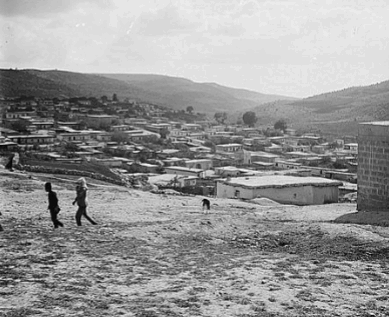

Both communities are recognised in the machinery of the state. Jordan's election law reserves minimum quotas in the House of Representatives: three seats for Circassians and Chechens together, nine for Christians and fifteen for women. The Circassian Guard of the Royal Guard, which attends the monarch, is the most visible of several institutional traces.
Christians in Jordan belong to some of the oldest continuously present Christian communities anywhere. Their number is variously given: about three per cent of the population on the general estimate, a range of roughly 250,000 to 400,000 people, and around 250,000 by a 2014 estimate of the Eastern Orthodox Church which excluded smaller denominations and the Iraqi and Syrian Christians resident in the country. The proportion has fallen a long way over time — it was around a fifth of the population in 1930 — through differential migration and birth rates rather than through any single event, and the absolute numbers have risen.
Bedouin tribes are described in Jordan as a backbone of the kingdom, the phrase reflecting the tribes' traditional support for the monarchy, and most of them migrated from the Arabian peninsula into what is now Jordan between the fourteenth and eighteenth centuries. Most live in the arid expanse extending east from the Desert Highway; the eastern tribes were traditionally camel breeders and herders, the western ones sheep and goat herders, and many are semi-nomadic, moving for part of the year and returning to farm. The larger groupings include the Bani Hasan across Mafraq, Zarqa, Jerash, Ajloun and parts of Amman; the Bani Sakher around Amman and Madaba; and the Howeitat in Wadi Rum. Not all Bedouin are Muslim: the Hijazeen, with roots in the Hejaz, are a Christian Bedouin tribe, and a photograph survives of a Hijazeen Christian family at Karak in 1895. The Ottoman policy of settling Circassians in traditionally Bedouin districts, and of attempting to sedentarise the nomads directly, was a source of considerable discontent at the time — a reminder that the composite character of the country long predates the twentieth century's refugee movements.
Language (Local dialect)
The charter's fourth bullet reads Language (Local dialect), with the parenthesis doing real work: the proposer was not offering to discuss Arabic in general, which soc.culture.arabic already existed for, but the way it is spoken in Jordan.
Jordanian Arabic is a dialect continuum of mutually intelligible varieties rather than a single variety, spoken by upwards of eight and a half million people and understood throughout the Levant. It divides first into sedentary and Bedouin varieties. The sedentary forms, spoken across the belt from Amman north to Irbid, belong to the South Levantine group and are conventionally split again into rural (Fellahi) and urban (Madani) speech; the Bedouin forms divide between Northwest Arabian varieties in the south and Najdi and Shawi varieties in the north. The North Arabian dialects are spoken by tribes including the Sirhan, the Bani Sakher and the Bani Khalid, and fall into Anazi-type dialects related to central Najdi and Shammari-type dialects related to northern Najdi.
Two features do most of the identifying work. Classical qāf is realised as [g] across the sedentary Jordanian varieties, and /k/ is frequently realised as [tʃ] — a lexically distributed alternation in the sedentary Horani and Balqawi dialects, and historically an allophone in the Syro-Mesopotamian Bedouin dialects. In a country where a great many speakers arrived from elsewhere in the Levant within living memory, features of this kind are not merely phonological; they are social information carried in every sentence, and a poster's dialect could say more about them than their signature did.
Over all of it sits diglossia, as everywhere in the Arab world: Modern Standard Arabic for documents, broadcasting and print, and the local colloquial for everything spoken. Usenet in the 1990s could not comfortably carry either in its own script, and soc.culture.jordan's charter simply declared the group English-speaking and moved on. The technical reasons why that was the path of least resistance — the seven-bit transport, the encoding negotiations, the rival Latin transliteration schemes and the argument about which of them to standardise on — are set out at soc.culture.arabic, with the Iraqi and Palestinian variants of the same problem at soc.culture.iraq and soc.culture.palestine. They are not retold here.
Food, hospitality and the rest of the repertoire
Every national group in this branch carried a great deal that was not politics, and the charter's list says so plainly: Food, Music, Art, Books, Social values. The material exists to describe what that meant in the Jordanian case.
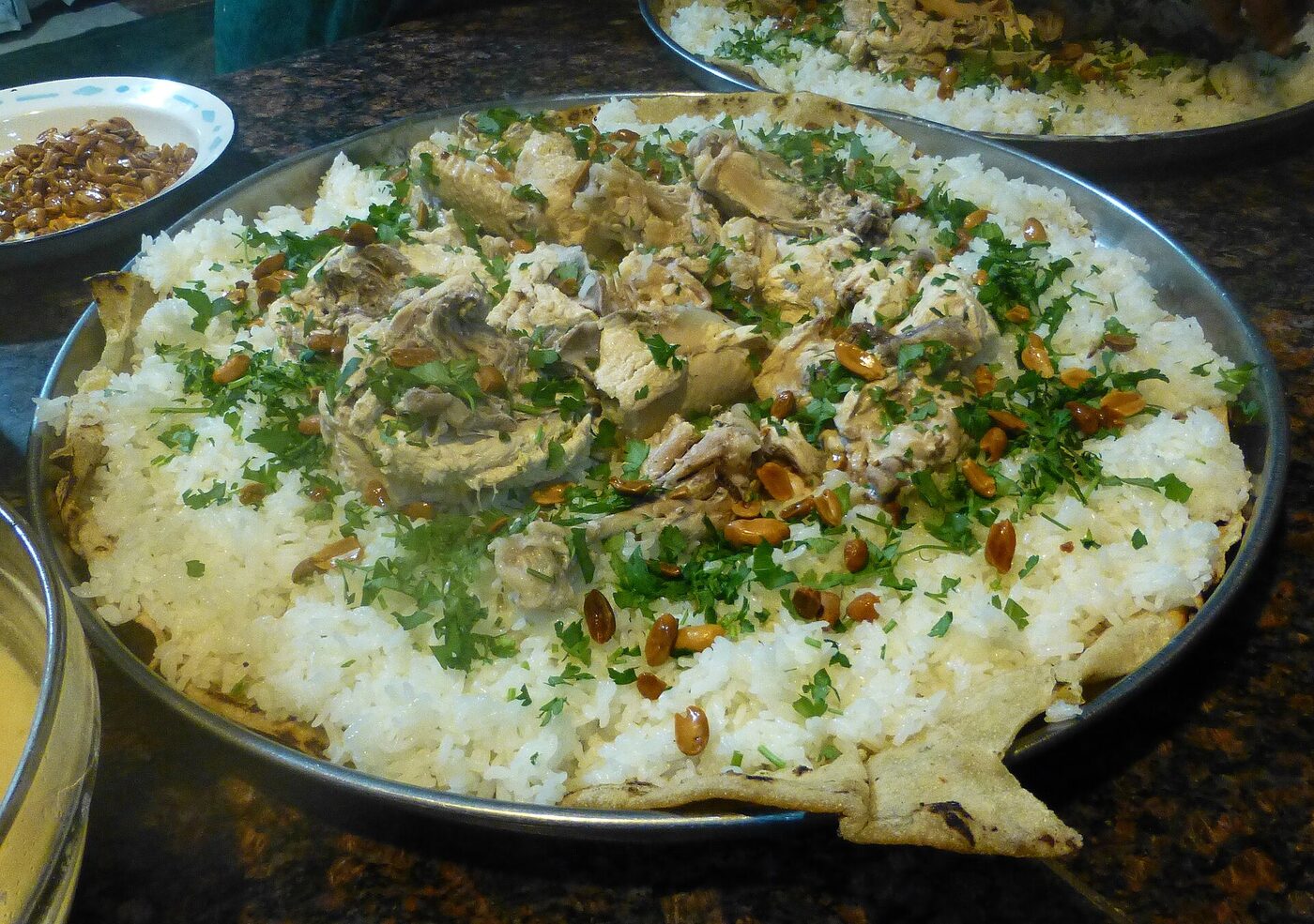
The national dish is mansaf: lamb cooked in a sauce of fermented dried yoghurt, the jameed that gives the dish its character, and served over rice or bulgur with a scattering of nuts. It is Bedouin and rural in origin and functions explicitly as a marker of hospitality; it is traditionally eaten standing around a communal tray, left hand behind the back, using the right hand rather than utensils, and it is served at weddings, births and graduations, at the two Eids, at Christmas and Easter and on Independence Day, and to honour a guest. It also has a formal role in tribal reconciliation: in the truce and peacemaking procedures known as the atwa and the ja'ha, the host's sacrifice of a sheep or goat for a shared mansaf is taken to mark the end of a dispute. Around it sits the wider Levantine table — hummus, ful medames, labaneh, baba ghanoush, tabbouleh, olives and pickles, tea with mint or sage — and Jordan is the eighth-largest olive producer in the world, which is why olive oil is the country's principal cooking fat and why that fact quietly shapes the whole cuisine.
.jpg)
Football is the most popular sport, with the country's clubs and national side carrying, as clubs and national sides do everywhere, rather more identity than the fixture list would suggest. The kingdom's Olympic record is thinner than its enthusiasm: Jordan's first Olympic medal of any colour came only in 2016, when Ahmad Abughaush won taekwondo gold at the 67-kilogram weight in Rio — long after the newsgroup had gone quiet, and a reminder that a group's archive is a slice of a country's life and not a summary of it.
The rest of the repertoire is the standing repertoire of every soc.culture.* group and needs no special pleading: greetings at Ramadan and at both Eids, requests for recipes and for the right word, arguments about music, and the steady traffic of practical questions — which university, which visa, which ministry, which form — that a diaspora asks of itself because there is nobody else to ask. Very little of that kind of posting is quotable today, and none of it is quoted here; what can be said is that a group whose charter listed Food and Education alongside Human Rights and Politics was chartered by someone who expected all four.
Archiology: Petra, the antiquities and the tourism economy
The charter's misspelled seventh topic is one of the country's largest industries. The Nabataeans, an Arab people who had led a nomadic existence in the Arabian desert, held an independent kingdom centred on southern Jordan from the middle of the third century BC, grew rich on control of the caravan and incense routes, and reached as far north as Damascus, which they held briefly between 85 and 71 BC. Petra, their capital, flourished in the first century AD on the strength of an elaborate rainwater-collection system in a desert setting, and its population is estimated to have peaked at around 20,000. Al-Khazneh, the most elaborate of its rock-cut facades, dates from that century and is generally, though not certainly, taken to be the mausoleum of the Nabataean king Aretas IV. Rome annexed Nabataea in AD 106 and renamed it Arabia Petraea, and Trajan rebuilt the old King's Highway through it as the Via Traiana Nova, from Aila on the Red Sea to Bostra; the road was finished under Hadrian. Petra's importance declined as sea routes displaced the caravans, and after an earthquake in 363 destroyed much of it the city was eventually abandoned to a handful of nomads.
It re-entered European awareness in 1812, when the Swiss traveller Johann Ludwig Burckhardt reached it in disguise; painters, pilgrims and antiquarians followed through the nineteenth century, and the prints they produced are the earliest widely circulated images of the site. Petra was inscribed on the UNESCO World Heritage List in 1985, on the same occasion as Qusayr 'Amra, the Umayyad desert castle whose frescoes of secular scenes are a rare survival of early Islamic painting.
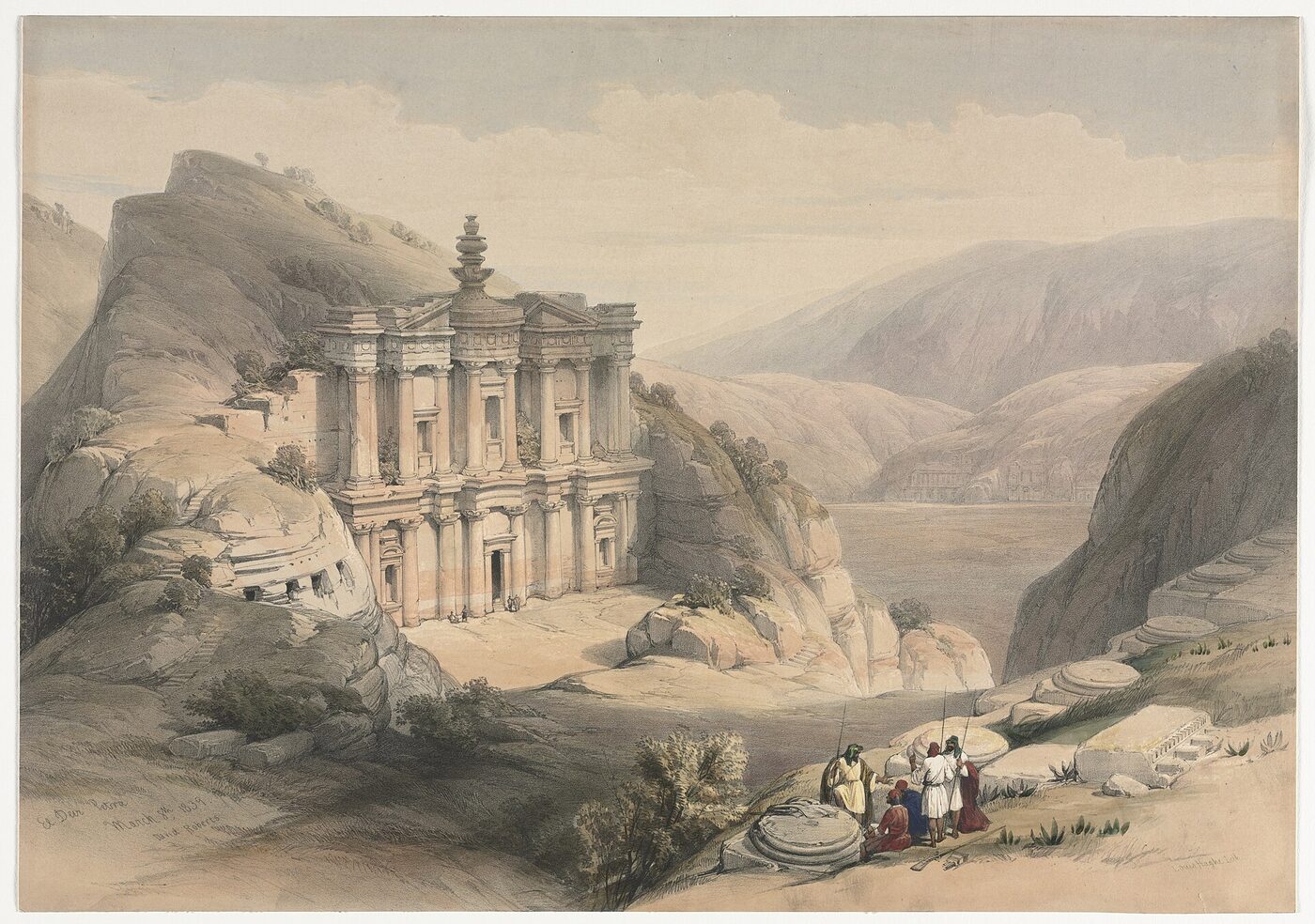

The listing had human consequences. The Bedul Bedouin, who had been living in Petra itself, were relocated by the Jordanian government to the nearby settlement of Umm Sayhoun in a process begun in the 1980s and spanning two decades, part of a wider programme of settling Bedouin communities and developing the site for visitors. The Bedul and the larger Liyathnah tribe both work in the tourism economy around Wadi Musa and the site today.
Visitor numbers rose sharply after the 2007 New 7 Wonders of the World campaign, an Internet and mobile-phone poll that gave Petra a level of global publicity no heritage body could have bought; the site received a little over a million visitors in 2019, the exact count varying with the source. Conservationists have catalogued the costs alongside the revenue — structural collapse, flood erosion, salt weathering, poor restoration and the pressure of visitor numbers themselves — and the Petra National Trust was set up in 1989 to work on them.
One chronological point is worth making, because it bears directly on what the group could have discussed. Jordan now has eight World Heritage Sites, but for the whole of soc.culture.jordan's active life it had two. Umm ar-Rasas, the Roman camp turned Byzantine and early Islamic settlement with its mosaic pavements and stylite towers, was inscribed in 2005; Wadi Rum in 2011; Al-Maghtas, the baptism site on the Jordan river, in 2015; As-Salt, the yellow-limestone merchant town whose prosperity ran from the 1860s to the 1920s, in 2021; Umm al-Jimal in 2024; and the Aqaba Marine Reserve, the country's first listing for natural value alone, in 2026. Jerash, one of the best-preserved Greco-Roman cities anywhere and visited by Hadrian himself in AD 129–130, is not among the eight at all; it has sat on Jordan's tentative list since 2004 and drew some 330,000 visitors in 2018 regardless. A reader in 1996 discussing Jordanian antiquity was discussing a shorter official list than a reader today would find, and a much longer real one.
Education and the universities
The charter lists Education, and the ballot roll explains why. Jordan's investment in higher education is the mechanism that put its nationals on the networks where this group lived.
The University of Jordan was established on 2 September 1962, the first university in the country, on a site in the Jubaiha district north of Amman. It opened in three buildings, with a budget of 50,000 dinars, eight faculty members and 167 students, seventeen of them women; the Jordanian press of late 1962 called it the Mother University. It began with a School of Arts, added a School of Sharia in 1964 and Schools of Science and of Economics and Commerce in 1965, and presented King Hussein with its first degree, an honorary doctorate, at a ceremony on 17 April 1965. Instruction in those early years was in Arabic for the humanities and in English for scientific and technical subjects — a division of labour the ballot roll of 1994 makes visible from the far end. Yarmouk University followed in Irbid in 1976 and the Jordan University of Science and Technology in 1986.
The universities were also, from early on, political spaces. The severe protests and social upheavals of the 1980s over inflation and the lack of political freedom were centred on Jordanian universities — Yarmouk especially — and on urban areas, and the disturbances at Ma'an in 1989 that reopened the parliamentary system belong to the same sequence.
The system's later scale is on the record: ten public universities, nineteen private universities and fifty-four community colleges, fourteen of the colleges public and twenty-four private, the rest affiliated to the armed forces, the Civil Defence Department, the Ministry of Health and UNRWA; over 200,000 students enrolled annually as of 2016, and roughly 20,000 more studying abroad. Female youth literacy, for ages 15 to 24, stood at 99.37 per cent in 2015. It is a system built to export graduates as well as to educate a population, and the December 1994 ballot roll — with its dozen Iowa State addresses, its Canadian and Australian campuses, its Bilkent and its Oxford and its Prague — is that policy visible from the far end.
How much traffic there was, and how we can tell
Nothing in the surviving paperwork records the group's readership or its posting volume directly. There is, however, one indirect measure, and it is exact as far as it goes. Every article that passed through UUNET's news server carried an Xref header listing the local article number the server had assigned it in each group named on the Newsgroups line. Those numbers only ever count upwards. Where an article crossposted to soc.culture.jordan survives in the news.announce.newgroups archive, its Xref line therefore records how many articles that one server had filed in the group by that date.
Six such articles survive from the group's first thirteen months, and they give a series:
- 25 January 1995 — 105, two weeks after creation.
- 30 January 1995 — 161.
- 24 March 1995 — 681.
- 4 April 1995 — 789.
- 18 April 1995 — 913.
- 1 May 1995 — 1,043.
- 25 January 1996 — 4,807.
That is roughly ten articles a day over the first three and a half months and roughly fourteen a day over the following nine, on one server. The caveats are real and worth stating. The number counts articles filed, which includes every crossposted article from elsewhere, not original postings; it belongs to one large commercial feed and not to Usenet as a whole; and the Xref host name in the sample changes from uunet to gs2.UU.NET partway through, though both are UUNET machines and the numbers run on consistently across the change. What the series will not support is a claim about readers, of whom it says nothing at all.
It does allow one comparison, because the same Xref lines number the neighbours on the same day. On 25 January 1996 the counter stood at 4,807 for soc.culture.jordan, 6,044 for soc.culture.kuwait, 5,409 for soc.culture.syria, 7,427 for soc.culture.egyptian, 11,722 for soc.culture.maghreb and 40,593 for soc.culture.lebanon; alt.culture.kuwait was at 568 and rec.music.arabic at 177. The groups are of different ages, so only the two closest in age compare cleanly: soc.culture.kuwait, created nine weeks before soc.culture.jordan, was running at about the same rate. Against the older and much busier rooms further along the corridor, soc.culture.jordan was a quiet address, and the arithmetic rather than the impression is what says so.
The region around it
soc.culture.jordan sat in a crowded corridor, and its own paperwork names the neighbours. The Request for Discussion went to soc.culture.israel, soc.culture.arabic, soc.culture.lebanon and talk.politics.mideast, and named alt.culture.kuwait as a further target; the Calls for Votes went to soc.culture.israel, soc.culture.palestine, soc.culture.lebanon, soc.culture.arabic and soc.culture.kuwait. Traffic ran the other way too: when a moderated companion to the Kuwaiti group was proposed, the second Request for Discussion of 25 January 1996 was filed by the receiving server under ten separate group names, and soc.culture.jordan was one of them.
Each of those neighbours owns its own subject on this site and is not retold here. soc.culture.palestine holds Palestine and its dated record; soc.culture.iraq holds Iraq; soc.culture.lebanon holds Lebanon; soc.culture.syria holds Syria; soc.culture.arabic holds the region at large along with the script and encoding problem; and soc.culture.kuwait.moderated holds the branch's fullest account of what crossposted quarrels did to these rooms and what remedies were available.
Two structural observations survive that traffic. The first is that the boundaries between these groups were nominal. An article carries a Newsgroups line, that line may name several groups, and every reply inherits it unless someone edits it; a thread crossposted between two national groups was not a visitor in either but a resident of both, which meant each community's sharpest arguments were conducted permanently in front of the other. The second is that soc.culture.jordan's charter promised to welcome all people and accept all opinions and made no provision for enforcing anything, which in the branch's usual way meant the group's tone was whatever its regulars were willing to maintain.
Outside Usenet, the group registered on the early web mainly as an entry rather than a place. The human-edited link directories of the late 1990s and early 2000s filed it under Jordan beside embassy pages, travel guides and university sites; those directories were mirrored, copied and left running for years, which is a large part of why references to pages like this one have outlived the traffic they described.
A forged rmgroup, and how carriage actually worked
The control-message archive holds one more thing worth reporting, because it demonstrates something about Usenet that is easy to state abstractly and much clearer with an example: a control message was a request, not an instruction, and every news administrator decided individually whether to honour it.
The first three messages in the file are the official ones — David C. Lawrence's newgroup of 11 January 1995 and its reissues of 18 January and 11 February, each carrying the tally, the newsgroups line and the charter. The fourth is not official at all. On 26 June 1995 Bert Hyman, a news administrator at Unisys in Roseville, Minnesota, issued his own newgroup for soc.culture.jordan with a Distribution header of unisys and an Approved line reading [email protected]. The Distribution header confined it to the company's own machines. It is simply a local administrator creating the group on his own servers, using the same mechanism, six months after the world had done so.
The last message in the file is dated 3 November 2001 and is a forgery. It is an rmgroup for soc.culture.jordan, crossposted to soc.config, soc.control and soc.groups, carrying From, Sender and Approved lines in the name of Urs Janßen of tin.org — the maintainer of the tin newsreader, a person with no authority over the Big Eight namespace and no reason to remove a national group. The Organization header and the forged Message-ID both point at a university host in Karlsruhe associated with him, which is part of the disguise. The body reads, in its entirety, please remove the bogus newsgroup soc.culture.jordan, and it is followed by a signature line of automatically generated nonsense of exactly the kind produced by the forged-control-message floods of that period. The tracing headers point elsewhere entirely: the posting host is a numeric address in Quebec, the injection path runs through a Quebec academic network, and the complaints address belongs to a Quebec consumer ISP. The group was not removed. It is still listed, with its original description, in the newsgroups file the ISC distributes today.
None of that was unusual in 2001, which is the point. By then Big Eight control messages were expected to carry cryptographic signatures and most well-run servers ignored anything that failed the check; the forgeries kept arriving anyway, and the surviving administrative record of a quiet national newsgroup ends with an attempt by an anonymous stranger to delete it.
What the record does not show
The honest inventory of what is missing is longer than the inventory of what survives, and saying so is part of the job.
- There are no readership figures. Brian Reid's Usenet readership surveys, which give useful estimates for the larger groups of the late 1980s and early 1990s, do not help for a group created in 1995, and no subsequent survey of comparable authority covers it.
- There is no post count and no traffic series in the ordinary sense. The Xref numbers set out above are an accident of crossposting: seven readings from one server across thirteen months, and nothing at all after January 1996.
- There is no thread inventory. Not a single subject line from the group is quoted anywhere in the surviving administrative record.
- There was no moderator, so there are no moderator reports, no vacancy notices and no periodic policy postings of the kind that document a filtered group's life.
- No FAQ for the group has been located in the news.answers archive, and no charter revision or reorganisation proposal appears in the ISC record after the creation sequence.
- The date the group effectively stopped cannot be established from the administrative record. Big-Eight groups were rarely removed, and soc.culture.jordan was not; the description in the newsgroups file records that the group exists, never that anyone is using it.
- The surviving message archives are, like all Usenet archives, incomplete and unevenly indexed. No claim in this article rests on the content of any individual posting, because none has been read or quoted for it.
What is left, and it is more than most groups in this directory can offer, is a complete creation record, a published electoral roll and a handful of hard traffic readings. Those settle the questions of when, by whom, under what rules, on what stated grounds, from where, and roughly how busily. They do not settle what was said. On that, the honest position is that the archive is patchy and first-hand, and patchy and first-hand still beats tidy and retrospective.
Scope, sources and limits
This page is about a newsgroup. Where it describes Jordan, it does so because the group's charter, its rationale and its electorate cannot be understood without the country and the decade around them, and it stops where that purpose stops.
The group's own facts — dates, names, the charter text, the newsgroups line, the tally, the voter roll, the Xref article numbers and the control messages — come from the news.announce.newgroups and control archives mirrored on the Internet Systems Consortium's public Usenet file server, and from the newsgroups file in the same server's configuration directory. The counts of academic and commercial addresses in the ballot roll were made for this article by classifying the published addresses: the domain-by-domain figures are exact, and the summary figure of 113 academic addresses out of 164 depends on treating named universities in ten countries as academic, which is a judgement rather than a measurement, and is stated that way. The delegation date for .jo and the registry's address come from the public delegation record. Country facts are drawn from standard encyclopaedic sources and, where a body did the counting, attributed to that body.
Where those sources conflict, the conflict is reported rather than hidden. Three instances are load-bearing enough to name: the Arab-brokered ceasefire that ended the main fighting of September 1970, which one account dates to 22–23 September and another to the Cairo agreement of 27 September; the ethnic composition of the population, given as 95 per cent Arab in one standard summary and approximately 98 per cent in another; and Petra's visitor total for 2019, which the same reference work reports both as 1,135,300 and as 1.2 million.
Jordan's politics, its place in the region's conflicts, and the questions of identity, citizenship and representation that run through its demography are contested, and the disagreements are held sincerely on all sides. The register here is deliberately narrow: what was proposed, what was voted, what was signed, what was counted, and by whom. Where estimates differ they are given as differing. Where a matter is argued, the article records that it is argued and declines to argue it. Readers looking for a verdict will not find one, which is the correct outcome for a directory entry about a room where the argument took place.
Reading soc.culture.jordan today
- Historical archive: Google Groups — soc.culture.jordan (coverage varies by group and era).
- Open in a newsreader:
news:soc.culture.jordan— the original site offered exactly this link, and it still works if your system has a newsreader registered for thenews:scheme. - Live access: point an NNTP newsreader at a modern server — see accessing Usenet today.
- The original news2mail e-mail subscription service ended in the mid-2000s and no longer operates.