soc.culture.uruguay
Uruguay: la banda oriental.
Small country, loyal group: mate before Argentina’s (a claim posted regularly), Peñarol–Nacional, the 1950 Maracanazo commemorated annually, and post-dictatorship politics including the Frente Amplio’s long rise.
Its size made it one of the friendlier Spanish-language groups, with Argentines welcome except on specified match days.
On this page
- The group and its era
- The paperwork, in sequence
- The charter, quoted
- The background clause, and the two mailing lists
- Two hundred and thirty-one voters, and where they were
- An unauthorised removal, 2001
- A small country with a large ballot
- Independence, and the nineteenth-century settlement
- The early welfare state
- 1973 to 1985
- The laws about prosecutions, and the ballots about the laws
- The crisis of 2002
- Who could post: .uy, SeCIU, and a national network
- The twentieth department
- Football, and two tournaments
- Candombe, murga and the Carnival
- Tango, and the property disputes of the river
- Mate
- The literature the exile carried
- Beef, and the town called Fray Bentos
- Rioplatense Spanish
- The neighbours across the river
- What the record does not show
- Scope and limits
The group and its era
soc.culture.uruguay belongs to the great widening of the soc.culture.* branch in the early 1990s, when the naming scheme worked its way down the atlas from large nations to small ones. Its neighbours were arriving in the same stretch of months: soc.culture.brazil was long established, soc.culture.argentina had been created that August, and a shared regional room, soc.culture.latin-america, was carrying the overflow from everywhere else. The Uruguayan proposal, put to the network in the summer of 1993, was an argument that a country of roughly three million people had enough to say to justify a door of its own. The vote agreed, emphatically, and the group opened in October of that year.
What makes this particular group worth a long entry is not that it was busy. It was not, by the standards of the branch. It is that its own paperwork survives complete — proposal, revised proposal, three calls for votes, a published result with every ballot listed by name and address, and the control message that created it — which is more documentation than most Usenet groups of any size can produce. That record is set out below, quoted from the archive rather than summarised from memory, because for a group of this size the paperwork is the most reliable thing about it.
Its arc afterwards was the ordinary one: growth through the 1990s, a plateau, then a slow leak to web forums in the 2000s as the diaspora conversation moved to places with search boxes and passwords. The news2mail gateway served the group from 2000 to 2004, which turned out to be years in which Uruguayans abroad had more reason than usual to follow the news from home. The old Deja News archive, absorbed by Google in 2001, preserves much of the run, with the usual gaps.
The charter's tag, la banda oriental, is the country's oldest name for itself: the Banda Oriental, the eastern bank of the Uruguay river, from which both the formal name — República Oriental del Uruguay — and the national self-designation orientales descend. It is a name that takes the river, and the neighbour across it, as the permanent frame of reference. That is a fair summary of the group's conversations too.
The paperwork, in sequence
The Internet Systems Consortium's mirror of news.announce.newgroups holds the file for this group in full. The sequence it records is as follows.
- 26 July 1993 — a Request for Discussion for an unmoderated soc.culture.uruguay, posted by Walter Garcia-Fontes, then at Stanford University, and cross-posted to news.groups, soc.culture.latin-america, alt.culture.argentina, soc.culture.brazil and soc.culture.spain. It proposed a discussion period running to 26 August and a vote from 1 to 20 September.
- 10 August 1993 — a second RFD from the same proposer, with the charter lightly reworded (the first had offered a phorum; the second settled for a forum) and the voting window extended to the whole of September.
- 8 September 1993 — the first of three Calls for Votes, issued by Ron Dippold of the Usenet Volunteer Votetakers, the standing pool of neutral vote-takers described on the branch page. Ballots were to be e-mailed to a voting alias and had to arrive by 23:59:59 UTC on 7 October 1993. The message-ID of this first call misspells the country: it reads
soc.culture.uruguary-CFV1. - 15 and 24 September 1993 — the second and third calls, each superseding the last, as the rules of the day required.
- 12 October 1993 — the result, posted under the subject line RESULT: soc.culture.uruguay passes 231:30.
- 19 October 1993 — the newgroup control message, sent by David C. Lawrence, then moderator of news.announce.newgroups, instructing news servers worldwide to create the group. A routine re-issue followed on 19 August 1994.
Two details in that list are worth pausing on. The first is the crossposting: the proposal went not to a general audience but to the specific rooms where Uruguayans were already reading — the Latin American regional group, the Argentine group on the alt side of the network, Brazil and Spain. By the time the calls for votes went out six weeks later the list had been widened again, to soc.culture.argentina, soc.culture.venezuela and soc.culture.peru. The proposer, and then the vote-taker, knew exactly where the electorate lived. The second is that the vote-taker was a neutral third party with no connection to the subject, which was the whole point of the Volunteer Votetakers: the count had to be verifiable by people who did not care about the outcome.
The result itself was not close. 261 valid ballots were received; 231 said yes and 30 said no. The rules of the period, set out in the call for votes itself, required a hundred more yes votes than no votes and two-thirds of all votes to be yes; the margin cleared the first condition by more than double, and 231 of 261 is a little under eighty-nine per cent. The result posting reproduced the arithmetic in a small table, ticked both conditions, and listed every voter.
The charter, quoted
The charter that went out with the calls for votes, and that the newgroup control message then carried to every news server that honoured it, reads in full:
The purpose of the soc.culture.uruguay newsgroup is to provide a forum for the exchange of information and the discussion of relevant issues for Uruguayans at home and abroad. The newsgroup will also be useful for non-Uruguayans who have an interest in the country and its cultural or political evolution, or for establishing academic or professional contacts relevant to Uruguay.
A list of suggested topics followed, in the loose register of someone who did not want to fence anything off: news from Uruguay including sports; news from the world and its relation to Uruguay; travel information; politics mainly related to Uruguay; literature and music from Uruguay; crafts, food, other artistic expressions; problems and solutions for Uruguayans abroad; other interesting topics; and, disarmingly, and much more . . . The list closed with a single centred line: Everyone is welcome.
A separate clause addressed language. The first RFD disposed of the question in five words — Primarily Spanish. Other languages are very welcome — and the second version, the one that was actually voted on, is more carefully drafted:
Spanish is expected to be the language most used in the group, and the use of any other language is very welcome, especially if it encourages the exchange of information.
The one-line description that servers filed in their newsgroups files, and that this directory still shows above, was fixed at the same moment and has never changed:
soc.culture.uruguay— Discussions of Uruguay for those at home and abroad.
The current ISC newsgroups file carries that line verbatim, thirty-odd years on, and the matching active file still lists the group as open for posting. It is a small demonstration of how Usenet's namespace works: a description written once, in a call for votes, and propagated by control message, becomes the group's permanent official description because nobody ever has cause to rewrite it.
The phrase that matters is at home and abroad, and it is in the charter twice — once in the opening sentence and once in the topic list, as problems and solutions for Uruguayans abroad. This is not boilerplate. Most soc.culture charters of the period describe a country; this one describes a country and a dispersal, and gives the dispersal its own agenda item.
The background clause, and the two mailing lists
The proposal also carried a background section, which is the single most informative paragraph in the whole file:
An Uruguayan mailing list has existed for three years, having gathered more than 200 subscribers. Most of the subscribers have access to Usenet. Periodically, non-Uruguayans ask questions about the country in soc.culture.latin-america or directly to the list, so these will be added to the readership of the group.
So the community predated the newsgroup by three years and already numbered over two hundred. The call for votes then names the lists directly, in a sentence explaining that the ballot would be mailed to them as well as posted: they were uruguay-adentro and uruguay-afuera, both at a University of Toronto machine. Inside and outside. The diaspora had not merely been noticed by the charter; it had its own list, on a Canadian university server, three years before the newsgroup existed.
That is an unusually clean illustration of a pattern the branch page describes in general terms. Usenet groups for small countries did not create their communities. They inherited them from mailing lists, and the vote was less a founding than a change of address — a move from a machine somebody had to administer to a namespace that propagated itself. The Argentine group next door has the same shape, and its own page records the same relief-valve reasoning; see soc.culture.argentina.
Two hundred and thirty-one voters, and where they were
Because the rules of the period required the vote-taker to publish the full roll, the result posting for this group is also a list of 261 people who, in September 1993, cared enough about Uruguay to send an e-mail about it. It is the closest thing to a membership document the group will ever have, and it can be read.
Sorted by the top-level domain of the voter's address, the 231 yes votes fall out like this:
.edu— 100, by a wide margin the largest bloc, and in 1993 almost entirely United States universities..com— 32, and.org— 8: the commercial and non-profit Internet, then still small..govadds 3 and.milone.- Canada 14, France 11, Germany 10, Spain 8, Israel 6, Switzerland 5, Australia 4, the United Kingdom 4, Italy 3, Sweden 3, Denmark 3, New Zealand 2, Japan 2, Portugal 1.
- Latin America, other than Uruguay: Argentina 1, Brazil 1, Chile 1, Venezuela 1.
- Uruguay itself — 5.
Five. Out of 231. And three of those five were at seciu.edu.uy or seciu.uy — the Servicio Central de Informática Universitaria of the Universidad de la República, which is to say the single institution that operated the country's academic network and its domain registry. The proposer himself, posting from Stanford, gave [email protected] as the contact address for questions about the group.
Some caution is owed to that arithmetic. An e-mail domain is not a nationality: a Uruguayan postgraduate at a Michigan university appears in the .edu column, and a good many of the hundred surely were exactly that. The .edu, .com, .org, .gov and .mil domains together hide 144 addresses whose physical location the roll does not disclose. The count measures where the mail came from, not where the voters were born, and this page draws no inference from anybody's surname.
But that is the point rather than a caveat against it. The address is where a person could be reached by the network in 1993, and on that measure the Uruguayan Internet contributed five reachable people to the founding of Uruguay's newsgroup. The other 226 were reachable from campuses and companies in twenty other national domains and in the location-opaque generic ones. The charter's phrase at home and abroad was, at the moment of the vote, a ratio of roughly one to forty-five.
Two hundred and thirty-one votes is also a substantial number for a Usenet ballot of the period, and the neighbouring results in the same archive give the scale. soc.culture.peru passed 142:21 and soc.culture.venezuela 208:22, both for countries many times Uruguay's size; soc.culture.costa-rica, for a country of comparable population, passed 216:13. Chile (415:34), Bolivia (417:22) and Ecuador (424:21) did better. Uruguay's count sits in the upper half of that group, well above what its population would predict. The explanation is the mailing list: two hundred subscribers already assembled, most of them with Usenet access, and a vote-taker who mailed the ballot straight to them. A dispersed population with university e-mail is, for the purposes of a Usenet ballot, an extremely efficient electorate.
An unauthorised removal, 2001
One more control message sits in the archive, and it is not a friendly one. Shortly after midnight UTC on 4 November 2001 an rmgroup control message for soc.culture.uruguay was injected into the network, carrying the name and address of Urs Janßen, the maintainer of the tin newsreader, and a body reading only please remove the bogus newsgroup soc.culture.uruguay. It entered through a Quebec news server and named a Quebec consumer ISP as its abuse contact.
It did not travel alone. Near-identical messages went out the same night, minutes apart, for other groups in the branch — soc.culture.argentina at 00:27, soc.culture.brazil at 00:29, soc.culture.bolivia at 00:29, soc.culture.chile at 00:30, soc.culture.peru at 00:40, soc.culture.uruguay at 00:43 — and every one of them carries a forged message-ID ending in the same string, which is the clearest single sign that one hand sent the lot.
It carried none of the marks of a legitimate Big-8 removal. Authorised newgroup and rmgroup messages for this hierarchy came from the moderator of news.announce.newgroups and, by that date, were cryptographically signed; this one was neither. It was, in short, one of the forged-control runs that periodically swept Usenet in the late 1990s and early 2000s, when the honour system that ran the namespace was tested by people who found the honour funny.
Servers configured to accept only signed control messages ignored it. That the run failed can be checked directly: the group is still listed with an active status in the current ISC configuration files, and its description line is still the one written into the 1993 call for votes. The episode belongs in the record chiefly because it fell squarely inside the years this gateway was running, and because it is the only thing anyone ever did to the group from outside.
A small country with a large ballot
The 231:30 count deserves one further observation, and it is not really about Usenet. Uruguay is a country that votes on things. Voting is compulsory; the constitution of 1967, still in force and amended in 1989, 1994, 1996 and 2004, gives citizens the power to force a referendum against a law already passed and to put constitutional amendments directly to the electorate. The result is a national habit of settling arguments by counting, and a twentieth-century record dense with plebiscites.
The consequential ones bracket the group's whole existence. On 30 November 1980 the military government put its own draft constitution to a vote and lost it, 57.2 per cent against — the beginning of the negotiated exit from dictatorship, and a result the regime chose to honour rather than falsify. On 16 April 1989 a referendum on annulling the law that blocked prosecution of the security forces retained the law, with just under 56 per cent voting to keep it. On 13 December 1992 a referendum struck out the greater part of a law on privatising state enterprises, with 72.6 per cent voting to repeal. In October 2004 a constitutional amendment putting the water supply beyond private operation was carried alongside the general election. On 25 October 2009 a second attempt on the amnesty law failed, 52 per cent declining to annul it.
That last ballot carried a second question, and its answer is the one that belongs on this page. Uruguayans were asked whether citizens living abroad should be able to vote by post. Sixty-two per cent said no. The diaspora that the group's charter named in its first sentence — the readership that had cast forty-five of every forty-six votes that created the group — was, sixteen years later, formally declined a ballot in the country it was arguing about. It is not the business of this page to have a view on that. It is worth recording that for the people the charter addressed, a newsgroup vote in 1993 was, in a narrow and literal sense, a franchise they did not otherwise possess.
Independence, and the nineteenth-century settlement
The country the group argued about is a small one with a crowded past, and the dates are worth setting down plainly because the group's arguments constantly reached back into them.
In 1811 José Gervasio Artigas, the national hero, revolted against Spanish authority and, with help from Buenos Aires, beat it on 18 May at the Battle of Las Piedras. The assembly convened at Buenos Aires in 1813 refused to seat his delegates; Artigas broke with the centralists, and from 1815 led the Federal League, also called the League of the Free Peoples, which at its widest covered the Banda Oriental, five provinces now in Argentina — Entre Ríos, Santa Fe, Corrientes, Misiones and Córdoba — and what is now Rio Grande do Sul in Brazil. In August 1816 an army invaded from Brazil and occupied Montevideo on 20 January 1817; after Artigas's final defeat in 1820 the territory was absorbed as the province of Cisplatina, and in 1824 it was annexed to the newly independent Empire of Brazil.
On 25 August 1825 the Thirty-Three Orientals, led by Juan Antonio Lavalleja, declared independence, with support from the United Provinces of the Río de la Plata. The war that followed was ended by the mediation of the British diplomat Viscount Ponsonby: by the Treaty of Montevideo of 27 August 1828, Brazil and Argentina agreed to recognise an independent Uruguay as a buffer state between them. The first constitution was sworn on 18 July 1830 — a date to remember, because it is why a football stadium built a century later is called the Centenario, and why 18 July is still a public holiday.
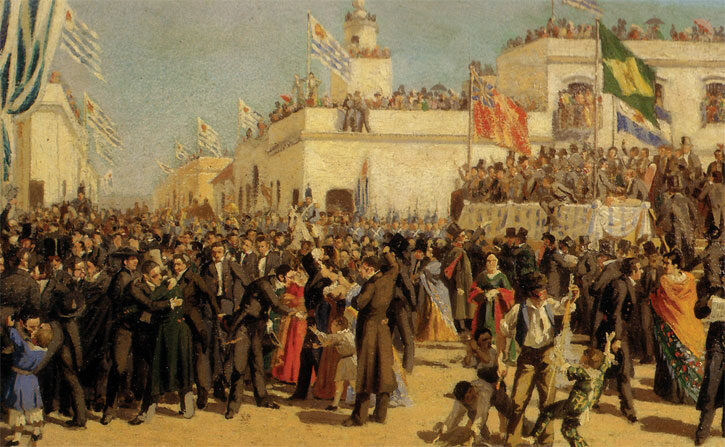

Politics immediately organised itself into the two parties that between them would hold the presidency for the next 175 years, until a left coalition finally took it in the election of 2004: the Blancos of the countryside, and the Colorados of Montevideo and commerce. Both were promptly entangled in Argentine factional war. In 1839 the Colorado leader Fructuoso Rivera declared war on Rosas of Buenos Aires, beginning the thirteen-year Guerra Grande; the great siege of Montevideo opened in February 1843 and was not lifted until 1851. In 1865 Uruguay joined Brazil and Argentina in the Triple Alliance against Paraguay. The peace of 1872, which ended the Blanco rising known as the Revolution of the Lances, introduced co-participation — the practice of giving the losing party a share of the departments and of the offices. It held in one form or another until Batlle, who thought dividing the departments between the parties undemocratic, broke it and provoked the last Blanco revolution, ended in 1904 by the death of Aparicio Saravia, mortally wounded at Masoller.
Two things from that century shaped everything after it. The first is that the country was built as a buffer between two much larger neighbours and never stopped defining itself against them. The second is immigration: a wave of arrivals through the second half of the nineteenth century and the first half of the twentieth, overwhelmingly Spanish and Italian, which is why a Uruguayan surname is as likely to be Genoese as Castilian, and why the accent sounds the way it does.
The early welfare state
The modern country was made in two presidencies. José Batlle y Ordóñez, of the Colorado party, held office from 1903 to 1907 and again from 1911 to 1915, and dominated politics until his death in 1929. What he built has a fair claim to be the first welfare state in the Americas, and it was built early enough to be genuinely startling.
The dated specifics are these. Capital punishment was abolished by Law 3,238 of 23 September 1907, during the intervening presidency of Batlle's ally Claudio Williman, and the abolition was given constitutional rank by the charter of 1918. Uruguay's first divorce law, Law 3,245, was passed on 26 October 1907; in 1913 Law 4,802 amended it to permit divorce at the sole will of the wife, without her having to plead a cause — the first such provision in Latin America. Crucifixes were banned from public hospitals by 1906 and references to God and the Gospel struck from public oaths, part of a secularisation that separated church and state comprehensively. The State Insurance Bank was established on 11 January 1912. The state took Montevideo's electric power plant, the note issue through the Bank of the Republic, and in 1914 the North Tramway and Railway Company. From 1911 Batlle pressed a project for eighteen departmental liceos to carry secondary education into the interior, and a Women's Section of Secondary Education was created by a law of 17 May 1912. Under Batlle the electorate grew from 46,000 to 188,000.
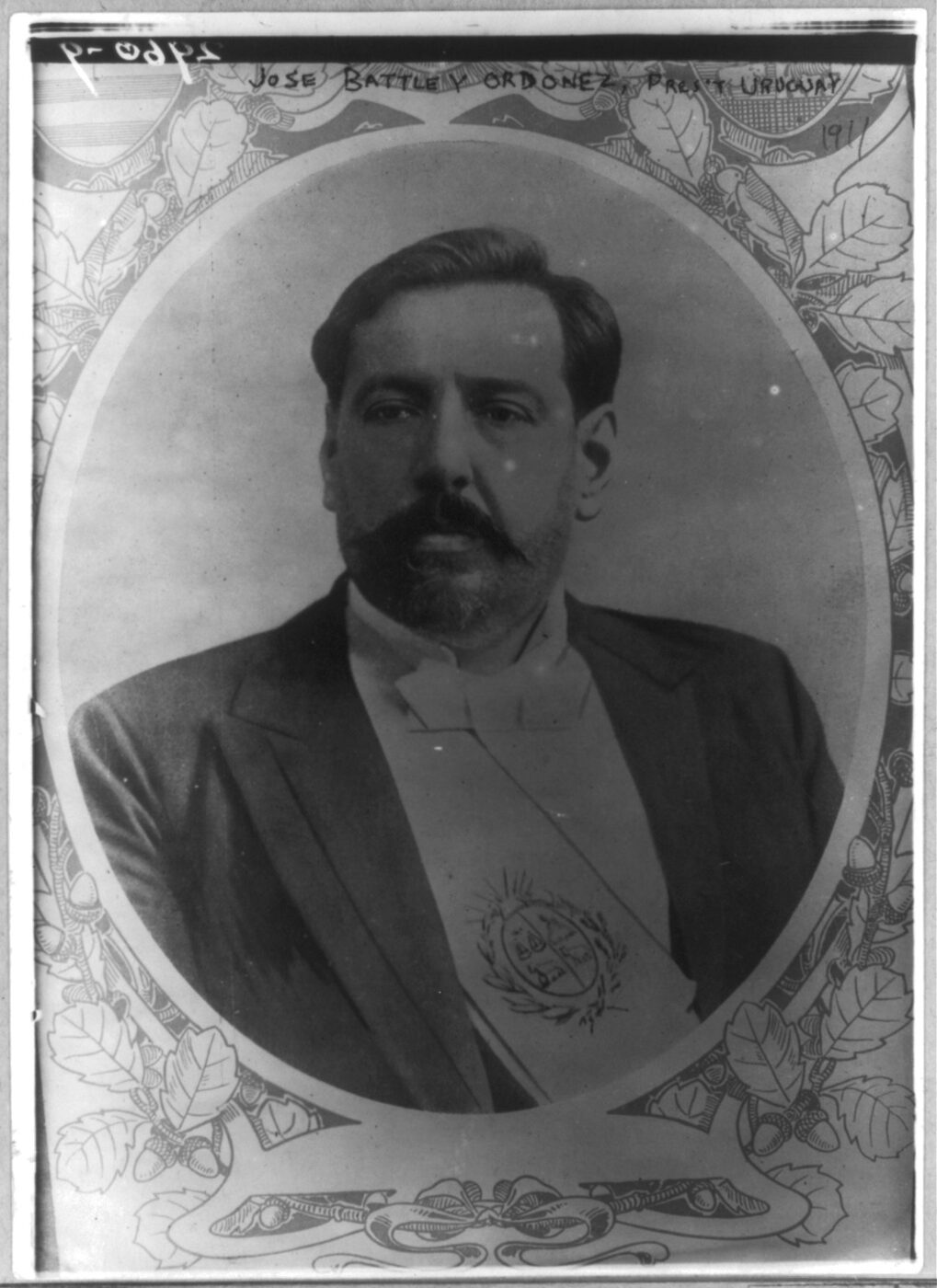

Batlle also spent his later career trying to abolish the presidency. Having studied French and Swiss politics between his terms, he proposed in 1913 to replace the single executive with a nine-member National Council of Administration on the model of the Swiss Federal Council, on the reasoning — as one study of the period puts it — that in a nation where every person older than thirteen had lived under a dictator, power ought not to be concentrated in one office. The proposal was defeated in a referendum in 1916, then salvaged in compromise: the constitution approved by plebiscite on 25 November 1917 and in force from 1918 split the executive between a president and the National Council of Administration.
The compromise did not survive the Depression. Gabriel Terra, president from 1931, dissolved the General Assembly by coup in 1933 and had a new constitution promulgated in 1934 that returned power to the president and abolished the council. The collegiate idea came back with the constitution of 1952, approved by a plebiscite in December 1951, and was abandoned again after the vote of November 1966 that produced the constitution of 1967. It is a very Uruguayan sequence: an argument about the shape of the executive, conducted over half a century, mostly by plebiscite.
The reputation this produced abroad — the Switzerland of the Americas, a phrase Uruguayans use with varying degrees of irony — is the backdrop against which everything that happened after 1968 was measured, at home and in the newsgroup.
1973 to 1985
The civic-military dictatorship is called that for a reason: the military did not seize the palace in a morning. It took power gradually from civilian presidents who stayed in office while it did so, which distinguishes the Uruguayan case from its neighbours, where senior officers seized power and directly served as head of state, and made it, at the time, harder to name.
The slide began under Jorge Pacheco Areco, president from 1967, who banned the Socialist Party and other left organisations, purged universities, suppressed unions and declared a state of emergency on 13 June 1968. The Tupamaros, an urban guerrilla movement, escalated in parallel. Between 1968 and 1971 military spending doubled from 13.3 per cent of the national budget to 26.2 per cent, while education fell from 24.3 to 16 per cent. In the 1971 election the newly founded Frente Amplio — a coalition of more than a dozen left parties, formed on 5 February 1971 and led by General Líber Seregni — took 18.3 per cent, the best showing of any third-party candidate in that election. Juan María Bordaberry became president on 1 March 1972 under the double simultaneous vote, declared a state of internal war on 15 April, and on 27 June 1973 dissolved parliament.
The twelve years that followed produced a distinctive statistic: Uruguay held, per head of population, more political prisoners than any country in the world. More than five thousand people were arrested for political reasons, torture was used systematically and continued until the end, and almost a tenth of the population left the country. Around 180 Uruguayans are known to have been killed under military rule, many of them abroad. A separate accounting was attempted by the Commission for Peace, established in 2000, whose final report in 2003 recorded 31 confirmed cases of Uruguayans kidnapped and killed inside Uruguay and 182 in Argentina, along with at least one case of a child born in captivity and given to another family. The Museo de la Memoria in Montevideo commemorates the dead and the disappeared.
The exit was slow and, unusually, partly electoral. On 30 November 1980 the regime put a constitution of its own drafting to a referendum and lost, 57.2 per cent against; that it held a real vote at all, and then accepted the answer, is the fact historians of the period keep returning to. General Gregorio Álvarez took the presidency on 1 September 1981. A law of 7 June 1982 let the traditional parties function again, the left still excluded. On 27 November 1983 around half a million people demonstrated in Montevideo, the largest gathering in the country's history. On 13 January 1984 the first twenty-four-hour general strike since 1973 was called. The Naval Club Pact of 3 August 1984 set the terms, restoring the 1967 constitution; elections were held on 25 November 1984; and on 1 March 1985 Julio María Sanguinetti took office.
The emigration of those years is the direct cause of the readership the charter named. By the time Usenet reached its stride there were Uruguayan communities across Argentina, Brazil, Spain, Sweden, Australia, Canada and the United States, and a great many of the people in them were of exactly the generation and education to end up with a university e-mail address. The 1993 vote roll is, among other things, a map of where the dictatorship sent people.
The laws about prosecutions, and the ballots about the laws
Uruguay left dictatorship with an argument it has never entirely closed, and because the group ran through the years in which that argument was loudest, the sequence deserves to be exact. It is a sequence of two laws and two referendums, and the two are often confused.
The first law came from the new democracy almost immediately. Law 15,737 of 1985, the National Pacification Act, amnestied political offences and emptied the prisons of the dictatorship's prisoners; among those released was José Mujica, who would be president from 2010 to 2015. That law was, and remains, broadly uncontroversial.
The second was not. The Law on the Expiration of the Punitive Claims of the State, Law 15,848, was passed on 22 December 1986. Co-written by legislators of the Colorado and National parties, proposed by the Sanguinetti government and supported by the opposition leader Wilson Ferreira Aldunate, it extinguished the state's power to prosecute military and police personnel for acts committed under orders before 1 March 1985. It was opposed by the Frente Amplio and by most of the human-rights organisations, and its detractors have always called it by a shorter word than expiry.
Then the ballots. A referendum on 16 April 1989 sought to annul the law and failed: just under 56 per cent voted to retain it, on a turnout of nearly 88 per cent. A second attempt, put to voters on 25 October 2009 alongside the general election, also failed, with 52 per cent declining annulment. In 2011 parliament passed Law 18,831, which restored the state's power to prosecute offences committed up to 1 March 1985 and classified them as crimes against humanity, technically repealing the expiry law; the Supreme Court subsequently declared two of its articles unconstitutional.
This is the hardest material the group carried, and it ran through it as it ran through the country, among people who had lived it from every position — the imprisoned, the exiled, those who stayed, and their children, who by the 1990s were old enough to have opinions of their own and a university account from which to post them. This page records the chronology and takes no side in it.
The crisis of 2002
The banking crisis of 2002 fell inside the years this gateway was running, and it is the last national emergency the group covered in real time.
Its roots were long. Chronic inflation and weak confidence in the peso had led Uruguayans to prefer dollars from the 1950s onward; by the mid-1970s the public debt was fully dollarised, and the banking system was correspondingly exposed to any external shock. On top of that, Uruguay had developed into a large offshore banking centre for its neighbours, on lax banking laws and a widespread Argentine view that Montevideo was a stable place to keep savings — a great deal of the money in Uruguayan banks was Argentine, and two of the largest private banks were owned by Argentine financial groups.
When Argentina imposed capital controls and froze deposits in December 2001, Argentine depositors withdrew what they could from Uruguay instead; by March 2002 the country had lost about twelve per cent of its bank deposits. The run then became general. Over 2002 roughly a third of the country's deposits left the banking system, five financial institutions were left insolvent, the central bank lost some seventy per cent of its international reserves from January, and the peso lost nearly half its value against the dollar. The government of Jorge Batlle — a great-nephew of the reformer — appointed Alejandro Atchugarry as minister of economy and finance at the height of it, a decision generally credited with the recovery, and took emergency support from the International Monetary Fund.
Uruguay recovered faster than Argentina, but the social cost was heavy and the demographic cost was immediate. The crisis produced the second great emigration wave of modern Uruguayan history, and it produced it among exactly the people the group's charter had in mind. The oldest Uruguayan question — whether to stay or to go — was being asked again, this time in threads, by people who had already answered it once.
Who could post: .uy, SeCIU, and a national network
Whether the group's Uruguayan half could participate at all was a question of infrastructure, and the infrastructure has dates.
The country-code domain .uy carries a registration date of 10 September 1990 in IANA's root zone database — three years and a month before the newsgroup vote. Its manager, then and now, is SeCIU, the Servicio Central de Informática Universitaria of the Universidad de la República, at Colonia 2066 in Montevideo, which has held the delegation since 1990. The second-level structure SeCIU laid out is the classic academic one: .edu.uy for education, .gub.uy for government, .com.uy, .net.uy, .org.uy and .mil.uy. Registration directly at the second level under .uy did not become possible until 2012.
The significance of that arrangement is that Uruguay's connection to the international network was, in its first years, a university service. The national domain registry and the academic network were run by the same body at the same institution — which is precisely why three of the five Uruguayan votes cast in 1993 came from a seciu address, and why the proposer of the newsgroup, an academic economist abroad, could give a seciu.edu.uy address as his point of contact. In 1993 the Uruguayan Internet was, to a first approximation, one organisation.
Access for the general public arrived afterwards, by dial-up through the state telecommunications company Antel — which holds a monopoly on fixed lines — and its competitors, and the balance of the group's traffic shifted accordingly, the same shift the Brazilian and Argentine pages describe for their own countries. This page does not put a date on Uruguayan commercial Internet provision, because the sources consulted for it do not carry one that could be verified; what can be said with confidence is that the country was present on the network from 1990 as an academic institution, and became present as a public gradually afterwards.
The later trajectory is worth a sentence because it is so unlike the starting position. Under the Ceibal project, begun in 2007, Uruguay became in 2009 the first country in the world to provide a laptop for every pupil in state primary education; over 2007 to 2009 some 362,000 pupils and 18,000 teachers were covered, and around seventy per cent of the machines went to children who had no computer at home. The programme had delivered 450,000 laptops within four years. Antel began deploying fibre to the home in Montevideo in 2012. The country that could muster five reachable addresses for its own newsgroup vote in 1993 had, within twenty years, one of the most thoroughly connected populations in the Americas. By then, of course, nobody was reading Usenet.
The twentieth department
Uruguay is administratively divided into nineteen departments. Uruguayans abroad are, in a piece of official terminology that would be sentimental if it were not also a government programme, the twentieth.
Departamento 20 was created at the beginning of the twenty-first century as a structure for coordinating and articulating the affairs of the emigrant population, and Law 18,250 of January 2008 established the Consultative Councils — representative bodies of Uruguayans living abroad whose role is to link them back to the country. It is a modest bureaucratic fact with an unusual implication: the state maintains a standing address for the part of the nation that is not in it, which is more or less what the charter of 1993 said the newsgroup was for.
Emigration from Uruguay began tentatively about a century ago and increased sharply from the 1960s, with the great pulses driven by the dictatorship and by the economic crises of 1982 and 2002. Recent estimates put the number of Uruguayans abroad at over half a million — a figure that has to be set against a resident population recorded at 3,499,451 in the 2023 census. Something on the order of a seventh of the nation is elsewhere. The most common destinations, then and now, are Argentina, Brazil, the United States, Canada, Australia and Spain, which is very nearly the list of national domains on the 1993 ballot roll.
For a decade or so, one of the addresses at which the elsewhere and the here could talk to each other was a newsgroup. That is a modest institution to weigh against the history above, and this page will not pretend otherwise. But it was a public one, it was free, it required no membership, and it kept its own minutes.
Football, and two tournaments
A soc.culture group for Uruguay was always going to be a football group part of the time, and the charter said so in its first bullet: news from Uruguay, including sports. The reason Uruguayan football carries the weight it does is that a country of three million holds a record that larger countries cannot dislodge from the books.
Uruguay won the Olympic football tournament in 1924 and again in 1928 — the two titles the Olympic Tribune of the Centenario is named for, and part of the reason the national shirt carries four stars. The Olympic movement itself is another page's subject; see rec.sport.olympics.
FIFA chose Uruguay to host the first World Cup for two reasons: the reigning Olympic champions were Uruguayan, and 1930 was the centenary of the constitution of 18 July 1830. The tournament ran from 13 to 30 July 1930. Thirteen teams entered — seven South American, four European, two North American — the European entry thinned by the cost and the length of the Atlantic crossing in the first year of the Depression. Every match was played in Montevideo, most of them at the Estadio Centenario, designed by Juan Antonio Scasso and built in nine months over 1929 and 1930, though heavy rain delayed the stadium and pushed the early fixtures onto the club grounds of Peñarol and Nacional; the Centenario opened on 18 July, the sixth match day and the centenary itself. In the final on 30 July, Uruguay beat Argentina 4–2 before 68,346 spectators. On 18 July 1983 FIFA declared the Centenario a Historical Monument of World Football — it remains the only building anywhere to hold that designation.
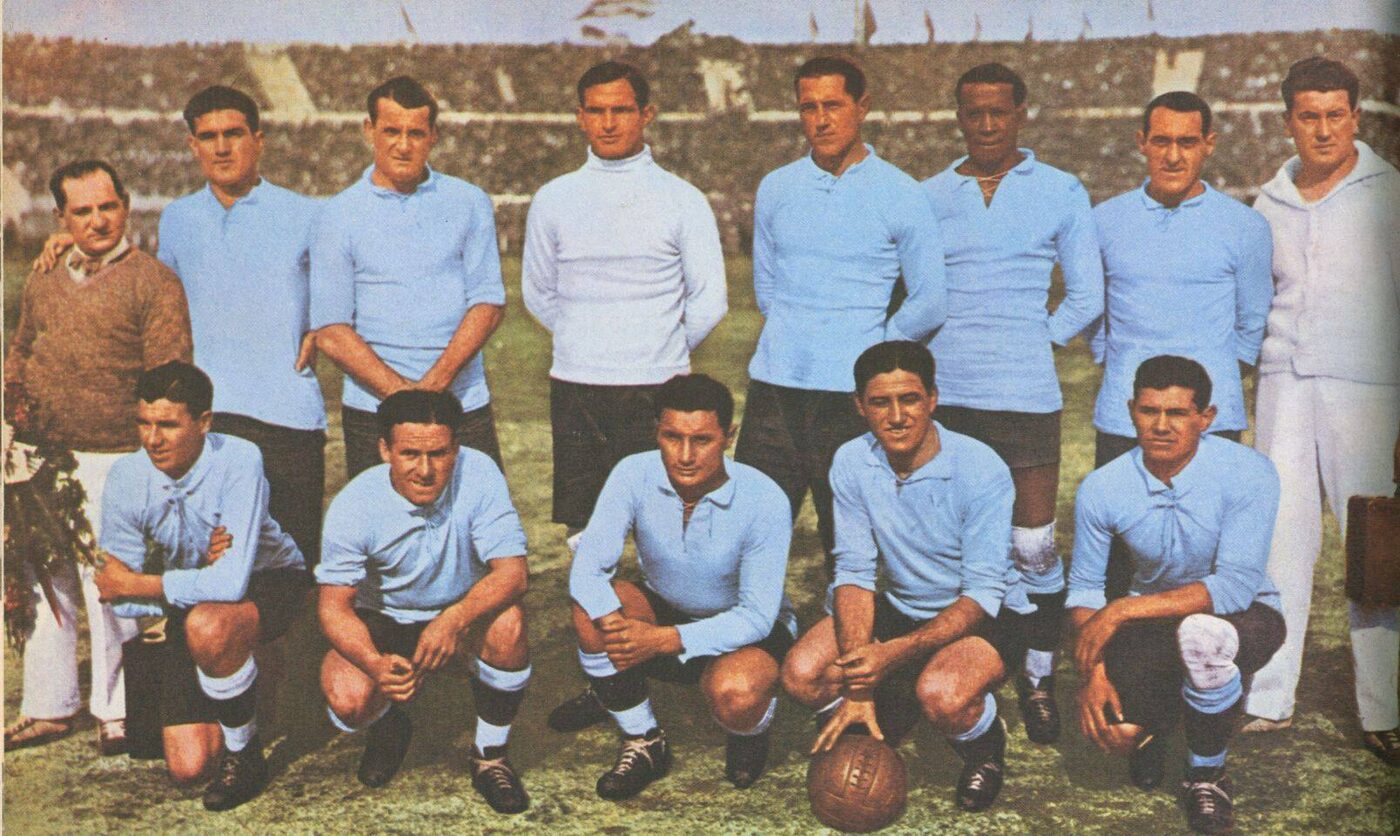

Twenty years later came the match that the country commemorates rather than merely remembers. The 1950 World Cup is the only edition decided by a final group rather than a knockout final, and the last fixture of that group, at the Maracanã on 16 July 1950, put Brazil, who needed only a draw, against Uruguay, who needed a win. The officially recorded crowd was 173,850, an all-time high for paid attendance at a football match; estimates including those who got in without paying run to 220,000. Brazil scored two minutes after the interval through Friaça. Juan Alberto Schiaffino equalised in the 66th minute and Alcides Ghiggia, running the right, put a low shot under the goalkeeper for the second. Uruguay won 2–1. The word coined for it in Portuguese and Spanish — Maracanaço, Maracanazo — has since been borrowed by both languages to mean any catastrophe suffered at home in front of one's own crowd. Ghiggia, by then the last surviving member of the Uruguayan side, died on 16 July 2015, sixty-five years to the day after he scored.
Domestically the argument is older and never finishes. Peñarol traces itself to the Central Uruguay Railway Cricket Club, founded on 28 September 1891 by employees of the British-owned Central Uruguay Railway to play cricket, rugby and — in the founders' own phrase — other male sports; it turned to football the following year. Nacional was founded on 14 May 1899 by the merger of two Montevideo clubs, Montevideo Football Club and Uruguay Athletic Club, and took the red, white and blue of Artigas; it was the first of the criollo clubs in a league then run by foreigners, and was refused admission until 1901 on the grounds that criollo clubs lacked category. The first meeting between the two was on 15 July 1900, won 2–0 by the railwaymen. Between them the clubs have taken all but a fifth of the national championships — as the association counts them, 52 for Peñarol and CURCC together and 50 for Nacional out of 123 played since 1900 — and from 1930 to 1975 no other club won at all. Whether Peñarol may properly claim 1891 as its founding date, given that the cricket club was dissolved on 22 January 1915 and that the football section had been separated from the railway company on 13 December 1913, is a question on which a great deal of ink and, later, a great deal of bandwidth has been expended.
Candombe, murga and the Carnival
The Uruguayan Carnival runs from mid-January to late February and is regularly described as the longest in the world; the Montevideo celebrations alone can last forty days. It has two distinct engines, and confusing them is the sort of error a culture group existed to correct.
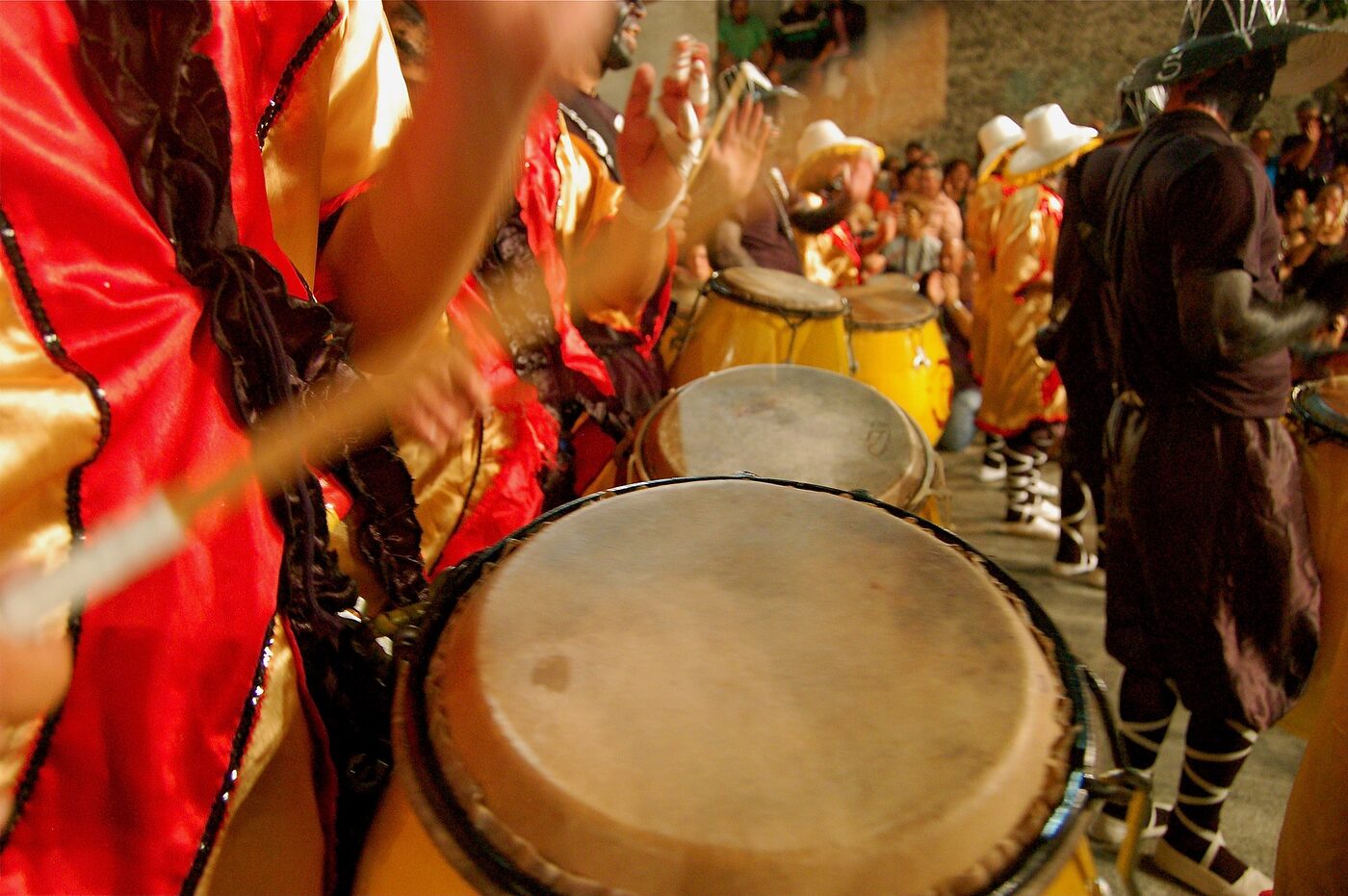
Candombe is the Afro-Uruguayan drum tradition, carried to the Río de la Plata during the seventeenth and eighteenth centuries by people enslaved in the kingdom of Kongo and the territory of present-day Angola and shipped chiefly by Portuguese traders, and sustained since in the Montevideo neighbourhoods of Barrio Sur and Palermo. It is played by a cuerda, a drum line built from three barrel drums of different sizes: the chico, small and high, which keeps the pulse; the repique, medium, which improvises against it; and the piano, the largest, which does the work of a bass. A minimum cuerda is three drummers, one to a part; a full one runs to fifty or a hundred, in rows of five or seven, the skins rope-tuned or fire-tuned minutes before they play. The drums are carried at the waist on a shoulder strap and struck with one stick and one hand. During Carnival the comparsas — eighty or ninety of them — parade in the Desfile de Llamadas, the calls, named for the summoning of the drums. UNESCO inscribed candombe on its list of intangible cultural heritage in 2009.

Murga is a different thing entirely: a form of popular musical theatre derived from the chirigota of Cádiz, performed by companies of up to seventeen singers who spend the months before Carnival preparing a suite of songs and heightened speech, some forty-five minutes long, and then perform it night after night on neighbourhood stages called tablados, and in an official competition that is followed closely and argued about at length. Murga is satirical, topical and verbal; its subject is the year the country has just had, which is why it became a vehicle of opposition under the dictatorship. Candombe is percussive and ancestral. Both are Carnival; they are not the same tradition, and neither is tango.
Tango, and the property disputes of the river
Tango belongs to both banks of the Río de la Plata, which has never stopped anyone on either bank from claiming it outright. Two of the standing disputes are Uruguayan, and both were reliable newsgroup material.
The first is settled, and settled in Montevideo's favour. La cumparsita was written in 1916 by Gerardo Matos Rodríguez, an eighteen-year-old architecture student, and first played on 8 February that year at the Café La Giralda in Montevideo — the site now occupied by the Palacio Salvo, where the city's tango museum stands today. It reached the world in a form Matos Rodríguez did not entirely control: the bandleader Roberto Firpo, handed the score that evening, judged that the march could be made into a tango and rebuilt it on the spot, splicing in material from two of his own unsuccessful tangos; the lyrics that made it famous were written in 1924 by the Argentine Pascual Contursi with Enrique Maroni, without the composer's involvement, and under a different title. The litigation ran for the better part of a quarter of a century and was ended in 1948 by an agreement drawn up by Francisco Canaro, which gave eighty per cent of royalties to Matos Rodríguez's estate and twenty to the lyricists'. In 1997 Uruguay declared the tune its cultural and popular anthem by Law 16,905. It is a very Uruguayan sort of victory: the melody indisputably Montevidean, the version everyone knows shaped in Buenos Aires, and the whole thing resolved by arbitration.
The second is not settled, though the documentary balance has long since tipped. Carlos Gardel, the central figure in the history of tango, was recorded at birth in Toulouse at about two in the morning on 11 December 1890, and registered later that day with the archdiocese as Charles Romuald Gardès, son of the laundress Berthe Gardès; a handwritten will produced after his death named Toulouse, his friends in Buenos Aires called him el francesito, and scholars working from the French birth and baptismal records have confirmed Toulouse as his birthplace. Against that stands a Uruguayan case, first argued at length by the writer Erasmo Silva Cabrera in 1967 and elaborated by others since, that he was born at Tacuarembó in 1887. It is not baseless: in October 1920 Gardel himself went to the Uruguayan consulate in Buenos Aires and filed papers stating exactly that, and a month later held an Argentine identity card describing him as a Uruguayan national. The likeliest explanation is that he had never registered for French military service during the Great War and wanted the papers of a country that had stayed neutral before touring France — but the filing is documented, and it is his own. Uruguay opened a Gardel museum at Valle Edén, some twenty-three kilometres south of Tacuarembó, in 1999, and issued a stamp in 2004 calling him the immortal Tacuaremboan.
What matters for this page is that the argument was live throughout the group's active years, and that it was conducted, on both sides of the river, with more stamina than malice. It was never settled to everyone's satisfaction, which most participants understood to be the point. The same is true of the other standing rioplatense property disputes that crossed the border with soc.culture.argentina in both directions: the true home of dulce de leche, the correct construction of an asado, and the question of whose mate is better.
Mate
Mate is not a beverage in Uruguay so much as a piece of equipment carried about the person. The infusion of dried Ilex paraguariensis came from the Guaraní, spread through the Southern Cone after colonisation, and is drunk across Argentina, Paraguay, southern Brazil and Uruguay. Uruguay's distinction is quantitative: it is the largest per-capita consumer in the world, at around nineteen litres a person a year.
The national posture — a gourd in one hand and a vacuum flask clamped under the opposite arm, on the street, on the bus, at work — is the most immediately recognisable thing about the country to anyone who has been there, and the practice is social rather than solitary: one gourd, one metal straw, refilled by whoever is serving and passed round the circle in turn, each drinker finishing it and handing it back without thanks until they mean to stop. Uruguayan mate is taken bitter, without sugar, which is one of the reliable markers distinguishing it from the sometimes sweetened versions drunk elsewhere.
There is a fact here that the newsgroup's periodic mate arguments tended not to dwell on. Uruguay grows none of it. As of 2018 the producers were Argentina, with fifty-six to sixty-two per cent of the crop, Brazil with thirty-four to thirty-six, and Paraguay with five — which is all of it. The country that drinks the most yerba in the world imports every gram. Where to buy it, in cities that stocked neither yerba nor dulce de leche, was one of the standing practical genres of the group's traffic, along with how paperwork worked through a distant consulate and who was flying to Montevideo and could carry something. And before Uruguayan newspapers were readable online, requests for news from home were a standing genre of their own in a group like this one, answered by whoever had a fresh copy or a relative with a telephone; the charter's first suggested topic, after all, was news from Uruguay.
The literature the exile carried
Uruguay produces writers at a rate its population does not explain, and the group's cultural traffic ran heavily to them — partly because the charter invited it, and mostly because the books had emigrated with the readers.
The line runs from Bartolomé Hidalgo, whose gaucho verse begins the national literature, through the Romantic period and Juan Zorrilla de San Martín, to the modernistas: Julio Herrera y Reissig, Delmira Agustini, Juana de Ibarbourou, and José Enrique Rodó, the essayist whose refined prose and modernista ideology made him the pre-eminent theorist of the school and, for a generation of Latin American students, required reading. Horacio Quiroga wrote the short stories, Felisberto Hernández the strangest of the fiction, Florencio Sánchez the plays. The Generation of 45 — Onetti, Benedetti, Ángel Rama, Emir Rodríguez Monegal, Idea Vilariño, Ida Vitale and others — supplied both the novels and the criticism. Curiously, two French poets were born in Montevideo and left as children: Isidore Ducasse, who wrote as the Comte de Lautréamont and was adopted posthumously by the Surrealists, and Jules Supervielle.
Then comes the generation that the dictatorship scattered, which is the generation the diaspora took with it.
- Juan Carlos Onetti was imprisoned in 1974 with fellow jurors of a literary competition run by the weekly Marcha, for having awarded its prize to Nelson Marra's story El guardaespaldas. He spent six months confined in the Colonia Etchepare mental institution, was released after open letters from writers including García Márquez, Vargas Llosa and Benedetti, left for Spain, won the Cervantes Prize in 1980, and never went home; he died in Madrid in 1994.
- Mario Benedetti spent the twelve years from 1973 to 1985 in exile, moving from Buenos Aires to Lima — where he was detained and deported — then to Cuba in 1976, Madrid in 1977 and Palma de Mallorca in 1980, while his wife remained in Montevideo caring for both their mothers. He returned in March 1985 and thereafter divided his life between Montevideo and Madrid.
- Eduardo Galeano was imprisoned after the 1973 coup and then fled to Argentina, where he founded the magazine Crisis; his 1971 book Las venas abiertas de América Latina was banned under the military governments of Uruguay, Argentina, Brazil and Chile. He returned to Montevideo at the beginning of 1985.
- Alfredo Zitarrosa, the singer whose milongas are as close as the country has to a second anthem, lived in exile from 1976 to 1984.
Their books and their records had travelled out with the people, and conversation about them in a diaspora newsgroup was rarely only about the work. A record of Zitarrosa in a flat in Stockholm in 1994 was doing a job that had nothing to do with musicology.
Beef, and the town called Fray Bentos
The Uruguayan economy has been an argument about cattle since before there was a Uruguay, and the group's traffic touched it constantly — in complaints about the price of a decent cut abroad, in the annual asado threads, and in the industrial history that put a Uruguayan town's name on tins in British larders for a century.
In 1847 the German chemist Justus von Liebig published a method for concentrating beef into an extract, intending a cheap nutrition for people who could not afford meat, and deliberately declined to keep the process to himself: the benefit, he wrote, should be placed at the command of as large a number of persons as possible. Meat in Europe was too expensive for it to pay. In 1862 a young German railway engineer, George Christian Giebert, read Liebig's Familiar Letters on Chemistry and wrote to him proposing that the process be industrialised where cattle were abundant and were being killed for their hides alone. With Liebig's agreement Giebert built the plant at Villa Independencia on the Uruguay river in 1863; the town was renamed Fray Bentos, and the British-registered Liebig's Extract of Meat Company was formed in 1865 to run it. Tinned corned beef followed from 1873 under the Fray Bentos label, the mark was registered in 1881, and the Oxo cube — the same company's later product — appeared in 1911. From 1899 a successor firm, the Frigorífico Anglo del Uruguay, made corned beef on the same site. It closed in 1979, after more than a century, and a museum opened in the buildings in 2005. On 5 July 2015 UNESCO inscribed the plant and its company town, the Barrio Anglo, on the World Heritage list as the Fray Bentos Cultural-Industrial Landscape.
The livestock economy behind all that has not gone away. In 2007 the national herd stood at around twelve million head against a little over three million people — 3.8 cattle per inhabitant, the highest ratio in the world — though eleven per cent of farmers held fifty-four per cent of the animals, and most holdings, 25,500 out of 39,120, are family-managed. Beef and wool are the main source of income for about two-thirds of them, and beef is the country's largest export. It sits at the centre of the cuisine accordingly: the asado, which is a social institution before it is a method of cooking, and the chivito, which despite its name involves no goat whatsoever.
Rioplatense Spanish
The group's working language was Spanish, as the charter predicted, and the variety was Rioplatense — the Spanish of the river, shared with Buenos Aires and immediately identifiable anywhere in the Hispanophone world. Its markers are few and strong: voseo, the use of vos in place of tú with its own verb forms, in writing as well as speech, of which this is the most prominent dialect anywhere; yeísmo carried further than elsewhere, so that ll and y merge into a postalveolar fricative, voiced as in English measure or voiceless like the sh of ship; the aspiration or loss of syllable-final s; and intonation patterns that resemble those of Italian dialects, the residue of mass Italian immigration between the 1870s and the 1960s. On the Brazilian frontier, around Rivera and Santana do Livramento, the local speech is a variety of Portuguese heavily influenced by Rioplatense Spanish, called fronteiriço or riverense and portuñol by its own speakers. Uruguay's Academia Nacional de Letras codifies the national usage alongside, and separately from, the Academia Argentina de Letras, which tells you something about the relationship.
Writing it on 1990s Usenet cost something. The ASCII of the day had no ñ, no accented vowels and no inverted opening punctuation, and the eight-bit character sets that did were unreliable in transit; posters either used the correct characters and hoped, or wrote the words unaccented and let the reader supply what was missing. The full story of what a seven-bit network did to a Latin-script language, and of the workarounds it produced, is told on the soc.culture.quebec page and not repeated here. For Spanish the tax was real but small — a handful of characters — which is why Spanish-language groups adapted with less visible strain than some of their neighbours.
The neighbours across the river
The proposal for this group was cross-posted to soc.culture.latin-america, alt.culture.argentina, soc.culture.brazil and soc.culture.spain, and the traffic afterwards followed the same channels. The border with soc.culture.argentina — which had itself been created only two months before, in August 1993 — was busy in both directions, for the excellent reason that the two countries share a language variety, a river, a musical form, a dispute about most of the above, and several hundred thousand people who hold papers from one and live in the other. The border with soc.culture.brazil, a considerably older group, was quieter and more linguistic, and busiest at Carnival and at World Cups.
The regional relationship is not only cultural, and Uruguay has generally done well out of institutionalising it. Mercosur was created by the Treaty of Asunción on 26 March 1991, by Argentina, Brazil, Paraguay and Uruguay; its headquarters are in Montevideo. The older Latin American Integration Association, created on 12 August 1980 by the Montevideo Treaty in place of its 1960 predecessor, is headquartered there too. The smallest founding member holding the secretariat is a familiar Uruguayan arrangement, and not an accidental one: a state that spent the nineteenth century as a buffer between two large neighbours has spent the twentieth and twenty-first making a profession of being the place where they meet.
Those two groups own their own countries on this site, and this page does not summarise them. It notes only that a reader of soc.culture.uruguay in 1997 was, in practice, reading two or three groups at once, and that the arguments that crossed between them were the oldest arguments in the neighbourhood.
What the record does not show
This page is unusually well supplied with primary documents and unusually poor in evidence about the group's actual life, and the distinction should be stated plainly.
What survives, and is quoted above, is the administrative record: two Requests for Discussion, three Calls for Votes, one result with a complete ballot roll, two newgroup control messages, one unauthorised rmgroup, and a description line still current in the ISC configuration files. Every date, name and number in this article's account of the group's creation comes from those files, and every one of them can be checked against the same public archive.
What does not survive, or at least has not been found for this page, is almost everything else. There is no recovered FAQ for the group. There are no subscriber or readership estimates: the network-wide readership surveys of the early 1990s did not sample reliably at this granularity, and no equivalent measurement for a group of this size has been located. There are no reliable article counts by year. The group was unmoderated, so there is no moderator, no submission archive, and no editorial record of any kind. No individual thread, subject line or poster is cited in this article, and none should be inferred: descriptions here of what the group discussed are drawn from the charter's own topic list, from the documented preoccupations of the community the charter names, and from the general character of the branch — not from a count of postings.
The 231 names on the 1993 ballot are the only membership-shaped document in existence, and they are a snapshot of who was willing to send one e-mail in September 1993, not a readership. Several of those people certainly never posted again. Others who posted for a decade never voted at all, because they arrived later. Read the roll as evidence about the reach of the network in 1993, which it is, rather than as a roster of the group, which it is not.
Scope and limits
This entry describes one newsgroup and the world it belonged to. It is not a history of Uruguay, and where it sets out the national record it does so as a chronology, because the group's conversations depended on that chronology and a reader arriving from a search engine will not have it to hand.
On the contested material — the accountability laws and the two referendums about them, the birthplace of a singer, the founding year of a football club — this page reports what the documents say, notes where they disagree, and stops. Those arguments were had in the group by people with far better standing to have them, and it is not the function of an archive page to adjudicate them thirty years late.
Neighbouring subjects belong to neighbouring pages. The branch itself, its naming conventions and the vote machinery invoked throughout this article are covered on the soc.culture.* hub. Argentina and Brazil have their own entries and their own connectivity histories. The seven-bit character-set problem is treated at length under soc.culture.quebec, and the Olympic movement under rec.sport.olympics. What is left here is the thing itself: a small, well-documented room, opened by 231 votes in October 1993, for a country that keeps something like a seventh of itself somewhere else.
Reading soc.culture.uruguay today
- Historical archive: Google Groups — soc.culture.uruguay (coverage varies by group and era).
- Open in a newsreader:
news:soc.culture.uruguay— the original site offered exactly this link, and it still works if your system has a newsreader registered for thenews:scheme. - Live access: point an NNTP newsreader at a modern server — see accessing Usenet today.
- The original news2mail e-mail subscription service ended in the mid-2000s and no longer operates.