soc.culture.asturies
Asturian culture and the Asturian language.
Focused on Asturias in northern Spain: the Asturian language (asturianu/bable) revival, mining-valley history, cider culture and regional politics. Posts ran in Asturian, Spanish and English.
The group was part of a wave of minority-language groups on Usenet that gave small languages an early online written record.
On this page
- The name on the door
- The paperwork, in dates
- Who actually voted
- Afterwards: one forged removal, and a line that would not die
- A language with an academy and no official status
- What has been asked for, and what the answers have been
- The language itself
- Counting speakers, and why the numbers disagree
- The standard, and how recent it is
- Writing Asturian in seven bits
- What was discussed
- A dated record
- Where the readers were
- Why the smallest address still keeps a page
- What the record does not show, and the limits of this page
The name on the door
The first argument a newsgroup can have is about its own address, and this one settled that argument before it existed. Asturies is the region's name in Asturian; Asturias is the Castilian form, and the form the rest of the world uses. The proposal that created the group asked for the first, and got it. Under the Big Eight's creation machinery every name was proposed in public, argued over in public and voted on in public, so the spelling was not a private editorial choice: it went into the newsgroup name itself, and from there into every newsreader listing, every crosspost header and every site's active file. A name in the language it is about is a small claim, but it is a claim, and it was made in the one place on Usenet where names had to survive a ballot.
The proposal is dated. A Request for Discussion for an unmoderated soc.culture.asturies was posted on 27 November 1995 by Ruben Zurita, writing from a University of Oviedo engineering host at Gijón, and approved into the moderated group news.announce.newgroups. It asked for the Asturian spelling and nothing else; no alternative name is proposed anywhere in it. The Internet Systems Consortium's mirror of the news.announce.newgroups archive holds files for nearly two hundred soc.culture.* proposals of the period, including a failed soc.culture.andalucia and a duly created soc.culture.basque. It holds no file for soc.culture.asturias. On the formal record, the Castilian spelling was never proposed, never voted on and never rejected; it was simply never asked for.
That is a narrower statement than it may look. The three-week discussion happened in news.groups, whose traffic the ISC archive does not mirror, so the absence of a rival proposal shows that nobody filed one, not that nobody objected. What the paperwork does show is that the objection, if it was made, left no mark on the process: the Call for Votes went out under the Asturian spelling, and so did the result.
The one-line description that shipped with the group is a study in the same question left half-resolved. It reads, in the newsgroups file, exactly as it did in 1996:
soc.culture.asturies Asturian culture.
The name is in Asturian; the description is in English, using the adjective English inherited by way of Castilian. Thirty years later that line is still there, character for character, in the newsgroups file distributed from the ISC's configuration archive, and the group is still carried in the matching active file — which is more than can be said for a good many groups created with far larger constituencies.
The proposal's rationale is worth reading for what a 1995 case for a small newsgroup looked like. It leans on geography, on the Roman wars, on the Reconquest, and on the constitutional formality that the heir of the Spanish throne is named the Prince of Asturias — a title created in 1388 for the heir of John I of Castile, the future Henry III, and one whose wording the rationale has since outlived: the holder has been a princess since 19 June 2014. It also asserts that Asturian culture is deeply marked by its celtic roots, and nominates cider as the Asturies national drink. Whether Asturias is a Celtic nation was, and remains, a matter of public argument; the point here is only that the group's founding document took a position on it, in writing, before a single article was posted.
The paperwork, in dates
The administrative trail is complete, which for a group this small is unusual and worth setting down in full. The Request for Discussion is dated 27 November 1995 and announced a three-week discussion in news.groups, to be followed by a Call for Votes conducted by a neutral third party. The first Call for Votes was issued on 18 January 1996 by Warren Lavallee, posting under the banner of the Usenet Volunteer Votetakers, the standing pool of neutrals who ran Big-Eight ballots in that era. A second and final call followed on 28 January. Votes had to reach the votetaker by 23:59:59 UTC on 8 February 1996, cast by e-mail and acknowledged individually.
The result was posted on 10 February 1996 under the subject line RESULT: soc.culture.asturies passes 790:44. Its arithmetic is stated in the message itself: 790 YES votes and 44 NO votes, for 834 valid votes, plus 12 ballots rejected as invalid. The two conditions are recited in the result exactly as the guidelines of the day put them — YES votes must be at least two-thirds of all valid votes, and there must be at least 100 more YES votes than NO votes. Both were cleared with room to spare. The result also announced a five-day period in which allegations of voting irregularity could be raised before the moderator of news.announce.newgroups created the group.
The group was then created by control message. David C. Lawrence, moderator of news.announce.newgroups, sent the newgroup control for soc.culture.asturies at 15:30:03 GMT on 15 February 1996, with the newsgroups line and a charter culled, as the message says, from the vote result announcement. He sent it again at the same minute of the day on 22 February and once more on 15 March, the routine repetition by which the Big Eight nudged laggard news servers into agreement.
The charter itself is short, and its most consequential clause is the last one but two. On subject matter it is a list, which is run together here into a single line:
soc.culture.asturies is intended to be an unmoderated forum for the discussion of issues relevant to asturian culture. All topics for discussion relevant to the asturian people are appropriate but would include, not exclusively: Asturian language; Asturian history; Asturian liturature, music and art; Asturian customs and traditions; Asturian politic; Asturian economy; Asturian nature.
The misspelling of literature is the charter's own. It survives four times in the news.announce.newgroups file — in the Request for Discussion, in both Calls for Votes and in the result — and three times more in the control archive, in each of the creation messages of 15 and 22 February and 15 March, because nobody along the chain was authorised to tidy it and nobody tried. On language the charter is explicit, and it is the sentence that makes this a language group rather than a regional one:
The primary languages of soc.culture.asturies will be asturian and spanish. Posting in other languages will be allowed, and we encourage translations into one or all of the primary languages for the benefit of the users of USENET.
Two named languages, in that order, with translation encouraged rather than required — a settlement that put Asturian first in the constitution of a forum where, by every survey of the period, most of the potential readership would write Castilian more fluently. The charter closes by discouraging flame wars and bad language and directing anyone in the mood for either to alt.flame, which is as close as a Big-Eight charter of 1996 came to a code of conduct.
One further detail of the paperwork is diagnostic of how the proposers saw themselves. The Request for Discussion and both Calls for Votes went to a fixed distribution of eight groups: news.announce.newgroups, news.groups, soc.culture.spain, soc.culture.europe, and then soc.culture.celtic, soc.culture.irish, soc.culture.scottish and soc.culture.welsh. Four of the eight were Celtic groups. The campaign was pitched to the Atlantic arc rather than to the other minority-language nations of the Spanish state — though the chronology is worth keeping straight before that is read as a snub. When the Request for Discussion went out on 27 November 1995, soc.culture.catalan did not yet exist: its ballot had closed, but its result was posted only on 28 November, the following day, and its creation control message was sent on 4 December 1995. soc.culture.basque did not exist either, and had not even been proposed; its own Request for Discussion is dated 21 March 1996, five weeks after this group was already running. Of the two, only Catalan existed by the time the Calls for Votes went out in January 1996, and it was not added to the list. The three groups are covered on their own pages, soc.culture.catalan and soc.culture.basque, and the Breton group that shared this proposal's Celtic framing has one too, at soc.culture.breton. Together with the broad roof of soc.culture.spain, they gave the smaller nationalities of Iberia addresses of their own.
The tally deserves one comparison, because it is counter-intuitive. Among the western European minority-language groups of the same window, soc.culture.breton passed 400 to 25, soc.culture.catalan passed 532 to 28 and soc.culture.basque, proposed as moderated, passed 164 to 62; soc.culture.andalucia failed 57 to 32. At 790 to 44, the group for much the smallest of those constituencies drew the largest creation vote of the set. The explanation is not that Asturias out-argued the others. It is in the voter roll, and the votetaker noticed it at the time.
Who actually voted
Big-Eight ballots published the names and addresses of every voter, so that anyone could check the count. The consequence, thirty years on, is that the vote roll for this group is the only headcount of anything connected to it that survives — and it is a real one, with 790 e-mail addresses on the YES side and 44 on the NO side, all of them still legible in the archived result.
Sorted by top-level domain, the 790 YES votes break down as 504 from .es, 91 from .edu, 61 from .com, 32 from .uk, 23 from .de, 16 from .net, 9 from .fr and 7 from .ch, with single figures from a further twenty domains including .mx, .ca, .pt, .ar and .ve. Just under two-thirds of the votes came from inside Spain; a little over a third came from outside it.
The Spanish two-thirds is far more concentrated than that summary suggests. Of the 790 YES votes, 437 — more than half of the entire favourable vote — came from hosts in the uniovi.es domain, that is, from machines of the University of Oviedo, the only university in the region. A single host, etsiig.uniovi.es, the Gijón engineering school from which the proponent himself posted, accounts for 254 of them, and other machines under that school's name for 46 more. The chemistry faculty's five hosts supplied 63 votes between them, the university computing centre's 32, and a second engineering school at Oviedo 33. Only 67 of the 504 Spanish votes came from anywhere in Spain other than the University of Oviedo, and those were scattered across universities and companies from Castellón to Barcelona with no Asturian cluster among them. The picture is unambiguous: soc.culture.asturies was created by a student and staff mobilisation at one university, conducted over a fortnight in early 1996 in accordance with rules that permitted exactly that.
None of this had to be reconstructed afterwards, because the votetaker saw it and said so. Appended to the roll is a short note in which he records that he was concerned about the number of votes from uniovi.es and thought it might be vote fraud, that he contacted the proponent, who was at the same domain, and was referred to the system administrator. The reply he prints is from the university's postmaster, and it is a snapshot of the Asturian internet in February 1996: Asturias has only one university, spread mainly over eight campuses in three cities, with 40,000 students and 2,000 teachers and staff using a thousand computers connected to the internet, and the main relay, etsiig.uniovi.es, delivers over 60,000 messages a week. The votetaker concluded that they were valid votes and counted them all, and then did the arithmetic that makes the point better than any argument: if he had deleted every vote from that domain, just to be safe, the result would have been about 354 to 30, and the proposal would still have passed. He wrote that the point was mostly moot, and on the numbers it was.
It is worth being precise about what the concentration does and does not mean. The Big-Eight guidelines required one person and one vote, cast directly by the voter, with the explicit purpose of measuring the genuine interest of people who would read the proposed group. They did not require the voters to be geographically dispersed, and organised turnout among people who genuinely wanted a group was the mechanism working as designed rather than against it. The votetaker examined the concentration, satisfied himself, published his reasoning alongside the roll, and let the count stand; the group was duly created five days after the challenge period opened. What the roll cannot tell us is how many of those 437 ever read the group afterwards. A creation vote measures the peak of a campaign; a readership is what is left the following winter.
The non-Spanish third is the part that bears on everything below. Ninety-one .edu votes in February 1996 means ninety-one accounts at educational institutions, overwhelmingly North American ones at that date, and the roll shows them spread across fifty-six separate institutions rather than clustered at one; the twenty-five distinct .uk hosts, and the .de, .fr and .ch entries, look much the same. For a region of roughly a million people whose emigration went overwhelmingly to the Americas, a founding electorate one-third of which sat abroad is the first documentary sign of a pattern the rest of this page returns to.
The domestic side of that arithmetic had a simple cause. Public dial-up in Spain arrived through the incumbent operator rather than around it: Telefónica opened InfoVía, reached by dialling 055 from anywhere in the country and billed by the minute, on 4 September 1995, less than three months before this Request for Discussion; it was deactivated on 1 December 1998 and replaced by InfoVía Plus the following year. Before that, and for most Spanish households well after it, network access meant an academic affiliation — RedIRIS, the network joining Spanish universities and research centres, was founded in 1989 as a project of the national research plan run with Telefónica, and Spain's country-code domain .es had been entered in the IANA root database on 14 April 1988. The International Telecommunication Union series republished by the World Bank puts the share of individuals in Spain using the internet at 0.4 per cent in 1995, 4.4 per cent in 1998 and 13.6 per cent in 2000, reaching 44.0 per cent only in 2004. The general shape of that story — how Spanish households came online, and how late — belongs to soc.culture.catalan, which tells it at length. What matters here is the local consequence: in February 1996 the Asturian internet was, very nearly, the University of Oviedo.
Afterwards: one forged removal, and a line that would not die
The control-message archive for the group runs to five entries, and the last one is the interesting one. Timestamped 4 November 2001 in GMT, and the evening of 3 November in the North American time zone from which it was injected, a message was posted carrying Control: rmgroup soc.culture.asturies and the body text please remove the bogus newsgroup soc.culture.asturies. It bore the name and address of a well-known Usenet software maintainer in its From, Sender and Approved headers; it travelled through a Quebec consumer internet provider; it carried its control instruction duplicated into an X-No-Archive header, where such an instruction has no business being; and it was signed with a line of machine-generated nonsense of the sort produced by dissociated-text toys. It was crossposted to soc.config, soc.control and soc.groups.
Nothing about it matches how a legitimate Big-Eight removal worked. Groups in the Big Eight were removed by the moderator of news.announce.newgroups after a public proposal and a public decision, and the group this message called bogus had passed a published ballot 790 to 44 and carried a creation control from that moderator on file. Forged control messages of this kind were a recurring nuisance on Usenet in the period, and this one has every mark of one; this page does not assert who sent it, and does not name the person whose identity it borrowed. It was not honoured. soc.culture.asturies appears in the newsgroups file and the active file distributed from the ISC configuration archive today, still carrying the description it was given in 1996.
Rather earlier in the sequence there is a quieter curiosity. On 20 February 1996, five days after the official creation, a second newgroup control for the group was issued from news.rediris.es, the Spanish academic network's own news server, with a distribution of es — a local administrator making sure the group actually appeared on Spanish machines rather than waiting for the international feed to settle. Its body has lost the group name altogether and been broken by a line-wrap, so that under the words For your newsgroups file: there stands only Asturian cult and, on the next line, ure. It is a very small artefact and an entirely characteristic one: the group's constituency did not simply wait to be delivered a newsgroup, it went and installed it.
The Big Eight was not the only namespace to acquire an Asturian address, though the others came later and without ceremony. The unmoderated alt.* hierarchy required no vote at all, and the control archive records alt.languages.asturian newgrouped on 10 June 2000 from a throwaway address, with an X-No-Archive header and nothing in the body but a bare newsgroups line carrying no description; alt.fr.lettres.langue.asturienne on 24 July 2004, created from France within the French-language alt subtree and reissued in September of that year; and alt.ast on 27 February 2005, described in its own control message, in French, as En asturien. All three are still in the ISC active file. None of them ever had to persuade a hundred net voters of anything, which is precisely the difference between the two hierarchies; the general point is made on the soc.* hierarchy page.
A language with an academy and no official status
Everything the group argued about most persistently rests on a single legal fact, and the fact is unusually clean. Asturian has a language academy, a codified orthography, a grammar, a dictionary, a school subject and a modern literature. It is not co-official anywhere. Among the languages of the Spanish state that possess the first list, it is the principal one that lacks the second, and the gap between the two is the space in which the group's longest threads lived.
The regulator has a date and a founding instrument. The Academia de la Llingua Asturiana was created by Decree 33/1980 of the Consejo Regional de Asturias — the pre-autonomy regional council — on 15 December 1980, and approved by Decree 9/1981. Xosé Lluis García Arias was its first president, from 1980 until 2001, when Ana Cano succeeded him. It has published the normative apparatus of the language in a recognisable sequence: the Normes Ortográfiques y Conxugación de Verbos in 1981, the Gramática de la Llingua Asturiana in 1998 and the Diccionariu de la Llingua Asturiana in 2000. Since 1982 it has kept a Day of Asturian Letters, the Día de les Lletres Asturianes, on the first Friday of May.
The constitutional position is set by the Statute of Autonomy, Organic Law 7/1981 of 30 December, published in the state gazette on 11 January 1982 and in force from 31 January. Article 4 of the Statute, in its original wording, reads in full:
El bable gozará de protección. Se promoverá su uso, su difusión en los medios de comunicación y su enseñanza, respetando, en todo caso, las variantes locales y voluntariedad en su aprendizaje.
In English: Bable shall enjoy protection; its use, its diffusion in the media and its teaching shall be promoted, respecting in all cases the local variants and the voluntary nature of its learning. The list of the Principality's exclusive competences adds the fomento y protección del bable en sus diversas variantes que, como modalidades lingüísticas, se utilizan en el territorio del Principado de Asturias — promotion and protection of bable in its various variants, which are used as linguistic modalities in the territory of the Principality. That item stands as Article 10.1.21 in the consolidated text; the 1998 language law, drafted under the earlier numbering, cites the identical wording as Article 10.1.15.
Two things are absent from the Statute's text, and their absence is the whole subject. The word oficial does not appear. And the language is called a set of modalidades lingüísticas, linguistic modalities, rather than a language — the formula the Spanish Constitution of 1978 uses in its Article 3.3 for linguistic modalities as cultural heritage, as distinct from the Article 3.2 mechanism by which the other Spanish languages become official in their autonomous communities in accordance with their Statutes. Because officiality runs through the Statute, making Asturian co-official has always required amending the Statute, and amending the Statute has always required the majorities described below. The consolidated text records three amending organic laws in all: 3/1991 of 13 March, 1/1994 of 24 March and 1/1999 of 5 January. Article 4 was touched once, by the last of them, which added a second paragraph stating that a law of the Principality would regulate the protection, use and promotion of bable. Its first paragraph has not been altered since 1981; the gazette's consolidation differs from the original only in the placing of two commas and one definite article.
That promised law had in fact arrived first. Law 1/1998 of 23 March, on the use and promotion of bable/Asturian, is the operative instrument, and it is worth reading closely because it is generous and limited in the same breath. Article 1 calls bable/Asturian the traditional language of Asturias and repeats the Statute's protection formula. Article 2 extends the same regime, by special regulation, to gallego/asturiano in the zones where it is the proper linguistic modality. Article 4.2 is the clause most often cited:
Se tendrá por válido a todos los efectos el uso del bable/asturiano en las comunicaciones orales o escritas de los ciudadanos con el Principado de Asturias.
The use of bable/Asturian in citizens' oral or written communications with the Principality shall be held valid for all purposes. Article 4.1 gives every citizen the right to use and express themselves in the language, in speech and in writing; Article 4.3 says the Principality will encourage its knowledge among public employees working in Asturias and that such knowledge may be valued in examinations and competitions for posts where the characteristics of the post and the nature of the duties require it. The law goes no further than may.
The limits are drawn in the same articles. Article 5.1 says the Principality's dispositions, resolutions and agreements, and the laws passed by the Junta General, may be published in bable/Asturian, in a separate edition of the official regional bulletin. Article 5.2 says institutional publications, forms, leaflets and announcements may appear in Castilian, in bable/Asturian or in both — but that anything intended to have effect as against third parties must obligatorily be published in Castilian. Article 10 guarantees the teaching of the language at all levels and grades, within school hours and as part of the curriculum, while respecting the voluntary character of learning it, and provides that choosing it may in no case be a ground of discrimination against a pupil. Article 15 gives the region's place names their official form in the traditional version, with a bilingual form permitted where the Castilian version is also in general use, the Council of Government determining them on the advice of the Principality's toponymy board. Taken together: a citizen may write to the administration in Asturian and be answered; the administration must publish in Castilian; a pupil may study Asturian and may not be penalised for it; nobody may be required to know it.
The law also assigns institutional roles, and one of them lands on the institution that supplied more than half the group's creation vote. Article 16 names four consultative and advisory bodies to the administration: the University of Oviedo, the Academia de la Llingua, the toponymy board and the Real Instituto de Estudios Asturianos. Article 17 makes the University of Oviedo responsible, through the relevant departments, for the initial training of the teachers needed to teach bable/Asturian, and for linguistic and philological research on the language. Article 18 sets out the Academy's functions: following regional programmes and plans, issuing opinions on its own initiative or at the request of the parliament or the regional government, and advising and making proposals when asked.
Two further instruments complete the position. Spain ratified the European Charter for Regional or Minority Languages on 9 April 2001, naming Asturian in its instrument as the llingua propia of Asturias; Asturian has been covered by the Charter's safeguard-and-promote provisions since 1 August 2001. And the Constitutional Court has since ruled on what Article 4.2 of the 1998 law is worth. In an order of 25 February 2010 it refused to admit, as manifestly unfounded, a question of unconstitutionality raised against that article by an Oviedo administrative court, on the reasoning that the provision does not recognise bable/Asturian as a normal means of communication within the regional administration, nor attribute that condition to it in dealings with private parties with full validity and legal effect — those being, the court said, the identifying marks of an official language. What the article does, on that reading, is deprive the administration of any discretion to refuse a communication written in Asturian. The right is real, and it is not officiality; the court said so in terms.
The wider architecture this sits in — the Spanish state's minority-language settlement, the autonomous-community system, and how a standard language and its keeper relate to a state — is set out on soc.culture.catalan and is not repeated here. The Asturian case is the one where the architecture exists and the top storey was never built.
What has been asked for, and what the answers have been
The demand has a name in Asturian public life — la oficialidá, officiality — and its content has been constant since the Statute was drafted: amend Article 4 so that Asturian is co-official with Castilian in the Principality, on the model of the other autonomous communities with a language of their own. The demand predates the newsgroup by fifteen years and has outlived it by more than twenty. This section records what has been asked and by whom, and what happened; it reaches no view on the merits, which are a live political question in Asturias.
The asking has come from a heterogeneous coalition rather than a party, and it is older than the Statute it wants amended. The first demonstration for the language was held in 1976, under the slogan Bable nes escueles, Autonía rexonal — Asturian in the schools, regional autonomy — and the campaign of that period, remembered by the same slogan, consisted largely of painting it on walls across the region. On the civic side the standing bodies are the Xunta pola Defensa de la Llingua Asturiana and, later, Iniciativa pol Asturianu, which have organised demonstrations, petitions, sit-ins for the school subject, street classes and press campaigns; a coordinating vehicle, the Conceyu Abiertu pola Oficialidá, convened joint mobilisations for years. On the party side the demand was carried first by Asturian formations of modest electoral weight — Andecha Astur, Unidá Nacionalista Asturiana, the Unión Asturianista — and adopted during the 1990s by Izquierda Xunida, the Asturian federation of Izquierda Unida. Two unions campaign for it, the general union CSI and the teachers' union SUATEA. Opposition has been equally organised, and has ranged from arguments about cost and imposition to the position put by a Vox deputy in the regional parliament in May 2021, that officiality is a caprice and not a right; the same party has described the co-officiality movement as an invention.
The procedural answer is arithmetic, and it explains why fifty years of campaigning have not produced a change. Under the Statute's own reform title, the initiative belongs to a quarter of the members of the Junta General, to two-thirds of the Asturian councils, to the regional government, or to the Spanish government or the Cortes; a reform must then be approved by the Junta General by a three-fifths majority of its members — 27 of the current 45 deputies — before being sent to Madrid to be passed as an organic law. Only a reform confined to widening competences in matters not constitutionally reserved to the state may pass on an absolute majority, and that exception was itself added in 1999. Co-officiality is not such a matter. No reform touching Article 4 has ever assembled 27 votes. The consolidated text of the Statute in the state gazette still carries the 1981 wording of Article 4's first paragraph.
Attempts are on the record all the same, and the earliest of them show the obstacle in miniature. In April 1988 the Junta General received the first popular legislative initiative ever brought in the autonomous community; its subject was the use of Asturian. The chamber's governing bureau ruled it inadmissible on 27 April 1988 on the ground that it exceeded the community's exclusive competence under Articles 4 and 10.1 of the Statute. In September of the same year a second popular initiative, this one to reform the Statute itself, was signed by five promoters including the writer and politician Xuan Xosé Sánchez Vicente, a founder of Conceyu Bable and later of the Partido Asturianista; the bureau ruled it inadmissible on 13 October 1988, on the ground that under Article 57.1 of the Statute the promoters had no standing to initiate a reform at all. A parliamentary reform proposal brought that December by the groups of Alianza Popular, the CDS and Izquierda Unida was rejected in plenary for want of the required majority. The commentary describes both 1988 reform attempts as directed at widening the community's competences rather than at the language alone.
The ordinary legislative route was no quicker. The regional government of Pedro de Silva had a bill of its own, a Proyecto de ley de protección del bable, admitted for processing on 29 November 1988 and containing most of what the 1998 law would eventually contain; the government withdrew it in July 1989 in order to bring a slightly weaker text, in which an obligation on the public authorities to promote the language became a simple statement that they would do so, and that second text lapsed in 1991 at the end of the legislature. What finally produced Law 1/1998 was a budget arithmetic rather than a change of mind: the Popular Party government of Sergio Marqués, twenty-one deputies short of a solid majority and unable to pass its 1996 budget, agreed terms with the Partido Asturianista, and the language bill was part of the exchange. Its initiative was approved by the chamber's bureau on 6 November 1997 and processed as urgent; alternative texts tabled by the Socialists and by Izquierda Unida were debated and rejected; the law was published in the regional bulletin on 28 March 1998 and in the state gazette on 30 April. Its constitutionality was publicly disputed before it passed, in a debate of constitutional and administrative lawyers held in Oviedo on 26 January 1998, on precisely the points that would later reach the Constitutional Court.
Reform attempts have continued in every decade since. The Consejo Consultivo of the Principality answered a long list of questions about a statutory reform in its opinion 93/2006; the regional parliament set up a working group on the reform in October 2007 which met into 2008, and the negotiations between the two largest parties collapsed not over the language but over a demand to write the capital status of Oviedo into the text. The most recent sustained attempt began in the parliamentary term of 2019 to 2023, when the regional government announced a Statute reform including co-officiality for Asturian and for Eonavian; it drew an organised campaign against it, directed in particular at the president of the Principality and at the one deputy whose vote would have carried it, and it did not produce an amended Statute. On 4 May 2024 the president again stated publicly that it was the hour for officiality. Article 4 stands as it was written.
Between the demand and the constitutional answer sits a layer of smaller, dated episodes that show what non-officiality means in practice, and these are the concrete material the argument runs on. The chamber's own rules of procedure were reformed in 2018 so that deputies might use bable/Asturian in parliamentary proceedings; Vox's parliamentary group in the Congress of Deputies challenged that reform before the Constitutional Court in 2020, arguing that it gave the language validity it did not have and that its use would obstruct parliamentary debate, and the court upheld the provision, holding it a promotion of the language rather than a disguised declaration of co-officiality. But the 2018 reform covered deputies and only deputies. On 1 October 2019 the regional culture councillor, herself a member of the Academy and a published author in Asturian, began her first committee appearance in the language; a Popular Party member of the committee said she could not follow it and asked for an interpreter, the Vox spokesman asked for a language everyone present could understand, and the chamber's lawyers, reading Article 11 of the rules literally, advised that only deputies had the right to speak Asturian in the chamber. The bureau asked her to continue in Castilian; she said publicly that she found it humiliating. The rules were amended on 1 July 2020 so that any person appearing before the Junta General may use the language, on the votes of the Socialist, Podemos, Izquierda Unida and Foro Asturias deputies.
The courts have supplied the other episodes. In January 2009 a defendant before the Audiencia Nacional in Madrid began to address the court in Asturian; the presiding judge interrupted him, established that he could speak Castilian, and required him to use it on the ground that Asturian is not a co-official language, telling him that he had no right to speak in whichever language he pleased. An interpreter of Asturian was present in the room. The defendant declined to testify and the proceedings were interrupted. Eight years earlier, in 2001, the nationalist party Andecha Astur had lodged a complaint under Article 510 of the Penal Code against a subsidised religious school in Villaviciosa which, it alleged, fined pupils twenty-five pesetas for every word spoken in Asturian; the investigating court in Villaviciosa dismissed the case, holding that fining pupils for using Asturian was not a criminal offence, and the provincial court at Oviedo agreed on appeal, adding that the matter should in any case have been taken through the administrative courts. Declarations of officiality by individual councils, among them Langreo and Bimenes, were struck down by the Constitutional Court; a local ordinance on the use of Asturian at Noreña was annulled by the regional high court in 2018. The Academy published a report on the non-recognition of linguistic rights in Asturias in 2002, and an international association for threatened languages visited the region that November and published its own recommendations in 2004.
These are the reported facts, and they are reported here as such. The group's posters argued about what they meant, in both directions and at length; that argument is not this page's to settle.
The language itself
Asturian — asturianu, and in the older official usage bable, a term the Academy and much of the revival now avoid — is a Romance language of the West Iberian group, descended like its neighbours from the Latin of the peninsula. It belongs to the Astur-Leonese family, whose historic domain runs from Asturias south through the Spanish provinces of León, Zamora and Salamanca and across the Portuguese border to the district of Miranda do Douro, where the same family's Mirandese has been officially recognised in Portugal. Its formation is bound to the Kingdom of Asturias, conventionally dated from 718 and moving its capital to León early in the tenth century, and to the Leonese kingdom that succeeded it; Astur-Leonese was used in the kingdom's official documents through the twelfth, thirteenth and part of the fourteenth centuries. Castilian arrived in force in the fourteenth century with the central administration's emissaries and officials, and has been the language of writing and government there ever since.
Two negatives are worth stating plainly, because they are the questions outsiders ask first. Asturian is not a dialect of Castilian: it is a sister of it, a separate development from Latin within West Iberian rather than a divergence from Spanish. And it is not Galician: Galician belongs with Galician-Portuguese, a different branch of the same West Iberian group. The confusion has a geographical basis, because the two branches meet inside Asturias. The strip of the region between the rivers Eo and Navia speaks transitional varieties which the Principality's own Law 1/1998 calls gallego/asturiano, which are also called Eonavian, and whose classification — western Asturian, eastern Galician, or a thing of its own — has been publicly disputed for decades. The Academy keeps a separate secretariat for them; the 1998 law gives them a special regulatory regime rather than folding them into the main one; the argument continues.
Internally, Asturian is conventionally divided into three dialect areas: western, central and eastern. They are mutually intelligible and shade into one another. The western varieties carry the sound written ḷḷ, the che vaqueira, where the central has ll; the eastern varieties debuccalise word-initial Latin f- to an aspirate written ḥ, so that facer, fornu and figos appear as ḥacer, ḥornu and ḥigos. Beyond the region's own boundaries the varieties do not stop: Asturian forms a dialect continuum with Cantabrian to the east and with Eonavian and Galician to the west, and a cluster of isoglosses along the river Purón links the easternmost Asturian councils — eastern Llanes, Ribadedeva and the two Peñamelleras — with Cantabria rather than with the rest of Asturias. Administrative borders and linguistic ones do not coincide anywhere along either edge, which is the ordinary condition of a Romance continuum and a permanent complication for anyone trying to count who speaks what.
The written standard is built on central Asturian, for the stated reason that the central dialect has by far the most speakers — more than eighty per cent of the total, the central belt being where Oviedo, Gijón, Avilés and the mining valleys all lie. That choice is the origin of one of the group's recurring arguments: whether a single written norm serves the language or flattens the valley-by-valley variation that its speakers actually have. The two dialectal graphemes above fall outside the standard model, and the Academy's answer has been to admit them as legitimate spellings rather than to erase them. The argument, like most standardisation arguments, has not concluded.
Counting speakers, and why the numbers disagree
Speaker figures for Asturian are contested, and the disagreement is not mainly about honesty; it is about what is being counted. A Romance language in a continuum with the state language, with no census question of its own, no official status and a long history of being called a way of speaking rather than a language, produces very different totals depending on whether the question is is this your mother tongue, can you speak it, do you speak it or can you understand it. The figures below are given with their sources and dates, and should be read as claims rather than as measurements of one quantity.
- A survey of 1983, cited in the philological literature, gave 100,000 native speakers — about 12 per cent of the population of Asturias at the time — and 250,000 people able to speak or understand it as a second language.
- The sociolinguistic study by Francisco José Llera Ramo, conducted in 1991 and published in 1994 for the Principality's education and culture department, found that 44 per cent of the population, around 450,000 people, could speak Asturian; that between 60,000 and 80,000 could read and write it; and that a further 24 per cent understood it, giving a combined figure of about 68 per cent with some command of the language.
- Roberto González-Quevedo, writing in a 2001 collection on multilingualism in Spain, gives 100,000 speakers as at 2000, describing them as around a third of Asturians.
- Ethnologue's figures, as cited on the language's English Wikipedia article, give 100,000 native speakers and 450,000 second-language speakers.
- The Academy's own third sociolinguistic survey of Asturias, an advance of whose results was published in 2017, is cited for a figure of 62 per cent of Asturians.
The population these proportions are taken against has been falling throughout. Asturias had 1,015,128 inhabitants in 2025 on the Spanish statistical institute's figures, against a regional population that has been declining since 1987 on the highest death rate and the lowest birth rate in Spain, with the mining valleys and the inland countryside emptying faster than the coastal cities. Any percentage of Asturians is a percentage of a shrinking base, and the philological literature is consistent in describing the language as endangered and in steep decline over the past century, whatever the level at which a given survey pitches it. The school figures are the one series measured rather than surveyed: Asturian entered the school system as an optional subject in the academic year 1984–85, and in the years from 2012 to 2017 the number of secondary pupils taking it held at around three thousand, some fourteen per cent of the age group.
The one number nobody has is the one this page would most like: how many people read the newsgroup. Usenet kept no subscriber lists, the group was never large enough to appear in the readership surveys that estimated audiences for the hierarchy's giants, and the surviving archive is not a reliable basis for a headcount. The 790 votes of February 1996 are the only figure attached to it, and they measure a campaign.
The standard, and how recent it is
The standard the group's posters argued from was, when they were arguing, younger than most of them. That is worth stating precisely, because it cuts both ways in the argument the group carried: the revival's critics called the norm an invention, and its defenders called it a codification long overdue. The dates below are the dates; the characterisation is not this page's business.
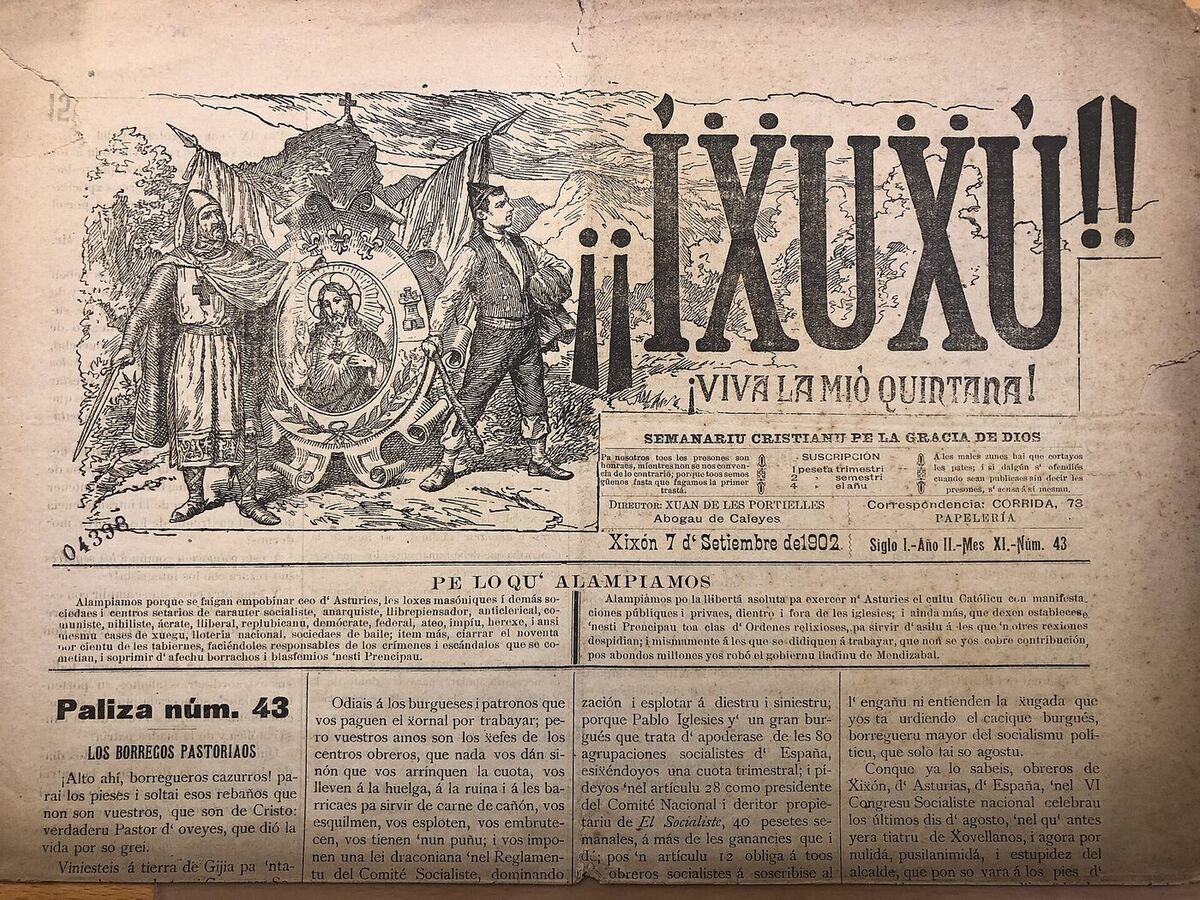
Written Asturian is old and the standard is not. The earliest documents claimed for the language are contested: the Fuero de Avilés, granted by Alfonso VI in 1085 and confirmed by Alfonso VII in 1155, survives in later copies rather than in an original, and was proclaimed in the nineteenth century as the first document written in Castilian romance with a secure date before being reclaimed for Asturian. Notarial documents, contracts and wills with Asturian features accumulate from the thirteenth century. Modern literature in the language is dated from 1605 and the clergyman Antón González Reguera, and runs through a recognisable line of authors into the twentieth century. Lexicography starts in 1788 with Carlos González de Posada's Diccionario de algunas voces del dialecto asturiano; Gaspar Melchor de Jovellanos was urging in his correspondence, at the end of the eighteenth century, the compilation of a dictionary and a grammar and the creation of a language academy, a project his imprisonment in Mallorca ended. The first book printed in the language was Juan Junquera Huergo's Llos Trabayos de Chinticu, 372 satirical verses published at Gijón in 1843 in an orthography of the author's own devising; the first novel was Enriqueta González Rubín's Viaxe del Tíu Pacho el Sordu a Uviedo, published at Oviedo in 1875 in the eastern dialect; the first newspaper written entirely in Asturian was Ixuxú, founded at Gijón in 1901 by the poet Francisco González Prieto, though verse, cartoons and satirical columns in Asturian had appeared in the regional press throughout the nineteenth century. The Gospel of Matthew appeared in Asturian in London in 1861, published by Louis Lucien Bonaparte; the complete Bible was not finished until 2021, after a translation effort begun in September 1988.

None of that produced a norm. The codification is a product of the last years of the Franco period and the transition that followed, and its sequence is tightly dated. A Regional Assembly of Bable met in 1973. From the movement of the following year came Conceyu Bable, whose founders were Xosé Lluis García Arias, Lluis Xabel Álvarez and Xuan Xosé Sánchez Vicente, and which first appeared as a section in issue 284 of the magazine Asturias Semanal on 16 November 1974; it settled the principle that the written norm would be based on central Asturian, and its plan for the acceptance and modernisation of the language led directly to the regional council's creation of the Academy in December 1980. The Academy issued the orthographic norms in 1981, the grammar in 1998 and the dictionary in 2000. The literary movement that grew alongside it, the Surdimientu, broke deliberately with the rural themes, moral messages and dialogue conventions of the older writing and produced a modern prose and poetry in the standardised language; a later generation, working in fantasy, science fiction and horror and known as l'Espardimientu, has since broken with the Surdimientu in turn.
So when the group was created in February 1996, the orthography was fifteen years old, the grammar had not yet been published and the dictionary was four years away. Posters asking for a grammar or a dictionary in the group's first years were not being lazy. There was not yet one to point them at.
Writing Asturian in seven bits
Whatever the Academy decided, the network had already decided something else. RFC 1036, the December 1987 standard for the interchange of Usenet messages, is unambiguous about the alphabet its headers may use. Of the full name a poster puts in the From line it says that full names may contain any printing ASCII characters from space through tilde, with parentheses and angle brackets excluded; message identifiers are likewise defined as strings of printing ASCII, and all characters between the angle brackets must be printing ASCII. Printing ASCII from space through tilde is ninety-five characters, and none of them carries an accent. A poster named Xosé or José was, strictly read, outside the standard in the very first line of every article they wrote — and gateways of the period were free to strip the eighth bit from anything that crossed them, so the strict reading was often enforced by accident.
For the body of an article the practical remedy was ISO/IEC 8859-1, Latin-1, published as an ISO standard in 1987 out of the earlier ECMA-94 of 1985. Latin-1 carries every accented letter ordinary Iberian text needs — á é í ó ú, ñ, ü — so once it was reliably deployed and reliably declared, ordinary Asturian survived transmission. On paths that mangled it the habit was the same as everywhere else in the Latin world: drop the accents and let context carry the word.
Two graphemes of the Academy's standard fall outside Latin-1 altogether, and they are exactly the two dialectal letters described above. The western ḷḷ, the che vaqueira, and the eastern aspirated ḥ both carry a dot below. Both live in the Unicode block Latin Extended Additional, U+1E00 to U+1EFF, whose main run of code points was assigned in Unicode 1.1 in 1993 — the small letters at U+1E37 and U+1E25, the capitals at U+1E36 and U+1E24, each defined as its base letter plus a combining dot below. Being in Unicode and being available are different things, and through the whole of the group's active life these characters were absent from most of the typefaces in ordinary use.
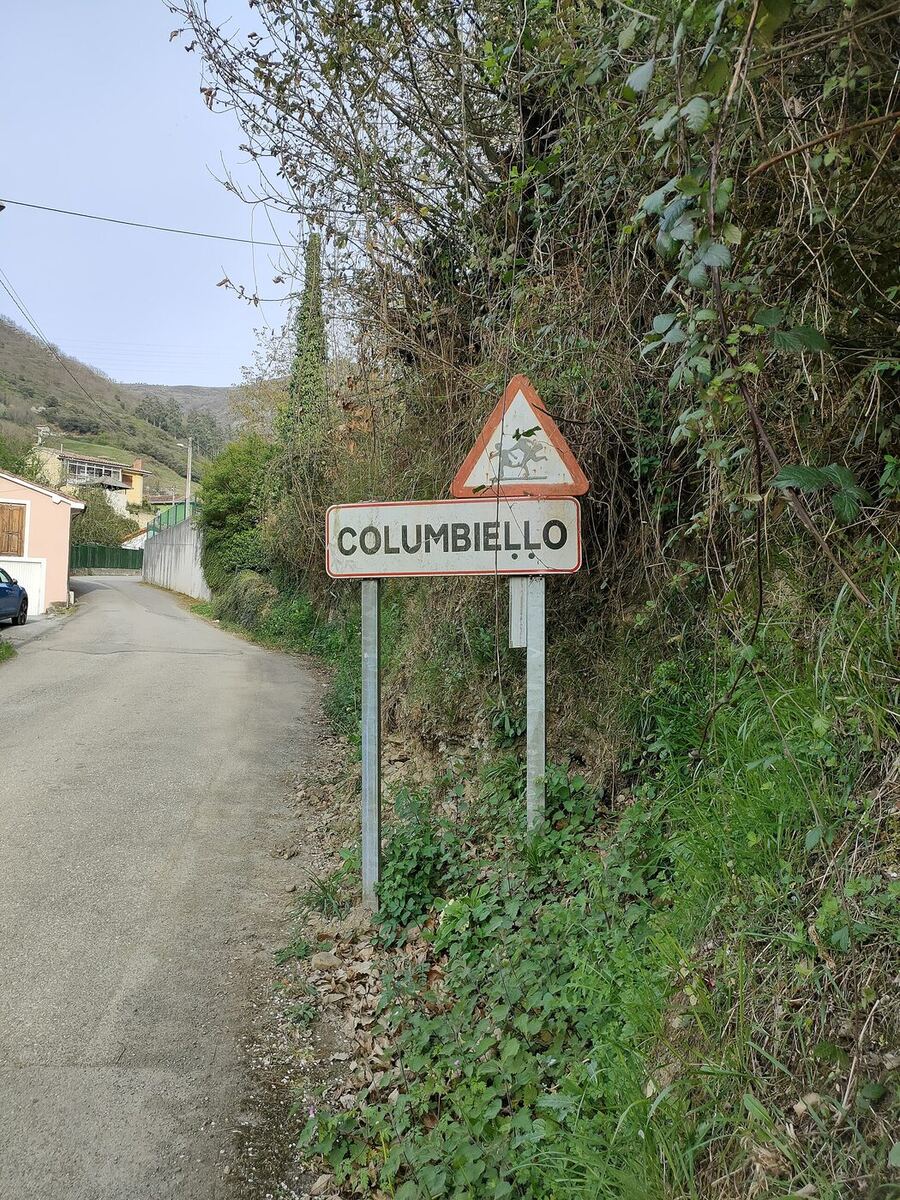

The workaround was older than the problem. The Academy's grammar records that l.l and h. — the letter followed by a full stop — had been used for printing in the past, and they remained the accepted substitutes. That is the detail that let standard-conformant Asturian be posted in plain seven-bit ASCII without leaving the norm: a poster with no Unicode font, no eight-bit path and no confidence in the gateways could still write the western forms correctly. The older nineteenth-century convention ts for the same sound also turns up.
The consequence for anyone searching the surviving archive today is practical rather than dramatic. The same Asturian word may appear with its accents, without them, doubled into the mojibake typical of Latin-1 decoded as something else, and — in the western forms — written ḷḷ, l.l, ll or ts. One query will not find them all. A search that returns nothing has usually tested a single spelling rather than proved an absence, which is a caution worth carrying into any use of the group's archive as evidence.
What was discussed
Language, first and last. The recurring questions were the region's own and were the questions set out above: whether asturianu should be co-official with Castilian, whether a single written norm served or flattened the valleys, whether the revival was restoration or invention. Posters who wrote in Asturian were sometimes practising, sometimes making a point and usually both; posters who doubted the enterprise answered in Castilian and said so. Between the two ran the ordinary traffic of a small language online — requests for grammars and dictionaries, help with a translation, corrections offered and occasionally welcomed — and the charter's two-language settlement meant nobody had to justify the language they chose.
Music travelled furthest, and the group's timing was lucky. The gaita, the Asturian bagpipe, anchored a folk scene that came with the perennial and unresolvable question of whether Asturias counts as a Celtic nation — the question the group's own founding document had answered in the affirmative before anyone arrived. The group's early years then coincided with the international run of Hevia's Tierra de nadie, released in 1998, which carried an electrified Asturian pipe into charts across Europe. It sold more than two million copies, took gold and platinum certifications in a string of countries, reached number one on the Spanish Los 40 Principales chart on 17 April 1999 on the strength of the track Busindre Reel, and supplied, in El garrotín, the official song of the 1999 Vuelta a España. For about two years, posters were spared the usual work of explaining their instrument to outsiders.
The rest was the standard furniture of a soc.culture group in local grain. Genealogical enquiries came from descendants of emigrants to Cuba, Argentina and Mexico. Football needed no manufactured heat, the rivalry between Real Oviedo and Sporting de Gijón being the region's own. There were recipes, travel questions and news from home. Regional politics surfaced in a lower key than in the group's Basque and Catalan neighbours: Asturian nationalism was a modest electoral force, and identity here was argued more often through language and culture than through programmes for statehood — which is one reason this group's arguments read differently from those on soc.culture.basque, where the language is an isolate and has been co-official since 1979. Coal ran underneath all of it: the contraction of the Asturian coalfield lasted the whole of the group's life and well past it, and its terms were standing material in regional politics throughout.
Underneath the arguments ran the calendar, which is the part of any culture group best documented outside it. The Descenso Internacional del Sella, a canoe race of some twenty kilometres from Arriondas down to Ribadesella, grew out of a river excursion in 1929 by Dionisio de la Huerta and three friends, five kilometres down the Piloña from Coya to Infiesto; descents followed in 1930 and 1931, and 1932 saw the first competitive edition over the definitive Arriondas–Ribadesella course, with thirteen paddlers. Entries from outside Asturias first appeared in 1935 and the first European entrants in 1951. It was declared a Fiesta de Interés Turístico Internacional in 1980. Its date is calculated rather than fixed, falling on the first Saturday of August after the second of the month — except in 1992, when it was put back a week to 15 August because the Barcelona Olympics were still running. Cider was the other fixture, and has since been formalised twice over: the protected designation of origin Sidra de Asturias was recognised in 2003, and Asturian cider culture was inscribed on UNESCO's representative list of the intangible cultural heritage of humanity on 4 December 2024.
A dated record
What follows is a chronology: the dated events an archive reader meets by reference, listed without any claim about what they signified. The group’s own creation appears in sequence, which is the only way to see at a glance what its posters could have been reading about and what postdates them entirely.

- 722 — Pelagius defeats an Umayyad force at Covadonga, the event traditionally treated as the foundation of the Kingdom of Asturias.
- 1085 — the Fuero de Avilés is granted by Alfonso VI; it is confirmed by Alfonso VII in 1155 and survives in later copies.
- 1388 — the title of Prince of Asturias is created for the heir of John I of Castile, the future Henry III.
- 1605 — modern literature in Asturian is dated from the work of Antón González Reguera.
- 1788 — Carlos González de Posada compiles the first Asturian dictionary.
- 1843 — the first book printed in Asturian, Llos Trabayos de Chinticu, is published at Gijón.
- 1861 — the Gospel of Matthew appears in Asturian, published in London by Louis Lucien Bonaparte.
- 1875 — the first novel in Asturian is published at Oviedo.
- 1901 — Ixuxú, the first newspaper written entirely in Asturian, is founded at Gijón.
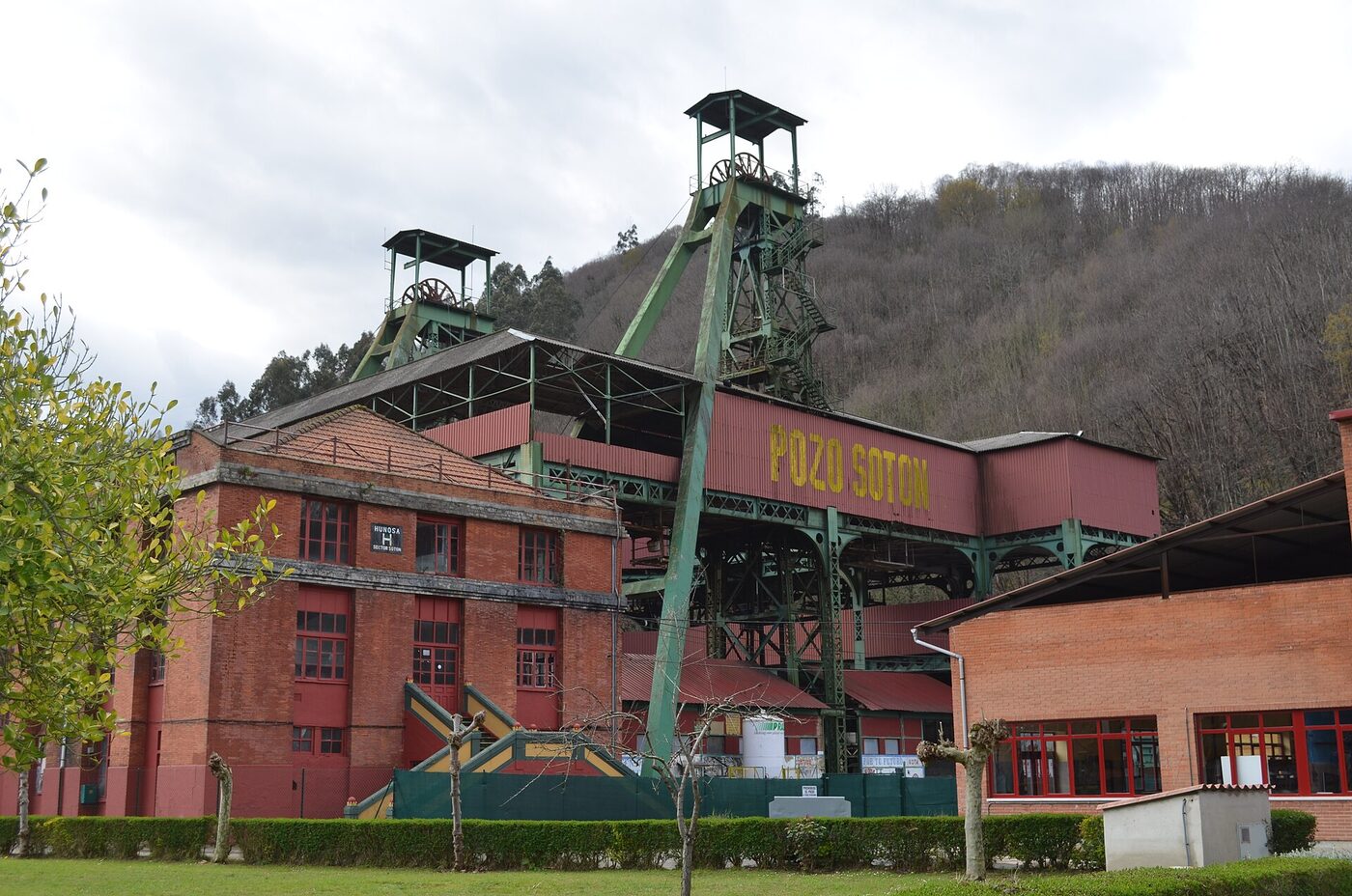
- 1918–1921 — Duro Felguera sinks Pozo Sotón to feed the blast furnaces at La Felguera; the complex is completed in 1921.
- Spring 1962 — the Asturian miners' strike known as la huelgona runs for about two months, ending between 4 and 7 June.
- 9 March 1967 — Decree 486/1967 creates the national company Hulleras del Norte, S.A. (Hunosa); it is incorporated by public deed on 14 July with capital of 3,380 million pesetas, the Instituto Nacional de Industria holding 76.97 per cent. The merged firms bring a payroll of 20,017 and production of 3,145,140 tonnes. Hunosa is today wholly owned by the state holding company SEPI.
- 16 November 1974 — Conceyu Bable first appears, in issue 284 of Asturias Semanal.
- 1976 — the first demonstration for the language, under the slogan Bable nes escueles.
- 15 December 1980 — the Academia de la Llingua Asturiana is created by Decree 33/1980 of the Consejo Regional de Asturias.
- 1981 — the Academy issues its first normative work, Normes Ortográfiques y Conxugación de Verbos.
- 30 December 1981 — Organic Law 7/1981 approves the Statute of Autonomy for Asturias; it is published in the state gazette on 11 January 1982 and in force from 31 January. Article 4 provides protection for bable and does not make it official.
- 1982 — the first Día de les Lletres Asturianes.
- 1984–85 — Asturian enters the school system as an optional subject.
- April 1988 — the community's first popular legislative initiative, on the use of Asturian, is ruled inadmissible by the bureau of the Junta General on 27 April.
- 14 April 1988 — Spain's country-code domain
.esis entered in the IANA root database. - September and December 1988 — two attempts to reform the Statute reach the Junta General; the first is ruled inadmissible on 13 October for want of standing, the second is rejected for want of the required majority.
- 1989 — RedIRIS, the Spanish academic and research network, is founded.
- 4 September 1995 — Telefónica opens InfoVía, reached by dialling 055 nationwide and billed by connection time; it is deactivated on 1 December 1998 and succeeded by InfoVía Plus.
- 27 November 1995 — the Request for Discussion for soc.culture.asturies is posted.
- 4 December 1995 — soc.culture.catalan is created by control message, a week after this group's Request for Discussion.
- 18 and 28 January 1996 — first and last Calls for Votes; voting closes at 23:59:59 UTC on 8 February.
- 10 February 1996 — the result is posted: 790 YES, 44 NO, 834 valid votes, 12 invalid.
- 15 February 1996 — the newgroup control message is issued at 15:30:03 GMT. Everything above predates the group; everything below falls within or after its life.
- 20 February 1996 — a local newgroup control for the group is issued from news.rediris.es with a distribution of
es. - 21 March 1996 — the Request for Discussion for soc.culture.basque is posted, five weeks after this group began.
- 6 November 1997 — the bureau of the Junta General admits the bill that becomes the language law.
- 23 March 1998 — Law 1/1998 of the Principality, on the use and promotion of bable/Asturian, is enacted; Article 4.2 makes citizens' communications with the Principality in the language valid for all purposes, and Article 2 names the western varieties gallego/asturiano. It is published in the regional bulletin on 28 March and in the state gazette on 30 April.
- 1998 — the Academy publishes its Gramática de la Llingua Asturiana; Hevia releases Tierra de nadie.
- 5 January 1999 — Organic Law 1/1999 reforms the Statute, adding a second paragraph to Article 4 and adding the reduced-majority route for competence-only reforms.
- 2000 — the Academy's Diccionariu appears.
- 10 June 2000 — alt.languages.asturian is newgrouped, without a vote and from a throwaway address.
- 9 April 2001 — Spain ratifies the European Charter for Regional or Minority Languages, naming Asturian as the llingua propia of Asturias; the Charter's safeguard-and-promote provisions have applied to it since 1 August 2001.
- 2001 — the Villaviciosa school case is dismissed at first instance and, later that year, on appeal.
- 4 November 2001 — a forged rmgroup control message for soc.culture.asturies is injected; it is not honoured.
- 2002 — the Academy publishes its report on the non-recognition of linguistic rights in Asturias.
- 2003 — the protected designation of origin Sidra de Asturias is recognised.
- 2004 — the Asturian-language edition of Wikipedia is launched.
- 24 July 2004 and 27 February 2005 — alt.fr.lettres.langue.asturienne and alt.ast are newgrouped from France.
- 25 February 2010 — the Constitutional Court refuses, as manifestly unfounded, a challenge to Article 4.2 of the 1998 law, holding that the article does not make Asturian a normal means of communication with the administration.
- September 2011 — 49 of the region's 78 councils have had their traditional place names made official.
- 5 March 2014 — Pozo Sotón is declared a Bien de Interés Cultural; the pit closes later the same year.
- 2018 — the rules of the Junta General are reformed to let deputies use Asturian in parliamentary proceedings; the reform is challenged before the Constitutional Court in 2020 and upheld.
- 1 October 2019 — the regional culture councillor is prevented from addressing a committee of the Junta General in Asturian on a literal reading of the chamber's rules; the rules are amended on 1 July 2020 to permit any speaker to use the language.
- 4 May 2024 — the president of the Principality states publicly that it is the hour for officiality.
- 4 December 2024 — Asturian cider culture is inscribed on UNESCO's representative list.
Only certain kinds of event carry a date at all — a statute, a ruling, an inscription — so the list leans that way by construction. What people made of them was the group’s business, and none of that survives on this site.
Where the readers were
The founding vote put a third of the group's electorate outside Spain, and that proportion is not an accident of who happened to have a network account. It is the shape of the Asturian population itself, and it is very well documented, because the emigration built institutions with addresses.
The industrial revolution reached Asturias in the nineteenth century with the systematic working of the coal of the Nalón and Caudal valleys and the iron works that fed on it, and the same decades sent large numbers of Asturians to the Americas — principally to Cuba, Argentina, Uruguay, Mexico and Puerto Rico, with a further concentration at Tampa. Those who came back rich were called indianos, and their houses are still the most conspicuous domestic architecture in parts of the region: villas with imported palms in the garden, together with the schools and libraries their owners endowed. The Fundación Archivo de Indianos, created on 22 May 1987 by the Principality, the Caja de Ahorros de Asturias and the University of Oviedo, keeps the archive and the museum of that emigration at the Quinta Guadalupe in Colombres, a house built in 1906 by the emigrant Íñigo Noriega Lasso and named for his wife; its archive collects, among other things, the records of the regional societies in America.
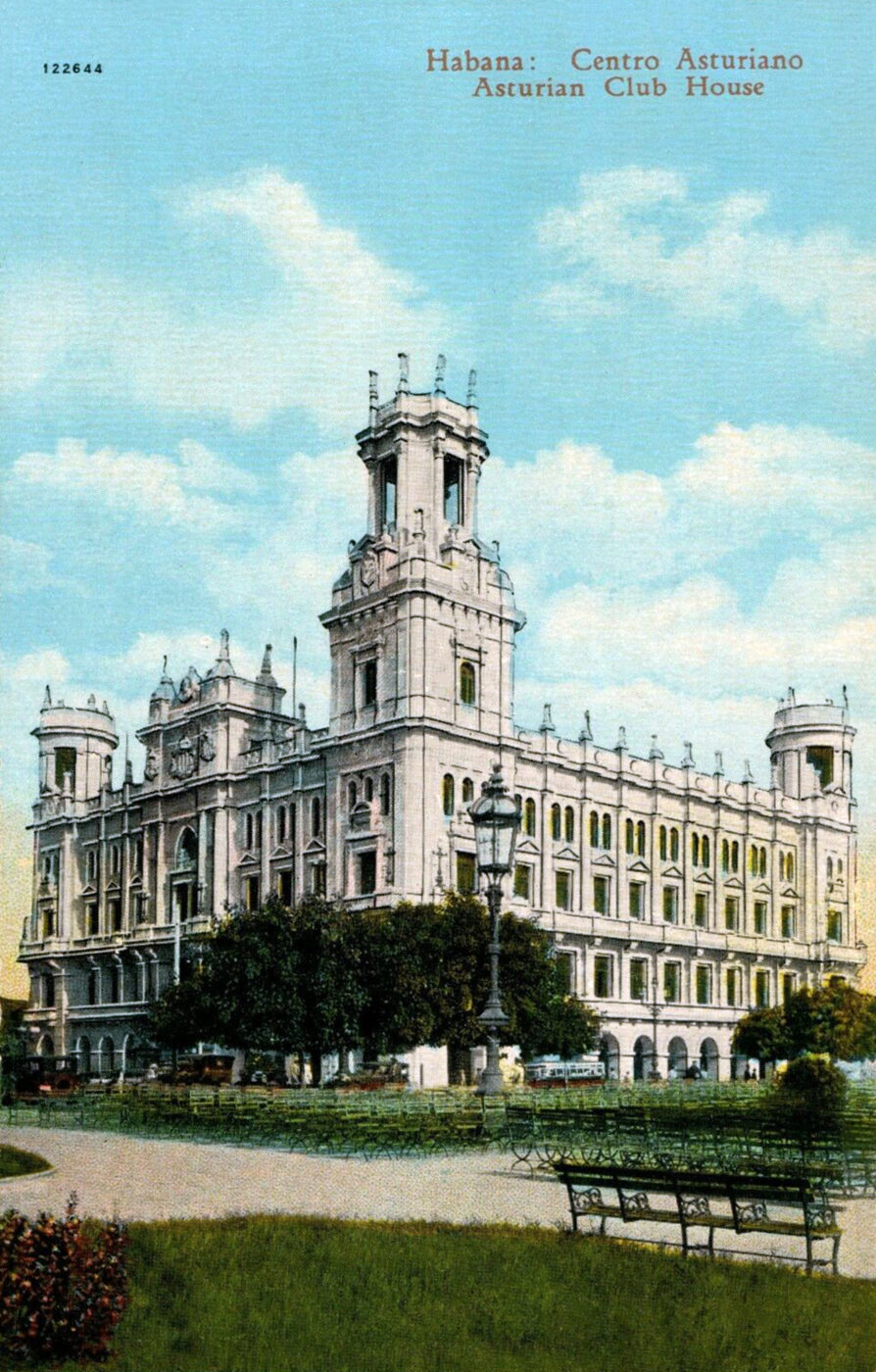
The largest of those societies is the standard illustration. The Centro Asturiano de La Habana was founded in 1886 as a mutual-aid and welfare association for Asturian emigrants in Cuba. Its premises burned in 1918; the replacement, designed by the Asturian architect Manuel del Busto, was built between 1924 and 1927 and inaugurated on 20 November 1927, a four-storey eclectic palace beside the Parque Central with marbles imported from Italy, Spain and the United States and the arms of Asturias, Spain and Cuba over its main front on the calle San Rafael. After the revolution of 1959 the association was dissolved and the building taken by the state; it housed a succession of institutions, and since 2001 it has held the universal art collections of Cuba's Museo Nacional de Bellas Artes. The buildings outlasted the memberships that raised them, which is the usual fate of emigrant institutions and the reason they are so much easier to date than the emigration itself. Cuba has its own address in this directory, at soc.culture.cuba.

At home the emigration is commemorated rather than forgotten, and the commemorations were built by the same two-way traffic. Oviedo has held a Día de América en Asturias since the first parade on 23 September 1950, now a Fiesta de Interés Turístico Nacional, in which floats representing the countries of the Asturian emigration process down the calle Uría; as the destinations of emigration shifted after the war, Belgium, France, Germany and Switzerland were added to the Latin American ones. Gijón has La madre del emigrante, Ramón Muriedas's four-metre bronze of a woman looking out to sea on the Rinconín seafront, inaugurated on 18 September 1970 and damaged in 1976; the committee that commissioned it, formed after the first Congress of Asturian Societies in 1958, had the mayor of Gijón as its chairman and the consuls of Cuba and Argentina and the president of the Centro Asturiano de La Habana among its members. The migration ran inside Europe too, and by the 1950s and early 1960s a share of the Asturian coalfield's own workforce was leaving for the mines of Belgium and Luxembourg.
A readership distributed like that has no shared working day, and the practical effect on a small unmoderated group is worth spelling out. Asturias keeps Central European Time, an hour ahead of UTC and two in summer. Havana runs five hours behind UTC, Buenos Aires three, Mexico City six. Add the store-and-forward propagation of Usenet, in which an article reached distant servers minutes, hours or occasionally a day after it was posted, and the unit of conversation becomes the day rather than the afternoon. A group of this kind was never busy and never quiet: it accumulated. Replies written overnight in the Americas were waiting in the morning in the Principality, and a thread that would have burned out in an evening on a local forum could run for a fortnight.
The economics pulled the same way. A reader on a flat-rate campus or office connection in Pittsburgh or Osnabrück could stay logged in for as long as a thread lasted; a household in Uviéu or Xixón paid for every minute of the call. Metered local telephone charges, not the price of a modem, set the length of an evening online in Spain until well after the group's founding, and the roll of voters from .edu and .de addresses is a snapshot of who could afford to linger.
Why the smallest address still keeps a page
This is one of the smallest addresses in this directory, and there is no honest way to make it sound otherwise. soc.culture.asturies served a region of about a million people and a language with, on the most generous survey, a few hundred thousand speakers. It was unmoderated, it was never large, it was never the subject of a study, and it produced no FAQ, no charter revision and no successor group. Its entire external documentation consists of four administrative messages and five control messages, all quoted or cited above. Everything else that can be said about it with confidence is said by inference from those, from the charter it was given, and from the world it belonged to.
What makes it worth a page is not size. It is that the record it left is unusually complete for a group of its scale, and that the record is about something. A creation vote of 790 to 44 with a published roll, carried by more than four hundred accounts at a single university and audited in public by the votetaker who counted them, is a documented fact about how a small language community organised itself online in early 1996 — before the web had taken the traffic, before the Asturian Wikipedia existed, before broadband, before most of the region's households had any network access at all. The charter's decision to name Asturian first among the group's two primary languages is a documented fact about what the founders thought they were building. And the name on the door is a documented fact about the argument the whole thing was for.
The wider case for keeping such addresses is made on the soc.culture branch page, and applies here as well as anywhere: for a good many diasporas of the 1990s, the soc.culture group was the first public online space their community had, and the smaller the community the more disproportionate that first room was. A million people with a stateless language got the same size of room as a nation of two hundred million. Whatever else Usenet's namespace did, it was indifferent to how large you were.
As elsewhere in the hierarchy, the conversation thinned through the 2000s. Web forums, Asturian-language portals and eventually social media took the traffic; the Asturian Wikipedia opened in 2004; and the unmoderated group filled, like all of them, with spam. The questions it carried have aged better than the medium. Officiality has been proposed, debated and deferred repeatedly since, and Article 4 of the Statute still reads as it did in 1981. The argument continues; only the venue changed.
What the record does not show, and the limits of this page
A page about a small newsgroup should be explicit about the boundary between what is documented and what is inferred, and this one runs the boundary here.
Documented, and quoted or cited above from primary sources: the Request for Discussion of 27 November 1995 and its proponent; the two Calls for Votes and the votetaker; the result of 10 February 1996 with its exact tally, its full voter roll and the votetaker's own note on the concentration of votes at one university; the charter and the newsgroups line, verbatim; the creation control message of 15 February 1996 and its repetitions; the local re-issue from news.rediris.es of 20 February 1996; the rmgroup of 4 November 2001; the group's continuing presence in the ISC newsgroups and active files; the creation dates of the three alt.* Asturian groups; and the dates and tallies of the neighbouring proposals used for comparison. The domain analysis of the vote is arithmetic performed here on the published roll and can be checked by anyone who fetches the same file.
Not documented, and therefore not asserted: how many people read the group; how many articles it carried, in total or in any year; when its traffic peaked or when it effectively stopped; the titles of any thread; the identity or nationality of any regular poster beyond the three names printed in the proposal's own contact line; whether the Asturian spelling of the name was contested during the discussion period; and what proportion of the group's articles were written in Asturian rather than Castilian or English. Each of those would be an easy sentence to write and none of them can be supported. The discussion in news.groups is not in the ISC mirror, and the archived copy of the group is a sample of uncertain completeness rather than a census — a point compounded, for this group specifically, by the spelling variation described above, which defeats naive searching.
Three smaller cautions. First, the speaker figures in this article disagree with one another because they measure different things, and they are given with their sources for that reason; readers should not average them. Second, the dating of the language's legal instruments has been taken from the consolidated texts in the Spanish state gazette rather than from secondary summaries, because at least one widely circulated encyclopaedia article misdates the 1998 law by five years while citing the gazette reference for the correct one. Where this page quotes an instrument, it quotes the gazette's text. Third, two dates in the deep background are given here as years rather than days because the reference sources disagree about the day: the creation of the title of Prince of Asturias in 1388, and the launch of the Asturian Wikipedia in 2004.
Finally, the register. Whether Asturian should be co-official is an open political question in Asturias, argued by organised campaigns on both sides and by every party in the regional parliament. This page has set out the legal position, the mechanism by which it could change, the positions taken and the dated episodes in which they collided. It has not reached a verdict, and it does not have one to reach.
Reading soc.culture.asturies today
- Historical archive: Google Groups — soc.culture.asturies (coverage varies by group and era).
- Open in a newsreader:
news:soc.culture.asturies— the original site offered exactly this link, and it still works if your system has a newsreader registered for thenews:scheme. - Live access: point an NNTP newsreader at a modern server — see accessing Usenet today.
- The original news2mail e-mail subscription service ended in the mid-2000s and no longer operates.