soc.culture.breton
Brittany and the Breton language.
Brezhoneg language revival, fest-noz music, Celtic-nations solidarity and the politics of French regionalism — a small group with strong ties to soc.culture.celtic and the diwan school movement.
Its bilingual French/Breton threads contributed to the language’s early digital corpus.
On this page
The group and its era
The soc.culture.* hierarchy was organised, for the most part, around states: one group per country, with the map doing the editorial work. soc.culture.breton belonged to a smaller class of exceptions — groups named for a people or a region rather than for a seat at the United Nations. The placement was itself a quiet statement, and readers on every side of Breton politics understood it as one.
The group filled out alongside the rest of the hierarchy's European margins in the 1990s, as the internet reached Brittany through its universities — Rennes and Brest both taught Breton at degree level — and then through home dial-up. Its natural constituency was split three ways: readers in Brittany itself, the large Breton population of Paris and the wider diaspora, and students of Celtic languages abroad, for whom an unmoderated newsgroup was the nearest available thing to a Breton-speaking street.
It was never a high-traffic group by the standards of the hierarchy's giants, and it did not need to be. Small groups had their compensations: a cast of recognisable regulars, and a fighting chance that a question would actually be read by everyone qualified to answer it.
It sat, in that respect, alongside a handful of siblings in the same hierarchy — soc.culture.basque, soc.culture.catalan, soc.culture.asturies — groups whose subject was a language rather than a passport. The kinship was not only editorial. The immersion school Breton parents opened in 1977 belongs to a family of minority-language school movements founded within a few years of one another — the Basque ikastolak, the Catalan La Bressola from 1976, the Occitan Calandreta from 1979, the Welsh Mudiad Ysgolion Meithrin and the Irish Gaelscoileanna — so the same questions about immersion teaching were live in several of these groups at once.
Getting online from Brittany
France was early to the domain system and late to the public internet, and the gap between those two dates governs who could post here. IANA's root database gives the .fr country-code domain a registration date of 2 September 1986, with the sponsoring organisation now listed as AFNIC. What mattered for a newsgroup was when an ordinary reader in Quimper or Lorient could reach a news server.
The research network came first. RENATER — the national telecommunications network for technology, teaching and research — was constituted as a public-interest grouping by an order of 27 January 1993, gathering up the academic networks that French research institutes had built separately. That is the route by which Brittany's universities were connected, and it arrived before any consumer market existed.
The consumer market was slowed by a French peculiarity: households were already online, but not on the internet. The Minitel terminal, attached to the Télétel videotex service, was trialled at Saint-Malo from July 1980, where fifty-five subscribers were given the electronic directory; it was launched by the PTT in 1982 and closed by France Télécom-Orange on 30 June 2012. For most of the 1980s and early 1990s it was what being connected meant in France. France Télécom did not create its own internet service, Wanadoo, until 2 May 1996. The World Bank's series for individuals using the internet as a share of the French population gives the shape of what followed: 0.6 per cent in 1993, 2.6 per cent in 1996, 9.1 per cent in 1999, 14.3 per cent in 2000, 26.3 per cent in 2001 and 39.2 per cent in 2004.
Two consequences follow for the group's composition. First, through the group's formative years the population in Brittany that could post was overwhelmingly attached to a university or a technical employer. Second, the people who actually had Breton as a first language were, by the sociolinguistic surveys of the period, largely elderly: a 1997 survey found about 300,000 speakers in Lower Brittany, of whom roughly 190,000 were sixty or older. The generation with the language and the generation with the modem barely overlapped. What a reader met on the group was therefore the written Breton of learners, teachers, students and the diaspora — which is one reason spelling, rather than pronunciation, was the thing people fought about.
What was discussed
Language questions supplied the most durable arguments. Breton spelling has been contested since the mid-twentieth century, when rival orthographies were codified and their partisans dug in, and the dispute reliably reappeared wherever Breton was written down; a newsgroup was no exception. Alongside it ran the older texture of the language itself — four traditional dialects, and a widening gap between the standardised Breton of adult learners and the speech of elderly native speakers, a sociolinguistic sore point aired by people living on both sides of it.
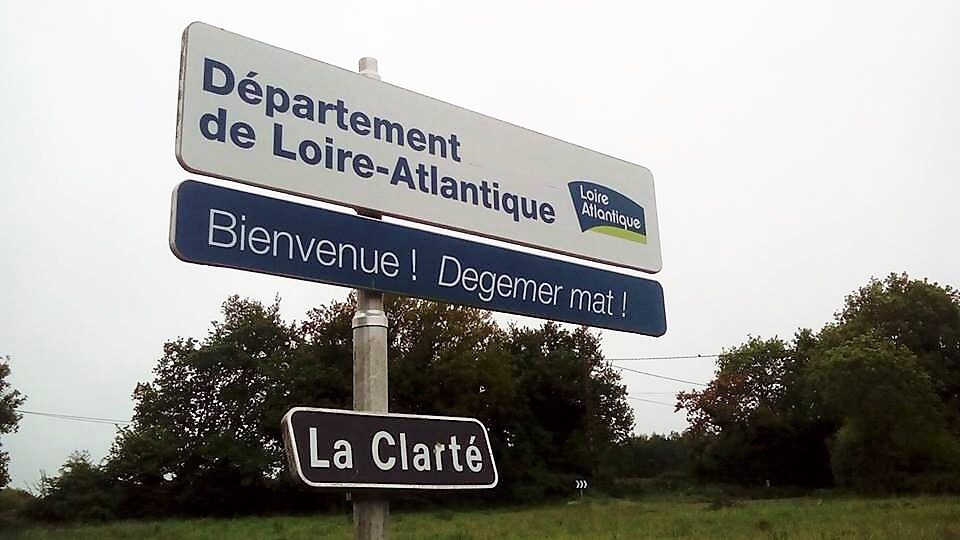
The politics were the politics of status and territory. Whether Breton would survive in schools and on the airwaves; whether road signs should be bilingual; what to make of France signing, in 1999, the European Charter for Regional or Minority Languages it has never ratified — these were questions the group existed to argue about. Beneath them ran the perennial territorial one: whether Loire-Atlantique, detached from the administrative region in 1941 and containing Nantes, the old ducal capital, is part of Brittany. On Usenet, as everywhere else, that question was never settled.

Not everything was contentious. Genealogy threads — Breton surnames travel well, and their bearers come looking for them — travel advice, festival dates and recommendations for recordings and books were the staples here as in any soc.culture group. The harder history was present too: the record of part of the nationalist movement during the Second World War is documented, painful, and impossible to keep out of any sufficiently long argument about Breton identity. When it surfaced, the group handled it the way Usenet handled most things — at length, and without a verdict.
Standards, spellings and the archive
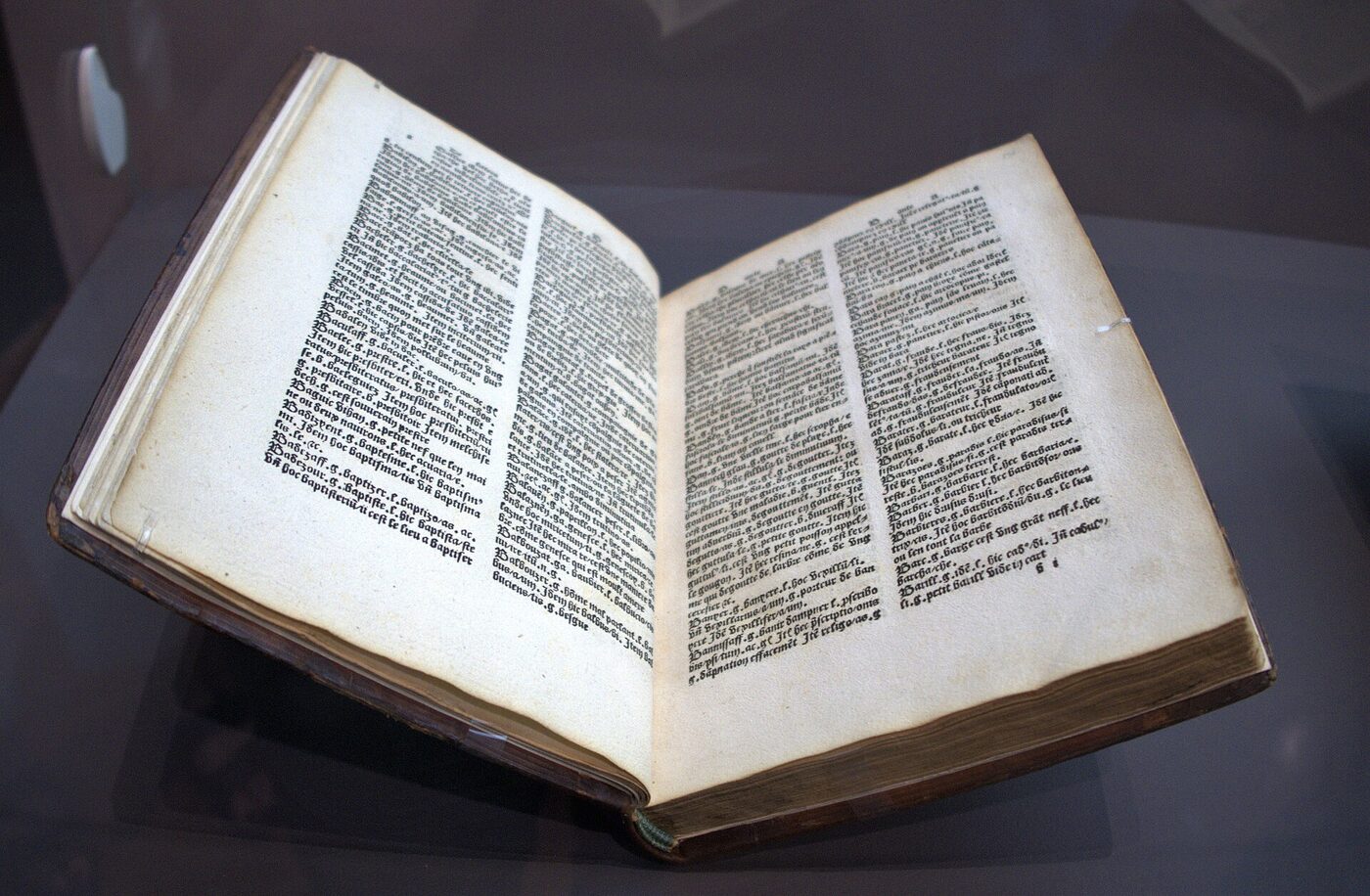
Breton has been written for a very long time and standardised for a very short one. The Catholicon, compiled by Jehan Lagadeuc in 1464 and printed at Tréguier in 1499, is a Breton–French–Latin dictionary and also the first dictionary of French; its spellings, modelled largely on French practice, became a reference point by existing in print. In the 1830s Jean-François Le Gonidec built a modern phonetic system for the language, and every later standard is a reform of his.

Four of those reforms matter, and all four were still in circulation when the group was active. The KLT orthography, established in 1911 by the writers' group Emglev ar Skrivanerien, covered the Cornouaille, Léon and Trégor dialects but not Vannetais. Peurunvan — "wholly unified" — merged the KLT and Vannetais systems in 1941 and is marked by the digraph zh, which stands for a sound realised as /h/ in Vannetais and /z/ in the KLT dialects. In 1955 François Falc'hun and the group Emgleo Breiz proposed the Orthographe universitaire, known in Breton as Skolveurieg, whose graphemes sit closer to French conventions; it was given official recognition by the French authorities as the orthography of Breton in French education, and was opposed in the region. In the 1970s a further standard, etrerannyezhel or interdialectal, was devised on the principle of deriving spellings from word formation. Most writers today use peurunvan, and it is what most Breton-medium schools teach.
Ordinary words therefore have three respectable spellings. The interdialectal, unified and university forms side by side:
- rain — glaw / glav / glao
- who — piw / piv / piou
- for — ewid / evit / evid
- most beautiful — brawañ / bravañ / brava
- where — pelecʼh / pelecʼh / peleh
For a reader coming to the archive now, that is not a curiosity but a search problem. Full-text search over an old Usenet corpus does no normalisation between orthographies, and there is no stemmer that will fold glao into glav. A query in one standard will silently miss the posts written in the others, and because the traffic was bilingual the French half of a thread is often easier to find than the Breton half of it. Anyone working through the record has to run each query several times.
Writing Breton on a seven-bit network
Usenet inherited its message format from internet mail, and mail was built for seven-bit US-ASCII. RFC 1036, the December 1987 standard for the interchange of Usenet messages by Mark Horton and Rick Adams, defines articles by reference to RFC 822 and restricts header material such as full names to "printing ASCII characters from space through tilde". MIME, the mechanism that made anything else legal, was published as RFC 1341 in June 1992 and restated as RFC 2045 to RFC 2049 in November 1996. Netnews formally caught up only in November 2009, when RFC 5536 required conformance to MIME and stated that "the character set for header fields is US-ASCII", with non-ASCII characters encoded by the MIME mechanisms. For most of this group's life, eight-bit text worked in practice and was guaranteed by nothing.
Breton was luckier than most minority languages in that lottery. The letters peurunvan needs beyond the bare alphabet — â, ê, î, ô, û, ù, ü and ñ, with é in addition for the university orthography — are all present in ISO 8859-1, the Latin-1 code page that western European Usenet had settled on by default. A dedicated Celtic code page did exist: ISO/IEC 8859-14:1998, Latin alphabet No. 8, informally Latin-8 or Celtic, registered as ISO-IR-199 in May 1998 on a submission from the Irish standards body and listing Breton among its languages; in practice Breton needed nothing that Latin-1 lacked, and Latin-1 is what stayed in use. The code page that mattered more to this group was ISO/IEC 8859-15:1999, Latin-9, published in March 1999: it added Œ, œ and Ÿ, which Latin-1 lacked and which the French half of a bilingual thread wanted.
The genuinely awkward character is the one in the middle of cʼh. Breton treats that trigraph as a single letter, distinct from ch, and the mark inside it is a letter, not punctuation. Unicode separates those two roles: U+02BC MODIFIER LETTER APOSTROPHE is "preferred where the apostrophe is to represent a modifier letter", while U+2019 RIGHT SINGLE QUOTATION MARK is "preferred where the character is to represent a punctuation mark, as for contractions". U+02BC sits in the Spacing Modifier Letters block, in the standard since Unicode 1.0, when that block was called simply Modifier Letters. Both are drawn as the same curved mark, and on a seven-bit transport neither was available: what went down the wire was the ASCII apostrophe, U+0027.
This is the other half of the archive-search problem, and it compounds the orthographic one. Depending on the poster's newsreader and the software it passed through, the same word may sit in the record as pelec'h, pelecʼh or pelec’h, and those are three different strings to any search engine. Subject lines are the least reliable part of a post: header text was formally US-ASCII, non-ASCII in headers required RFC 2047 encoded-words, and not every newsreader of the period decoded them, so accented subject lines in the surviving record cannot be assumed to show what their author typed.
Context
Breton is a Brythonic Celtic language, close kin to Welsh and Cornish rather than to Irish, carried to Armorica by migration from Britain in the early Middle Ages. It is the only Celtic language in everyday use on the European mainland, which gives it a double character: in Celtic terms a major language, in French terms a regional one.
The twentieth century nearly finished it. Within a single lifetime Breton went from the everyday majority language of western Brittany to one spoken mostly by the old, as schooling, social pressure and the plain economics of French persuaded parents to stop passing it on. The French state's position framed everything: the constitution has declared French the language of the Republic since 1992, and the 2008 amendment recognising regional languages as part of the national heritage came well after this group's liveliest years. UNESCO classifies Breton as severely endangered.
Against that background an unmoderated newsgroup was worth more to Breton than its size suggested: a distribution channel that no ministry licensed and no broadcaster scheduled. When Usenet ebbed in the 2000s the conversation moved on — to web forums, mailing lists and in time a Breton-language Wikipedia — but the function the group had served, giving a dispersed language community somewhere public to talk, did not disappear with it.
The era as a dated record
What follows are dated events in the legal and institutional history behind the group's arguments, given as a record and without comment. The news2mail gateway itself operated between 2000 and 2004, which marks whether an item fell inside or outside the group's liveliest years.
- 11 January 1951 — Law 51-46, the loi Deixonne, published in the Journal officiel on 13 January, permits optional teaching of Basque, Breton, Catalan and Occitan. It was repealed on 15 June 2000, its provisions passing into the education code.
- 10 July 1970 — Decree 70-650 governs the optional baccalauréat papers in languages and dialects.
- 23 May 1977 — The first Diwan nursery class opens at Lampaul-Ploudalmézeau, near Brest, with Denez Abernot as its teacher; published accounts differ on whether it began with five pupils or seven. The first primary class follows in 1980, the first collège in 1988 and the first lycée in 1994.
- 25 June 1992 — A constitutional revision inserts into Article 2 the sentence "the language of the Republic is French".
- 1993 — Parents become legally free to register Breton given names for their children.
- 4 August 1994 — The loi Toubon on the use of the French language is adopted; from the same year Diwan holds association contracts with the ministry of education.
- 15 January 1999 — The Office de la langue bretonne is founded at the château de Kerampuil, Carhaix, succeeding the Breton-language service of the Institut culturel de Bretagne. It becomes a public establishment on 17 September 2010.
- 7 May 1999 — France signs the European Charter for Regional or Minority Languages at Budapest, indicating 39 of its 98 undertakings.
- 15 June 1999 — In decision 99-412 DC the Conseil constitutionnel holds that the Charter contains clauses contrary to the Constitution, reasoning from Article 2; it adds that none of the other undertakings France proposed is itself unconstitutional. Ratification has not followed.
- 28 May 2001 — At Rennes, the education minister Jack Lang and the Diwan president Andrew Lincoln sign a protocol transferring the Diwan schools to public status.
- 5 October 2001 — The Office launches the Ya d'ar brezhoneg agreement for firms and associations.
- 30 October 2001 — The Conseil d'État suspends execution of that protocol; the annulment takes effect in October 2002.
- 12 May 2003 — An order sets the terms for equal-hours bilingual teaching in regional languages in schools and in regional-language sections of collèges and lycées.
- 13 January 2004 — An order fixes the list of académies in which certain modern-language papers may be taken at the 2004 baccalauréat; Breton stands in that list beside the foreign languages.
- 2004 — The Breton-language Wikipedia is started.
- 22 December 2004 — The Ya d'ar brezhoneg charter for local authorities is launched at Pontivy with ten communes.
- 23 July 2008 — A constitutional revision inserts Article 75-1, recognising regional languages as part of France's heritage. This is after the gateway closed.
- 5 December 2012 — The fest-noz is inscribed on UNESCO's Representative List of the Intangible Cultural Heritage of Humanity. Also after the gateway closed, and roughly a decade after the period in which such groups were most used.
- 27 October 2015 — The Senate rejects the constitutional amendment that would have allowed ratification of the Charter.
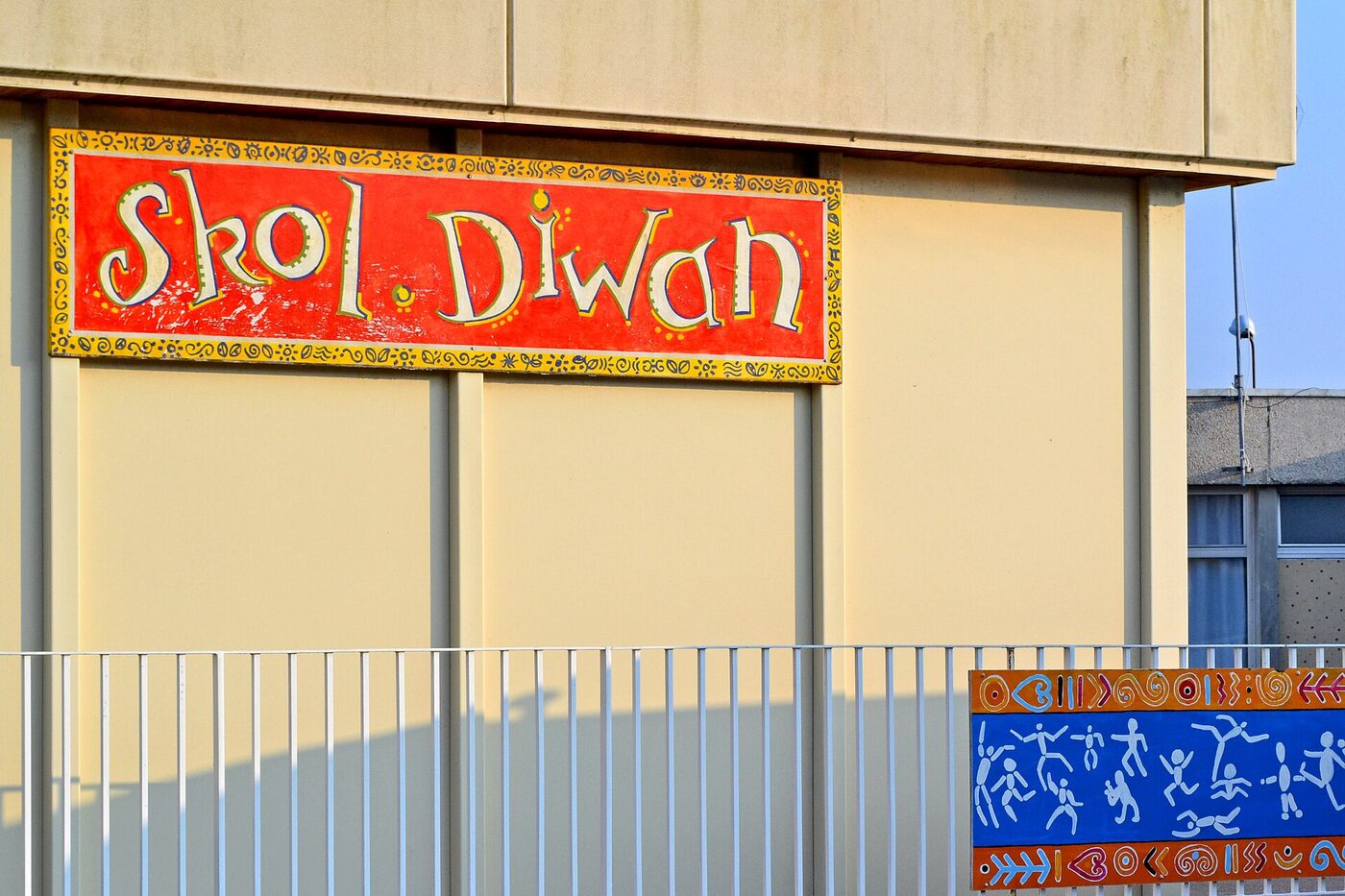

Two figures bracket the same period from the other side. Pupils in Breton-medium and bilingual schooling — Diwan with the Catholic Dihun and state-sector Div Yezh streams — numbered 11,732 in 2007 and 18,337 in 2018, about two per cent of all pupils in Brittany, while the count of Breton speakers fell from more than a million around 1950 to roughly 107,000 in a 2024 regional sociolinguistic survey. The two curves point in opposite directions, and were doing so throughout the group's life.
Where the readers were
Estimates of the Breton-descended population of the Paris region run to about a million, roughly a tenth of the region — an estimate of descent, not a count of speakers and still less of readers. The emigration to the Americas had its own centre of gravity around Gourin, in Morbihan; Bretons from there founded Gourin City, now part of the Regional Municipality of Wood Buffalo in Alberta.
The Paris end of that has a physical address. The Mission bretonne was founded in 1947 by the abbé Élie Gautier to give practical and moral support to Bretons arriving in the capital, taking over the work of the earlier Paroisse bretonne de Paris; it was in the rue La Quintinie from 1962 and has been at 22 rue Delambre, in the Montparnasse quarter behind the station where the Breton lines terminate, since 1977. It runs classes, lectures, a fest-deiz and a fest-noz, and the Paris round of the Kan ar Bobl competition — an institution that exists, as the newsgroup did, because the readership was not where the language was.
The other axis ran along the Celtic seaboard. Breton is classified as a Southwestern Brittonic language, closest to Cornish, with Welsh the more distant of the two relatives; the interceltic festivals and the international federation of Celtic wrestling gave that relationship a calendar and a fixture list rather than only a family tree.
Because Brittany, Paris and most of the diaspora share one time zone, soc.culture.breton had a dominant clock in a way a genuinely global culture group does not: a thread posted in the Breton evening was read by most of its audience that evening. The North American segment sat five to nine hours behind, enough to make a transatlantic exchange take a day per turn, which Usenet's threading absorbed without anyone noticing.
The cultural traffic
Between the arguments, this was a group about a calendar. The Festival de Cornouaille at Quimper dates from 1923, when the first Reine de Cornouaille was elected, and celebrated its centenary in 2023. The Festival interceltique de Lorient was created in 1971, taking up the thread of an international bagpipe festival that Bodadeg ar Sonerion — the assembly of pipers, founded by Polig Monjarret in 1943 — held at Brest in 1953 for its own tenth anniversary. The same body has run the national championship of the bagadoù every year since 1949, in a spring round and a summer round, the latter held at Lorient for some categories.
The fest-noz itself is a revival rather than a survival. The communal dances that punctuated collective farm work had faded by the 1930s; the modern form was assembled in the 1950s in inland Cornouaille and is attributed to Loeiz Ropars, who ran the first kan ha diskan singing competition at Poullaouen in 1954. The folk movement of the 1970s, and Alan Stivell's audience from 1972, took it out of central Brittany and made it urban. UNESCO inscribed it in 2012 under the title "Fest-Noz, festive gathering based on the collective practice of traditional dances of Brittany", the file having been prepared by the archive association Dastum, and put the number of gatherings at around a thousand a year.
Literature in Breton had its own institutions and its own long-running quarrel. Al Liamm, the Breton-language literary review founded by Ronan Huon, published its first issue in April 1946 and absorbed the reviews Kened and Tír na nÓg in 1948; it still appears bimonthly, entirely in Breton. Behind it stands the Barzaz Breiz, the collection of popular songs published by Théodore Hersart de La Villemarqué in 1839, whose authenticity has been disputed since at least 1872, when François-Marie Luzel published De l'authenticité des chants du Barzaz-Breiz. A dispute about whether a national song collection was collected or composed is exactly the sort of question a culture group returns to.
Food and sport supplied the lighter traffic and, occasionally, the sharper. The kouign-amann is claimed for Douarnenez around 1860, on an attribution to the baker Yves-René Scordia, and also for Scaër and its baker Henri Postic; other accounts hold that sugaring and buttering leftover bread dough was an old farmhouse habit the pâtisserie trade later formalised. Gouren, Breton jacket wrestling on a mat, is governed in France by the Fédération de Gouren and internationally through the Fédération Internationale des Luttes Celtiques, whose meetings have taken it to Cornwall and Scotland and as far as a wrestling school in New Orleans. And the Tro Bro Leon, the road race over the ribinoù — the stone and dirt farm tracks of northern Finistère that earn it comparisons with Paris–Roubaix — was created in 1984 by Jean-Paul Mellouët, who had founded the Abers cycling club the year before to raise money for the Diwan school at Lannilis.
Reading soc.culture.breton today
- Historical archive: Google Groups — soc.culture.breton (coverage varies by group and era).
- Open in a newsreader:
news:soc.culture.breton— the original site offered exactly this link, and it still works if your system has a newsreader registered for thenews:scheme. - Live access: point an NNTP newsreader at a modern server — see accessing Usenet today.
- The original news2mail e-mail subscription service ended in the mid-2000s and no longer operates.