soc.culture.basque
Basque culture, language and current affairs.
Euskara language learning, Basque cuisine and sport (pelota, the txapela), and — unavoidably in its era — the politics of ETA, GAL and the peace process, argued from every side.
The group was a notable early home for Basque-language text online, alongside the language’s own mailing lists.
On this page
- The group's own paperwork
- The vote, and the control messages
- What was discussed
- A language related to nothing else
- The families it has been assigned to, and left
- Where Basque is spoken, and by how many
- Euskara batua: a written standard within living memory
- Writing Basque on a seven-bit network
- Who could actually read it
- The language in law
- Schools, broadcasting and the relay run
- The conflict, as the record has it
- A dated record
- The eighth province
- Sport, the table and the calendar
- What the record does not show
- Scope and limits
The group's own paperwork
Most groups in this branch of the directory left almost nothing behind but a one-line description. soc.culture.basque is an exception. Two files in the Usenet administrative archive mirrored by the Internet Systems Consortium carry it from the first proposal to the removal notice: the news.announce.newgroups file, which holds the Request for Discussion, both Calls for Votes and the result, and the control-message file, which holds every newgroup and rmgroup message ever issued in its name. Between them they are the only wholly reliable sources about the group, and they are worth setting out before anything else.
The Request for Discussion was posted to news.announce.newgroups on 21 March 1996, from an academic account at the University of Virginia, with a named mentor alongside, as the group-creation guidelines encouraged. Its distribution list is itself a small map of where Basque conversation had been happening on Usenet up to that point: besides news.groups, the RFD went to soc.culture.spain, soc.culture.french, soc.culture.catalan, soc.culture.asturies and soc.culture.breton, and it was mailed on to the BASQUE-L discussion list, which ran on the City University of New York's LISTSERV and was gatewayed to news as bit.listserv.basque-l.
The rationale was plain about the problem it was solving. Discussion of Basque matters, it said, was "occasionally conducted in the national groups soc.culture.spain and soc.culture.french, and specially on the mailing list BASQUE-L"; with the number of Basque readers growing, a group of their own would help. Then the sentence that decided the group's whole character: "The newsgroup is proposed as moderated mainly to spare advocations of violence and abuse that other forums have endured." A moderated soc.culture.* group was uncommon. Here it was the point of the exercise, and it was stated in the first paragraph of the first document.
The line proposed for the newsgroups file, which is what a reader would actually have seen in a server's group list, was the group name followed by a tab and the description Basque culture and related issues. (Moderated). It never changed: the same line appears in the RFD of March, both Calls for Votes, the result announcement of June and the control message that finally created the group in July.
The charter opens with a sentence of deliberate width:
soc.culture.basque shall exist for the purpose of providing basques the world over with a virtual place to discuss social, political, cultural or any other issues that participants may consider pertinent to arise, related to basques or of more general scope. soc.culture.basque shall also be a place for scholars, students, or interested individuals to request information and discuss on matters related to the basque people and/or their culture.
Two clauses follow that a reader of the archive should keep in mind. The first settles the language question by refusing to settle it: "The languages of the newsgroup shall be basque, english, spanish and french." Four languages, no order of precedence, no requirement that anyone use any particular one — which is why a search of the archived group in one language will always miss part of it. The second is an invitation rather than a restriction: "Participants are strongly urged to put forward questions that are in the center of political and social debate and most specifically those that by its very nature are in the avant garde of social concern." This was not a group designed to avoid difficult subjects.
The charter's treatment of violence changed measurably between March and May, and the change is visible in the file. The March draft ruled out "the use of violence or its justification, by any means whatsoever, however slight, and in any possible way, be it direct or indirect", and separately barred "the posting of communiques, quotes or opinions that advocate, justify, condone or excuse the use of violence in social life". By the Call for Votes both had been compressed into one narrower sentence: "Postings shall abide by the accepted patterns of tolerance and openness. Therefore, articles explicitly advocating or justifying the use of violence shall be rejected by the moderators." The moderation policy in the same document restated it as "the instigation to commit violence and the justification of consummated violent crimes shall not be tolerated". Whether the discussion period produced that redrafting is not recorded in the archive; what the archive shows is that both versions survive in the same file, a few screens apart, and that the second is the one that passed.
Against that stood an equally emphatic guarantee, capitalised in the original: "Articles will NEVER be rejected based on whether the moderator(s) disagree with the views expressed." Submissions were to be distributed at random among the active moderators, moderators' own articles going through the same lottery as anyone else's; a rejected author could appeal to the panel as a whole. The other grounds for rejection were mundane — personal attacks, technical faults such as an invalid return address, commercial junk, articles with less than a quarter original text, crossposting to more than two other groups — with one addition rarely seen elsewhere: "Political propaganda relating to elections." The March draft had been stricter still on that point, barring crossposting outright; the version that passed allowed it within limits.
The charter also contains a sentence of pure period flavour, and it deserves quoting because no summary improves on it: "As a people with a long history of intellectual achievements, we will try to display a proud and lively debate on present and future issues within standard of the art parameters of social excellence." Usenet charters were written by volunteers, at length, in a second or third language, and occasionally with more hope than syntax.
The vote, and the control messages
The first Call for Votes went out on 15 May 1996, headed "FIRST CALL FOR VOTES (of 2)" and conducted by a neutral votetaker of the Usenet Volunteer Votetakers running version 3 of the UseVote software, with ballots mailed to a counting address at Emory University and a deadline of 23:59:59 UTC on 5 June 1996. The promised second CFV followed on 28 May, carrying a Supersedes header pointing at the first. Both were crossposted to the same set of neighbouring culture groups and mailed to BASQUE-L, and both named the five people who had by then agreed to serve as moderators — the March RFD had left the post to be settled during the discussion — together with the article submission address at virginia.edu. The panel was scattered across Canada, the United States and Spain, which for a moderated group was less an administrative nicety than a rota: submissions could be read in more than one time zone.
The result was posted on 16 June 1996 under the heading "RESULT: soc.culture.basque moderated passes 164:62". There were 226 valid votes, one abstention and eight ballots ruled invalid — six for giving no name, which the CFV had warned in capitals was required, and two for containing no vote statement at all. Both Big-8 conditions were satisfied comfortably: the margin of 102 yes votes cleared the required hundred, and 164 of 226 is a shade over 72 per cent, above the two-thirds floor. As was standard practice, the full roll of voters was published with the result, addresses and names, so that anyone could check the arithmetic; thirty years later it is still there, which is a fair illustration of how public Usenet's constitutional procedures were.
After the mandatory five-day objection period, the newgroup control message was issued on 8 July 1996 at 22:03:58 GMT, PGP-signed, from the moderator of news.announce.newgroups. It recorded the vote, gave the submission address, listed the five moderators and reproduced the charter in full, so that any administrator honouring it received the group's constitution along with the group.
The control archive holds something odder from the months before that. On 1 April 1996 — Date header set to 11:11:11 GMT, body carrying the cheerful boilerplate "Anyone can create a newsgroup in the alt, biz, comp, earth, humanities, misc, news, rec, sci, soc, talk, us, or any other Usenet hierarchy" — a forged newgroup message for soc.culture.basque went out, three months before the group legitimately existed and eleven days after the RFD. It gave the group a description of its own invention, "Basque language and culture", rather than the line the RFD had proposed. Between 4 April and mid-May the moderator of news.announce.newgroups sent a series of rmgroup messages in reply, each opening "The recent newgroup for this group in my name was a forgery" and each explaining that "soc.culture.basque is widely considered a bogus newsgroup given that it has not been approved by accepted USENET group creation procedures." For roughly a hundred days the name existed on some servers and nowhere in the record.
Once the real group was created, its practical problem was propagation. On 22 September 1996 a Spanish internet provider issued a newgroup control message of its own, in English and Spanish, reporting that "many sites, including some of great relevance to the audience of this group are misconfigured, resulting in erratic article propagation", and asking administrators who carried the group as unmoderated to correct their configuration, with a pointer to the official archive as proof of its status. A group that was moderated on paper and unmoderated on a badly configured server would silently lose exactly the screening it had been created for.
Then the archive fills up. One hundred and five control messages survive for this one group, and seventy-six of them fall in a single stretch running from late August to late November 1998, during the wave of forged control traffic that swept the Big Eight that year. Fifty-six carry a variation on one sentence — that soc.culture.basque "is an unmoderated newsgroup which passed its vote for creation by" some figure "as reported in news.announce.newgroups" on a given date — and the figure is different almost every time, running from 50:38 to 340:10 across fifty-five distinct tallies, none of them a vote that was ever called, held or reported. The longer ones append a rewritten control.ctl fragment that would honour every newgroup and, under a heading promising to drop them all and not log them, discard every rmgroup. The same fifty-six carry the header "Organization: The Cabal" and sign off "Meow!", and several slip a fictitious meow hierarchy into the list of hierarchies anyone may create. They are forgeries, and the surviving genuine messages of the period are the ones bearing valid signatures from the hierarchy's maintainers. One further bogus rmgroup, asking administrators to "please remove the bogus newsgroup soc.culture.basque" over an unrelated signature block, arrived in November 2001 and was likewise ignored.
The last entries in the file are recent and final. Following a series of Requests for Discussion on 3 January, 2 February and 11 March 2025, and a final RFD and Last Call for Comments on 5 May 2025, the Big-8 Management Board resolved on 21 May 2025 to remove 89 moderated groups, by a vote of three in favour with one member not voting. The stated rationale was administrative rather than editorial: "Currently, these groups cannot be used for discussion because of the lack of a moderator. Most of these groups haven't had a moderator for a long time and have been unused for years." The rmgroup control message for soc.culture.basque was issued on 18 June 2025 and repeated over the following month, and the group no longer appears in the newsgroups file the ISC distributes, though its neighbours soc.culture.spain, soc.culture.catalan, soc.culture.asturies and soc.culture.breton all still do. The moderation that had been the group's founding purpose was, in the end, the thing that outlived its moderators.
What was discussed
The most durable thread in the group's repertoire was the definitional one: what makes a person Basque — surname, birthplace, residence, or command of the language. Homeland and diaspora tended to answer differently and never finally settled it. The question came in with the readership, having run on BASQUE-L before the newsgroup existed, and it was fed constantly by the group's other reliable genre, the surname query: readers scattered from Idaho to Argentina asking what their name meant and which valley their people had left.
Language supplied a second standing argument, distinct from the learning of it. The relationship between euskara batua, the unified written standard, and the dialects it was assembled from was a live policy question throughout the group's lifetime, as were schooling models, broadcasting and what the wider programme of linguistic normalisation should mean in practice. These divided opinion inside the group as they did outside it, and the arguments were not between a Basque side and a Spanish one; they ran between Basque speakers.
Current affairs supplied the volume. Reports from the Spanish, French and Basque press were relayed and disputed, often line by line, and the vocabulary itself was contested ground: what to call the territory, the organisation, the violence and its dead was never a neutral choice, and posters on every side knew it. What set the group apart from comparable arguments elsewhere in the hierarchy was proximity. Many participants were writing about their own towns and families, which kept the exchanges bitter but rarely abstract; and moderation, whatever else it managed, could screen invective more easily than grief.
Underneath all of that ran the ordinary business of a culture group, and it is the part best documented outside the archive: cookery, festival dates, music, pelota results, travel questions from outsiders, and requests for help reading a nineteenth-century baptismal entry. The charter's four languages meant these threads could arrive in any of them, and frequently in two at once.
A language related to nothing else
Everything else on this page follows from one fact, and it is the fact that makes soc.culture.basque unlike every other group in this branch. Euskara is a language isolate: it has no demonstrated genealogical relationship to any other living language on earth. It is Europe's only known isolate, and it is surrounded on every side by Romance languages to which it is not related.
The term deserves care, because it is easy to mis-hear as a romantic claim and it is not one. To call a language an isolate is a statement about what has not been demonstrated, not about what has been proved impossible. Every language has ancestors; an isolate is simply a language whose ancestors left no other surviving descendants that the comparative method can identify. The method itself needs material to work on — regular sound correspondences across a body of related forms — and for Basque the material is thin, since continuous written documentation runs back only a few centuries. Scholars accordingly note that the prehistory of Basque may be irrecoverable by the ordinary comparative route, except insofar as it can be applied internally, to the differences between the dialects.
What is generally accepted is a chronology rather than a family. Most scholars treat Basque as the last surviving descendant of one of the pre-Indo-European languages of prehistoric Europe, and hold that an early form of it was spoken in and around the present Basque Country before the Indo-European languages reached western Europe in the third millennium BC. The one relative that is widely accepted is dead: Aquitanian, known from personal and divine names in Latin inscriptions from Roman Gaul, preserves forms with clear cognates in reconstructed proto-Basque — Nescato and Cison beside modern neskato, a young girl, and gizon, a man. Aquitanian is either an ancestor of Basque or a close sister; either way it enlarges the family to two, both of them Vasconic.
Not every argument for antiquity has survived scrutiny. The best known is the observation, made by writers including Louis-Lucien Bonaparte and Miguel de Unamuno, that the words for knife (aizto), axe (aizkora) and hoe (aitzur) appear to derive from the word for stone (haitz), from which they concluded that the vocabulary dates to an age when those tools were made of stone. Later writers have found the derivations unlikely, and the argument is not now generally accepted. The position that is left is duller and stronger: the language is demonstrably old, demonstrably unrelated to its neighbours, and demonstrably not reconstructible past a certain point.
What Basque did absorb is loanwords, in layers that read like a history of who governed the valleys: Latin first, then Gascon in the north-east, Navarro-Aragonese in the south-east and Spanish in the south-west. Roman administrative neglect of the western Pyrenees is the usual explanation for why Aquitanian survived there while Iberian and Tartessian, spoken by better-connected neighbours, did not.
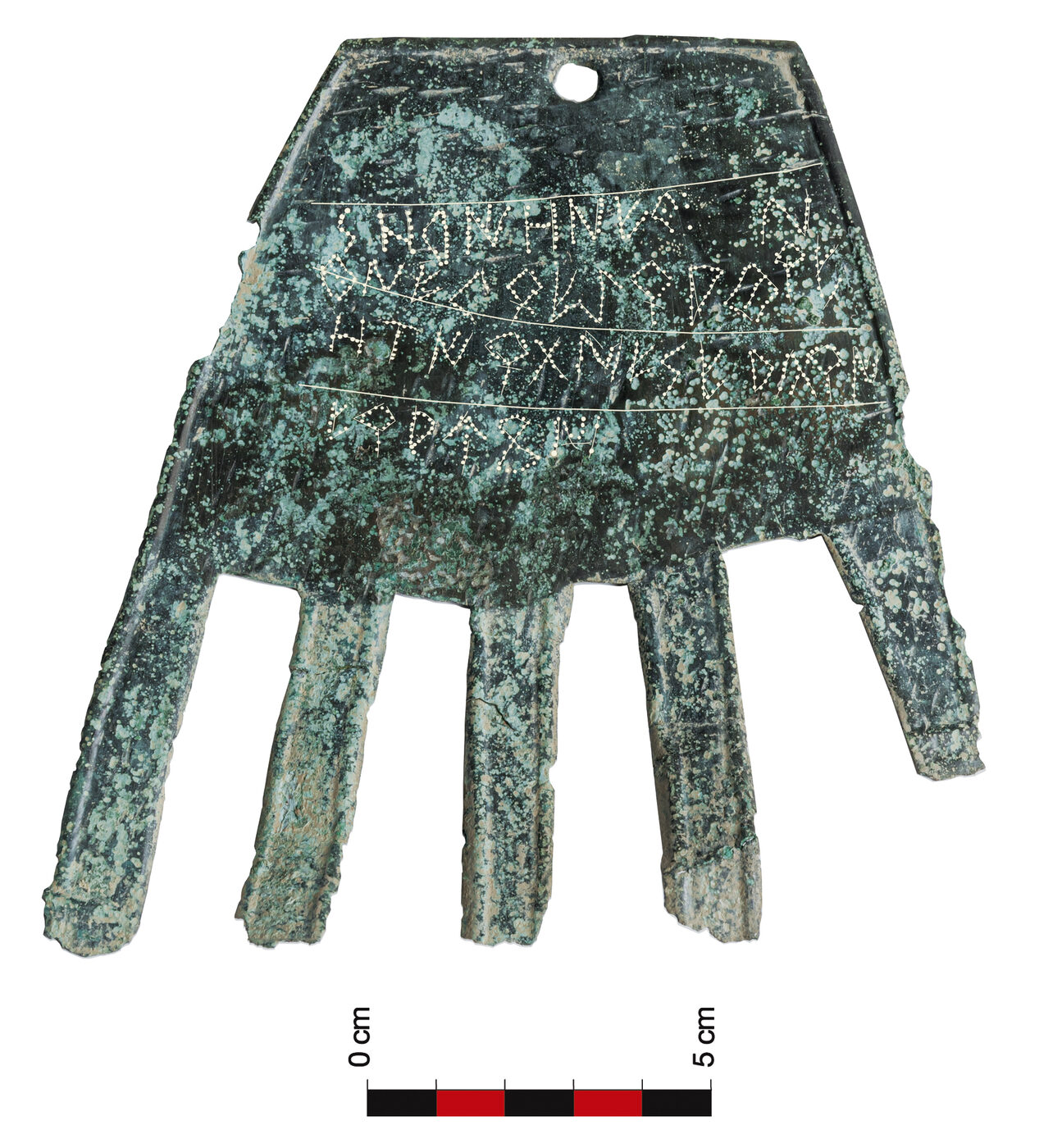
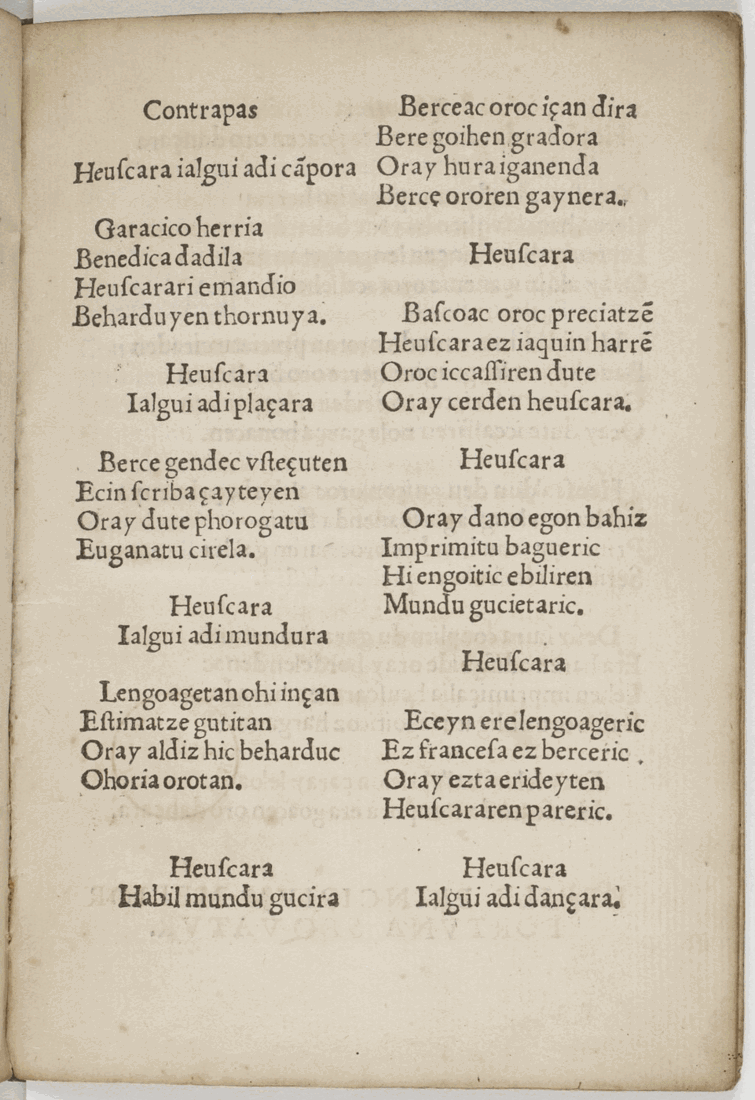
The written record begins late and thinly. Bernard Etxepare's Linguae Vasconum Primitiae, a collection of poems printed at Bordeaux in 1545, is generally taken as the first book published in Basque; Joanes Leizarraga's Basque New Testament, printed at La Rochelle in 1571, followed, and with it the first serious attempt at a common literary form. In 1729 the Jesuit Manuel Larramendi published a grammar under the splendid title El Imposible Vencido — the impossible overcome — aimed squarely at those who held that a grammar of Basque could not be written. That is roughly four centuries of printed Basque before the twentieth century began, against two millennia of printed Latin around it.
The families it has been assigned to, and left
Because an isolate is an unfinished sentence, people keep trying to finish it. The documented history of attempts to attach Basque to some larger family is long, and no proposal has gained mainstream acceptance. The list is worth setting out plainly, because it turns up in the group's own subject matter and because most popular accounts get the status of these ideas wrong in one direction or the other.
- Ligurian. A nineteenth-century substrate proposal, associated with d'Arbois de Jubainville, Pokorny and Kretschmer among others, which absorbed the older Basco-Iberian idea.
- Iberian. Another ancient language of the peninsula, itself unclassified, which shows similarities with Aquitanian and Basque. Most scholars hold that the evidence does not distinguish geographical contact from genealogical relationship; claimed correspondences in numerals and noun case markers have been published and are not generally accepted.
- The Vasconic substratum hypothesis. Advanced by a German linguist, this holds that toponymic evidence shows Basque to be the survivor of a family once spread across most of western Europe, with traces left in the Indo-European languages now spoken there. It is a minority position.
- Georgian and the Kartvelian languages. Now widely discredited. The idea was encouraged by the coincidence of the name Iberia — used both of the peninsula and of an ancient Caucasian kingdom — and by typological resemblances, particularly in ergative constructions. Typological similarity is not evidence of common descent, and the historical material on both sides is too sparse for the comparative method to arbitrate.
- North-East Caucasian and Dene-Caucasian. Some long-range comparativists regard Chechen and its relatives as likelier candidates for a very distant connection, and a few have proposed folding Basque into a Dene-Caucasian superfamily spanning Eurasia and North America. The superfamily itself is highly controversial.
- Indo-European. The most recent serious attempt. A long article in the Journal of Indo-European Studies in 2013 argued that Basque is an Indo-European language; the same double issue carried a series of rebuttals, from scholars who hold the mainstream isolate view and from proponents of wide-range genetic relations alike, and the proposal was rejected by most reviewers. The hypothesis was revived in a 2018 monograph and again in a statistical word-list study published in 2021; the reviews that followed ranged from admiring but unconvinced to outright rejection.
The pattern is consistent across a century and a half: a hypothesis, a body of suggestive resemblances, and an inability to convert them into the regular correspondences the method requires. Long-range comparison has produced the most confident claims and the least accepted ones. It is a case study in the difference between a language whose relatives are unknown and a language that has been shown to have none, and the correct description remains the first: no relationship has been demonstrated.
Where Basque is spoken, and by how many
The territory is conventionally seven provinces straddling the western Pyrenees: Álava, Biscay, Gipuzkoa and Navarre on the Spanish side, Labourd, Lower Navarre and Soule on the French. The seven appear together as early as the first decades of the seventeenth century, in Axular's Gero; the slogan Zazpiak Bat, the seven are one, was coined in the late nineteenth. Taken together the area is 20,947 square kilometres, with a population estimated at 3,155,597 for 2017 — very nearly the size and population of Wales, distributed across two states and three administrative regimes.
The Basque-speaking area has been shrinking for two thousand years, and the direction of travel matters when reading anything the group's members wrote about it. Toponyms and Roman-era epigraphy suggest that at the beginning of the common era the language reached the Garonne in the north and at least the Val d'Aran in the east, on both sides of the Pyrenees; the southern and western limits are not clear at all. By the sixteenth century it had contracted roughly to the present seven provinces, minus southern Navarre, south-western Álava and western Biscay, while still reaching into parts of Aragon and Béarn. In 1807 Basque was still spoken in the northern half of Álava, including Vitoria-Gasteiz, and across a wide area of central Navarre; in both it then retreated rapidly northwards. Schools and adult teaching centres have since carried it back into districts such as western Enkarterri and the Ribera del Ebro in southern Navarre, where it is not known ever to have been widely spoken — which is a genuinely unusual thing for a minority language to be doing.

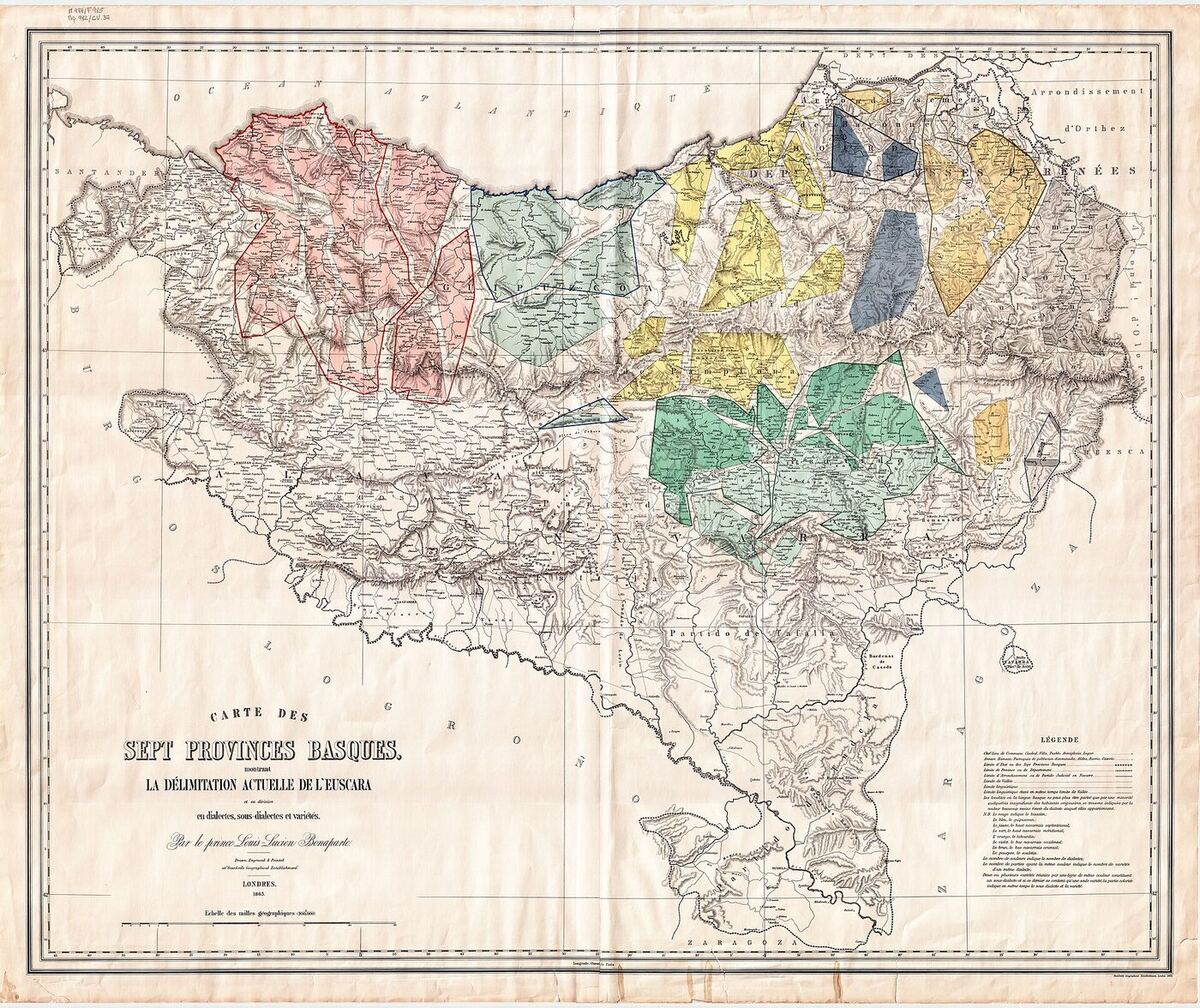
Dialectology has counted between six and nine dialects at different times. The revision published in 1998 by a professor of Basque philology at the University of the Basque Country settles on six: Western or Biscayan, Central or Gipuzkoan, Upper Navarrese, Eastern Navarrese, Navarro-Lapurdian and Souletin. In the alternative modern grouping, which folds Lower Navarrese and Lapurdian together into a single dialect, there are five, subdivided into eleven subdialects and twenty-four minor varieties. Two varieties are gone. Alavese died out in the nineteenth century, known now chiefly from a sixteenth-century manuscript and from place names. Roncalese ended in 1991, with the death of its last speaker, five years before the newsgroup was created. At the extremes — Biscayan in the far west, Souletin in the far east — the phonological, morphosyntactic and lexical differences are described as comparable to those between Catalan and Castilian, though most speakers report understanding one another without much trouble.
Speaker numbers come from a sociolinguistic survey conducted across all the Basque territories at five-year intervals, which is why the figures can be quoted with dates rather than as a single number. Among people aged 16 and over, fluent speakers were 22.3 per cent of the population across the whole territory in 1991, 24.4 per cent in 1996, 25.4 in 2001, 25.7 in 2006, 27.0 in 2011, 28.4 in 2016 and 30.6 in 2021. In absolute terms the 2021 survey counted 806,000 speakers out of 2,634,800 people over 16, plus a further 434,000 with passive command — against about 539,000 speakers thirty years earlier.
The aggregate hides two opposite movements, and the group's active years sit squarely in the middle of them. In the Basque Autonomous Community the proportion rose from 24.1 per cent in 1991 to 36.2 in 2021, with the highest concentration now among 16-to-24-year-olds at 74.5 per cent — described as nearly triple the comparable figure for 1991. In Navarre it rose more slowly, from 9.5 to 14.1 per cent, with sharp internal variation between the Basque-speaking north, where the figure is 62.3 per cent, and the south, where it is 1.6. In the French Basque Country it fell throughout: 26.4 per cent in 1996, 24.8 in 2001, 22.5 in 2006, 20.0 in 2021. A newsgroup created in 1996 for a language spoken across that border was therefore serving, in the same thread, readers whose language was recovering by state policy and readers whose language had none.
Euskara batua: a written standard within living memory
A text medium needs a written standard, and Basque acquired one only twenty-eight years before this group was created. That is the fact which connects the language to the newsgroup, and it is worth taking slowly.
Before the late 1960s there was no agreed common written form. A writer chose a dialect, and in choosing one lost part of the readership: a text in Biscayan was hard going in Soule and vice versa. Attempts at a literary standard go back to the sixteenth century, but none held. The institution that eventually produced one was created in the framework of the Congress of Basque Studies held at Oñati in 1918, when the provincial government of Biscay took the initiative and the other three peninsular provincial governments joined it; Euskaltzaindia, the Royal Academy of the Basque Language, was legally constituted in October 1919, and launched its journal Euskera the following year. Its early decades produced description rather than prescription — a major morphology published between 1923 and 1934, and a far-reaching survey among speakers begun in 1922 — and then, from 1936, silence: under the language policies of the Franco period the academy's activity was reduced to almost nothing, reviving cautiously at the beginning of the 1950s, with reformed statutes in 1954 and a first postwar congress at Arantzazu in 1956.
The decisive meeting came twelve years later, at the same place. From 3 to 5 October 1968 the academy met at the sanctuary of Arantzazu, in the Gipuzkoan highlands, and adopted the first body of rules for a unified Basque, covering orthography, morphology, declension and neologisms, published as the Arantzazu report. The project it approved had been presented by the linguist Koldo Mitxelena, and rested in turn on a report accepted after a congress held at Bayonne in August 1964. A standard verb table followed in 1973. The base chosen was the central dialect, Gipuzkoan, for reasons that were argued at the time and are still rehearsed: it is the meeting point between the divergent extremes, the central and western areas held the largest body of speakers, its Beterri variety had carried the most prestige since the eighteenth century, and — an argument nobody expected to be persuasive — Gipuzkoa was the only Basque province without a single dominant non-Basque-speaking city.

The rules were not received quietly. The letter h was the sorest point: silent across Biscay and Gipuzkoa, still pronounced in much of the north-east, and required in writing by the standard, which meant that speakers of the largest dialects had to learn by rote where to put a letter they did not pronounce, while northern writers had to drop it from words their own tradition had spelled with it. Standard Basque was called an artificial language by its critics, and a Madrid newspaper column of May 1982 labelled it a "euskeranto" — a portmanteau of euskera and Esperanto that stuck. Writers who preferred the traditional dialects argued then and later that the standard would kill the varieties it was made from; defenders replied that it had given the language a form usable in administration, broadcasting and schooling, which no dialect on its own had. Standard accounts date the argument to the years 1968 to 1976 and the adoption to 1976 to 1983, the latter running in parallel with the arrival of regional self-government.
For a mail-and-news gateway the consequence is direct and unglamorous. A newsgroup is a shared file of plain text with no editor and no house style; it works only if a reader in Bayonne and a reader in Bilbao can read the same article without translation, and it works better still if a reader in Boise who learned the language in a class can read it too. Euskara batua is precisely what made that possible, and it was agreed within the adult lifetime of many of the people posting. The generation that filled soc.culture.basque was the first that could write Basque to strangers and be confident of being understood, and some of them had opinions about the spelling because they had been present at the argument.
Writing Basque on a seven-bit network
RFC 1036, the December 1987 standard for the interchange of Usenet messages, builds the article format on RFC 822 mail, and RFC 822 defines a message body as lines of US-ASCII — the seven-bit set of 128 codes. MIME, which supplied the machinery for declaring a character set and encoding it safely, reached its settled form as RFC 2045 and its companions in November 1996, four months after this group was created; deployment took years longer. The general consequences of that for a European language are set out on the soc.culture.catalan page and are only summarised here. What follows is specific to Basque, and it is a happier story than most.
The standard orthography fixed by Euskaltzaindia uses twenty-seven letters: the twenty-six of the basic Latin alphabet plus n with tilde. Its distinctive consonants are written as digraphs rather than as accented characters: tx, tz, ts, tt, dd, rr and ll, each a pair of ordinary Latin letters. The letters c, q, v, w and y are in the alphabet only for loanwords. The one native character above code point 127 is n with tilde; u with diaeresis appears in Souletin words and place names, and c with cedilla occasionally, both treated by the academy as variants rather than as separate letters. Even the mute h, the most argued-over letter in the language, is a plain ASCII character. The upshot is that the overwhelming bulk of running Basque text passes through a seven-bit channel unharmed — a property no other language in this part of the directory can claim, and one produced entirely by orthographic decisions taken in 1968 for reasons that had nothing to do with computers.

The fragile part was everything quoted alongside it. A group whose charter admitted Basque, Spanish, French and English carried acutes, graves, circumflexes, cedillas and inverted punctuation in every second article, and those live in the upper half of ISO/IEC 8859-1, published as an ISO standard in 1987 after appearing as ECMA-94 in March 1985, and echoed with variations in Windows-1252. Unicode adopted that repertoire wholesale as its Latin-1 Supplement block, U+0080 to U+00FF, in version 1.0.0 of 1991. Transport and newsreaders caught up slowly, and an article carrying any byte above 127 might still meet a relay that stripped the eighth bit.
The revision of Latin-1 that arrived during the group's lifetime changed nothing for Basque and one thing for its readers. ISO/IEC 8859-15:1999, Latin-9, replaced eight positions of Latin-1 with the euro sign, the OE ligature in both cases, and S, Z and Y in the accented forms other languages wanted. Every letter Basque needs survives the substitution untouched. What the revision supplied was a currency symbol that became newly useful on 1 January 2002, when euro notes and coins entered circulation in Spain and France alike; a poster who wanted to type a price rather than spell it out now had somewhere to get the character from, if the far end agreed about the character set.
For a reader of the archive today the practical consequence is a search strategy rather than a catastrophe. A word may survive correctly encoded, stripped of its accent, or garbled into the doubled bytes typical of Latin-1 read as something else — and this affects the Spanish and French in the group far more than the Basque. Search the digraph spellings as they stand; search Spanish and French words with and without their accents; and expect the same thread to appear in more than one spelling.
Who could actually read it
Public dial-up reached Spain barely ahead of the group. Telefónica, then still a monopoly, opened InfoVía — a network running TCP/IP over ordinary telephone lines, through which retail customers bought access from third-party providers — to the public on 4 September 1995, and it was shut down on 1 December 1998 in favour of a successor service, as the telecommunications sector was liberalised. The wider shape of Spanish internet access in this period, the academic network included, belongs to the soc.culture.catalan page, which sets it out for all the groups of the peninsula. Two things are specific here.
The first is that the Basque Country built its own network operator, and built it just before the group existed. From 1992 the Basque Government, through a public telecommunications company called Euskalnet, began laying an optical-fibre data network, linking public buildings, hospitals, university centres and government offices, and within three years was extending it to the three provincial capitals. On 3 July 1995 Euskaltel was constituted to run services over it — a company in which the Basque Government, through Euskalnet, held about forty per cent and the three Basque savings banks the other sixty, and whose declared purpose was to have a telephone company of the region's own, independent of the state operator, in time for liberalisation. The country-code domain the group's homeland readers used, .es, had been entered in the IANA root database on 14 April 1988, seven years before that.
The second is the border. Three of the seven provinces are in France, and French and Spanish connectivity in the late 1990s ran on different curves and different price structures. The World Bank series, compiled from ITU returns, puts Spain at 1.33 per cent of the population using the internet in 1996, 13.62 per cent in 2000 and 44.01 per cent in 2004, with France at 2.58 per cent in 1996 and 39.15 per cent in 2004 — behind at the start, ahead through the middle years, and behind again at the end. A group founded in mid-1996 therefore opened to a homeland readership numbered in the low tens of thousands at most, and to a diaspora in countries that had been connected earlier and in larger proportions. The vote roll of June 1996 is consistent with that: it is thick with academic addresses, in Europe and North America both.
The language in law
The legal status of Basque changed twice within living memory, in opposite directions, and both changes are documented in instruments with dates. Reporting them is straightforward; the arguments about them belong to the people who had them.
Basque was made co-official with Spanish in the Statute of Autonomy approved by the Cortes of the Second Republic at Valencia on 1 October 1936, adopted during the civil war and effective only in the shrinking territory the Republic still held. The war reached the province quickly: Gernika was bombed on 26 April 1937 by aircraft of the German Condor Legion and the Italian Aviazione Legionaria acting for the Nationalist side, and Bilbao fell that June. Under the dictatorship that followed, Spanish was declared the state's only official language and the use of the other languages of Spain in administration was banned, discouraged or tolerated according to period and place. The registration of newborns under non-Spanish names was forbidden in 1938, except for foreigners; Spanish alone was used in schools and public services, and teachers who taught the local languages were punished. Accounts of the period are consistent that enforcement was harshest in the 1940s and 1950s and eased in the late 1960s and early 1970s. The Basque-language schools that existed did so clandestinely or under the cover of parish schools; adult literacy in the language was taught at night classes.
One documented exception is worth recording because it belongs to the same story as the cookery threads further down this page. The txoko, the closed gastronomic society, characteristically writes into its constitution a ban on the discussion of politics. During the Franco years that clause had an unintended effect: it made the txokos among the few places where the authorities permitted Basque to be spoken and Basque songs to be sung.
The recovery has its own paper trail. Article 3 of the Spanish Constitution of 1978 makes Spanish the official language of the state and permits the autonomous communities to give co-official status to the other languages of Spain. The Statute of Autonomy of the Basque Country was approved in its final form at Gernika on 29 December 1978, ratified by referendum on 25 October 1979 despite the abstention of more than 40 per cent of the electorate, and accepted by the Congress of Deputies on 29 November and the Senate on 12 December that year. It makes Basque, alongside Castilian, an official language of the community. Navarre followed a different route and arrived at a zoned arrangement, in which Basque is co-official in the Basque-speaking north and not in the south; the zoning has been publicly argued about ever since, some Navarrese parties defending it as a fit to the territory's actual linguistic and cultural diversity and others rejecting it as making a citizen's language rights depend on where they live. In the French Basque Country the language has no official status at all, and French citizens may not use it officially in a French court — a contrast with the Spanish state's arrangements that soc.culture.breton treats at length.
The instrument that did the practical work in the autonomous community was Law 10/1982 of 24 November, the Basic Law on the Normalisation of the Use of Basque. It set out citizens' language rights and the corresponding duties of public authorities: the right to deal with the administration in either official language, bilingual publication of regulations and administrative decisions, the use of either language before the courts, competence over official place names, rules for road signs and public forms, sworn translation, and a programme for making the public workforce bilingual. It underpinned the creation of the public broadcaster and, in schooling, the three models — A, B and D — of which the D model teaches through Basque with Spanish as a subject.
Schools, broadcasting and the relay run
The classroom that carried the standard was the ikastola. The first official one opened in 1914; a small network of Basque schools appeared in Navarre in the early 1930s, at Pamplona in November 1931, Estella-Lizarra in 1933 and Elizondo in 1935. After the war they were suppressed, and where they continued they did so clandestinely. In 1969 the Catholic Church and the parents' associations arranged a lawful Diocesan Federation of Ikastolas, later secularised; after 1975 the movement expanded quickly across the southern Basque Country, and in the French provinces a private network, Seaska, grew from later beginnings until it covered schooling up to the baccalaureate. A 1993 law on the Basque public school required each ikastola to choose between full integration in the public system and operating as a chartered private school. Tens of thousands of children now attend them, with the practical status varying sharply from one district to the next: firmly established in the traditionally Basque-speaking parts of the autonomous community, less so on its southern fringes, and officially recognised but unequally funded in Navarre.
Broadcasting arrived in a rush at the end of 1982. The Basque Parliament unanimously approved the law establishing Euskal Irrati Telebista on 20 May 1982; the radio station Euskadi Irratia began broadcasting on 23 November; and Euskal Telebista reached households at midnight on 31 December 1982, with regular programming from 16 February the following year, made by a staff of around thirty at a centre in Iurreta and broadcast exclusively in Basque. A second channel, in Spanish, followed on 31 May 1986. Two later services matter to a group with a diaspora readership: ETB Sat, which from May 2001 could be received across Europe from the Astra satellite under an agreement with a Spanish pay-television group that put it within reach of some 87 million households, and Canal Vasco, aimed specifically at the Americas and carried by cable and direct-to-home operators there. For a reader in Buenos Aires or Boise, the turn of the century was the first moment at which both a live television signal and a text newsgroup from the homeland were plausibly available at once.
The most visible institution of the language revival is a running race. Korrika, organised by the adult Basque-teaching network AEK, is a relay run day and night without interruption across the whole territory, in which each kilometre is sponsored and a wooden baton is passed from runner to runner. The first edition set off from Oñati on 29 November 1980 and finished in Bilbao on 7 December, against a good deal of contemporary opinion that the idea was foolish; it has run every second spring since, and by its twenty-third edition in 2024 covered 2,700 kilometres over eleven days. It is routinely described as one of the largest demonstrations in support of a language anywhere and as the longest relay race in the world; this page reports those descriptions rather than endorsing them.
The conflict, as the record has it
The group's active years fell inside a political conflict in which a campaign of armed violence and a state response to it are both documented and both argued about. What follows is a record of dated events, legal instruments and the findings of courts, with contested characterisations attributed to whoever made them. This page reaches no conclusion about the political question, and none should be inferred from the order in which the items appear.
ETA was founded on 31 July 1959, under the dictatorship, by a group of Basque nationalist students. Standard reference accounts state that between 1968 and 2010 it killed 829 people, of whom 340 were civilians, and injured more than 22,000; the wider conflict is generally given as more than 850 killed, some 2,600 wounded and nearly 90 people kidnapped. It was designated a terrorist organisation by France, the United Kingdom, the United States, Canada and the European Union, a classification followed by a plurality of domestic and international media. It declared ceasefires in 1989, 1996, 1998, 2006 and on 5 September 2010.
The state response includes conduct that Spanish courts have found criminal. Between 1983 and 1987 death squads operating under the name Grupos Antiterroristas de Liberación, GAL, killed at least 27 people and injured 26, most of them ETA members or Basque nationalist activists and some with no known connection to either, with all but one of the killings carried out on the French side of the border. The episode is known in Spanish public argument as la guerra sucia, the dirty war. The connection to the state was established in court rather than asserted in a newspaper: on 29 July 1998 the Supreme Court of Spain gave judgment in the case of a man seized at his home in Hendaye in December 1983 in mistake for someone else, sentencing to ten years, among others, a former Minister of the Interior, a former Director General of State Security and a former civil governor of Biscay. The two most senior did not enter prison until that September and were released three months later under a partial pardon. The Constitutional Court confirmed the sentence in March 2001, and in January 2010 the European Court of Human Rights held that the trial had been fair. A Civil Guard general and the civil governor of Gipuzkoa were separately convicted over two killings of October 1983.
Within the group's own life the chronology is dense. On 10 July 1997 Miguel Ángel Blanco, a town councillor in Ermua for the People's Party, was abducted by ETA, which threatened to kill him unless prisoners were moved to the Basque Country within two days; he was shot and died in hospital on 13 July, and the demonstrations that followed were among the largest Spain had seen. On 12 September 1998 the Basque nationalist parties and a range of unions and associations signed a declaration at Estella-Lizarra, seeking a process of dialogue and negotiation modelled explicitly on the study of the Northern Ireland settlement; a ceasefire followed within days and was abandoned a little over a year later. On 27 June 2002 Organic Law 6/2002 on political parties was enacted, providing for the dissolution of parties that give express or tacit political support to terrorism; on 27 March 2003 a special chamber of the Supreme Court unanimously declared Herri Batasuna, Euskal Herritarrok and Batasuna illegal and dissolved them. The Constitutional Court confirmed the decision unanimously on 16 January 2004, and on 30 June 2009 the European Court of Human Rights rejected the parties' application, holding the dissolution to answer a pressing social need and to be proportionate to the aim pursued.
The press was caught in the same machinery. On 20 February 2003 the Basque-language daily Euskaldunon Egunkaria, founded in 1990 and for thirteen years the only newspaper published wholly in Basque, was closed on the order of an investigating judge of the Audiencia Nacional over an alleged association with ETA. A successor title, Berria, began publication that June. On 15 April 2010 the court acquitted the defendants of all charges relating to ties to ETA, finding that the closure had interfered with press freedom; the question of damages, and allegations of ill-treatment in custody made by members of the board, remained open afterwards.
The gateway that produced this directory closed in the middle of the last convulsion. On 11 March 2004, three days before a general election, coordinated bombings on Madrid commuter trains killed 193 people and injured around 2,500. The Spanish government attributed the attack to ETA in its first statements; within the week the investigation established that it had been carried out by radical Islamists, and the dispute over what had been said when dominated the final days of the campaign.
What lay beyond the archive is quickly told. On 20 October 2011 ETA announced a definitive cessation of its armed activity. On 7 April 2017 it announced that it had given up all its weapons and explosives. On 2 May 2018 it made public a letter dated 16 April 2018 stating that it had completely dissolved all its structures and ended its political initiative. By then the news2mail gateway had been shut for fourteen years, and the group it had carried was quiet.
A dated record
What follows is a chronology and nothing more: dated events a reader of the archive will find referred to, set down without argument about what they meant. The group's own creation is marked in place, so that it is clear which items its posters could have discussed and which they could not.
- 1545 — Bernard Etxepare's Linguae Vasconum Primitiae is printed at Bordeaux, generally taken to be the first book published in Basque. 1571 — Joanes Leizarraga's Basque New Testament is printed at La Rochelle.
- 1729 — Manuel Larramendi publishes the grammar El Imposible Vencido.
- 1863 — Louis-Lucien Bonaparte's map of the seven provinces divides them into dialects, subdialects and varieties.
- 1870 — the first txoko is formed at San Sebastián. 1877 — Laurak Bat is founded at Buenos Aires on 13 March. 1879 — the first Kontxako Bandera regatta is rowed at San Sebastián.
- 1898 — Athletic Club is founded at Bilbao on 18 July. 1911 — it adopts the signing policy it still follows.
- 1914 — the first official ikastola opens.
- 1918 — the Congress of Basque Studies is held at Oñati. October 1919 — Euskaltzaindia is legally constituted.
- 1 October 1936 — the Cortes of the Second Republic approve a Statute of Autonomy making Basque co-official; the civil war is already under way.
- 26 April 1937 — Gernika is bombed by the Condor Legion and the Aviazione Legionaria.
- 1938–1975 — under the Franco dictatorship Spanish is the state's only official language; non-Spanish names for newborns are forbidden from 1938, public use of Basque is restricted, and its teaching excluded from schools.
- 1952 — the first Basque pelota world championship is held; three-yearly until 1958 and four-yearly since.
- 6–7 June 1956 — the first Western Basque Festival is held at Sparks, Nevada. 1956 — Euskaltzaindia holds its first postwar congress at Arantzazu.
- 31 July 1959 — ETA is founded.
- 3–5 October 1968 — the Arantzazu congress adopts the first rules of euskara batua. 1973 — a standard verb table follows.
- March 1973 — delegates from Basque clubs across the American West meet at Reno and found the North American Basque Organizations.
- 29 December 1978 — the Statute of Autonomy is approved in final form at Gernika. 25 October 1979 — it is ratified by referendum, more than 40 per cent of the electorate abstaining.
- 29 November – 7 December 1980 — the first Korrika runs from Oñati to Bilbao. It has run biennially since.
- 20 May 1982 — the Basque Parliament unanimously approves the law creating Euskal Irrati Telebista; radio follows on 23 November and television at midnight on 31 December.
- 24 November 1982 — Law 10/1982 on the normalisation of the use of Basque is enacted.
- 1983–1987 — the GAL death squads are active; Spanish courts later convict officials including a former Minister of the Interior.
- 1985 — the Basque Museum and Cultural Center opens in Boise, Idaho.
- 14 April 1988 — the .es country-code domain is entered in the IANA root database. Eight years before the group.
- 1991 — the last speaker of the Roncalese dialect dies.
- 1993 — the Bertsolari Txapelketa Nagusia begins the four-year cycle it has kept since.
- 27 May 1994 — the Basque Parliament passes Law 8/1994 on relations with Basque communities abroad, creating the register of euskal etxeak.
- 4 September 1995 — Telefónica opens InfoVía, national dial-up access over TCP/IP, to the public. 3 July 1995 — Euskaltel is constituted by the Basque Government and the three Basque savings banks. 1995 — the first World Congress of Basque Collectivities is held.
- 1 April 1996 — a forged newgroup control message for soc.culture.basque circulates; rmgroup messages follow through April and into May.
- 21 March – 16 June 1996 — RFD, two Calls for Votes, and a result of 164 to 62 on 226 valid votes.
- 8 July 1996 — soc.culture.basque is created. Everything above predates the group; everything below falls within or after its life.
- 22 September 1996 — a control message reports that many sites carry the group misconfigured as unmoderated.
- 10–13 July 1997 — a councillor in Ermua is abducted on 10 July and dies of gunshot wounds on 13 July; demonstrations follow across Spain.
- 18 October 1997 — the Guggenheim Museum Bilbao is inaugurated.
- 29 July 1998 — the Supreme Court of Spain convicts former senior officials over the 1983 Hendaye kidnapping.
- late August – late November 1998 — a flood of forged control messages claims the group has become unmoderated by votes that never took place.
- 12 September 1998 — the Estella-Lizarra declaration is signed; a ceasefire follows and is abandoned in late 1999.
- 1 December 1998 — InfoVía is withdrawn as the Spanish telecommunications market is liberalised.
- May 2001 — ETB Sat becomes receivable across Europe from the Astra satellite.
- 1 January 2002 — euro notes and coins enter circulation in Spain and France.
- 27 June 2002 — Organic Law 6/2002 on political parties is enacted.
- 20 February 2003 — Euskaldunon Egunkaria is closed by judicial order; Berria begins publication that June; the defendants are acquitted on 15 April 2010.
- 27 March 2003 — the Supreme Court declares Herri Batasuna, Euskal Herritarrok and Batasuna illegal; confirmed by the Constitutional Court on 16 January 2004 and upheld at Strasbourg on 30 June 2009.
- 11 March 2004 — the Madrid train bombings kill 193 people three days before a general election.
- 20 October 2011 — ETA announces a definitive cessation of armed activity. 7 April 2017 — it announces disarmament. 16 April 2018 — a letter, made public on 2 May, states that it has dissolved.
- 6 March 2014 — the .eus top-level domain is registered in the IANA root, sponsored by Puntueus Fundazioa of Donostia. A decade after the gateway closed.
- 18 June 2025 — the rmgroup control message for soc.culture.basque is issued, following the Big-8 board's decision of 21 May to remove 89 moderated groups left without moderators.
Dates attach to instruments, rulings, foundations and inscriptions, so those are what a list of this kind can hold. The argument each of them caused was the group’s actual subject, and none of it is recoverable here.
The eighth province
The Basque diaspora is sometimes called the eighth province, after the seven of the homeland, and it is old, large and unusually well institutionalised. Nineteenth- and twentieth-century emigration planted Basque communities across the Americas — Argentina above all, with Uruguay, Chile, Mexico, Venezuela, Colombia and Peru — and a separate stream took Basques to the Philippines during the Spanish colonial period. Estimates of descent in South America are surname-based and vary enormously, which is why this page gives institutions and dates rather than population figures for that half of the story. Argentina and Chile have their own groups in this directory: soc.culture.argentina and soc.culture.chile.
The institutions are firm. Laurak Bat of Buenos Aires was founded on 13 March 1877 by thirteen young men who had arrived after the Second Carlist War, and is reckoned the oldest euskal etxea still running anywhere; a shoot of the Tree of Gernika was planted in its courtyard in 1906, and the building contains a trinquet for pelota and rooms for Basque classes, which it has been organising since 1904. Earlier centres are recorded at Havana in 1868 and at Montevideo in 1876, and which of them came first is not settled; the Montevideo house, long held to be the earliest, closed many years ago. One detail from Laurak Bat deserves recording on a page about a language: from the 1900s the bertsolari Pello Mari Otaño, who spent years in Argentina as a shepherd and then taught at the centre, gave Basque classes to the children of the diaspora — organised teaching of the language in the homeland itself did not begin until the 1920s and 1930s. The eighth province was, for a moment, ahead of the other seven.

In North America the pattern is different and the arithmetic firmer. The 2000 United States census, taken mid-way through the group's life, recorded 57,793 people of full or partial Basque descent, concentrated in California (17,598), Idaho (8,196), Nevada (5,056), Oregon (3,162) and Washington (2,579). By proportion the map is sharper still: Winnemucca in Nevada at 4.2 per cent, Gooding in Idaho at 4.1, Battle Mountain at 4.1 and Elko at 3.7. That distribution is the residue of sheep. Basques went to the American West with the mining rushes and stayed as herders; the last large wave came under contract, recruited through the Western Range Association from the 1940s until about 1970 to fill wartime and postwar labour shortages. Herding is solitary, seasonal work in high country, which is a fair part of why the clubs and the boarding houses mattered so much.
The club network is datable throughout. The oldest in the United States is the Central Vascoamericano, founded in New York in 1913 and now the Euzko Etxea of Brooklyn; the Basque Club of Utah followed at Ogden in 1914, the Kern County Basque Club at Bakersfield in 1938 and the first Zazpiak Bat club at San Francisco in 1960. The first Western Basque Festival was held at Sparks, Nevada on 6 and 7 June 1956. In March 1973 delegates from clubs in California, Idaho, Nevada, Utah and Oregon met at Reno and founded the North American Basque Organizations, a federation which — as its own account is careful to note — brought together French and Spanish Basques who in the old country had had little to do with one another. Boise, Idaho holds the largest single urban concentration, with a Basque Museum and Cultural Center founded in 1985 on West Grove Street, the only Basque museum in the country; a Basque Block downtown; a festival, Jaialdi, held roughly every five years around the Fourth of July; a Basque-language immersion preschool, opened in 1998 and described as the only one in the United States; and a sister-city relationship with Gernika dating from 1990. Pelota courts followed the herders: a fronton was built at Jordan Valley, Oregon in 1915, and the first in the United States proper at Miami in 1924.
The homeland's side of the relationship acquired a statutory basis two years before the newsgroup did. Law 8/1994 of 27 May, passed by the Basque Parliament, regulates relations with Basque communities abroad, defines what a recognised centre is, and created the register that now lists 164 centres in 21 countries. It also mandated a World Congress of Basque Collectivities every four years, attended by three delegates from each of those countries; the congresses of 1995, 1999 and 2003 all fall inside the group's active life, and their agendas are a reasonable guide to what the diaspora half of the readership was thinking about while it posted.
A readership running from Boise through Buenos Aires to Bilbao has no common evening. That is part of why a store-and-forward medium suited it: an article written at midnight in Bizkaia was waiting at breakfast in Idaho, and neither party had to be awake for the other. It is also why the definitional argument never resolved. The seven provinces and the eighth were, for the first time, in the same room, and discovered that they had been maintaining slightly different answers to the same question for a hundred and twenty years.
Sport, the table and the calendar
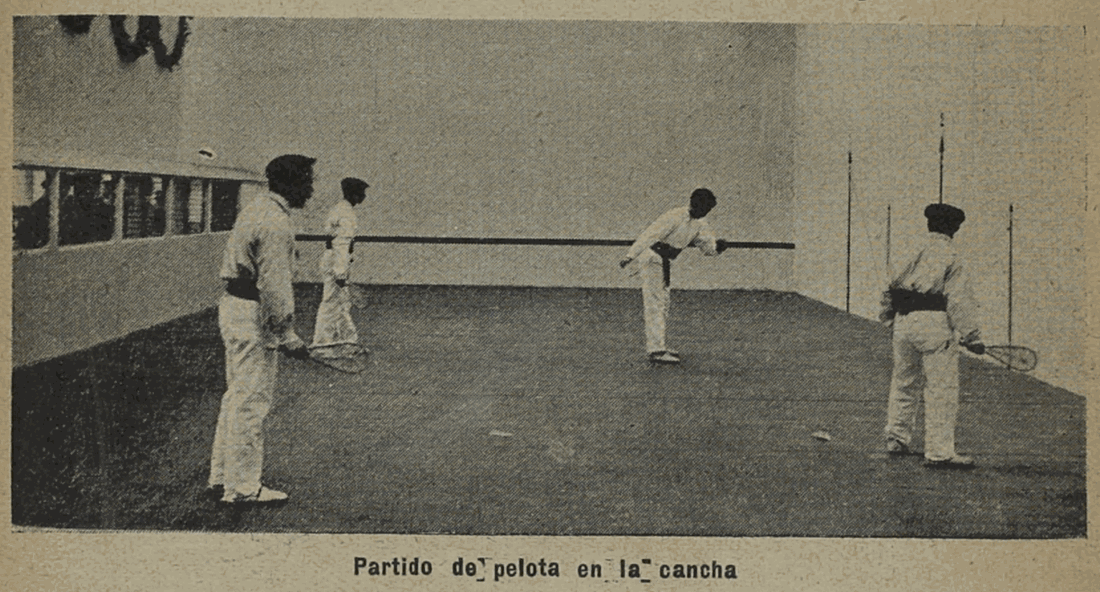
Between the crises the group ran on the ordinary business of a culture group, and this material is better documented than its politics. Pelota is not one game but a family of them, played bare-handed, with a wooden bat, with a racket, or with the long basket of the chistera, against a single wall or in an enclosed trinquet. Its international federation standardised the varieties into four modalities — walls of thirty, thirty-six and fifty-four metres, plus the trinquet — admitting fourteen disciplines with fixed ball weights, rules and court dimensions, which is what makes a world championship possible and what purists complain has flattened local character. The first world championship was held in 1952, at three-year intervals until 1958 and every four years since. Pelota was a full Olympic sport once, at Paris in 1900, and a demonstration sport in 1924, 1968 and 1992. In the basket game the ball is fast enough that the Basque Government has claimed it as the fastest game on earth; the record cited is 302 kilometres an hour, set at a fronton in Rhode Island on 3 August 1979.
The rural sports have a formal list. In 2006 the Basque Government's strategic plan for their promotion identified eighteen, known as the H18K, all of them derived from farm or harbour work. Among them: wood-chopping with an axe; the dragging trials in which men, horses, oxen or donkeys haul a stone across a measured course; stone-lifting, with granite blocks of between 100 and 212 kilogrammes lifted to the shoulder; drilling holes in rock with a steel bar; anvil-lifting, raising an eighteen-kilogramme anvil thirty centimetres above one's own head as often as possible in a set time, with champions managing some eighty repetitions in two minutes; hay-bale lifting on a pulley and hay-bale tossing over a bar; cob-gathering; churn-carrying; weight-carrying and sack-carrying; two-man sawing; the oxcart game; tug-of-war; and scything. The scythers have the best archive: the earliest record of a contest is a verse of 1880 about a match at Iturriotz, and a famous meeting at the same place in 1925 drew a crowd of six thousand, the winner cutting 4,294 kilogrammes of grass in two hours against his rival's 3,957. The winner of any of these takes home a beret, the txapela, which is why the Basque word for champion is txapeldun, the one who has the beret.
On the water, the estropadak are rowed in a traineru, a boat descended from nineteenth-century fishing craft, crewed by thirteen oarsmen — twelve in pairs and one alone in the bows — and a cox who stands facing them from the stern. Almost every coastal town from Biscay to Galicia holds a regatta between July and October; the fixed point is the Kontxako Bandera in the bay at San Sebastián, first rowed in 1879 and contested on the first two Sundays of September.
Football supplied the sharper argument. Athletic Club of Bilbao, founded on 18 July 1898, was a founder member of the Spanish first division in 1928, and by 1930 five of the ten clubs in that division were Basque. Since 1911 it has fielded only players born in, or trained in football in, the greater Basque Country: Biscay, Gipuzkoa, Álava and Navarre, with Labourd, Soule and Lower Navarre across the border. The policy turns every transfer window into a live test of the same definitional question the group could never settle, decided this time by a committee with a fixture list.
The table was safer ground, and better company. The txoko, the closed gastronomic society where members cook for each other and pay into the larder, is generally dated to San Sebastián in 1870; more than a thousand are reckoned to exist, and the scale is local rather than metropolitan — Gernika, a town of some 15,000 people, has nine of them with around 700 members between them. Membership has traditionally been male, and the constitutions that bar politics have commonly restricted what women may do in the kitchen as well. The nouvelle cuisine basque of the 1970s and 1980s made the region a culinary destination and exported the pintxo; the txoko is the older and more characteristic institution, and the one that carried the language through the years when little else could.
The calendar gave the year its shape and the group its recurring seasons. San Fermín at Pamplona opens with the chupinazo at noon on 6 July and closes at midnight on 14 July with the singing of Pobre de mí. Korrika runs every second spring. And the Bertsolari Txapelketa Nagusia, the great championship of improvised sung verse, is the fixture that belongs most completely to the language: contestants are given a subject, a tune and a metre on the spot and must sing a finished verse. It was first held in 1935, repeated in 1936, then stopped by the war; it resumed in 1960, lapsed again after 1967, and returned in 1980 at San Sebastián before an audience of some ten thousand. Since 1993 it has run on a four-year cycle, so that its 1997 and 2001 finals fall inside the group's life. In 2009 the final filled an exhibition hall in Bilbao with fifteen thousand people and was won for the first time by a woman. A sport in which the equipment is a language and the crowd is the size of a football crowd is not the least of the reasons this group existed.
What the record does not show
The paperwork is unusually complete; the group itself is not. Nothing in the surviving administrative files records how many people subscribed, how many articles were submitted, how many were rejected, or on which of the charter's grounds. There are no moderation logs. The readership estimates that exist for the famous groups of the 1980s come from surveys that had stopped before this group was created, and none of them covers it.
Nor is there a record of the panel's own history. Five moderators were named in 1996; the charter anticipated that "moderators will come and go throughout the course of the group" and set out a procedure for adding and removing them, including a supermajority vote for any change to the existing situation, but no vacancy notice or moderator change was ever filed in the archive that holds the creation documents. The 2025 removal notice states only that the group, like the other 88, had not had a moderator "for a long time". When the last one stopped, and whether the group had already gone quiet before that, is not recorded anywhere this page could find.
Two further things are worth being explicit about. First, the balance of languages in the group is not documented. The charter admitted four; which of them predominated, and in what proportion at what date, would require counting the archive rather than reading about it, and this page has not done that count. Second, no thread titles, posters, quotations from postings or message counts appear anywhere above, because none could be verified from a source. Where this article describes what was discussed, it describes the standing subjects a group of this kind and this charter necessarily carried, and it says so.
Scope and limits
This page is a reference article about a newsgroup, assembled from the group's own administrative record and from published sources about the language, the territory and the period. The creation documents quoted above — the Request for Discussion, the Calls for Votes, the result and the control messages — are reproduced from the Usenet administrative archive; their wording, spelling and capitalisation are theirs, not this page's.
The general framework of minority languages in the Spanish state, the autonomous-community system and the question of who keeps a standard is set out on the soc.culture.catalan page and is not duplicated here; the other minority-language nation of the Spanish state in this batch, with a Romance language and no co-official status, is covered at soc.culture.asturies; the very different treatment of regional languages by the French state belongs to soc.culture.breton; and the branch-generic material about soc.culture.* lives on the soc.culture hub.
On the political conflict, this page reports dates, instruments and the findings of courts, attributes characterisations to those who made them, and takes no position. Where a figure is disputed or an estimate, it is described as such. Where the record is silent, the section above says so rather than filling the gap.
Reading soc.culture.basque today
- Historical archive: Google Groups — soc.culture.basque (coverage varies by group and era).
- Open in a newsreader:
news:soc.culture.basque— the original site offered exactly this link, and it still works if your system has a newsreader registered for thenews:scheme. - Live access: point an NNTP newsreader at a modern server — see accessing Usenet today.
- The original news2mail e-mail subscription service ended in the mid-2000s and no longer operates.