soc.culture.austria
Austria and its people.
Viennese coffee-house culture, alpine dialects, Haider-era politics and the eternal question of Austrian vs. German identity — discussed by Austrians at home, expats, expatriates and German participants.
Posts mixed German and English; the group coordinated informally with the de.* hierarchy for German-language topics.
On this page
- The group's own paperwork
- What the charter asked for
- Two hierarchies next door, and only one of them Austrian
- Where the votes came from
- Austrian German as a variety, and the protocol that protects it
- German on a seven-bit network
- The dated record, 1918 to 1955
- How Austria characterised its own role, and how that changed
- 1989 to 2002: the years such groups were at their busiest
- What a culture group actually carried
- What the record does not show
- Scope and limits
The group's own paperwork
soc.culture.austria has a complete administrative file, which is more than most Usenet groups can say. The Internet Systems Consortium's mirror of news.announce.newgroups holds all four documents in one place: the Request for Discussion of 2 April 1993, the Call for Votes of 10 May, a second Call for Votes with vote acknowledgement on 19 May, and the result on 11 June. Every one of them was posted from a Vienna address at Siemens Österreich, cross-posted to news.announce.newgroups, news.groups, soc.culture.europe and soc.culture.german, and carries an Approved: header from [email protected] — the moderator of the announcement group, through whom every Big-Seven proposal of the period passed.
The vote ran, in the CFV's own words, from Monday, 10 May 1993 at 00:01 GMT to Monday, 7 June 1993 at 23:59 GMT, a period the document itself describes as twenty-nine days. Ballots went by e-mail to a dedicated address at the proposer's employer, one vote per person per address, with the latest legal timestamp taken where an address voted more than once. The result posting is headed RESULT: soc.culture.austria passes 334:23 and gives the arithmetic in full:
Total Votes: 357 · Yes Votes: 334 (93.56%) · No Votes: 23 (6.44%) · Yes-No Votes: 311 · Duplicates: 7 · Duplicate Resolution: Last vote taken as valid
Against the standing Big-Seven threshold — at least a hundred more yes votes than no votes, and at least two-thirds of valid votes in favour, the two conditions described on the soc.* hierarchy page — a margin of 311 at 93.56 per cent in favour cleared both conditions several times over. The seven duplicate ballots were resolved by taking the last valid one, as the rules required, and the full roster of voters was published with the count, names and addresses included, so that anyone could check it. That roster is the single most informative surviving document about who was in the room, and it is used below.
The group entered the network's own bookkeeping and stayed there. In the newsgroups file distributed from the same archive the line reads, tab-separated and complete:
soc.culture.austria Austria and its people.
In the active file the entry is soc.culture.austria 0000000000 0000000001 y — the trailing y meaning unmoderated, anyone may post, exactly as the charter specified. One further line in the same file records a small piece of housekeeping: the alt.* namespace carried a group called alt.culture.austrian, whose entire description is Use soc.culture.austria instead.
What the charter asked for
The charter is a period document in the best sense: formal in structure, slightly informal in tone, and candid about why the group was wanted. Its purpose clause is a list — arts and entertainment, business, culture, development and technology, education, history, information, music, news, politics, travel and tourism — which is to say the standard soc.culture.* remit, filed under a country. The rationale is more interesting, because it states a grievance:
soc.culture.austria will provide a suitable forum for the discussion of one of the smaller countries in Europe, not yet in the common market. Austria is one of the last remaining countries in Europe that does not have its own newsgroup. Currently news on Austria in general are often crossposted to other groups like soc.culture.german. Wheras Austria has German as native tongue too, it is spoken differently in everyday usage and has different dialects and idioms.
Two claims sit inside that paragraph, and both were live questions in 1993. The first is administrative: Austrian traffic was being carried in a group named for a language rather than for the country, and the proposal wanted a room of its own. The second is linguistic, and it is the reason this page has a section on Austrian German further down: the charter's argument for a separate group is, in part, that the shared language is not quite shared.
The document also legislates for the joke it knew was coming. Under the same rationale heading it adds that a further purpose is to clearly distinguish between Australia and Austria, and wherever confusion may arise, a sense of humor is expected — a clause drafted in the knowledge that in every alphabetical group list ever printed, soc.culture.austria sits immediately below soc.culture.australian. Vienna souvenir shops still sell the same observation to travellers on T-shirts reading No kangaroos in Austria. It is one of the very few Usenet charters to make provision, in advance, for a misunderstanding about kangaroos.
Two further clauses are worth quoting because they set the group's working conditions. On conduct, the charter asks posters to refrain from flames, insults and unnecessary criticism of a person, to keep any criticism constructive and polite, and to take insults to private e-mail — an unenforceable request in an unmoderated group, and a normal one to make. On language, it is explicit:
The official language of soc.culture.austria will be English and Deutsch(German), and various forms of dialects, although other languages are welcome but may not be understood by the group as a whole!
That sentence is the group's constitution. A bilingual charter in an internationally propagated hierarchy is an unusual thing to write down, and it defines the whole of what follows: the group was designed from the outset to be readable by people who had no German, and writable by people who preferred it.
Two hierarchies next door, and only one of them Austrian
An Austrian reader in the middle 1990s who wanted to discuss Austria in a newsgroup had a choice of three addresses, and they were not interchangeable. This is the part of the story that distinguishes soc.culture.austria from most of its neighbours in the branch, and it turns entirely on language.
The first address was this group: English and German both, unmoderated, and propagated worldwide on the soc.culture.* feed — one of the branches that took its present shape in the Great Renaming of 1987 — so that it reached every site carrying the Big Seven, which by 1993 meant most news servers anywhere. Its natural readership was anyone who had heard of Austria, in any country, on any continent.
The second was de.*, and the crucial fact about de.* is not that it is German but that it is German-language. The hierarchy was assembled in January 1992 out of two older German-language trees, dnet.* and sub.* — its own page tells that story — and the Usenet control file that tells a news server whose control messages to trust describes it in exactly those terms. The entry in control.ctl is headed DE (German language), gives the administrative group as de.admin.news.announce and a contact at dana.de, and instructs a server to honour newgroup, rmgroup and checkgroups messages for de.* only when they verify against that key. Nowhere in the entry does the word Germany appear. A hierarchy organised on that principle serves Germans, Austrians and German-speaking Swiss from one namespace, and in the current group list distributed by the ISC — 233 groups — there is no group anywhere in de.* whose name or description marks it as Austrian. That is by design, not by neglect: the branch is sorted by subject, and the subjects are supposed to be common property.
The third address was Austria's own. An at.* hierarchy exists in the same control file, with its own arrangements: its administrative group is at.usenet.gruppen, its control messages come from [email protected], they are PGP-verified like the German ones, and the entry publishes the address at which the key can be fetched. The group list carries 65 groups, and their names are a portrait of a national hierarchy doing domestic work — at.anzeigen.* for classified advertisements in fourteen categories from jobs to flat-hunting, at.gesellschaft.politik for Austrian politics, at.gesellschaft.zivildienst for civilian alternative service, at.verkehr.bahn for the railways, at.medien.fernsehen for Austrian television, at.region.graz for the city of Graz and its surroundings and at.region.noe for the province of Lower Austria. Two whole sub-trees belong to single institutions: at.tuwien.general, .hardware, .software and .student for the Vienna University of Technology, and at.univie.club, .edv, .general and .publizistik for the University of Vienna. Every description in the list is in German.
So the division of labour was clean, and it was a division by language and by audience at the same time. at.* was for Austrians talking to Austrians about Austrian things, in German, on a feed most sites outside the country did not carry. de.* was for the German language as such, shared with two other countries, and no more Austria's than anyone else's. soc.culture.austria was the only one of the three that a curious American, a Japanese student of German or an emigrant who had lost the language could read at all. That is why a country of eight million with a functioning national hierarchy of its own still wanted a room in the international branch, and why the charter insisted on English as a working language alongside German. The three addresses did not compete; they answered three different questions about who was being addressed.
What makes the arrangement distinctive rather than generic is the middle term. Several other national groups in the branch sat beside a hierarchy in the same language — but a hierarchy that belonged to their own country. Austria's neighbouring hierarchy belonged to a language shared with Germany, whose population was roughly ten times Austria's, and with German-speaking Switzerland; the domestic option was a third and smaller hierarchy under the country code.
Where the votes came from
The published vote roster of June 1993 is the best evidence anyone has about the connected population that produced this group, because it is a list of real addresses at a known date rather than an estimate. Of the 334 yes votes, 331 carry a parseable e-mail address (three voters are listed by name and institution only). Counted by domain, 151 of those addresses are in .at. Of those, 106 are academic .ac.at machines and 45 are Austrian company sites: twenty-five of the company addresses are at the proposer's own employer, and almost all the rest are at Vienna engineering and telecommunications firms, Kapsch and Alcatel among them.
The academic breakdown is a map of Austrian computing in 1993, and it is not the map one might guess. The Vienna University of Technology supplies 35 addresses, spread across at least a dozen institute machines; the University of Linz 22; the Vienna University of Economics and Business 12; Salzburg 8; the University of Graz 7; the University of Vienna 6; the economic and social science research machines 6; Graz University of Technology 6; the Seibersdorf research centre 3; Klagenfurt 1. Beyond Austria, 73 addresses are at United States .edu sites, with smaller groups in Germany, Canada, Australia, France, the United Kingdom and Sweden, three votes from Japan and single votes from as far off as Finland, Portugal and the Soviet Union's .su domain, which was still in use in 1993. Three ballots carry BITNET addresses and one a FidoNet address.
The twenty-three no votes are almost entirely from outside Austria — universities in the United States, including two in Alaska, and in Germany, Britain and Mexico, together with a handful of company addresses in the United States, the Netherlands and Japan. Exactly one came from an Austrian machine, at the Vienna University of Technology.
That the base was academic is not accidental; for most of the group's first decade it was the only base there was. Austria's research network, ACOnet, was begun in 1981 by the university computing centres together with the science ministry. Its first international links came in 1985, to EARN and EUnet, with the national EARN node at the University of Linz; the ACONET association was founded in 1986. The first phase was a private X.25 ring joining Vienna, Graz, Leoben, Klagenfurt, Innsbruck, Salzburg and Linz at 9.6 and later 64 kbit/s. Internet connectivity proper arrived in 1990, when the University of Vienna obtained a 64 kbit/s link to Geneva under an IBM-funded European academic supercomputing initiative, from which a 1.5 Mbit/s path to the American NSFNET could be used; the other Austrian universities followed quickly. In 1992 the X.25 network was replaced by an IP network whose core was a triangle between Vienna, Linz and Graz running at 64 and 128 kbit/s. The country's news feed, in other words, arrived over a link narrower than a single modern photograph, and it arrived at universities.
The country-code domain is dated precisely. IANA's root database gives 1988-01-20 as the registration date for .at, and the delegation record still lists the technical contact in care of the Vienna University Computer Center and two of the zone's name servers under univie.ac.at. Nearly forty years on, the university whose computing centre took the country online is still in the paperwork.
How narrow the domestic base was can be stated in figures. The World Bank series for individuals using the internet, which draws on ITU reporting, puts Austria at 0.77 per cent of the population in 1993, 1.39 in 1994, 1.89 in 1995, 6.91 in 1996, 9.53 in 1997, 15.4 in 1998, 23 in 1999 and 33.73 in 2000. In the year of the vote, fewer than one Austrian in a hundred used the internet at all; through the group's founding years the great majority of Austrians at home had no means of reading it. The ones who could held an institutional account or, later in the decade, a dial-up subscription.
The counterweight is the diaspora. The 1990 United States census recorded 948,558 people claiming Austrian origins; the 2000 census recorded 735,128 of full or partial Austrian descent, three in every thousand Americans, concentrated in New York, California, Pennsylvania, Florida, New Jersey and Ohio. Add the long-settled communities in Germany, Canada and Switzerland, and the arithmetic of the group falls out on its own. Austria runs on Central European Time, the American east coast six hours behind it and the Pacific coast nine: a thread opened in Vienna after work collected its first replies while the city slept, and its author woke to an argument that had moved on without him.
Austrian German as a variety, and the protocol that protects it
The charter's linguistic claim — that Austria has German as a native tongue too, but speaks it differently — is not folklore. It has a state publication behind it, an academic controversy around it, and a clause in an international treaty.
The publication is the Österreichisches Wörterbuch, the Austrian Dictionary. It was ordered in 1950 by the education minister Felix Hurdes and first appeared in 1951: 276 pages, some 20,000 headwords, and a print run of 20,000 copies that sold out within the year. It is not a commercial reference work but the codification of the orthography binding on Austrian schools and public administration, published for the education ministry, and its arrival displaced the Duden dictionaries from that role. Its own foreword, in the thirty-second edition of 1972, states the position plainly, in translation:
We Austrians use a number of expressions that are no less correct, good and beautiful than those used elsewhere. They have naturally been given preference in the dictionary, whereas those current only in northern Germany have either not been considered at all or have been expressly marked as foreign to us, or at least unfamiliar.
The dictionary has had its own domestic politics. The thirty-fifth edition of 1979 admitted more than five thousand mainly Viennese words; western and southern Austrians protested at the eastward tilt, and most of the additions were removed again in the next edition. Editorial judgement about which Austrian is the Austrian has been contested inside the country for as long as the book has existed, which rather undercuts any simple account of a single national standard confronting a single German one.
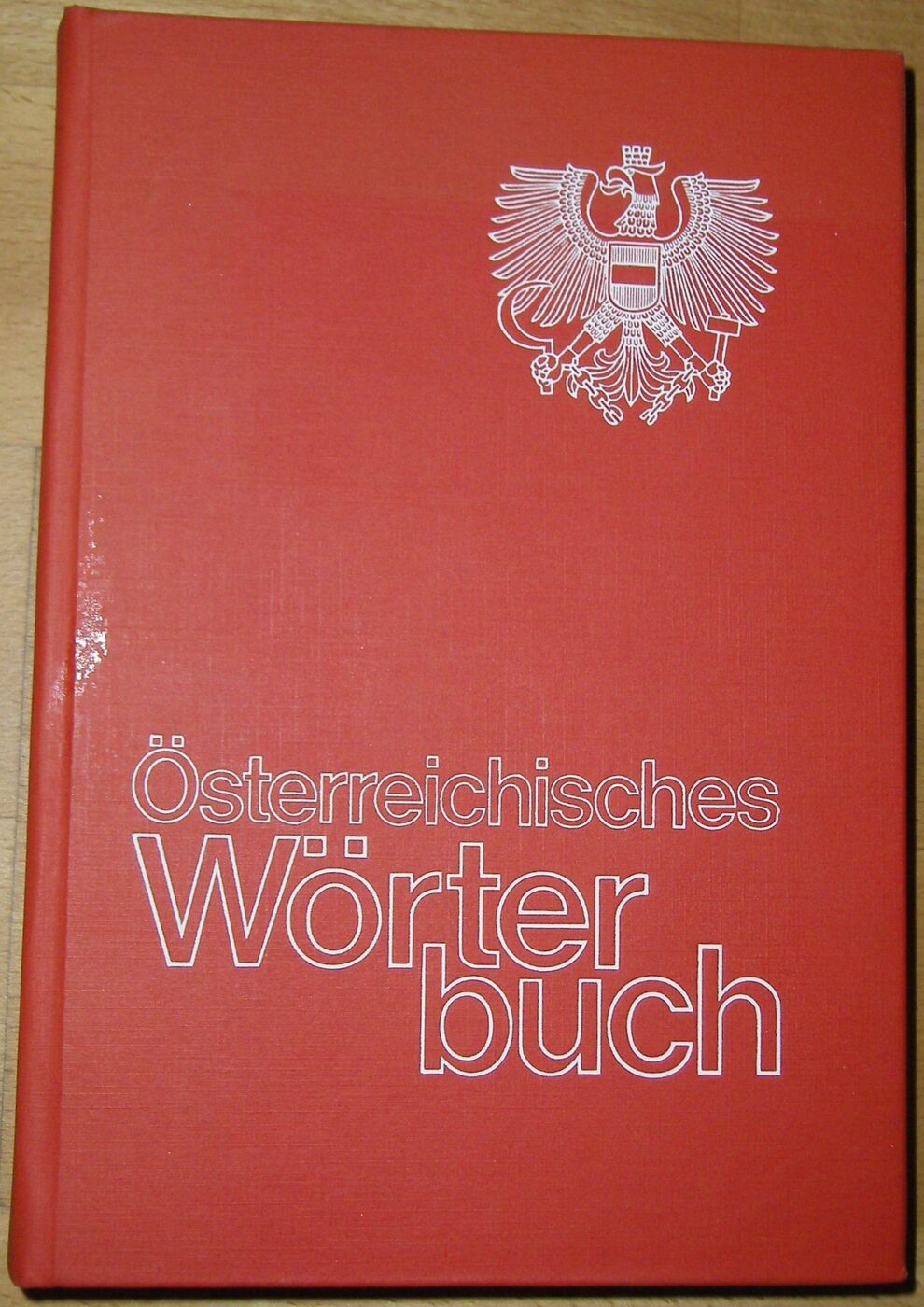

Austrian Standard German differs from the German of Germany in ways that are documented rather than impressionistic. Calendar months: Jänner rather than Januar, and the rarer Feber alongside Februar. Everyday adverbs: heuer for this year. Domestic nouns: Stiege for a staircase, Rauchfang for a chimney. Grammar differs too — verbs of position take sein rather than haben in the perfect, so that an Austrian sentence distinguishes ist gestanden, stood, from hat gestanden, confessed, where the German of Germany collapses both into one form. Whole registers of legal and administrative vocabulary descend from the chancery German of the Habsburg monarchy and have no counterpart across the border. And then there is food, where the differences are densest and most cheerfully argued: Erdäpfel against Kartoffeln, Paradeiser against Tomaten, Marillen against Aprikosen, Kohlsprossen against Rosenkohl, Karfiol against Blumenkohl, Fisolen against grüne Bohnen, Obers against Sahne, Topfen against Quark, Faschiertes against Hackfleisch, Ribisel against Johannisbeeren, Kren against Meerrettich.
That last category is the one that ended up in a treaty. When Austria negotiated accession to the European Union, it obtained a protocol annexed to the accession instrument — Protocol No 10, on the use of specifically Austrian expressions of the German language — giving twenty-three such terms the same legal standing as the corresponding German ones, so that European legislation drafted in German could not oblige Austria to use the northern words for its own produce. Every one of the Austrian food words listed above is among the twenty-three; the annex, as published in the Austrian Federal Law Gazette, runs from Beiried for roast beef through Erdäpfel, Marillen, Melanzani for aubergines and Powidl for plum jam to Weichseln for sour cherries. The protocol took effect with accession on 1 January 1995. Commentators on the pluricentricity of German note that this makes Austrian German the only variety of a pluricentric language recognised in European primary law, and that its concentration on food words is an accident of what trade rules happened to require. The politics of the moment were not subtle either: during the referendum campaign of June 1994 the mayor of Vienna had Erdäpfelsalat bleibt Erdäpfelsalat — potato salad stays potato salad — posted on hoardings across the city.
The same instinct is codified in food law without any treaty. The Austrian food codex defines Sachertorte as a cake made with at least fifteen per cent chocolate by weight, and Austrian law reserves the name Wiener Schnitzel to a cutlet of veal; pork versions are sold as Schnitzel Wiener Art or with the meat named. Germany went the other way: a judgment there in 2009 held that a pork cutlet could still be sold as Wiener Schnitzel vom Schwein, the name being understood more broadly north of the border. Two jurisdictions, one dish, two answers — which is the whole Austrian-German question in miniature, and precisely the sort of thing a bilingual newsgroup could be relied on to relitigate.
Spelling itself moved during the group's lifetime, and Austria was in the chair. The reform of German orthography was settled by a declaration of intent signed in Vienna on 1 July 1996 between the German states, Austria, Switzerland, Liechtenstein and other states with German-speaking populations; the new rules became obligatory in schools and public administration from 1 August 1998, with a transitional period during which the traditional spellings were not marked wrong in schools, running to 2005. The Austrian dictionary's editors had taken part in the discussions and held to the agreed reform, and the edition that carried it into the book — published at the end of the decade, and identified by the German-language accounts as the thirty-eighth, while the English Wikipedia article gives the thirty-ninth of 2001 — used the occasion to admit a large quantity of additional Austrian vocabulary, its headword count rising from 37,100 to 62,800. The reform's single most consequential provision was the rule governing when to write ss and when ß, which accounts for more than ninety per cent of the words the reform changed, and which mattered most of all to anybody typing German into a newsreader.
German on a seven-bit network
Which brings us to the wire. The group's own paperwork demonstrates the problem before it describes it: the Request for Discussion is signed off Mit freundlichen Gruessen, and one voter's institutional affiliation appears in the tally as Oesterreichisches Forschungszentrum Seibersdorf. Nobody was being careless. They were writing German in a transport that could not be relied on to carry it.
RFC 1036, the December 1987 specification for the format of Usenet articles, required an article to be a valid Internet mail message in the sense of RFC 822, and that world was seven-bit US-ASCII. The umlauts and the sharp s had no guaranteed passage through it. ISO/IEC 8859-1, whose first edition was published in 1987 and which is universally called Latin-1, contained a, o and u with diaeresis and the eszett, and became the working encoding for German-language articles; ISO/IEC 8859-15 followed in 1999 to add the euro sign, which had not existed when the earlier standard was drafted. Neither contained a capital sharp s: Unicode admitted one only in version 5.1 of April 2008, at U+1E9E, in the Latin Extended Additional block. MIME offered a proper route for non-ASCII text — RFC 1341 in June 1992, then the RFC 2045 to 2049 set of November 1996, whose encoded words could carry accented characters in headers — but only where both ends implemented it, and subject lines were the usual casualty. The fuller account of how a German-language hierarchy lived with all this belongs to the de.* page, which carries it.
What matters here is the local consequence, and it is visible in the Austrian administrative record itself. The official short descriptions of the at.* groups, as distributed, are written in plain ASCII with the substitutions spelled out: Kauf und Verkauf von motorisierten Zweiraedern, Veranstaltungen in Oesterreich, Diskussionen ueber oesterreichische Politik, Club der Universitaet Wien, Strassenverkehr in Oesterreich. Sixty-five group descriptions, and not one umlaut among them. This was not a stylistic preference but an engineering decision, taken so that the list would survive any transport on any machine.
Posters in soc.culture.austria worked under the same constraint and hedged the same way — ae, oe and ue for the umlauts, ss for the eszett, or simply dropping the diacritic — with the added complication that a reader whose software assumed a DOS code page or the Windows-1252 superset of Latin-1 could still be handed the wrong glyph for a correctly encoded article. The result is an archive in which one word can appear three ways and be corrupted a fourth. Anyone searching these groups today should try every variant before concluding that a subject went undiscussed: a query for Grüße will miss Gruesse, Grüsse and Grusse, and whatever a mismatched code page made of the rest. For a group whose charter declared two working languages, the practical effect is that half its vocabulary is hard to index.
The dated record, 1918 to 1955
A country group carries its country's history as background noise, and in Austria's case the background is unusually documented and unusually contested. What follows is the record with its dates, stated as the sources state it.
The Habsburg monarchy ended in November 1918. The last emperor renounced any participation in the business of the state on 11 November — he never formally abdicated — and on 12 November the Republic of German-Austria was proclaimed. It did not survive under that name: the Treaty of Saint-Germain-en-Laye, signed on 10 September 1919, fixed the new borders, prohibited union with Germany without the consent of the League of Nations, and required the state to call itself the Republic of Austria. The First Republic's constitution was enacted on 1 October 1920 and amended on 7 December 1929.
The interwar years ran to a familiar pattern of escalation: the July Revolt of 15 July 1927; the self-elimination of parliament in March 1933; a civil war fought between 12 and 15 February 1934; an authoritarian constitution proclaimed on 1 May 1934; and, between 25 and 30 July 1934, a failed coup by Austrian National Socialists in which the chancellor was killed. In March 1938 Austria was annexed by Germany and ceased to exist as a state until 1945.
The document that shaped everything afterwards was written by three foreign ministers in Moscow. The Moscow Declarations were signed on 30 October 1943, and the Declaration on Austria, agreed by the United Kingdom, the Soviet Union and the United States, reads in part:
The governments of the United Kingdom, the Soviet Union and the United States of America are agreed that Austria, the first free country to fall a victim to Hitlerite aggression, shall be liberated from German domination. […] They regard the annexation imposed upon Austria by Germany on March 15, 1938, as null and void. […] Austria is reminded, however that she has a responsibility, which she cannot evade, for participation in the war on the side of Hitlerite Germany, and that in the final settlement account will inevitably be taken of her own contribution to her liberation.
Both halves of that text are load-bearing, and Austrian post-war politics made far more use of the first than of the second. Independence was declared on 27 April 1945, and the country was then occupied by the four Allied powers, with Vienna divided into sectors, for ten years.
The occupation was ended by the Austrian State Treaty — formally the treaty concerning the re-establishment of an independent and democratic Austria — signed in the Marble Hall of the Belvedere in Vienna on 15 May 1955 by the four occupying powers and the Austrian government, and in force from 27 July 1955. It forbade any political or economic union with Germany, prohibited National Socialist and fascist organisations, and set out the rights of the Slovene and Croat minorities. The last Allied troops left on 25 October 1955, and on 26 October the Austrian parliament enacted the Declaration of Neutrality as a constitutional law, in which Austria of her own free will declared her permanent neutrality and undertook never to join a military alliance or permit foreign military bases on her territory. 26 October has been the national holiday ever since; it commemorates the declaration rather than the departure.
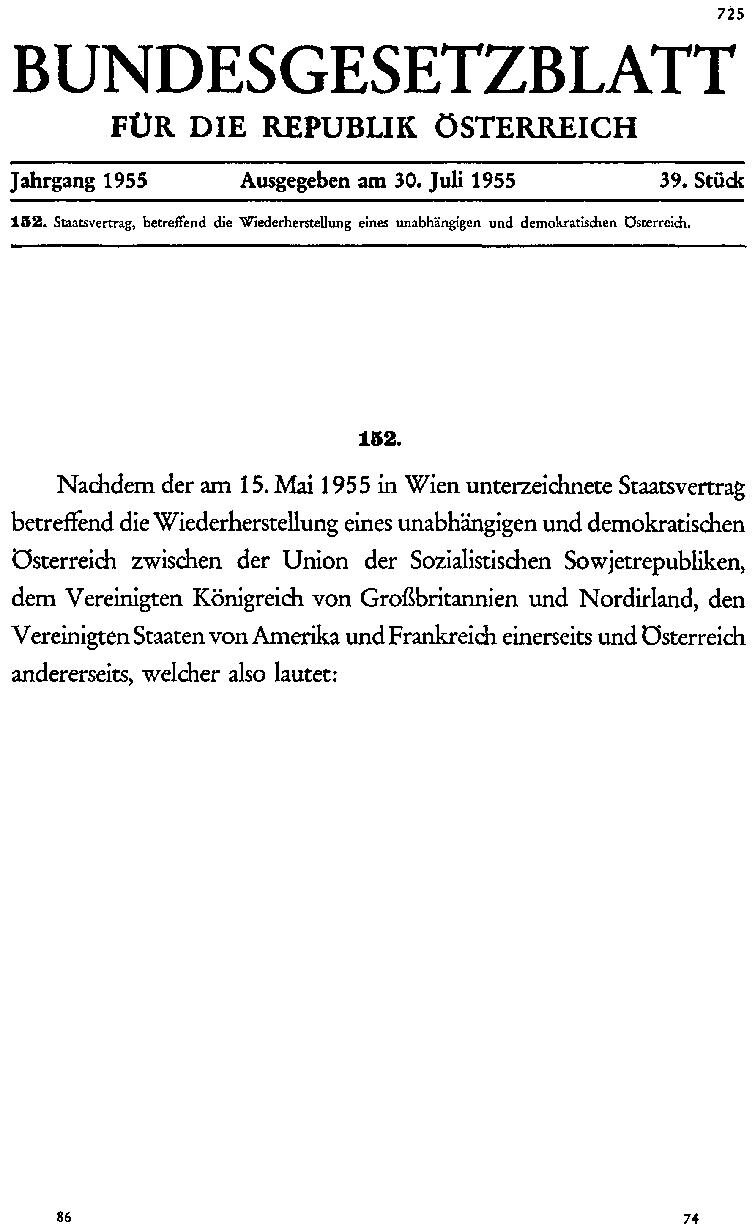
_1955_0725.jpg)
One editorial fact about the treaty text is directly relevant to the argument that came later. On the day before signature, in the closing negotiations in Vienna, the Austrian foreign minister Leopold Figl secured the removal from the preamble of the mention of Austria's share of guilt for the Second World War — the Soviet delegation being, by the standard account, the party that chiefly had to be persuaded. The treaty as signed contains no such clause, and its absence became one of the two documents on which the post-war account of the country's role rested.
How Austria characterised its own role, and how that changed
This section reports positions taken and findings published. It reaches no conclusion of its own, and none of the characterisations below are this page's.
Scholarship on the subject uses the term Opferthese, victim theory, for the account of 1938 to 1945 in which Austria was the first victim of German aggression, its statehood interrupted, and the republic re-established in 1945 therefore not answerable for the crimes committed in the interval. Historians of the question identify two documentary supports: the opening sentence of the Moscow Declaration, and the absence of the guilt clause from the 1955 treaty preamble. An early statement of the official view is the Red-White-Red Book published by the Austrian foreign ministry in 1946. In Austrian usage the doctrine is often called the Lebenslüge of the Second Republic, its life-lie; that phrase belongs to the doctrine's critics and is reported here as a characterisation on the record, not adopted.
The doctrine's practical reach was into restitution law. The federal law of 15 May 1946 declaring null and void the property transfers made during the German occupation was the basis for seven separate restitution statutes, the first enacted on 26 July 1946 and two more in February 1947, whose application deadlines were then extended repeatedly and confusingly — by a year, by a few months, by half a year again — before finally expiring between 1952 and 1954. Research commissioned decades later found that of about 10,700 applications lodged between 1946 and 1956 with the finance directorate for Vienna, Lower Austria and Burgenland under the first of those laws, roughly 77 per cent ended favourably for the applicant, though usually after very long proceedings. No restitution law existed at all for rented flats, licences or copyrights, and since almost all flats before 1938 were rented, returning survivors had no legal route back into the homes taken from them.
The public turning point is conventionally dated to 1986. In the presidential campaign of that year, an Austrian news magazine reported omissions concerning the years 1938 to 1945 from the recently published memoirs of the candidate, Kurt Waldheim, and from March 1986 the World Jewish Congress published a series of allegations concerning his wartime service and his account of it. Waldheim was elected on 8 June 1986, took office on 8 July 1986 and served to 8 July 1992; he died in 2007. On 27 April 1987 the United States departments of justice and state announced that an investigation had established a prima facie case bringing him within the statutory bar on entry to the country — the first time a serving head of state had been placed on such a watchlist.
In June 1987 the Austrian government appointed an international commission of historians to examine the years in question. Its report, dated 8 February 1988, found no evidence of personal wrongdoing and no participation in war crimes, while concluding that he had been, in the commission's published words, in close proximity to some Nazi atrocities, knew they were going on and made no attempt to stop them, and noting that he only had very minor possibilities to act against the injustices happening. Those are the commission's findings as published; the affair and the report were argued over at length in Austria and abroad, and this page does not adjudicate them.
Official language changed in stages afterwards, and the stages are dated. In July 1991 the federal chancellor made a statement in parliament acknowledging Austrians' share of responsibility — responsibility, in the formulation used, rather than collective guilt — for National Socialist crimes, the first such acknowledgement by an office-holder. A state visit to Israel in 1993 extended the acknowledgement from the nation to the state; the federal president made a public statement in the same terms in 1994. Historians of the subject describe the victim theory as having been abandoned at the level of the highest organs of government by that point, while continuing to argue about how far the change reached beyond them.
Then came the institutions, and they are best given as a list with their names and dates.
- National Fund of the Republic of Austria for Victims of National Socialism — established by parliamentary resolution in 1995, published as BGBl. Nr. 432/1995, to make payments to people who had received nothing or grossly insufficient provision, as quickly and unbureaucratically as possible.
- Art Restitution Act 1998 (Kunstrückgabegesetz) — with a provenance-research commission at the federal monuments office, beginning the systematic review of the federal museums' holdings for objects taken between 1938 and 1945 and never returned; several provinces set up equivalent bodies.
- Austrian Historical Commission — installed on 1 October 1998 by the federal chancellor, the vice-chancellor and the presidents of both chambers, with a mandate covering the whole complex of property seizure on Austrian territory during the National Socialist period and the restitution, compensation and social provision made since 1945. It ran 47 projects with about 160 researchers, published 49 volumes, and handed its final report to its commissioning authorities on 24 January 2003.
- Austrian Fund for Reconciliation, Peace and Cooperation — created by the Reconciliation Fund Act, in force on 27 November 2000, for voluntary payments to former slave and forced labourers of the National Socialist regime on the territory of present-day Austria, its categories of beneficiary aligned with the corresponding German foundation. By its closure on 31 December 2005 some 132,000 people worldwide had received payments totalling about 352.6 million euro.
- General Settlement Fund for Victims of National Socialism — established in 2001 on the basis of the Washington Agreement, to allow a comprehensive settlement of the remaining compensation questions. The National Fund was separately charged with compensation for confiscated tenancy rights, household effects and personal valuables.
Almost all of that legislative activity falls inside the years soc.culture.austria was busiest, which is why memory was the group's heaviest recurring subject and why the arguments in it ran the full range of positions the country itself contained. The group did not settle any of it. It hosted it, at Usenet length, in two languages, mostly among people who were reading the news from somewhere else.
1989 to 2002: the years such groups were at their busiest
The group's active life coincided with the most eventful decade the Second Republic had had. The Iron Curtain came down along Austria's eastern border in 1989, and Vienna found itself back in the middle of a region it had spent forty years facing away from. Two years later the wars of Yugoslav succession began at the southern border; fighting reached it during Slovenia's secession in 1991, and Austria took in refugees from Bosnia. Events next door stayed inside the group's field of view without being its subject — soc.culture.slovenia and soc.culture.yugoslavia had their own rooms, and their own far heavier traffic.
The European question was put to a referendum on 12 June 1994. The ballot asked whether the National Council's decision of 5 May 1994 on the constitutional law concerning accession should be enacted; 3,145,981 voted yes and 1,578,850 no out of 4,768,401 ballots cast from an electorate of 5,790,578 — a shade under 67 per cent in favour on a turnout above 82 per cent. Accession took effect on 1 January 1995, carrying Protocol No 10 with it. Each step of that process reopened the question of what remained of the permanent neutrality adopted in 1955, and the group had the question put to it in real time by people who had grown up with the answer.
The sharpest political season came at the turn of the millennium. At the National Council election of 3 October 1999 the Freedom Party took 1,244,087 votes and 52 seats and the People's Party 1,243,672 votes and 52 seats: a second place decided by 415 votes out of more than four and a half million. After months of negotiation the two formed a coalition, appointed on 4 February 2000.
The reaction abroad has a name in Austria and a different description in the documents. The governments of the other fourteen European Union member states announced, in a declaration issued through the Portuguese Council presidency, that they would conduct or accept no official bilateral contacts at political level with an Austrian government including the Freedom Party, would support no Austrian candidates for posts in international organisations, and would receive Austrian ambassadors in their capitals only at technical level. The measures were expressly bilateral acts of fourteen individual states rather than acts of the Union, and required no finding under the treaty article that governs Union sanctions; in international law they amounted to what is termed an unfriendly act. In Austria they were nonetheless universally called the EU sanctions, and political scientists writing afterwards have described the successful establishment of that label as among the government's most effective pieces of communication. That characterisation is theirs.
The measures were ended through a report. Three appointed figures — a former head of state, an international lawyer and a former European commissioner — received their mandate on 12 July 2000 from the president of the European Court of Human Rights on behalf of the fourteen, and were asked to assess the Austrian government's commitment to European values, the rights of minorities, refugees and immigrants in Austria, and the evolution of the Freedom Party's political nature. Their report, adopted in Paris in September 2000, concluded that the Austrian government was committed to those values and that the legal position of asylum seekers and immigrants was comparable to that in other member states, while recording criticism of ambiguous language used by senior Freedom Party officials, of the party's 1999 campaign, and of its use of defamation suits; it found that the conduct of the party's ministers in office since February 2000 could not in essence be criticised, and advised that continuing the measures would be counterproductive. The fourteen governments lifted them shortly afterwards. For one season the home country led foreign front pages, and the group filled with explanation, defence and denunciation in roughly the proportions the country itself supplied.
The decade closed with a currency. Euro notes and coins entered circulation on 1 January 2002, retiring the schilling. By then the traffic of Usenet as a whole was already draining towards the web, and the country groups were emptying with it.
What a culture group actually carried
Politics is what a search engine surfaces from an archive. It is not what kept people reading between the arguments, and the charter's own list of subjects — music, travel, food, history, arts and entertainment — is a better guide to ordinary traffic.
Music came with institutions attached, and they are old. The Vienna Philharmonic was founded in 1842; the Court Opera, the first major building on the Ringstrasse, was completed in 1869 and became the State Opera after the fall of the monarchy; the Musikverein, built on land granted by the emperor to the Society of Friends of Music, was inaugurated on 6 January 1870 and has housed the orchestra ever since. The Salzburg Festival was revived after the First World War by five men now counted as its founders — Hugo von Hofmannsthal, Richard Strauss, Max Reinhardt, Alfred Roller and Franz Schalk — and was inaugurated on 22 August 1920 with Reinhardt's production of Hofmannsthal's Jedermann on the steps of Salzburg Cathedral. The play has been given at the cathedral square ever since, and the festival still runs for five weeks from late July. The Vienna Philharmonic's New Year's Concert was first given on 31 December 1939 — the only occasion in its history when it did not fall on New Year's Day. The orchestra now plays the same programme on 30 and 31 December and on 1 January and broadcasts the last of the three, which reached audiences in 73 countries in 2012 and more than ninety by 2017. The orchestra's conduct in the wartime years was examined by an independent panel of three historians it commissioned, which was given unrestricted access to the archives and published its findings on the orchestra's website in March 2013.
.jpg)
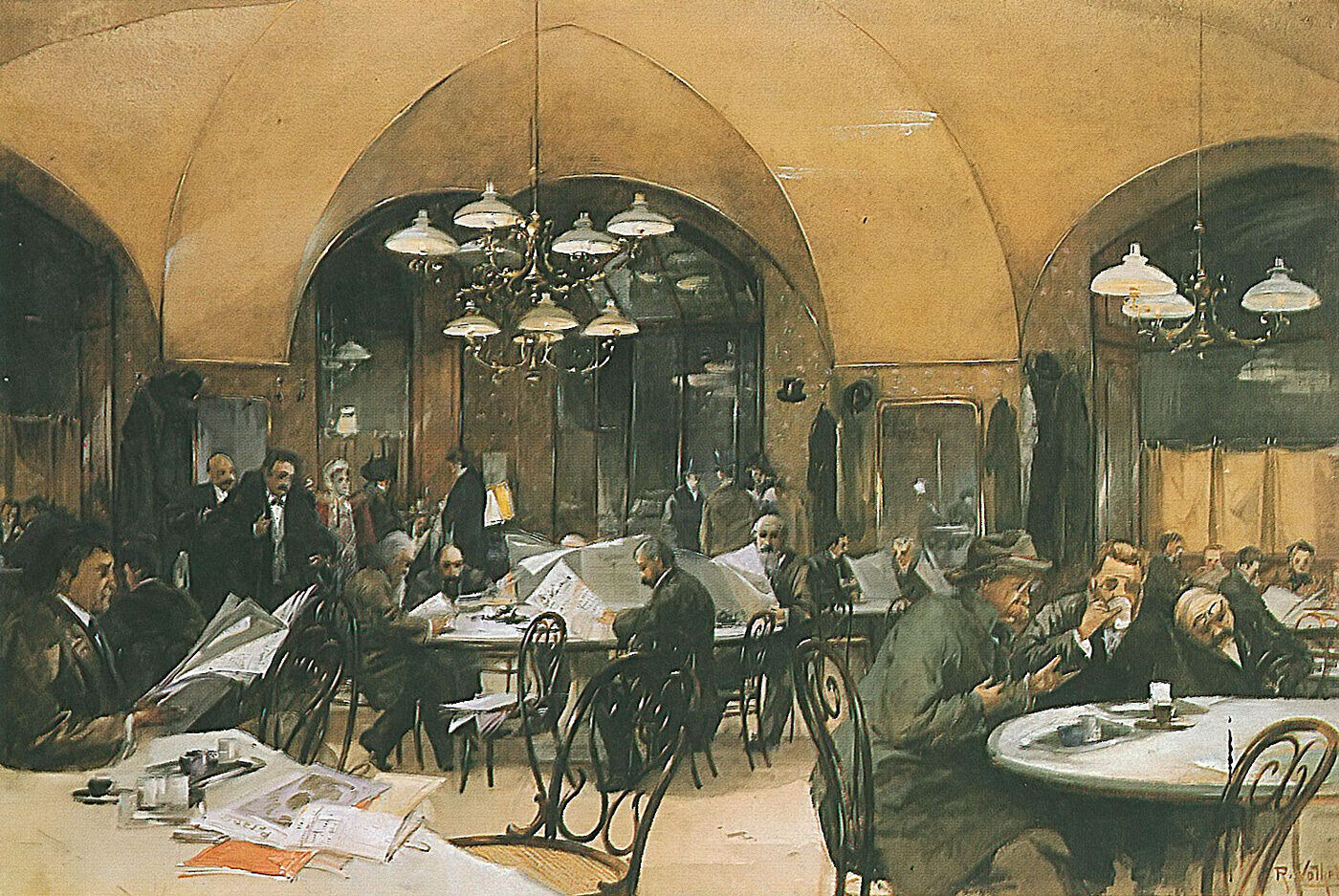
The coffee house is the subject Austria is most often asked about from outside, and it is documented rather than merely evoked. On 17 January 1685 an Armenian merchant and imperial courier known as Johannes Theodat, or Diodato, received a privilege granting him the sole right for twenty years to prepare and sell coffee, tea and sherbet in Vienna, and opened the first Viennese coffee house in his own house on the Haarmarkt, today Rotenturmstraße 14. The oldest surviving house, the Frauenhuber in the Himmelpfortgasse, dates from 1824. The cafés of the decades around 1900 were working addresses rather than refreshment stops: the Griensteidl on the Michaelerplatz, in the Palais Dietrichstein and carrying the postal address Herrengasse 3, and the Central in the Palais Ferstel on the Herrengasse are the addresses attached to Peter Altenberg, Arthur Schnitzler, Hugo von Hofmannsthal and Stefan Zweig, and to the literary movement that took its name from the city. In October 2011 Viennese coffee house culture was entered on the Austrian national inventory of intangible cultural heritage maintained under the UNESCO convention, where it is described as a place
where time and space are consumed, but only the coffee is found on the bill.

Food supplied the group with its most reliable low-stakes argument, because in Austria the names are legislated and the recipes are litigated. The Sachertorte dispute is the classic: after the Hotel Sacher's bankruptcy in the 1930s the founder's grandson sold the recipe to the Demel pastry shop, which from 1934 sold a single-layer version under one name while the hotel sold a two-layer version as the original. Litigation over which was entitled to the name — and over whether the original had one layer of sponge or two — reached the Austrian Supreme Court and ended only in 1963, by a decision that some accounts describe instead as an out-of-court agreement. The food codex now settles the composition if not the argument. Beside it sit the schnitzel rule described above, and the daily business of any country group: recipes and the disputed names of their ingredients, songs put up for identification, the festival calendar, and where to buy Austrian goods at a distance.
Sport arrived on a calendar. The alpine World Cup was launched in 1966 and became an official event of the international federation in the spring of 1967; the first race was a slalom at Berchtesgaden on 5 January 1967, won by an Austrian, which set an expectation the country has been living with since. The season runs from autumn to March, and results in the circuit are a form of national accounting; the years in which such groups were busiest produced the most quoted sequence in it, an Austrian racer who crashed out of the downhill at the 1998 Nagano Olympics and won the super-G and the giant slalom within days, and who took four overall World Cup titles, in 1998, 2000, 2001 and 2004. Where to ski, and when the snow comes, were perennial questions from abroad — and exactly the sort a scattered readership answers better than a guidebook does.
What the record does not show
The administrative file for this group is excellent. The archive of the group itself is not, and honesty about the difference is the point of this section.
Nothing on this page rests on a count of articles, a subscriber estimate, a thread title or a quotation from a posting. No such figures survive in a form worth citing: readership estimates for individual Usenet groups were always extrapolations from small samples, the surviving archives of the middle 1990s are incomplete and unevenly propagated, and the encoding problem described above makes any keyword search of German-language traffic systematically unreliable. Where this page describes what was discussed, it describes it from the charter, from the dated public record of the country, and from what the group was structurally for — never from a message it claims to have read.
The vote roster is likewise a snapshot and not a census. It records who cared enough to send an e-mail in May 1993, at a moment when the Austrian connected population was under two per cent and concentrated in universities. It is superb evidence about the founding constituency and weak evidence about the readership five years later, by which time dial-up subscriptions had changed the shape of the country's traffic entirely.
Nor is there any surviving evidence about the group's decline that would let anyone date it. Country groups in the branch thinned through the 2000s as the web absorbed their functions — forums, then mailing lists on the web, then social platforms — and the ISC files still list soc.culture.austria as an active unmoderated group, which tells you about the namespace and nothing at all about whether anybody is posting.
Scope and limits
This page owns soc.culture.austria: its paperwork, its charter, its constituency, and its relationship to the hierarchies next door. It does not own those hierarchies. The history of the German-language tree — how it was assembled, how it governs itself, how its proposals are voted and its control messages signed — belongs to the de.* page, which treats it at length; the material here is confined to what an Austrian used which hierarchy for. The generic questions about the branch — how a soc.culture.* group came to be proposed at all, what the charter conventions were, how the vote thresholds worked — belong to the soc.culture.* page and the hierarchy page.
On the historical material, the rule followed here is that every characterisation is attributed to whoever made it: to a treaty, to a commission's published report, to a parliamentary statement, to a named piece of legislation, or to historians writing about the period. Where sources disagree, the disagreement is reported rather than resolved. The page reaches no verdict on the Waldheim affair, on the victim doctrine, on the events of 1999 and 2000, or on any of the arguments the group hosted.
Two practical notes for anyone working the archives. First, search every spelling: Österreich correctly encoded, Oesterreich with the substitution, and Osterreich with the diacritic simply dropped are three different strings, and a mismatched code page can produce a fourth. Second, remember what the charter said. This was a bilingual group in an English-language hierarchy, sitting beside a German-language hierarchy that was not Austrian and a national hierarchy that was not international. A thread that seems to be missing from one of the three may simply have happened in another.
Reading soc.culture.austria today
- Historical archive: Google Groups — soc.culture.austria (coverage varies by group and era).
- Open in a newsreader:
news:soc.culture.austria— the original site offered exactly this link, and it still works if your system has a newsreader registered for thenews:scheme. - Live access: point an NNTP newsreader at a modern server — see accessing Usenet today.
- The original news2mail e-mail subscription service ended in the mid-2000s and no longer operates.