soc.culture.bulgaria
Discussing Bulgarian society.
From the fall of Zhivkov through EU accession, the group tracked Bulgaria’s transition with the scepticism of people living it. Cyrillic encoding wars (KOI-8 vs. Windows-1251) were an early recurring technical theme.
Folklore threads — Thracian archaeology, martenitsa customs, the irregular meters of Bulgarian folk music — gave it depth beyond politics.
On this page
- The group's own paperwork
- Who could post
- The computer country
- The virus years
- Where that story was actually told
- Writing Bulgarian in Latin letters
- The alphabet's own history, and the twenty-fourth of May
- The dated record: state, party and the assimilation campaign
- 1989 and after, in the years the group was reading
- The Macedonian question, as a disputed matter
- The FAQ, and what a monthly posting could be
- What a culture group carried
- What the record does not show
- Scope and limits
The group's own paperwork
Two documents record the making of soc.culture.bulgaria, and they do not entirely agree. One is the group's own FAQ, whose opening chapter reproduces the proposal, the timetable and the count as the people who ran the ballot reported them at the end of 1991. The other is the Internet Systems Consortium's mirror of the Usenet control-message archive, which preserves the message that actually brought the group into being. Read together they date the group to the autumn in which Bulgaria held its first parliamentary election under a post-communist constitution, and the proposal itself gives that election as part of its reason for existing.
The FAQ's first substantive chapter is headed How was soc.culture.bulgaria created, is credited to one of the two people who processed the vote, and carries the date 31 December 1991 — written, in other words, in the group's first week. It quotes the Request for Discussion:
I am submitting a request for discussion to create a new newsgroup SOC.CULTURE.BULGARIA. Why: The country is being reborn. Politics, economy and culture are rapidly changing. History is being given a fresh look. Free exchange of information and ideas is essential. The input of everyone interested in Bulgarian society and culture is important. Besides: Older waves of emigration were followed by a new one. There is a need to create links between Bulgarians around the world and to sustain the connection with the home country.
The charter attached to that proposal is one sentence, and it is the sentence the control message later carried out to every news server on the network:
CHARTER: To promote exchange of information and ideas on all aspects of Bulgarian culture and society. STATUS: Unmoderated
The dates in the FAQ run as follows. The proposal was made on 10 October 1991; it appeared in the group-creation forum on 16 October, opening the customary thirty-day discussion period; voting ran from 21 November to 15 December 1991 and was processed by two volunteers, one of whom wrote the chapter. The announcement of the result, quoted in the same chapter, reported that a total of 270 people voted of which 241 in support and 29 against, and set out the arithmetic that mattered under the rules of the day — yes minus no equal to 212, comfortably over the required margin of 100, and yes votes at more than twice the no votes.
The control message tells the same story with one digit different. It was issued by David C. Lawrence, then the moderator of news.announce.newgroups, from an address at Rensselaer Polytechnic Institute, and it reads in part:
soc.culture.bulgaria is an unmoderated newsgroup which passed its vote for creation by 242:29 as reported in news.announce.newgroups on 17 Dec 1991.
The same message then dictated the line every administrator was to paste into his newsgroups file, group name and description separated by a tab — soc.culture.bulgaria and Discussing Bulgarian society. — and reprinted the charter, in its words culled from the call for votes, in the identical wording the FAQ had preserved: To promote exchange of information and ideas on all aspects of Bulgarian culture and society. That line is the one still at the head of this page, and it stands unchanged, character for character, in the master newsgroups file distributed from the same archive today.
The one-digit difference is worth stating rather than smoothing over. The FAQ's figure of 241 is internally consistent — 241 and 29 sum to the 270 voters it reports, and 241 less 29 gives the margin of 212 it quotes — while the control message says 242. Both are contemporary; neither is obviously the copy of the other; and no third document survives on the ISC mirror to arbitrate, because the news.announce.newgroups archive there holds no file for this group at all. The proposal, the call for votes and the result posting are simply absent from the administrative archive, which is why the FAQ's transcription is the only surviving text of the charter's own justification.
The creation date is doubled in the same way. The FAQ states that the group was created on 24 December 1991 — adding, in Bulgarian, the observation that this made it the nativity of Christ and of the group at once — and that the first posting appeared on 30 December. The control message that carried the group to the network is dated 26 December 1991 at 19:33 GMT. Both dates are defensible: a decision could be taken on one day and the message sent on another, and the waiting period that then followed a result would have permitted either. The honest summary is that the group was voted through in the middle of December 1991, announced on the 17th, created in the week of Christmas, and posted to before the new year.
What follows in the control archive is the ordinary sediment of a working namespace. Further newgroup messages for the group were issued from individual servers — one from a business school in New York in April 1992, one from a small system in Alberta in April 1993, one from a server in Novosibirsk in November 1995 — the routine business of an administrator adding a group his machine had missed. Then, in November 2001, an rmgroup control message appeared asking sites to remove the bogus newsgroup soc.culture.bulgaria. It was issued over the name of an individual poster rather than by the moderator of news.announce.newgroups, it was cross-posted to soc.config, soc.control and soc.groups, and it did not take effect: the line the 1991 message dictated is still in the master newsgroups file. This page does not assert that the message was forged; it records only who did and did not send it, and what happened afterwards, which is nothing.
Who could post
A group about a country is only written from inside that country if the country has a network, and in December 1991 Bulgaria barely had one. The reference literature dates full TCP/IP service in Bulgaria to 1992, with electronic mail, network news and a few other services available earlier, across the period from 1989 to 1991, and records that the .bg domain name was organised in 1991. The delegation itself came later still: the IANA root database gives the registration date of .bg as 3 January 1995, and the manager of record, Register.BG, sits at an address in Varna on the Black Sea coast, with administrative and technical contacts whose electronic mail addresses are in the digsys.bg domain — the domain of Digital Systems, one of the two commercial providers the group's own FAQ named in 1995. An earlier version of this page described that firm as the first Internet provider in Bulgaria on the strength of its own website; that claim could not be re-verified for this revision, and has been dropped in favour of what the root database and the FAQ actually show.
The FAQ supplies the sharpest picture of what the state of Bulgarian connectivity meant in practice. Its chapter on electronic connectivity carried an entry titled Internet providers in Bulgaria, contributed from an address at one of the two firms and last updated 9 August 1995, and the entry is two lines long. It names CIT Ltd. and EUnet Bulgaria / Digital Systems, and nothing else. In the summer of 1995, four years into the group's life, a Bulgarian reader wanting to reach it had two commercial doors and whatever a university would give him.
The consequence is audible in the archive. For most of its first decade the group was written largely from outside the country. The emigration of the late 1980s and the 1990s had deposited Bulgarian students and researchers in university computer rooms across North America and Western Europe, where network access was free at the point of use and news feeds were complete; the group's centre of gravity sat with them. The FAQ was compiled at Columbia University in New York, published on the web from a Columbia machine, and distributed by anonymous FTP from the news.answers archive at MIT and by two mail servers, one in North America and one in the Netherlands. Its list of contributors is itself a map of the diaspora: the addresses beside the names run through American, Canadian, British, German, Finnish, Swedish, Norwegian and Australian universities and providers, with a minority inside Bulgaria. As connectivity spread at home the balance shifted and posting from inside Bulgaria became ordinary, but the group never lost its diaspora accent, and the practical chapters of the FAQ — embassies, consulates, sending money home, where to find a Bulgarian radio programme in New York — record whose handbook it was.
One measure of the group's size survives, and deserves stating with its provenance attached. The chapter of the FAQ about the newsgroup carries, as its second entry, a reproduced extract from the periodic Usenet readership reports, dated 26 October 1995, which estimated 15,000 readers, put the group at 0.2 per cent of the network's readership, counted 1,278 messages a month or 43 a day at 4.2 megabytes, and noted that 63 per cent of sites carried the group and 7 per cent of its traffic was crossposted. These figures were sampled estimates rather than counts, and the reports themselves said so; but they are contemporary, they were quoted by the group about itself, and they place soc.culture.bulgaria among the middling soc.culture groups rather than the giants — busy enough to sustain a threaded argument, small enough that regulars knew each other.
By the news2mail years of 2000 to 2004 the group was past that peak. Bulgarian-language web forums were absorbing its audience, and the general weather of late Usenet — thinning traffic, thickening spam — applied here as everywhere. The e-mail gateway carried the group through exactly that long, slow afternoon.
The computer country
Usenet met Bulgaria as a country with an unusual quantity of computing in its recent past, and no market left for any of it. Under the Comecon division of labour Bulgaria had been assigned the manufacture of computers and peripherals for the bloc, and it took the assignment seriously. The standard Bulgarian account of the period, a short survey of the development of computing in Bulgaria published in 2014 by the academician Kiril Boyanov, is the source of the figures usually quoted: at its peak the country supplied around 40 per cent of the computers in Comecon; the electronics industry employed some 300,000 workers; and it generated eight billion roubles a year. The country's whole population at the time was under nine million — the FAQ's own country entry, written at the end of 1991, gives 8.8 million.
The hardware came in two families. At the large end were the IZOT machines and the ES EVM series, the Unified System of Electronic Computing Machines created in 1969 by the Soviet Union, Bulgaria, Hungary, East Germany, Poland and Czechoslovakia — a bloc-wide programme, built between 1968 and 1998, to produce mainframes broadly compatible with IBM's System/360 and System/370 and known in English as the Unified System or Ryad; more than 15,000 of them were produced. Around them Bulgaria built the peripherals: hard disks from the DZU works at Stara Zagora, whose name stands for Disk Memory Devices, monitors and other peripherals from smaller plants across the country, and a large plant in Sofia. At the small end were the personal computers, and those came from one town.


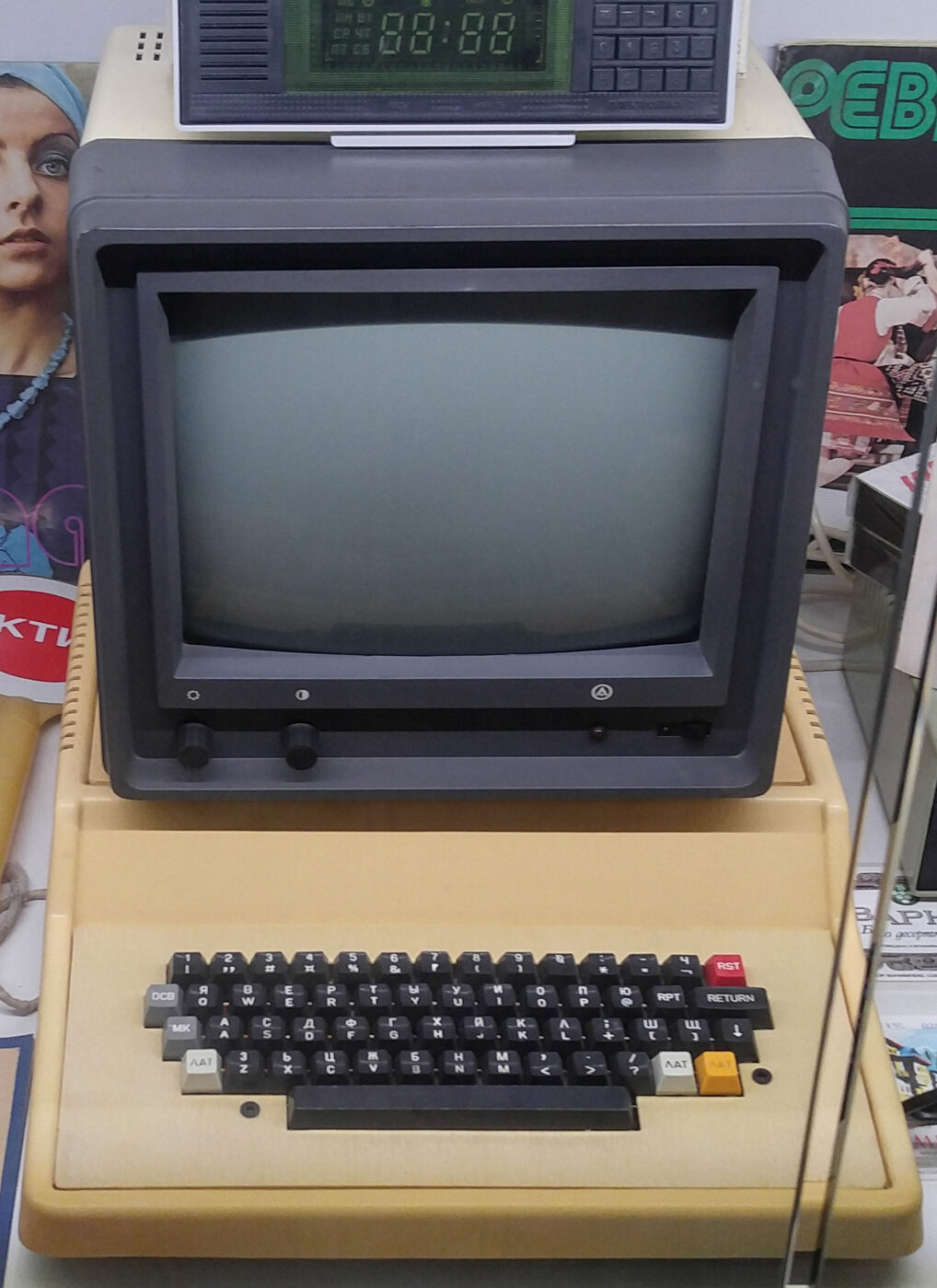
The prototype was IMKO-1 — the initials stand for Individual Micro Computer — whose development began in 1979 at the Institute of Technical Cybernetics and Robotics, a section of the Bulgarian Academy of Sciences, with the first working samples built in 1980. It was an Apple II clone, and the change that mattered was in the character table: because the keyboard transmitted character codes in seven bits, the Cyrillic letters overlapped the lowercase Latin ones, so that a user could type in uppercase Latin or in Cyrillic but not in lowercase Latin at all. That substitution is the whole story of a later section in miniature. The reference literature is not consistent about which prototype was the clone of the Apple II Plus and which carried the run of about fifty test units in 1982 — the article on the series attributes both to a second prototype, IMKO-2, the article on IMKO-1 attributes both to the first — and this page does not attempt to settle it. What is not in dispute is that industrial production followed at the town of Pravets, about sixty kilometres from Sofia, under the name the town gave the machines. The institute's machines also drove the country's robots: an IMKO-1 was shown at a robotics symposium in England in 1981 controlling a ROBKO-01 arm, at a moment when comparable Japanese and American demonstrations used minicomputers.
The Pravetz line ran from 1979 onwards and is documented model by model. The 8-bit series were Apple-compatible: the Pravetz 82, with a 6502 at one megahertz, 48 kilobytes of memory and 12 of read-only memory, whose ROM and schematics the reference literature describes as identical to the Apple II's; the 8M, which added a Z80A at four megahertz as a second processor so that it could run CP/M; the 8E, an industrial model on the 82's architecture; the 8A, built around the Bulgarian-made SM 630, a local clone of the 6502, with Cyrillic capitals and small letters in its character table and arrow keys on its keyboard; the 8C, a streamlined 8A; and the 8D, which broke the pattern by taking its architecture from the English Oric Atmos instead. The 16-bit Pravetz machines were IBM PC compatibles, beginning with an 8088 at 4.77 megahertz and 256 or 512 kilobytes of memory, and later models reached the 286, the 386 and the 486. They were prohibitively expensive for private individuals; they were sold to government institutions — the educational, military and administrative sectors.
That last point is the one that matters for what followed. The contemporary Bulgarian account of the country's virus wave, discussed below, describes computer education in Bulgaria as very widely introduced and reaching everyone, from children in kindergartens to teachers a few years from retirement, and observes that the people who became most skilled in it were consequently very young. They learned on machines the country had built itself, in a decade when its factories were turning out processors, hard disks and industrial robots. The country had, in short, manufactured a large cohort of young people who understood microcomputers intimately, at the exact historical moment when the market those machines had been built for was about to disappear.
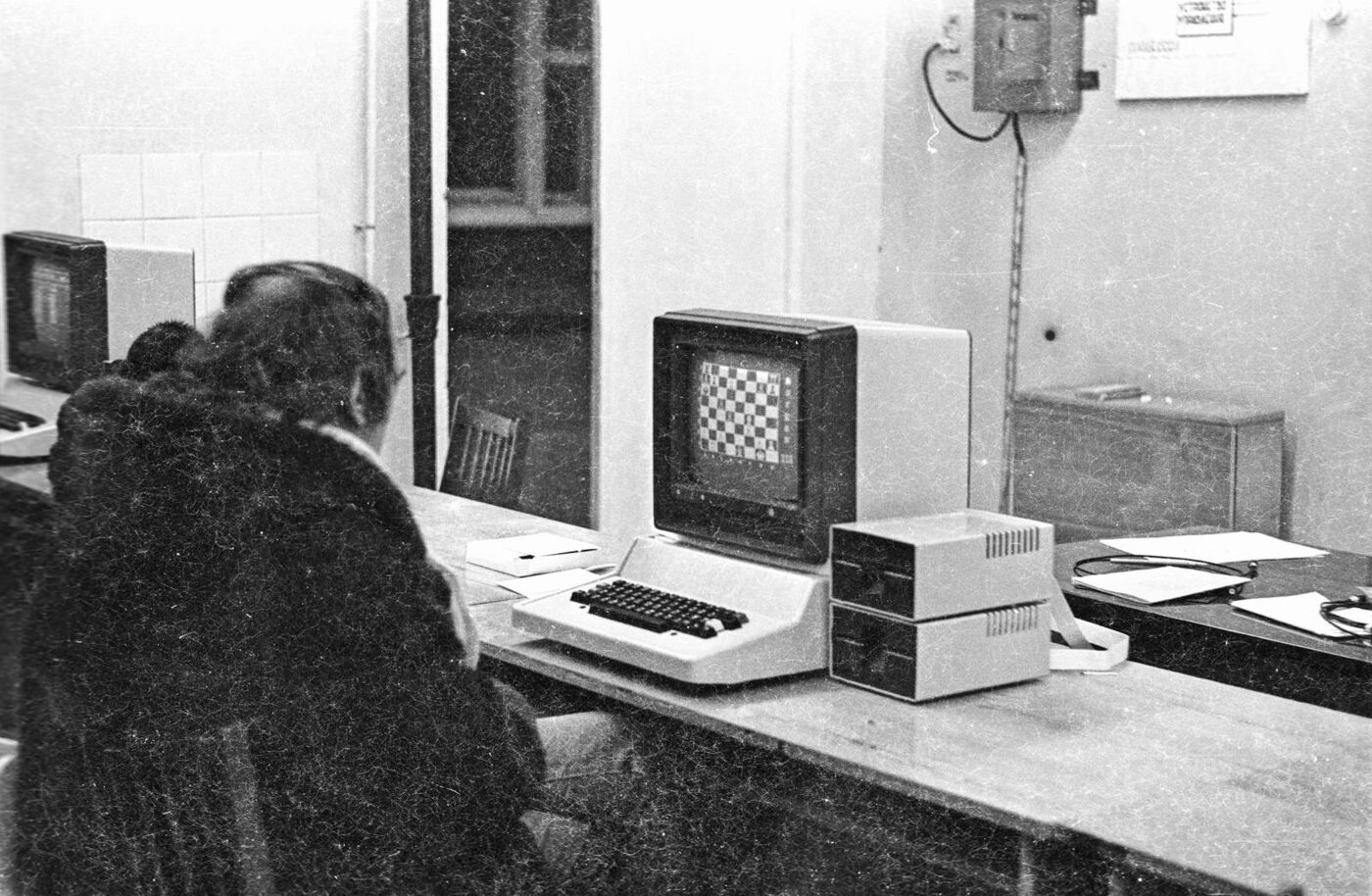

It disappeared with the bloc it had served. What was left behind was a well-trained technical population with no employer, in a country in economic free fall, at the moment when the personal computer, the modem and the copied floppy disk were spreading quickly and cheaply. Nearly every account of Bulgarian computing in the 1990s begins from that arithmetic, and the most detailed contemporary account of what happened next begins from it explicitly.
The virus years
Between roughly 1989 and 1993 Bulgaria acquired a second computing reputation, and it is the reason the country appears in histories of the network that have nothing to do with the Balkans. The trail is unusually well documented from the beginning, because the person best placed to document it did so at the time. The document is a paper of 1991 called The Bulgarian and Soviet Virus Factories, written by Vesselin Bontchev, then of the Laboratory of Computer Virology at the Bulgarian Academy of Sciences and later a regular of the Usenet and mailing-list forum described in the next section. What that paper records should be kept separate from what it argues, and both should be read as the work of 1991: its counts, its estimates and its virus names are those of that year, and nothing in it can speak to what happened afterwards.
The record part runs like this. The Bulgarian computer magazine Komputar za vas — Computer for You — first mentioned computer viruses in its April 1988 issue, in a piece translated from an article in the German magazine Chip titled, in translation, The new danger — computer viruses; the same magazine soon afterwards published an article, by Bontchev himself, explaining why computer viruses could not be dangerous. In the autumn of the same year two men walked into the magazine's editorial office claiming to have found one; examination showed it to be the Vienna virus, arrived from abroad. Cascade and Ping Pong followed, all three probably imported on pirated program disks. Bulgarian programmers took the Vienna virus apart, found no black magic in it and a good deal of sloppy code, and produced improved versions — the paper lists local variants at 627, 623, 622, 435, 367, 353 and 348 bytes against the original's 648, the same function in nearly half the space.
The first virus actually written in Bulgaria came out of an idle conversation. The two file-infecting viruses then known both attacked COM files only, which led Bontchev to suppose that infecting EXE files was much harder; he said so to an acquaintance, who soon afterwards produced a virus that infected EXE files and played Yankee Doodle when it did. It is known to the field as Old Yankee. Its author, the paper notes, lost interest once the puzzle was solved and wrote nothing further.
Others did not lose interest. In the spring of 1989 there appeared the first virus signed Dark Avenger, carrying the string This program was written in the city of Sofia (C) 1988-89 Dark Avenger. It was ferociously infectious — merely opening or copying an executable while the virus sat in memory was enough, a strategy for which the field afterwards coined the term fast infector — and deliberately destructive, overwriting a random disk sector on every sixteenth run of an infected program, so that damage accumulated invisibly until the user's backups were corrupted too. The overwritten sector was filled with the first 512 bytes of the virus body, which is why cleaned-up systems were left with files containing the string Eddie lives... somewhere in time!, a reference to Iron Maiden. Later viruses attributed to the same pseudonym went further: Phoenix and Nomenklatura corrupted the file allocation table so subtly that the user could not afterwards tell which files were damaged, and reformatting the disk was the only remedy; and a later family shipped a mutation engine that changed the virus's own signature from copy to copy, defeating the pattern-matching on which antivirus software then depended. The V2000 and V2100 viruses carried a false copyright string naming Bontchev, and hung any machine that ran a program containing it.
By 1991 the count of viruses of Bulgarian origin stood at more than 160, of which the paper reports more than 80 per cent had been detected in the wild inside Bulgaria itself. Only a handful travelled well — the paper names Dark Avenger, V2000, V2100, Phoenix, Diamond, Nomenklatura, Vacsina and Yankee Doodle, of which the first four and the last two it calls extremely widespread — but those few travelled very far indeed, with reports from across Europe, the United States, the Soviet Union, Thailand and Mongolia. The paper cites John McAfee's estimate that about ten per cent of all infections then being seen in the United States were caused by Bulgarian viruses, usually Dark Avenger, and reports German figures of ten million marks of damage from Vacsina alone while cautioning that such numbers were probably largely overestimated. That caution is characteristic and worth keeping: the folklore around this subject has always run well ahead of the evidence.
The organised part of it had an address. The paper devotes a section to the Virus eXchange BBS, a specialised bulletin board dedicated to virus exchange, run by a computer science student at Sofia University from his own home. Antivirus programs on it could be downloaded freely; the virus area required an upload. Contribute one new virus and you got the run of the entire collection, which by then held about three hundred, with no questions asked about why you wanted them. Users were not identity-checked and were encouraged to use false names — the paper lists, among the aliases on the board, George Bush from New York and Saddam Hussein from Baghdad. Because the collection was already so large that finding a new virus was harder than writing one, the board's entry requirement functioned as a standing commission for fresh work, which the paper says outright. Worse, in its author's judgement, was that the board carried assembler source code and commented disassemblies as well as binaries, and source code is what produces variants by the score; the paper points at the Vienna, Jerusalem, Cascade and Amstrad families, whose published sources it reckoned had already generated about a fifth of all viruses then known. A Bulgarian FidoNet echo devoted to virus writing ran alongside the board, and the board itself carried a local conference in which the writers kept in touch.
The explanation the paper offers is social rather than technical, and it is the passage most often quoted since. Its author sets out, in his own order: a computerisation policy that trained a great many very young people very fast without troubling about the ethics of the thing; software piracy so universal that it amounted to state policy, combined with pay so low that an honest programmer had no way to be rewarded — a Bulgarian programmer, the paper says, then earned a hundred to a hundred and twenty times less than an American of the same qualifications, which left capable young people embittered; the total absence of any law under which writing or spreading a virus was an offence, or indeed under which computer information was anybody's property at all; a country too poor to organise a defence; a public that regarded virus victims as the butt of a bad joke rather than the victims of a crime; and, last and least important in his estimation, easy access to technical information. Underlying all of it, the paper argues, was a national decision to manufacture hardware and steal software rather than the reverse, which trained a generation in breaking copy protection instead of writing programs.
The identity behind the Dark Avenger pseudonym has never been established. What the contemporary paper records is narrow: that its author could not identify him; that he was a regular user of several Bulgarian bulletin boards, so that one could exchange electronic mail with him; that asked why his viruses were destructive he replied that destroying data is a pleasure; and that no Bulgarian law of the time made any of it an offence, so that nothing could be done. A person answering to the name gave an interview to the antivirus researcher Sarah Gordon, published by IBM's antivirus research group. A long investigation in Wired in 1997, by the journalist David S. Bennahum, set out to find him, did not establish his identity, and came to suspect the operator of the virus-exchange board; neither that man nor a person claiming to be Dark Avenger would confirm it. That is the whole of what is documented, and the abundant material beyond it is not.
Where that story was actually told
This is the part that belongs to a Usenet directory rather than to a history of malware. The forum in which the Bulgarian virus wave was reported, disputed and catalogued as it happened was not soc.culture.bulgaria. It was VIRUS-L, a mailing list started in 1988 on the BITNET and EARN academic networks, and the moderated Usenet group gatewayed to it.
The Big-8 paperwork for that group states the relationship exactly, in the removal notice circulated years later, which quotes the proponent for removal:
The newsgroup comp.virus was created in May 1989 as a gateway for the virus-l mailing list (which had been created in April 1988). It had roughly 5 to 10 articles per day until it was first interrupted in September 1995.
Its newsgroups-file line was comp.virus — Computer viruses & security. (Moderated) — and the surviving newgroup control messages of 1991 all carry the word moderated in the control line, which is the essential fact about it: a moderated group with a mailing-list gateway was the arrangement under which people who worked with live viruses were willing to talk in public. The full text of its founding Request for Discussion has not been located for this revision; an earlier draft of this page quoted a charter for it, and that quotation has been removed rather than left standing unverified.
The chronology lines up with the Bulgarian one almost month for month. VIRUS-L opened in April 1988, the same month Komputar za vas printed the article that started the Bulgarian wave. comp.virus opened in May 1989, weeks after the first Dark Avenger virus appeared in Sofia. Through the years when Bulgarian viruses were reaching the West, the group carried five to ten moderated articles a day, and the reference literature describes VIRUS-L, the newsgroup and their shared FAQ as the public group of record for computer virus issues from 1988 to 1995. The list's membership is the roll-call of the field as it then was: alongside Bontchev it is recorded as including Alan Solomon, Friorik Skulason, John McAfee, Eugene Kaspersky, Mikko Hypponen and Peter Szor, names that ended up on antivirus companies on both sides of the Atlantic.
The group's own end is documented as precisely as its beginning, in the same removal notice. Traffic was interrupted in September 1995; it resumed in January 1996 at over ten articles a day; it stopped again in August 1997, with a one-day burst that October; there was a final attempt at revival from March to June 1999, at under two articles a day, and nothing after that. A Moderator Vacancy Investigation was opened in October 2004 and came to no conclusion, leaving the group inactive. A Last Call for Comments on 20 June 2007 opened a five-day comment period, after which the Big-8 Management Board decided by consensus to remove comp.virus; the rmgroup message went out on 25 June 2007.
Usenet's own security and abuse groups, and the shape of the comp.* namespace that held them, are the subject of other pages here — see alt.comp.* and the comp.* hierarchy — and this page does not retell their story. The point that belongs to Bulgaria is narrower and stranger: for four or five years in the early 1990s, two Bulgarias were being written about on Usenet at once, a few groups apart. In one, emigrants argued about language, history and how to get a parcel to Plovdiv. In the other, a moderated technical group catalogued the output of programmers a tram ride from those parcels' destination. Neither group, so far as the surviving record shows, had much to say about the other.
Writing Bulgarian in Latin letters
A Cyrillic-alphabet country arriving on a network built around seven-bit ASCII had a practical problem, and Bulgaria's version of it was not Russia's. The two languages use different alphabets with different histories, different letter inventories and — decisively for this story — different code pages. The Russian group's encoding wars, KOI8-R and the standards that fought over it, are told on soc.culture.russian's own page and are not repeated here. What follows is the Bulgarian case.
Modern Bulgarian has thirty letters, three fewer than Russian: it does without the Russian yo, yery and e-oborotnoye. The FAQ stated the number in its first sentence on the language and then did something that tells you everything about the period. Bulgarian uses the Cyrillic alphabet, its entry on pronunciation begins. There are 30 letters. I will show them using a graphical description of the capital letter (in a 7X7 bitmap). What follows is thirty capitals drawn as patterns of the letter O on a seven-by-seven grid, because the only characters the maintainer could rely on reaching a reader intact were the ones on an American keyboard. A monthly posting about a Slavonic country was rendering that country's alphabet in ASCII art in the middle of the 1990s.
The eight-bit answer, where it existed, was local. Bulgarian DOS machines mostly used MIK, a code page derived from the character set of the Bulgarian-built Pravetz 16 — the country's own hardware dictating the country's own encoding. It was the most widespread DOS code page in Bulgaria, ahead of code pages 808, 855, 866 and 872; almost every DOS program written in Bulgaria that displayed Bulgarian text used it, and many of them were still in use long after DOS was not. MIK had one genuinely elegant property, which its documentation sets out explicitly: it kept all the Cyrillic letters in alphabetical order, so that any byte beginning with binary 10 was a Cyrillic letter, with 100 marking a capital and 101 a small letter. Case tests, case conversion and sorting therefore reduced to bit operations and plain numeric comparison, which on the hardware of the day was not a small consideration. Against MIK stood the international standard ISO/IEC 8859-5, whose first edition was published in 1988 and which the reference literature describes flatly as never widely used, and later Microsoft's Windows-1251, which covered Bulgarian along with Russian, Ukrainian, Belarusian, Serbian and Macedonian. Neither displaced MIK quickly. Bulgaria's page was also sometimes called code page 856 in the country, a number that in fact belonged to an IBM Hebrew page; FreeDOS and Star printers know it as code page 3021; and the Kermit project, which had to name every encoding it touched, settled on calling it BULGARIA-PC.

Unicode was the settlement, and it arrived on paper long before it arrived in practice. The main Cyrillic block occupies U+0400 to U+04FF; 188 of its characters were encoded in version 1.0 of the standard in October 1991, and the core of the block is laid out on ISO 8859-5. Bulgarian was luckier than most Cyrillic orthographies in what that meant: every letter of the modern Bulgarian alphabet falls inside two unbroken runs of the 1991 block, U+0410 to U+042F for the capitals and U+0430 to U+044F for the small letters, less the two letters Bulgarian does not use. There was no wait for a supplementary block and no argument about a missing character. There was simply a decade of waiting for mail software, news software and the machines at either end to agree on which of the available encodings a given message was in — and Usenet software of the period could not be relied on to declare or preserve an eight-bit encoding at all.
So the alphabet was given up. The common answer was to write Bulgarian in Latin letters by no fixed system at all, the informal romanised Bulgarian later nicknamed shlyokavitsa — a word formed on the pattern of the names of alphabets, kirilitsa, glagolitsa and latinitsa, and simultaneously a name for a low-quality rakia. Its substitutions are half phonetic and half visual, and the visual ones are the memorable part: the digit 4 does duty for ch, both because the Bulgarian for four begins with that sound and because the glyph looks like the letter; the digit 6 stands for sh because the Bulgarian for six begins with it; the digraphs 6t and sht render the letter shta, whose transcription as sht is specific to Bulgarian and differs from the shch of the East Slavic conventions; and the letter q stands in for ya on pure resemblance. The vowel written with the hard sign in Bulgarian, a schwa with no Latin equivalent, came out as a, u, y or the digit 1 according to the writer's mood. There was no rule. The same word could be spelled two ways in one paragraph, and frequently was; the reference account notes that the hard sign could appear as u, a and y in three adjacent words.
The consequence is worth stating plainly for anyone working with the archive: a great deal of Bulgaria's early online life, this group included, was written in Latin letters by people whose language uses Cyrillic, and a search conducted in Cyrillic will pass straight over it. Where Cyrillic was used, it survives only if the declared character set came through every hop intact. English served as the other fallback, which is part of why the group reads as bilingual.
Officialdom took rather longer to settle the same question. Bulgaria has adopted three transliteration systems officially at overlapping times: a scientific one with diacritics, identical to ISO/R 9:1968, taken up in Sofia in 1972, by the United Nations in 1977 and as the Bulgarian state standard BDS 1596:1973; a French-oriented scheme used in travel documents until 1999; and an English-oriented digraph system without diacritics, in official use since the mid-1990s, which writes ch, sh, zh and y where the older scheme wrote diacritics. That third system, later named the Streamlined System, was adopted in 1995 for Bulgarian place names in Antarctica and, in a close variant, for identity documents in 1999, the two becoming identical after an amendment in 2000. An ordinance of 2006 added an exception for names ending in -ия, to be written -ia rather than -iya, which is why the country is Bulgaria and its capital Sofia rather than Bulgariya and Sofiya. Then, on 13 March 2009, the State Gazette published a Transliteration Act, passed by parliament, making that system mandatory for all official use and for some kinds of private publication, and extending the -ia exception to every word-final instance. The system was afterwards adopted by the United Nations and by the American and British boards on geographic names; the reference literature dates the latter to 2013 and gives both 2012 and 2013 for the former, and this page does not choose between them. A country whose informal romanisation had no rules at all ended by legislating one.
The last act of this story is the reverse journey, and it took even longer. Register.BG began accepting second- and third-level domain names in Cyrillic, using only letters of the Bulgarian alphabet, on 5 September 2009. The Cyrillic top-level domain took another seven years: the application for .бг was rejected by ICANN in May 2010 and again in March 2011 on the ground that the two Cyrillic letters looked too much like the Latin br of Brazil's .br, and was approved only in 2014, after a review panel compared the strings against br, bt, bs, BT and BF in several typefaces. The domain entered the root on 5 March 2016 and was delegated on 25 June that year. The country that had supplied 40 per cent of Comecon's computers waited until 2016 to spell its own name in its own alphabet at the top of the Domain Name System.
The alphabet's own history, and the twenty-fourth of May
The distinction drawn above between Bulgarian and Russian Cyrillic is not pedantry, and Bulgarians are not shy about it. Glagolitic, the first Slavonic alphabet, was devised by Cyril and Methodius and introduced into the Bulgarian Empire in the ninth century; the script that displaced it, and that now bears Cyril's name, was developed around the Preslav Literary School at the end of that century and was in official use from 893. It was carried from Bulgaria to Kievan Rus' and there evolved into the Russian, Ukrainian and Belarusian alphabets, along with the alphabets of a great many other languages, Slavonic and otherwise. The Bulgarian claim, in short, is priority; the point recurs on the group and in its FAQ, and is unremarkable enough to be stated in the reference literature.
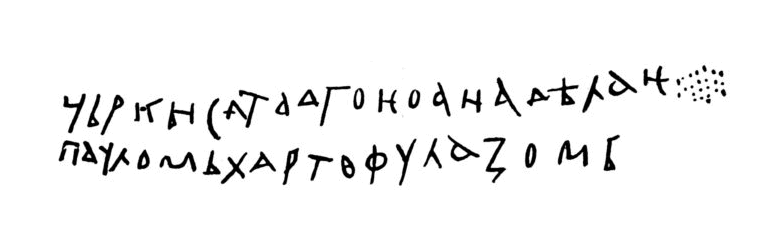

The Bulgarian alphabet reached its present shape by a nineteenth-century codification and a twentieth-century amputation. Several Cyrillic alphabets of between 28 and 44 letters were in use during the codification of modern Bulgarian in the early and middle nineteenth century, until a 32-letter alphabet proposed by Marin Drinov gained the field in the 1870s. It served until the orthographic reform of 1945, which removed the letters yat and the big yus and brought the count to thirty. Some letter shapes in Bulgaria were also deliberately made to look more Latin over the twentieth century, which is why Bulgarian and Russian printed italics can look like different scripts to a reader who knows only one of them.
The script has its own public holiday, official since 1990. The 24th of May is the Day of the Bulgarian alphabet, Bulgarian enlightenment and culture and of Slavonic letters, to give the name it was expanded to in 2020. Its documented pedigree is older than the modern state: an Armenian traveller recorded his visit to a celebration of the Bulgarian script at Shumen on 22 May 1803, and the first recorded secular celebration in the modern form was held at Plovdiv on 11 May 1851, on the initiative of the educator Nayden Gerov, who at the same time named a local school after the two brothers. The date drifted to the 24th with the calendar: 11 May in the Julian reckoning of the Orthodox church is 24 May in the Gregorian. In 2007, when Bulgaria joined the European Union, Cyrillic became the third official script of the Union after Latin and Greek — a fact Bulgarian officials noted at length, and one that is traceable in a straight line back to Preslav.
The dated record: state, party and the assimilation campaign
The modern Bulgarian state was constituted twice over in the nineteenth century and once more in the twentieth. The Principality of Bulgaria was established by the Treaty of Berlin in 1878 as a vassal state under Ottoman suzerainty; it incorporated Eastern Rumelia in 1885; and de jure independence was proclaimed at Tarnovo on 5 October 1908 by Prince Ferdinand, who then took the title of tsar. The monarchy ended after the Second World War: the coup of 1944 ended the country's alliance with the Axis, the monarchy was abolished by referendum on 15 September 1946, and the People's Republic of Bulgaria followed. It lasted until 1990, governed by the Bulgarian Communist Party, inside both Comecon and the Warsaw Pact. Todor Zhivkov led the party for thirty-five years.
The most contested episode of that period, and one of the two subjects that returned to the group without ever being settled, is the assimilation campaign of the 1980s. Its documented outline is as follows, and the characterisations attached to it belong to the parties named. The campaign began at Gregorian Christmas 1984 and continued until December 1989. The state imposed new Bulgarian names on about 850,000 people, banned the public use of Turkish, and restricted religious and cultural practice; the government declared the forced renaming complete on 31 March 1985, though the restrictions on language, religion and cultural practice remained in force until the end of the decade. The euphemism by which the campaign is universally known, the Revival Process, was first used at a Politburo meeting on 18 January 1985 by the Central Committee secretary Georgi Atanasov; scholars describe it as a euphemism, and the Bulgarian economist who has written at length on the subject observes that its use has nonetheless become difficult to avoid.
The state's own justification, as officials advanced it at the time, was that Bulgaria's Turks were the descendants of Bulgarians forcibly converted to Islam and Turkish culture under Ottoman rule, so that the campaign was a restoration rather than an imposition; officials also cited physical-anthropological claims, including phrenological arguments, to the same end. Historians describe the implementation as the encirclement of Turkish villages by security forces and military vehicles, with employers carrying out some name changes at official direction, and the language, religious and cultural restrictions enforced through fines, surveillance, detention and internal exile. Deaths occurred in the state's suppression of protest and in camps, among them Belene; estimates of the toll vary between sources and no figure is agreed. The campaign was criticised at the time by Turkish and Western officials and media, by human rights organisations and by international bodies.
In the spring of 1989 the policy changed from assimilation to expulsion. At the end of May 1989, after prominent dissidents were removed, the authorities enabled mass departures by loosening travel restrictions, by intimidation and eventually by opening the border with Turkey, presenting the departures as temporary tourist travel; state propaganda called the episode the Big Excursion. More than 300,000 people left Bulgaria for Turkey between 29 May and August 1989 under state pressure, until Turkey temporarily closed the border and the movement ended. Bulgaria had entered economic decline through the 1980s and its own state media had discussed possible insolvency as early as 1987; the events of 1989 intensified that crisis, and the economist cited above writes that they revealed the economic costs associated with the campaign.
The campaign ended with the regime. Party leaders removed Zhivkov on 10 November 1989; the government that followed under Petar Mladenov restored the right to hold Turkish names and eased the religious and cultural restrictions on 29 December 1989. Legal mechanisms for restoring original names were established after 1989, and Bulgaria undertook minority-rights reforms. On 11 January 2012 the National Assembly formally condemned the Revival Process.
All of this was recent memory, not history, for the people arguing about it on the group in the 1990s, and it was argued by people on every side of it. The group was unmoderated and refereed none of it. This page reports the documented record and attributes the characterisations; it does not adjudicate them, and neither did the group.
1989 and after, in the years the group was reading
The transition the group was created to discuss can be dated closely, which is fortunate, because the group's own busiest years sit on top of it. Through the autumn of 1989 the independent environmental organisation Ecoglasnost, founded that April, campaigned in Sofia against water-diversion schemes and the Belene nuclear plant, circulating its papers as samizdat and submitting them to a thirty-five-nation environmental meeting held in the city from 16 October to 3 November; the reference account credits it with an important part in the political process that ended with Zhivkov's removal on 10 November 1989, the same day the Communist Party was forced to give up its political monopoly. The first free national elections since 1931 were held on 10 June 1990, on a turnout of nearly 91 per cent, and were won by the party's renamed successor, the Bulgarian Socialist Party. A new constitution was adopted by the Grand National Assembly on 12 July 1991 and took effect on 13 July. Parliamentary elections on 13 October 1991 — three days after the proposal for this newsgroup was submitted — returned the Union of Democratic Forces with 110 of the 240 seats against the Socialists' 106, on a turnout of almost 84 per cent, and produced the first non-communist government in forty-six years. That is the meaning of the phrase in the proposal about politics changing rapidly: it was written in the middle of a genuinely close election campaign.
The second act came in the middle of the decade and was economic. Bank failures ran through 1996 and took much of the banking system with them; prices ran into hyperinflation over the following winter. A month of nationwide protests brought down the Socialist government; President Petar Stoyanov appointed a caretaker cabinet under Stefan Sofiyanski; and early elections on 19 April 1997 gave the United Democratic Forces 137 of the 240 seats, after which Ivan Kostov became prime minister. A currency board arrangement was put in place from 1 July 1997, fixing the lev to the Deutsche Mark at a thousand leva to the mark; on 5 July 1999 the currency was redenominated at a thousand to one, so that one new lev equalled one mark, and the three zeroes vanished. These events were argued over on the group as they happened, by people whose savings and whose relatives were inside them.
The rest of the sequence runs past the period in which such groups were most used and past the news2mail years. Bulgaria joined NATO on 29 March 2004 and the European Union on 1 January 2007, the accession that made Cyrillic an official script of the Union. The peg moved from the mark to the euro at 1.95583 leva; the lev entered the European exchange rate mechanism on 10 July 2020; border checks with the rest of the Schengen area were lifted for air and sea travel on 31 March 2024 and for land borders on 1 January 2025; and the euro replaced the lev on 1 January 2026, with the notes and coins circulating alongside it for a month. The group had been quiet for a long time by then.
The Macedonian question, as a disputed matter
The other subject that returned to the group and was never settled concerns the status of the language spoken in what is now North Macedonia, and it must be stated as what it is: a dispute between positions, each of which is here attributed to whoever holds it. This page takes no side and offers no resolution.
The uncontested part is small. Macedonian and Bulgarian belong to the Eastern South Slavic group and form part of a dialect continuum which shades into Serbo-Croatian, with the transitional Torlakian dialects classified in the eastern group by some authors; the two are mutually intelligible to a high degree. Macedonian was declared an official language by the anti-fascist assembly of Macedonia on 2 August 1944 and standardised in Yugoslavia the following year, on a dialectal base drawn primarily from the west-central dialects of the region.
From there the positions diverge. The North Macedonian position, set out by that country's governments and scholars, is that Macedonian is the first written Slavic language and stands in direct continuity with Old Church Slavonic; a Macedonian foreign minister has rejected the Bulgarian claims as having no basis in international law, Macedonian being a well-established language. The Bulgarian position, maintained by the Bulgarian state and by most of the country's academic establishment, is that it belongs to the Bulgarian dialect area; the Institute of Bulgarian Language defined it in 1978 as a regional written norm of the Bulgarian language, and Bulgarian linguists have argued since 1948 that its codifiers deliberately introduced features drawn from Serbian. The intervening history is tangled: Bulgaria recognised the existence of Macedonian in 1946 and 1947, allowing it as a language of instruction in schools in Pirin Macedonia, and rejected it again after the Tito–Stalin split of 1948, a rejection given its scholarly form in a paper of 1952. Bulgaria was nonetheless the first country to recognise the independence of the Republic of Macedonia in 1991. In 1999 the two governments settled the diplomatic problem without settling the linguistic one, by a joint declaration of 22 February drawn up in Macedonian, pursuant to the Constitution of the Republic of Macedonia, and in Bulgarian, pursuant the Constitution of the Republic of Bulgaria — a formula that concedes nothing and permits business. The dispute has since been among the main reasons for which Bulgarian governments have obstructed North Macedonia's European Union accession.
The position recorded in the reference literature is that the international consensus outside Bulgaria treats Macedonian as an autonomous language within the Eastern South Slavic dialect continuum, with a small minority of linguists divided between calling the two separate languages and calling them one pluricentric language. Threads on this subject ran at length in the group, drew crossposters from the neighbouring national groups, and produced on both sides histories the other declined to accept. The group's job, as an unmoderated forum, was to carry the argument; it never had the standing to conclude it, and neither does this page.
The FAQ, and what a monthly posting could be
The most durable thing the group produced was its FAQ, and by the standards of the genre it was enormous. Its own summary header states that it includes eleven parts numbered from 0, the table of contents, to 10; those parts hold twenty-four numbered chapters, 0 to 23. It was posted approximately once a month to soc.culture.bulgaria, archived in the news.answers collection under the archive name bulgaria-faq, and it told readers that the most recent version was always to be had from the Usenet newsgroup soc.answers — the group whose own page is here. It was available on the World Wide Web from a Columbia University machine, by anonymous FTP from rtfm.mit.edu, and from mail servers in North America and the Netherlands. It was maintained by Dragomir R. Radev, then a doctoral student in computer science at Columbia. The version circulating in 2001 was numbered 4.11 and had last been modified on 17 July 2000, with a note at the top warning that a rewrite was under way, that articles might disappear from future releases, and asking for volunteers.
Its structure is the best surviving inventory of what the group was for. Chapter 0 was the introduction, including the contributor list; chapter 1 was about the newsgroup itself. Chapter 2 covered general information about the country, including entries on who the Slavs are and who the Pomaks are, and one on where to buy Bulgarian flags. Chapters 3 and 4 covered visiting Bulgaria and travelogues — travel agencies, visas, hotels, taxis, medical care, how to use a credit card, how to send mail home, police assistance, the exchange rate for the lev between 1995 and 1997. Chapter 5 was education, chapter 6 information for Bulgarians abroad, chapter 7 news sources, including how to receive Bulgarian news by e-mail and the BBC's Bulgarian-language schedule. Then institutions and organisations, business contacts and funding sources, electronic connectivity, the language, art and culture, music and dance, literature, politics, history, famous Bulgarians, traditions, religion, sports, cuisine, a miscellany and a bibliography. The miscellany chapter has exactly two entries: an article on Macedonians in Bulgaria, in Bulgarian, and an ASCII map of the country.
What makes it a historical document rather than a curiosity is that a substantial part of it was written by the group's own readers and credited to them by name, entry by entry, with a date of last update on each. Several entries are dated 31 December 1991 — written in the group's first week, alongside the account of its creation. Several are marked as being in Bulgarian. Some are transcriptions of United States government material, the credits naming the State Department, the Department of Commerce and the CIA World Factbook; some are personal travel notes. Assembled, they amount to a small handbook of a country compiled at a moment when almost nothing about Bulgaria existed online in organised form, by people who mostly could not visit it easily and wanted others to be able to.
Its maintainer, born on 7 August 1968, took his doctorate at Columbia in 1999 and went on to a substantial career in natural language processing, teaching at Michigan and at Yale. He founded the North American Computational Linguistics Olympiad, for which he shared the Linguistic Society of America's Linguistics, Language and the Public Award in 2011, and coached the United States team at the International Linguistics Olympiad. He was elected a fellow of the Association for Computing Machinery in 2015 for contributions to natural language processing and computational linguistics, was a fellow of the Association for the Advancement of Artificial Intelligence, and received the Association for Computational Linguistics' Distinguished Service Award in 2022. He died on 29 March 2023, aged 54. The soc.culture.bulgaria FAQ is the earliest widely circulated document carrying his name, and in hindsight a ten-year exercise in structuring, crediting and periodically re-summarising a large heap of contributed text looks less like a hobby than like a rehearsal.
What a culture group carried
Underneath the arguments ran everything else, and the FAQ's chapter headings are a fair index of it. Music came first among the exportable things. The compilation Le Mystère des Voix Bulgares, the product of fifteen years' work by the Swiss ethnomusicologist Marcel Cellier, some of it recorded by him and some drawn from the archives of Radio Sofia, was released on his own small Disques Cellier label in 1975. It reached the West by an unlikely route: a third- or fourth-generation cassette lent to Ivo Watts-Russell of the British label 4AD by Peter Murphy of the band Bauhaus, after which Watts-Russell tracked down and licensed the recordings. 4AD reissued the record in 1986, Nonesuch in the United States in 1987, and the second volume, released in 1988, won the Grammy Award for Best Traditional Folk Album in 1990. The singing is by the Bulgarian State Radio and Television Female Vocal Choir, founded in 1952, with arrangements on the second volume by Filip Kutev among others; Kutev and Maria Kuteva had founded Bulgaria's first professional national folk ensemble the year before the choir. For a diaspora group in the early 1990s this was an unusual asset: a national musical tradition that people abroad already knew about, and which needed no defending.
Bulgarian singing had in fact already left the solar system. Izlel e Delyo Haydutin, a Rhodope song recorded in 1968 by Valya Balkanska with the gaida players Lazar Kanevski and Stephan Zahmanov, was recorded in the late 1960s by the American folklorist Martin Koenig and released on vinyl in the United States; a copy of that record reached the compilers of the Voyager Golden Record, and the song was included in the ninety-minute musical selection that flew on Voyager 2, launched on 20 August 1977, and on Voyager 1 two weeks later on 5 September. Voyager 1 became the first object of human origin to leave the heliosphere on 25 August 2012.
Food occupied an entire chapter and, unusually for a FAQ, a technically demanding one, because the diaspora's central culinary problem was reproducible only with a specific organism. The bacterium responsible for Bulgarian yoghurt is named for the country — Lactobacillus delbrueckii subspecies bulgaricus, commonly shortened to Lactobacillus bulgaricus — and the FAQ carried two yoghurt entries, one of them specifically on how to make Bulgarian yoghurt in the United States, along with recipes for banitsa, the layered filo pie; for pickles and marinated mushrooms; for baklava; for the Easter bread kozunak; and for a page of cocktails credited to five contributors. Several of the recipe entries are in Bulgarian.
Literature and the export of Bulgarians occupied two more. Ivan Vazov, the novelist and poet conventionally called the patriarch of Bulgarian literature, stands at the head of the national canon. Elias Canetti, born at Ruse on the Danube in 1905 into a Sephardic Jewish family and writing in German, won the Nobel Prize in Literature in 1981. And the chapter headed Famous Bulgarians has exactly three entries: two separate accounts of John Vincent Atanasoff, and one of Canetti. Atanasoff — born at Hamilton, New York, on 4 October 1903 to an electrical engineer of Bulgarian origin, credited with inventing the first electronic digital computer at Iowa State in the late 1930s, and holder of the Bulgarian Order of Saints Cyril and Methodius, First Class, conferred in 1970 — came first, and twice. A group of expatriate programmers, in a decade when their country's programmers were internationally notorious, had put a computing ancestor at the top of its list of famous compatriots. It is not hard to see why.
What the record does not show
Almost nothing survives about this group as a group. There is no external documentation of soc.culture.bulgaria's internal life — no memoir, no institutional history, no scholarly treatment — and this page has invented none. What exists is the administrative paperwork described above, the FAQ, and whatever remains in the general Usenet archives.
Several specific things are therefore unavailable, and it is better to name them than to imply otherwise. There is no reliable count of the group's total traffic, only the sampled readership estimate of October 1995 quoted earlier. There is no record of who its most prolific posters were beyond the contributor credits scattered through the FAQ, and this page has not turned those credits into a list of regulars, because contributing an entry and posting daily are different activities. No thread titles are cited here, because none can be cited from a verified source. The proportion of the group's traffic that was in Bulgarian rather than English cannot be recovered, and for the reasons set out above much of the Bulgarian-language material is not even searchable in Bulgarian.
The absence of a proposal file in the news.announce.newgroups archive is itself part of the record, and an instructive one: for many Big-8 groups that archive preserves the Request for Discussion, the Call for Votes and the result posting with their full tallies, and for this group it preserves none of them. Everything known about the vote comes from a control message and from a FAQ chapter written by one of the two people who counted it. That is a thinner evidential base than it looks, and the one-vote discrepancy between the two sources is a useful reminder of how thin.
Scope and limits
This page is about a newsgroup and the world it belonged to. It reports what was documented, argued and recorded; it does not take positions on any of the contested matters it describes. The characterisations of the assimilation campaign of 1984 to 1989 are those of the historians, human rights bodies, governments and scholars named; the positions on the status of the Macedonian language are those of the states, academies and reference works to which they are attributed; the account of the Bulgarian virus wave is drawn from a single contemporary paper of 1991, whose counts and estimates are its own and stop there, and from the Big-8 administrative record of the group where the subject was discussed. Where sources disagree — over a vote tally, a creation date, or the year in which the United Nations adopted a transliteration standard — this page reports the disagreement rather than picking a winner.
People are named here where the naming is documented and load-bearing: the author of the 1991 virus paper, who published it under his own name and is identified as a member of the VIRUS-L list in the reference literature; the maintainer of the FAQ, who signed every release of it and died in 2023; the moderator of news.announce.newgroups, in his administrative capacity; and public figures of the historical record. The people who wrote Bulgarian viruses are not named, because their identities were not established: the 1991 paper deliberately reduced them to initials, Dark Avenger is a pseudonym, and the operator of the virus-exchange board is described here by his role, as the paper describes him. The two people who ran the 1991 ballot, and the individual contributors credited in the FAQ, are likewise described by role.
For the machinery of how a soc.culture group was proposed, debated and voted into existence, and for the family resemblance among the national groups of the branch, see the soc.culture.* hub. For the neighbouring groups whose decade was harder than Bulgaria's — the successor-state groups whose creation votes were themselves political events — see soc.culture.yugoslavia. Bulgaria's transition was not fought; the group's crises were constitutional and economic rather than military, and the difference is audible in the archive's tone.
Reading soc.culture.bulgaria today
- Historical archive: Google Groups — soc.culture.bulgaria (coverage varies by group and era).
- Open in a newsreader:
news:soc.culture.bulgaria— the original site offered exactly this link, and it still works if your system has a newsreader registered for thenews:scheme. - Live access: point an NNTP newsreader at a modern server — see accessing Usenet today.
- The original news2mail e-mail subscription service ended in the mid-2000s and no longer operates.