soc.culture.palestine
Palestine and the Palestinian people.
One of the national and ethnic rooms of soc.culture.*: intifada news relays, refugee-family histories, olive-harvest seasons, and argument — endless, unresolved, crossposted — with every neighbouring perspective on Usenet.
Beneath the politics ran cultural preservation: village names, embroidery patterns (tatreez), recipes and poetry — the subjects a diaspora group of this kind carried.
On this page
- Fourteen September 1993: the paperwork, and what it says
- The vote: 211 to 90
- What the ballot roll shows about who was reading
- The domain that did not exist
- Lines, licences and percentages
- A readership in other people's time zones
- The subjects the charter named
- The neighbourhood, and how a post reached five groups at once
- Palestinian Arabic as a variety
- Spelling as evidence
- Embroidery, and the collections that hold it
- The olive year
- Soap, cheese and the rest of the kitchen
- Songs with no fixed words
- Poetry, prose and the hikaye
- The institutions that did the preserving
- The dated record
- A forged rmgroup, November 2001
- What the record does not show
- Scope, sources and limits
Fourteen September 1993: the paperwork, and what it says
For a Big-Eight group created in the 1990s the administrative record usually survives, and for this one it survives complete. Filed under the group's name in the news.announce.newgroups archive mirrored by the Internet Systems Consortium are five documents — two Requests for Discussion, two Calls for Votes and a RESULT — and, in the separate control archive, the message that actually created the group. The sequence from first proposal to created newsgroup took nine weeks and one day.
The first Request for Discussion is dated 14 September 1993. The Declaration of Principles on Interim Self-Government Arrangements had been signed in Washington the previous day. The proposal was posted from a machine at Queen's University at Kingston, in Ontario, and crossposted to news.announce.newgroups, news.groups and soc.culture.arabic; it asked for a group called soc.culture.palestinian, left the moderation status as open to discussion, and gave a short rationale. The rationale as it appears in the later, tidied Call for Votes reads:
There is currently no specific forum for the discussion of Palestinian politics, culture and society. Also the Gaza-Jericho First Agreement leads to the creation of at least limited Palestinian autonomy. The success or failure of this in the next few years creates plenty of room for discussion and debate.
That is the whole of the case made for the group. It rests on an absence and on a document: no forum exists, and an agreement has just been signed whose consequences will need discussing. Whatever else can be said about soc.culture.palestine, its founding paperwork is unusually candid about being a response to a news event. The absence it claims also fixes where the subject had been going before: the proposal was addressed, by its own Newsgroups header, to the readers of soc.culture.arabic, and the designated venue for the politics, talk.politics.mideast, already existed and had done for years.
A second RFD followed on 24 September, ten days later, and changed the name. The proposer wrote that the change was made due to widespread demand and after consulting the moderator of news.announce.newgroups on what the document calls, with the original's spelling, the proprierty of changing a proposed group name in mid-stream. From that point the proposal was soc.culture.palestine — the place rather than the people — and it carried a draft charter:
The purpose of soc.culture.palestine will be to discuss Palestinian society, politics and culture throughout the world and specifically to discuss the emerging Palestinian administration in the West Bank and Gaza strip, its challenges, successes, failures etc.
That draft is not the charter the group ended up with. Between 24 September and the Call for Votes of 20 October the text was rewritten, and the version put to the electorate — reproduced identically in both Calls for Votes, in the RESULT and in the newgroup control message — reads in full:
An unmoderated forum open to all those interested in discussing Palestinian culture, politics, economics etc; the condition of Palestinians living under Israeli administration and the progress of and challenges facing the emerging Palestinian administration in the West Bank and Gaza.
Two things were added. The word economics appeared, and so did a clause the September draft did not contain: the condition of Palestinians living under Israeli administration. Whether that clause was added to widen the group's remit or to make its remit explicit before a vote, the documents do not say. What they do record is that it was in front of every voter who cast a ballot.
The one-line description that a news administrator's software has shown beside this group since 1993 was fixed in the same round of drafting. The Call for Votes gives it, the RESULT repeats it, the control message repeats it again under the heading For your newsgroups file, and it reads:
soc.culture.palestine Palestinian people, culture and politics.
It is a noun phrase and a full stop, in the ordinary form of the branch. Thirty-three years later it is still the line: the newsgroups file distributed today by the Internet Systems Consortium carries it unaltered, word for word and comma for comma, and the active file carries the group with the flag y, meaning unmoderated and open to posting.
The vote: 211 to 90
The Call for Votes went out on 20 October 1993 from a neutral third party working under the Usenet Volunteer Votetakers, the standing pool of experienced non-participants who ran Big-Eight ballots in this period. It was crossposted more widely than the RFD had been — to news.announce.newgroups and news.groups, and to soc.culture.arabic, soc.culture.iranian and soc.culture.pakistan. Ballots were to be mailed to an address at Emory University, and the deadline was stated to the second: 23:59:59 UTC on 10 November 1993. A last call went out on 5 November. The mechanics of this procedure — the thirty-day discussion, the neutral votetaker, the published roll, the five-day waiting period — belong to the hierarchy and are described on the soc.* hierarchy page rather than here.
The Call for Votes stated the passing condition in its own words: 100 more YES votes than NO votes and 2/3 of all votes being YES are the requirements for group creation. The RESULT, posted on 11 November 1993 under the subject line RESULT: soc.culture.palestine passes 211:90, records both tests as met.
- 360 votes received in all.
- 45 duplicates deleted from the final count — voters were permitted to change their minds, and only the last ballot from an account counted.
- 303 valid votes: 211 yes, 90 no, 2 abstaining.
- 3 invalid votes, not corrected after three attempts to notify the voters.
- 2 votes — one abstention and one yes — arriving after the poll closed and therefore not counted.
The margin was 121, against a required 100. The yes share was 211 of the 301 ballots cast either way, a little over 70 per cent, against a required two-thirds. The votetaker's note adds the formula that governed everything downstream: Therefore, barring any serious objections over the vote, soc.culture.palestine should be created after 5 days. No objection is recorded. The newgroup control message was issued on 17 November 1993 at 15:30:13 GMT by the moderator of news.announce.newgroups, six days after the RESULT, and an identical message was reissued on 19 August 1994 in the ordinary course of keeping distant servers in step.
What the ballot roll shows about who was reading
Big-Eight votetakers published the full roll — every voter's name and address, sorted into yes, no, abstain and error lists — so that any reader could audit the count. The consequence, thirty years on, is a dated snapshot of who was close enough to Usenet in the autumn of 1993 to hear about a proposed newsgroup and mail a ballot. It is not a survey of opinion and it is not a census of readers. It is a list of 303 people with working e-mail and an interest in the question, and its shape is worth setting out because it says something about the group that no later source can.
Sorted by the top-level domain of the address each ballot came from, the yes votes fall out as follows: 94 from .edu, 55 from .com, 18 from .ca, 12 from .uk, seven from .de, four each from .fr and .au, three from .nl, two each from .ch, .se, .cl, .il and .org, and one each from .jp, .fi, .net and an old-style UUCP address. The no votes: 48 from .edu, 23 from .com, seven from .il, two each from .mil and .org, and one each from .gov, .net, .ca, .uk, .nl, .au, BITNET and UUCP.
Three features of that distribution are worth stating plainly, because each is checkable against the published roll.
- The electorate was overwhelmingly academic. Universities supplied 142 of the 301 ballots cast either way. The second-largest block, the
.comaddresses, is itself substantially institutional: it includes a cluster of accounts at one large American software company, the internal network of a minicomputer manufacturer, and several early commercial providers. Free-net community systems in Ottawa and Cleveland each supplied voters. - Nine ballots came from Israeli addresses, two yes and seven no, and every one of them was at an Israeli university. Israel's country-code domain,
.il, had been registered on 24 October 1985 according to IANA's root database, and Israeli academic networking was correspondingly mature by 1993. - Not one ballot came from a country-code domain of any Arab state, and not one came from the West Bank or Gaza. There was no domain from which such a ballot could have been sent: the territories had no country-code top-level domain in 1993, and would not have one for another six years and four months.
Two yes votes arrived from a university in Chile — a small detail with a large demography behind it, discussed further below. The rest of the picture is the picture of the 1993 Internet: a network that reached campuses, research laboratories and large employers in North America and western Europe, and reached almost nothing else. A group about Palestinians was voted into existence by people writing from the places where the network was, which was very largely not the places where the people were.
The domain that did not exist
That absence is not a rhetorical point; it is documented, in detail, in the delegation report the Internet Assigned Numbers Authority published when the domain was finally created. The report is one of the more useful primary sources on this page's subject, precisely because it is an engineering document that repeatedly declines to be anything else.
Its chronology runs as follows. In November 1995 the United Nations Statistics Division placed the name Palestine on an interim list of area names, and in response the ISO 3166 Maintenance Agency agreed to set aside the two-letter code ps in case a later decision brought Palestine onto the ISO 3166-1 list; in April 1996 the Agency formally moved the code to its register of exceptional reservations, meaning the code should not be used for anything else. In February 1997 IANA received an enquiry about delegating a country-code domain, and in May 1997 declined, on the stated ground that no code for Palestine appeared on the ISO 3166-1 list. In April 1998 IANA said it would instead delegate a second-level domain, palestine.int, on the basis of Palestine's status as a Permanent Observer at the United Nations, expressly in lieu of a current top level domain; that delegation was made on 14 May 1998 and was used chiefly for a governmental third-level domain. In the summer of 1999 the UN Statistics Division notified the Maintenance Agency that it had added Occupied Palestinian Territory to its list of standard country and area codes for statistical use, and on 30 September 1999 the Agency announced that from 1 October 1999 the code ps would enter ISO 3166-1 with that designation. An application for the top-level domain followed on 11 October 1999. The IANA report is dated 11 February 2000; IANA's root database gives the registration date of .ps as 22 March 2000, and records a further report on redelegation dated 21 June 2004.
On the question a reader might expect such a report to dodge, it is unusually direct. Having noted that the ISO 3166-1 table is the authoritative reference for which codes may be delegated, and that the table already contains many entries that are not states at all, it says:
Assessments regarding sovereignty and nationhood are not among the IANA's functions.
That sentence is quoted here because it is the exact posture this page takes, and because it was written by a body with a much stronger claim than a newsgroup directory to be asked the question. The operative fact for the group's history is simply arithmetic: the newsgroup was created in November 1993; the domain arrived in March 2000; and for the first six years and four months of its life the group had readers in the territories only insofar as they could reach the network by some route that did not carry their own country code.
Lines, licences and percentages
The other half of the connectivity question is infrastructure rather than naming. Palestinian telecommunications passed into local hands during the interim period: the Palestine Telecommunications Company was founded in 1995, and its cellular arm launched in 1999. What the network then carried can be read off a published series. The World Bank's indicator for individuals using the Internet in the West Bank and Gaza, compiled from International Telecommunication Union returns, records no observation at all before 2000, and then:
- 2000 — 1.11 per cent of the population
- 2001 — 1.84 per cent
- 2002 — 3.10 per cent
- 2003 — 4.13 per cent
- 2004 — 4.40 per cent
- 2005 — 16.0 per cent
The news2mail gateway carried this group to e-mail between 2000 and 2004. Across those five years, on the World Bank's figures, the share of people in the West Bank and Gaza who used the Internet at all rose from about one in ninety to about one in twenty-three. Whatever soc.culture.palestine was during its most active years, it was not, and could not have been, a forum written mainly from the territories it discussed.
It was written instead from the connected world's institutions, and the ballot roll of 1993 shows exactly which ones: universities, research networks, large employers, the first commercial providers, and — for anyone writing from inside Israel — the academic network on a country-code domain that had existed since 1985. This is a constraint on the evidence rather than a fact about anybody's views, and it cuts in every direction at once. The proportions in any surviving archive of this group are the proportions of who had an account, not the proportions of who held an opinion.
A readership in other people's time zones
The demography behind that is the ordinary reason a soc.culture.* group existed at all. The Palestinian Central Bureau of Statistics, itself established in 1993, reported in its Statistical Abstract of Palestine No. 5 of October 2005 that the number of Palestinians worldwide at the end of 2003 was 9.6 million, an increase of 800,000 on 2001. The largest Palestinian population anywhere outside the West Bank and Gaza is in Jordan, usually given as around 3.24 million; the next largest concentration in the region is in Syria. The United Nations Relief and Works Agency, which maintains the registration rolls for its five fields of operation, records registered refugee populations in Jordan, Syria, Lebanon, the West Bank and the Gaza Strip; a census conducted by the Lebanese government in 2017 counted about 174,000 Palestinians in Lebanon, while UNRWA's register of Palestine refugees in Lebanon stood at 489,292 in 2023 — a gap between two differently defined counts that is worth naming rather than smoothing over.
Beyond the region, the largest single community is in Chile, generally given as around 500,000 and described in the standard accounts as the largest Palestinian population outside the Middle East; there are long-established communities in Honduras and El Salvador, and substantial populations in Saudi Arabia, Qatar, the United Arab Emirates, Kuwait, the United States, Germany, Canada and Brazil. Those two yes votes from a Chilean university in November 1993 sit on top of a migration that began in the late nineteenth century.
Jordan, Lebanon, Syria and Chile all host large Palestinian populations, and each has a page in this directory — soc.culture.jordan, soc.culture.lebanon, soc.culture.syria and soc.culture.chile — where those countries' own accounts belong. The point here is narrower and concerns the newsgroup: a group whose subject was a people most of whom lived outside the territory named in its charter had no single home time zone, no hour of the day that reliably belonged to one set of its readers, and no local newspaper to argue with. That is close to the archetype of what the soc.culture.* branch was built for. The hierarchy page makes the general case; the figures above are what it looks like in one instance.
The subjects the charter named
No message archive for this group is preserved on this site, and this page therefore makes no claim about what any individual thread contained. What can be stated is what the group was chartered to carry, and what the documents of the period put on the agenda.
The charter names four areas — culture, politics, economics, and the condition of Palestinians living under Israeli administration — plus the progress and challenges of the emerging administration in the West Bank and Gaza. The rationale names one event, the Gaza-Jericho arrangement. And the instrument signed the day before the first RFD supplied, in its own text, the list of questions that would remain open for the whole of the group's active life. Article V of the Declaration of Principles set a five-year interim period, required permanent status negotiations to begin no later than the start of the third year of that period, and listed the issues those negotiations would cover: Jerusalem, refugees, settlements, security arrangements, borders, relations and co-operation with other neighbours, and other issues of common interest.
A newsgroup created the week that document was signed, chartered to discuss the administration it created, and running for the whole of the interim period and past its expiry, therefore had its standing agenda written for it by treaty. Every one of those seven items was contested in public, in print and in the press throughout the group's life, by parties who disagreed about all of them; a group open to all comers, unmoderated, and crossposted into by four neighbouring groups will have carried that disagreement. This page does not adjudicate any of it, and does not pretend to know how any particular exchange went.
One dated feature of the period does belong here, because it was a publishing fact rather than a claim about any thread. The years on either side of the group's creation saw a body of revisionist scholarship on 1948 — written largely from Israeli state archives opened after the statutory thirty years, and labelled from 1988 onward with a term coined by one of its own number — reach a general readership in English and in Arabic translation. A group chartered in 1993 to discuss Palestinian politics and history was created into that publishing moment, whatever any individual reader made of it.
Alongside the argument, a dispersed-community group of this kind carried the ordinary traffic of dispersal: requests for word from particular towns, questions about documents and crossings, notices of lectures and community events abroad, and newcomers of every disposition asking to be pointed at a book. That is a generic description of the genre rather than a claim about specific posts, and it is offered as such.
The neighbourhood, and how a post reached five groups at once
The branch was older than the group. soc.* was one of the seven hierarchies created in the Great Renaming of 1987, the restructuring that replaced the earlier net.*, mod.* and fa.* names with comp.*, misc.*, news.*, rec.*, sci.*, soc.* and talk.* — the set later known as the Big Seven and, once humanities.* was added in 1995, the Big Eight. By the early 1990s soc.culture.* held a long roster of national and ethnic groups, each of them added one at a time through the proposal-and-ballot procedure described above. soc.culture.palestine joined that roster by exactly that procedure and by no other.
Most members of that roster are named for states. This one is named for a place whose status the instruments listed later on this page left open, and its charter named a population rather than a citizenry. That is an observation about the branch's naming conventions and about the wording of one charter; it is not a position, and this page takes none.
soc.culture.palestine did not sit alone. The same newsgroups file that carries its description carries, a few hundred lines further down, the line for the group where Middle East politics was formally supposed to go:
talk.politics.mideast Discussion & debate over Middle Eastern events.
That group has no page in this directory, and this one does not stand in for it. It is named here only because any honest account of the neighbourhood has to record that a designated venue for the argument existed, and that it was, by common contemporary account, among the busiest and least tranquil places on Usenet.
The mechanism that made the borders between all these groups porous belonged to the software rather than to anybody's intentions. A Usenet article carries a Newsgroups header that may name several groups at once; the article is stored once on a server and appears in every group named, so a single post could be read and answered by the regulars of four or five groups simultaneously. A Followup-To header could steer replies into one group, but supplying it was optional and frequently omitted. The Call for Votes for this group was itself crossposted to five newsgroups, which is a fair illustration of how the cluster behaved when it was on its best behaviour.
Several members of that cluster have pages here: soc.culture.arabic, which owns the account of the Arabic language community and of Arabic script on the network; soc.culture.jewish, which owns its own branch, charter and documentary record; and soc.culture.syria, soc.culture.jordan and soc.culture.lebanon. Each had its own vote, its own charter and its own regulars. None of them is answered, mirrored or rebutted here, and any account of what was said in one group of a crossposting cluster is partial by construction.
Palestinian Arabic as a variety
The language of the group was English, as it was for most of soc.culture.*, with Arabic surfacing in words, phrases, proverbs, song lines and the spelling of names. The variety behind those fragments has a linguistic description, and it is worth giving because the divisions in it are geographical in a way that mattered to a dispersed readership.
Palestinian Arabic is not a single dialect but a continuum of mutually intelligible varieties within Levantine Arabic, conventionally sorted into three groups. The urban varieties, madani, closely resemble the colloquial Arabic of western Syria and Lebanon — a homogeneity usually attributed to the trading networks between Ottoman-era cities — and are marked by the realisation of the letter qaf as a glottal stop and by the merger of the interdental consonants into dental plosives. The rural varieties, fallahi, keep the interdentals and keep the masculine and feminine plural pronouns distinct; the central rural belt, running roughly from Nazareth to Bethlehem, has a combination described as unique in the Arab world, pronouncing kaf as a ch sound and qaf as a pharyngealised k. The Bedouin varieties, badawi, realise qaf as a hard g and, in the Negev, are closely related to the dialects of the Hijaz and Sinai.
What makes this more than a phonology lesson is that these are, in origin, place-markers. A single consonant could tell a listener whether a speaker's family came from a coastal city, a hill village or a tent, and the twentieth century shuffled all three together in the same camps, suburbs and diasporas. Linguists record movement in both directions: rural speakers adopting urban forms as towns grew, and speakers elsewhere deliberately keeping the rural pronunciation of qaf in what one account calls a pride reaction against its stigmatisation. On a text-only network, none of that carries at all. Everyone's accent is invisible, and the only thing left to mark provenance is spelling.
Spelling as evidence
Usenet in this period was in practice a Latin-script medium: the transports and newsreaders in general use handled seven-bit ASCII reliably and anything else unreliably, so Arabic script, where sent at all, was liable to arrive as unusable bytes. Arabic-speaking posters commonly wrote Arabic in Latin letters instead, using the conventions that were then developing wherever Arabic was typed on a Latin keyboard and were later catalogued as the Arabic chat alphabet, or Arabizi: numerals standing in for consonants the Latin alphabet does not carry, with 2 for hamza, 3 for ayn, 5 for khaa, 7 for haa and 9 for saad. The general account of Arabic on a seven-bit network — the encodings, the keyboard question, the full repertoire of substitutions — belongs to soc.culture.arabic and is not retold here. What belongs to this group is the narrower problem that follows, and it is a problem the medium made unavoidable rather than one anybody chose.
Two romanisation registers were available. For titles, documents and scholarly citation there were the academic transliteration systems, which mark long vowels and emphatic consonants with diacritics the medium could not carry either, so the diacritics were routinely dropped and the systems degraded to something ambiguous. For everything else there were the informal conventions then developing among Arabic speakers wherever they typed on Latin keyboards. Neither had authority, and the result was a text medium in which one town could appear under four defensible spellings in a single week.
Place names were the sharp end of it, and not only because of romanisation. A locality on the coastal plain or in the Galilee could carry an Arabic name and a Hebrew one, each with two or three defensible transliterations, none of them incorrect under the conventions in use. The same is true of personal names and of the titles of books. Spelling therefore carried information beyond the word: the form a writer chose indicated which maps, gazetteers and reference works stood behind it, and readers treated it as a marker accordingly. It is one of the few features of this subject on which the medium had a direct and documented effect, since in speech the question mostly does not arise.
This page follows one rule and states it here rather than pretending it has none: it uses whatever form the source it is citing uses, names the source, and adopts no form as its own.
Embroidery, and the collections that hold it
The best-documented Palestinian material tradition, and the one with the largest institutional paper trail, is embroidery. Until the 1940s a woman's dress recorded, to a knowledgeable eye, her district, her village, her marital status and her household's means; the discipline of reading garments that way is old enough that the museum catalogues are organised around it. The formal recognition arrived late — UNESCO inscribed the art of embroidery in Palestine, practices, skills, knowledge and rituals on its Representative List of the Intangible Cultural Heritage of Humanity in 2021, seventeen years after the group's gateway years — but the collections are much older than the listing.
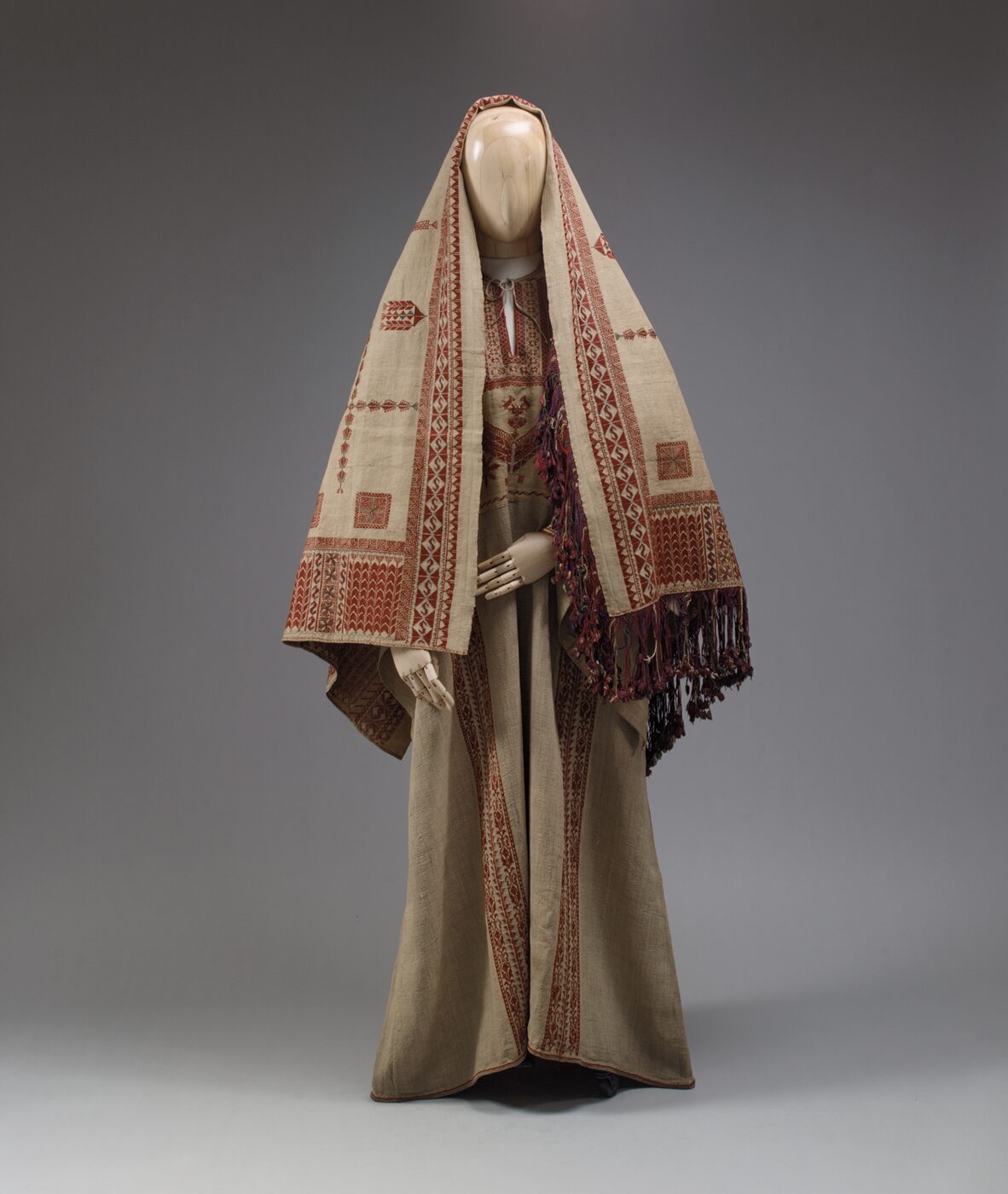
The vocabulary is specific and consistent across sources. The garment is the thobe; the square embroidered chest panel is the qabbeh, the decorated back panel the shinyar, the side panels the banayiq. Married women in the Bethlehem area wore the shatweh, a conical hat described in one catalogue as shaped rather like an upturned flower pot, which held the chin chain in place. Bethlehem and neighbouring Beit Jala were known for couching stitch, used for the panels of the malak or queen wedding dress, which was popular enough among brides of the surrounding villages that the panels came to be made commercially. In the Galilee the standard ensemble was a coat, the jillayeh, over tunic and trousers, with patchwork and other techniques rather than much cross-stitch.
The motifs recur across the literature: the eight-pointed star, the moon, birds, palm leaves, stairs, the cypress tree, and diamonds and triangles used as amulets against the evil eye — the dense block of work on the chest panel being understood as protection for the chest. Colour was determined by what dyes could be made: reds from insects and pomegranate, dark blues from indigo, yellow from saffron, soil and vine leaves, brown from oak bark, purple from crushed murex. The colour indigo produced, nileh, was held on one curator's account to avert the evil eye in its own right; in 1870 there were ten dyeing workshops in one quarter of Jerusalem employing around a hundred men. Curators disagree, on the record, about how much of the later repertoire is indigenous: one collector argued that anything after 1918 showed the influence of European pattern books, while others date the curvilinear flowers and paired birds to the late 1930s.
Weaving had its own centres — Majdal, Bethlehem, Ramallah and Jerusalem produced woollen cloth, and majdalawi fabric was made by male weavers on single-treadle looms in black and indigo cotton shot with fuchsia and turquoise silk. Majdal itself is today part of Ashkelon; the weaving technique is maintained in Gaza City as a preservation project. The displacement of 1948 broke the village-by-village system: displaced women had neither the time nor the money for the old work, new styles emerged from the camps in the 1960s, and the individual village signatures gave way to a generalised style recognisable simply as Palestinian.
The objects, meanwhile, are in museums, and this is the part a reference page can be most precise about. The British Museum holds over a thousand pre-1948 items in its Palestinian costume collection, the basis of a major exhibition and monograph in 1989. The Museum of International Folk Art in Santa Fe holds a collection assembled with the provenance of each piece noted down at acquisition, including garments from villages depopulated in 1948, the oldest traceable to the 1840s. The Israel Museum in Jerusalem holds one of the largest collections and exhibited from it in 1986–87. The Tareq Rajab Museum in Kuwait holds a substantial collection built from a private one. The Widad Kawar collection, an important private holding now in Amman that toured widely in the 1980s, was catalogued in a German museum publication of 1987. And the Metropolitan Museum of Art in New York holds the nineteenth-century Ramallah ensemble shown below, released by the museum into the public domain.
.jpg)
The olive year
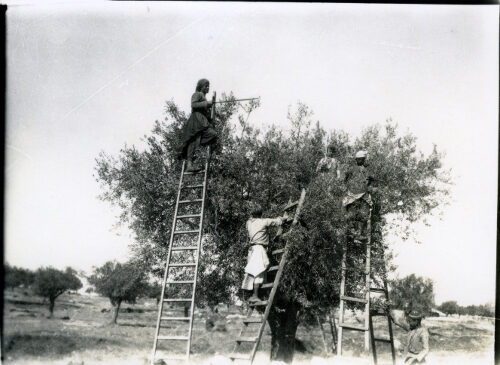
The olive is the other subject that organises itself around a calendar, and a calendar is exactly the sort of thing a dispersed readership marks. The harvest falls in the autumn, and the traditional repertoire around it is documented in three separate literatures — agricultural, culinary and musical — which is unusual for any single crop.
On the musical side, the standard account of Palestinian village music lists work songs used for specific tasks: fishing, shepherding, harvesting and the making of olive oil. On the culinary side, several dishes are recorded as seasonal and tied to the pressing: musakhan, the roasted chicken over taboon bread with fried onions, sumac, allspice and pine nuts that originated in the Jenin and Tulkarm area; and the olive-oil breads maltoot and musaffan, which are made when the new oil comes in. Until about the 1950s or 1960s, one account of the rural kitchen has it, the mainstays of village cooking were olive oil, oregano and bread baked in the clay oven called a taboon — an oven which, a visitor wrote in 1905, is not in the house, it has a building of its own, the joint property of several families whose duty is to keep it always hot.
The terraced landscape that the trees stand on has its own documentation. In 2014 UNESCO inscribed a cultural landscape south-west of Jerusalem on the World Heritage List under the name Palestine: Land of Olives and Vines — Cultural Landscape of Southern Jerusalem, Battir, and simultaneously on the List of World Heritage in Danger. The citation rests on the terraces and on an irrigation system of Roman date, fed by springs, still in use and still shared out among the village's clans on a rota — which is the origin of the local saying, recorded by more than one visiting journalist, that in Battir a week lasts eight days rather than seven. The inscription came a decade after this newsgroup's gateway years; the terraces did not.

Soap, cheese and the rest of the kitchen
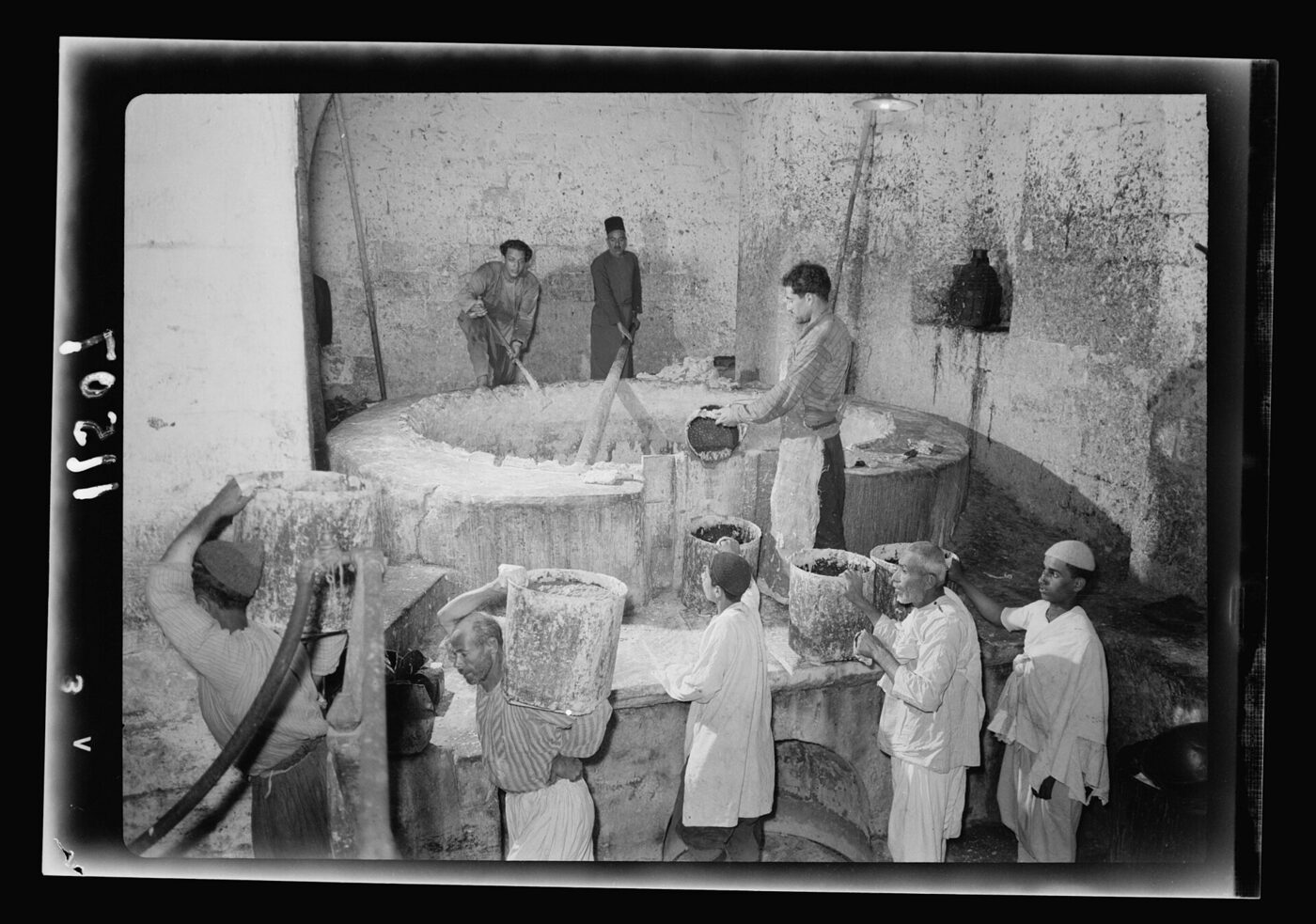
Where the olive harvest ends, a manufacturing history begins, and it is one of the better-documented craft industries of the eastern Mediterranean. Nabulsi soap is an olive-oil hard soap made in Nablus, ivory-coloured and almost scentless. Its alkali came from the ashes of the barilla plant, qilw, which grows along the Jordan, mixed with local lime; the trade in barilla ash was a standing item of business between the town and the Bedouin, who alone could supply it. The process is a matter of record: oil, water and alkali heated in copper vats over fermentation pits, the solution concentrated over forty cycles across eight days, stirred continuously with an oar-shaped wooden tool called a dukshab, then poured into wooden frames, cut into cubes, stamped with the maker's seal and stacked in hollow ceiling-high cones to dry for anything from three months to a year.
By the fourteenth century this was a significant industry; by 1907 the city's thirty factories were producing close to 5,000 tons a year, more than half of all soap made in Palestine. The trade declined through the twentieth century — the 1927 earthquake destroyed much of the old city, and later disruptions did the rest — and by the mid-2000s the chamber of commerce was reporting soap at 41.5 per cent of the city's exports in 2005 and 36.2 per cent in 2006, with the number of working factories falling from about thirty in late 2004 to roughly twenty a year later against twenty-five still formally registered, many of those reported as having stopped or cut production. A separate account gives two factories still working in the old city of Nablus by 2008.
_improvements_in_Nablus._The_Soap_Factory._The_boiling_pot_liquid_soap_being_carried_to_stock_room_LOC_matpc.20375.jpg)
The kitchen around it is Levantine and locally inflected. Maqluba, the upside-down casserole of rice, fried aubergine and meat, is known across the Levant and dated in one culinary history to the thirteenth century. Kanafeh is associated with Nablus and made with the city's own white brined cheese. Mansaf, lamb with rice under a sauce of dried yoghurt, jameed, belongs to the central West Bank and the Naqab and has its roots among the Bedouin of Jordan — an account that soc.culture.jordan owns and that is only noted here. Gaza's cooking is separately distinctive, with a heavy fishing component and a taste for chilli: sumaghiyyeh of ground sumac, tahina, chard and beef; rummaniyya of unripe pomegranate seeds, aubergine and lentils; zibdieh, shrimp baked in a clay pot; the crushed-tomato salad dagga, made in a clay bowl. Bread runs from everyday khubz to the near-transparent markook. Foraging remains ordinary practice, with mallow, gundelia, sage and purslane among the plants gathered, cooked in oil or folded into pies. And a shift in the staple grain is recorded across the twentieth century: dishes once made with bulgur or freekeh — the roasted green wheat — were adapted to rice.
Songs with no fixed words
The musical forms of the villages have a feature that suits a text medium badly and a live gathering perfectly: many of them have a fixed rhythm and metre but no fixed lyrics. The singer is usually a family member or a close friend, and the words are made on the spot, which is why the same song differs from town to town.
- Ataaba and mejana — the most widespread form, sung by farmers, workers and shepherds as a work song but at home above all at weddings. The ataaba is built on four lines of verse, the first three ending in words that sound alike but mean different things, the fourth closing on a set sound.
- Dal'ona — the other great popular form, and the one most often carried by the dance.
- Sahja — a wedding form in which the men stand in two facing lines or surround the groom while a lead singer improvises a verse and the whole group answers it; the women's version follows the same pattern with several older women leading.
- Zaghareet — one of the oldest recorded forms, sung by women at weddings and important occasions, one woman opening with a short rhymed passage before the others join on a long ululation.
- Dabke — the line dance of the Levant generally, and the fixture of wedding celebration; a leader, the lawweeh, heads the line, sets the step and breaks away from it to dance alone when the singers finish.
The travelling singers and storytellers who carried the epic repertoire were the zajaleen, and the term for the lead improviser at a wedding, zajal, comes from the same root. The wedding repertoire is itself a system: henna songs for the henna evening, processionals for the entrance, dance songs for the rest.
Institutions followed. The East Jerusalem group Sabreen was founded in 1980 to develop a modern Palestinian song. The National Conservatory of Music was established in 1993, its first branch opening in Ramallah in October of that year — the same month the Call for Votes for this newsgroup went out, which is a coincidence and is recorded here only as one; it later took the name of the critic and scholar Edward Said and now runs branches in Ramallah, Jerusalem, Bethlehem, Nablus and Gaza City.
Poetry, prose and the hikaye
The literary record is dense, dated and, for a page with this page's constraints, unusually easy to handle: the principal figures of the twentieth century are all dead, their works are published with dates, and their names can therefore be given.
Ibrahim Tuqan (1905–1941) wrote in the Mandate period; his sister Fadwa Tuqan (1917–2003), whom he tutored, published from the 1940s onward and has sometimes been called the poet of Palestine. Palestinian literature as a distinct body of writing is usually dated from after 1948, and Ghassan Kanafani (1936–1972) both wrote it and named it: he was the first to apply the term resistance literature to Palestinian writing, in two studies whose own titles date the periods they survey to 1948–1966 and 1948–1968. His novels include Men in the Sun (1963 in his published bibliography, 1962 in some accounts), All That's Left to You (1966, which took the Lebanese literary prize that year), Umm Sa'ad (1969) and Returning to Haifa (1970). Emile Habibi (1922–1996), a novelist who sat in the Knesset for two communist parties, published his satirical epistolary novel The Secret Life of Saeed, the Ill-Fated Pessoptimist in 1974. Jabra Ibrahim Jabra (1919–1994), born in Adana, brought to Bethlehem as a child and schooled there and in Jerusalem, wrote and translated in both Arabic and English. Mahmoud Darwish (1941–2008) edited the literary review al-Karmel and wrote the text of the Declaration of Independence issued on 15 November 1988.
Underneath the printed literature sits an oral one, and it is the tradition UNESCO recognised first. The Palestinian hikaye was inscribed on the Representative List in 2008 — the first element from Palestine to be inscribed, thirteen years before the embroidery. It is a narrative form performed by women, at home and on winter evenings, for small groups of women and children; the citation records that men rarely attend, as this is considered inappropriate, and that the tradition is carried chiefly by elderly women, almost every Palestinian woman over the age of seventy being a teller of it. Its defining features are recorded as the use of the Palestinian dialect rather than standard Arabic, and the storyteller's command of rhythm, emphasis and vocal inflection. It is, in other words, a tradition defined by everything a written medium removes — which is a fair summary of what any diaspora newsgroup could and could not carry.
The institutions that did the preserving
The base description of this page mentions village names, and there is a specific reason the phrase recurs in accounts of Palestinian cultural work. The standard reference is All That Remains: The Palestinian Villages Occupied and Depopulated by Israel in 1948, edited by the historian Walid Khalidi (1925–2026) with a team of researchers and published by the Institute for Palestine Studies in 1992, in Arabic in 1997. It describes 418 villages, one entry at a time, with location, history and what stood on the site at the time of writing. It appeared one year before this newsgroup was created, and it is the sort of book a group of this kind existed partly to point people at.
The institute that published it was incorporated in Beirut in December 1963 as an independent research and publishing centre, and is the oldest independent non-profit research institute in the Arab world; it also holds photographic archives of the pre-1948 period, including the work of the Jerusalem studio photographer whose 1930 olive-harvest picture appears above. Other bodies belong to different eras. Birzeit University began as a girls' elementary school in 1924 and became a university in 1975. The Palestinian Central Bureau of Statistics dates from 1993, the same year as the newsgroup, and is the source of most of the population figures on this page. The Khalil Sakakini Cultural Center opened in Ramallah in May 1996 as a branch of the Ministry of Culture and was registered as an independent non-governmental organisation in 1998, taking its name from a Jerusalem teacher and writer of the Mandate generation. The Palestinian Museum at Birzeit was inaugurated on 18 May 2016, twelve years after the last of the years this directory covers.
Two observations follow, and both are about dates rather than merits. First, most of the institutional apparatus of Palestinian cultural preservation with a public web presence today was founded either long before the group existed or well after it ended; the group ran through a gap. Second, the international recognitions — the hikaye in 2008, the embroidery in 2021, Battir in 2014 — all post-date it. A reader coming to this subject from the present will find a body of formally recognised heritage that simply did not have that status while soc.culture.palestine was busy.
The dated record
The group's charter refers to an administration then emerging, and its rationale to an agreement then a fortnight old. Neither makes sense without the sequence they sit in. What follows is that sequence as instruments and events, each given in the terms of the document that produced it, with the body that produced it named. No adjective in this list is doing any work, and no item in it is a judgement.
- Mandate for Palestine — approved by the Council of the League of Nations on 24 July 1922; in force from 29 September 1923 until 15 May 1948.
- UN General Assembly Resolution 181 (II), 29 November 1947 — adopted the plan drafted by the UN Special Committee on Palestine on 3 September 1947, recommending partition into an Arab and a Jewish state, economically linked, with a special international regime for Jerusalem.
- 1948, and the counts of displacement — the United Nations Conciliation Commission for Palestine estimated in September 1949 that 711,000 Palestinian refugees were outside Israel. UNRWA's final 1949 estimate was 726,000, against 914,000 then registered with it; the Conciliation Commission attributed the gap to duplicated ration cards, the inclusion of people displaced from other areas, and the inclusion of the destitute who had not been displaced. Scholarly accounts published since give figures from about 700,000 to about 750,000 or more. The figures differ because the definitions differ, and this page gives them as their authors gave them.
- UN General Assembly Resolution 194 (III), 11 December 1948 — paragraph 11 resolves that refugees wishing to return to their homes and live at peace with their neighbours should be permitted to do so at the earliest practicable date, and that compensation should be paid for the property of those choosing not to return and for loss or damage.
- UN General Assembly Resolution 302 (IV), 8 December 1949 — established the United Nations Relief and Works Agency for Palestine Refugees in the Near East, which began operations in 1950.
- Palestine Liberation Organization founded, 1964.
- 1967, and its counts — the displacement from the West Bank and Gaza Strip during and after the June war is generally given as between 280,000 and 325,000 people.
- UN Security Council Resolution 242, 22 November 1967 — adopted unanimously at the Council's 1,382nd meeting.
- UN General Assembly Resolutions 3236 (XXIX) and 3237 (XXIX), 22 November 1974 — the first on the rights of the Palestinian people and the addition of the question of Palestine to the Assembly's agenda; the second granting observer status to the Palestine Liberation Organization.
- First intifada, 9 December 1987 to 13 September 1993 — the dates given in the standard reference accounts; it ended on the day the Declaration of Principles was signed, the day before the first Request for Discussion for this group was posted.
- Declaration of Independence, 15 November 1988 — proclaimed by the Palestine National Council in Algiers; its text was written by Mahmoud Darwish.
- Madrid Conference, 30 October to 1 November 1991 — hosted by Spain, co-sponsored by the United States and the Soviet Union; Palestinians from the West Bank and Gaza attended within a joint Jordanian-Palestinian delegation.
- Declaration of Principles on Interim Self-Government Arrangements, 13 September 1993 — signed in Washington after negotiations completed in Oslo on 20 August; known as Oslo I. Article V set a five-year interim period and listed the permanent status issues quoted earlier on this page.
- Agreement on the Gaza Strip and the Jericho Area, 4 May 1994 — signed in Cairo; the Palestinian Authority was established under it.
- Interim Agreement on the West Bank and the Gaza Strip, 28 September 1995 — first signed at Taba in Egypt on 24 September and formally signed in Washington four days later; known as Oslo II; divided the West Bank into Areas A, B and C with different arrangements for civil and security authority in each.
- Protocol Concerning the Redeployment in Hebron, 17 January 1997 — dividing the city into the zones designated H-1 and H-2.
- Wye River Memorandum, 23 October 1998 — signed at the White House; a redeployment in three stages and a date for concluding permanent status talks.
- Sharm el-Sheikh Memorandum, 4 September 1999 — a timetable for outstanding commitments and for resuming those talks.
- Camp David summit, 11 to 25 July 2000 — ended without an agreement.
- Second intifada, 28 September 2000 to 8 February 2005 — the dates given in the standard reference accounts; the whole of the news2mail gateway's run falls inside them.
- UN General Assembly Resolution 67/19, 29 November 2012 — accorded Palestine non-member observer State status in the General Assembly; adopted at the 44th plenary meeting by 138 votes to 9, with 41 abstentions and 5 members absent.
Eight of those items fall inside the group's own lifetime, several within months of one another. The practical consequence for a reader of the archives, wherever they survive, is that a discussion could be overtaken between one week's posts and the next, and that a thread's date is often the most informative thing about it.
A forged rmgroup, November 2001
Several soc.culture.* groups on contested subjects attracted forged control messages, and this one has exactly one incident on its record. The control archive for soc.culture.palestine holds three messages in total: the newgroup of 17 November 1993, the identical reissue of 19 August 1994, and a single rmgroup dated 4 November 2001 at 00:40 GMT.
The rmgroup was crossposted to soc.culture.palestine, soc.config, soc.control and soc.groups. Its entire body reads: please remove the bogus newsgroup soc.culture.palestine, followed by a signature consisting of a single nonsensical sentence. Its From and Approved headers carry the name and address of the maintainer of a well-known Unix newsreader, who did not send it; its Message-ID reuses an identifier belonging to a German university host, while the injection path and the posting host recorded in its own headers are those of a Canadian consumer service provider. Every one of those inconsistencies is visible in the message as archived.
It achieved nothing, and the reason it achieved nothing is worth setting out because it is the whole practical meaning of the Big-Eight namespace. The control.ctl file distributed with the standard news server software, and mirrored on the same archive that holds the message, tells administrators what to do with control messages for the Big-Eight hierarchies. For soc.* it carries two instructions: a newgroup or rmgroup from any sender is to be dropped, full stop; and only a message from the Big-Eight administrative address, cryptographically verified against the signing key for news.announce.newgroups, is to be acted on. A forged rmgroup arriving unsigned from a stranger therefore had no path to a server's configuration at all.
The evidence that it failed is in the current files. The group is still listed in the newsgroups file with its 1993 description, and still carried in the active file. Other groups in the neighbourhood received forged control traffic in the same period; soc.culture.jewish tells the story of its own, which is a different story and is not repeated here.
What the record does not show
This page has been able to be precise about paperwork, dates and institutions because those things were written down and preserved. The following were looked for and are not here, and the distinction matters more on this page than on most.
- No message archive is preserved on this site. Not one article, thread title, subject line or quotation from soc.culture.palestine is reproduced here, and none is invented. Nothing on this page should be read as a description of what any individual said in the group.
- No traffic figures exist. There is no article count, no subscriber estimate, no posts-per-day figure for this group in any source consulted, and the numbers that circulate for Usenet groups of this era are generally derived from partial feeds. None is offered.
- No FAQ or periodic posting was found. Many soc.culture.* groups maintained a Frequently Asked Questions document, posted monthly and archived alongside the group's proposals. The news.announce.newgroups archive for this group contains its proposals and nothing else, and no charter revision, moderation proposal, reorganisation attempt or moderator vacancy notice appears anywhere in the record.
- The ballot roll is not a readership. The 303 valid votes of November 1993 are a sample of people who both had network access and heard about the vote in a three-week window. They are evidence about the 1993 network. They are not evidence about the group's later readers, and they are not evidence about anybody's opinions beyond the single question on the ballot.
- The names in the roll are not used here. The votetaker published them for auditing, and they remain public on a public archive; this page has counted them by domain and named none of them.
- Nothing is known here about the group's end. No removal was ever carried out, so there is no closing document. The group remains listed. When it stopped being busy, and whether it stopped, are not recorded in any source consulted.
What can be said is what the record does show: that a group was proposed the day after a treaty was signed, renamed ten days later, chartered in a form that named the condition of a population as one of its subjects, voted through by 211 to 90 by an electorate almost entirely composed of universities and large employers on two continents, created on 17 November 1993, attacked once by a forgery in 2001 that the namespace's own machinery ignored, and never removed.
Scope, sources and limits
This page describes a newsgroup. It is not a history of the conflict its charter names, not an argument about that conflict, and not a judgement on any party to it.
- It endorses and refutes no position. Where a characterisation appears, it is attributed to whoever made it, and the attribution is part of the claim rather than decoration on it.
- It makes no determination about status, territory, sovereignty or responsibility, and it takes no view on any question the instruments listed above left open. Where those instruments are quoted, they are quoted because a newsgroup's charter and its readers' argument both refer to them, not because this page is adopting them.
- No living person is named. The proposer, the votetaker, the moderator who issued the control message, the applicants for the domain, the officials who wrote to IANA, the person whose identity the 2001 forgery borrowed, and every voter on the published roll are described by role and institution only. The writers named in the literary section are named because they are dead and their works are dated; that is the whole of the test applied.
- Figures are given as ranges where their sources give ranges, and each is attributed to the body or study that produced it. Where two bodies count differently — as UNRWA and the Conciliation Commission did in 1949, or as the Lebanese census and the UNRWA register do now — both counts are given rather than one being chosen.
- Spellings follow the sources cited, including for place names that have more than one name as well as more than one romanisation. No form is adopted as this page's own, and no inference should be drawn from any of them.
- Where sources disagree, both readings are given. Two instances stand on this page: the year of one novel, and the recorded number of Palestinians in Lebanon, where a national census and an agency register count different things.
- The documentary sources are the news.announce.newgroups and control archives mirrored by the Internet Systems Consortium, which supply the RFDs, the Calls for Votes, the RESULT, the control messages and the newsgroups, active and control.ctl files quoted above; IANA's root database and its published delegation report of 2000 for the domain record; the World Bank's ITU-derived series for connectivity; and the published statistical, museum and heritage records cited in place for everything else.
Where this page is uncertain it says so, and where the record stops it stops. That is a smaller claim than the subject usually attracts, and it is the only one a directory of newsgroups is in a position to make.
Reading soc.culture.palestine today
- Historical archive: Google Groups — soc.culture.palestine (coverage varies by group and era).
- Open in a newsreader:
news:soc.culture.palestine— the original site offered exactly this link, and it still works if your system has a newsreader registered for thenews:scheme. - Live access: point an NNTP newsreader at a modern server — see accessing Usenet today.
- The original news2mail e-mail subscription service ended in the mid-2000s and no longer operates.