soc.culture.peru
Peru: politics and patrimony.
The Fujimori decade argued in real time — autogolpe, Sendero’s defeat, the corruption videos — by Peruvians home and abroad, between food threads that treated ceviche as constitutional matter.
The group’s archaeology arguments (whose Machu Picchu?) never resolved and never ended.
On this page
- The proposal, and the paperwork it left
- The charter, quoted
- A ballot in two languages
- A seven-bit network and a language with accents
- The mailing list, and the friends at rcp.pe
- Who could post: .pe, the RCP and the cabinas
- Where the readership actually was
- Deep time: the sequence archaeology gives
- Conquest, viceroyalty and the demographic record
- 1968 to 1980: the military decade
- 1980 to 2000: the internal conflict
- What the commission found
- The 1990s, in sequence
- The prosecutions, and their outcomes
- Language: three official tongues, and forty-eight
- Machu Picchu, and the paperwork of a discovery
- The Nazca lines, and what is claimed about them
- The quipu: what is settled and what is not
- The museums and what they hold
- Food, and the argument about who owns it
- Music: the huayno and the criollo tradition
- Football, and two disasters
- Costa, sierra, selva
- What was argued in the group
- Its neighbours in the hierarchy
- What the record does not show
- Scope and limits
The proposal, and the paperwork it left
Unlike most of the groups in this directory, soc.culture.peru has a complete administrative file. The news.announce.newgroups archive mirrored by the Internet Systems Consortium holds four postings for it — the Request For Discussion, the Call For Votes, a second CFV carrying an acknowledgement of the votes received so far, and the RESULT. The separate control archive holds three messages: the newgroup message that created the group, an identical reissue a year later, and one unsigned removal request sent in 2001. For a Big-Eight proposal of 1993 that is the ordinary outcome and still an unusual luxury: dates, names, procedure and the charter’s own wording all survive, which means almost everything said below about the group’s founding can be checked rather than inferred.
The RFD is dated 10 May 1993. It was written by Walter A. Manrique, then at NYNEX Science & Technology in White Plains, New York, and posted to news.announce.newgroups, news.groups and soc.culture.latin-america — the last of these being the regional group the new one would be carved out of. Like every such posting of the period it was approved by [email protected], David C. Lawrence, who moderated news.announce.newgroups from UUNET. The proposal was terse about its own mechanics: the name would be soc.culture.peru, it would not be moderated, discussion would happen in news.groups, and anyone without Usenet access could send follow-ups to a mailing list address for forwarding. The proposer wanted to close discussion by the end of May and put the question to a vote some time in June; the charter attached to the RFD named 4 June for the Call For Votes.
He was a week late. The Call For Votes went out on 11 June 1993 and set a voting period running to 23:59 EDT on Thursday 8 July. The rules it printed were the standard Big-Eight ones and were printed in full: votes by electronic mail only, votes posted to Usenet not counted, no proxies, no voting on another’s behalf, no anonymous remailers, no mailing-list administrator collecting votes for the membership, one vote per person with the latest legal timestamp winning, and — a clause that mattered more than it looks — You are voting for the whole proposal as written. Votes such as “I would vote YES if you change this ...” will be disqualified. A second CFV, with a running list of everyone whose vote had arrived by 18 June, followed on 21 June.
The RESULT was posted on 12 July 1993, the day the CFV had promised it; because the posting went out at 20:33 Eastern time, the control message that followed dated it 13 July. Its subject line is the sentence this directory has quoted for years:
RESULT: soc.culture.peru passes 142:21
Beneath the subject line stood a single line of tally: 142 YES, 21 NO, a margin of 121, 87.12 per cent in favour, and the word Pass. The Big-Eight bar of the period, as recited in RESULT postings of these years, was that YES votes must be at least two-thirds of all valid votes and that there must be at least a hundred more YES than NO. A margin of 121 and a ratio close to seven to one cleared both without argument. The acknowledgement printed beneath the tally lists every voter by date, name where given and address; counted by hand, it contains exactly 142 entries in favour and 21 against, which is a small piece of evidence that the arithmetic was done properly. The votetaker closed with a line that reads oddly today and was routine then: The verification of votes and their classification were done by hand please excuse any problems that may have been introduced.
The newgroup control message went out a week later, over Lawrence’s signature at UUNET, timed 12:00:37 GMT on Monday 19 July 1993. It recites the tally, reproduces the charter, and supplies the single line that every news server would file away:
soc.culture.peru All about the people of Peru.
That sentence — six words, one full stop — is the description that propagated into newsgroups files worldwide, into the published group lists of the 1990s, and from there into this directory. It is still the line carried in current newsgroups files, and it is the group’s only official self-description.
Two more control messages sit in the same file. On 19 August 1994 Lawrence reissued the newgroup message word for word, which was the ordinary way of repairing servers that had missed the first one. Then, at 00:40 GMT on 4 November 2001, an rmgroup message arrived from an address that had nothing to do with the group’s creation, carrying a single line of justification: please remove the bogus newsgroup soc.culture.peru. It was not an isolated act. The same message, with only the group name changed, reached soc.culture.bolivia at 00:29 and soc.culture.ecuador at 00:31 that morning. None of the three groups was removed; all three are still listed.
The charter, quoted
The charter reproduced in the CFV, and again in the control message, is longer than the one-line listing and worth having at length, because it is the only statement of intent the group ever formally adopted:
A common meeting place for the discussion of issues and events that concern the peruvian people. It is a place for peruvians and friends to meet and chat. The purpose of this group is to provide a source of information for anyone that is interested in Peru, its history, its people and its culture. A mailing list will also be provided for those unable to access Usenet directly. […] Everyone is welcome to participate.
Two further clauses were attached. The first was about conduct, and shows a proposer who had read enough of soc.culture.* to know what he was signing up for: Because soc.culture.peru is not moderated anyone is able to post to the newsgroup. However, nettiquette is required. Please do not post unnecessary flames. Articles should contain constructive material. The spelling is the original’s. Unmoderated groups had no mechanism whatever to enforce such a clause; it was a statement of hope, and it is present in a great many charters of the period for exactly that reason.
The second clause was about language, and it is the more interesting of the two:
Languages: Primarily Spanish, English and Quechua. But all other languages will also be accepted.
Naming Quechua in a 1993 Usenet charter was not a common act. It was also, in the strictest technical sense, an aspiration rather than a plan: as the next-but-one section explains, the transport the group ran on could not carry the alphabet in which either Quechua or Spanish is properly written.
A ballot in two languages
The second Call For Votes, on 21 June 1993, was issued in English and Spanish. The Spanish half is not a summary but a full parallel text — the voting period, the rules, the instructions, and a complete translated charter headed Constitucion Propuesta para soc.culture.peru, with the clauses renamed Nombre, Moderacion, Constitucion, Reglas, Idiomas, Hitoria and RFD. Bilingual CFVs existed elsewhere in soc.culture.*, but they were the exception; most national groups were proposed, argued and voted on entirely in English, by people who had reached Usenet through an English-speaking university.
The Spanish text also carries, without comment, the whole of the era’s technical compromise. Not one byte in the archived file — English half, Spanish half, charter, rules and the entire roll of voters — lies outside the seven-bit US-ASCII range. There are no acute accents anywhere. The language clause reads Idiomas: Primeramente Espaniol, Ingles y Quechua — Espaniol, with ni standing in for the letter eñe, because the letter itself could not be transmitted. The word for welcome is spelled bienbenidos, the word for because Bebido, and the heading for the background section Hitoria. Some of that is haste. The absent accents are not haste; they are the medium.
A seven-bit network and a language with accents
The rule was written down. RFC 1036, Standard for USENET Messages, published in December 1987 by Mark Horton and Rick Adams, settled the question by deferring to electronic mail: all Usenet news messages, it says, must be formatted as valid Internet mail messages according to RFC 822, and the Usenet standard is more restrictive than the Internet one, not less. RFC 822 in turn defines a message body as a sequence of lines containing ASCII characters, and defines its character repertoire as the values 0 to 127. Everything above 127 — which is to say á, é, í, ó, ú, ñ, ü, ¿ and ¡ — had no sanctioned representation at all.
Spanish is not a language that tolerates this gracefully. The accents are not decoration: they carry stress, and in a handful of cases they carry meaning. Quechua is worse served still. The orthography adopted for it by the Peruvian government in 1975, the one preferred by the Academia Mayor de la Lengua Quechua, has eñe among its core letters; a charter that formally welcomed Quechua was welcoming it to a network that could not spell it.
The workarounds were folk solutions and everybody used them. Accents were simply dropped. The eñe became n, or ni, or ~n, or nn — the group’s own voters’ roll contains a name rendered Sanchez-Pe~a. Where a poster’s software emitted eight-bit ISO 8859-1, a proportion of the readers on the other side saw mojibake instead, which produced its own recurring genre of thread. The standards did catch up, slowly: MIME arrived as RFC 1341 in June 1992 and was restated as RFC 2045 in November 1996, giving mail and news a documented way to declare a character set, but adoption across newsreaders and transports took years and was never uniform. Netnews did not get a standards-track article format with Unicode properly in it until RFC 5536 in November 2009, which finally obsoleted RFC 1036 — by which time the traffic this directory covers had largely moved elsewhere. The practical consequence for a reader today is worth stating plainly: much of what survives of Spanish-language Usenet is unaccented, and that is a property of the wire, not of the writers.
The mailing list, and the friends at rcp.pe
The group did not begin from nothing. Its RFD and charter both rest on an existing mailing list, [email protected], run out of San Francisco State University, which the charter describes as having over 400 subscribers. The stated reason for wanting a newsgroup at all is a piece of 1993 network economics: Based on the volume of messages that appear on the peruvian mailing list, it will be an improvement to move towards the creation of a usenet news group. Usenet news groups work on an on-demand basis as opposed to mailing lists which work on an unsolicited basis. A list pushed every message into every subscriber’s mailbox and every subscriber’s disc quota; a newsgroup sat on the server until somebody asked for it.
The proposal was careful to promise that nobody would be cut off. A gateway would run between list and group, existing subscribers would be unaffected, and the connection would be, in the charter’s word, transparent; would-be subscribers were pointed at [email protected]. Then comes the sentence that dates the whole document more precisely than its header does:
Note that usenet news groups also provide feeds to mailing lists. This is convenient for our friends at rcp.pe since they don’t have access to usenet yet - as far as I am told.
The domain rcp.pe is the Red Científica Peruana. In May 1993 it existed, it had a name in the domain system, and — on the proposer’s information, hedged as such — it could not read Usenet. That single clause is among the most useful things in the file, because it fixes the group’s founding relationship to Peru itself: the newsgroup was created abroad, for readers who were mostly abroad, with a mail bridge held open for the people at home who could not yet reach it directly.
Who could post: .pe, the RCP and the cabinas
The delegation record held by IANA gives the .pe country-code domain a registration date of 25 November 1991 and names its manager as the Red Científica Peruana, at an address in the Surquillo district of Lima. Among the nameservers listed against the domain to this day is one called quipu.rcp.net.pe; the article returns to the quipu below.
Peru was first connected to the internet in 1991, through a node on the campus of the Universidad ESAN in Lima. The RCP, founded by José Soriano and constituted as an association of civil and university organisations, was the country’s first service provider as well as the registrant of the domain. In 1994 it opened what is generally recorded as the country’s first public internet room, at the Centro Cultural Ricardo Palma in Lima: forty machines, twenty of them PCs and twenty of them Macintoshes, with a free introductory talk in an adjoining classroom and then fifteen or twenty minutes at a keyboard for anyone who wanted them. In 1995 the RCP obtained a satellite link to servers in the United States, which is when the World Wide Web and real-time chat became usable from Peru rather than merely describable.
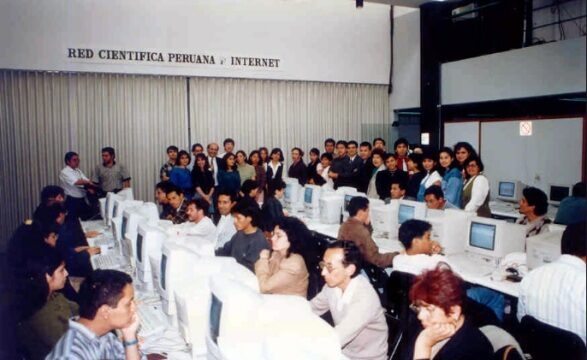

What followed was the cabina pública, and it changed the arithmetic of who could post. Hundreds of commercial cabinas opened nationally from about 2000, a year in which, by the figure usually quoted, only 180,000 Peruvian families owned a computer at all; by 2002 some 1,740,000 people were using the internet at least once a month; and the 2007 national household survey conducted by the Instituto Nacional de Estadística e Informática counted around 40,000 cybercafes across the country. Writing from Peru itself had stopped being a privilege of a university department or a foreign employer and become a matter of an hour bought over a counter, in a room with a queue.
The timing matters for reading the archive. The group was created in 1993, when almost nobody could post to it from inside the country; by the end of the decade a great many people could, at a price, in a shared room, on a shared machine. Anyone treating surviving threads as a sample of Peruvian opinion has to hold both facts at once.
Where the readership actually was
The vote acknowledgement is the only hard census of this group’s constituency that exists, and it is emphatic. Of the 142 addresses recorded in favour, 82 end in .edu. Another 18 end in .com and three in .net. The remaining 39 sit on university, research and company hosts in Canada, Switzerland and the United Kingdom — six apiece — in Japan and Spain, three apiece, in France, Germany and Australia, two apiece, and one each in Austria, Sweden, Portugal, Mexico, Brazil and Venezuela, with a .gov address, a BITNET address and a .us address making up the rest. Not one address in either list — in favour or against — ends in .pe. The only appearance of a Peruvian domain anywhere in the file is the RFD’s aside about friends who did not yet have access.
That is a portrait of a diaspora with institutional accounts, which is what soc.culture.* largely consisted of in 1993, and it maps onto a real emigration. Peru’s official register of international migration counts about 3.5 million departures between 1994 and 2024, and more than a tenth of Peruvians now live outside the country; the destinations, over that period, run the United States, Spain, Argentina, Chile, Italy, Japan and Canada in that order. Japan holds a smaller but distinctive population — of the order of 60,000 Peruvian residents in the mid-2010s — largely made up of descendants of the Japanese migration to Peru that began with the arrival of the Sakura Maru at Callao in 1899, going in the other direction under visa arrangements for people of Japanese descent that drew large numbers from about 1990. Those are recent counts and are given as such; comparable figures for the mid-1990s were not verified for this page.
Part of that emigration was shaped by the violence the group spent its first decade arguing about, which produced the particular texture of a soc.culture.* group in wartime: people writing about a country they had left, to people who had left it for different reasons, about events that some of them had been present for and others had only read about.
Deep time: the sequence archaeology gives
Peru is one of the small number of places where civilisation is held to have originated independently rather than by transmission, and the group’s standing archaeology arguments were arguments about a genuinely long record. The dates below are the ones the discipline currently gives; several of them moved during the years this directory covers, and one of them moved a great deal.
The earliest layer is the Caral–Supe complex on the north-central coast, sometimes called Norte Chico: as many as thirty major population centres, with the first city generally dated to around 3500 BCE at Huaricanga in the Fortaleza area, large-scale settlement and communal construction clearly apparent from about 3100 BCE, and a decline around 1800 BCE. It is recognised as the oldest known civilisation in the New World and as one of the six places worldwide where civilisation arose separately. Caral itself, 182 kilometres north of Lima and 23 kilometres from the coast, was inscribed as a UNESCO World Heritage Site in 2009 — after the period this directory covers, which is why the group’s own threads on the subject predate the official recognition.
Then, in order: the Chavín culture of the northern highlands, from roughly 900 to 250 BCE, the defining culture of what Peruvian periodisation calls the Early Horizon, whose type site of Chavín de Huántar in Ancash contains construction from as early as 1200 BCE and was inscribed by UNESCO in 1985. The Moche of the north coast, roughly 100 to 800 CE, who left the portrait ceramics and the metalwork that fill Peru’s museums. The Nazca of the southern coast, roughly 100 BCE to 800 CE, strongly influenced by the Paracas culture before them. The Wari empire, which emerged around 600 CE in the Ayacucho basin and lasted some five centuries, to about 1100. The Chimú kingdom, whose adobe capital Chan Chan near Trujillo was the largest city of the pre-Columbian era in South America and was inscribed by UNESCO in 1986, and placed on the list of World Heritage in danger in the same year.
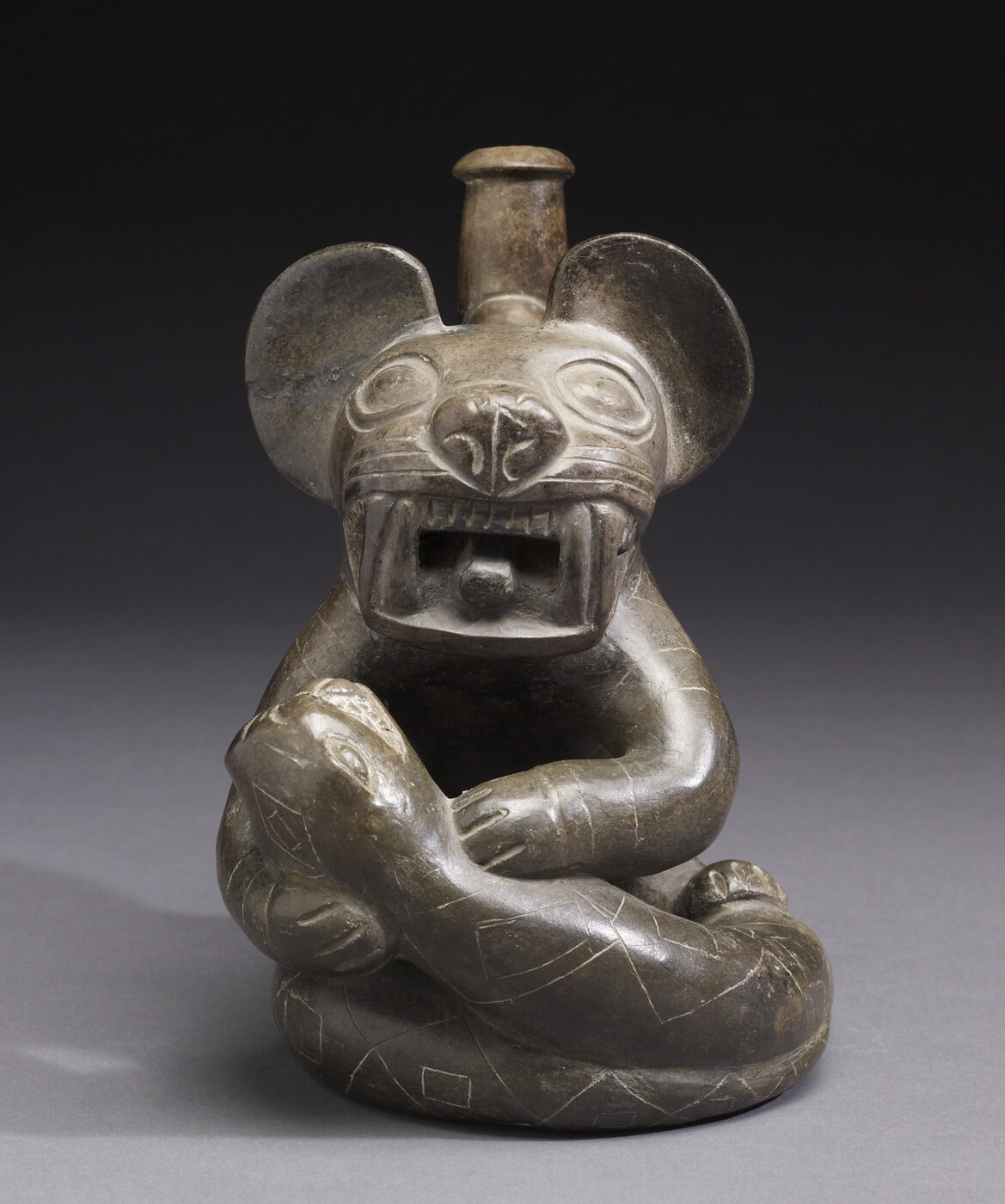

The Inca state is the last and the shortest. It rose from the Peruvian highlands some time in the early thirteenth century and expanded most rapidly under Pachacuti, whose reign is conventionally dated from 1438, reaching from southern Colombia to northern Chile between the Pacific and the Amazon before the Spanish arrived. Its administrative language was Quechua, and its capital was Cusco. Almost every argument the group had about heritage was, at bottom, an argument about which of these layers a modern Peruvian was supposed to claim.
Conquest, viceroyalty and the demographic record
The conquest is dated with unusual precision because its participants wrote it down. Francisco Pizarro, with 168 Spanish soldiers and indigenous auxiliaries drawn from peoples the Inca had themselves conquered, seized the Sapa Inca Atahualpa at Cajamarca on 16 November 1532, in the middle of a dynastic civil war between Atahualpa and his half-brother Huáscar. That was the first step of a campaign that took four decades: the last Inca state, at Vilcabamba, was not extinguished until 1572. What followed was the Viceroyalty of Peru, administered from Lima, and the silver economy that made it the wealthiest possession in Spanish America.
The demographic figures are estimates and are given as such. The indigenous population of what is now Peru is estimated to have fallen from somewhere between five and nine million in the 1520s to around 600,000 by 1620, overwhelmingly through epidemic disease introduced from Europe, compounded by forced labour and social dislocation. Spaniards and enslaved Africans arrived in numbers from 1532 onward. Chinese and Japanese migration followed at the end of the nineteenth century, and both left permanent marks — on the language, on the surnames, and, as the food section notes, on the cooking.
Independence took the better part of two decades and was largely won by armies from elsewhere. Peru was proclaimed independent on 28 July 1821, under José de San Martín; the Battle of Ayacucho on 9 December 1824, commanded by Antonio José de Sucre, secured that independence and ended Spanish rule on the continent. The last major royalist stronghold, Callao, surrendered in 1826, and the last Gran Colombian garrison returned the Real Felipe fortress there to Peru on 16 February 1827. The date of the proclamation is why the national holiday falls on 28 July, and why Peruvian presidents are inaugurated on that day — a detail that matters below.
1968 to 1980: the military decade
On 3 October 1968 a group of officers led by General Juan Velasco Alvarado deposed President Fernando Belaúnde Terry in a bloodless coup and installed what called itself the Revolutionary Government of the Armed Forces. It was a left-nationalist military government rather than the conservative kind then common in South America, and it moved fast. Within a week of the coup the army seized the disputed oil fields of the International Petroleum Company at Talara, the North American concession whose contract had helped bring the government down. In 1969 it launched an agrarian reform which abolished the great estates and reorganised the land into cooperatives; in its first ten years the government expropriated some 15,000 properties totalling around nine million hectares and settled about 300,000 families on them, a programme usually described as the largest in Latin America after Cuba’s.
The same government produced the single most consequential language decision in Peruvian history. In 1975, by Decreto Ley 21156, it recognised Quechua as an official language of the Republic, on an equal footing with Spanish — the first country anywhere to do so. Bolivia followed in its constitution of 2009, and Ecuador confers official status on Kichwa in its own. The same year the Peruvian government adopted a new official orthography for Quechua, superseded in 1985 by a three-vowel variant and argued over ever since. What the 1975 recognition actually delivered in schools, courts and broadcasting was disputed at the time and has been disputed since; one account notes that the law was never enforced and lapsed with the constitution of 1979. The group inherited that argument intact.
At the end of August 1975 General Francisco Morales Bermúdez displaced Velasco and reversed most of the direction of travel. A constituent assembly was convened at the end of the decade, a new constitution followed in 1979, and in 1980 Peru held its first national elections in a dozen years and returned Belaúnde — the man deposed in 1968 — to the presidency. It is also the exact moment the next thing began.
1980 to 2000: the internal conflict
On the eve of the 1980 elections, in the village of Chuschi in Ayacucho, members of the Communist Party of Peru – Shining Path burned the ballot boxes. The organisation had been founded in 1969 by Abimael Guzmán Reinoso, a philosophy lecturer at the university in Huamanga, who took the nom de guerre Presidente Gonzalo; its doctrine was Maoist and its method was rural people’s war. A second and much smaller organisation, the Túpac Amaru Revolutionary Movement, was formed between 1980 and 1982 out of two existing left-wing groups and carried out its first armed action, a bank robbery in the La Victoria district of Lima, on 31 May 1982. The state answered with police and then with the army, and by the mid-1980s large parts of the sierra were under emergency rule.
The conflict ran, on the reckoning later adopted by the truth commission, from May 1980 to November 2000. It overlapped almost exactly with an economic collapse: under Alan García’s first presidency (1985–1990) inflation reached 7,649 per cent in 1990 and a cumulative 2,200,200 per cent between July 1985 and July 1990, the currency was replaced twice inside six years — the sol by the inti in mid-1985, the inti by the nuevo sol in July 1991 — and annual income per head fell to around 720 dollars, below its 1960 level, while GDP dropped by a fifth. The two crises fed each other, and the vocabulary used to describe either of them was itself contested. What to call the conflict, what to call its parties, and what to call its episodes were positions, not neutral labels — in the country and, in due course, in the newsgroup.
What the commission found
The Truth and Reconciliation Commission sat from 13 July 2001 to 28 August 2003. Its establishment was approved under the interim president Valentín Paniagua and ratified, and its membership enlarged, by Alejandro Toledo; it was chaired by Salomón Lerner Febres, philosopher and rector of the Pontificia Universidad Católica del Perú, and had twelve commissioners. Its mandate covered violations of human rights and international humanitarian law committed between May 1980 and November 2000. It gathered some 17,000 testimonies in 129 provinces and held 27 public hearings. Everything in this section is reported as the commission’s finding, because that is what it is.
The headline estimate was the one that startled the country. Before the commission reported, the working figure in public debate was around 24,000 dead. Using indirect capture–recapture methods on multiple casualty lists, the commission concluded that approximately 69,280 people had been killed or disappeared over the twenty years. On attribution it found the Shining Path responsible for 54 per cent of the deaths, agents of the state — military, police and other security forces — for 37 per cent, and the MRTA for about 1.5 per cent of deaths and 1.8 per cent of violations. It found that 83 per cent of the sexual violence against women and girls that it documented was attributable to state officials.
Its findings about who died are the ones that bear most directly on the arguments this group carried. The commission reported that 75 per cent of those who died spoke Quechua or another indigenous language as a first language, against a national figure it gave as 16 per cent; that rural areas, which held 29 per cent of the population, accounted for 79 per cent of the victims; that 45 per cent of reported deaths and disappearances came from Ayacucho alone; and that 85 per cent came from six departments — Ayacucho, Junín, Huánuco, Huancavelica, Apurímac and San Martín. The commission stated that the conflict had not been caused by ethnic conflict, and equally plainly that the distribution of its victims reflected what it called a veiled racism in Peruvian society.
For comparison, the 1993 national census — taken in the middle of the period, and the one a poster in 1994 would have had to hand — recorded mother tongues among Peruvians aged five and over as 80.27 per cent Spanish, 16.56 per cent Quechua, 2.29 per cent Aymara and 0.70 per cent other indigenous languages: rather under a fifth of the population speaking an indigenous language first, against three-quarters of the dead.
The report was contested from the day it appeared and remains so. Sections of Peruvian opinion have argued that it was biased against the armed forces; others that it was too generous to the state. The casualty estimate itself has been challenged in the academic literature — a 2019 reanalysis by Silvio Rendón put the total nearer 48,000 and attributed a significantly larger share to the state, and was answered in the same journal by Daniel Manrique-Vallier and Patrick Ball, two of the statisticians behind the original estimate, who defended the method; Rendón published a rejoinder in turn. The dispute is live, it is technical, and this page takes no view on it.
Two non-textual objects belong to the same moment. Yuyanapaq, whose Quechua title means to remember, is a photographic exhibition the commission itself commissioned, assembled from more than ninety archives ranging from family albums to the files of the armed forces and the police. El Ojo que Llora, in the Campo de Marte in Lima, was a private initiative by the artist Lika Mutal, completed in 2005, which inscribed on stones some 32,000 names taken from the commission’s list of victims. When it emerged that the list included 41 Shining Path prisoners killed in the 1992 Castro Castro prison raid — deaths the Inter-American Court of Human Rights ruled in November 2006 to have been violations — the memorial became the object of a bitter public argument about who counts as a victim, and it was vandalised in September 2007, the day after the former president arrived in Lima to stand trial.
One point of chronology governs how the surviving archive should be read. The report appeared in August 2003, near the end of the years this directory covers. Almost everything written in this newsgroup about the conflict was written before there was any agreed account of it.
The 1990s, in sequence
The decade the group was created to argue about can be laid out as dates, and it is worth doing so, because the sequence is what the arguments were about.
- 28 July 1990 — Alberto Fujimori, an agronomist who had been rector of the National Agrarian University and entered the race as an outsider, is sworn in as president after defeating Mario Vargas Llosa in the second round. The stabilisation programme that followed was known as the Fujishock.
- 3 November 1991 — the Barrios Altos massacre in central Lima: members of the Grupo Colina death squad, drawn from the armed forces, kill fifteen people including an eight-year-old child and wound four others at a neighbourhood barbecue held to raise money for repairs to the building. Judicial authorities later established that the victims were not terrorists.
- 5 April 1992 — the autogolpe. With the collaboration of the military, the president dissolves Congress and the judiciary, suspends the constitution, assumes legislative and judicial powers, and has prominent opposition politicians and journalists detained.
- 18 July 1992 — the La Cantuta massacre: nine students and a professor of the university of that name are abducted and killed by the same unit, two days after a Shining Path car bombing in the Tarata street in Miraflores.
- 12 September 1992 — Operation Victoria. A unit of the anti-terrorism directorate raids a house in the Surco district of Lima that had been operating as a ballet studio, having searched the rubbish for weeks and noticed that a household of one person produced too much of it, and discarded tubes of psoriasis cream besides. Guzmán and eight others are arrested on the second floor. He is tried within weeks by a military tribunal of judges whose identities were concealed, under Ley 25475 of May 1992, and sentenced to life imprisonment.
- 31 October and 29 December 1993 — a new constitution, drafted by a constituent congress elected after the self-coup, is approved by referendum in October and promulgated on 29 December; it takes effect at the end of the year.
- 26 January to 28 February 1995 — the Cenepa War with Ecuador, fought at the headwaters of the Cenepa river. It was followed by mediation from the guarantors of the 1942 Rio Protocol — Argentina, Brazil, Chile and the United States — the Brasilia Presidential Act of 26 October 1998, and formal demarcation of the border on 13 May 1999.
- 17 December 1996 — fourteen MRTA members blow a hole in a wall of the Japanese ambassador’s residence in San Isidro, Lima, during a reception for the Emperor’s birthday, and take more than six hundred guests hostage. Most are released within days.
- 22 April 1997 — after 126 days, a specially assembled commando unit of about 140 men, named for the archaeological site at Chavín de Huántar and its underground passages, storms the residence. Of the 72 hostages still held, one dies — a Supreme Court judge, Carlos Giusti Acuña — along with two soldiers and all fourteen MRTA members.
- 14 September 2000 — a cable channel broadcasts a recording of Vladimiro Montesinos, head of the National Intelligence Service, handing money to an opposition congressman, Alberto Kouri, to change sides. It is the first of the vladivideos; the government’s remaining support collapses within weeks.
- 13 to 22 November 2000 — the president leaves for an APEC meeting in Brunei on the 13th; Valentín Paniagua becomes president of Congress on the 16th after the pro-government leadership loses a confidence vote; the president travels on to Tokyo on the 17th and submits his resignation by fax. On 22 November Congress declines to accept the resignation and votes instead, 62 to 9, to remove him from office on the ground of permanent moral incapacity, barring him from office for ten years. Paniagua takes over as interim president and holds elections in April 2001.
The prosecutions, and their outcomes
The judicial sequel ran for a quarter of a century and is reported here as a record of court decisions, which is the only way it can be reported neutrally.
Japan declined to extradite the former president, recognising him as a Japanese citizen. On 6 November 2005 he arrived unexpectedly in Santiago de Chile and was detained within hours on a warrant issued at Peru’s request. The Supreme Court of Chile granted extradition on 21 September 2007, on seven of thirteen charges, and he was flown to Lima the following day. On 11 December 2007 a Peruvian court sentenced him to six years and a fine for abuse of authority in ordering a warrantless search of the apartment of Montesinos’s wife. On 7 April 2009, after a trial lasting fifteen months, a three-judge panel of Peru’s Supreme Court convicted him over the Barrios Altos and La Cantuta killings and the abductions of the journalist Gustavo Gorriti and the businessman Samuel Dyer, and sentenced him to twenty-five years. On 20 July 2009 he received seven and a half years for embezzlement after admitting the transfer of fifteen million dollars of state money to Montesinos, and on 30 September 2009 six years for bribery. Under Peruvian law the sentences run concurrently to a maximum of twenty-five years.
The sentence was then litigated for a further fifteen years. A presidential pardon was granted on health grounds on 24 December 2017; the Supreme Court reversed it on 3 October 2018 and ordered his return to prison, and the pardon was formally annulled in February 2019; the Constitutional Court reinstated it by four votes to three on 17 March 2022; the Inter-American Court of Human Rights ordered Peru not to release him on 8 April 2022; and the Constitutional Court ordered his release on 5 December 2023, which took effect the next day. He died on 11 September 2024.
The other principal figures followed their own paths through the courts. Guzmán’s 1992 military conviction was set aside when the tribunals that produced it were held unconstitutional; he was retried in a civilian court and sentenced to life imprisonment again on 13 October 2006, on charges of aggravated terrorism and murder, in a verdict that took more than six hours to read. He died on 11 September 2021, aged 86, in the maximum-security wing of the Callao naval base, and was cremated and his ashes scattered at an undisclosed place to prevent a grave becoming a monument. Montesinos was convicted on multiple counts of embezzlement, abuse of power, influence peddling and bribery; received a twenty-year sentence in September 2006 for arranging a shipment of some ten thousand assault rifles from Jordan to Colombian guerrillas; and on 29 January 2024 pleaded guilty to homicide and forced disappearance over the killing of six farmers at Pativilca in 1992, for which he received nineteen years. Separately, the Inter-American Court of Human Rights has found Peru responsible in a series of cases arising from the conflict, among them Barrios Altos, La Cantuta and the Castro Castro prison raid.
None of this was known when such groups were at their busiest. The arguments in the archive were conducted while the outcome was open, which is precisely what makes them a source rather than a summary.
Language: three official tongues, and forty-eight
Article 48 of the 1993 constitution makes Spanish official throughout the republic, and Quechua, Aymara and the other indigenous languages official in the zones where they predominate — a formulation that grants co-official status geographically rather than nationally. The 1975 recognition described above is its ancestor, by way of the 1979 constitution, which used the same device. In 2011 the position was elaborated by Ley 29735, approved on 2 July that year, the law regulating the use, preservation, development, recovery, promotion and diffusion of Peru’s original languages.
The number of those languages is conventionally given as 48, though the count depends on where the line between a language and a dialect is drawn: 44 by a stricter reckoning, about fifty by a looser one. Most are Amazonian, and around forty of the Amazonian languages are grouped into some seventeen families — Arawakan, Panoan, Cahuapanan, Chicham, Bora–Witoto, Zaparoan, Peba-Yagua and others — with the Andean group reduced, outside Quechua and Aymara, to Jaqaru and Kawki. Quechua is itself a family rather than a single language, divided between the central and peripheral branches, and reference works assign separate codes to dozens of its varieties. Aymara has roughly half a million first-language speakers, concentrated in the south, in parts of Puno, Moquegua and Tacna. Peruvian Sign Language is used by the country’s deaf community and was given statutory recognition by Ley 29535; the 2007 census asked nothing about it, and the 2017 census corrected the omission.
The census figures give the shape of the country the group was writing about, and how it has shifted. In 1993, Spanish was the first language of 80.27 per cent, Quechua of 16.56 per cent, Aymara of 2.29 per cent and other indigenous languages of 0.70 per cent. By 2017 the same question returned 82.94, 13.60, 1.61 and 0.81 per cent. On the coast, and in Lima above all, monolingual Spanish is the norm; in the rural sierra and much of the Amazon it is not. That divide is the subject of a later section, and it structures more Peruvian arguments than any other single fact.
Machu Picchu, and the paperwork of a discovery
Whose Machu Picchu, and who found it, were live questions in this group and are still live questions in the literature. The documented position is more interesting than either popular version of it.
The site is an Inca royal estate on a ridge above the Urubamba, at about 2,430 metres, some 80 kilometres north-west of Cusco. The older chronology, built on John Rowe’s reconstruction of the reign of Pachacuti, dated construction to around 1450. A 2021 study led by Richard Burger, using twenty-six accelerator mass spectrometry radiocarbon measurements on human remains from the site’s cemeteries, placed occupation between about 1420 and 1530, earlier than the textual chronology; other radiocarbon work has pointed the same way. The site appears to have been abandoned in the mid-sixteenth century, around the time of the conquest, and it is not clear that its builders called it Machu Picchu at all: a study published in 2021 argues from Bingham’s own field notes and early maps, and from sixteenth-century Spanish records, that the name in use was Huayna Picchu, or simply Picchu.
Nor was 1911 the first visit. In 1902 the Peruvian explorer Agustín Lizárraga reached the ruins and wrote his surname and the year in charcoal on the central window of the Temple of the Three Windows. Hiram Bingham, a Yale lecturer who was not a trained archaeologist, arrived on 24 July 1911 looking for the last Inca capital, led up from the river by a local man, Melchor Arteaga. He found the charcoal inscription and recorded in his pocket field journal that Agustín Lizárraga is discoverer of Machu Picchu. He acknowledged Lizárraga in his early writings and in Inca Land (1922), and progressively less thereafter; in Lost City of the Incas (1952) he claimed the find for himself. Lizárraga’s younger brother Angel helped organise the local labour for Bingham’s excavations.
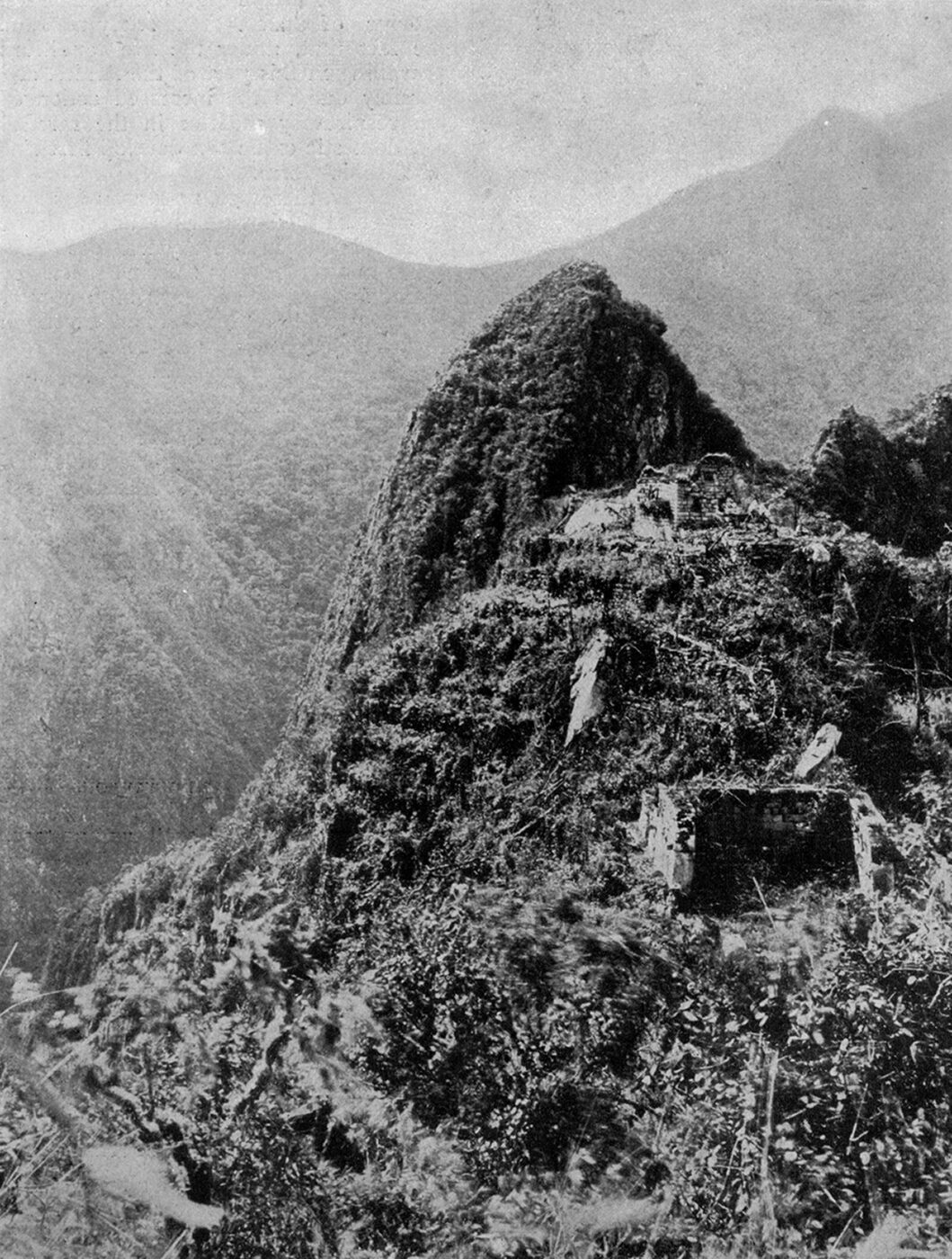

The objects went to New Haven. Bingham returned in 1912 under Yale and National Geographic sponsorship, with excavation continuing in 1914 and 1915, and removed thousands of artefacts — ceramic vessels, silver figures, jewellery and human remains — openly and, under the Peruvian civil code of 1852 as then read, lawfully; the objects were said to be going abroad for eighteen months. Yale kept them until 2012, arguing that Peru lacked the means to care for them. Yale returned some pieces in 2006 while retaining more than 250 described as museum quality; agreed in 2007 to a joint exhibition and a research centre in Cusco and acknowledged Peru’s title; agreed in November 2010 to return the disputed material; and delivered the third and final batch in November 2012. It is now held at the Casa Concha in Cusco, owned by the Universidad Nacional de San Antonio Abad. Throughout the years this directory covers, the collection was in Connecticut, and the argument was unresolved.
The formal designations came late and in order: national historic sanctuary in 1981, covering some 326 square kilometres of the surrounding landscape as well as the ruins, UNESCO World Heritage Site in 1983, and one of the New Seven Wonders of the World in a private ballot in 2007. In the late 1990s the government granted concessions for a cable car, a luxury hotel and a bridge; the plans drew sustained protest and objections from the national natural-resources institute, and were not built. A no-fly zone exists over the site.
The Nazca lines, and what is claimed about them
The Nazca lines are geoglyphs cut into the desert floor of the southern coast by removing dark, iron-oxide-coated surface pebbles to expose lighter ground beneath. They were made between about 500 BCE and 500 CE in two phases — a Paracas phase from about 400 to 200 BCE and a Nazca phase from about 200 BCE to 500 CE. Their combined length runs to more than 1,300 kilometres across some fifty square kilometres. Hundreds are simple lines and geometric figures; more than seventy are zoomorphic, among them a hummingbird, a spider, a monkey, a condor, a heron, a lizard and a human figure. They are shallow, typically ten to fifteen centimetres deep, and survive because it almost never rains there and the exposed subsoil hardens under the morning mist.
The modern record begins with pilots. Peruvian military and civilian aircrew were the first to report them in the twentieth century; the Peruvian archaeologist Toribio Mejía Xesspe came upon them on foot in 1927 and presented them at a conference in Lima in 1939. The American historian Paul Kosok, in Peru in 1940–41 to study ancient irrigation, is credited as the first to study them in depth, and was joined by the German-born mathematician Maria Reiche, who spent the rest of her life documenting and defending them and became known as the Lady of the Lines. Kosok and Reiche proposed an astronomical function. Later work has gone against that reading: Gerald Hawkins and Anthony Aveni found no statistically significant correlation between the orientations and recurring celestial events, while Reiche’s protégée Phyllis Pitluga proposed a different astronomical scheme again, which Aveni also criticised. Current scholarship generally ascribes religious or ritual significance without claiming to have settled the question.
What is established is that they could be made with the tools available: Joe Nickell reproduced figures using period technology, and the method — stakes, cord, and a plan scaled up from a small drawing — is not mysterious; wooden stakes found at the ends of some lines support it, and one of them supplied a radiocarbon date for the complex. What is not established is a single purpose. What has no support in the discipline is the claim that made them famous outside archaeology: Erich von Däniken’s Chariots of the Gods?, published in 1968, proposed them as landing sites for extraterrestrial craft. The lines were inscribed as a UNESCO World Heritage Site in 1994. Documented damage has come from the ground rather than the air — off-road vehicles of the Dakar Rally in 2012 and 2013, on geoglyphs outside the World Heritage area; a protest banner laid out among the figures in December 2014, for which the organisation responsible apologised and an activist was later fined; and a lorry driven across three geoglyphs in 2018.
The quipu: what is settled and what is not
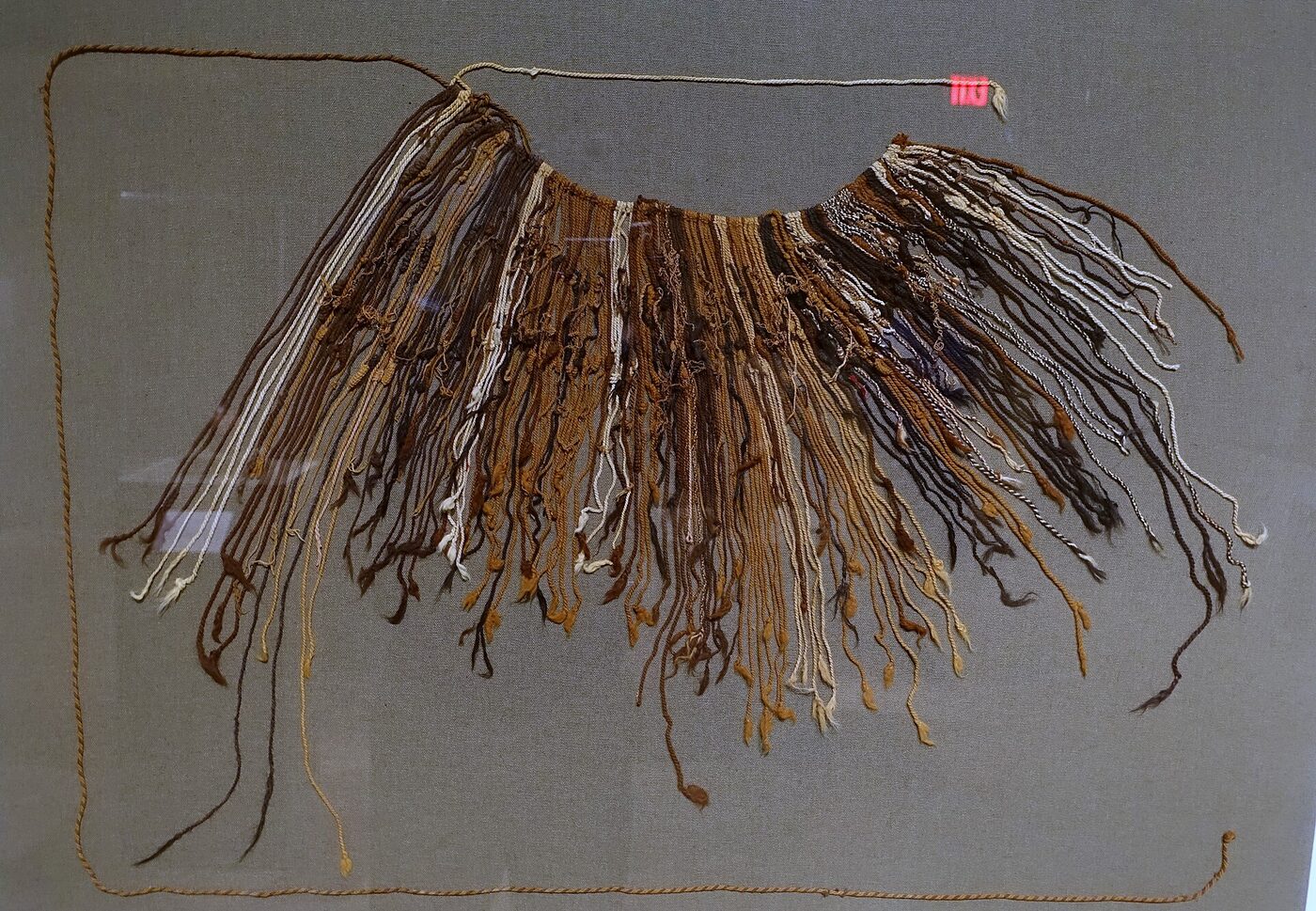
The quipu or khipu is a record kept in knotted cords of cotton or camelid fibre, hanging from a main cord, carrying information in colour, order, position and knot. Objects unambiguously identifiable as quipus appear in the archaeological record during the first millennium CE, probably under the Wari; they became central to Inca administration, which used them for tribute and labour obligations, census records, calendars and military organisation. A quipu may carry a few cords or several thousand. A survey of museum and private inventories published in 2021 puts the number of surviving pre-Columbian examples at just under 1,400.
The settled part is the arithmetic. Leland Locke, in a 1912 paper and a 1923 monograph for the American Museum of Natural History, is credited with first demonstrating that many quipus encode numbers in base-ten positional notation. From the late 1960s Marcia and Robert Ascher analysed several hundred examples and showed that most of the recorded information is numerical and can be read systematically. In the first decades after the conquest, Spanish officials accepted quipu accounts in court: a quipucamayoc could be summoned, and his bookkeeping treated as valid evidence of past payments.
_composed_of_two_main_cords_with_subsidiary_and_tertiary_cords%2C_Inca%2C_Peru%2C_Late_Horizon%2C_1476-1534_AD%2C_cotton%2C_plant_fiber%2C_indigo_dye_-_Dallas_Museum_of_Art_-_DSC04703.jpg)
The unsettled part is everything else. Some knots, and features such as colour, fibre and cord attachment, appear to form a non-numeric system that has not been deciphered, and the absence of any demonstrated link to a particular Andean language has long supported the view that the quipu is not a glottographic writing system with phonetic referents. Gary Urton has argued that it encodes a binary system capable of carrying phonological or logographic data; Frank Salomon has argued that it is semasiographic, conveying meaning without representing speech, in the manner of numerals or musical notation; Martti Pärssinen has argued that quipucamayocs memorised oral texts keyed to the cords; Sabine Hyland claims a phonetic reading of two colonial-era epistolary quipus from San Juan de Collata. None of these is established. Many quipus were destroyed as idolatrous after the conquest, while others were adapted for colonial and ecclesiastical bookkeeping, and hybrid quipu boards survive. In the Andean villages of Tupicocha and Rapaz, quipus are still kept — at Tupicocha as objects of local office and record, at Rapaz as communal patrimony.
The subject holds the distinction this article keeps drawing, between what the evidence supports and what a good story would prefer. It is also, as noted above, the name on one of the nameservers that has answered for the .pe domain.
The museums and what they hold
The collections are where the deep-time sequence becomes visible, and they were a recurring reference point whenever the group argued about patrimony.
The National Museum of Archaeology, Anthropology and History of Peru, in the Palacio de la Magdalena on the main square of the Pueblo Libre district of Lima, is the country’s largest and oldest, holding more than 100,000 objects spanning the whole record of human occupation; among its best-known holdings are the Raimondi Stele from Chavín and a large scale model of Machu Picchu. A few streets away, in an eighteenth-century viceregal building, is the privately owned Larco Museum. It opened to the public on 28 July 1926, founded by Rafael Larco Hoyle and named for his father Rafael Larco Herrera, whose gift of some 600 ceramic pieces the year before had started the collection; the son then bought two large collections of 8,000 and 6,000 pieces and several smaller ones from the Chicama and Virú valleys. It is organised as a chronological walk through five thousand years, and its storage gallery lets visitors see the whole of its classified collection; it is best known abroad for a gallery of Moche erotic pottery, and it lends part of its holdings to a daughter museum in Cusco.
In the north, the Royal Tombs of Sipán Museum at Lambayeque, opened in 2002 and designed to resemble a Moche tomb, holds the material recovered by the archaeologist Walter Alva and Susana Meneses at Huaca Rajada from 1987 — the burial of a Moche ruler, the Lord of Sipán, with his entourage, found intact and untouched by looters and reckoned among the most important archaeological discoveries in South America of the late twentieth century. The Machu Picchu material returned by Yale is at the Casa Concha in Cusco. Some Chavín material is at the Museo de la Nación in Lima and some at the site museum at Chavín itself.
Food, and the argument about who owns it
Cuisine was treated in this group as a matter of national standing long before it acquired an international one, and the arguments were regional and genealogical rather than culinary. Peruvian cooking draws on the produce of three very different environments and on successive waves of migration: Spanish from the 1530s, African under slavery, then Chinese and Japanese from the late nineteenth century, with Italian, Middle Eastern and other contributions besides. The Chinese inheritance produced chifa, a Cantonese-Peruvian tradition that gave the country dishes now eaten as ordinary Peruvian food; the Japanese one produced nikkei. Both are Lima traditions with their own restaurants and their own vocabulary, and neither is a footnote.
Ceviche is the standing example. Raw fish or shellfish cured in citrus, it is claimed as a national dish by several Pacific countries, and pre-Columbian coastal populations used other acids before limes arrived. Peru declared it national cultural heritage by a directoral resolution of the Instituto Nacional de Cultura in March 2004, and in December 2023 UNESCO inscribed the practices and meanings associated with the preparation and consumption of ceviche on its list of intangible cultural heritage, as a tradition of Peru. The internationalisation of the cooking — the restaurants abroad, the chefs who became public figures, Gastón Acurio foremost among them — belongs mostly to the years after the period in which such groups were most used. What belongs to the group’s own years is the argument that preceded it: coast against sierra, the competing claims of particular cities, and whether a dish counted as national or merely regional. The dispute with Chile over the denomination pisco is a separate and longer-running matter; the neighbouring country has its own page at soc.culture.chile.
Music: the huayno and the criollo tradition
Two traditions dominate, and the line between them is the same line that runs through everything else. The huayno is Andean, popular above all among Quechua speakers, and dates in its recorded form to the colonial period as a fusion of rural folk music with urban dance music: high vocals over quena, harp, panpipes, charango, violin, mandolin, accordion and latterly saxophone, on a rhythm that stresses the first beat and follows it with two short ones. It is common not only in Peru but in western Bolivia, north-west Argentina and northern Chile. The great internal migration to Lima from the 1950s carried it to the coast, where it acquired amplification, record labels, radio slots and a commercial market of its own, and where it fed the electric hybrid known as chicha.
Música criolla is coastal, and its name tells its history: criollo began as a term for people of unmixed Spanish descent and broadened into a socially inclusive marker of coastal identity. The music blends European, African and Andean elements — the Peruvian waltz and the polka on one side, the cajón and the Afro-Peruvian repertoire, landó and festejo, on the other. The marinera, a courtship dance performed with handkerchiefs, mixes Spanish contradanza with the Andean zamacueca; Trujillo has been recognised as its national birthplace since 1986, and the annual competitions held there date from 1960. Which of the two traditions counted as the national music was not a question a newsgroup could settle.
Football, and two disasters
The Peruvian federation was formed on 23 August 1922, affiliated to FIFA in 1924 and to CONMEBOL in 1925, and the national side played its first match on 1 November 1927. The team has won the continental championship twice, in 1939 on home soil and in 1975, and has reached the World Cup finals five times: 1930, as one of the thirteen invited teams at the first tournament; 1970 and 1978, its two best runs, both recorded as quarter-final finishes; 1982; and then, after a gap of thirty-six years, 2018.
That gap is the point for this directory. Through the entire active life of soc.culture.peru, the national team did not appear at a World Cup. Whatever football threads the archive holds were written by people watching qualifying campaigns fail, which is a different genre of thread from the one a Brazilian or Argentine group was producing at the same moment.
Two dates sit outside the sporting record and belong to the country’s general history. On 24 May 1964, during a Peru–Argentina Olympic qualifying match at the Estadio Nacional in Lima, a disallowed goal brought spectators onto the pitch; police fired tear gas, the crowd fled down tunnels closed by steel shutters, and the official death toll was 328, with some accounts putting it higher because deaths by gunshot were not included. It remains one of the deadliest incidents in the history of the sport. On 8 December 1987 a Peruvian Navy Fokker F27 chartered by Alianza Lima crashed into the Pacific near Callao; of the 43 people aboard, only the pilot survived, and the club lost effectively its entire first team.
Costa, sierra, selva
Almost every Peruvian argument has a geographical shape, and the three-way division is the country’s own. The costa is a narrow, largely arid Pacific plain broken by valleys cut by seasonal rivers; it holds Lima and the great majority of the country’s urban population and commerce. The sierra is the Andes, including the Altiplano and Huascarán at 6,768 metres, the country’s highest peak, and is where Quechua and Aymara are spoken as first languages. The selva is the Amazon lowland and its cloud-forest approaches; it covers almost sixty per cent of the national territory and holds the great majority of the country’s indigenous languages and the smallest share of its people.
The three regions differ in climate, produce, music, food, speech and political weight, and the differences are old enough to have their own literature and their own insults. In the twentieth century the sierra emptied towards the coast, and Lima grew from a viceregal city into a metropolitan area of some ten million, roughly a third of the national population. It is the fundamental division of the country, and it is the one the truth commission’s findings put in the sharpest possible light: the violence fell overwhelmingly on the region with the least political weight and the fewest Spanish monolinguals.
What was argued in the group
Politics ran through everything, and the vantage points available were mutually incompatible. Somebody writing from Lima in 1996, somebody writing from Ayacucho in 2001 through a cabina, and somebody writing from a graduate department in the United States who had left in 1989 were not describing the same decade, and none of them was in a position to concede the point. Every reading of the period had its adherents; a newsgroup settled none of them. Even the vocabulary was contested, in the group as in the country: what to call the conflict, what to call its parties, and what to call its episodes were themselves positions.
Beneath the politics ran the standing subjects of any emigrant group: work, remittances, papers, the arithmetic of whether and when to go back, and the practical business of getting news from home before the newspapers were online. Andean and coastal Peru were argued over as cultural claims and as political ones, and the status of Quechua and the other indigenous languages belonged to that argument as much as to the constitutional one. Patrimony was the other durable subject, and it had an unusually concrete object: for the whole of the period this directory covers, the material Bingham removed was in Connecticut, and the group had opinions about that.
Food was argued with the same seriousness as any of it and rather more pleasure. So was the archaeology — whose Machu Picchu, whose Inca inheritance, whose ancestors — and none of that was ever going to end in agreement, which is the ordinary fate of arguments about who a country belongs to.
Its neighbours in the hierarchy
soc.culture.peru sat in the national run of soc.culture.*, unmoderated as most of that hierarchy was, and shared with its neighbours crossposts, regional news and comparisons that not everyone wanted made. The immediate neighbours each have their own page here: soc.culture.bolivia, with which it shares the Aymara-speaking Altiplano and a good deal of the Quechua-speaking one; soc.culture.ecuador, with which Peru fought the last of its border wars in 1995 and settled it in 1998; soc.culture.argentina, home to one of the largest Peruvian communities abroad; and soc.culture.uruguay further down the same coast. The branch as a whole, and how its groups were made, is covered at soc.culture.*.
One institutional detail is worth recording because it is in this group’s own file. The RFD and both CFVs were crossposted to soc.culture.latin-america, the older regional group, and the proposal was in substance a request to be allowed to leave it. That was the ordinary way national groups were made in the early 1990s: a regional group accumulated enough traffic about one country, somebody proposed a split, and the vote was taken among people most of whom read both. The forged removal request of November 2001 shows the same neighbourhood from the other side: Peru, Bolivia and Ecuador were worked through in alphabetical proximity within a quarter of an hour, by somebody who had never read any of them.
What the record does not show
Everything above about the group’s creation comes from four archived administrative postings and three control messages. Nothing above about the group’s ordinary traffic comes from a comparable source, and the difference should be stated rather than smoothed over.
No subscriber figures survive for soc.culture.peru, and none ever existed in a reliable form: Usenet had no membership. No traffic counts, no reliable list of frequent posters, no FAQ maintained under the group’s name has been located for this page. Whether the mailing-list gateway promised in the charter was ever actually built is not recorded anywhere the author could find; the promise is documented, the implementation is not. The 400-plus subscribers of [email protected] are the charter’s own figure, given in June 1993, and there is no independent confirmation of it. No thread titles, no quotations from ordinary postings and no named participants beyond the votetaker appear in this article, because none were verified for it; the votes list contains 163 names and addresses, and this page has deliberately not mined it, those being private individuals rather than public actors.
What can be said honestly is what the paperwork says: an unmoderated group, created on 19 July 1993 on a 142:21 vote, described in every newsgroups file as being about the people of Peru, chartered in Spanish, English and Quechua, and founded by and for a readership that in July 1993 was almost entirely outside the country.
Scope and limits
This page describes a newsgroup and the world it belonged to. It is not a history of Peru, and the country sections above are compressed to the dates and findings that bear on what the group discussed. Where a question is contested — the casualty estimate, the attribution of responsibility, the purpose of the Nazca lines, the status of the non-numeric quipu, the merits of any of the judicial decisions recited above — this page reports the positions and their sources and reaches no conclusion of its own. That is a deliberate limit, not an oversight.
Dates and figures here were checked against reference sources during the writing, and the group’s own dates, tallies and quoted text against the archived Usenet record, which was re-read line by line for this version. Where a figure is an estimate it is labelled as one; where it is a court’s finding or a commission’s finding it is attributed to that body. Present-day statistics — diaspora totals, resident populations, museum holdings — are present-day statistics, and are not evidence about the 1990s. The archive links elsewhere on this page lead to the traffic itself, which is unedited, contemporaneous and inconclusive, and is therefore a source rather than a conclusion.
Reading soc.culture.peru today
- Historical archive: Google Groups — soc.culture.peru (coverage varies by group and era).
- Open in a newsreader:
news:soc.culture.peru— the original site offered exactly this link, and it still works if your system has a newsreader registered for thenews:scheme. - Live access: point an NNTP newsreader at a modern server — see accessing Usenet today.
- The original news2mail e-mail subscription service ended in the mid-2000s and no longer operates.