soc.culture.puerto-rico
Puerto Rico: culture and the status question.
Boricua culture on and off the island — music from salsa to early reggaeton, food, and the eternal status debate (statehood, commonwealth, independence) rehearsed through every referendum.
The stateside diaspora, New York above all, supplied much of the traffic.
On this page
- The proposal, and the mailing list behind it
- The charter, in the words its voters read
- The vote: 355 to 23
- Who cast the ballots
- Creation, and the message that did it
- A citizenship without a vote: the constitutional record
- Seven plebiscites, and their arithmetic
- Legislation and judgments after 2016
- Who could post, and from where
- Two official languages, and a century of reversals
- Puerto Rican Spanish, and what a seven-bit wire did to it
- Music, which was most of the traffic
- Baseball, boxing, and a flag of its own
- Food, and the calendar of the year
- Vieques, inside the gateway's own years
- After the gateway: the storms, and the accounting
- What the record does not show
- Scope and limits
The proposal, and the mailing list behind it
The paperwork for this group survives in full. The Internet Systems Consortium's mirror of news.announce.newgroups holds five documents for soc.culture.puerto-rico — a Request for Discussion, a second RFD, a first Call for Votes, a last Call for Votes and the result — and the separate control archive holds the newgroup message that actually brought the group into being. Between them they date the group precisely, name the people who proposed and administered it, and preserve its charter in the wording its voters saw.
The first RFD was posted on 1 February 1994 by Mauricio A. Hernández, whose Organization header reads Columbia University Department of Computer Science; his signature block gives the same department and the city, New York. It was crossposted to news.announce.newgroups, news.groups, soc.culture.latin-america and soc.culture.caribbean, with follow-ups directed to news.groups as the guidelines required. A second RFD followed on 16 February, carrying the charter in what the proposer expected to be its final form.
What distinguishes the proposal from most of its neighbours is that it did not begin on Usenet at all. Its stated justification is a mailing list: BORIKEN, run by the University of Puerto Rico and reachable at an address on BITNET. The RFD describes it as the only electronic forum wholly dedicated to open discussion of Puerto Rican matters, says it began about two and a half years earlier as a small experiment, and reports that it had grown to over 200 participants. The newsgroup was proposed by members of that list, because the list's own traffic had outgrown it. A soc.culture.* group being spun out of a university listserv is not unusual in itself; what is unusual is that the listserv was on the island, and that the RFD says so.
The RFD is also unusually explicit about what was wrong with the existing arrangements. Puerto Rican subjects, it says, had been discussed in soc.culture.latin-america, but the discussion there was mostly confined to major political questions — and it names one: the current political relationship between Puerto Rico and the United States. That, the proposers argued, did not describe the social, cultural and political life of Puerto Rican society. They noted soc.culture.caribbean as well, and set it aside on two grounds: it concentrated on the Lesser Antilles, Haiti and Jamaica, and it used English as its primary language.
The charter, in the words its voters read
The charter went to the vote in four numbered clauses. Quoted as the Call for Votes printed it, with the original's ragged spacing normalised:
1) Topics of discussion: Soc.culture.puerto-rico will be a newsgroup dedicated solely to the discussion of issues related to the life, culture, and politics affecting the nearly 6 million Puerto Ricans living in the island, in the mainland USA, and around the world.
2) Posting Policy: Soc.culture.puerto-rico will be unmoderated. Contributors must use their own judgement to decide the relevance of their articles to the topics discussed in soc.culture.puerto-rico. Discussions that are only relevant to a very few individuals should be moved to e-mail.
3) Language: Spanish is Puerto Rico's principal language. Thus we expect Spanish to be the dominant language in the newsgroup. Nevertheless, a large part of Puerto Ricans who have access to USENET know and use English as a second language. Therefore, articles written in English will be as welcomed as those written in Spanish.
4) BORIKEN: Soc.culture.puerto-rico will not be initially gatewayed to the list server BORIKEN ([email protected]). However, the possibility of a link will remain open and will be decided later by the members of the BORIKEN list server.
Four things in that text are worth pausing on. The first is that politics is named in clause 1, in the charter's own list of subjects, alongside life and culture: the group was chartered for the discussion of the life, culture and politics of Puerto Ricans, in that order. The standing argument that followed was therefore inside the remit rather than an intrusion on it.
The second is the phrase in the island, in the mainland USA, and around the world. The charter defines its constituency by dispersal rather than by residence, and the figure it attaches — nearly six million — is a combined one. It stands up reasonably well against the census: the 1990 count found 3,522,037 people living in Puerto Rico and some 2.7 million Puerto Ricans in the states, so the charter's arithmetic was of the right order in 1994 and, if anything, conservative.
The third is clause 4, which exists to say what the group would not do. Gatewaying a Usenet group to a mailing list was a real technical option: it would have merged BORIKEN's membership into the newsgroup's traffic in both directions. The second RFD had ruled it out flatly — the group will not be gatewayed to BORIKEN — and the clause that actually went to the vote softened that into a refusal for the time being, with the possibility left open and the decision expressly reserved to the list's own members. The two forums began, and so far as the record shows remained, separate.
The fourth is the description line. The charter's own Description: field wavered — the second RFD printed Puerto Rican culture, politics, and society, the Calls for Votes and the result printed Puerto Rico's culture, politics, and society — but the line that mattered, the one-line entry destined for every news server's newsgroups file, was fixed from the first Call for Votes onward and reads:
soc.culture.puerto-rico Puerto Rican culture, society and politics.
That is still the line the Internet Systems Consortium's current newsgroups file carries, more than thirty years later. Politics is in it too, third of three, exactly as the charter has it.
The vote: 355 to 23
The Call for Votes was issued on 9 March 1994 by Ron Dippold, posting from an address at Qualcomm under the organisation line Usenet Volunteer Votetakers — the standing pool of neutral third parties who ran Big-Seven ballots in this period. A last Call for Votes superseded it on 15 March. Ballots went to a dedicated voting alias and had to be received by 23:59:59 UTC on 30 March 1994. Both Calls carried the whole charter, and both stated that the CFV would also be posted to the BORIKEN list — so the ballot reached the island community through the same channel that had produced the proposal.
The result was posted on 1 April 1994 under a subject line that says the whole story: RESULT: soc.culture.puerto-rico passes 355:23. The body gives 355 YES votes and 23 NO votes, 378 valid votes in total, and two invalid ballots.
Set that against the rule the result itself restates. For a Big-Seven group to pass, YES votes had to be at least two-thirds of all valid votes, and there had to be at least 100 more YES than NO. The group cleared the first test at 93.9 per cent and the second by a margin of 332, more than three times the required surplus. A tally of that shape is what an electorate already assembled elsewhere produces: the proposal came out of a mailing list two and a half years old with more than 200 members, and the ballot was crossposted to two established regional groups and sent to the list itself.
The procedure then ran its remaining course exactly as written. The result announced a five-day discussion period in which allegations of voting irregularities could be raised; none is recorded in the archive. The Call for Votes had also warned voters that the addresses and votes of everyone who took part would be published in the final results, which is why the record that follows exists at all.
Who cast the ballots
The result posting lists every voter by e-mail address and, where the mail supplied one, by name. That list is the only large-scale evidence about the group's readership that survives from its founding, and it is worth reading as data rather than as a curiosity. Sorted by the domain each ballot came from, the 355 YES votes fall out as follows.
- .edu — 193 votes, a clear majority. The single largest institutional block is the University of Puerto Rico, with 28 ballots from addresses under its
upr.clu.edudomain, including a cluster from the Mayagüez campus machines. After that the pattern is mainland-university: MIT with 24, the University of Michigan with 20, Carnegie Mellon with nine, Texas A&M with eight, Pittsburgh with seven, Purdue and Ohio State with six each. - .com — 92 votes. Motorola contributed 18, Bellcore ten, Hewlett-Packard nine, AT&T six, IBM five, Oracle four. Three ballots came from America Online, whose Usenet gateway had opened only that March.
- .gov — 33 votes, of which 31 are NASA addresses, the largest single group at a Lewis Research Center machine.
- .mil — 16 votes, spread across Army and Navy installations.
- .net and .org — eight votes between them.
- Country-code domains outside the United States — eleven votes in all: four from Canada and one each from the United Kingdom, Sweden, Italy, Germany, Peru, Chile and Argentina. One further ballot came from a
.usaddress in Minnesota and one from an address given simply aslocalhost; those two, with the six categories above, account for all 355.
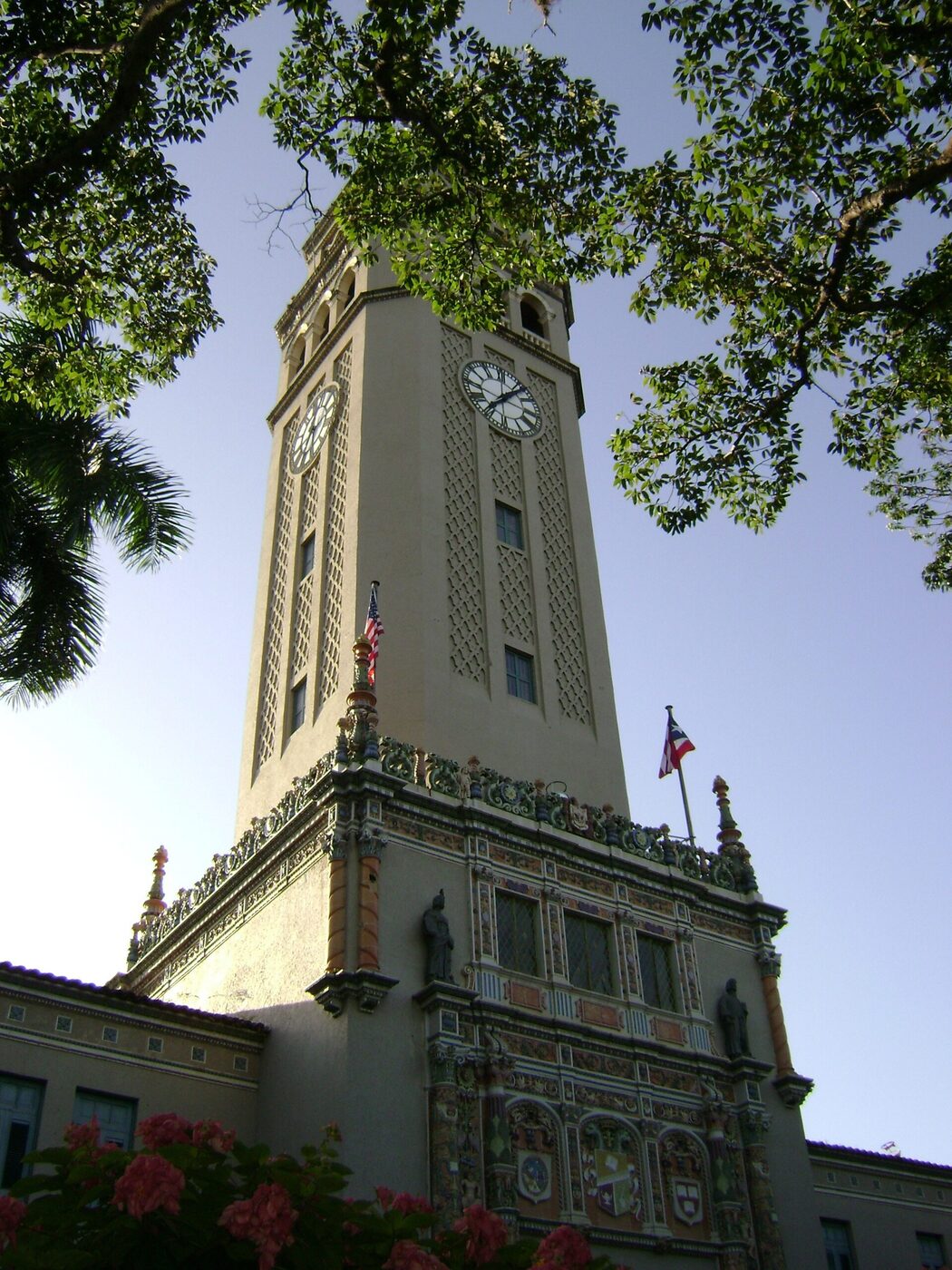
upr.clu.edu domain. Osvaldo Ocasio · public domain · via Wikimedia Commons.
Two conclusions are safe and a third is not. It is safe to say that the electorate was overwhelmingly institutional: in 1994 an e-mail address still meant a university, a laboratory, a large employer or an early commercial provider, and this roll is a fair cross-section of all four. It is safe to say that both halves of the charter's constituency were present — the University of Puerto Rico block is unmistakably island-based, and the mainland universities and corporations are unmistakably not. What is not safe is to read the roll as a census of the group's later readers. A founding vote measures who was reachable and motivated in March 1994; it says nothing about who was reading a decade later, when the gateway that produced this directory was carrying the group to e-mail.
The NO votes are listed too, by name and address, in the same public fashion; the published list carries twenty-four entries, one of them marked as invalidated during the count, which is how twenty-three valid NO votes were arrived at. They are scattered — universities, two medical schools, an Air Force installation, several commercial providers, and addresses in the Netherlands, the United Kingdom and Canada — and no pattern emerges from them. This was the ordinary background level of objection in a Big-Seven ballot, where a certain number of voters opposed almost every proposed group on general principles of namespace hygiene.
Creation, and the message that did it
The control archive completes the sequence. On 6 April 1994, five days after the result was posted and at the expiry of the mandatory waiting period, David C. Lawrence — then the moderator of news.announce.newgroups, posting as tale from UUNET — issued the newgroup control message. It states the group is unmoderated, cites the 355:23 vote and the date the result was reported, prints the newsgroups-file line for administrators to paste in, and reproduces the charter, described in the message's own words as culled from the call for votes.
A control message of this kind was, formally, a request rather than an order: every news administrator on the network decided individually whether to honour it. For Big-Seven groups they almost always did, and this one propagated. The archive shows the message reissued on 19 August 1994, a routine occurrence at the time, since periodic re-sends were how the namespace repaired itself on servers that had missed or discarded the original. The mechanics of Big-Seven group creation, and the reasoning behind the two-thirds rule and the hundred-vote margin, are set out on this directory's soc.* hierarchy page and are not repeated here.
A citizenship without a vote: the constitutional record
The group's standing subject has a documentary history that is unusually precise, because almost every step in it was taken by a statute, a treaty, a plebiscite or a court. Setting the record out plainly is the most useful thing this page can do; what the record means is exactly the question the group existed to argue, and this page takes no position on it.
Spain ceded Puerto Rico to the United States by the Treaty of Paris, signed on 10 December 1898 at the close of the Spanish–American War; American forces had landed at Guánica on 25 July that year, and a military government held it until civil administration was established. The Foraker Act, signed on 12 April 1900 and effective from 1 May, replaced the military government with a civil insular government under continued federal jurisdiction.
The Insular Cases, decided from 1901, gave that arrangement its constitutional theory. In Downes v. Bidwell (1901) the Supreme Court held that the Constitution does not necessarily apply in full to territories, and described Puerto Rico in a formula that has been quoted in the argument ever since: a territory appurtenant and belonging to the United States, but not a part of the United States within the revenue clauses of the Constitution. Balzac v. Porto Rico (1922) extended the reasoning, holding that the Sixth Amendment right to jury trial did not follow the flag into an unincorporated territory. The doctrine of incorporation those cases established still governs the status of Puerto Rico, Guam, American Samoa, the U.S. Virgin Islands and the Northern Mariana Islands.
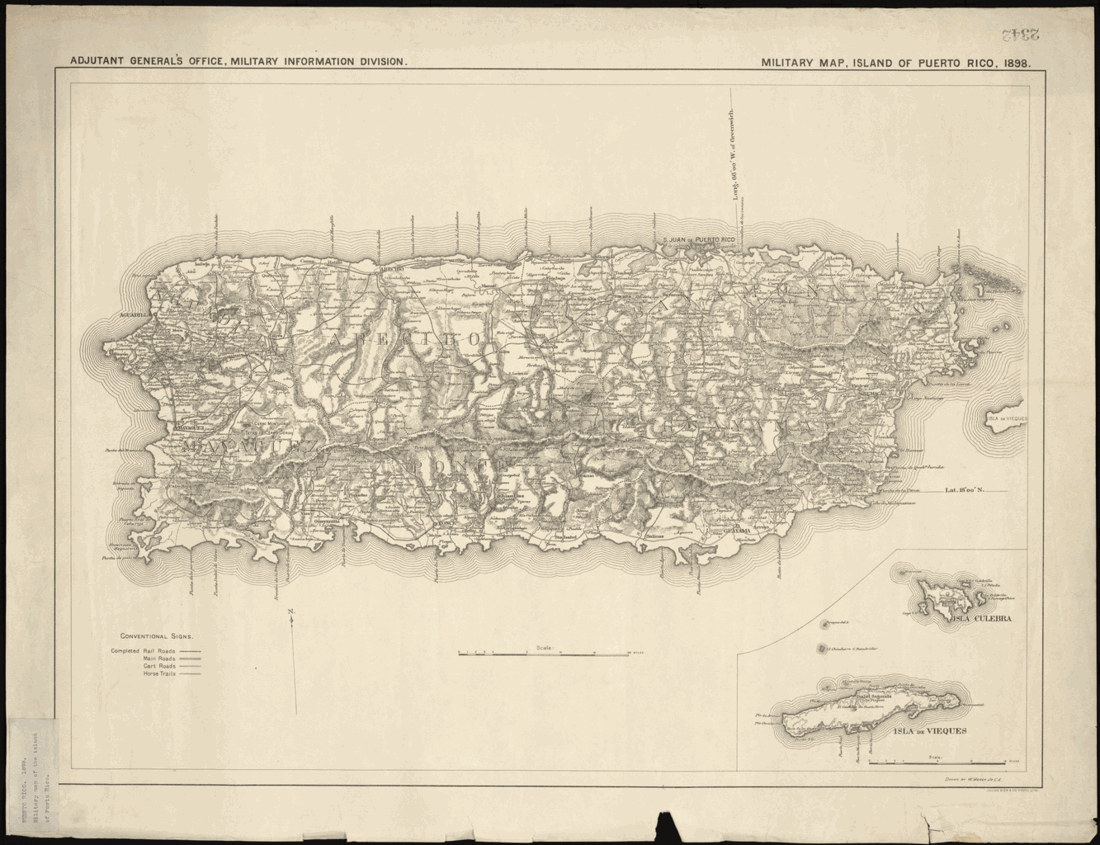

Citizenship arrived by statute. The Jones–Shafroth Act was signed by President Wilson on 2 March 1917, extending United States citizenship to Puerto Ricans by statute and serving as the island's organic law until the constitution of 1952; the Nationality Act of 1940 later restated the citizenship of those born in the territories within the general nationality code. The practical consequence has been constant ever since and is the single fact that most shaped this newsgroup: moving between island and mainland requires a plane ticket and no paperwork at all.
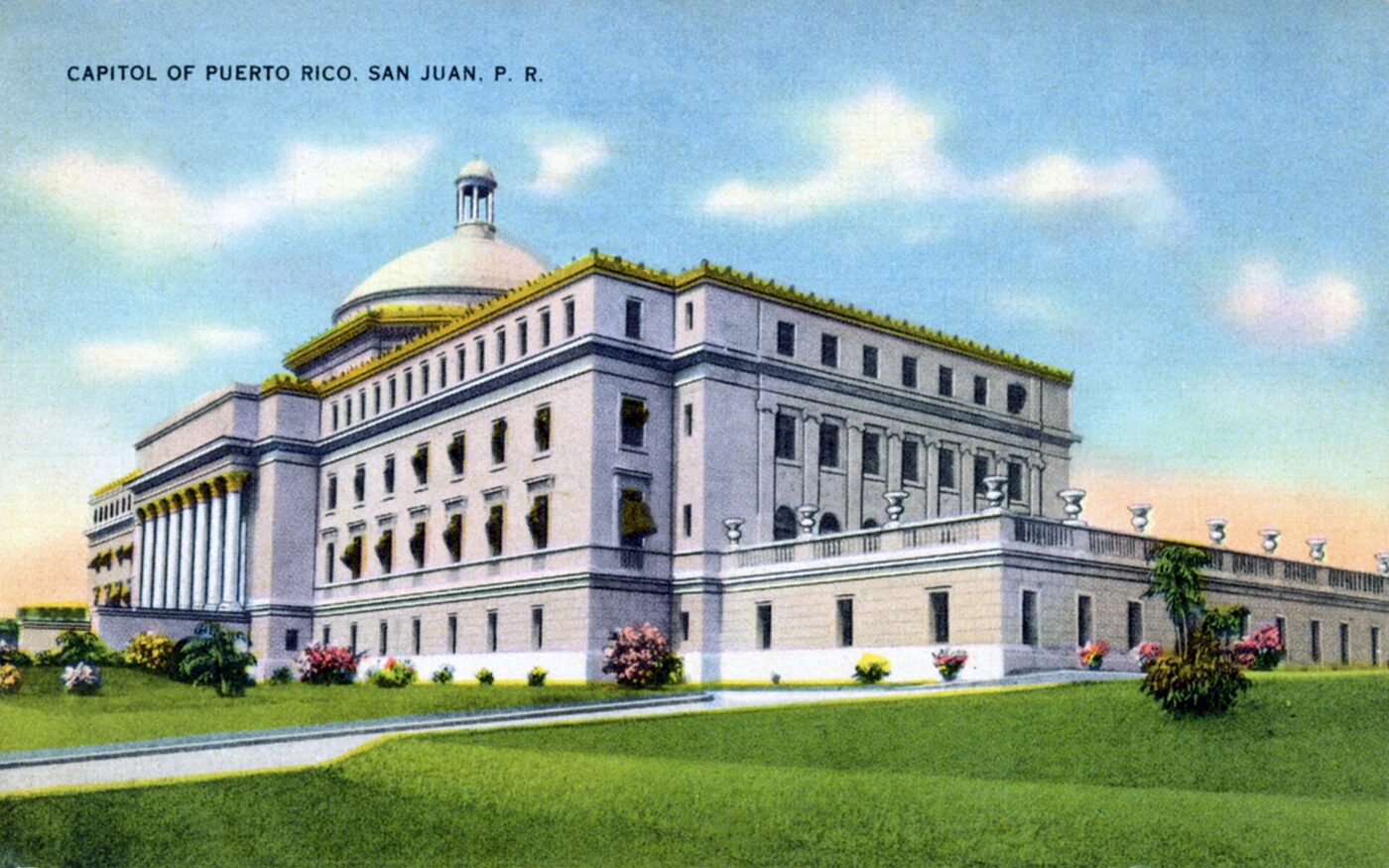
The present arrangement dates from the middle of the century. The Puerto Rico Federal Relations Act — Public Law 600 — was signed by President Truman on 3 July 1950, allowing the island's residents to write a constitution of their own. Voters approved that constitution on 3 March 1952; Congress ratified it, with amendments, on 3 July 1952; and Governor Luis Muñoz Marín proclaimed it in effect on 25 July 1952, a date kept since as Constitution Day. The entity it created is styled Estado Libre Asociado de Puerto Rico in Spanish and Commonwealth of Puerto Rico in English — two names whose imperfect correspondence has itself been a subject of argument.
The international record ran alongside. On 27 November 1953 the United Nations General Assembly adopted Resolution 748 (VIII), which ended the transmission of information about Puerto Rico under Article 73(e) of the Charter and so removed it from the list of non-self-governing territories. The vote was 20 in favour, 16 against and 18 abstentions. From 1972 the Special Committee on Decolonization returned to the case, and it has since adopted a long series of resolutions affirming the right of the people of Puerto Rico to self-determination and independence; the position of record on the other side has been that Resolution 748 settled the question and that the resolution has never been revoked. Both positions are on the record, and both were rehearsed in the group.
What all this produced, by the time the newsgroup existed, was a set of arrangements that everyone could describe and nobody agreed about. Residents of Puerto Rico are United States citizens. They send one non-voting Resident Commissioner to the House of Representatives, who sits and votes in committee but has no vote on the floor. They do not vote in presidential general elections, though they take part in the parties' presidential primaries. They pay federal payroll and other federal taxes; most are exempt from federal income tax on income earned on the island. A Puerto Rican who moves to Ohio acquires the presidential vote on becoming a resident there and loses it again on moving back.
Three parties carry the three answers, and each has done so for decades. The Popular Democratic Party, founded in 1938 and long led by Muñoz Marín, holds that the commonwealth is a compact of association to be developed rather than abandoned. The New Progressive Party, founded in August 1967 by Luis A. Ferré after the statehood movement split over that year's plebiscite, holds that only admission as a state ends the inequality. The Puerto Rican Independence Party, founded on 27 October 1946 by Gilberto Concepción de Gracia, holds that sovereignty is the only outcome consistent with self-determination. Each states its case in those terms; readers who want the case argued will find it argued, at length and by its own adherents, in the group's archive.
Seven plebiscites, and their arithmetic
Puerto Rico has voted on its status seven times. Two of those votes fell within the newsgroup's own life and one within the years the news2mail gateway was running; the rest bracket it. The figures below are the certified returns.
23 July 1967. The first plebiscite offered commonwealth, statehood and independence. Commonwealth took 425,132 votes, statehood 274,312 and independence 4,248 — 60.4, 39.0 and 0.6 per cent of the valid vote, on a turnout of about 66 per cent of an electorate of 1,067,349. The historic pro-statehood Republican party boycotted the ballot; the dissidents who broke with it over that decision founded the New Progressive Party within weeks.
14 November 1993. Commonwealth took 826,326, statehood 788,296 and independence 75,620 — 48.9, 46.6 and 4.5 per cent — on a turnout of 73.5 per cent. No option reached a majority. The first Request for Discussion for this newsgroup went out eleven weeks later, and this was the argument its early readers inherited: a plurality for the status quo, a statehood vote within three points of it, and no mandate for anyone.
13 December 1998. The five-column ballot produced the result that travelled furthest beyond the island. None of the above took 787,900 votes, a narrow majority at 50.5 per cent, against 728,157 for statehood (46.6 per cent), 39,838 for independence, 4,536 for free association and 993 for the column labelled territorial commonwealth. Turnout was 71.3 per cent. The commonwealth party had rejected the definition of its own option as printed on the ballot and campaigned for the blank column instead; the winning result was therefore a protest against the ballot rather than a preference among the choices on it, which is how both sides described it at the time and how the group discussed it.
6 November 2012. A two-part ballot. Asked whether Puerto Rico should continue its current territorial status, 828,077 voted yes and 970,910 no. Asked which non-territorial option they preferred, 834,191 chose statehood, 454,768 free association and 74,895 independence — but 515,348 ballots in the second question were left blank or rejected. Statehood thus took 61 per cent of the valid second-question vote and about 44 per cent of all ballots cast on it, a discrepancy that became the whole of the subsequent argument in Washington and on the island. Turnout was about 78 per cent.
11 June 2017. Statehood took 508,862 votes, 97 per cent of those cast; free association or independence took 7,981 and the current territorial status 7,048. Turnout was 22.9 per cent. The commonwealth party called for a boycott, and the figures record its effect exactly: the winning option's share and the turnout are each the direct consequence of the other.
3 November 2020. The first ballot to put a simple question: should Puerto Rico be admitted immediately into the Union as a state? Yes took 655,505 votes and no 592,671 — 52.5 against 47.5 per cent — from an electorate of 2,355,894, giving a turnout of about 55 per cent. It was held alongside the general election and was non-binding; the power to admit a state rests with Congress.
5 November 2024. Statehood took 620,782 votes, free association 313,259 and independence 125,171 — 58.6, 29.6 and 11.8 per cent of the valid vote. Counting the 181,200 blank ballots and 23,141 invalid ones, statehood took 49.1 per cent of everything cast. The elections commission certified the result on 17 January 2025, after an initial machine error had transposed the free-association and independence totals.
The pattern across sixty years is that the plebiscites have been consistent about one thing and inconclusive about everything else. Every ballot has been non-binding, since the power to admit a state or to alter the territory's status rests with Congress. Every ballot has been contested on its wording before it was contested on its result. And in four of them — 1967, 1998, 2012 and 2017 — a major party told its voters to stay away, to leave the paper blank or to use a column that stood for none of the choices offered, which means that in those years the turnout figure and the winning share have to be read together or not at all.
Legislation and judgments after 2016
Two developments postdate the gateway entirely and are set down here because a reader arriving at this page from a search will want them dated correctly rather than folded into the group's own years.
The government-debt crisis began in 2014, when the major credit agencies downgraded Puerto Rican bond issues to junk and the island lost access to the market. In June 2015 Governor Alejandro García Padilla stated publicly that the debt was not payable. Congress responded with the Puerto Rico Oversight, Management, and Economic Stability Act — PROMESA — introduced in the House on 18 May 2016 and signed by President Obama on 30 June 2016. It created a Financial Oversight and Management Board with ultimate control over the commonwealth's budget, known on the island as la junta, and it opened a bespoke restructuring procedure under its Title III. That procedure was invoked on 3 May 2017, and on 5 May Chief Justice Roberts assigned the case to Judge Laura Taylor Swain of the Southern District of New York. The oversight board's own debt investigation, published in August 2018, put the liabilities at some 74 billion dollars in bond debt and 49 billion in unfunded pension obligations as of May 2017. Puerto Rico formally exited the proceeding on 15 March 2022, in what was reported at the time as the largest public debt restructuring in United States history.
Three Supreme Court decisions of the same period bear directly on the status question, and each is worth stating by its holding rather than by its reputation.
- Puerto Rico v. Sánchez Valle (9 June 2016). By 6–2, in an opinion by Justice Kagan, the Court held that Puerto Rico and the United States are not separate sovereigns for double-jeopardy purposes, because the ultimate source of the island's prosecutorial power is an Act of Congress. The Double Jeopardy Clause therefore bars successive prosecutions by both for the same conduct under equivalent laws.
- Financial Oversight and Management Board for Puerto Rico v. Aurelius Investment, LLC (1 June 2020). The Court held that appointments to the oversight board are not subject to the Appointments Clause, because the powers its members exercise are primarily local rather than primarily federal, even though the board was created by federal law.
- United States v. Vaello Madero (21 April 2022). By 8–1, in an opinion by Justice Kavanaugh, the Court held that the exclusion of residents of Puerto Rico from the Supplemental Security Income programme does not violate the Fifth Amendment's Due Process Clause, given the breadth of Congress's authority over the territories under Article IV.
These are reported here as findings, which is what they are. The uses to which each has been put in the political argument are numerous and are not this page's business.
Who could post, and from where
Almost every soc.culture.* group divided its readers into those at home and those away. This one divided them across a border that was not one, and in something close to equal proportions.
The census figures make the point better than any description. Puerto Rico's population was 3,522,037 in 1990 and reached its recorded peak of 3,808,610 in 2000; it stood at 3,725,789 in 2010 and 3,285,874 in 2020. The stateside Puerto Rican population was about 2.7 million in 1990, 3,406,178 in 2000, 4,623,716 in 2010 and 5,601,863 in 2020. For the whole of the newsgroup's active life, in other words, the two populations were of comparable size, with the island still slightly ahead; the crossover came afterwards, and by 2020 the mainland community was some seventy per cent larger than the island's. Very few diasporas anywhere are the same order of magnitude as the homeland, and fewer still are diasporas of citizens who can move in either direction without a document.
Where the stateside community lived was changing during exactly these years. Around 1960 roughly seven in ten stateside Puerto Ricans lived in New York City, and its neighbourhoods — East Harlem, the South Bronx, Williamsburg, the Lower East Side that its residents called Loisaida — remained the diaspora's reference points in conversation long after the proportion fell. New York State held 1,050,293 Puerto Ricans at the 2000 census and 1,000,764 at the 2020 one: essentially flat. Florida held 482,027 in 2000, 847,550 in 2010 and 1,153,880 in 2020. Greater Orlando is now the second-largest metropolitan concentration of Puerto Ricans after Greater New York, and in the southern parts of Osceola County — Kissimmee, Poinciana and their neighbours — Puerto Ricans are the majority. The group's readers were watching that shift happen, and arguing about it, while it happened.
The migration is also unusually circular. The scholarly description, in Jorge Duany's study of what he calls mobile livelihoods, is of people, money and children moving back and forth over a working lifetime rather than departing once. That produces a recognisable genre of posting, and anyone who reads the archive will meet it within a few screens: what a returning family should expect of the schools, whether a professional licence or a qualification transfers in which direction, who is flying down next week and could carry something.
As for the wires, the island was connected early by the standards of the region. IANA's delegation record for .pr gives a registration date of 27 August 1989 — ahead of most of the Caribbean, several of whose country-code domains were not delegated until the early 1990s — and the ccTLD manager of record is Gauss Research Laboratory, Inc., of San Juan. The BORIKEN list that produced this newsgroup predates that delegation's practical use by very little: a BITNET address at the University of Puerto Rico, carrying a couple of hundred people, was in the early 1990s a perfectly ordinary way for an island community to be online. What the founding vote shows is that by March 1994 the university's own machines could deliver 28 ballots on their own.
Two official languages, and a century of reversals
Language policy on the island has been legislated, reversed, re-legislated and reversed again, and the dates are worth having in order because the group argued about all of them.
The starting point is 21 February 1902, when the Official Languages Act, passed under the Foraker Act framework, made English and Spanish co-official and required that both be used indiscriminately in official and public business, with translation as needed. Historians differ on the motive — some read it as part of a deliberate Americanisation programme, others as a practical necessity for an Executive Council whose mainland appointees largely did not speak Spanish — and both readings are in the literature. The same 1902 law made English the obligatory language of instruction in the island's high schools.
What followed in the schools was not one policy but a series. A study prepared for the Library of Congress counts seven different language policies put forward by successive heads of the education department after 1898. The turn came in 1948, when a decree by the Commissioner of Education, Mariano Villaronga, made Spanish the language of instruction in the public schools for every subject except English itself; that has been the basic settlement in public education ever since. The 1952 constitution, notably, says nothing at all about an official language.
The two changes the group actually lived through came in quick succession. In 1991 the administration of Rafael Hernández Colón and the Popular Democratic Party made Spanish the sole official language of the government — the measure was widely called the Spanish-only law — and the Spanish monarchy awarded the people of Puerto Rico the Príncipe de Asturias prize that same year in recognition of the island's defence of the Spanish language and culture. On 4 January 1993 the twelfth Legislative Assembly, with the support of the newly elected New Progressive administration of Pedro Rosselló González, passed Senate Bill 1, restoring English alongside Spanish as official languages of the government. Both remain official today. The judiciary of the commonwealth has operated in Spanish throughout; the federal district court for Puerto Rico conducts its business in English, a divergence that supplies its own recurring argument.

The demographic reality underneath the legislation has been stable. Spanish is the language of business, education and daily life, spoken by well over ninety per cent of island residents. American Community Survey figures for 2005–2009 record that 94.5 per cent of island residents aged five and over speak a language other than English at home and that 76.6 per cent do not speak English very well. Stateside the picture inverts by generation: island-born Puerto Ricans overwhelmingly speak Spanish first, while many mainland-born Puerto Ricans speak English first, and a large number move between the two without effort.
Puerto Rican Spanish, and what a seven-bit wire did to it
The variety itself belongs to Caribbean Spanish and derives principally from Canarian and Andalusian Spanish — the accents of the settlers who arrived in greatest numbers, and the reason a Puerto Rican in Tenerife or Las Palmas is commonly taken for a Canarian from another island. Its best-known features are the ones that show up in transliteration: aspiration or loss of syllable-final s, so that los dos becomes something closer to lo do; the realisation of syllable-final r as l, which is why Puerto Rico is so often written by outsiders as Puelto Rico; and the dropping of intervocalic d in participles, hablado to hablao. The Taíno substrate survives in everyday vocabulary that long ago escaped into general Spanish and beyond — hamaca, huracán, tabaco — and in place names across the island: Arecibo, Caguas, Mayagüez, Jayuya, Luquillo, Vieques. The word boricua, which posters used of themselves constantly, is from the Taíno Borikén, and it is also, spelled BORIKEN, the name of the mailing list that produced the group.
Usenet's transport handled all of this cheaply. A Latin-script language costs a seven-bit medium almost nothing, so where groups written in other scripts had first to agree a transliteration scheme before they could hold a conversation, this one only ever lost its diacritics — the acute accents and the ñ, restored by readers or left off by writers according to the software in front of them.
The charter's clause 3 predicted Spanish would dominate and welcomed English equally. What the archive actually shows is a third thing the charter did not anticipate: a great deal of traffic in both languages inside a single message, switching mid-sentence in the way bilingual speakers do when both languages are to hand and neither is a performance. Usenet preserved that unedited, headers and all, which makes the surviving run a small primary record of how a bilingual community wrote to itself at the turn of the century — a thing that is remarkably hard to find for any period before the web and remarkably easy to find here.
Music, which was most of the traffic
On the weeks when the status argument was quiet, and on many when it was not, music was the group's other subject. The chronology of the island's own forms is well documented, and it is worth setting out, because the group argued about that as well.
Bomba is the oldest surviving tradition on the island: an umbrella term for a family of related drum-and-dance forms developed by enslaved Africans and their descendants on the coastal sugar plantations, most notably at Loíza, Mayagüez, Ponce and San Juan. Dates given for its formation vary with the source — some trace it to the seventeenth century, others describe the form as recognisable by about 1800 — but every account agrees on where and among whom it took shape, and on the essential relation, in which a single dancer leads and the lead drum follows rather than the other way round.
Plena is urban and much younger. It originated in Barrio San Antón in Ponce around 1900, initially instrumental, with singing added early on, and played on hand-held frame drums called panderetas — three sizes, seguidor, punteador and requinto — with a scraped güiro. It was known as el periódico cantado, the sung newspaper, because it carried news and gossip through neighbourhoods that had few other ways of spreading either. The upper classes of Ponce thought it indecent and fought its rising popularity, and in December 1917 an ordinance banned the dances inside the city limits; by the 1930s radio and records had carried it everywhere. Its portability — three drums and a gourd, no amplification — has kept it a music that can be played in the street.
Danza and the jíbaro repertoire of the mountain interior, played on the ten-stringed Puerto Rican cuatro, supply the other half of the traditional canon, and the composers of the early twentieth century, Rafael Hernández above all, wrote boleros and canciones that were sung across the Spanish-speaking Americas.
Salsa was made in New York. Its musical components are largely Cuban — son montuno and son cubano at the base, with mambo, cha-cha-chá, bolero and rumba alongside, plus bomba and plena from the Puerto Rican side and a great deal of jazz and rhythm and blues from the surrounding city — and its assembly in the 1960s and 1970s was very substantially the work of Puerto Rican and Nuyorican musicians in the city's Puerto Rican neighbourhoods, alongside Cuban and Dominican ones. The label that gave the style its commercial shape, Fania Records, was founded in 1964 by the Dominican-born bandleader Johnny Pacheco and his lawyer Jerry Masucci. The Cuban side of that inheritance belongs to soc.culture.cuba and is not retold here; what belongs here is that the argument about whose music salsa is was conducted, at length, in both groups.
Reggaetón is the one the group watched happen. Its ancestry runs through reggae en español in Panama and through Jamaican dancehall — the Dem Bow riddim, produced in Kingston by Bobby Digital Dixon, is the pattern underneath nearly all of it — but its technical development, its name and its consolidation as a genre happened in Puerto Rico in the early 1990s, in a scene then simply called underground. Cassettes were recorded in carports, marquesinas, and in public housing complexes on second-hand equipment, and sold or given away on the street from the boots of cars. DJ Playero, DJ Negro, DJ Nelson and DJ Eric were the producers whose tapes circulated; Ivy Queen's first album appeared in 1996.
The official reaction is a matter of record. In February 1995 a government-backed campaign against underground music culminated in police raids on six record shops in San Juan; hundreds of cassettes were confiscated and fines imposed under Laws 112 and 117 against obscenity, and the Department of Education banned both the music and baggy clothing from schools. For months afterwards the local media described the performers, in a phrase the scholarly literature has preserved, as “irresponsible corrupters of the public order”. In 2002 Senator Velda González of the Popular Democratic Party led public hearings on the sexual content of the lyrics; by 2003 politicians including González were using reggaeton in election campaigns to reach younger voters. The genre found an international audience in the early 2000s, which is to say during the gateway's own four years.
The Nuyorican literary current of New York's Puerto Rican neighbourhoods — poetry above all, and the café that gave it its name — recurred as reliably in the group as the music did, and for the same reason: it was a body of work that belonged to both halves of the readership at once and to neither exclusively.
Baseball, boxing, and a flag of its own
Sport gave the group a second permanent subject, and one where the status question turned up in an unexpected place.
The island's winter league dates from 1938: it was constituted on 29 July that year, as a semi-professional organisation, with six founding clubs among them the Senadores de San Juan, the Leones de Ponce, the Criollos de Caguas, the Brujos de Guayama and the Grises Orientales de Humacao. Its first stars included Hiram Bithorn and Luis Olmo, the first Puerto Ricans to reach Major League Baseball, and in its early seasons its rosters carried Negro leagues players of the calibre of Satchel Paige and Josh Gibson. The winter league's champion goes to the Caribbean Series each February. In 2012 the league was renamed for Roberto Clemente, who accumulated exactly 3,000 hits in eighteen seasons for the Pittsburgh Pirates, was the first Caribbean and Latin American player to win a World Series as a starting position player and to take a National League Most Valuable Player award, and who died on 31 December 1972 when the aircraft he had chartered to carry earthquake relief to Nicaragua came down off Isla Verde. The Hall of Fame waived its waiting period and inducted him in 1973, the first Caribbean and Latin American player elected. The national team reached the final of the World Baseball Classic in both 2013 and 2017, finishing runner-up each time.
The unexpected place is the Olympic movement. The Puerto Rico Olympic Committee was constituted in 1948 and recognised by the International Olympic Committee the same year; the island has sent a team to every Summer Games since, and won its first medal at that first appearance, a bantamweight boxing bronze taken by Juan Evangelista Venegas in London. When a Puerto Rican wins gold, the anthem played is La Borinqueña, not the American one — a circumstance that first arose in practice at Rio in 2016, when the tennis player Mónica Puig won the women's singles. A territory whose residents cannot vote for the president competes under its own flag and its own anthem against the country of which they are citizens. Every side in the status argument has found that fact useful, and the group rehearsed all of the uses.
Food, and the calendar of the year
Food threads are the reliable furniture of every soc.culture group, and they run on recipes, on sourcing and on the question of who does it properly. The Puerto Rican kitchen rests on sofrito — a sauté of garlic, onion, culantro and coriander, sweet peppers, ají cachucha and cubanelle — and on adobo, the garlic-and-oregano seasoning rubbed on meat before it is cooked. Arroz con gandules, rice with pigeon peas, is widely called the national dish; mofongo, green plantain fried then mashed with garlic and crackling in a wooden pilón, is the one every visitor is told about; lechón asado is the centre of any occasion large enough to justify a whole pig. Several of the staples are of African derivation, mofongo, funche, bacalaítos and pasteles among them, a lineage acknowledged in the scholarship and not always in the restaurants. Breadfruit, introduced to the island by Captain Bligh in 1793, has since naturalised so thoroughly that there is a breadfruit version of nearly everything.
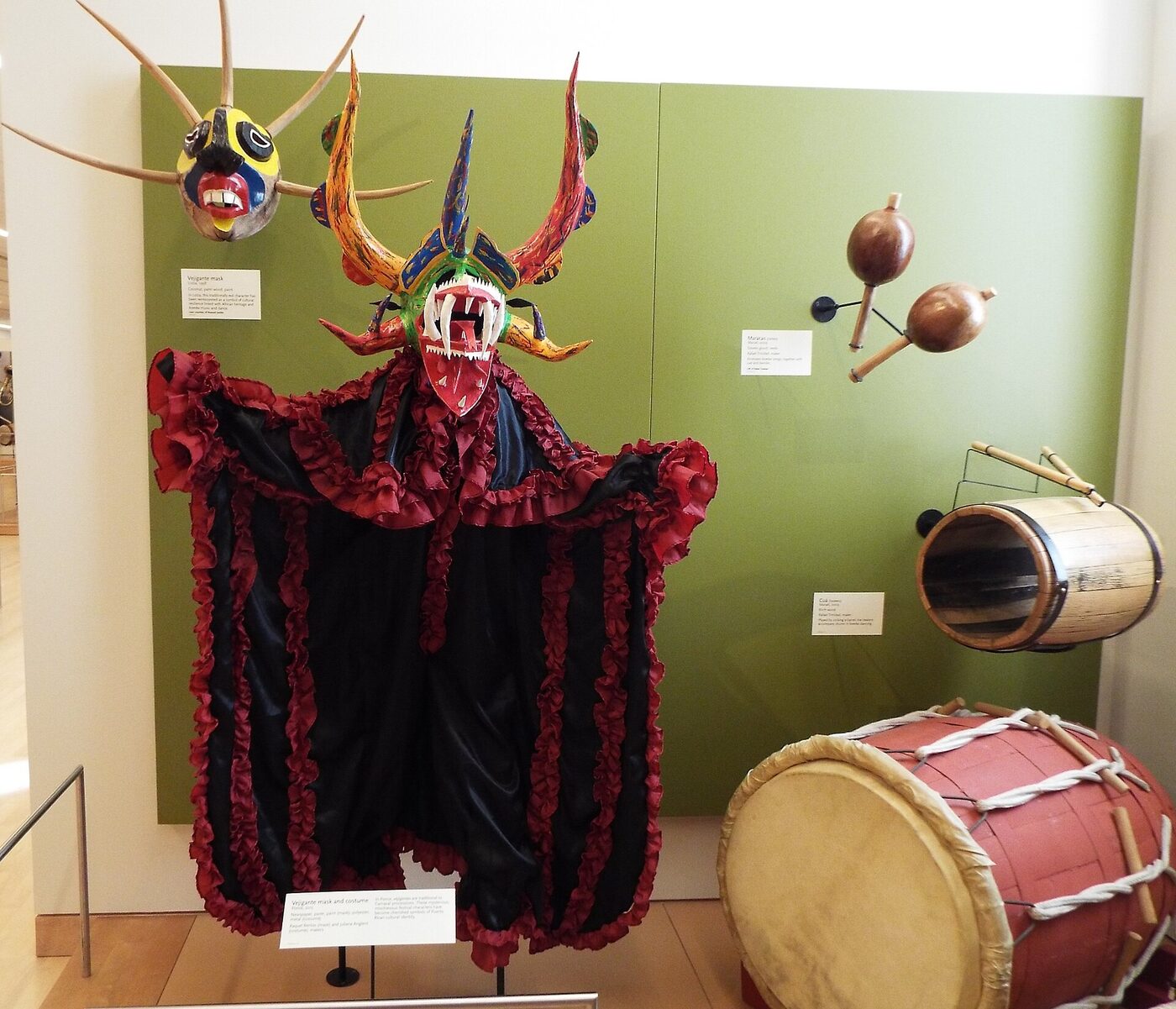
The year has a shape, and it is the shape the group's calendar threads followed. The Christmas season is long, runs on pasteles steamed in banana leaf and on the parranda — the ambush-carolling visit that arrives without warning and expects to be fed — and does not end at Epiphany. Three Kings' Day on 6 January is the children's festival; the winter league's all-star game was for decades scheduled to coincide with it so that the gate could buy toys. The Fiestas de la Calle San Sebastián in Old San Juan, held over the third weekend of January and revived in 1970 at the suggestion of the historian and anthropologist Ricardo Alegría, close the season with four days — Thursday to Sunday — of processions, craft stalls, dancing and the Comparsa de los Cabezudos, the parade of outsized heads representing well-known Puerto Rican figures. February or March brings the Carnaval Ponceño, documented since 1858 and ending on Shrove Tuesday, with its horned vejigante masks. In late July, Loíza keeps the Fiestas de Santiago Apóstol, the most fully Afro-Puerto Rican of the island's festivals, whose vejigante masks are made from coconut rather than papier-mâché. The feast day itself, 25 July, is also the anniversary of the American landing at Guánica in 1898 and, since 1952, Constitution Day.

Vieques, inside the gateway's own years
One episode ran through the period in which such groups were most used from beginning to end, and unlike most of the material on this page it can be dated to the day.
The United States Navy had used the island-municipality of Vieques, some five miles east of the main island, as a training and live-fire range since November 1941. On 19 April 1999 a Marine Corps F-18 on a training mission dropped two 500-pound bombs on a security post, killing David Sanes Rodríguez, a Vieques-born civilian employed by the Navy as a security guard, and injuring four others. The Congressional research account records that the ordnance was dropped “within the overall range perimeter”; the range was closed immediately afterwards.
What followed was a sustained campaign of civil disobedience on Vieques, with protesters repeatedly entering the live-fire area, and demonstrations in the mainland cities where the diaspora was concentrated. President Clinton asked the Secretary of Defense to convene a special panel, which reported on 19 October 1999. In January 2000 Clinton and Governor Pedro Rosselló jointly proposed a referendum of Vieques residents. Naval operations resumed on 27 April 2001; on 14 June 2001 the incoming Bush administration ordered training on Vieques to end in May 2003. On 1 May 2003 the Navy completed the transfer of its holdings — the eastern portion of the island, 14,573 acres — to the Department of the Interior; much of it became a National Wildlife Refuge and was simultaneously placed on the National Priorities List for Superfund clean-up, which was still running years later. Roosevelt Roads Naval Station on the main island, whose reason for existing was the range, closed on 31 March 2004.
The withdrawal therefore fell inside the four years the news2mail gateway was running, which is to say that a reader of this directory's own archive can watch the campaign end. The health and contamination questions that followed the withdrawal, and the arguments over what the range's decades of use did to the island's residents, were live in the group and remain live; this page records that they were argued, and declines to adjudicate them.
After the gateway: the storms, and the accounting
Everything in this section postdates the gateway's closure in 2004, and is set down separately for that reason.
Hurricanes are not new to the island and two large ones fell within the group's own life — Hugo in September 1989, before the group existed but well within its readers' memory, and Georges in September 1998, which crossed the whole length of the island. Neither compares with what came in 2017. Irma passed just to the north of the island in early September; Hurricane Maria made landfall near Yabucoa at 06:15 local time on 20 September 2017 as a high-end Category 4 storm with sustained winds of 155 miles per hour, the most intense hurricane to strike Puerto Rico since the San Felipe Segundo storm of 1928. Rainfall peaked at 37.9 inches at Caguas. The electrical grid failed island-wide and much of it stayed down for months.
The death toll became a documented dispute, and the honest way to report it is to name each study and what it actually said. The government's official count stood at 64 for many months. On 29 May 2018 a research team led by Nishant Kishore published in the New England Journal of Medicine a household-survey estimate of 4,645 excess deaths, with a ninety-five per cent confidence interval running from 793 to 8,498 — a range whose width was widely lost in the reporting of the central figure. On 28 August 2018 the Milken Institute School of Public Health at George Washington University, commissioned by the government of Puerto Rico and assisted by the University of Puerto Rico, published an excess-mortality study estimating 2,658 to 3,290 additional deaths in the six months after the storm, adjusted for emigration. The government revised its official toll to 2,975 on the strength of that study, and that is the figure now generally cited. Hurricane Fiona struck in September 2022.
Two other events of the period belong on any timeline of the island a reader might build from this page. In July 2019 the publication of a private group chat between Governor Ricardo Rosselló and his staff set off mass demonstrations — an estimated half a million people in Old San Juan on 17 July — and he resigned on 2 August 2019. And the 2020 census recorded the island's population at 3,285,874, down by nearly twelve per cent in a decade, while the stateside count rose past 5.6 million: the demographic crossing that the group's readers had spent twenty years anticipating, completed after most of them had stopped posting.
What the record does not show
What survives of this group is a founding file and an archive of articles. What does not survive is nearly everything a reader would most like to know about it, and the honest thing is to say so precisely.
There are no subscriber figures. No readership survey of the period gives a number for this group, and the estimates that circulate for other Usenet groups of the era come from instruments that did not cover it. There is no traffic series: nobody preserved a monthly article count for soc.culture.puerto-rico, and the archives that exist are not complete enough to reconstruct one reliably. There is no record of whether the BORIKEN gateway contemplated in clause 4 was ever established — the charter left the decision to the list's members, and the list's own administrative record does not appear to survive in any public mirror.
There is no moderator, because there was never meant to be one: the group was unmoderated by charter, and clause 2 put the whole burden of relevance on the individual contributor's judgement, which is the Usenet way of saying that nobody was in charge. There are, consequently, no moderation logs, no cancel records and no policy history — the sort of documentation that makes a moderated group's story writable.
And there is no reliable way to characterise the group's typical thread without misrepresenting it. This page has deliberately named no individual thread, quoted no posting and attributed no view to any poster, because the archive is large, uneven and easy to cherry-pick, and because on this subject in particular a selected quotation would function as an argument. Readers who want to know what was said should read it; the archive is public and the box above says where.
Scope and limits
This page covers one newsgroup and the world it belonged to. It does not cover the Caribbean as a region, its federation history or its other diasporas, which belong to soc.culture.caribbean; nor travel and practical questions about the islands, which belonged to rec.travel.caribbean; nor the neighbouring national groups, each of which has its own page in this directory. The mechanics of Big-Seven group creation, the Great Renaming and the soc.* hierarchy's own history are on the hierarchy page.
Everything in the sections above that is quoted from the group's own paperwork — the charter clauses, the newsgroups line, the vote tallies, the dates and the names of the proposer and the votetaker — comes from the Internet Systems Consortium's mirrors of news.announce.newgroups and of the control-message archive, and can be checked there. Everything else is context: dates, statutes, holdings, census counts and cultural chronology drawn from published sources and stated as such. Where a figure is contested, as with the mortality estimates after 2017, both the figure and the study that produced it are named.
On the status question this page reports and does not conclude. There are three long-established positions, each held by a party with a founding date and a platform, each supported by referendum results that can be read in more than one way, and each with a body of legal authority it regards as decisive. A directory page is not the place to choose between them, and a group that spent a decade choosing between them left a better record of the argument than any summary could. What can be said without taking a side is what the charter said in 1994: that this was a newsgroup for the life, culture and politics of a people spread across an island, a mainland and the rest of the world, and that for about a decade it gave all of them one public address at which any part of it could be argued out.
Reading soc.culture.puerto-rico today
- Historical archive: Google Groups — soc.culture.puerto-rico (coverage varies by group and era).
- Open in a newsreader:
news:soc.culture.puerto-rico— the original site offered exactly this link, and it still works if your system has a newsreader registered for thenews:scheme. - Live access: point an NNTP newsreader at a modern server — see accessing Usenet today.
- The original news2mail e-mail subscription service ended in the mid-2000s and no longer operates.