soc.culture.azerbaijan
Azerbaijan and the Azerbaijani people.
Created as the Soviet Union dissolved, the group carried the first open online discussion of Azerbaijani independence, the Nagorno-Karabakh war, and the Latin-script reform of the language.
Diaspora threads connected Baku with communities in Turkey, Iran (Iranian Azerbaijanis were a constant, complicated presence) and the West.
On this page
- The paperwork, and how it ends
- What the proposal actually asked for
- The roll
- January 1997: created anyway
- The alt.* group that took twenty-one minutes
- Four alphabets in a century
- The letter that would not fit
- Two Azerbaijans
- Who could post
- The record, in dates
- Oil, which is the other half of the charter
- What a culture group actually carried
- What the record does not show
- Scope, sources and limits
The paperwork, and how it ends
The Internet Systems Consortium mirrors the administrative record of Usenet. For every name that anyone ever put through the Big Eight's group-creation machinery there is a file of the formal documents, and for every name that anyone ever tried to create or destroy on the wire there is a second file of the control messages sent in its name. Both exist for this group, and neither says what a reader would expect.
The group-creation file for soc.culture.azerbaijan is 244,458 bytes long — about 239 kilobytes — carries a last-modified date of 12 January 1997, and holds five documents: a Request for Discussion of 8 May 1996, a revised Request for Discussion of 27 September 1996, a first Call for Votes of 27 November 1996, a second Call for Votes of 9 December 1996, and a result. The subject line of the result is the whole story:
RESULT: soc.culture.azerbaijan fails 1732:920
The proposal was defeated. Its own tally sheet, posted on 12 January 1997 by a neutral votetaker of the Usenet Volunteer Votetakers, who gave a contact address at the University of Arizona, states the arithmetic and the rule in the same breath:
There were 1732 YES votes and 920 NO votes, for a total of 2652 valid votes. There were 23 invalid ballots.
For group passage, YES votes must be at least 2/3 of all valid (YES and NO) votes. There also must be at least 100 more YES votes than NO votes.
Both conditions had to hold. The first — a hundred more yes than no — was satisfied eight times over: the margin was 812. The second was not. Two-thirds of 2,652 is 1,768, and 1,732 votes were cast in favour. The proposal failed by thirty-six votes on a supermajority test, having won 65.3 per cent of a ballot that a simple majority rule would have carried comfortably. The twenty-three spoiled ballots were itemised too: twenty-two rejected for an invalid address, one because the message contained no vote statement at all.
The size of that ballot deserves a note, because it is not typical. Eleven other files in the same branch were checked for this article, of which eight hold a result document. soc.culture.baltics passed 135 to 18; soc.culture.rep-of-georgia passed 130 to 20; soc.culture.belarus passed 164 to 19 and soc.culture.basque 164 to 62; soc.culture.croatia passed 236 to 35, soc.culture.bosna-herzgvna 512 to 52, soc.culture.albanian 564 to 30, and the largest of them, soc.culture.kurdish, passed 959 to 94. That is 1,053 ballots for the biggest neighbouring electorate on file. The Azerbaijani vote drew 2,652 valid ballots and 23 invalid ones, more than twice the largest of them, and lost.
The result carried the standard coda: a five-day discussion period in which irregularities could be raised, and a bar on voting the same proposal again for six months. The archive holds nothing after it. No revised proposal, no second ballot, no result, no creation. The file ends on 12 January 1997 and the name never came back through the front door.
What the proposal actually asked for
The document that lost is worth reading, because it is the only sustained statement anyone connected with this group left in a public archive. It proposed a moderated group, which in the Big Eight meant a panel of volunteers reading every submission before it reached the network, and it gave the newsgroups-file line that administrators were to paste into their servers:
soc.culture.azerbaijan Azerbaijan and Azerbaijanis. (Moderated)
That is not quite the description this directory carries at the head of this page. The two are close enough to be obviously related and different enough to show that whatever supplied the directory's line was not copying the proposal; where that wording came from is not recorded in the archives consulted here.
The rationale is a period document in its own right. It describes Azerbaijan as one of the three newly independent Transcaucasian states of the former Soviet Union, hopes the group will attract researchers working on post-communist development and transnational economics, and gives moderation as the means of keeping what it calls a high signal-to-noise ratio. Its figures are the proposal's own claims and are reproduced here as such: a population of 7.8 million as of 1995, given as 90 per cent Azeris with Dagestani peoples, Russians, Armenians, Jews, Talysh and Kurds making up the rest; a 1994 oil consortium valued at 7.5 billion dollars; and, since 1988, over a million refugees. It also names the rooms the conversation was borrowing in the meantime — soc.culture.soviet, talk.politics.soviet, soc.culture.iranian, soc.culture.turkish, the CENASIA and TRKNWS-L mailing lists, and a list devoted solely to Azerbaijan which the May document credits with sixty subscribers and roughly ten messages a day, and the September document with seventy.
The charter proper lists eight permitted subjects, in this order: culture and religion; economics, business and oil contracts; education, science and research opportunities; history and literature; the development and promotion of computer networking; politics, humanitarian aid and refugees; travel, tourism and geography; and sports and entertainment. A national culture group that puts oil contracts third and computer networking fifth is telling you something about the decade it was written in.
Then comes the part every charter written for a contested subject spends most of its length on: the list of what is off-topic. There are nine numbered prohibitions. Some are the ordinary furniture of Usenet — no advertisements, no spam, no lines longer than 75 characters, no crossposting to three or more groups besides this one, no binaries except that, in the revised version, PGP signatures under 2K are exempt. Some are sharper. One bans deliberate misattribution of quotations from historical documents and figures, and explains itself in a clause that reads like a scar:
The moderators shall interpret this rule loosely -- newsgroups are not academic journals -- but deliberate misattributions have poisoned the atmosphere in other newsgroups.
Another is the eighth, and it is the reason the group was proposed moderated at all:
Propagation of national, religious, racial, sexual, or ethnic hostility or animosity -- including posts openly justifying violence, war crimes, or ethnic cleansing.
The governance clauses are unusually careful for a 1996 newsgroup. A rejected submission could be appealed to the whole panel, which decided by majority; and if the panel split evenly, the submission was to be posted. New moderators could be admitted, and sitting ones removed, only by a two-thirds supermajority of the panel — the same fraction the group itself failed to reach. If traffic proved heavy, the moderators reserved the right to write a robomoderation script.
Five moderators were named, all of them students or researchers abroad: at the University of Southern California, Pace University, Cornell, the University of North Carolina at Chapel Hill, and the Open Media Research Institute in Prague. The slate of proponents was headed by Adil Baguirov, then an undergraduate at the University of Southern California, who was also the administrative contact and the first-named moderator. The article-submission address was at usa.net, a free web-mail provider of the period. A moderated Big-Eight newsgroup routed through a webmail account is as good a snapshot of 1996 as any.
One charter clause matters more than the rest for what follows. The proposal set the group's languages as English and Azeri, and added:
Posts in any other language, alphabet, or non-ASCII coding scheme will be subject to consideration by the panel of moderators.
A moderation policy about character sets. It is a small clause and an entirely rational one, and it points straight at the problem the next two sections of this page are about.
The distribution list at the foot of both proposals shows who the proponents thought they were addressing. Besides news.announce.newgroups and news.groups, the documents went to sci.geo.petroleum, soc.culture.arabic, soc.culture.iranian, soc.culture.pakistan, soc.culture.russian and its moderated sibling, soc.culture.turkish and talk.politics.mideast; to mailing lists including a Central Asia announcement list at Harvard, an international political economy list in Colorado, a former-Soviet-Union list, and — in the May version — a pipeline news list at Georgetown; and as pointers to a further seventeen or eighteen groups, the list differing slightly between the two versions, among them soc.culture.rep-of-georgia, soc.culture.baltics, soc.culture.afghanistan, soc.culture.jewish, rec.travel.asia and sci.econ. The first proposal was posted from an academic address at University College London, the second from the University of Southern California.
The roll
Usenet ballots were public. The votetaker published every address and every name supplied with it, so that anyone could check the count, and the result document for this proposal accordingly runs to 2,882 lines, most of them voters. The roll can therefore be counted by anyone who wants to, which is the point of publishing it.
A plain scan of that roll for this article recovers 1,730 of the 1,732 yes addresses and 917 of the 920 no addresses; a handful in each column are wrapped or malformed in ways a simple pattern misses, so the figures below are approximate to within a few votes and are offered as such. Sorted by the top-level domain of the voting address, they fall out like this:
- .edu — 714 yes, 355 no. American universities were where Usenet lived, and they were the largest single block on both sides of the ballot.
- .com — 196 yes, 254 no, the commercial providers that the Eternal September had brought onto the network.
- .tr — 307 yes, none recorded against.
- .am — 96 no, one yes.
- .az — 65 yes, none recorded against.
- .uk — 128 yes, 10 no; .ca — 41 yes, 46 no; .net — 47 yes, 87 no.
- Smaller counts run through another forty-odd domains, among them
.su, the Soviet Union's country code, still carrying twenty-five yes votes and none against, five years after the state that owned it had ceased to exist.
Two things follow from those numbers and no more than two. The first is that the electorate was overwhelmingly a diaspora and university one: the sixty-five votes from Azerbaijani addresses are a rounding error against the 714 from American campuses, which is exactly what the connectivity figures further down this page would predict. The second is that a Usenet vote in 1996 measured whichever constituencies could be reached by e-mail and persuaded to write a one-line message, and both sides reached theirs. What was said in news.groups during the discussion period is not preserved in this archive, which keeps only the formal documents; the arguments themselves are gone, and this page will not reconstruct them.
January 1997: created anyway
Ten days after the result was posted, the group was created.
The control-message file for the name holds four messages and no more. The first, dated 22 January 1997 at 17:39:46 GMT, is a newgroup for soc.culture.azerbaijan. It was sent from the lead proponent's own university address by way of an American commercial provider, using a Windows newsreader whose version string is preserved in the headers, and its From, Sender, Reply-To and Approved lines all carry his name, Adil Baguirov. The body is empty. Nothing about the message is concealed or borrowed: it was issued openly, over the sender's own name and from his own address, five weeks after the ballot had failed — a different kind of act from the forgeries described later in this section, and the file is unambiguous about which of the two this was.
Five days later the moderator of news.announce.newgroups answered. His rmgroup of 27 January 1997, PGP-signed and three lines long, says:
soc.culture.azerbaijan is widely considered a bogus newsgroup given that it has not been approved by accepted USENET group creation procedures. Please remove the group from your active file.
The same three lines went out again on 3 February 1997 and again on 27 February 1997, and the file stops there: one creation, three repudiations, thirty-six days from end to end. The repetition is not temper. A single removal reached only the servers that were listening when it was sent; the machines that had been offline, or fed slowly, or had taken the creation and missed the correction, each needed reaching again.
What the file does not contain is worth stating precisely, because the neighbouring names in this branch make it easy to assume otherwise. None of the three removals carries the sentence that the same moderator attached to genuine forgeries — that the recent newgroup in his name was not his. It is absent because it did not apply. In the whole of this file — four messages across thirty-six days — there is no message purporting to come from him that he did not send, no manufactured vote tally, no impersonation of any kind. For a national name in soc.culture.* during exactly the years when such names were being forged wholesale, that is a genuinely unusual clean sheet.
It was not, however, the only Azerbaijani name on the network. A second file, kept under soc.culture.azeri, holds 113 control messages — 70 creations and 43 removals — and it is a different kind of document altogether. Its first message is a newgroup stamped 1 April 1996 at 11:11:11 GMT, offering the newsgroups line soc.culture.azeri — The culture and the people of Azerbaijan above two sentences of parody boilerplate announcing that anyone may create a newsgroup in any hierarchy and that proposals may optionally be discussed. Sixty-six of the messages carry the header Organization: The Cabal and the one-word sign-off Meow, and each of those sixty-six asserts a different vote tally, from 50 to 34 at the low end to 349 to 58 at the high end, no two alike, attributed to twenty-four different days on which no such result was ever published. Sixteen of the sixty-six would not have satisfied the passing rule they claimed to have met. The file's last message is a removal dated 23 February 1999. That template — the header, the sign-off, the invented tallies — was applied to several national names in this branch in the same weeks, and the mechanism by which a forged control message propagated faster than its correction is set out in detail on the page for soc.culture.armenian, which received the same treatment; it is not retold here.
One reply in that file is worth keeping, because it is the only recorded human voice in either archive. On 4 April 1996, three days after the April Fool creation, a news administrator at Worcester Polytechnic Institute issued his own removal for the name, with a covering note:
Well, heck, then anyone can cancel a forged newgroup message which had been composed to appear to have been issued on April Fool's Day, 11:11:11 GMT.
Such bogus newsgroups may optionally be cancelled without discussion anywhere.
The parody was answered in kind, by a news administrator with a server and a sense of humour.
One piece of surrounding context belongs here, and no more than this. Automated posting on the subjects this branch dealt with was a recent memory in 1996. For several months in the first half of 1994 a poster using the alias Serdar Argic ran what most observers concluded was a program: it scanned Usenet for mentions of Turkey or Armenia and answered them with saved pages of political text, the output running to tens of thousands of articles concentrated in soc.history, soc.culture.turkish and misc.headlines, and it stopped in April 1994 when the upstream provider cancelled the account it came from. The proposal for a moderated group states its own reason for moderation — maintaining what it calls a high signal-to-noise ratio — and no document in either archive connects the two. The episode is recorded here as period context and not as a cause.
The alt.* group that took twenty-one minutes
There was one hierarchy where none of this applied. alt.* existed precisely as the escape valve from the Big Eight's formalities: a group there exists if administrators choose to carry it, and the customary courtesy is to announce the intention in alt.config and send a booster message a few minutes later for the servers the first one missed.
On the evening of 31 December 1996 — two weeks after the ballot closed and a fortnight before the result was posted — a poster in Munich did exactly that, and changed his mind halfway through. At 20:55 GMT he created alt.culture.turkish.azerbaijan; at 20:56 he boosted it; between 21:07 and 22:05 he removed it four times. At 21:09 he created alt.culture.azerbaijan instead, and at 21:16 he boosted that. The newsgroups line he supplied, and the single line of justification under it, have survived unchanged for thirty years:
alt.culture.azerbaijan Azerbaijanian Culture
This group shall be an international discussion group on the Azerbaijanian culture.
Twenty-one minutes, two names, no vote, no forgery, no correction, and nobody's permission. The control file for the surviving name holds those two messages and nothing else.
The consortium's current namespace files record how the two routes ended. The master active and newsgroups files distributed from the same archive each hold 45,003 entries, of which 213 are in soc.* and 139 in soc.culture.*. soc.culture.azerbaijan is in neither file. alt.culture.azerbaijan is in both, carrying the description its creator typed on the last day of 1996. So, without a description, is alt.culture.turkish.azerbaijan, the name the same poster created and then removed four times inside an hour.
None of which settles what was on anyone's news server. A group can be absent from the recognised namespace and present on the machine in front of you, and this directory is evidence that it was: these pages exist because a mail-to-news gateway carried the groups they list from 2000, and one of them was soc.culture.azerbaijan. Commercial feeds of that period offered the name years after the network's registrar had told them three times to drop it. The vote decided what the Big Eight recognised. It did not decide what people read.
Four alphabets in a century
Now the part of this group's story that no other page in this directory can carry, and which explains both the charter's clause about coding schemes and a good deal else besides. Within the lifetime of a single long-lived reader, Azerbaijani has been written in four different alphabets, and the last of the four changed shape again six months after it was introduced.
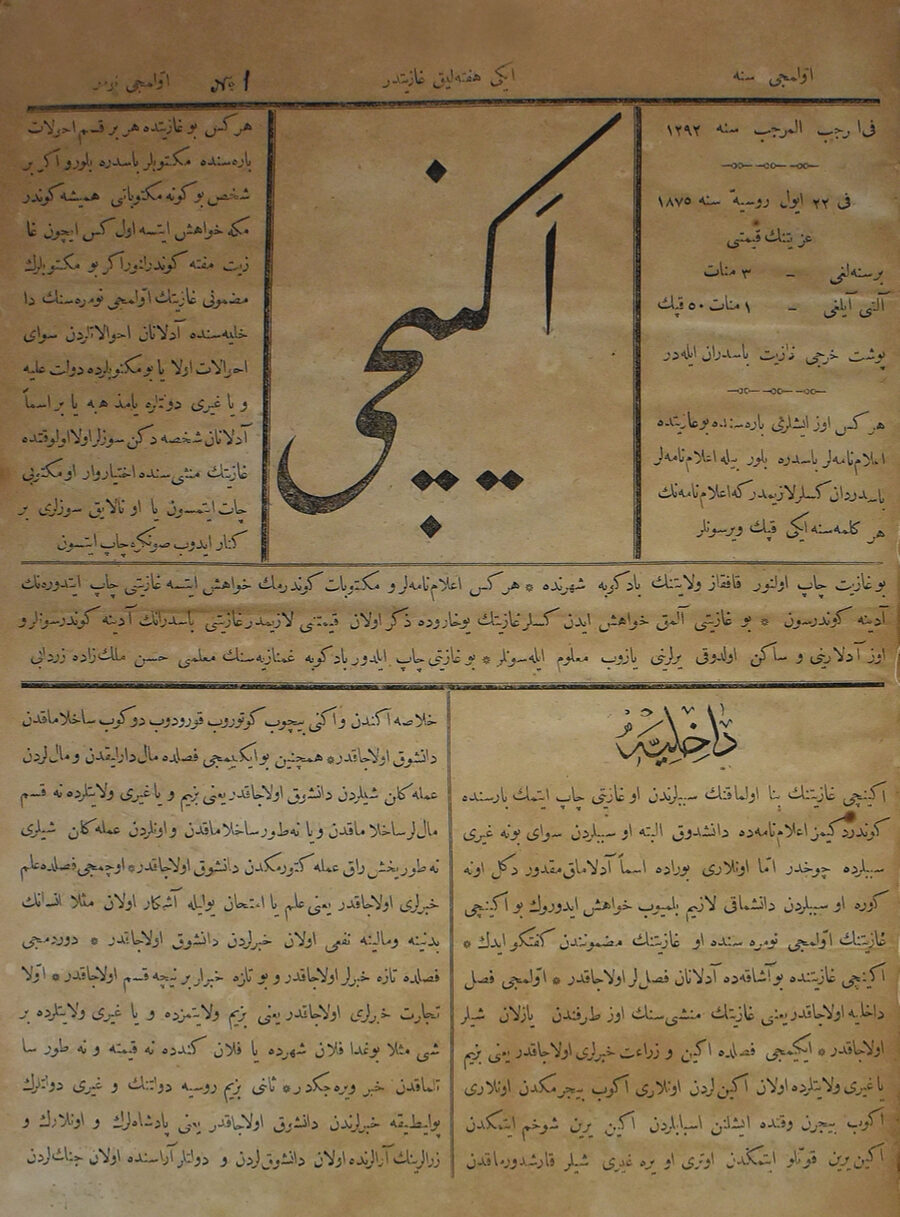
The Perso-Arabic script, to 1929
Azerbaijani was written in a modified Perso-Arabic script for centuries, and south of the border, in Iran, it still is; standard reference works date the practice there to the Safavid period. The system has known drawbacks for a Turkic language: the Persian alphabet carries several letters for a single consonant sound, and lacks dedicated characters for several Turkic vowels. It is written with the ordinary Arabic apparatus of diacritics — fatha, hamza, sukun — over alef, vav and ye to mark nine vowels, six of them shared with Persian and three not.
Reform was proposed long before it happened. The playwright and official Mirza Fatali Akhundov, who died in 1878, spent about twenty years developing alphabet projects, moving from a de-dotted Arabic to separated letterforms to, finally, a left-to-right Latin alphabet representing all vowels; he presented the scheme in Istanbul in 1863 and submitted proposals to Iranian authorities from 1857. Neither adopted it, for reasons the sources give as printing costs and politics in roughly equal measure. His argument was that the structure of the Arabic alphabet made literacy hard for ordinary people and kept education in the hands of a small elite.

The first Latin alphabet, 1922 to 1939
The reform arrived with Soviet power. In 1922 a New Turkic Alphabet Committee, sponsored by the USSR, was set up in Baku to devise a Latin alphabet; both Arabic and Latin scripts were used in print in Azerbaijan from 1922 to 1929, and in 1929 the Latin script officially replaced the Arabic one. The reform had been endorsed at the First Turkology Congress, held in Baku in 1926, where it was carried by 101 votes to 7.
That alphabet was then reformed again in 1933 to bring it into line with the alphabets of the other Soviet Turkic languages — the scheme usually called Yanalif or the Uniform Turkic Alphabet — which changed both glyphs and phonetic values. It is a strange-looking alphabet to modern eyes: a small-capital B for lower-case b, a Cyrillic-looking capital for y, a barred O, a Z with a stroke, an N with a descender, and the letter that will matter most in the next section, the schwa.
Cyrillic, 1939 to 1991
In 1939 the Latin script was discontinued by order and Azerbaijani was written in Cyrillic instead. The Cyrillic alphabet used from 1939 needed seven letters that Russian does not have — Ғғ, Әә, Ҝҝ, Өө, Үү, Һһ and Ҹҹ — and a revision in 1958 dropped several letters that had been carried only for Russian loanwords and brought in Ј, an eighth letter Russian does not have. That alphabet had a working life of just over half a century, which means it is the script in which the great majority of twentieth-century Azerbaijani printing was done and the one in which most people then alive had learned to read. It has not vanished: reference works note that in Dagestan, across the northern border, Azerbaijani is still commonly written in Cyrillic.
The second Latin alphabet, from 1991
When the Soviet Union collapsed, one of the first laws passed by the new parliament adopted a new Latin alphabet. It was introduced on 25 December 1991. As introduced, it used A-diaeresis — Ä ä — for the vowel written in the International Phonetic Alphabet as a low front unrounded vowel, the commonest vowel in the language. On 16 May 1992, less than five months later, that letter was replaced by the schwa, Ə ə, which the language had carried in both of its post-Arabic alphabets, Latin and Cyrillic alike. The reasons given for the reversal are historical: Ä ä is what Tatar, Turkmen and Gagauz use, and would have been the simpler choice, but the schwa was the letter the language's own printed past was written with.
The current alphabet has 32 letters. Set against the 29 of the Turkish alphabet it is the same list with three letters added — Əə, Xx and Qq — and nothing of the Turkish alphabet missing from it. From 1991 to 2001 both Latin and Cyrillic were accepted in a transitional period; since 2001 the Latin alphabet has been the republic's official script.
Set those dates against the group's own. The ballot closed on 18 December 1996. At that moment the republic's alphabet was five years old, its current form four and a half; the transitional period had another five years to run; the alphabet in which nearly everyone reading had done their schooling was Cyrillic; and the larger Azerbaijani-reading population, south of the border, was reading none of the above. A newsgroup is a text medium. This one had to choose a text.
The letter that would not fit
Usenet's floor was seven bits. RFC 1036, the December 1987 standard for the interchange of Netnews messages, defines the article as a simplified subset of the Internet mail standard of the period, and the network that grew on top of it moved plain ASCII reliably and anything else on trust. The formal article format that requires conformance with MIME — and therefore a declared character set — is RFC 5536, which obsoleted RFC 1036 in November 2009, a decade after the culture groups' busiest years were over. In between, eight-bit posting worked when the sender, every relaying server and the reader's software happened to agree, and produced mojibake when they did not.
ASCII contains none of the fourteen non-ASCII letters of the 1992 Azerbaijani alphabet: Ç, Ə, Ğ, İ, ı, Ö, Ş, Ü and their counterparts. So the practical question for anyone writing Azerbaijani on Usenet was which eight-bit code page to reach for. The answer is more interesting than it looks, and it can be checked to the code point by anyone with a character-set library to hand.
The Latin side: one letter short
The obvious candidate was ISO/IEC 8859-9, Latin-5, standardised for Turkish, with Windows-1254 as its Microsoft counterpart. Latin-5 is Latin-1 with exactly six positions changed: at 0xD0, 0xDD, 0xDE, 0xF0, 0xFD and 0xFE, the Icelandic letters Ð, Ý, Þ, ð, ý and þ give way to Ğ, İ, Ş, ğ, ı and ş. Because Azerbaijani and Turkish share every letter but three, that substitution is very nearly enough. Every letter of the 1992 Azerbaijani alphabet is present in both encodings — every letter but one. Ə and ə have no position in Latin-5 or in Windows-1254, and there is no near neighbour to fall back on.
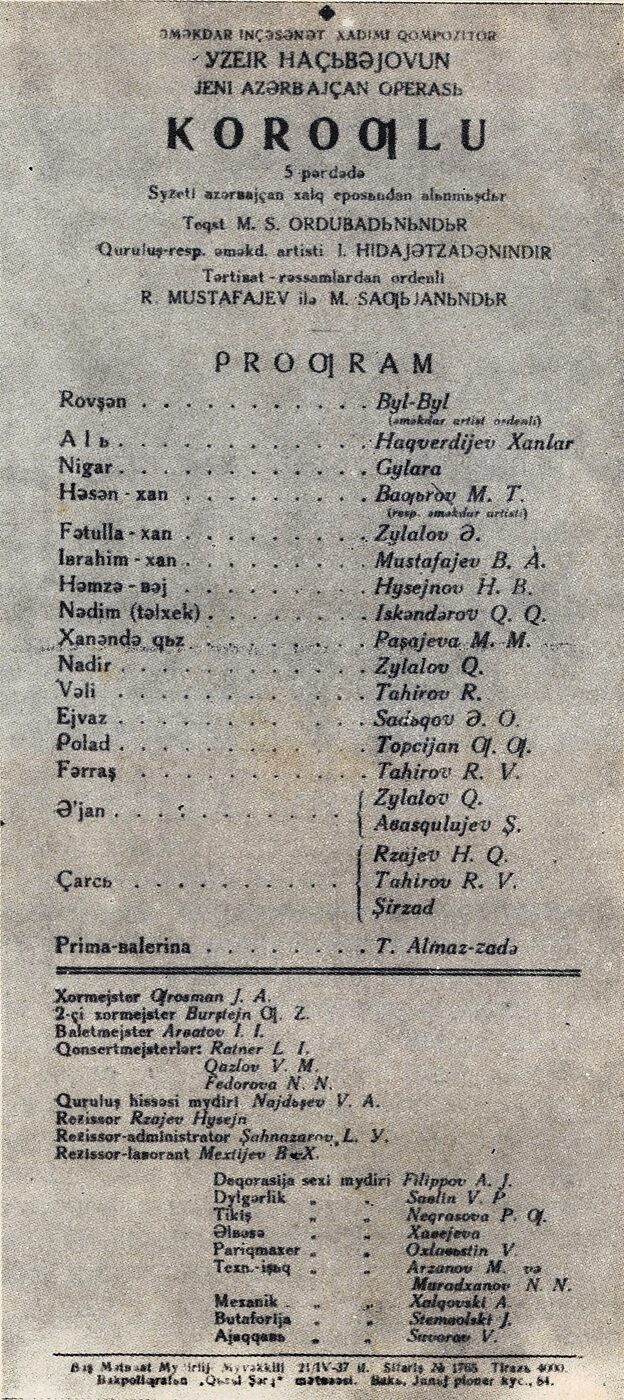
The schwa is not a letter the language can do without. It writes the front vowel /æ/, and it stands at the head of such ordinary words as əl (hand), ət (meat) and əzmək (to crush), besides running through a great many personal names. A 1937 theatre programme reproduced below carries it line after line down a cast list.
There is one exquisite consequence of the 1992 change. The alphabet as promulgated on 25 December 1991, with Ä ä in the schwa's place, fits entirely inside ISO 8859-9 and Windows-1254: not one character missing. For not quite five months, Azerbaijani was a fully encodable language on the eight-bit Internet. On 16 May 1992 it stopped being one. Where the schwa was needed and could not be sent, Ä ä was pressed back into service — the Tatar and Turkmen substitution, and an accidental return to the letter the alphabet had started with.

The Cyrillic side: seven letters short
A reader might reasonably assume the older alphabet was better served, since Cyrillic code pages were everywhere in the former Soviet Union. It was not. The seven letters Azerbaijani Cyrillic needed beyond the Russian inventory — Ғ, Ә, Ҝ, Ө, Ү, Һ and Ҹ — are absent from ISO 8859-5, from Windows-1251, from KOI8-R, from the DOS code page 866 and from the Macintosh Cyrillic encoding alike. Every one of those five carries the complete Russian alphabet and not a single one of the seven. The eighth letter, Ј, fares slightly better: ISO 8859-5, Windows-1251 and the Macintosh Cyrillic encoding all have it, because Serbian needs it, while KOI8-R and code page 866 do not.
Put the two halves together and the position is stark. Through the whole of the eight-bit era, Azerbaijani had no standard single-byte encoding in either of the two alphabets its readers were actually using. The Latin one was one letter short; the Cyrillic one was seven letters short. The Internet Assigned Numbers Authority's registry of character sets — the list from which the charset label on a MIME body is drawn — currently holds 258 entries, and not one of them is Azerbaijani. There was nothing to register.
Unicode, and why it did not help yet
Unicode had the letters from the beginning. The consortium's own age data assigns every character of both modern alphabets to version 1.1, released in 1993: the Latin capital schwa at U+018F and the small schwa at U+0259 in IPA Extensions, Ğ and ğ at U+011E and U+011F, İ at U+0130 and ı at U+0131, Ş and ş at U+015E and U+015F, and on the Cyrillic side Ғғ at U+0492 and U+0493, Әә at U+04D8 and U+04D9, Ҝҝ at U+049C and U+049D, Ҹҹ at U+04B8 and U+04B9, Үү at U+04AE and U+04AF, Һһ at U+04BA and U+04BB, and Өө at U+04E8 and U+04E9. Every letter this article has named was assigned a code point in the year the group's proponents were still undergraduates.
A code point is not a transport. Having a number for a character does nothing for a message that must travel through relays which will strip the eighth bit, arrive in a reader that has no font for it, and be quoted back by a third party whose software normalises it to a question mark. The gap between assignment in 1993 and dependable delivery on Netnews is most of this group's life.
The two Soviet-era Latin alphabets fared worse still, and this is the detail that gives the whole story its shape. Several of their letters waited a very long time for numbers. The N with descender, Ꞑ ꞑ, which both alphabets used, was encoded at U+A790 and U+A791 only in Unicode 6.0, released in 2010; the reversed open E, Ɜ, which belongs to the 1922 alphabet and was dropped in the 1933 revision, arrived at U+A7AB in version 7.0, released in 2014. A book set in Baku in the 1933 alphabet could therefore not be transcribed completely in Unicode until 2010, and one set in the 1922 alphabet not until 2014 — in each case a good deal longer than the alphabet in question lasted.
The consequence falls on the reader of the archive rather than on the writer of the post. One word may appear in these groups with ə, with ä, with a bare e or a, or in the Russian-derived transliteration that Soviet practice had made standard for two generations, under which the country itself was spelled Azerbaydzhan. Searching a Usenet archive for Azerbaijani material means searching for every spelling at once, and accepting that some of it is unfindable. The charter clause about non-ASCII coding schemes was not fussiness. It was a moderation panel writing down, in advance, that they would have to decide what to do about a language their transport could not carry.
Two Azerbaijans
The single fact that explains most about this group's readership is that the largest Azerbaijani-speaking population does not live in Azerbaijan.
The totals are agreed in outline and disputed in detail, and the honest way to give them is with their sources attached. A standard political encyclopaedia of the Middle East, published in 2002, puts the world Azerbaijani population at 30 to 35 million, distributed as roughly 20 million in Iran, 8 million in the republic, 1 to 2 million in Turkey, a million in Russia and 300,000 in Georgia. Estimates for Iran alone range across the literature from about 12 to 23 million: Ethnologue gave an ethnic population of 16.7 million in 2019 and 10.9 million Azerbaijani speakers in Iran in 2016; the CIA's World Factbook put Azerbaijani speakers at around 16 per cent of Iran's population in 2010, some 13 million; a 2013 academic survey notes that CIA and Library of Congress estimates range from 16 to 24 per cent, which on the then-current total gives 12 to 18 million. Ethnologue's 2022 figure for the Azerbaijani macrolanguage as a whole is 23.8 million speakers. Against any of these, the World Bank puts the republic's total population — all nationalities — at 8,048,600 in 2000.
Census figures, where they exist, are firmer than estimates. Georgia's census of 2002 recorded 284,761 Azerbaijanis, 6.5 per cent of the country. The United States census of 2000 recorded 14,205 residents born in Azerbaijan, of whom 5,530 were naturalised citizens, and 5,553 people claiming Azerbaijani ancestry; that census did not count Azerbaijani-Americans born anywhere other than Azerbaijan, which for a community with a large Iranian-born component leaves a great deal out.
The script divide runs straight through the middle of these numbers. North of the Aras, the republic's population reads a Latin alphabet introduced in 1991. South of it, the far larger population reads a modified Arabic one. The International Organization for Standardization treats Northern and Southern Azerbaijani as distinct languages; Ethnologue treats them as two members of one macrolanguage with significant differences in phonology, lexicon, morphology, syntax and loanwords; linguists who have tested the question report a high degree of mutual intelligibility. The two literatures, however, are not mutually legible on paper without learning a second script, and standardisation of the Iranian orthography was still being worked out in seminars in Tehran in 2001, five years after the group's ballot.
What this meant for a newsgroup is simple and slightly melancholy. An English-language group in the Latin alphabet, hosted on a network whose Iranian connectivity in the late 1990s was thinner than Azerbaijan's, sat some distance from the demographic centre of its own subject. The proposal's charter promised English and Azeri. Neither was the reading language of most Azerbaijani speakers alive at the time.
Who could post
Azerbaijan's arrival on the network can be dated to the day. IANA's root database gives the registration date of the country-code domain .az as 25 August 1993 and lists its manager at an address in Baku — three years and four months before the ballot closed.
How few people that described is the substance of the matter. The World Bank's series for individuals using the internet, compiled from returns to the International Telecommunication Union, records Azerbaijan at 0.0063 per cent of the population in 1996 — about six people in every hundred thousand. The series then reads 0.0992 per cent in 1999, 0.1478 in 2000 and 0.3056 in 2001, jumps to 5.0 per cent in 2002, and does not pass a quarter of the population until 2009, when it reaches 27.4. Through the whole of the period in which this name was contested, created and repudiated, the domestic audience for a newsgroup ran to a few thousand people at the very most, reached over dial-up and typically from a workplace, a university or an internet cafe rather than from home.
The sixty-five yes votes cast from .az addresses in December 1996 look small until they are set against that denominator, at which point they look like a substantial fraction of everyone in the country who could vote at all.
The rest of the electorate, and the rest of the readership, sat abroad: students on university feeds, researchers, and professionals who had left during the war years. This is the ordinary shape of a 1990s soc.culture group for a poor and newly independent country, and it had the ordinary consequence — the conversation about the place happened mostly outside the place, with news from home arriving second-hand, often as relayed press summaries, and with more advocacy and homesickness in the register than local reporting.
A readership spread that far has no common evening. Baku keeps UTC+4 and Tehran UTC+3:30; readers on the North American coasts sat at UTC−5 and UTC−8. That is twelve hours end to end, and it means no hour of the day finds such a group awake together. Every participant meets every argument several hours cold.
The record, in dates
What follows is a chronology and nothing more. Instruments are given by name and date; every figure and every characterisation is attributed to the body that produced it, and where sources differ the range is given. This directory adjudicates nothing about territory, responsibility or characterisation, and readers looking for a verdict will not find one here.
- 28 May 1918 — the Azerbaijan Democratic Republic is founded by the Azerbaijani National Council in Tiflis, after the collapse of the Transcaucasian Democratic Federative Republic. Its parliament, of 96 deputies, opened on 5 December 1918. It extended the vote to women in 1918, making it, on the standard account, the first majority-Muslim state to grant women equal political rights with men. It ceased to exist on 28 April 1920.
- 28 April 1920 — the Azerbaijan SSR is created following the Red Army's entry. It was incorporated into the Transcaucasian SFSR and became a separate union republic again in 1936. The Nagorno-Karabakh Autonomous Oblast was created within it on 7 July 1923.
- 20 February 1988 — the soviet of the Nagorno-Karabakh Autonomous Oblast votes 110 to 17 in favour of transfer to the Armenian SSR.
- 27 February to 1 March 1988 — the Sumgait pogrom. Official Soviet data record 32 killed; Armenian sources give figures above 200.
- 19 to 20 January 1990 — Black January in Baku, during a state of emergency declared as the Soviet Union came apart. Azerbaijani official estimates give 147 civilians killed, 800 injured and five missing; compilations of the reported figures give a range of 131 to 170 killed and 700 to 800 injured.
- 30 August and 18 October 1991 — the declaration and then the constitutional act of state independence. The Soviet Union is dissolved on 26 December 1991.
- 26 February 1992 — Khojaly. The Azerbaijani government's figure is 613 civilians killed, including 106 women and 63 children. Human Rights Watch, reporting in 1992 and 1994, wrote that it is widely accepted that 200 Azerbaijanis were killed and noted that as many as 500 to 1,000 may have died; the Russian human-rights centre Memorial also investigated and reported on the events.
- 1992 — the Conference on Security and Co-operation in Europe creates what becomes the OSCE Minsk Group to seek a negotiated settlement. It never produced a treaty.
- 1993 — the United Nations Security Council adopts four resolutions on the conflict, all unanimously: 822 on 30 April, 853 on 29 July, 874 on 14 October and 884 on 12 November. Each demands the cessation of hostilities and the withdrawal of forces from districts of Azerbaijan named in the text; 874 reaffirms the sovereignty and territorial integrity of Azerbaijan and of all other states in the region.
- May 1994 — the Bishkek Protocol, signed by representatives of Armenia, Azerbaijan, the breakaway authorities in Karabakh and Russia, with Kyrgyz and CIS signatories, brings large-scale fighting to a stop on 12 May 1994. It settled nothing else, and the conflict entered what the literature calls a frozen state.
- Displacement, 1988 to 1994 — standard reference compilations give approximately 724,000 Azerbaijanis displaced from Armenia, Nagorno-Karabakh and the surrounding territories, and 300,000 to 500,000 Armenians displaced from Azerbaijan, Nagorno-Karabakh and Nakhchivan.
- 27 September to 10 November 2020 — renewed full-scale fighting, forty-four days of it. A ceasefire agreement was signed on 9 November and ended hostilities from 00:00 Moscow time on 10 November 2020; approximately 2,000 Russian peacekeepers were deployed with a mandate of at least five years. Azerbaijan's figure for its own military dead is 2,906; Armenian and Karabakh authorities give 3,825. Civilian deaths are reported as 100 Azerbaijani and 85 Armenian.
- 19 to 20 September 2023 — a further offensive, ended by a ceasefire on 20 September 2023 under which the Karabakh forces were disbanded and disarmed; the breakaway authorities announced the dissolution of the republic on 28 September. Armenian government figures record over 100,617 people, put at some 99 per cent of the population, as having arrived in Armenia from Karabakh by 3 October 2023, out of an estimated population of about 120,000.
Almost all of that predates the group. The ballot closed on 18 December 1996, and everything down to and including the ceasefire and the oil contract of 1994 was inherited history by then rather than news. The proposal's rationale acknowledged as much in its own dry way, citing the unresolved conflict and over a million refugees as reasons the world's interest in Azerbaijan had increased. The last two entries fall long after the group had gone quiet, and they are the reason its archived threads read differently now than they did when they were written.
The other party to this conflict has its own page in this directory, describing its own newsgroup and its own record. Neither page answers the other, and neither is written as a reply.
Oil, which is the other half of the charter
The charter's third topic was economics, business and oil contracts, and of all the subjects a national culture group might have nominated in 1996 that one was the least speculative. Baku is one of the places the world petroleum industry was invented, and the documentary record is long, dated and — unusually for this page — uncontested.
The beginning is earlier than most histories of oil suggest. A Russian engineer built an oil-distilling works at Balakhani in 1837. In 1844 he proposed drilling for oil rather than digging for it; the proposal was supported in a government report on the Baku region, the viceroy of the Caucasus authorised funds in 1845, and in 1846 an engineer using a percussion drill sank a 21-metre well at Bibiheybat and struck oil. Edwin Drake's well in Pennsylvania, conventionally the start of the industry, was drilled in 1859.
The boom proper followed a change in the law. In 1873 the old otkupchina contract-monopoly was replaced by a long-term lease system, and the excise on kerosene was removed in 1877. The Nobel brothers' firm, Branobel, was established in 1879, having bought a refinery in 1873 and a large part of the Balakhani field in 1875. Foreign companies were admitted to the annual bidding for exploration and development rights in 1898, and British firms put 60 million roubles into the fields between 1898 and 1903.
The numbers from the peak are the sort that need checking twice. Between 1898 and 1901 Baku produced more oil than the United States. In 1898 the fields yielded about 8 million tonnes, some 160,000 barrels a day. By 1901 they produced more than half of the world's oil — 11 million tonnes, about 212,000 barrels a day, and 55 per cent of all Russian production — from, on the standard account, some 1,900 wells packed into six square miles. Production then fell away through the strikes and violence of 1903 and 1905, dropped to about 65,000 barrels a day by 1918, and collapsed further in 1920.
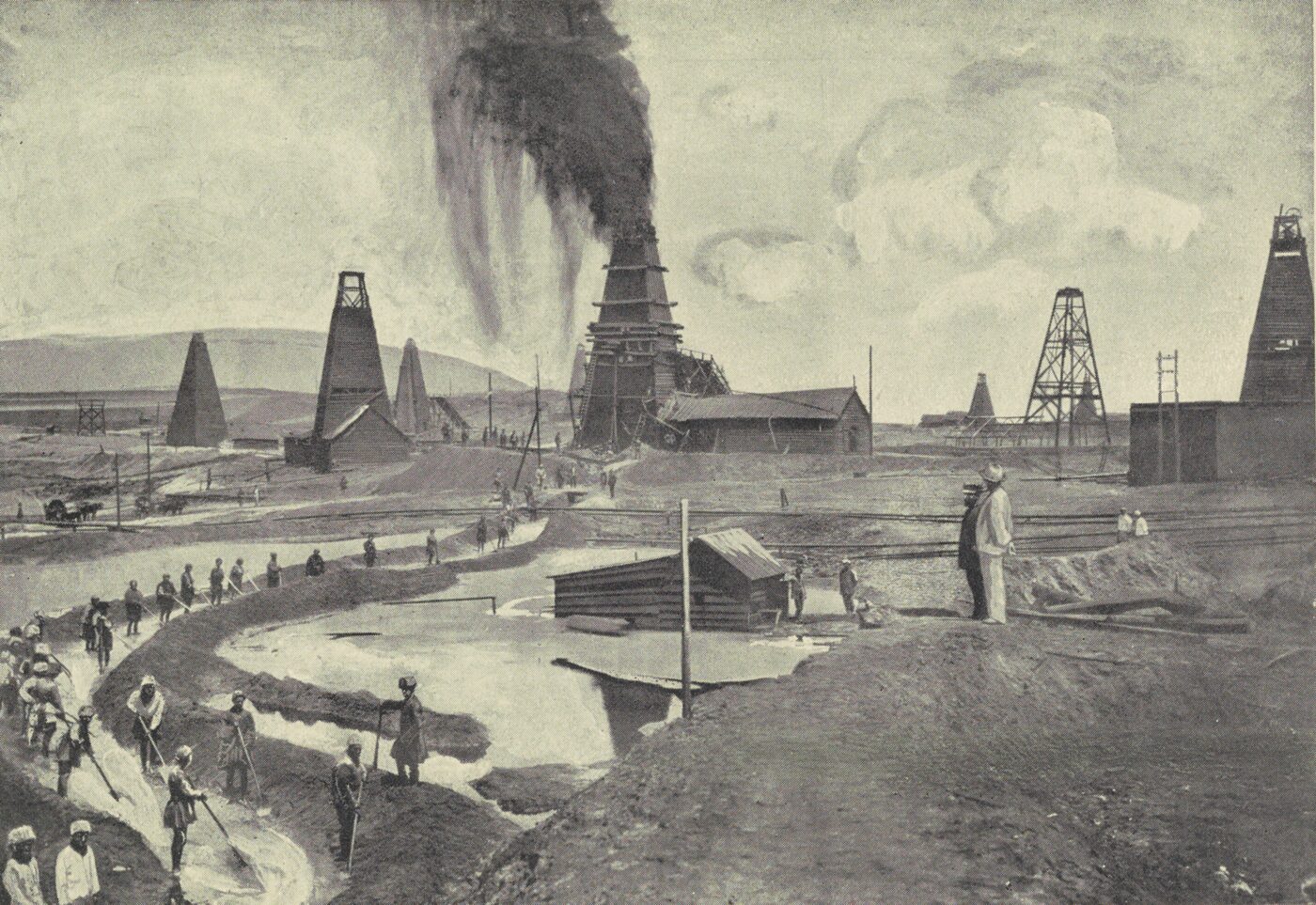
Under Soviet management the industry was nationalised into the state concern Azneft in 1920, and an oil academy was founded in Baku the same year to train the specialists the fields no longer had; of 1,800 qualified oil specialists then working in the Russian industry, 1,232 were in Azerbaijan. Output recovered: 8.7 million tonnes in 1928–29 out of a Soviet total of 13.5 million, and 23.5 million tonnes in 1940 — a national record not broken again until 2005. The strategic consequence is well documented on both sides. Britain and France drew up Operation Pike in 1939–40, a plan to bomb the Baku fields while the Soviet Union was supplying oil to Germany; Germany's 1942 southern offensive, Case Blue, was aimed at seizing them, and Hitler signed Directive No. 45 for the Caucasus advance on 23 July 1942. Neither plan reached the derricks. By the summer of 1942 more than 25,000 women, a third of the workforce, were working eighteen-hour shifts in the Azerbaijani oil industry; by 1944 the proportion of women had reached 60 per cent.
On 24 August 1949, after a causeway had been built out into the Caspian, the first offshore exploration well was spudded at Neft Dashlari, the Oil Rocks. In November, at 1,000 metres, it tested at about 700 barrels a day. The settlement that grew around it — a working town built on trestles and on the hulls of deliberately sunk ships — is recorded as the world's first operating offshore oil platform.
Then the sequence the charter's authors were writing about. On 20 September 1994 the production-sharing agreement for the Azeri, Chirag and deep-water Gunashli fields was signed with a consortium of international companies; parliament ratified it on 2 December and it entered into force on 12 December 1994. It is universally known as the Contract of the Century, and the operating company formed in 1995 to execute it, the Azerbaijan International Operating Company, originally had eleven members from the United Kingdom, the United States, Russia, Norway, Turkey and Azerbaijan.
Getting the oil out was a separate and longer argument, and it ran through the whole of the group's active life. The Ankara Declaration of 29 October 1998 committed several regional heads of state to a Baku–Tbilisi–Ceyhan route; the intergovernmental agreement between Azerbaijan, Georgia and Turkey was signed on 18 November 1999 at the OSCE summit in Istanbul; the construction ceremony was held on 18 September 2002; building ran from 2003 to 2005; the first oil pumped from the Baku end reached Ceyhan on 28 May 2006, and the terminal was inaugurated on 13 July 2006. The finished pipeline is 1,768 kilometres long. The Shah Deniz gas field, found in 1999, later turned the same route into a gas corridor as well.
Of everything in this section, only the pipeline entries fall inside the group's own lifetime. That is the general shape of this page: the group arrived after its subject's most eventful decade and spent its own years watching the consequences arrive.
What a culture group actually carried
Crises are what a country group is remembered for and not what most of its traffic consists of. The charter's first topic was culture and religion, its fourth history and literature, its eighth sport, and those are the subjects a soc.culture group runs on between the arguments: greetings at Novruz, recipes, translation requests, genealogy, music, and the perennial question of who a classical poet belongs to.
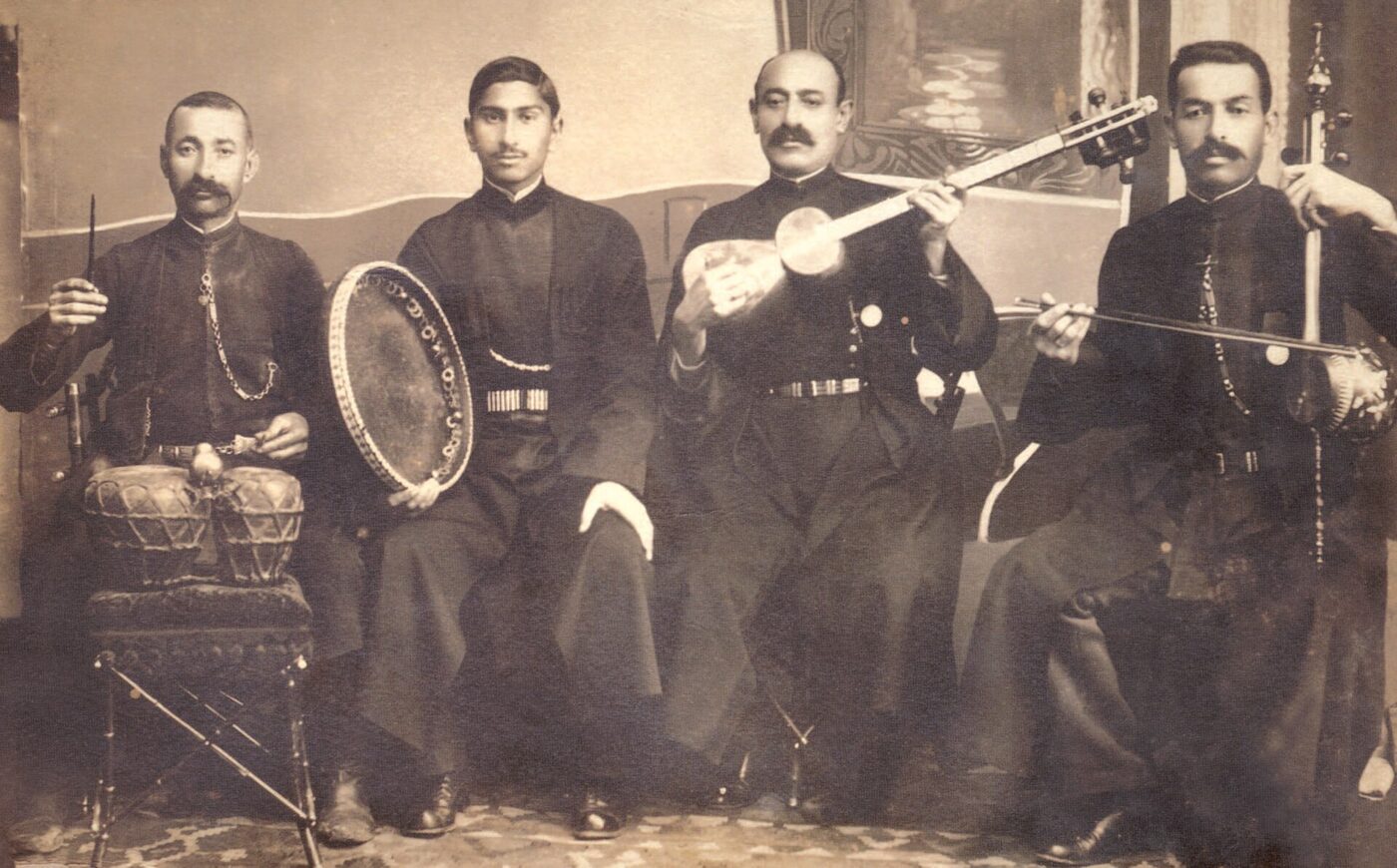
The music is mugham: a classical art of modal suites and large-scale improvisation, sung by a khananda with tar, kamancha and frame drum, transmitted by ear from master to pupil, with three principal schools recognised from the late nineteenth century in Karabakh, Shirvan and Baku. Uzeyir Hajibeyov, who composed the first Azerbaijani opera in 1908, published a systematic account of its modal system, Principles of Azerbaijan Folk Music, in 1945. Its formal recognitions came after the group's active years: UNESCO proclaimed Azerbaijani mugham a Masterpiece of the Oral and Intangible Heritage of Humanity in 2003 and added it to the Representative List in 2008, with the ashiq bardic tradition following in September 2009 and Azerbaijani carpet weaving in November 2010; dolma making was inscribed in 2017. One older recognition is the oddest of them: a short passage of mugham in the Çahargah mode, played on the double-reed wind instrument called the balaban and taken from a Radio Moscow recording, is on the Voyager Golden Record, and is now in interstellar space.

The carpets have a collection record to point at. The national carpet museum in Baku was founded in 1967 and first opened to the public in 1972 in the Juma Mosque in the walled old city; it moved in 2014 into a purpose-built hall on the seafront, shaped like a rolled carpet, and holds more than 10,000 exhibits across seven collections, of which the pile carpets are only one. The weaving regions each have their own repertoire of patterns, which is why a carpet in that museum is catalogued by district as well as by date.
The literature supplies the argument. Nizami Ganjavi, a twelfth-century poet, is described in the standard reference literature as the greatest romantic epic poet in Persian literature, and his heritage is widely appreciated in Afghanistan, Azerbaijan, Iran, the Kurdistan region and Tajikistan alike; how a poet who wrote in Persian is to be nationally assigned is a question with a long and unresolved bibliography, and it was argued on Usenet as it is argued everywhere else. Fuzuli, of the sixteenth century, composed in his native Azerbaijani as well as in Persian and Arabic and is a major figure in both Azerbaijani and Ottoman literature. One literary anniversary fell squarely inside the group's own lifetime: Azerbaijan and UNESCO nominated the Turkic epic cycle Kitabi-Dede Qorqud in 1998 and celebrated its thirteen-hundredth anniversary in 2000 — a state commemoration of a text whose ownership is itself argued over across several national literatures.
Sport supplied the period's cleanest dates, as it usually does. The republic's footballers played their first official international on 17 September 1992, losing 6–3 to Georgia at Gurjaani, and have entered qualifying for every major tournament from Euro 1996 onwards without reaching a finals. At Atlanta in 1996 — the first summer Olympics entered as an independent state, and the year of the ballot — 23 athletes, twenty men and three women, competed across nine sports, and Namik Abdullayev took silver in the men's freestyle wrestling at 52 kilograms.
And the food, which the charter's first topic covers as surely as its religion does: plov, served with herbs and greens in a manner distinct from the Central Asian preparations; dolma, wrapped in vine or cabbage leaves or stuffed into aubergines, and inscribed by UNESCO in 2017 as a shared tradition; and the long list of regional variations that any recipe thread exists to argue over.
What the record does not show
It is worth being blunt about the limits of everything above, because the temptation with an archive this rich is to mistake it for a record of a community.
The control archive records what was said to the network about a name. It records nothing whatever about what was posted, read or argued under that name. Four control messages and a lost ballot are the documentary remains of an administrative episode; they are not the remains of a conversation. The group-creation archive is better, because the proposals contain a charter and a rationale that people wrote deliberately and signed, but it too stops at the threshold: it preserves what the proponents said they wanted, not what they got.
What is missing, specifically:
- The discussion. The Request for Discussion of May 1996 opened a three-week comment period in
news.groups, and the proposal was revised before the second RFD in September — the charter's off-topic list was reordered and a PGP exemption added, and a mentor was credited. So there was a discussion, and it had effects. The archive keeps the before and after and not the argument in between. - Any traffic figure. Nothing in either archive records how many people read this group, how many articles it carried, or in what year it was busiest. Nothing here should be read as implying otherwise.
- Any thread. No subject line, no poster, no quotation from the group itself appears on this page, because none has been verified. Where this article describes what such a group discussed, it is describing what its own charter listed and what the surrounding documentary record establishes about the period, and nothing else.
- What the moderators would have done. The panel of five never moderated anything under this name, because the group they proposed was never created. Their appeal procedure, their tie-break rule and their two-thirds threshold were never tested.
There is one more absence, and it is the largest. Whatever ran under the name soc.culture.azerbaijan on the servers that carried it anyway — including the feed that produced this directory — ran without any of the machinery the proposal had designed. The charter that anticipated the trouble, the panel that was to handle it, and the appeal that was to check the panel all failed with the vote. What propagated was an unmoderated group with a moderated group's name.
Scope, sources and limits
Everything in the administrative sections of this page comes from two files in the Internet Systems Consortium's Usenet mirror — the group-creation archive for soc.culture.azerbaijan and the control archives for that name, for soc.culture.azeri and for alt.culture.azerbaijan — together with the consortium's current master active and newsgroups files. Quotations from those documents are exact. Counts of messages, of tallies and of vote-roll domains were made for this article from the files themselves and can be repeated by anyone; where a count is approximate, as with the vote roll, it is described as approximate.
The encoding claims can be checked directly. The six replaced positions in ISO 8859-9 and the absence of the schwa from it and from Windows-1254 are properties of the published mappings; so is the absence of all seven extra Azerbaijani Cyrillic letters from ISO 8859-5, Windows-1251, KOI8-R, code page 866 and Macintosh Cyrillic. The Unicode assignments and version numbers come from the consortium's own derived-age data, and the character-set count from IANA's registry.
Dates for the four alphabets, for the oil industry and for the cultural inscriptions were verified against standard reference works for this article. Population figures are given with their sources attached because they differ substantially between sources, and the ones for Iran differ by a factor approaching two. Connectivity figures are the World Bank's series built on ITU returns, and the domain registration date is IANA's.
Personal names are used sparingly here. The documents quoted are public and carry the names of everyone who signed them. This page names the lead proponent, because the proposal and the January 1997 control message cannot be described accurately without him and because an earlier version of this page named him; and it names historical figures — a nineteenth-century alphabet reformer, a composer, an Olympic medallist, a singer photographed in 1916 — where the name is what identifies the fact. The other proponents, the five named moderators, the votetaker, the news administrators and the poster who created the alt.* group are described by role and institution, and a reader who wants their names will find them in the archives cited above.
One correction to an earlier version of this page is recorded here rather than left silent. That version described the group as having gone through Usenet's formal creation machinery at the end of 1996 and as propagating widely afterwards. Its dates were right and its account of the charter was right, but the proposal failed, and the name was then created outside the procedure and removed three times; the documents that establish this are the five in the group-creation file and the four in the control file, both cited above. The same earlier version said that sceptics in news.groups questioned whether moderation could be even-handed and pressed for an unmoderated group instead. That discussion is not preserved in the archives consulted here, and the characterisation is therefore neither asserted nor denied on this page.
The historical chronology is a chronology. Where two sources give different figures, both are given; where a figure originates with a government, an international body or a named organisation, it is attributed to it. This page reports what the documented record contains and declines to weigh it. The people, the alphabet and the events of January 1990 each have a substantial literature, and readers wanting an interpretation should go to it rather than to a page about a newsgroup that failed its vote.
For the mechanics of Big-Eight group creation — the Request for Discussion, the votetakers, the arithmetic, the five-day wait and the control message at the end of it — see the soc.* hierarchy; for the culture branch as a whole, see soc.culture.*. The Russian-language question in the former Soviet Union, which touched every group in this region, belongs to soc.culture.russian.
Reading soc.culture.azerbaijan today
- Historical archive: Google Groups — soc.culture.azerbaijan (coverage varies by group and era).
- Open in a newsreader:
news:soc.culture.azerbaijan— the original site offered exactly this link, and it still works if your system has a newsreader registered for thenews:scheme. - Live access: point an NNTP newsreader at a modern server — see accessing Usenet today.
- The original news2mail e-mail subscription service ended in the mid-2000s and no longer operates.