soc.culture.canada
Discussions of Canada and its people.
Hockey, healthcare, and the constitutional question — soc.culture.canada spanned the 1995 Quebec referendum era, when it briefly became one of the most intense rooms on Usenet, through years of calmer Canadian-identity conversation.
It maintained a peaceful, mostly bilingual coexistence with soc.culture.quebec, with periodic diplomatic incidents.
On this page
- The proposal, the vote and the paperwork
- What the vote list shows about who was in the room
- How Canadians got on the network
- The .ca domain and its unusually long-running volunteer registry
- The hierarchies next door: can.* and the local trees
- The group next door
- The calendar the group lived through
- The definitional question
- Land and treaties: the documented record
- The Indian Act and its amendments
- Residential schools: the commissions, and when they reported
- Modern agreements, the courts and a new territory
- The words that changed inside the group's lifetime
- Two official languages, one English-language group
- Syllabics, and what the network could not carry at all
- Hockey
- Weather as a national subject
- Books, prizes and the table
- Regions, the border and what else the group carried
- The later years, and one forged control message
- What the record does not show
- Scope and limits
The proposal, the vote and the paperwork
soc.culture.canada belongs to the family of national groups that grew up inside soc.culture.* after the Great Renaming of 1986–87 sorted Usenet into seven topical hierarchies. Those groups were added one at a time, each by the proposal-and-vote ritual conducted in news.groups, and this one arrived in the spring of 1991 — early enough to be well established before the general public began appearing on the network, late enough that the procedure had settled into its mature form. Its administrative record survives in full, which is more than most groups of its vintage can say. The Internet Systems Consortium's mirror of news.announce.newgroups holds a single file for the group, about twenty kilobytes of archived mail and news, and it contains the whole procedure from first suggestion to final count. The proposal itself is short enough to quote entire, and it is dated 3 February 1991 — filed, through some accident of the archivist's mailbox, under the subject line Re: can you help me?, which is not a promising start for a national institution.
I propose creation of the group SOC.CULTURE.CANADA. This group would be similar to the other soc.culture._____ groups. The group would be unmoderated. Postings would be allowed in either english or french.
I hope that readers of can.general or can.francais which are newsgroups available only in Canada, would occasionally post articles of interest to the rest of the world.
Two things in that paragraph are worth marking, because they define the group's whole subsequent shape. The first is bilingualism by charter: postings in either language, stated in the founding document and never rescinded. The second is the proposer's own account of what the group was for — a window through which a domestic conversation already running in Canada-only groups could be shown to the rest of the world. soc.culture.canada was proposed, from the outset, as an export.
The Call for Votes went out on 28 February 1991, cross-posted to news.groups and to soc.culture.british, soc.culture.australian and soc.culture.french — the three sibling groups whose readerships the proposer evidently judged most likely to care. Its description of the group added a joke that reads today as a small piece of policy: the group would be "basically the same as the other soc.culture.groups, with the proviso that it will not be can.politics :-)". The ballot was bilingual too. Voters mailed [email protected] or [email protected] and were told to "Put a simple 'yes' or <oui> or 'no' or <non> in your message." Voting was to run to 25 March 1991.
A second Call for Votes on 20 March carried, as the convention of the day required, an acknowledgement list of the votes received so far — 179 addresses, yes and no together, published so that anyone could check whether their ballot had arrived. Voting closed early on Tuesday 26 March; the last vote had come in on the Monday evening. The RESULT posting is dated 28 March 1991. It gives the arithmetic once and the conclusion twice, in each official language in turn:
31 no/non · 194 yes/oui · 225 total
Ca fait deux tiers des votes, et plus que 100 plus oui que non. Le group a passe'!
More than two-thirds of the votes and more than 100 more yesthan no votes were receiveds. Hence, the group has passed.
That is the Big Seven's passing rule applied exactly as written: a hundred more yes votes than no votes, and at least two-thirds of the valid votes in favour. 194 out of 225 is 86 per cent, and the margin was 163, so the group passed with room to spare. The subject line of the same posting reads "soc.culture.canada passes 194:30", and the enumerated yes-list beneath it runs to 195 lines against a no-list of 31 — small inconsistencies of exactly the kind hand-tallied Usenet ballots routinely carried, some of them explained by a single correspondent appearing under two addresses. The mandatory five-day challenge period existed to catch precisely this sort of thing; nobody appears to have challenged anything.
The votetaker's closing note records where the ballots had come from: "Votes were received from all over: Australia, Finland, UK, US, Canada, Switzerland, France etc. (I apologise if I missed your country; I did only a cursory search)." The same posting thanked the people who had sent puns, and declined to thank "the people who said the only culture in Canada is in yoghurt :-)".
The group came into existence on 2 April 1991, when the moderator of news.announce.newgroups issued the control message. Its body runs to five lines, and it is the group's founding document. It reports the vote and then supplies, under its own heading, the single tab-separated line that every news administrator's software actually consumed:
soc.culture.canada is an unmoderated newgsroup which passed its vote for creation by 194:30 as reported in news.announce.newgroups on 28 March.
For your newsgroups file:
soc.culture.canada Discussions of Canada and its people.
The typographical error in "newgsroup" has propagated, uncorrected, through thirty-five years of archived control traffic. Two further newgroup messages for the name appear in the ISC control archive — a local re-issue from a Massachusetts company's news server in May 1991, and one confined to the University of Maine's campus distribution in April 1992 — both of them administrators making sure their own machines had the group, rather than anyone attempting to create it afresh.
What the vote list shows about who was in the room
Because the votetaker published every address, the 1991 ballot is the single best surviving evidence of who cared about this group at its creation, and it is worth reading as a document rather than a list. Almost nothing else about the group's readership survives in that form.
The first thing it shows is that the electorate was not, in any simple sense, Canadian. Voters wrote from Swiss federal institutes, from CERN, from Australian universities, from Finland, Denmark, Norway, France and Germany, from the American national laboratories and from a long file of United States campuses. Canadians voted in numbers, but they voted alongside a large constituency of people who were interested in Canada from somewhere else — the standing condition of every soc.culture group, and the reason the branch existed at all. The proposer's stated purpose, showing a domestic conversation to the rest of the world, had an audience before the group had a name.
The second thing it shows is the state of the network in early 1991, in a way no summary can. The list is a museum of address formats. There are BITNET addresses gatewayed through Iowa State and through CUNY, in the shouting uppercase of the mainframe world. There are UUCP bang paths routed through uunet.UU.NET and decwrl.dec.com. There is a vote from a FidoNet node. There are Australian addresses in the old .oz.au form. Several correspondents appear twice, having reached the votetaker by two different roads, which is how mail worked when there was no single road.
The third thing is more specific to Canada, and it bears on the section below. Canadian voters appear under two quite different kinds of address. Some wrote from .ca: from Saskatchewan, from British Columbia community systems, from Hydro-Québec's research institute, from Carleton, from the University of British Columbia, from an Ontario public-access site. Others did not. Every Toronto ballot was cast from toronto.edu, and Waterloo's more often from waterloo.edu than from uwaterloo.ca, because in 1991 the Canadian country-code domain was four years old, entirely voluntary, and had not yet swept up the campuses that had been on the network longest. The arithmetic is easy to check: of the 226 lines in the two published lists, 31 carry a .ca address and a further 11 come from Toronto or Waterloo under .edu — a little under a fifth of the electorate, identifiably Canadian, in a group about Canada.
How Canadians got on the network
The claim that Canada was unusually well wired for the period is not atmosphere; it has a documented history, and it is the structural reason a country of that size supported a busy worldwide newsgroup about itself.
The groundwork predates the Internet. Canada's DATAPAC, opened for use in 1976, was the world's first public data network designed specifically for the X.25 packet-switching standard. Academic networking followed in 1983, when a project driven from the University of Guelph set out to link roughly twenty Canadian universities so that they could share files and forward mail. It used the IBM RSCS protocol — designed to attach remote printers and card readers to mainframes, and adapted without much ceremony to carry mail between them — over leased point-to-point lines typically running at 2,400 bits per second, with each university paying for the line to its nearest neighbour. The resulting cluster was called NetNorth, and it was the Canadian arm of BITNET, the American academic network that used the same protocols. Interconnection with BITNET was negotiated and operational at the startup in 1984.
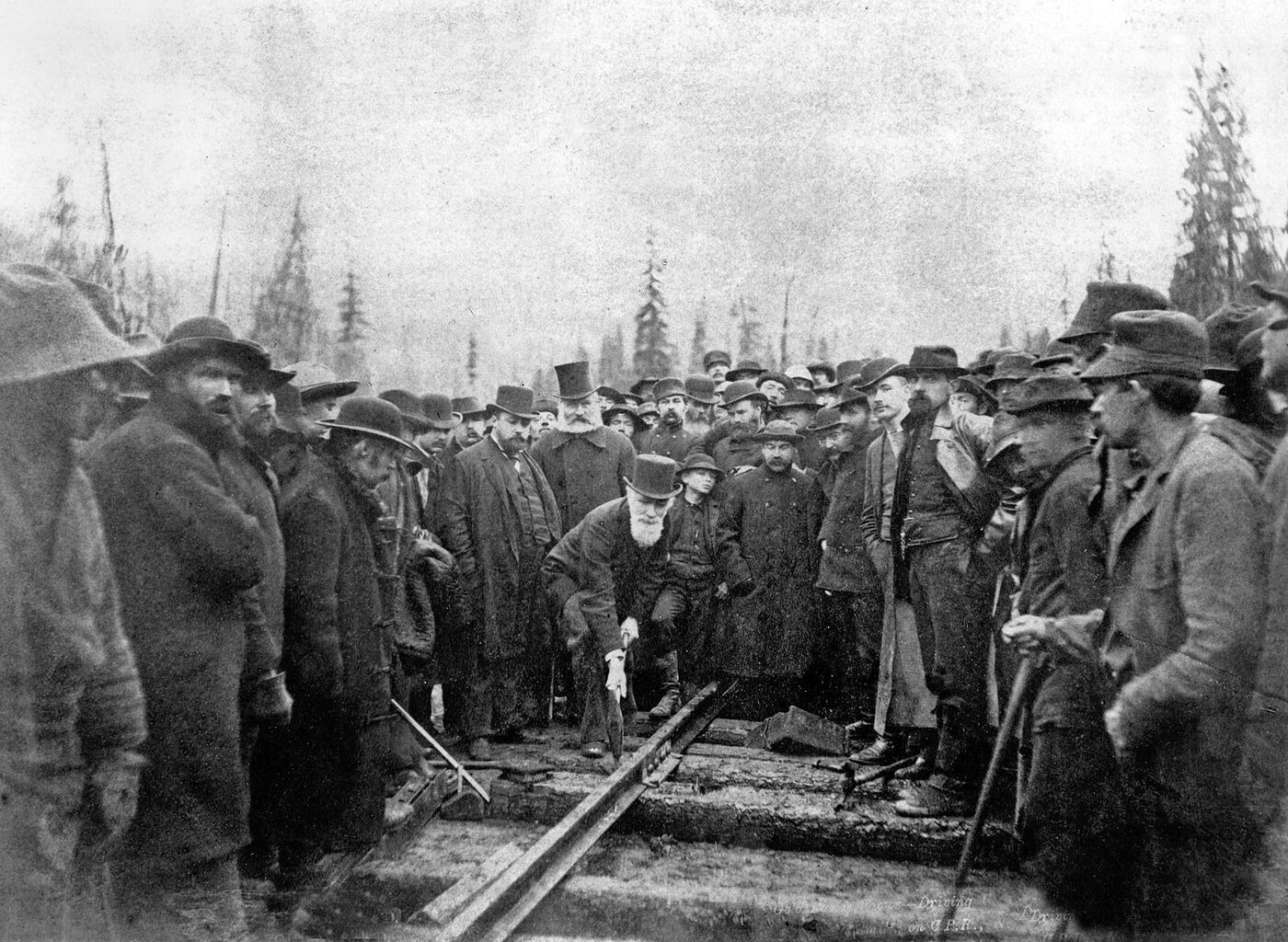
Before the end of the following year, coast-to-coast connectivity to BITNET was in place — one hundred years to the day after the last spike of the Canadian Pacific Railway was driven at Craigellachie, British Columbia, on 7 November 1885. Whether the engineers arranged the coincidence or merely noticed it is not recorded; the anniversary is noted in the standard chronologies of the Canadian network, and has been repeated in accounts of it since.

Research networking in the Internet sense was assembled the same way, province by province, on regional networks serving each province's universities: ONet in Ontario, RISQ in Quebec, BCnet in British Columbia and their counterparts elsewhere. Gateways from the Canadian academic network to ARPANET, CSNET and — in 1989 — the American NSFNET followed. CA*net was created in 1990 as the national backbone, with support from the National Research Council. CANARIE, the not-for-profit body that would go on to run the national research network, was established in 1993; the backbone reached 56 kbit/s that year, 10 Mbit/s in 1995 and an aggregate 100 Mbit/s in 1996, and operating control of network operations passed to a commercial carrier in 1997.
None of this was built for newsgroups. But Usenet in 1991 ran on university and research machines, and a country whose campuses were connected early, cheaply and from coast to coast put its readers on the network sooner than its population alone would predict. That is the unglamorous explanation for a Canadian presence out of proportion to the size of the country, and for the fact that when the vote was called in 1991 there were already Canadian campuses that had been reachable from the rest of the network for the better part of a decade.
The .ca domain and its unusually long-running volunteer registry
The other piece of Canadian network infrastructure that bears on this group is the country-code domain, because its peculiar governance is visible in the group's own paperwork.
In May 1987 the Information Sciences Institute at the University of Southern California — then performing the function later formalised as IANA — delegated .ca to the University of British Columbia. The university was named the sponsoring organisation; its computing facilities manager in the computer science department became administrator and technical contact; and for the next decade a group of volunteers ran the national domain of a G7 country. That is not a figure of speech. There was no registry corporation, no fee schedule and no staff: applications were assessed by hand against a published set of rules about who was entitled to what.
Those rules produced the shape of Canadian addresses that a reader of the 1991 vote list will notice. Organisations that could not demonstrate a national presence were not given a plain second-level name; they were placed under a province or a municipality instead, which is why so many Canadian addresses of the period read something.on.ca, something.bc.ca or something.qc.ca. The convention outlasted the registry: new registrations at that third level were only stopped in 2010.
The volunteer arrangement lasted until the end of the 1990s. After public consultations, the Canadian Internet Registration Authority was incorporated on 30 December 1998; the federal government recognised it as the authority for the domain in a letter of 11 March 1999; an umbrella agreement between the registry, the university and the government followed on 9 May 2000; and ICANN redelegated .ca to the new body with effect from 1 December 2000. At the handover the domain held roughly 120,000 registrations — a small number by later standards, and a reminder that for most of soc.culture.canada's active life the Canadian namespace was a hand-run affair with a few tens of thousands of entries in it.
The hierarchies next door: can.* and the local trees
soc.culture.canada was never the only place Canadians could argue with one another, and the proposal said so in its second sentence. The national hierarchy can.* already existed in 1991, and it was substantial. The canonical newsgroups file that the Internet Systems Consortium publishes as the description of the world's namespace — the copy consulted for this article lists 45,003 groups in total, of which soc.culture.* accounts for 139 and soc.* as a whole for 213 — still carries 48 can.* groups.
Read down that list and the division of labour becomes obvious. can.general took items of general interest; can.politics took Canadian politics; can.legal, can.taxes, can.med.misc and can.consumers took the business of living in the country rather than discussing it. Two groups split the country by language outright — can.english, "The Canadian English-speaking population (in English)", and can.francais, "The Canadian Francophone population (in French)" — and a third took the inevitable consequence, which the newsgroups file describes in a single line:
can.talk.bilingualism Flames about Canadian English or French, depending.
Beneath can.* sat an unusually thick layer of regional and institutional hierarchies. INN's control.ctl, the file that tells a news server whose control messages to honour for which prefix, still lists twenty-one entries whose headers place them in Canada, seventeen of them naming the country outright and the rest identified only by a Canadian place: provincial trees for British Columbia, Ontario and Newfoundland and Labrador; city and regional trees for Ottawa, Vancouver, Winnipeg, St John's, Halifax, Hamilton, Kitchener–Waterloo and the Niagara Peninsula; three community networks, in Toronto, Ottawa and one general-purpose Canadian project; and campus hierarchies for Carleton, Concordia, McMaster, Toronto, Waterloo, Western Ontario and York. The University of Waterloo's tree is the largest single Canadian entry in the whole namespace: 796 groups, well over half of them per-course newsgroups carrying the description "Course newsgroup" and nothing else.
Two absences in the same files are worth recording without over-reading them. can.* itself has no entry in the copy of control.ctl consulted here, although its groups remain in the newsgroups file — a hierarchy still described but no longer administered by anyone the distributed configuration knows about. And the Winnipeg tree carries a note that says plainly what happened to most of them: still in use, no active maintainer, control messages not to be honoured without confirming who sent them.
The practical distinction between all of this and soc.culture.canada was propagation. A regional hierarchy is carried by the servers that choose to carry it, which in practice meant Canada and a handful of neighbours. A Big Seven group went everywhere. can.politics was where Canadians talked to Canadians; soc.culture.canada was where a prospective immigrant in Manila, a homesick expatriate in Zurich or an argumentative undergraduate in Ohio would actually find them. The general shape of that bargain — worldwide propagation in exchange for having to explain yourself — is described on the soc.culture.* hub, and the mechanics of Big Seven group creation on the soc.* hierarchy page.
The group next door
Every country page in this branch has a most-argued subject. This one is unusual in that its most-argued subject had a separate address in the same branch, and two further namespaces of its own besides.
soc.culture.quebec was proposed on 8 June 1994 and passed on 15 August 1994 by 440 votes to 80 — an electorate more than twice the size of the one that had created soc.culture.canada three years earlier, which is itself a measure of how much the network had grown and how much the subject mattered. The proposal's case for a separate group included a traffic estimate that is, so far as the surviving record goes, the only contemporary numerical statement anyone made in public about how busy soc.culture.canada was:
Issues related to Quebec are often discussed in the groups soc.culture.french and soc.culture.canada, where it is not uncommon to see more than 100 messages posted daily. We can therefore expect a slight decrease in the volume of postings handled by those two groups following the creation of soc.culture.quebec.
Whether the expected decrease materialised is not recorded. What the arrangement meant for this group's scope, however, is clear enough. From August 1994 onward there existed a worldwide, English-dominant group whose subject was Quebec; a provincial hierarchy, qc.*, of which the newsgroups file still lists three groups, qc.politique among them; and the francophone hierarchy fr.*, open to any French speaker anywhere and running to some 144 groups in the same file. soc.culture.canada retained the federal frame — the country as a whole, its institutions, its regions and its arguments with itself — and cross-posting did the rest. The same article about language law could be read very differently depending on which group a reader had opened it in, which is a general property of cross-posted threads and was a specific occupational hazard here.
What soc.culture.canada carried in the referendum weeks of 1995 was, characteristically, the administrative consequences: currency, borders, passports, citizenship, the division of the public debt, the mechanics of a count. The group came at the question predominantly from the federal side, which is a description of where most of its readers sat rather than a statement about where anyone ought to have sat; the sovereigntist case was argued in it too, at length and by people who lived with the consequences. The margin settled nothing, and neither did the group.
This page defers accordingly. The group for Quebec, the three-namespaces arrangement, the referendum of 1995 in detail, and the province's cinema, chanson and vernacular are the subject of soc.culture.quebec; the provincial hierarchy, the parties and the language legislation are the subject of qc.politique. Neither is retold here.
The calendar the group lived through
A reader coming to the archive cold needs the dates, because the traffic tracks them closely. What follows is a bare chronology of the federal events that fell inside or immediately before the group's active years; each is a matter of record, and none of them is settled by being listed.
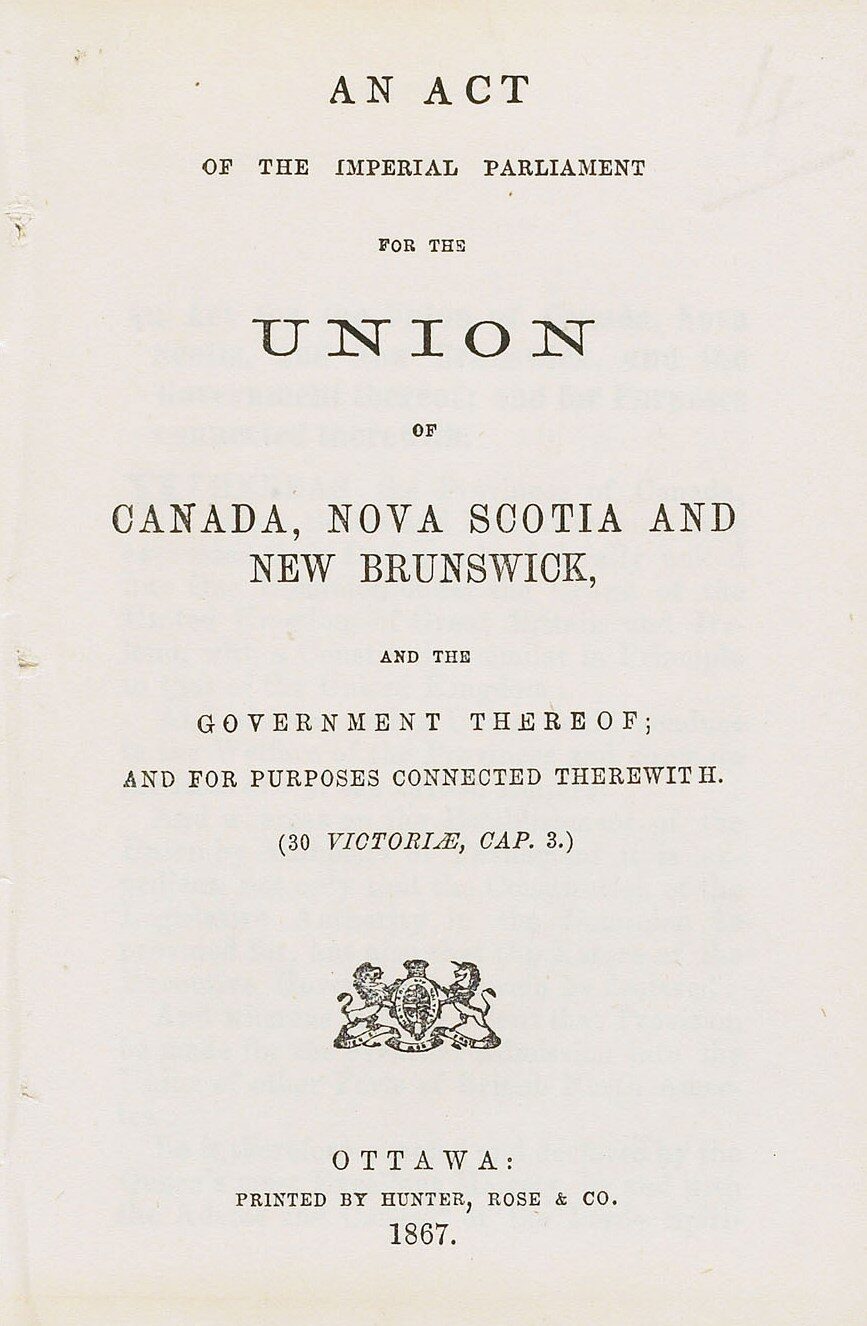
- 1 July 1867 — Confederation. The Province of Canada, Nova Scotia and New Brunswick were united as the Dominion of Canada under the British North America Act, 1867, now the Constitution Act, 1867. Newfoundland joined in 1949.
- 17 April 1982 — patriation. The Constitution Act, 1982, including the Canadian Charter of Rights and Freedoms, was proclaimed in force, giving Canada a domestic amending formula for the first time. Quebec's National Assembly did not approve the amendments.
- 30 April and 3 June 1987 — the Meech Lake Accord. Amendments negotiated at Willson House on Meech Lake, and finalised in Ottawa a month later, were intended to secure Quebec's endorsement of the 1982 changes. Quebec's ratification on 23 June 1987 started a three-year clock; the Accord lapsed on 22 June 1990 without ratification by Manitoba and Newfoundland.
- 11 July to 26 September 1990 — the Oka Crisis, a 78-day standoff over plans for a golf course on land known as The Pines, at Kanehsatà:ke, which included a burial ground. Two people died.
- 26 October 1992 — the Charlottetown Accord, a much broader package, was put to a national referendum and rejected, 54.3 per cent No to 45.7 per cent Yes.
- 30 October 1995 — the Quebec sovereignty referendum. The sovereignty-partnership question was rejected by 50.58 per cent to 49.42, on a turnout of 93.52 per cent — the largest in the province's history.
- 1 April 1999 — Nunavut was separated from the Northwest Territories under the Nunavut Act and the Nunavut Land Claims Agreement Act, the first change to Canada's internal map since 1949.
- 29 June 2000 — the Clarity Act received royal assent, setting out the conditions under which the federal government would negotiate following a provincial vote on secession. It was drafted on the basis of the Supreme Court's 1998 opinion in the secession reference, and was tabled on 13 December 1999 and passed by the House of Commons on 15 March 2000.

The group's active life sits almost exactly on top of that list. It was created nine months after Meech lapsed and rather more than six months after the Oka standoff ended; its first busy years ran through the Charlottetown campaign; its most intense weeks were the autumn of 1995; and the creation of a new territory and the passage of the Clarity Act fell in the years when Usenet was still the default place to argue about either. A group that opened in April 1991 could hardly have picked a decade with more to discuss.
The definitional question
Beneath the constitutional set pieces ran the group's perennial subject, which was definitional rather than legal: what distinguishes Canada from the United States, and how much effort a state should spend maintaining the distinction. It is the question every soc.culture group about a small country next to a large one ends up asking, and it arrived here with an unusually well-documented policy apparatus attached.
The apparatus began with the Royal Commission on National Development in the Arts, Letters and Sciences, founded in 1949 and universally known as the Massey Commission. Its report led to the National Library in 1953 and to the Canada Council for the Arts in 1957; the Canadian Film Development Corporation followed in 1967. Broadcasting had its own machinery. The Canadian Broadcasting Corporation dates from 1936; Canadian content quotas, administered by the CRTC under the Broadcasting Act, were built for radio on the MAPL system — music, artist, performance, lyrics — adopted in 1971 at 25 per cent of airplay, raised to 30 per cent during the 1980s and to 35 per cent with effect from 3 January 1999. Television carried quotas of its own: the annual requirement on private broadcasters stood at 60 per cent through the group's active years and was lowered to 55 per cent of the broadcast year in 2011, alongside 50 per cent of the evening period from six o'clock to midnight, with 60 per cent for the public broadcaster.
All of which meant that when a poster asked why Canada needed rules about how much Canadian music its radio stations played, there was a specific, dated, checkable answer available, and the regulatory record is detailed enough that any participant could produce it. The same argument ran, with less machinery attached, over the funding of the public broadcaster and the survival of Canadian book publishing in a market whose distribution ran largely through New York. American participants asked why any of it was necessary, in varying degrees of good faith, and got varying degrees of patience in reply. The lighter version of the same argument was orthographic. Whether one wrote colour, centre and cheque, and whether a Canadian who wrote color had given something up, served as a compact proxy for the entire debate, and had the advantage of being arguable at any hour without reading anything.
Around the set pieces ran the ordinary traffic of any group in this branch: immigration questions from people thinking of moving, comparisons of cities and of winters, expatriates asking what had changed at home, and recommendations of books, films and music — with the durable subplot of whether the recommender's choices were Canadian enough to count.
Land and treaties: the documented record
Indigenous questions were a standing subject in the group rather than an occasional one, and its active years coincided almost exactly with the period in which much of the modern public record was formally established. What follows sets out that record, with dates and sources attributed, because dated documents are what this site can honestly offer. The arguments themselves are not adjudicated here.
The framework predates Confederation. The Royal Proclamation of 1763 is generally treated as the foundation of treaty-making in what became Canada; among other provisions, it reserved to the Crown alone the purchase of land from Indigenous peoples. After 1867, section 91(24) of the Constitution Act, 1867 placed "Indians, and Lands reserved for the Indians" under federal jurisdiction.
The numbered treaties are eleven agreements concluded between First Nations and the Crown between 1871 and 1921, in two waves. Their dates of first signing, as tabulated in the standard reference works and in the treaty texts themselves, are: Treaty 1, 3 August 1871, at Lower Fort Garry; Treaty 2, 21 August 1871, at Manitoba Post; Treaty 3, 3 October 1873, at the North-West Angle of the Lake of the Woods; Treaty 4, 15 September 1874, at Fort Qu'Appelle; Treaty 5, 20 September 1875, at Berens River; Treaty 6, signed near Fort Carlton on 23 and 28 August 1876 and near Fort Pitt on 9 September of that year; Treaty 7, 22 September 1877, at Blackfoot Crossing of the Bow River; Treaty 8, 8 July 1899, at Lesser Slave Lake and elsewhere; Treaty 9, 6 November 1905, in northern Ontario; Treaty 10, 7 November 1906, at Île-à-la-Crosse; and Treaty 11, between 27 June and 22 August 1921, at posts across the Northwest Territories. Several carry later adhesions. Between them they cover the whole of present-day Alberta, Manitoba and Saskatchewan and parts of British Columbia, Ontario, the Northwest Territories, Nunavut and Yukon.
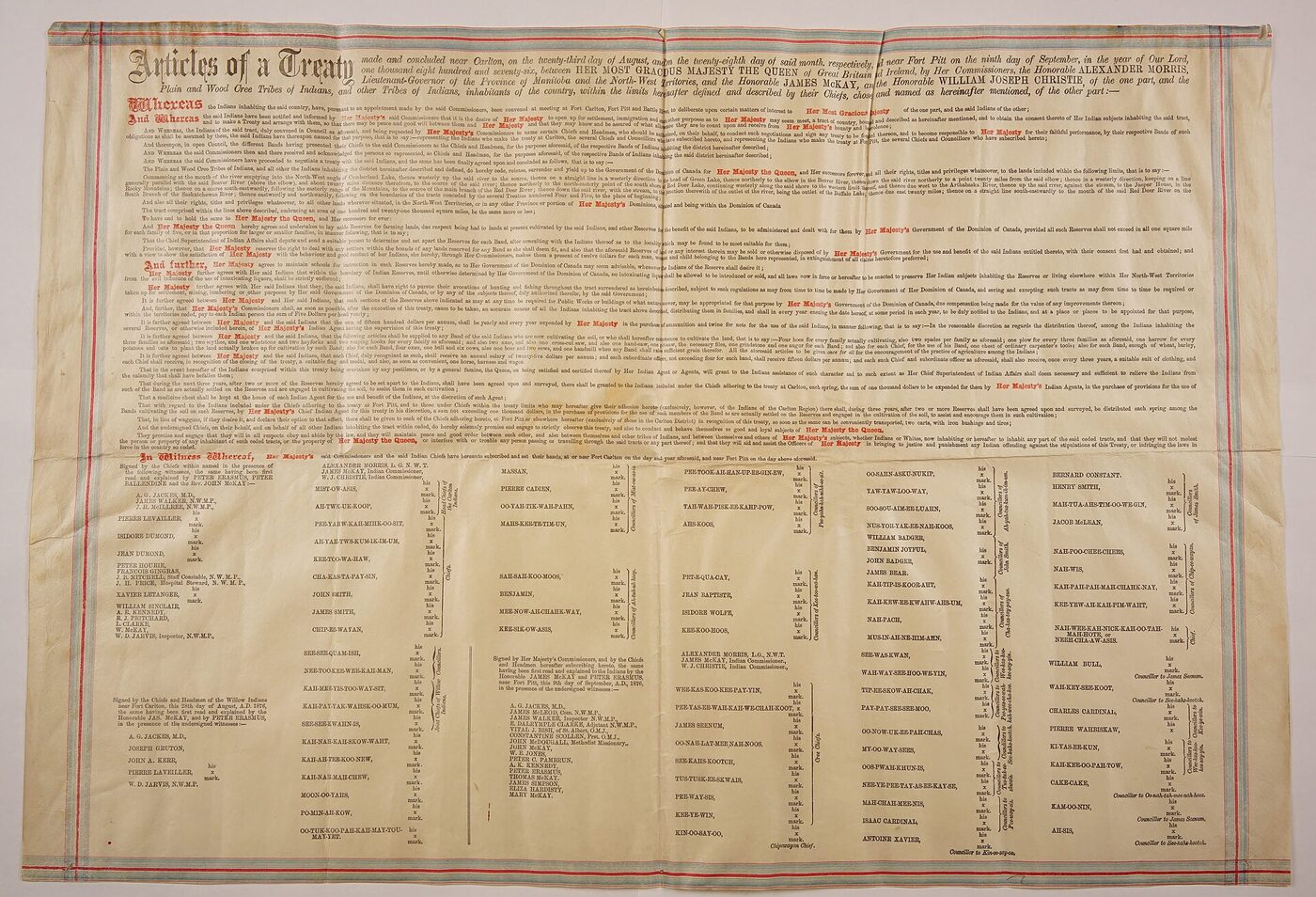

What the treaties say and what they were understood to say are not the same question, and the difference is itself part of the documented record rather than a matter of opinion. The written instruments were drawn in English by Crown officials; the negotiations were conducted through interpreters and, on the Indigenous side, recorded and transmitted orally. Historians have documented specific disputes over particular clauses — the surrender language in Treaty 6 among them — and Indigenous accounts of the negotiations, including contemporaneous notes taken by chiefs, are part of the surviving evidence. The Royal Commission described below examined precisely this gap, and Canadian courts have been examining it since.
Large areas of the country were never covered by treaty at all. British Columbia is the standing example, and its consequences ran through the group's whole lifetime, as the next sections describe.
The Indian Act and its amendments
The statute that governed the daily lives of status Indians for a century and a half was consolidated in 1876. An Act to amend and consolidate the laws respecting Indians received royal assent on 12 April 1876; it survives, much amended, as the Indian Act, RSC 1985, c I-5. It brought together earlier legislation, notably the Gradual Enfranchisement Act of 1869, and placed communities, land and band finances under federal administration. The Truth and Reconciliation Commission later summarised its effect as making "Indians wards of the state, unable to vote in provincial or federal elections or enter the professions if they did not surrender their status", and as severely limiting participation in spiritual and cultural practice.
The amendment history is long, and the dates matter because the group's terminology arguments frequently turned on them. The following are among the provisions most often cited in the literature:
- 1879 and 1880 — successive amendments and a re-consolidation extended punishment for trespass on reserves and expanded the disciplinary powers of band councils.
- 1881–1882 — Indian agents were made justices of the peace and then given the powers of magistrates; the sale of agricultural produce by Indians in the Prairie provinces was prohibited without a permit from an agent.
- 1884 — attendance at school was made enforceable for Indian youth, and the potlatch and Tamanawas dances were prohibited by an amendment signed in April of that year and operative from 1885; the ban on ceremonies was extended in 1896 to any dance, ceremony or festival involving the wounding of people or animals or the giving away of money or goods.
- 1894 — school attendance was made compulsory for Indigenous children between 7 and 16, subject to exemptions for school location, health and prior completion of examinations; band control over non-Indigenous residents on reserve was removed.
- 1911 — the so-called Oliver Act allowed municipalities and companies to expropriate parts of reserves for public works without surrender, and allowed a judge to move a whole reserve away from a municipality where it was deemed expedient.
- 1914 — official permission became necessary before western Indians could appear in "Aboriginal costume" at any dance, show, exhibition, stampede or pageant.
- 1920 — attendance at residential school was made mandatory for parents to arrange, and the Department of Indian Affairs was empowered to ban hereditary rule of bands.
- 1927 — an amendment, commonly cited as section 141 of the consolidation, made it an offence for anyone, Indigenous or not, to solicit or receive money to pursue a claim on behalf of a band without a licence from the Superintendent-General; the effect, as the Royal Commission and the Nisga'a record both describe it, was to make it impossible in practice for a First Nation to retain counsel to advance a land claim. It remained in force until 1951.
- 1951 — a substantial revision removed both the prohibition on pursuing land claims and the prohibition on ceremonies including the potlatch, allowed the sale and slaughter of livestock without an agent's permit, and permitted status women to vote in band elections. The 1951 text also expressly excluded Inuit from the Act's operation.
- 1961 — compulsory enfranchisement of men and of bands was ended.
- 1985 — Bill C-31 voided the enfranchisement process and restored status to women who had lost it by marrying non-status men, and to their children. Roughly a decade later nearly 100,000 people had been reinstated. The two-generation cut-off it introduced has been the subject of litigation ever since, addressed further by Bill C-3 in 2011 and Bill S-3, which received royal assent in December 2017 and came fully into effect in August 2019.
Nothing in that list was obscure by the 1990s, but a great deal of it was unfamiliar to general readers, and threads in which one participant supplied a date and a section number to another are a recognisable feature of the archive's Indigenous-policy traffic.
Residential schools: the commissions, and when they reported
The residential school system was funded by the federal government and administered largely by Christian churches. It began with pre-Confederation legislation, operated principally under the Indian Act after 1876, and became compulsory in 1894. The denominational division is documented at the system's peak: of the 80 schools operating in 1931, 44 were run by Catholic dioceses and religious communities, 21 by the Church of England and its successor the Anglican Church of Canada, 13 by the United Church of Canada and 2 by Presbyterians. The oldest continuously operated school, at Six Nations of the Grand River near Brantford in Ontario, opened as a day school for boys in 1828, began taking boarders four years later, and remained in operation until 30 June 1970. By the 1930s about 30 per cent of Indigenous children were attending. The last federally funded school closed in 1997.
The scale of the system, as published: around 150,000 children were placed in residential schools nationally over its more than 160-year history. More than 4,000 student deaths have been documented, and the chair of the Truth and Reconciliation Commission suggested that the true figure may exceed 6,000; the great majority of the recorded deaths were caused by disease, tuberculosis above all.
The public record was built in two stages, and the group's own lifetime falls between them — a point of real importance for anyone reading the archive today.
The first stage was the Royal Commission on Aboriginal Peoples, established in 1991 in the aftermath of Oka and the collapse of Meech Lake. Five commissioners, working to a budget of $60 million, held 178 days of public hearings in 96 communities. The commission reported in November 1996: five volumes, some 4,000 pages, and 440 recommendations, framed as a twenty-year agenda. The summary of the later Truth and Reconciliation Commission's report credits it with drawing the attention of non-Indigenous Canadians to Indigenous experience and redirecting the terms of the conversation; most of its recommendations were not implemented.
The second stage came after the years in which such groups were busiest. The Indian Residential Schools Settlement Agreement of 2007 provided for a Truth and Reconciliation Commission, which was formally established on 1 June 2008, the same year in which the federal government apologised in the House of Commons, on 11 June 2008, for the role of past governments in administering the schools. The commission collected statements from survivors across the country, released an executive summary with 94 Calls to Action in June 2015, and concluded in December 2015 with a multi-volume final report which characterised the system as cultural genocide. Its records passed to the National Centre for Truth and Reconciliation at the University of Manitoba, which opened in the autumn of 2015 and put its digital archive online on 3 November 2015; the centre's holdings include millions of church and government records and over 7,000 survivor statements, and were added to UNESCO's Canada Memory of the World Register in September 2019. On 30 September 2019 the centre released a memorial register documenting 4,037 students who died while attending residential schools, noting at the time that the register was incomplete and that many names remain unknown.
Almost all of that machinery postdates the period in which such groups were most used. What soc.culture.canada had, through the 1990s, was the earlier and much more contested state of the record: the royal commission's hearings and volumes, the closing of the last schools, the litigation then beginning, and an account carried until then mainly by survivors and their own communities. Readers of the archive should expect to find the vocabulary, the estimates and the framings of that earlier moment, not those of 2015.
Modern agreements, the courts and a new territory
The other half of the record built during the group's lifetime was made in courtrooms and at negotiating tables, and it produced dates a reader can check.
The turning point usually cited is the Supreme Court of Canada's 1973 decision in Calder, brought by the Nisga'a Nation Tribal Council, in which the Court acknowledged for the first time that Aboriginal title to land had existed prior to colonisation and was not merely a creature of statute. Comprehensive land-claim negotiation followed. The James Bay and Northern Quebec Agreement was signed on 11 November 1975 by the federal and Quebec governments, Hydro-Québec, the Grand Council of the Crees and the Northern Quebec Inuit Association, after a Quebec Superior Court injunction of 15 November 1973 had briefly blocked hydroelectric development; the Naskapi joined through the Northeastern Quebec Agreement of 31 January 1978. The Inuvialuit Final Agreement, covering the western Arctic, followed in 1984.
Constitutional protection arrived with patriation. Section 35 of the Constitution Act, 1982 sits outside the Charter and reads, in its first two subsections:
35. (1) The existing aboriginal and treaty rights of the aboriginal peoples of Canada are hereby recognized and affirmed.
(2) In this Act, "aboriginal peoples of Canada" includes the Indian, Inuit and Métis peoples of Canada.
Two further subsections were added after the 1983 constitutional conference, extending "treaty rights" to rights arising from modern land claims agreements and guaranteeing the section's rights equally to men and women. What the word "existing" meant then fell to the courts. In R v Sparrow, decided on 31 May 1990, the Supreme Court held that Parliament could no longer extinguish rights that still existed in 1982, and read into "recognized and affirmed" a fiduciary duty requiring restraint. R v Van der Peet in 1996 set out a test for what counts as an Aboriginal right, and Delgamuukw v British Columbia, [1997] 3 SCR 1010, produced the Court's first comprehensive account of Aboriginal title, in a case brought by Gitxsan and Wet'suwet'en hereditary chiefs over 58,000 square kilometres in northwest British Columbia after a trial that ran 374 days between 1987 and 1990.
The most visible outcome of the period was territorial. The Nunavut land claims agreement was completed in September 1992 and ratified by nearly 85 per cent of voters in the region; it was signed at Iqaluit on 25 May 1993; the Nunavut Land Claims Agreement Act and the Nunavut Act were passed by Parliament and received royal assent on 9 July 1993; and on 1 April 1999 the territory came into being. The agreement gave Inuit title to roughly 350,000 square kilometres, with mineral rights over some 35,000 of them, and equal representation with government on the wildlife, resource and environmental boards. A federation redrawing its internal map in peacetime and by agreement is the kind of development a group like this could take apart at length, and did, on grounds of governance and cost as much as constitutional principle.


Last in the sequence, and first of its kind in its province, the Nisga'a Final Agreement was signed on 27 May 1998 and came into effect on 11 May 2000 — the first modern comprehensive treaty concluded in British Columbia, in a province where the Nisga'a Land Committee had been pressing the question since about 1890 and where, for twenty-four years from 1927, the Indian Act had made it an offence to hire a lawyer to pursue it.
The words that changed inside the group's lifetime
The vocabulary used for Indigenous peoples in Canada shifted during the years this group was busy, and the shift was argued over in the group as it happened. That makes it exactly the sort of dated usage question this directory is useful for, and the account below records how the words moved rather than adjudicating the argument.
- Indian remained the operative legal term — in section 91(24) of the Constitution Act, 1867, in the Indian Act, in the Indian Register and in the phrase "status Indian" — while becoming unacceptable in ordinary Canadian usage. It is still used in legal documents and in the names of historical institutions; general reference works note that most people now consider it pejorative in everyday speech.
- First Nations, most often in the plural, came into general use from the 1970s in place of Indians and Indian bands. First Peoples, covering First Nations, Inuit and Métis together, spread over the same period.
- Native was common in Canada, and Native Canadians was often used into the 1980s specifically to mark the difference from the American Native American — a term which is rarely used in Canada at all, being reserved for peoples within the present-day United States. The general objection to native is that it also means simply "born there": a person from Calgary may be a Calgary native.
- Aboriginal peoples was the collective legal term, defined by section 35(2) as including Indian, Inuit and Métis peoples, and it served as the umbrella through the 1990s. It has since been displaced in ordinary and official Canadian usage by Indigenous, which federal style now capitalises when it refers to peoples, cultures or communities.
- Eskimo gave way to Inuit in Canada and Greenland, the older term having acquired pejorative connotations. The Yupik of Alaska and Siberia do not describe themselves as Inuit, and ethnographers treat them as a distinct people, which is why the substitution is not universal.
Two court decisions bracket the legal side of the same question: Reference Re Eskimos in 1939 held that Inuit fell within the word "Indians" in the 1867 Act, and Daniels v Canada, decided by the Supreme Court on 14 April 2016 after a Federal Court ruling in 2013, held the same of Métis and non-status First Nations. Whether a term used in a 1991 posting was neutral, careless or offensive at the time it was written is a question a reader of the archive has to answer with the calendar in hand.
Two official languages, one English-language group
Canada's Official Languages Act came into force on 9 September 1969 and was substantially amended in 1988. It gives English and French equal status in the institutions of the federal government: services from federal departments and Crown corporations in either language, hearings before federal courts in the language of the litigant's choice, statutes and regulations enacted and published in both versions with equal legal weight, and both languages as languages of work within designated bilingual regions. Section 16 of the 1982 Charter entrenched the equality of the two languages in Parliament and the federal government, and made New Brunswick the one province with both as official languages.
The founding proposal for soc.culture.canada promised postings "in either english or french", and the ballot accepted oui and non. In practice the group ran in English, as almost every soc.culture group did: the branch's electorate was overwhelmingly anglophone, the surrounding machinery — news.groups, the votetakers, the guidelines — operated in English, and a French-language posting in a worldwide group reached a smaller audience than the same posting in fr.* or can.francais. The country's formal bilingualism and the group's working monolingualism coexisted without much comment, which is itself the sort of thing worth noticing in a directory about what these rooms were actually like.
The technical dimension of writing French on a network built for seven-bit US-ASCII — the accents that went missing, the workarounds, the charter clauses that addressed it — belongs to soc.culture.quebec, whose own founding documents deal with it at length, and is not repeated here. For Canada as a whole the point to record is narrower: an English-language group about a bilingual country inherited, structurally, one side of an argument it also had to host.
Syllabics, and what the network could not carry at all
French accents were an inconvenience. The writing systems used for Inuktitut and for several Cree and Ojibwe dialects were, for most of this group's active life, simply outside what Usenet could transmit.
Canadian Aboriginal syllabics are a family of abugidas developed in the nineteenth century for Cree and subsequently adapted for Inuktitut, Ojibwe, Blackfoot, Carrier and several Athabaskan languages, in which the orientation of a character indicates the vowel. They are in daily official use. Nunavut's official languages are the Inuit language — Inuktitut and Inuinnaqtun, together known as Inuktut — together with English and French, and Inuktitut in Nunavut is written for the most part in syllabics; Inuktitut also became an official language of the Northwest Territories in 1984, a status both territories kept when they separated in 1999.
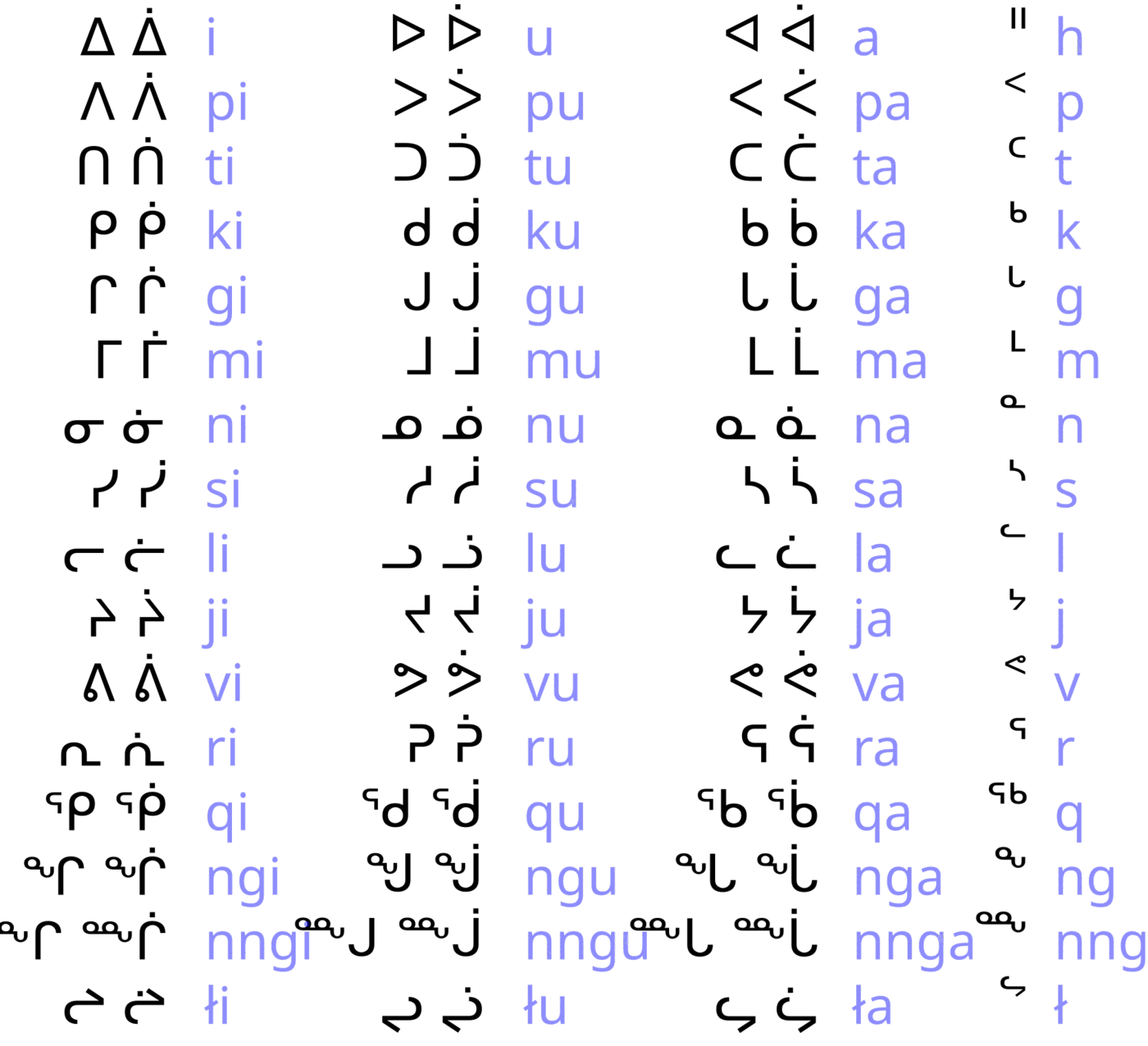

Nothing in the character sets Usenet ran on could represent any of it. Articles in the group's early years moved as seven-bit US-ASCII, with eight-bit ISO 8859-1 spreading unevenly and unreliably later; neither contains a single syllabics character. The Unicode block that does — Unified Canadian Aboriginal Syllabics, U+1400 to U+167F — was added in Unicode 3.0, published in 1999, with 630 characters; ten more were added in Unicode 5.2 (2009), which also introduced the Extended block at U+18B0 to U+18FF with a further 70 characters for Cree, Ojibwe, Dene and Carrier dialects. A third block, Extended-A, followed later.
The chronology is worth stating plainly, because it is easy to assume otherwise. For the first eight years of soc.culture.canada's existence there was no standard way to write Inuktitut on the network at all, and for years after that there was a standard but very little software that implemented it. Discussion of the North, of the new territory and of Indigenous languages therefore took place, of necessity, entirely in the roman alphabet — a limitation of the medium rather than of the participants, and one that no amount of goodwill in the group could have worked around.
The problem did not disappear when the code points arrived. In September 2019, after eight years of work, Inuit Tapiriit Kanatami adopted a unified roman orthography, Inuktut Qaliujaaqpait, for all varieties of Inuktitut — designed among other things to be typed on ordinary devices without specialised keyboard layouts, and explicitly not a replacement for syllabics. Whatever else that is, it is a reminder that the constraint the group ran into in 1991 was a real one, and that it outlived the group.
Hockey
Hockey was the group's reliable common denominator, the subject that could be raised in any month and by anyone, and the middle of the decade handed a group about Canadian identity a grievance ready-made.
The background first. National radio coverage of Saturday games began in 1931 as the General Motors Hockey Broadcast, became one of the founding programmes of the CBC on its creation in 1936, moved to television with the launch of CBC Television in 1952 and continued to be simulcast on radio until 1965 — a fixture of the Canadian week for longer than most national institutions have existed. The other standing reference point was the Summit Series of September 1972, eight games between a Canadian team of NHL professionals and the Soviet national side, decided in the last minute of the eighth game in Moscow on 28 September 1972. It remains one of the fixed reference points of Canadian sporting memory, and its anniversaries fell inside the group's active years.
Then came the losses. The Quebec Nordiques, in the NHL since 1979 and with the best record in the Eastern Conference in their final season, were sold in May 1995 and moved to Denver as the Colorado Avalanche — where they won the Stanley Cup in their first season after the move. The Winnipeg Jets, in the league equally long, played their last season in 1995–96 and became the Phoenix Coyotes. The reasons given in both cases were the same three: a small market, an arena built for another era, and a payroll denominated in American dollars against a weakening Canadian one. That last item made the subject something more than sport. A currency argument, a subsidy argument and an argument about whether a country can keep its own institutions in the face of a larger neighbour's market are close relations, and a group about Canadian identity had all three available to it at once. The NHL returned to Winnipeg in 2011; Quebec City has not had a team since.
Hockey as a sport, as distinct from hockey as a national grievance, had its own address: see rec.sport.hockey.
Weather as a national subject
The comparison of winters between cities is a durable Canadian conversational form, and it transferred to Usenet intact — a genre with its own conventions, in which the correct response to a claim about Winnipeg is a claim about Yellowknife. But it also produced real news, and one storm inside the group's active years produced enough of it to dominate the traffic for weeks.
Between 4 and 10 January 1998 five successive freezing-rain systems, held in place by an unusually strong high over the Atlantic, laid ice across eastern Ontario, southern Quebec, New Brunswick and Nova Scotia and into northern New York and New England, reaching about 100 mm in the worst-affected band. Freezing rain fell for more than eighty hours. Roughly 1,000 steel transmission pylons and 35,000 wooden utility poles came down; more than four million people lost power at the peak, some of them for a month; 28 people died in Canada and 16 in the United States. Three weeks after the storm ended, 150,000 people in Quebec were still without electricity.
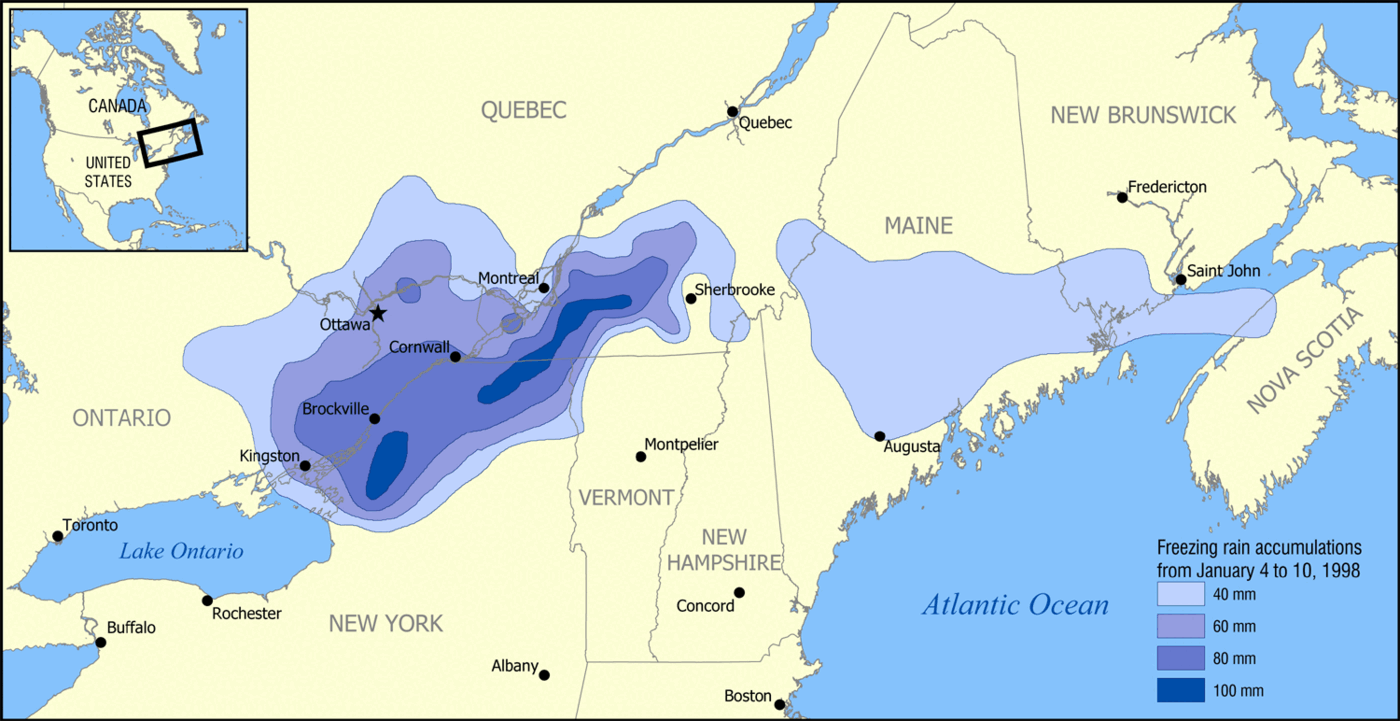

On 7 January New Brunswick, Ontario and Quebec requested military assistance, and Operation Recuperation began the following day. At its height it involved 15,784 deployed personnel, including 3,740 reservists — 10,550 in Quebec, 4,850 in Ontario and 384 in New Brunswick — with a further 6,200 service members and departmental staff providing logistical support from their regular posts. It was the largest operational deployment of Canadian military personnel since the Korean War. Troops from about 200 units cleared roads, evacuated the sick, sheltered and fed some 100,000 people frozen out of their homes, and on 13 January, at Quebec's request, assumed the powers of peace officers in the worst-affected areas around Montreal.
For a readership scattered across six time zones and several continents, a storm on that scale was the kind of event a worldwide group about the country was structurally suited to carry: the storm fell across the most densely populated corridor in the country, and the places that stayed dark longest were inside it.
Books, prizes and the table
The literary conversation in the group had a peculiarity of its own: a national canon assembled largely within living memory, with the institutions that assembled it still visibly at work. The Governor General's Literary Awards were inaugurated in 1937 for books published in 1936, in two categories, by a governor general who was himself a prolific novelist; the Canada Council, created in 1957, took over their administration in that same year, and a cash prize was attached from then on. The Giller Prize was founded in 1994 — the same year soc.culture.quebec was voted into existence — for a novel or short-story collection by a Canadian author in English, awarded each November with a cash prize then of $25,000. The CBC's Canada Reads, a broadcast argument in which advocates defend one Canadian book each until only one is left, began in 2002, by which time the argument had largely moved off Usenet; its French counterpart, Le Combat des livres, ran from 2004.
What that machinery produced, for a newsgroup, was an inexhaustible supply of eligibility disputes. A prize whose criterion is nationality invites the question of who qualifies, and the group asked it about writers, musicians and films with the same energy it applied to the MAPL rules for radio.
Food was the lighter register and, being harmless, one of the more durable threads. The butter tart has the best-documented pedigree: the earliest published Canadian recipe appeared in a Barrie, Ontario, hospital auxiliary cookbook of 1900, with another in a pie cookbook of 1915. The Nanaimo bar's first printed appearance under recognisable form is in the Women's Auxiliary to the Nanaimo Hospital Cookbook of 1952, where three near-identical recipes appear as "chocolate square" or "chocolate slice"; the name came later. Maple syrup is older than any of it — Algonquian peoples were tapping maples and concentrating the sap by freezing before Europeans arrived — and the 1998 ice storm did enormous damage to the sugar bush, which is how the weather thread and the food thread occasionally met. Quebec's own table is discussed on its own page and not duplicated here.
Regions, the border and what else the group carried
A country page in this branch is always partly a regional argument, and this one was more so than most, because the group's readers were distributed across a landmass that took six time zones to cross.
Toronto's place in the national imagination was a standing subject, generally raised by people who did not live there. Western alienation — the complaint that federal attention, federal money and federal policy were set in central Canada for central Canadian reasons — was a recurring frame rather than an occasional topic, and it had a live political vehicle through the whole of the decade in which such groups were most used. The economic position of the Maritimes, and the distance of the North from anything decided in Ottawa, supplied the other two standing regional threads. None of these was resolved, which is the normal condition of a regional argument in a large federation and was in no way peculiar to Usenet.
Underneath all of it ran the border. Comparative threads about health care, guns, taxes, crime, the cost of things and how the two countries' politics were reported to each other recurred with the reliability of a timetable, and they were the threads most likely to draw American participants — a large, well-connected readership one hop away who found the group easily and did not always arrive briefed. The soc.culture branch's other big anglophone national rooms, soc.culture.british among them, ran comparable traffic with comparable results.
What the group mostly did not carry, by the standards of its own branch, was grief. Within a hierarchy whose national groups often held wars, partitions and the losses of scattered diasporas, soc.culture.canada was one of the quieter rooms. Its existential questions were pressed through accords, courts and referendums rather than armies, and even its worst weeks — flame wars over language law and secession — were mild by the standards of soc.culture.*, however heartfelt they were to the people writing them. That is an observation about the subject matter, not a compliment to the participants.
The later years, and one forged control message
The arc is the familiar one for a Big Seven discussion group: steady growth through the early 1990s, a surge when the commercial providers opened their gateways in the middle of the decade, industrial-scale spam arriving with them, and then the slow migration of conversation to web forums after 2000 and to social platforms after that.
One administrative event from the tail end deserves recording, because it is in the control archive and is the only irregularity in the group's whole documented history. On the evening of 3 November 2001 local time — 4 November by the message's own UTC date stamp — a control message headed cmsg rmgroup soc.culture.canada was injected, carrying a one-line body:
please remove the bogus newsgroup soc.culture.canada
Every feature of it says forgery. It carries the name and address of a well-known author of newsreader software, who had no plausible reason to remove a Big Eight culture group; it was injected through a Quebec news host unconnected with that author; and its body is followed by a line of machine-generated nonsense of the kind that forged control messages of that period habitually carried. Nothing else in the group's documented history supports the description of it as bogus: it was created by a 194-to-31 vote and had been carried worldwide for a decade. Servers carrying the Big Eight accepted removals for these groups only from the hierarchy's recognised control-message signer, so the message did nothing: soc.culture.canada is still listed in the current newsgroups file and still marked in the active file as accepting postings.
What actually ended the conversation was not a control message. The archive of the group's past survives because Deja News began archiving Usenet in 1995 and Google acquired that archive in 2001, which is why threads from the group's best years can be read at all. What remains is a period document: a decade and more of a middle power arguing with itself in public, in front of an audience it had invited, and doing it politely more often than not.
What the record does not show
Almost everything above about the group's administration is documentary. Almost nothing above about its traffic is, and the distinction is worth being blunt about.
No readership survey figure for soc.culture.canada has been located. The news.answers archive holds no FAQ for the group. There is no charter beyond the single line in the control message and the sentences in the proposal, both quoted in full above. The group was unmoderated, so there is no moderator, no submission address, no policy statement and no record of anybody having authority over it — which is the correct answer to the question of who ran it, not a gap in the research.
The one contemporary statement about the group's volume is the estimate in the 1994 soc.culture.quebec proposal, quoted above, and it is a third party's round number offered in support of a different argument: it says that more than a hundred messages a day was not uncommon in soc.culture.french and soc.culture.canada together, not that either group averaged that. No thread titles, no posters, no message counts and no quotations from the group's own traffic appear anywhere on this page, because none could be verified. Where this article describes what was discussed, it describes recurring subject matter of the kind any reader of the archive will recognise, and it names dates and documents rather than posts.
Scope and limits
This page is about a newsgroup and the world it belonged to. The historical, legal and constitutional material set out above is included because the group's traffic is unreadable without it, and it is reported as it stands in the published record: treaties by number and date, statutes by name and date of assent, commissions by their own findings and their own reporting dates, referendums by their published results.
On two subjects in particular the page reports and does not adjudicate. The record of the residential school system and of the treatment of Indigenous peoples in Canada is given here in the terms of the bodies that established it — the Royal Commission on Aboriginal Peoples, the Truth and Reconciliation Commission, the National Centre for Truth and Reconciliation, the courts and the statutes — with their characterisations attributed to them. Where terminology, figures or conclusions are contested, that is noted rather than settled. On Quebec sovereignty, the referendum results are matters of record and the arguments are live; positions are described as their holders state them, and the detailed treatment belongs to soc.culture.quebec and qc.politique.
Corrections of fact are welcome. Nothing here is offered as advice, and no verdict on any of the arguments the group carried is offered at all — the group did not reach one either, over a decade and more of trying.
Reading soc.culture.canada today
- Historical archive: Google Groups — soc.culture.canada (coverage varies by group and era).
- Open in a newsreader:
news:soc.culture.canada— the original site offered exactly this link, and it still works if your system has a newsreader registered for thenews:scheme. - Live access: point an NNTP newsreader at a modern server — see accessing Usenet today.
- The original news2mail e-mail subscription service ended in the mid-2000s and no longer operates.