soc.culture.nepal
Nepal and Nepalis.
From panchayat aftermath through the 1990 democracy movement, the Maoist insurgency and the 2001 palace massacre — a small diaspora group repeatedly overtaken by enormous news.
Trekking-season questions from outsiders were answered patiently in between.
On this page
The group and its era
soc.culture.nepal belonged to the long national run of soc.culture.*, and like nearly every group in that run it was unmoderated: no gatekeeper, and a character set entirely by whoever posted. The one-line description carried in the hierarchy’s own group list is as plain as the conventions of the day allowed — discussion of people and things in and from Nepal.
Who those readers were was decided by where the wires ran. Nepal’s first internet service opened in August 1994, run by a non-profit at the Tribhuvan teaching hospital; a commercial provider was operating by early 1995, and access stayed concentrated in the Kathmandu valley for years afterwards. A group named for Nepal was therefore written largely from outside it, the Nepalis best placed to post being students and professionals in the United States, India and Japan.
The registry record puts a checkable date beside that. IANA’s root database gives the registration of the .np country-code domain as 25 January 1995, with Mercantile Communications Pvt. Ltd. of Kathmandu as the listed ccTLD manager — a commercial firm rather than a ministry or a university, and still the listed manager when the record was last updated in July 2025. The national domain and the country’s commercial network therefore arrived together, five years after the events of 1990 with which the account above begins.
The years it covered rewrote the state twice over. The movement of 18 February to 8 April 1990 ended the partyless panchayat system; the ban on political parties was lifted on 8 April and a new constitution followed in November. The armed conflict that began on 13 February 1996 with seven simultaneous attacks across six districts ran for ten years and left more than 17,000 dead before the peace accord of 21 November 2006.
Between those came the shooting at the Narayanhiti palace on 1 June 2001, in which ten people died, King Birendra and Queen Aishwarya among them; Gyanendra was crowned on 4 June, and the explanation of the killings has been disputed since. On 1 February 2005 the king dismissed the government and assumed direct rule, a period in which press freedom and other civil liberties were restricted; parliament was reinstated on 24 April 2006 and the monarchy abolished on 28 May 2008. The news2mail gateway carried the group from 2000 to 2004, placing the palace killings and the middle years of the conflict inside its own run.
How large the constituency inside the country actually was can be read off the international series. The International Telecommunication Union’s indicator for individuals using the internet, as republished by the World Bank, records Nepal at 0.20 per cent of the population in 2000, 0.45 per cent in 2004 and 0.83 per cent in 2005 — roughly one person in five hundred when the gateway opened and about one in 220 when it closed, out of a population the same source puts at 24.5 million in 2000 and 26.0 million in 2004. The figure does not reach 7.9 per cent until 2010, 17.6 per cent until 2015 or 37.0 per cent until 2020. In its busiest years this was not a conversation most people in Nepal were in a position to join.
What was discussed
Politics, unavoidably, argued by people with family in the affected districts: the settlement of 1990, the conduct of the conflict, the emergency measures, the palace and its powers. News relay was a genre in itself — before Nepali papers were readable online, and at points when reporting was restricted, whoever had a fresh edition or a working telephone line posted what they had, sometimes translating as they went.
Under the politics lay the subject that touched most households directly. Foreign employment on a large scale — to the Gulf states and Malaysia, alongside the older and less formal movement to India — became the economic backbone of the country, and remittances have since been estimated at around a quarter of national income. With it came the practical traffic: recruitment terms, contracts, exchange rates and the mechanics of sending money home.
From outside came the trekking and mountaineering questions — permits and peak fees, seasons and routes, guides and altitude — answered patiently, and sometimes wearily, by regulars who had answered the same ones the previous autumn. Language was its own subject: Nepali is written in Devanagari, and recent censuses record more than a hundred mother tongues, from Indo-Aryan and Sino-Tibetan families alike. Devanagari had been in Unicode since the standard’s first version in 1991, but fonts, keyboards and mail software lagged years behind it, so Nepali on Usenet was generally typed in improvised romanisation.
The rest was the ordinary business of a culture group: festival dates and food; the Bikram Sambat calendar, some fifty-six or fifty-seven years ahead of the Gregorian and beginning in mid-April, which had to be converted for any visitor; and the standing question of Nepal’s position between India and China.
The record, by date
What follows is a chronology and nothing else: dates that can be checked against published records, set down without characterising any party to them. Several entries fall outside the years in which such groups were busiest, and where that is so it is said.
- 9 November 1990 — the Constitution of the Kingdom of Nepal promulgated, in succession to the instrument of 16 December 1962.
- 31 August 1992 — Nepali added to the list of scheduled languages of the Indian constitution.
- 25 July 2001 — a ceasefire declared, with talks held between August and November.
- 26 November 2001 — a nationwide state of emergency declared and the army deployed.
- 29 January 2003 — a second ceasefire, followed by talks; withdrawn on 27 August 2003.
- 22 November 2005 — a twelve-point understanding issued jointly by the Seven Party Alliance and the CPN (Maoist).
- 15 January 2007 — the Interim Constitution promulgated, after the gateway had closed.
- 10 April 2008 — election to a Constituent Assembly of 601 seats, 575 of them elected; turnout about 60 per cent of some 17.5 million registered voters. The assembly first sat on 28 May 2008.
- 10 February 2015 — the Truth and Reconciliation Commission and the Commission of Investigation on Enforced Disappeared Persons constituted under the Act of 2014.
- 20 September 2015 — the present constitution came into effect, adopted by the second Constituent Assembly, itself elected on 19 November 2013, by 538 votes to 60 of 598 members.
The accounting of the conflict’s human cost is best given the same way, as figures with their custodians attached. Published totals for the dead cluster above 17,000 and are compiled elsewhere as a range of 17,800 to 20,000, with about 1,300 recorded missing. The two commissions constituted in 2015 registered claims on a far larger scale: the Truth and Reconciliation Commission has reported receiving about 63,000 complaints, and the Commission of Investigation on Enforced Disappeared Persons around 3,000. Both registration exercises postdate the group’s active life by roughly a decade.
Devanagari on a seven-bit network
Usenet articles were, by the standard that governed them, internet mail messages. RFC 1036, Standard for Interchange of USENET Messages (M. Horton and R. Adams, December 1987), required articles to be formatted as valid messages under RFC 822, and specified printing ASCII for the fields it set out in detail. A script written with conjunct forms, stacked vowel signs and a continuous headline stroke had no place in that envelope at all.
Two lines of solution existed off the network. One was an eight-bit code page: the Indian Script Code for Information Interchange, standardised as IS 13194:1991 by the Bureau of Indian Standards, which kept plain ASCII in the lower 128 positions and placed Devanagari and eight other Brahmic scripts in the upper 128, switching between them by code. The other was Unicode, which largely preserved the ISCII layout inside each script’s own block. Devanagari occupies U+0900 to U+097F, 128 code points, present from Unicode 1.0 in 1991 with 104 characters then assigned and the block filled since; Devanagari Extended, at U+A8E0 to U+A8FF, followed only in Unicode 5.2 in 2009.
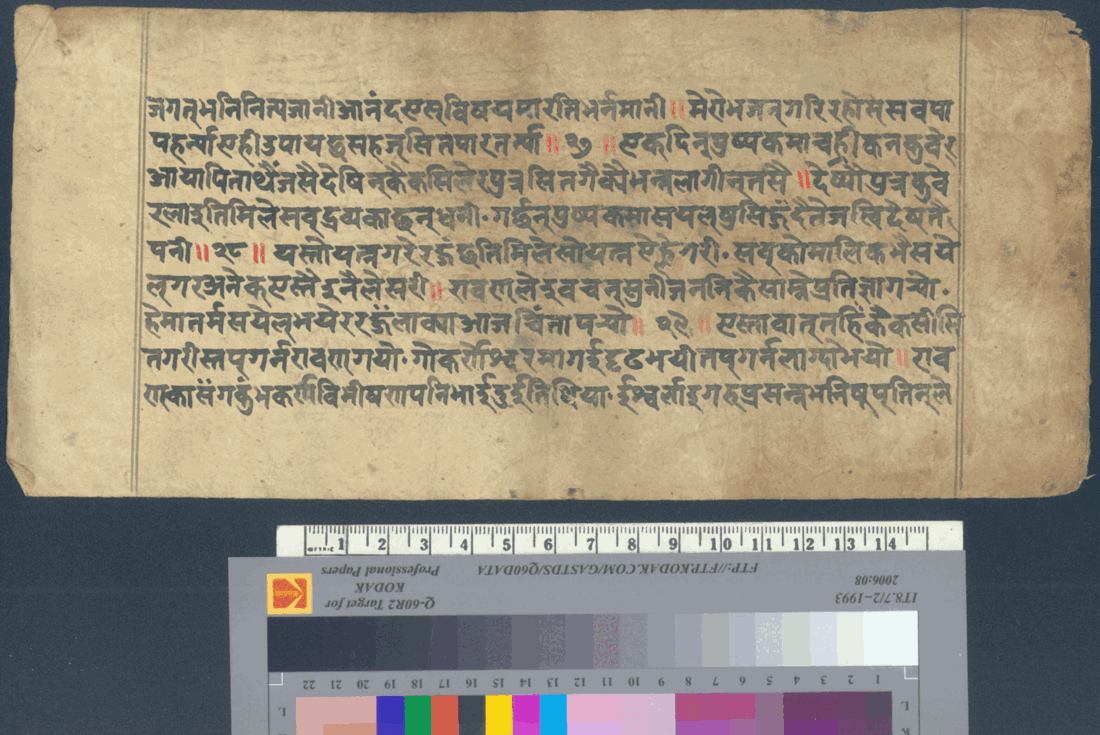

Neither helped much while the transport still assumed seven bits. UTF-8 was sketched in September 1992 and first published as an internet specification in RFC 2044 in 1996, revised as RFC 2279 in 1998 and settled as RFC 3629 in November 2003; it did not become the commonest encoding on the web until 2008, four years after the gateway shut. For the whole of the period this page describes, Nepali went out in romanisation.
The romanisations were themselves a Usenet product. ITRANS — Indian languages TRANSliteration, by Avinash Chopde — emerged on the rec.music.indian.misc newsgroup as early as 1994, because people wanted to post song lyrics in something every reader could see, and it uses nothing outside plain ASCII. The Harvard-Kyoto convention answered the same problem by pressing capital letters into service where a scholarly transliteration would use diacritics, and is described as used predominantly in e-mail and electronic texts. Beside them stood the Velthuis scheme, the academic IAST convention, and later ISO 15919, published in 2001.
The consequence lands on anyone searching the archive today. A word set in Devanagari will not match the same word typed as ITRANS, as Harvard-Kyoto, or in the loose ad-hoc spelling most posters actually used; and because no scheme was obligatory, a single place-name or surname can appear several ways inside one thread. Searching the surviving messages for Nepali-language content is therefore a matter of guessing spellings rather than of querying a script, and any count of how often a subject came up is a floor and not a measurement.
The press that was being relayed
The relaying habit had a specific object: a print and broadcast ecology that was, for most of the group’s life, unreadable from abroad. Gorkhapatra, the oldest newspaper in Nepal, was founded on 6 May 1901 — 24 Baisakh 1958 in the Bikram Sambat reckoning — by Dev Shumsher Jung Bahadur Rana. It began as a weekly and became a daily on 18 February 1961 (7 Falgun 2017 BS); it is state-owned, published by the Gorkhapatra Sansthan, and is reckoned the sixth-oldest newspaper in continuous publication in South Asia and the oldest in the country.
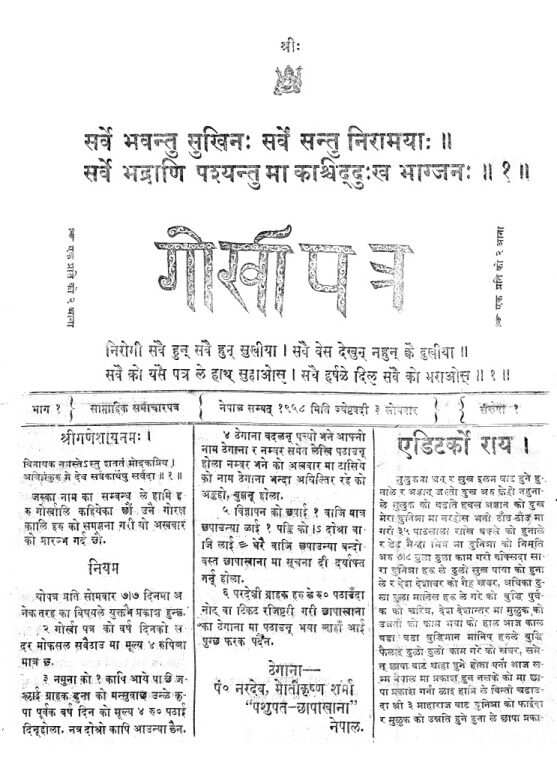

Broadcasting arrived at mid-century. Radio Nepal was established on 2 April 1951 and began with a 250-watt short-wave transmitter, later adding medium wave and FM; the first FM channel covering the Kathmandu valley and the districts adjoining it started in 1995, the same year the country-code domain was registered.
Where the readers actually were
The United States census supplies the clearest contemporaneous measure of the group’s likeliest core. Americans reporting Nepalese ancestry numbered 2,616 in 1990 and 7,858 in 2000. The counts then climb steeply — 51,907 in 2010, 205,297 in 2020, 223,930 in 2023 — with the largest concentrations in the New York and Washington metropolitan areas and in Texas, California, Ohio and Pennsylvania. Almost all of that growth postdates the newsgroup.
The wider dispersion is later still, and its figures describe the 2020s rather than the 1990s. United Nations international migrant stock estimates for 2024 put Nepali-born populations at 663,518 in India, 502,596 in Malaysia, 297,561 in Saudi Arabia, 266,580 in Qatar, 264,317 in the United States and 185,644 in Japan; the Office for National Statistics estimated 64,000 in the United Kingdom in 2018 and the Australian Bureau of Statistics 213,580 in 2025. The British population has a legal history of its own: four Gurkha regiments transferred to the British Army on 1 January 1948 under the tripartite arrangement of 1947, and on 21 May 2009 the Home Secretary announced that veterans with four or more years’ service before 1997 could settle in Britain.
Eastern Nepal also held, throughout the group’s life, a refugee population from Bhutan. Camps administered with UNHCR in the eastern districts — Timai, Goldhap, Khudunabari, Sanischare and Beldangi — held about 100,000 people by 1996 and peaked above 107,000. Organised resettlement to third countries began in 2007, with arrivals in the United States from 2008, and by November 2015 more than 100,000 people had been resettled, some 85 per cent of them to the United States.
A readership scattered like that has no shared working day. Nepal keeps a distinctive standard time of UTC+05:45, adopted in 1986 and referred to the meridian of Gaurishankar about 100 kilometres east of Kathmandu — one of only three offsets in the world set at forty-five minutes past the hour, the others being Chatham Island and the unofficial central western zone in Australia. A poster in Kathmandu, one in New Jersey and one in Doha shared almost no waking hours; a thread advanced in daily instalments rather than in exchanges, and a fast-moving story could be reported, contradicted and re-reported several times over as successive time zones came online.
The remittance economy in the published series
The World Bank series for personal remittances received as a share of gross domestic product records the change with unusual clarity. Nepal reads 1.5 per cent in 1993, 1.0 per cent in 1996 and 2.0 per cent in 2000. The recorded figure then stands at 11.2 per cent in 2002, 12.2 per cent in 2003 and 11.3 per cent in 2004; 16.1 per cent in 2006, 23.2 per cent in 2009, 25.9 per cent in 2014 and a peak of 27.6 per cent in 2015. It has stayed between roughly 22 and 26 per cent since, reading 26.2 per cent in 2023 and 26.0 per cent in 2024.
The step between the 2001 and 2002 readings falls inside the gateway’s own run, so the years in which news2mail was delivering soc.culture.nepal to e-mail subscribers are also the years in which the recorded remittance share moved from about a fiftieth of national income to more than a tenth of it. Where the money came from can be read off the migrant-stock table above; several of those destinations have pages of their own in this directory, among them soc.culture.malaysia and soc.culture.kuwait.
The mountains as an administered industry
The subject that brought outsiders to the group has a documented chronology of its own. Annapurna I, 8,091 metres, was climbed on 3 June 1950 by Maurice Herzog and Louis Lachenal of the French expedition — the first eight-thousander climbed anywhere. Everest followed on 29 May 1953, when Tenzing Norgay and Edmund Hillary reached the summit at 11:30 a.m. on an expedition led by Colonel John Hunt. That expedition approached from the Nepalese side because the route through Tibet had closed, and it moved on the country’s own logistics: about 362 porters and twenty Sherpas carrying some 10,000 pounds of equipment. The news travelled as everything else did — a coded message carried by runner to the wireless station at Namche Bazaar, reaching London on 2 June 1953.
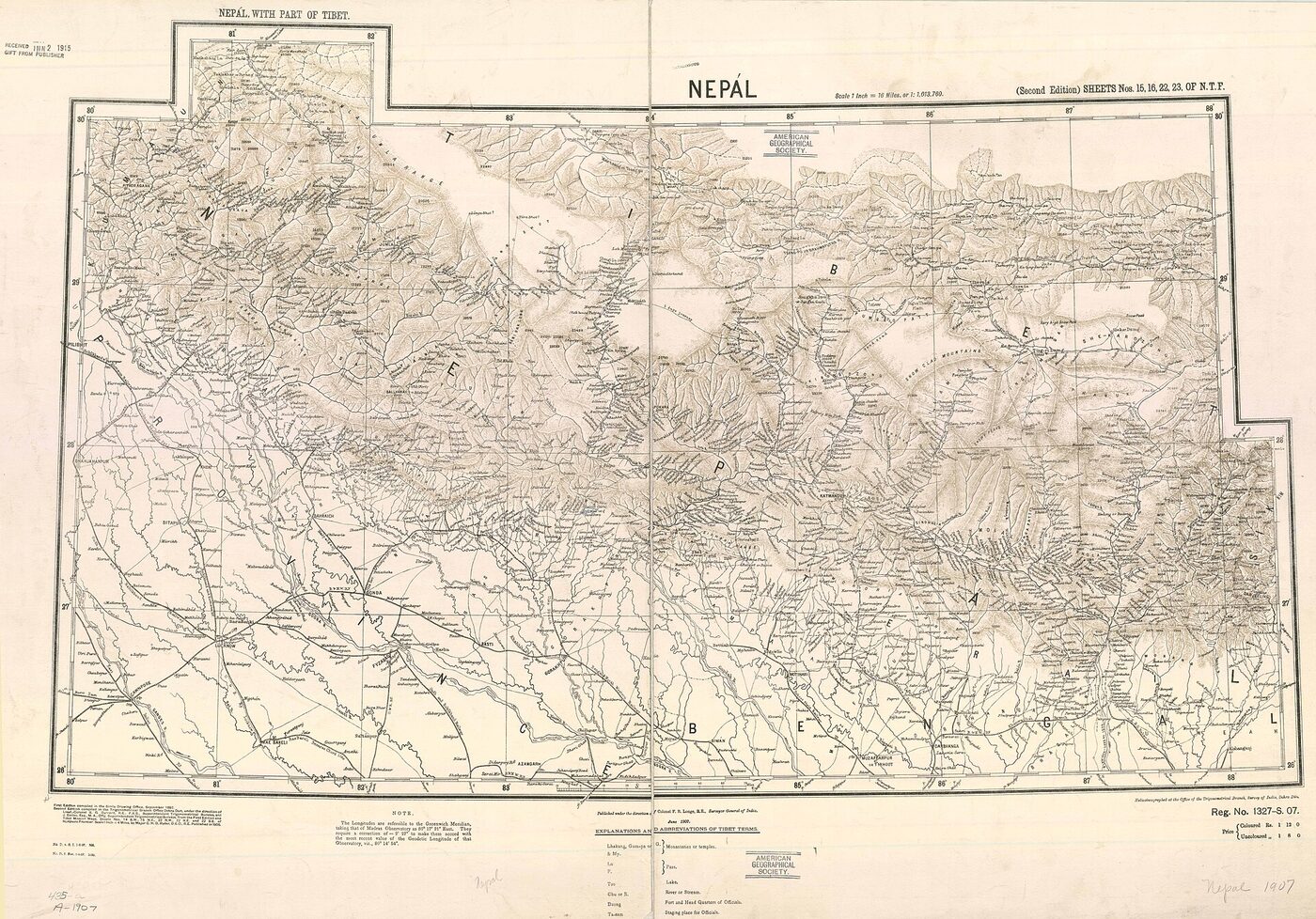

What the group’s correspondents were asking about half a century later was the administrative layer built on top of all this. The Nepal Mountaineering Association, founded in 1973, issued permits for the twenty-seven trekking peaks between 5,800 and 6,600 metres; in October 2015 the government transferred that authority to the Ministry of Culture, Tourism and Civil Aviation. Everest’s height was restated as 8,848.86 metres by a joint Nepali and Chinese survey in 2020. The scale of the visiting public can be given from the arrival statistics: of foreign arrivals in 2018 the largest national groups came from India (254,150), China (169,543), the United States (93,218) and the United Kingdom (61,144), while total arrivals were 230,085 in 2020, 1,014,885 in 2023 and 1,147,548 in 2024.
The calendar, the books and the songs
Between the crises the group did what every culture group does, and the calendar set the rhythm. Dashain is the longest festival in both the Bikram Sambat and the Nepal Sambat year, running fifteen days from Ghatasthapana on the first day of the bright fortnight of Ashwin to Kojagrat Purnima at the full moon, with Phulpati on the seventh day, Maha Ashtami on the eighth, Maha Navami on the ninth and Bijaya Dashami, the principal day, on the tenth. Because it is set by the lunar fortnight rather than by a solar date, it falls between September and November in the Gregorian year, and its dates have to be worked out again each year. Nepal Sambat, the era counted from 20 October 879 CE, was adopted as a national calendar by government decision on 25 October 2011, after the group’s active life.
Literature supplied the fixed points. Bhanubhakta Acharya, born on 13 July 1814 and dead in 1868, rendered the Ramayana into Nepali; the work was compiled and published by Motiram Bhatta in 1887, and his birth anniversary, Bhanu Jayanti, falls on 29 Ashadh, in mid-July. Laxmi Prasad Devkota’s Muna Madan, written in 1936 in the jhyaure metre he took from the singing of women planting rice in the month of Asar, follows a newly married man who leaves Kathmandu for Lhasa to earn money, and the wife left behind; it is regularly studied in schools and remains a best-seller for its publisher, Sajha Prakashan.
Music and film carried their own dates. Narayan Gopal, 4 October 1939 to 5 December 1990, recorded over 137 songs in a career of some twenty-eight years that included eighteen films, and died in the year the panchayat system ended. Nepali-language cinema began outside the country with Satya Harishchandra, released on 14 September 1951; Aama, released on 7 October 1964, was the first film produced in Nepal; the Royal Nepal Film Corporation was established in 1971; and after 1990 production rose sharply, with some 140 films made within three years.
Sport gave the group its recurring fixture arguments. Nepal became an affiliate member of the International Cricket Council in 1988 and an associate member on 2 February 1996; the under-19 side first appeared at an Under-19 World Cup in 2000, finishing eighth of sixteen. Twenty20 international status came on 28 June 2014 and one-day international status on 15 March 2018, both well outside the years in which such groups were busiest.
Context
For a scattered student population the group did work that little else then available could. Nepali students abroad were spread across many campuses, often in small numbers at any one of them; a single address gathered them, and with them the older migrants and the outsiders with a reason to ask — noticeboard, translation desk and news wire at once.
Within the hierarchy it sat among the subcontinent’s other groups — soc.culture.bengali and soc.culture.bangladesh nearby, with soc.culture.asian as the wider room and soc.culture.sri-lanka keeping a comparable watch on its own decade.
What the archive holds, where it survives, is a contemporaneous record of a decade that changed the form of the state entirely: written by people who did not know how it would end, unedited, in the same message list as the trekking questions and the festival greetings. Like most of Usenet the conversation thinned in the 2000s as it moved to web forums and then to social platforms, leaving the kind of source that later accounts, written with the outcome known, cannot reconstruct.
Anyone citing those messages should keep two limits in view. The text is romanised, so a Devanagari search string will not reach it and the spellings are each poster’s own; and the writers are drawn from the fraction of Nepalis with network access at the time, which the connectivity series places below one per cent of the resident population for the whole of the gateway’s run. The archive is a record of what one dispersed readership said. It is not a sample of national opinion, and it was never assembled as one.
Reading soc.culture.nepal today
- Historical archive: Google Groups — soc.culture.nepal (coverage varies by group and era).
- Open in a newsreader:
news:soc.culture.nepal— the original site offered exactly this link, and it still works if your system has a newsreader registered for thenews:scheme. - Live access: point an NNTP newsreader at a modern server — see accessing Usenet today.
- The original news2mail e-mail subscription service ended in the mid-2000s and no longer operates.